When I first started cycling to work down W54th street in Manhattan , I used to find it puzzling how
cars would suddenly come to a complete, but brief, halt half way between 7th
and 6th avenues. Then, after a while, I realised what was going on.
There was a stop sign intended to protect a crosswalk on the new 6½ Avenue
pedestrian path half-way along the block. Cars would carefully come to a
complete - but milliseconds long – halt at the sign, to fulfill the legal
requirements.
But I quickly recognised a second phenomenon. When I
approached the crosswalk, I would stop if I saw pedestrians waiting to cross
and let them go. Most motorists would do
the brief halt and drive on regardless, forcing the pedestrians to wait until a
break in traffic.
The crosswalk came to symbolise for me the way that many
drivers in cities worldwide end up reacting to road rules. They follow what
they understand to be the letter of certain laws – in this instance, that cars
must stop fully at a stop sign in New
York City . But they ignore the wider spirit – that one
should not barge past pedestrians trying to cross the road at a designated
crossing point. The road environment for pedestrians trying to use 6½ Avenue is
little safer as a result of the drivers’ brief stop at the stop sign than if
they simply blew through. The sign plays next-to-no role in reducing the horrific annual death toll on New York City’s roads.
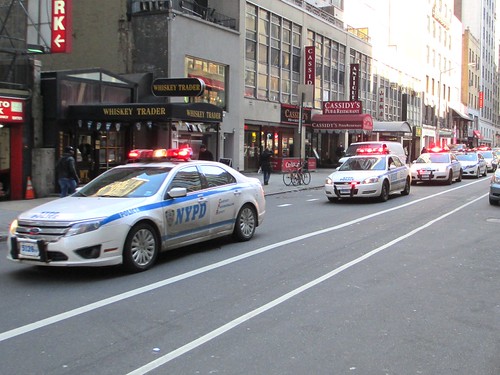 |
| Five New York Police Department cruisers on W55th Street. A heroic guess: in none of these vehicles is an officer pondering how to push road users towards Kohlberg's higher stages of moral development. |
The behaviour puts me in mind of the famous work on moral
development by Lawrence Kohlberg, a psychologist who classified people’s moral
development from the earliest stage – when they merely sought to avoid
punishment – to the highest – when they behaved according to an established set
of ethical principles. The drivers’ behaviour around the stop sign demonstrates
the kind of moral reasoning that, in other fields, one might associate with a
toddler seeking to be naughty but get away with it.
The question is how a city – any city, but the most pressing
examples for me at present come from New
York – can become a place where people interact according
to the most advanced stages of moral development. Cities should be striving
towards roads where users treat each other out of genuine concern and insight
into the other person’s interests.
 |
| A Citibike stand, by the Brooklyn Waterfront, complete with neophyte cyclists. Let's hope they're as keen when they've completed the ride as before |
The subject has been particularly on my mind this week
because of the launch of New York ’s
Citibike bike-sharing scheme. It’s clear – from my own observations and from
Dmitry Gudkov’s excellent stories and pictures of riders – that many new
riders are using bikes for transport for the first time in New York City. It
would be a tragedy if, after such a positive start, those new cyclists were to
find themselves put off by the near-misses and abuse that other cyclists all
too often experience.
The answer, it seems to me, lies in a shift in policing
thinking intended, as good parenting should, to push road users gradually
towards more considerate use of the road. It is likely unfortunately to prove a long,
slow process.
I encountered evidence of the scale of the challenge on my
way to work on Friday, as I made my way down E55th street . A car started pulling out
into the bike lane as I approached, trying to push into a traffic jam, despite
my repeated shouts that he was pulling into my path. When I finally, despite
his continued efforts to block me, squeezed past, he shouted after me, sanctimoniously, “Share
the road!”
There’s a simple problem underlying these complex issues,
however. The NYPD, like probably quite a few police forces worldwide, doesn’t
seem to have much of an idea what it’s trying to achieve with its road policing.
That’s self-evident looking at most precincts’ traffic ticket statistics.
Ticketing focuses heavily on issues like excessively tinted windows that are
easy to prove, rather than on offences such as speeding or distracted driving
where the behaviour is harder to prove but creates far more danger.
Only basic laziness – and the need to meet some arbitrary
monthly target for ticketing – can explain incidents such as the one in April
where several policemen - from a force, remember, that claims to have too few
resources to investigate crashes properly - stationed themselves late at night
on part of the Hudson River Greenway and ticketed and fined cyclists “for their own safety” for the purely technical offence of being in a New York City park
(rather than on the far more dangerous roads) after the parks’ official 1am
closing time. This and other similar incidents – the truck policing unit that ticketed more
cyclists than trucks, for example – suggests the pressure on NYPD traffic cops
is to meet quotas for ticket issuing, rather than to make the streets safer.
If such an approach is at work, it would chime with the
evidence that’s emerged from the civil case against the NYPD over “stop and frisk” – the NYPD’s insistence on stopping young men to search them for weapons
on even the most flimsy evidence. That trial has produced evidence that
officers were told to meet targets for monthly stops, rather actually arresting
criminals for serious offences. The force is facing legal action because many
officers seem to have assumed – and in some cases to have been explicitly told
– that the goal was to harass young black and Latino men.
 |
| Traffic infringements abound on W54th street. A simple contribution to the police benevolent fund, however, and no driver need worry. |
On traffic policing, meanwhile, another regular sign of
attitudes is the proliferation on cars of signs showing support for one or
other police organisation or benevolent organisation. The signs clearly reflect
an attitude that a traffic ticket is a piece of random bad luck to be made go
away, rather than a punishment for a serious offence that could kill or maim
another human being. That these signs continue to be so popular suggests they
are effective at deterring trouble – and that many police officers agree on
road offences’ importance.
It would surely make far more sense for senior police
officers’ pay or promotion prospects to depend on measures of desirable
outcomes on the roads. Would a precinct commander who knew his pay depended on
a 20 per cent fall in road deaths and serious injuries send officers to harass
cyclists using an important cycle path simply because it was too late
at night? Would he allow his officers to hand out as many or more fines for
excessively tinted windows in a month as for the widespread – and deadly –
offence of speeding? It’s instead far more likely, I’d suggest, that officers
would start to think seriously about policing the crimes that kill and injure
large numbers of people every year. It should also help to stop the nonsense
that drivers effectively buy immunity from prosecution via donations to police
benevolent associations.
I can’t pretend, of course, that such a change would
immediately turn every city road user everywhere into a practitioner of the
highest, level six stage of moral development under Kohlberg’s principles. Those
who have reached level six apply universal moral principles to their
interactions with others, seeking to be entirely fair. Most UK police forces concentrate more on the
deadliest offences – even if I disagree with many of their attitudes – and
drivers in London remain often aggressive and inconsiderate.
But a clearly-signalled change of strategy would surely
indicate to drivers that the outcomes of their behaviour – the numbers of
pedestrians mowed down in crosswalks, for example – matter. It would shift
drivers’ thinking about road policing away from a focus on the grubby
transaction – how do I get this officer to ignore my speeding? – towards
something a little more positive. What happens if I speed here, hit someone and
get treated as other killers would?
 |
| The Manhattan Bridge: it is physically impossible, in good weather, to bowl down the bike lane unobstructed without a smile on one's face |
I recognise such a change remains, sadly, far off in New York , although it
may be closer – or may even have arrived – elsewhere.
The scene I encountered in the early hours of Saturday as I
rode home makes me wish that were not so.
I had to work late and took a convoluted route home, through
Times Square, the Broadway Bike
Lane and the east side bike path to the Manhattan Bridge New York
City cyclists. I can only now imagine they’re warmly
commending the experience to their friends. It would be sad if a nasty grouch such as E55th street man were to change their
minds – and an unspeakable tragedy if something still worse were to befall
them.
