One day in mid-June, having taken a rare week off work, I
was walking my son to school when we spotted two curled-up $20 bills on the
sidewalk. It was the kind of sum that, to many people in our area, might be
entirely inconsequential. But, to, say, a struggling food delivery cyclist or
cleaner, those two bills might, I thought, represent a substantial loss. With
that thought in mind and being temperamentally unsuited to pocketing something
I hadn’t earned, I headed after I’d dropped the Invisible Visible Boy at school
to report the cash as lost property at the New York Police Department’s 76th
Precinct House.
 |
| Unlikely site for an epiphany: the NYPD's 76th precinct house. |
As I sat waiting for someone to talk to me about my
discovery, however, I noticed something significant about the layout of the
area around the station house’s main entrance. Behind the public counter, by
the door – in a position where they would be the last thing many officers would
see before heading out on patrol – stood three memorials to officers from the
precinct who’d died in the line of duty. Among them was Maitland Mercer, a
patrolman shot dead in 1965 while off duty and trying to arrest a suspect.
The plaques excited mixed emotions in me. Each of the deaths
– although each occurred decades apart – must have shocked and appalled the
dead men’s fellow officers and devastated their families. I was horrified by
the killing of two New York police officers just before Christmas. But the memorials were also, it seemed
to me, manifestations of a culture around US law enforcement that celebrates
the profession’s dangers and focuses on violent confrontations, at the expense
of a more collaborative philosophy. The near cult-like celebration of fallen
police officers encourages, I suspect, the dangerous idea that virtuous
officers are engaged in a Manichean struggle against dark forces every time they
leave the precinct house.
I quickly moved on to worrying about something else. If I
felt so uneasy about the culture surrounding US policing, it occurred to me, wasn’t
it strange that I instinctively wanted police officers to be tougher on traffic
violations? It’s a striking feature of the many of the highest-profile killings
of black people by police that the incidents in question start with traffic
stops. The killing in April of Walter Scott in North Charleston , South Carolina Cincinnati after being
stopped by a University
of Cincinnati Texas jail cell on July 13, had been stopped three days earlier for not using her indicators to pull her car over as a
police officer followed her.
 |
| NYPD cruisers in midtown: a force for road safety? |
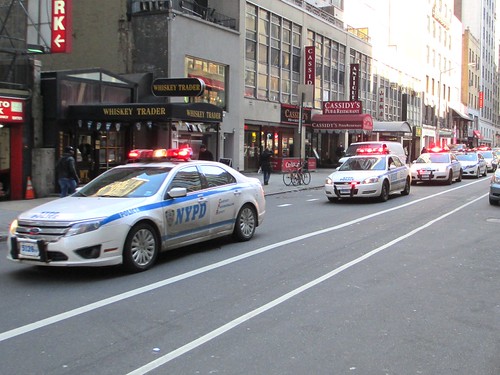
I’ve had regular cause since that moment in the 76th
precinct house to ask myself: is it possible to reconcile an effort to tighten
up traffic policing on the US ’s
roads with a desire to cut the dreadful annual toll of deaths at the hands of
police officers?
The starting point in the search for an answer is to unpick
what’s actually going on in the traffic stops that end in an officer’s standing
over some black person’s prone body – which is that few of them seem to involve
serious safety violations. It’s important that vehicles have working brake
lights, that drivers use their indicators and that vehicles bear appropriate
licence plates. But it’s significant, it seems to me, that neither Sandra Bland
nor Samuel DuBose nor Walter Scott was stopped, say, for speeding or using a
mobile phone while driving or refusing to yield to pedestrians in a crosswalk –
all offences that lead to thousands of deaths annually in the US.
These traffic stops seem, instead, to have had far more in
common with the kind of policing-as-harassment tactics that are familiar in many
parts of the world but for which the US has a particular predilection.
The broken tail-light, the apparently missing licence plate, the momentary
failure to signal aren’t of much interest to the officer. The point – as it was
with the New York Police Department’s now-abandoned Stop and Frisk policy of
searching people on the flimsiest of pretexts – seems far more to have been to
exert control.
The motivation often appears to be for officers to mark
their territory and stamp their authority on anyone who seems suspicious to
them – a group that seems inevitably disproportionately to include
African-Americans. The simplest act of defiance – such as Sandra Bland’s
continuing to smoke a cigarette while a police officer addressed her – seems in
such a context to be an act of infuriating insolence that demands a response.
 |
| These NYPD officers may be fine, upstanding people - but it's easier to understand the system where they work if one understands it's racist. |
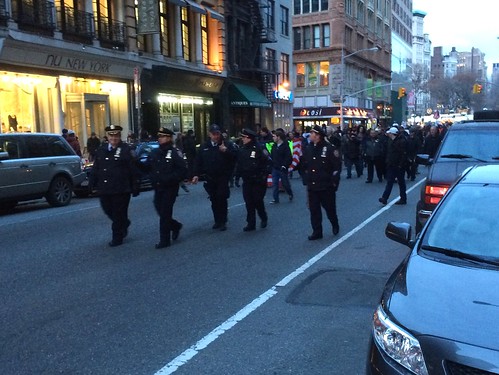
It’s easier to understand why such a high proportion of the
New York Police Department’s traffic stops are for the apparently minor offence
of having excessively tinted windows when one sees traffic stops as part of a
racist system. It’s a modification that officers associate with the desire of
members of minority groups to hide from onlookers, especially the police. It’s
a relatively minor safety issue but a significant affront to police officers
who experience traffic policing as a kind of primal marking of their territory.
Still more reprehensibly, it’s clear that many
municipalities – notably Ferguson, Missouri, where the killing a year ago of Michael Brown, a young black man, by a white police officer started the current
agitation over policing violence – use traffic stops as an important source of
revenue. The US
justice department’s report on the municipality in March recorded pressure from
the town authorities on the police to ramp up ticketing to raise money for the
budget. It also noted that 85 per cent of vehicle stops in Ferguson were of black people, although they
made up only 67 per cent of the population.
Ta-Nehisi Coates, the US writer criticises the arbitrary,
racist thinking behind such policing in Between the World and Me, his superb new book about growing up as an
African-American man. The book talks at length about how Prince Jones, a black
college friend of Coates’, was killed by police in an apparently unjustified
traffic stop in Virginia
in 2000.
“You know now, if you did not before, that the police
departments of your country have been endowed with the authority to destroy
your body,” Coates writes to his 15-year-old son. “It does not matter if the
destruction is the result of an unfortunate overreaction. It does not matter if
it originates in a misunderstanding… The destroyers will rarely be held
accountable.”
Yet, while it’s impossible to defend contemporary traffic
policing in the US, I’m also deeply resistant to the idea – which seems to be
gaining ground amid the discrediting of current behaviour – that traffic
policing is a trivial matter that could reasonably be put aside as part of the
police’s responsibilities. A better-focused system of traffic policing could
surely improve on the US ’s
current dismal record on road safety. In 2013, the most recent year for which
data are available, 32,719 people died on the US ’s roads. The US ’s minorities
– who disproportionately live in areas poorly served with crosswalks and public
transport – must suffer a disproportionate share of these deaths too.
 |
| Nuneham Courtenay: a rural idyll, protected by speed camera |
As a result, I’ve found my mind turning increasingly to the village of Nuneham Courtenay,in Oxfordshire, in England ,
which I visited in 2011. I visited the village the day after residents achieved
their aim of having reactivated a speed camera that had significantly slowed
traffic on the 30mph road that divides the village. The camera had been
deactivated as part of a populist backlash against cameras under the coalition
government after the UK ’s
2010 general election. Villagers had looked on in horror as, without the threat
of a speeding fine, drivers increasingly ignored signs telling them to slow
down from the 70mph speed limit on the roads outside to the far slower speed
required when passing right by villagers’ front doors.
It’s an obvious virtue of mechanising the process of
policing bad driving that the policing is no longer subject to arbitrary
considerations such as whether policing staffing is down because of school
holidays. It’s also helpful that cameras are generally places where there’s
general agreement they’re serving a real safety, not fund-raising purpose. In
the UK ,
the main criterion has been that four people should have been killed or
seriously injured at a site in the past four years. It’s also, however, a great
virtue of cameras that they won’t display racist bias. Policing should be far
more closely linked to drivers’ behaviour and far less linked to their race.
 |
| Officers from the NYPD's 28th precinct demonstrate how seriously they take road safety, by parking blocking a bike lane in Harlem |
A nationwide programme of speed and red light camera
installation across the US
could, if wisely implemented, be part of a wholesale rethinking of policing in
the area. It’s clear that there are some violations – such as the use of phones
while driving – that it will always be hard to hand over to cameras. But it
would be transformative, as I’ve argued before, to start linking the promotion
prospects of officers charged with traffic policing to the number of crashes,
injuries and deaths on their roads, rather than to the number of tickets
issued. Such a policy would immediately, I’d guess, eliminate many NYPD
precincts’ enthusiasm for ticketing cyclists – a form of harassment that’s far
less grave than that against black people and other minorities but stems, I
think, from a similar desire to exert control over a group seen as troublesome
outsiders.
Not that I sensed any mood for revolutionary change at the
76th precinct. Before I could even finish my explanation about finding the
money, an officer interrupted, shouting across the room, to demand what identification
I’d found with the money. None, I replied.
“We will never find the owner of that money,” the officer
replied, sending me burdened with the Protestant guilt of an unearned $40, back
into the street.
His last words rang in my ears as I trudged back towards the
apartment.
“Sometimes it’s just your lucky day,” he said.
It wasn’t, a voice in my head objected, a lucky day for the
person who’d lost $40 on the way to the subway, though, was it?
The idea fed into concerns far more significant than a mere
$40. There is no element of luck attached to whether a driver gets a speeding
ticket in Nuneham Courtenay. Luck plays far too large an element both in
whether US police forces catch dangerous traffic violations – and in whether
people stopped by US
traffic patrols survive the encounter. It’s an obscene gambling with lives that
can be and should be stopped.


