Showing posts with label Michael Brown. Show all posts

Monday, 10 August 2015

A Precinct House, a String of Deaths - and How to Stop Traffic Stops from Gambling with People's Lives

One day in mid-June, having taken a rare week off work, I was walking my son to school when we spotted two curled-up $20 bills on the sidewalk. It was the kind of sum that, to many people in our area, might be entirely inconsequential. But, to, say, a struggling food delivery cyclist or cleaner, those two bills might, I thought, represent a substantial loss. With that thought in mind and being temperamentally unsuited to pocketing something I hadn’t earned, I headed after I’d dropped the Invisible Visible Boy at school to report the cash as lost property at the New York Police Department’s 76th Precinct House.
Unlikely site for an epiphany: the NYPD's 76th precinct house.

As I sat waiting for someone to talk to me about my discovery, however, I noticed something significant about the layout of the area around the station house’s main entrance. Behind the public counter, by the door – in a position where they would be the last thing many officers would see before heading out on patrol – stood three memorials to officers from the precinct who’d died in the line of duty. Among them was Maitland Mercer, a patrolman shot dead in 1965 while off duty and trying to arrest a suspect.

The plaques excited mixed emotions in me. Each of the deaths – although each occurred decades apart – must have shocked and appalled the dead men’s fellow officers and devastated their families. I was horrified by the killing of two New York police officers just before Christmas. But the memorials were also, it seemed to me, manifestations of a culture around US law enforcement that celebrates the profession’s dangers and focuses on violent confrontations, at the expense of a more collaborative philosophy. The near cult-like celebration of fallen police officers encourages, I suspect, the dangerous idea that virtuous officers are engaged in a Manichean struggle against dark forces every time they leave the precinct house.

I quickly moved on to worrying about something else. If I felt so uneasy about the culture surrounding US policing, it occurred to me, wasn’t it strange that I instinctively wanted police officers to be tougher on traffic violations? It’s a striking feature of the many of the highest-profile killings of black people by police that the incidents in question start with traffic stops. The killing in April of Walter Scott in North Charleston, South Carolina, by a police officer followed a stop for a broken brake light. Samuel DuBose died on July 19 in Cincinnati after being stopped by a University of Cincinnati police officer who thought (wrongly, given the local law) he was missing a vehicle licence plate. Sandra Bland, who was found dead in a Texas jail cell on July 13, had been stopped three days earlier for not using her indicators to pull her car over as a police officer followed her.
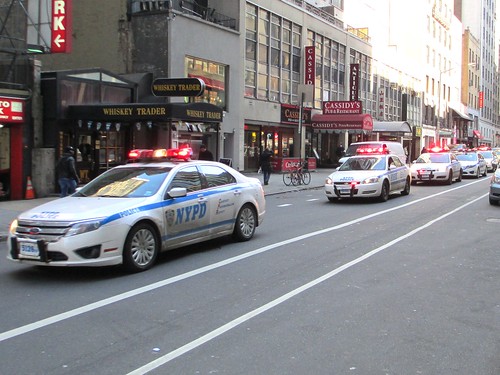
 
NYPD cruisers in midtown: a force for road safety?
I’ve had regular cause since that moment in the 76th precinct house to ask myself: is it possible to reconcile an effort to tighten up traffic policing on the US’s roads with a desire to cut the dreadful annual toll of deaths at the hands of police officers?

The starting point in the search for an answer is to unpick what’s actually going on in the traffic stops that end in an officer’s standing over some black person’s prone body – which is that few of them seem to involve serious safety violations. It’s important that vehicles have working brake lights, that drivers use their indicators and that vehicles bear appropriate licence plates. But it’s significant, it seems to me, that neither Sandra Bland nor Samuel DuBose nor Walter Scott was stopped, say, for speeding or using a mobile phone while driving or refusing to yield to pedestrians in a crosswalk – all offences that lead to thousands of deaths annually in the US.

These traffic stops seem, instead, to have had far more in common with the kind of policing-as-harassment tactics that are familiar in many parts of the world but for which the US has a particular predilection. The broken tail-light, the apparently missing licence plate, the momentary failure to signal aren’t of much interest to the officer. The point – as it was with the New York Police Department’s now-abandoned Stop and Frisk policy of searching people on the flimsiest of pretexts – seems far more to have been to exert control.

The motivation often appears to be for officers to mark their territory and stamp their authority on anyone who seems suspicious to them – a group that seems inevitably disproportionately to include African-Americans. The simplest act of defiance – such as Sandra Bland’s continuing to smoke a cigarette while a police officer addressed her – seems in such a context to be an act of infuriating insolence that demands a response.
 
These NYPD officers may be fine, upstanding people -
but it's easier to understand the system where they work
if one understands it's racist.
It’s easier to understand why such a high proportion of the New York Police Department’s traffic stops are for the apparently minor offence of having excessively tinted windows when one sees traffic stops as part of a racist system. It’s a modification that officers associate with the desire of members of minority groups to hide from onlookers, especially the police. It’s a relatively minor safety issue but a significant affront to police officers who experience traffic policing as a kind of primal marking of their territory.

Still more reprehensibly, it’s clear that many municipalities – notably Ferguson, Missouri, where the killing a year ago of Michael Brown, a young black man, by a white police officer started the current agitation over policing violence – use traffic stops as an important source of revenue. The US justice department’s report on the municipality in March recorded pressure from the town authorities on the police to ramp up ticketing to raise money for the budget. It also noted that 85 per cent of vehicle stops in Ferguson were of black people, although they made up only 67 per cent of the population.

Ta-Nehisi Coates, the US writer criticises the arbitrary, racist thinking behind such policing in Between the World and Me, his superb new book about growing up as an African-American man. The book talks at length about how Prince Jones, a black college friend of Coates’, was killed by police in an apparently unjustified traffic stop in Virginia in 2000.

“You know now, if you did not before, that the police departments of your country have been endowed with the authority to destroy your body,” Coates writes to his 15-year-old son. “It does not matter if the destruction is the result of an unfortunate overreaction. It does not matter if it originates in a misunderstanding… The destroyers will rarely be held accountable.”

Yet, while it’s impossible to defend contemporary traffic policing in the US, I’m also deeply resistant to the idea – which seems to be gaining ground amid the discrediting of current behaviour – that traffic policing is a trivial matter that could reasonably be put aside as part of the police’s responsibilities. A better-focused system of traffic policing could surely improve on the US’s current dismal record on road safety. In 2013, the most recent year for which data are available, 32,719 people died on the US’s roads. The US’s minorities – who disproportionately live in areas poorly served with crosswalks and public transport – must suffer a disproportionate share of these deaths too.

Nuneham Courtenay: a rural idyll, protected by speed camera
As a result, I’ve found my mind turning increasingly to the village of Nuneham Courtenay,in Oxfordshire, in England, which I visited in 2011. I visited the village the day after residents achieved their aim of having reactivated a speed camera that had significantly slowed traffic on the 30mph road that divides the village. The camera had been deactivated as part of a populist backlash against cameras under the coalition government after the UK’s 2010 general election. Villagers had looked on in horror as, without the threat of a speeding fine, drivers increasingly ignored signs telling them to slow down from the 70mph speed limit on the roads outside to the far slower speed required when passing right by villagers’ front doors.

It’s an obvious virtue of mechanising the process of policing bad driving that the policing is no longer subject to arbitrary considerations such as whether policing staffing is down because of school holidays. It’s also helpful that cameras are generally places where there’s general agreement they’re serving a real safety, not fund-raising purpose. In the UK, the main criterion has been that four people should have been killed or seriously injured at a site in the past four years. It’s also, however, a great virtue of cameras that they won’t display racist bias. Policing should be far more closely linked to drivers’ behaviour and far less linked to their race.
 
Officers from the NYPD's 28th precinct demonstrate
how seriously they take road safety, by parking blocking
a bike lane in Harlem
A nationwide programme of speed and red light camera installation across the US could, if wisely implemented, be part of a wholesale rethinking of policing in the area. It’s clear that there are some violations – such as the use of phones while driving – that it will always be hard to hand over to cameras. But it would be transformative, as I’ve argued before, to start linking the promotion prospects of officers charged with traffic policing to the number of crashes, injuries and deaths on their roads, rather than to the number of tickets issued. Such a policy would immediately, I’d guess, eliminate many NYPD precincts’ enthusiasm for ticketing cyclists – a form of harassment that’s far less grave than that against black people and other minorities but stems, I think, from a similar desire to exert control over a group seen as troublesome outsiders.

Not that I sensed any mood for revolutionary change at the 76th precinct. Before I could even finish my explanation about finding the money, an officer interrupted, shouting across the room, to demand what identification I’d found with the money. None, I replied.

“We will never find the owner of that money,” the officer replied, sending me burdened with the Protestant guilt of an unearned $40, back into the street.

His last words rang in my ears as I trudged back towards the apartment.

“Sometimes it’s just your lucky day,” he said.

It wasn’t, a voice in my head objected, a lucky day for the person who’d lost $40 on the way to the subway, though, was it?

The idea fed into concerns far more significant than a mere $40. There is no element of luck attached to whether a driver gets a speeding ticket in Nuneham Courtenay. Luck plays far too large an element both in whether US police forces catch dangerous traffic violations – and in whether people stopped by US traffic patrols survive the encounter. It’s an obscene gambling with lives that can be and should be stopped.

Monday, 22 December 2014

A ride with the police, a senseless attack - and why I'm seeing visions of injustice this Christmas

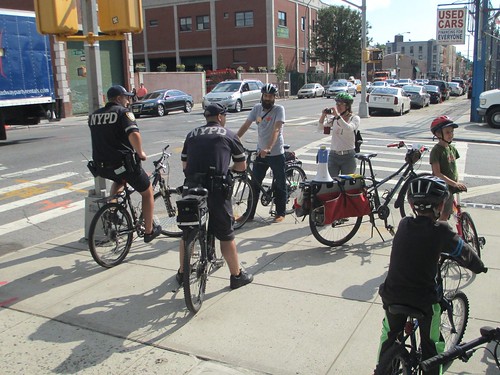
It was one Saturday back in September that I had much my most positive experience with officers of the New York Police Department. My family and I were taking part in a Kidical Mass ride for families from a park in Gowanus, near our home, to the Brooklyn waterfront. Two bike patrol officers from the NYPD’s 78th precinct joined us, as did a community relations officer and Frank DiGiacomo, the precinct commander. The officers stopped traffic to allow our families to ride through difficult intersections and chatted to us as we rode along.

A positive cyclist-police interaction: Hilda Cohen, ride
organiser, photographs two members of the 78th Precinct's
bike patrol.
By the time we reached Pier Six looking across to Manhattan, I was feeling warm enough towards them to try a gentle joke.

“I suppose I don’t really need to ask a police officer whether he’d like a doughnut,” I said to one of them, as I proferred him a bag of police officers’ favourite treat.

He felt sufficiently friendly in the other direction that he replied with a friendly punch to my shoulder.

I’ve been thinking about that incident in the last few days because of an appalling act of brutality against two NYPD officers just a few miles from where I gave the bike patrol officers their doughnuts. On December 20, as my family and I were packing for our Christmas break in the United Kingdom, Ismaaiyl Brinsley, a 28-year-old black man, walked up to a police patrol car and shot the two police officers inside - Wenjian Liu and Rafael Ramos – in the head, killing both. Brinsley, who had posted anti-police messages on Instagram, then ran into the Willoughby Avenue subway station and, as police closed in on him, shot himself fatally in the head.

Given that Brinsley’s aim appears to have been to kill New York police officers no matter who they were, he could just have easily targetted any of the four who accompanied us.

The incident has challenged me to consider whether I, as someone who’s regularly complained about the attitudes of the NYPD both over traffic policing and race relations, helped to create the atmosphere that led to Saturday’s horrendous deaths. Pat Lynch, president of the Patrolmen’s Benevolent Association, the New York police union, expressed fury in the wake of the crime over the criticism his members have faced in recent weeks.

"There's blood on many hands tonight - those that incited violence on the street under the guise of protest, that tried to tear down what New York City police officers did every day," Lynch said outside the hospital where the officers were taken. "We tried to warn - 'it must not go on, it cannot be tolerated’. That blood on the hands starts on the steps of City Hall, in the office of the mayor."
 
The Invisible Visible Man and Bill de Blasio, while the now-
mayor was campaigning. Both of us, I'm sure, have had reason
these past few days to reflect on Pat Lynch's criticisms.
Lynch’s comments, although intemperate, have made me look back on that September bike ride and wonder if those cycling officers perhaps represented a truer face of the NYPD than I’ve previously recognised. I’ve consistently focused on the negatives about the force. As a well-off white person, after all, I don’t rely as heavily on the police’s protection from crime as residents of the Tompkins Houses public housing, outside which Liu and Ramos were sitting. I encounter officers mainly when they’re in my way – for example, when they’re blocking bike lanes.

Since the police department’s handling of the issue that most acutely concerns me – road safety – is grossly inadequate, I’ve tended to feel resentful when I’ve encountered individual police officers, especially when they’re engaged in some pointless traffic policing. Because statistics show that there are disproportionately high numbers of brutality claims from blacks and Latinos, I’ve sometimes assumed that pretty much any police officer I encounter is likely to be racist.

It’s easy for someone such as me to ignore the effects of, say, last year’s sharp drop in New York City’s murder rate. That was achieved, according to the police, by examining patterns of Facebook and other messages surrounding gang violence, particularly in The Bronx. They brought conspiracy charges against the associates of those responsible.
 
Families part-way through September's Kidical Mass ride:
a scene I should recall when I wonder what the NYPD
has done for me
I’ve sometimes, I suspect, drifted close to the same thinking error as Ismaaiyl Brinsley, by viewing individual members of the NYPD as if they were responsible for the collective failures of the group or its culture. Liu and Ramos, as far as I know, were no more responsible for the wider failings of their department than I am responsible, say, for the conduct of cyclists who misbehave on the roads, or for the shortcomings of other British journalists.

Yet it remains fatuous to pretend that Brinsley decided to act as he did other than of his own free will. Even if the protesters’ rhetoric had not been mostly admirably temperate, only Brinsley himself decided to pervert the understandable, justifiable anger over the police’s killing of Eric Garner in Staten Island and Mike Brown in Ferguson, Missouri, into murderous rage against individual officers. The story is at least complicated by Brinsley’s having shot in Baltimore, before he headed to Brooklyn, Shaneka Thompson, his girlfriend, who is not a police officer. She remains in hospital.
 
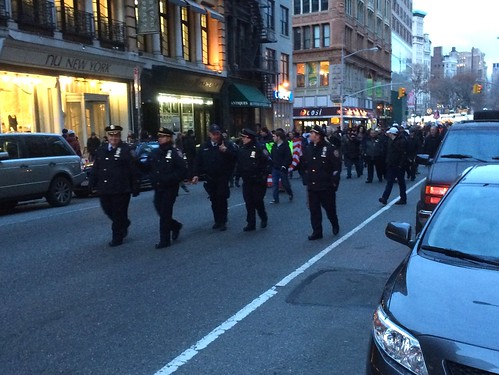
NYPD officers calmly march at the head of December 13's
Millions March NYC event: just because we take for granted
their readiness to protect marchers criticising them
doesn't mean it's not hard to do.
It makes no more sense to claim protesters somehow prompted Brinsley’s misdeeds than to claim that the NYPD somehow deserved them.

Instead, Brinsley was acting like the worst of the police officers he so hated. He showed the nihilistic lack of self-control that is a hallmark of many police brutality cases. Like the worst police officers, he used unjustified violence in such a way that the victims would have no reasonable chance to respond. He seems to have shared with violent cops a determination to impose his will on others no matter the havoc he risked unleashing.

It is certainly an important distinction that police officers are sometimes entirely justified in using violence, in a way that ordinary citizens seldom are. It’s also critical, however, that police officers are expected to act with discipline and self-restraint in a way that no-one expects a common criminal to do.

It’s vital to point out the balance of risks. New York police officers kill multiple unarmed people every year, yet Saturday’s killings were the first of an NYPD police officer on duty since 2011.
 
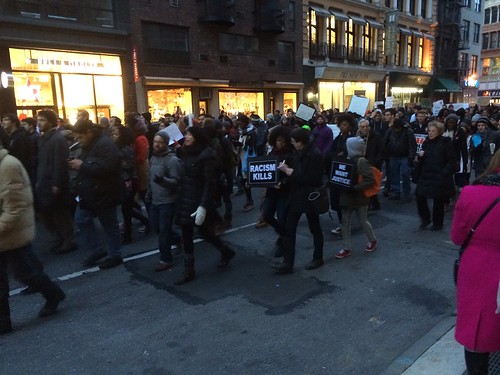
Marchers on the Millions March NY protest: some of them
shouted, "How do you spell racist? NYPD." I'd now be more
careful to point out it's the overall system - rather than each
individual officer - that's racist.
US Society, however, shouldn’t be tolerating even that limited amount of violence against police officers – just as it most assuredly should not tolerate the casual tossing aside of black people’s lives. While Ismaaiyl Brinsley had no justification for his brutal killing, there was also no justification for the actions of “pro-police” demonstrators who on Friday evening, the night before Brinsley’s attack, paraded outside New York’s City Hall wearing, “I Can Breathe” sweatshirts. The shirts mocked the proliferation among protesters of sweatshirts bearing the legend, “I Can’t Breathe” – the words that Eric Garner gasped out 11 times as a police officer throttled him on a Staten Island sidewalk.

It’s critical if this rift is to be healed to get away from the divisive rhetoric that currently disfigures nearly every debate in US public life. While there are certainly intemperate anti-police voices, there’s an equally disturbing tendency for any web story about a police killing of a young black man to become infested with slanders and lazy assumptions about the person’s lifestyle or behaviour.

US society has, somehow, to learn again to recognise the humanity of people on different sides of its profound racial and ideological divides.

I would normally offer policy prescriptions for how I think that can be achieved. But, after a year of chronicling dispiriting car crashes and a miserable deterioration in the US’s race relations, this final blow feels as much emotional and spiritual as practical. Brinsley twisted a knife in deep wounds that Eric Garner’s killing, the non-indictment of his killer and many other cases have left in New York’s body corporate this year.

Given the time of year, I’ve been prompted regularly in recent weeks to advocate that somehow the wider city could be more like the Episcopal Church I attend every Sunday in Park Slope. The congregation is made up of a vast range of people – around half of them black – of many different ages, backgrounds and sexual orientations. There is what feels to me, as a relative newcomer, a remarkable sense of unanimity for such a diverse group.

Note to self: next time you see a line of cars like this,
remember there are people inside
I attend the church partly because its clergy have been so quick to recognise the spiritual importance of contemporary events in the US. I’ve sat at points in tears as preachers have related the injustices that people who in some cases live very close to us have suffered to ancient spiritual themes and long-ago suffering.

While I know that few if any of my readers will share my specifically Christian experience of the last few months’ events, I imagine I can’t be the only one who’s had a sense of something truly momentous happening. The questions feel bigger than individual human beings.

I found myself describing to my wife recently the powerful sense I’ve experienced at points in recent weeks of how my faith relates to my feelings over the injustices I’ve seen being perpetrated.

“I keep thinking that somehow Jesus is there,” I told her, of Eric Garner’s death. “He’s lying facedown in front of a row of tacky shops in Staten Island.”

I have a similar sense about Michael Brown’s death in Ferguson, Missouri – and about the fates of the many victims of traffic crime that go neglected by the police and criminal justice systems.

They’re thoughts that will, I’m sure, seem to many like the kind of foolish sentimentality against which I normally rail. To atheists, they will seem like the kind of deliberate missing-of-the-point of which they accuse all religious people.

Perhaps they are right.

But, for the moment, I also can’t help feeling that the central figure of my faith in some sense also sides with officers Liu and Ramos. Five days before Christmas, Jesus lay on the sidewalk beside them as paramedics worked in vain to undo yet another senseless injustice.