It’s one of those tasks that’s so difficult it’s become a
kind of fascination to me. When I ride over the Manhattan
Bridge towards work each morning, I’m
generally passed, at a gap of just a few feet, by a B or D subway train taking
commuters into Manhattan .
The passengers stare out the window, blankly, apparently staring straight
through those of us labouring up the slope to the bridge’s summit or speeding
down from it. The stares are so blank that I’ve taken to waving at individual
commuters to see if I can get a reaction.
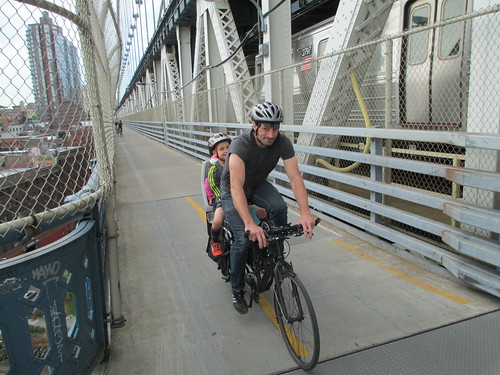 |
| A subway train passes a cyclist on the Manhattan Bridge: the subway passengers can't see the cyclist. Fact. |
Yet the reaction of the subway commuters to cyclists, it’s
dawned on me, is only one example of a far more widespread city phenomenon. Big
cities are full of people moving around conscious almost solely of their own
environment, their own needs and their own sense of right and wrong behaviour. We’re
mostly gliding around in little bubbles of our own distinct worlds, over and
below each other, avoiding contact as far as possible. But quite a few of the
crashes in cities, it strikes me, are cases where, almost literally, two worlds
– two contrasting sets of expectations about norms and behaviours and who
should give way to whom – collide. This makes it a phenomenon worth noticing
and exploring.
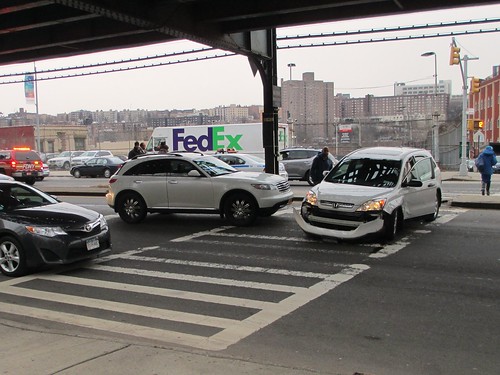 |
| Two cars collide in Northern Manhattan - but so, quite possibly, do two competing expectations about who gives way to whom. |
The driver I encountered on 55th street in Manhattan 10 days ago illustrates
the most obvious form of the problem. I’d spotted that he was driving
erratically as he left a parking space near Broadway. He then squeezed past me, dangerously, driving in a parking space, only for me to catch up with him at the traffic lights at 9th avenue .
His window was rolled down and he was deep in a conversation on his mobile
phone. “Stop talking on your phone!” I shouted at him. “It’s making you
drive like an idiot.” He gave me a dirty look and slowly rolled up his
heavily-tinted window. I was an unwelcome intrusion from outside the two worlds
he was carrying around with him – the world inside his sports utility vehicle
and his interaction with his interlocutor in the telephone call. His reaction
was to close down his interaction with the place where he was physically
present – and where his driving presented a serious danger.
There are multiple ways that people pursue the illusion that
their cars are private spaces. They can blast out music so loud that any
outside intrusion is inaudible. They can choose to drive a car so large or so
fast that it intimidates other road users. They can talk incessantly on the
telephone to people outside their immediate confines. People want to drown out
the mixture of stress and boredom that comes from sharing a city street with a
host of other people with competing claims on the space. Their desire to do so
makes the street a little less safe for pedestrians, cyclists – everyone
outside their world-in-a-car.
The little bubbles in which people move around also reflect
their culture. At my son’s school, it’s mostly the parents with the mild,
mid-western accents of hipster incomers that arrive bearing their children on
long bikes, tandems and other unlikely bits of cycling apparatus. If I see
children spilling out of some huge SUV – there’s a family that arrives daily in
a Cadillac Escalade, one of the biggest vehicles on the road – I’m far more
likely to hear a traditional Brooklyn accent calling out after them.
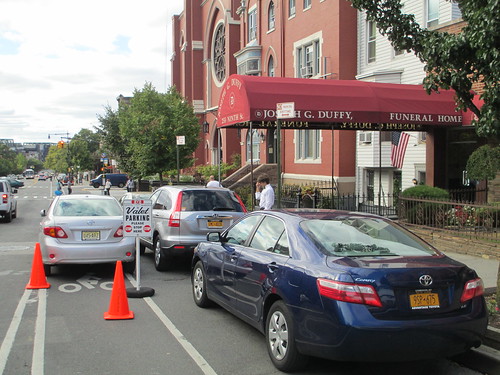 |
| Inhabitants of Duffy Funeral Home's world worry about where they're going to park. Other users of Park Slope's 9th St worry where they'll ride their bikes. Here's where those worlds collide. |
We maintain our contrasting cultures while sharing the same
bits of road partly through the impermeability of a big car’s steel sides. It’s
no coincidence in my view that cars that keep the outside world at bay are far
more popular than, say, convertibles for city driving.
But it’s not only the motorists that are travelling around
in little bubbles of their own worlds. Look on the average city street and
nearly everyone is cutting him or herself off from the wider street. Headphones
– once limited to discreet earbuds – are now often a large and obvious symbol
that the wearer wants to be left alone. Mobile telephone calls and texting take
the participant away from his or her immediate surroundings. For many runners,
they seem to form an almost indispensable aspect of the experience, providing
the rhythm and focus that interaction with the wider world might take away. A pedestrian cursed at me the other day on the Lower East Side for riding, perfectly legally and safely, onto a bike lane across a small city
park. It's no coincidence, I think, she was a runner sequestered from reality by her headphones.
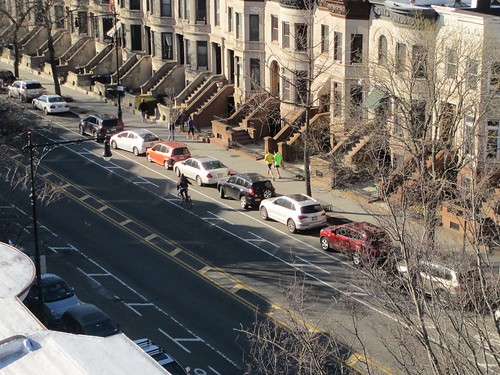 |
| A cyclist, runners and motor cars in Park Slope: sure, they look close together. But they could be worlds apart. |
The question, of course, is how far any of this is a bad
thing. Would New York City
– or any other big city – be a better place if subway commuters were waving to
me every morning? Should I expect that runners eschew headphones to try to make
their runs as pure an experience as possible of interacting with the city? I’m
inclined to say no. When a behaviour is as widespread as this retreat by city
dwellers into their private worlds, it suggests a deep need. This is part of
how inhabitants of big, densely-packed cities get by without assaulting each
other or rioting more often than they currently do.
I'm struck, however, that
it’s often the people least cut off from the reality of the city around them –
cyclists out on the streets, intensely aware of all that’s going on – that are
disproportionately involved in campaigns to make the streets safer. It’s a
serious safety issue that so many vehicles allow their users to cut themselves
off so thoroughly from events outside. It’s hard not to imagine that people
with clearer views of pedestrians and cyclists and fewer barriers to hearing street sounds might be less likely to run them over.
I have no immediate policy magic wand to wave to bring about
that change of perception.
But an idea came to me the other night as I undertook a late night ride home past the still-buzzing bars and music venues of Bleecker St, the
Greenwich Village street where Bob Dylan performed many of his earliest gigs.
In Talking World War III Blues, one of the songs from that early era, he
describes a dream about being the lone survivor of a third world war. Then he remarks,
in the last verse, that many other people seem to have similar dreams.
"Everybody sees themselves/ Walkin' around with no-one else," he says.
"Everybody sees themselves/ Walkin' around with no-one else," he says.
Not everybody’s dream can be right, he says.
"I'll let you be in my dreams if I can be in yours," he drawls.
"I'll let you be in my dreams if I can be in yours," he drawls.
That's the nearest I have to a solution. I'll let you be in my street-world if I can be in yours.
