Showing posts with label Cycling in London. Show all posts

Sunday, 23 April 2017

An angry man on a pavement, a rash of misunderstandings - and why I'll be seeking to bridge the gap

One morning in mid-March, because I was running late for a meeting, I opted to ride across Waterloo Bridge, expecting it to be the fastest route, despite its being a hostile environment for cyclists. Only just over half way across, however, I found myself stuck behind a queue of buses stretching all the way to the Strand. Resting my foot on the kerb, I peered down the long, red, double-deck wall, wondering what I should do.
Waterloo Bridge, approaching Covent Garden (c Google):
scene of a run-in that briefly enraged me,
before opening my metaphorical eyes

As I did so, a passing pedestrian decided to lecture me on the basis of what he thought I was doing, not my actual actions.

“Hey, mate!” he shouted in my direction, before pointing down at the pavement (or sidewalk, North American readers). “This here is a footway!”

I tried shouting after him to explain I had not the slightest intention of riding my bike down the pavement, as he assumed I planned to do. But he was already off, an air of self-righteousness buzzing around him like flies round a smelly cow.

It was one of several times recently when I’ve come across people making judgements about people’s behaviour on the roads based on their perceptions of what was happening, rather than the reality. I’ve had to pull out of my son’s front tyre a tack that had been left, presumably deliberately, on a cycle path to thwart someone’s idea of bad, irresponsible cyclists. I’ve rowed with an Uber driver who thought I was being unreasonable by riding down the middle of a narrow street to stop him from dangerously overtaking me and my family. I’ve seen pedestrians pause as I slowed to a stop at traffic lights, apparently assuming I would breeze on through.
The tack that caused my son's puncture:
anti-cyclist prejudice made manifest

These and other incidents have all made me realise how hard it is to change attitudes about events on the road. As far as the angry man on Waterloo Bridge is concerned, he went away having prevented a cyclist from riding on the pavement, an event that can only have reinforced his self-righteousness. The people who scattered the tacks on the cycle track will have assumed they thwarted some lycra-clad cycle commuter and won’t have seen my son’s anxiety over the incident. The Uber driver gained no understanding of why I was riding in the middle of the road so will only think cyclists more unreasonable. The wary pedestrians will assume I’m the exception, not the rule.

But the incidents have also made me think about how I react when I’m out on the streets myself. Time and again, as I assess the risks of some situation, I look round to work out how much of a danger a particular driver’s behaviour is likely to represent. I notice that I retreat into the basest assumptions about how people of a particular race or gender will behave or judge a person solely on his or her choice of car. The recognition has impressed on me yet again the vital importance of getting to know the widest possible range of people and understanding their views. Yet both on the roads and in politics - which it’s now my day job to cover - groups appear to be growing more polarised and less apt to talk to each other, rather than less.

At the heart of the on-street misunderstandings is a paradox of road use that has struck me repeatedly over the years. It feels like a private experience to use a street - particularly when driving in a car. But one’s in fact engaged in a very complex social interaction. It’s vital to anticipate how others are going to act and that people broadly adhere to the expected ways of behaving, even if those are not the same as the formal rules of the road.

In the US and UK, where cycling is a minority means of getting about, this creates a problem for people who ride bikes. Very few drivers or pedestrians can picture themselves in a cyclist’s place on the road or understand the multiple pressures on a cyclist on a busy road or mixed-use path or some other place where conflict between users arises. This only exacerbates, it seems to me, people’s tendency to stereotype cyclists’ behaviour. The wincing pedestrians at traffic lights are a case in point. While they perceive cyclists as inherently unlikely to obey traffic lights, I’m far more struck by how many cyclists obey signals whose placing and timing is generally governed by another mode’s needs.
A crash on Clapham Road: road use is such a complex
interaction it's surprising such scenes remain relatively rear.

The challenges are all the greater because people have to make decisions on the roads fast. Many of my own reactions, I’m aware, come from bits of my brain that work so instinctively I’m barely aware of them. I’m startled into fear by the sudden movement of a car in my peripheral vision, much as my distant ancestors must have been hard-wired to jump at the movement in the corner of their eyes that signified a prowling bear or wolf. Once those fight-or-flight responses are aroused, I tend not to revert quickly to my normal polite, reasonable self.

On top of all this, most people, I think, carry the mental scars of past bad experiences, which they recall far more readily than good things. It’s easy to miss how much that shapes one’s perceptions. A friend from New York, for example, cycled in London last summer and raved about how she saw no-one driving while using their mobile phone, comparing that favourably with New York. She had yet to build up my experience of spotting drivers using mobile phones in London. For me, by contrast, each time I see someone’s driving while using a mobile, it slots into a convenient mental envelope - “yet more evidence that dangerous mobile phone use is endemic among London drivers”.
A clear message to drivers about driving
around cyclists: all too rare - and all too
badly needed

The net result of all these human foibles, it seems to me, is that nearly every road-user travels around a mess of prejudices, dangerous assumptions and hurt feelings. It’s hardly surprisingly, consequently, that myths about road user behaviour seem particularly persistent and prejudices against cyclists seem particularly hard to shift. People’s assumptions are shored up not only by what they see going on around them but by the far greater number of things they think they see going on. My apparent determination to plough down a busy pavement on a Monday morning probably did more to reinforce the prejudices of the Angry Man of Waterloo Bridge far more than any encounter with a real pavement cyclist would have done.

Yet, however urgent the need to bridge this chasm of comprehension, the gap seems currently to be growing ever wider. Whereas debates about roads policy might once have been played out mainly through newspaper articles or in other media that had a range of contributors and readers, social media such as twitter seem to let narrow groups reinforce each other’s prejudices. Drivers’ twitter accounts often bristle with violent anger against cyclists, frequently reinforced by other, like-minded people. Cycling social and other media, meanwhile, are prone to a self-congratulatory tone and, sometimes, scorn for anyone using any other transport mode, including buses.

I was particularly disappointed recently to read a column by Ashok Sinha, chief executive of the London Cycling Campaign, lambasting those of us who point to the evidence linking worsening motor traffic congestion with the building of London’s segregated Cycle Superhighways for spreading “fake news”. It would be far harder for this conviction to maintain its current hold on London’s cycling advocates if more of them spent time with transport planners and advocates from outside the activist community. Even planners who are well-disposed towards cycling and want to see cycling levels rise go slack-jawed in amazement at activists’ reluctance to accept the clear, substantial evidence that the new facilities have played a significant role in worsening congestion for motor vehicles.
A busy North-South Cycle Superhighway,
next to a congested road: my views about
the relationship between the two are
"fake news," apparently.

Yet I understand all too well why the echo chambers get sealed off from outside noises. Two of my Facebook friends would, for a while, respond every time I complained about dangerous drivers by complaining about the alleged danger posed by cyclists on pavements. When even a blogpost analysing the evidence on this point failed to persuade them, I took, I admit, the path of least resistance. I unfriended them, making my experience of Facebook less stressful but simultaneously less diverse.

The problem is far from confined to cycling advocacy. This past week, I started a new, temporary day job as a political correspondent. It’s impossible to avoid the idea that politics in both the UK and US have grown polarised partly because people have so little experience of communicating with people with a different point of view. The stubborn insistence of some supporters of Jeremy Corbyn that he can lead the Labour Party to a general election victory makes far more sense if one imagine how information flows to Corbyn’s hardest-line supporters. Since most presumably have twitter feeds and Facebook timelines full of people agreeing with them, it must be easy to assume that the opinion polls - which show the party 20 percentage points or so behind the Conservatives - are some nefarious plot.

The widespread nature of the problems, meanwhile, means I can’t offer an easy solution. I wanted to put the Angry Man of Waterloo Bridge straight but I couldn’t catch up with him. If the gulfs of understanding that separate multiple groups in contemporary society were easy to cross, misunderstanding would be far less rife than it currently is.

The angry man’s reaction was, nevertheless, a useful reminder of how easy it is to slip into assuming the worst about another person and failing to question how one’s interpreting a situation. I will seek in future to be slower to anger, less ready to assume the worst about others and more ready to explain my own position politely and calmly.

Sunday, 20 November 2016

Obstructive pedestrians, a crass video - and why your city's cyclists are the kind you don't like

If I’d gone out looking for evidence of how differently people regard cyclists from how I regard myself, I could scarcely have done better than my experience this Saturday. In the afternoon, as I rode with my wife and my son along the Embankment in Central London, we encountered a crowd of pedestrians crossing the cycle track against the signal. “Watch out in the cycle track, please!” I shouted.

The East-West Cycle Superhighway near Parliament Square:
site of the Invisible Visible Man's contretemps with
a group of pedestrians
Then, in the evening, I came across a trailer for Trigger Happy, a new series of Channel 4 comedy shorts. The first - Angry Cyclist - features helmet camera footage of the eponymous cyclist riding around streets. “Cycle lane!” he shouts at pedestrians, in imitation of precisely the tone I’d taken than afternoon. He then rides onto a section of pavement that is not, in fact, a cycle lane.

The video was only the latest evidence I’ve seen in recent weeks of how cyclists continue to be regarded in the UK - and possibly even more in the US - as a strange, fringe out-group whose behaviour is baffling and infuriating to others. Earlier in the week, I’d felt a similar sinking feeling when I saw Tweets by Mark Dennison, a presenter on BBC Nottingham, a local radio station, encouraging people to call his show. “Cyclists… what do they do that winds you up?” he asked. He later defended the transparently tendentious tweet as merely a way of encouraging a “balanced” debate.

The comedy short and Mark Dennison’s tweet both came across as belittling a group of people who, at least when sharing the roads with motor vehicles, are vulnerable and relatively powerless. They showed the depth of the chasm of misunderstanding between cyclists and others. While my request to the pedestrians on the Embankment would have seemed self-righteous or priggish to the makers of Trigger Happy, it was in fact motivated by fear. I was worried that, unless they got out of the way, my nine-year-old would be marooned in the roadway when motor vehicles restarted.
The Invisible Visible Boy on his bike
in central London: a reason for concern I hope
even the haters can understand

The incidents have led me to query why so many people continue to find me and other cyclists so bafflingly alienating. It strikes me as an especially important question given that many cyclists, like me, believe their countries’ transport systems would work better if more people joined them by starting cycling. Current attitudes appear to be both a symptom and a cause of cycling’s remaining a niche activity, practised by a relatively small group of people.

I should say, first of all, that I understand at least a little bit of why Trigger Happy finds some cyclist behaviour funny. There is an underlying similarity to a lot of helmet camera video footage that cyclists post on YouTube. The cyclist is riding along a road - often at some speed - when a motorist does something stupid, dangerous and possibly malevolent. The driver’s behaviour is then held up for general condemnation in a tone that generally suggests the poster is standing, hands-on-hips shaking his head in shocked but unsurprised disbelief. I am sure that, while I don’t use a camera, my complaints about bad driver behaviour have a similar, rather priggish tone. I can see how someone might find it so predictable that it starts to seem a little ridiculous.

But the jokes become far less funny, it seems to me, the moment one starts to think about what shapes the culture that Trigger Happy and others hold up to ridicule. I’m surrounded by fast, aggressive cyclists on my morning commute down Clapham Road not because Londoners are by nature fast and aggressive when cycling but because the conditions have selected both who rides and how they do it. People who don’t feel capable of maintaining a steady 20mph are unlikely to feel comfortable riding down a wide, straight road in close proximity to drivers driving at 30mph and faster.

Cyclists at the Oval on my route to work:
some clichés about London cyclists persist
because they're partly true.
The cyclists I see around me have been as surely shaped by their environment as giraffes have been by conditions on the savanna or the American bison by the high plains. People wear bright clothing and helmets because they hope they’ll help to prevent or ameliorate collisions with fast-moving motor vehicles. It takes both the skills of racing cycling and a road-racer’s appetite for risk truly to embrace this style of commuting. That point came home to me forcibly on Friday when a fellow cyclist, to my astonishment, slipped through the gap - of barely a metre - that I’d allowed myself when overtaking a bus. One especially stressful recent morning, I witnessed a blazing row between two fellow cyclists over an apparent near-collision caused, as far as I could tell, by excessive risk-taking by one of them. The argument continued over a considerable distance, being resumed as both stopped at successive junctions.

This environment explains one of the most frequently remarked upon issues about the demographics of London cycling - that cyclists disproportionately tend to be better off, whiter and more male than the city as a whole. In a car-centric city where people feel skill, knowledge and equipment are necessary to cycle commuting, it's hardly surprising that cycle commuters often come from the class of people who have the leisure and finance to develop the requisite cycling skills recreationally.

A fairly typical bike path in London's
Docklands: experts can't work out why
cycling hasn't taken off here.
I’ve been struck recently by how even I, someone who’s cycled an average of nearly 4,000 miles a year for the last 13 years, feel a little spooked by conditions on much of my commute. I’ve had so many close passes from drivers after pulling out round stopped buses that I find myself increasingly stopping to let buses pull away. On Friday morning, a beautiful morning with nearly ideal conditions, I remembered well over half-way into my commute that I’d forgotten my security pass. I felt a frisson of fear as well as excitement when I realised I’d have to turn around and head home for it, even though I’d normally welcome the excuse to put in some extra miles.

There have, undoubtedly, been efforts to widen cycling’s appeal, both in London and New York, where I lived for four years until July. But Trigger Happy’s scoffing at cyclists’ tendency to shout at other road users about their rights highlights the big problem with many of them. Inadequate on-road cycle lanes, areas where cyclists and pedestrians share space and some quiet routes down parking-clogged back streets build in a significant level of conflict between cyclists and others. It might seem irritating to pedestrians to be asked please not to walk in a bike lane. But it is profoundly frustrating regularly to have to use spaces whose use is so unclear that other users obstruct cyclists unless specifically asked not to do so.

It should certainly surprise no-one that, in existing conditions, some cyclists are apt to break the road rules. If one knows, after all, that the traffic lights on a certain road are timed to suit drivers, not cyclists, and that a phalanx of drivers will chase after one the moment the lights change, the temptation to ride off through a red light and get away in peace can be very strong.

Helmetless, relaxed tourists on the east-west cycle
superhighway: evidence of how conditions dictate who rides.
The way to shape this culture is not, it seems to me, to berate existing cyclists for being as they are but to create conditions that will encourage a different kind of cycling. I certainly feel very different during the brief period each day when I cycle on the protected north-south cycle superhighway from when I’m in a 20mph pack racing down a bus lane. Even small changes can have a big effect. While I still jostle drivers for most of my commute, there are now segregated bike lanes through Stockwell Cross and past Kennington Park, previously the riskiest parts of the route I take. It’s no coincidence, I think, that, since those improvements, I see the occasional couple cycling to work and holding hands at traffic lights. While lycra-clad men still predominate, I find my heart lifting over such normal, human moments.

Better conditions are even, I think, starting to generate different types of cyclists. For four weeks in July and August, when we first returned from New York, I rode each day from our temporary apartment down the Cable Street protected bike path in the East End and onto the east-west cycle superhighway. I couldn’t help noticing that, in a deprived area with such good facilities, I’d see some families of eastern European immigrants out getting about by bike. On Prudential Ride London weekend, when many streets in the capital were closed to motor vehicles, I vividly recall the sight that most raised my hopes for the future. Near Blackfriars Bridge, a Bangladeshi woman in Salwar Kameez clothes paused on her hire bike as she waited for her son to make his way up the hill from the Blackfriars underpass.

The East-West Cycle Superhighway in
Parliament Square: politicians will be slow
to build more such facilities while
cyclists remain alien
Yet the challenge remains that, for the moment, many existing cyclists fit into the kind of stereotypical pattern that can prompt others to label us as “them”. That makes politicians reluctant to provide the kinds of facilities that would produce more obviously non-alien cyclists. It is certainly not surprising that London’s new, left-wing mayor is back-pedalling on his predecessor’s plans to encourage cycling. It is easy to understand his concern that his natural constituency of poorer voters will find themselves stuck on the bus while middle-class cyclists such as I zip by on new facilities and vote for his rivals.

Until that impasse is broken, however, London and other big cities will find that most of its cyclists are people prepared to face down sometimes naked aggression from motorists and even, sometimes, from frustrated pedestrians.

The challenge was made brutally clear to me as I completed my lengthy commute on Friday. As I neared Elephant & Castle, a van driver deliberately pulled into my path. Then, apparently eager to ensure he cleared the junction before the traffic light changed, he tried, despite my clear signals to him, to turn across my path and force me to stop. It was hard not to be reminded of the most succinct answer to Mark Dennison’s question about what cyclists did that wound people up. “Breathe” was one of the very first responses.

Sunday, 30 October 2016

A clichéd advert, cycling in the mist - and what a foggy London reveals about the city's identity

When La Défense, Paris’ equivalent of London’s Canary Wharf, launched a campaign to woo financial services firms from London earlier this month, they used a slogan to make long-term London residents sigh. “Tired of the fog?” it asked. “Try the frogs!” It was an irritating illustration of how comprehensively people’s ideas of London continue to be shaped by Charles Dickens and Arthur Conan Doyle. Especially since the advent of clean air legislation, it’s really not a typical London experience to find a man in a deerstalker emerge into view from only a few feet away, by the light of a conveniently-placed gaslamp.

Foggy London might be as much of a cliché as 
parliament's clock tower. But, as this picture
taken in this week's misty weather shows,
both still exist. 
Yet clichés survive when there’s a little bit of truth in them. The last few days in London have been a powerful reminder for me, after four years in New York’s very different climate, about the distinctiveness of London’s weather. Day after day has dawned with anything ranging from a slight mist to a definite fog. As I’ve cycled to work or to meetings, the air’s felt an odd mixture of warm from the enveloping blanket of mist and cold from the pervasive dampness. Each day has felt slightly different, in a way that’s obvious only to someone travelling about by bike. The experience has stood in sharp contrast to the switchback ride between hot high summer and chilly late fall that my friends still in New York seem to have been experiencing.

The relative mildness of London’s climate fits with a general atmosphere that’s more subdued than in some other metropolises. More intense, denser, in-your-face New York bakes its residents - and especially cyclists - in summer, only to freeze them in winter. Even its fog is more intense. While the city’s less prone to the generalised, damp mist that’s settled over London the last few days, such dense, impenetrable fog sometimes settles over the East River that I sometimes rode to work over the Manhattan Bridge unable to see the water below.

Even its fog is more intense: cyclists head into dense,
East River fog on the Manhattan Bridge bike lane.

My feelings about the weather have made me realise how puzzlingly rural much of London continues to feel. Generation after generation has sought to erect a very English calm facade for a metropolis of nearly 9m people. I’m always a little surprised here when I encounter the same dense crowds of people I’d expect to see at every corner in Manhattan. In Manhattan, by contrast, if workmen were digging a hole and I saw soil underneath, I always felt a little incredulous. The city felt like a mass made solely of concrete and steel that should properly be bolted straight into the bedrock.

The issue has serious implications. In dense New York, far more people live within what should, theoretically, be easy cycling distance of their places of work and education. London’s lower density makes many trips longer and the rationale for getting about by motor vehicle stronger.
The Wimbledon Common windmill: a bucolic scene
a short bike ride from a town centre wrecked by excess traffic

But it’s also striking how London’s current dependence on cars is strangling much of what’s worth preserving. London is formed of a collection of villages that happened to be swallowed by a city. Yet town centres, such as Wimbledon’s, that could be the hearts of communities are instead noisy, polluted and divided rather than held together by roads that should be their main public spaces.

My main insight from the last few days, nevertheless, is simply that fog simply sits well on London, like a comfortable sweater on a middle-aged man. It is almost by definition a form of mild, still, temperate weather. In the streets around where I live in genteel Brixton Hill, that’s of a piece with the rows upon rows of Victorian houses. Instead of being built to impress with their opulence, these represent an ideal of restraint, moderation and good taste. The fog heightens that sense still further because it obscures a skyline cluttered with the towers that are increasingly making the City and the banks of the Thames resemble Dubai.
A City of London back alley in last week's mist:
an oasis thanks to two millennia of haphazard
development.

The effect is thanks partly to fog’s muting effect on the city’s sounds. It may be partly because it so disrupts flights into Heathrow Airport but there has been an eerie calm around my area today thanks to the fog. It’s a very different feeling from our Brooklyn apartment, where we were treated nearly 24 hours a day to a cacophony of emergency vehicles, squealing subway trains and building work. The effect has been all the more striking because I can, if I want, ride down urban streets that feel, in the fog’s limited visibility, as deserted as a country lane. London’s haphazard growth has left it with a wealth of such meandering back streets. The metronomic grid of a more planned metropolis tends to distribute cars more evenly.

I find my horizons closing in metaphorically as well as literally. A foggy day prods one to feel one’s way gently to the local shops, rather than to venture farther afield. Where one’s local town centre is feels mostly like a better-defined question in London than in many other cities. When an improvised bomb exploded at W23rd Street & 6th Avenue in Manhattan in September, for example, there was considerable confusion about how to describe the area (Chelsea? Flatiron?). In London, where some streets were laid out as long ago as the Roman occupation, the delineations mostly seem clearer.

Fog-induced myopia could on such a day trick one into sentimentality about London’s clear, organic links with its past. As I rode my bike back from church in this morning’s fog, I even passed an older spinster lady I know heading by bike towards a later service. She was a living embodiment of one of George Orwell’s archetypal pictures of England - “old maids biking to Holy Communion through the mists of the autumn morning”.

An unfinished part of the east-west cycle superhighway
in Hyde Park: vested interest at work
Yet one of the most striking factors behind the city’s current atmosphere is the prevalence of vested interests among those who control its territory. I was able to cycle across Clapham Common, for example, because the ancient right of Clapham’s people to graze their livestock on a patch of land by the village. Such commons are dotted all across London, often taking up several square miles of empty space. The influence of royalty is still more pervasive. St James’ Park, Hyde Park, Regent’s Park and others occupy vast swathes of Central London thanks to their ownership by the crown. The City of London Corporation, the unelected government of the square mile where the financial industry is concentrated, also owns some big tracts of land, including Hampstead Heath.

These big, conservative landowners are often fixated on their narrow ideas of how their open spaces should be used and hard to pressure to change. Foot-dragging by Royal Parks currently appears to be holding up further development at the west end of London’s east-west cycle superhighway, yet the body’s very unaccountability makes it impossible to force it to obey the will of the people who ultimately fund it.
London's new towers might be as unloveable as Dubai's,
but a denser, more urban London is probably necessary.

The generally suburban feeling in even large parts of Central London, meanwhile, represents a tendency that’s no less insidious. The UK has for centuries nurtured a cultural bias towards the idea that the countryside is more wholesome and honest than the city. Much of London was built with houses surrounded by gardens big enough to persuade their inhabitants that they were not really in an urban setting. Its housing shortages, congestion and car dependency could all be more easily resolved if the city had embraced the need for density far earlier, as constrained New York has all along been forced to do. While London’s distinctive atmosphere will suffer if more high-rise housing is built, the underground, surface trains, buses and cycling will all gain.

Yet it’s easy on a foggy morning to let those big worries go, at least for a while. Instead, this morning I slipped out of the house with my son and headed off along the deserted, early morning streets towards church. The dampness in the air hung so heavy that we felt big droplets kissing our cheeks as our breath filled the air in front of us. Only the leaves stood out, as if they’d painted themselves red and gold expressly to stand out against the fuzzy-white background.
Fog on Clapham Common: scene for an Orwellian idyll.

The mystery only increased as we rode out onto the common. Trees looked like grease stains on a bag from a bakery, the mist rolling more densely round the bases of their trunks than round their branches. Other cyclists and runners emerged from the mist then faded back into it.

The most remarkable point, however, was that this scene was unfolding not in some old, idealised landscape painting but a mere five miles from central London. I was, once again, reminded of the remarkable privileges I can enjoy by simply riding a bicycle to get around this big, infuriating but ultimately endlessly beguiling city.

Sunday, 16 October 2016

A British Stand-off, an Unbridged Divide - and Why it's Time for Cycle Campaigners to Change the Conversation

There was something almost endearingly British about the standoff. In a typical autumnal light drizzle last Saturday in Swiss Cottage, North London, a group of other cyclists and I stood listening to speeches in support of the building of Cycle Superhighway 11, a planned segregated bike route from London’s West End, through Regent’s Park and up to the point where we were standing. Then, a demonstration against the plan arrived. Participants in the two demonstrations did some mild chanting at each other. Afterwards, we went our separate ways.
Protesters against CS11 meet its supporters, in Swiss Cottage:
a very British stand-off


But, however mild-mannered the two demonstrations at Swiss Cottage might have been, there has been no disguising in the past weeks that demonstrators like those opposing CS11 are growing increasingly vocal in many parts of the developed world. From Community Board meetings in Brooklyn to the pages of daily newspapers in the UK, there have been noisy complaints that newly-introduced or planned cycling facilities are a tyrannical imposition by unfeeling authorities out of touch with the feelings of ordinary people.

The UK’s Daily Mail two weeks ago produced the most eye-catching manifestation of the phenomenon, devoting a double-page spread to what it called “cycle lane lunacy,” which it said was “paralysing Britain”. However, there have been plenty of other examples. The Community Board that oversees planning issues in Park Slope, Brooklyn, and surrounding areas is preparing for a meeting where some locals are expected to vent their near-apoplexy over the Citibike bikeshare system’s arrival in their neighbourhood. Local councillors in Ayr, in the West of Scotland, have voted, under pressure from drivers, to remove the town’s only significant protected bike lane.
A cyclist and motorists in Regent's Park: a powerful
illustration of the arrangements the anti-CS11 campaigners
are fighting to preserve


Yet the cycling sceptics and supporters seem as incapable of meaningful communication as the two groups shouting at each other last Saturday morning. The motorists’ side complains that bike lanes often look empty. Cyclists argue that just shows cycling’s efficiency. Motorists complain that cyclists don’t pay “road tax,” as they do. Cyclists reply that vehicle excise duty in the UK has not been a hypothecated tax for many decades. Motorists complain that congestion is growing worse. Cyclists retort that the people complaining are themselves the traffic. My mind turned, as I rode home from Swiss Cottage, to whether there is some way to narrow this currently apparently unbridgeable divide.

A couple of incidents have highlighted to me the width of the communication gap. The first was on September 23 when, after I published in my day job a piece about the future of London’s roads, a former colleague wrote to me. He questioned whether it could possibly be true, as I had written in the piece, that some London roads with cycle superhighways were carrying more people per hour in rush hours than they were before the superhighways were put in place. He also asserted that cycling was, in fact, far more dangerous than people admitted and that, anyway, only the young and fit could do it.
Morning rush-hour traffic on the north-south superhighway:
no, there's no way this street's carried more people since the
segregated bike path went in


Then, two weeks ago, a fellow guest at a dinner party asked me how I’d found my just-finished four years in New York. Struggling to sum up the wealth of experience, I said that New York drivers weren’t terribly nice to cyclists. “But isn’t that how everyone feels?” he blurted out, before looking mortified as it dawned on him that I was, in fact, a cyclist.

The two incidents reminded me that cyclists, for most people, seem like a strange, alien species, taking unfathomable risks yet somehow eager to suck other, new people into participating in their strange mode of transport. The reminder was all the more stark because it was clear that neither of my interlocutors were people of ill will. They thought their frustration over growing cyclist numbers and efforts to facilitate cycling was simple common sense.

It is unsurprising to me that the many people who hold such views see dedicating road space that was previously mainly used by motor vehicles to cycling as a strange, ideologically extreme act. The Swiss Cottage demonstrators were portraying Transport for London’s determination to put in more facilities to encourage cycling as a bizarre, politically-driven effort to punish ordinary people. For many New Yorkers, the notion that a person might ride a bike to work is entirely crazy. That bikes to allow people to do so are now taking up what used to be their normal parking space must seem like a personal insult.
Drivers in a traffic jam by an empty bit of superhighway:
all, I'm sure, would be calmed to learn they're not paying
road tax.


Yet the response from many cycling advocates could be calculated to heighten the irritation, rather than calming it. For example, cycling activists often retort when drivers complain that cyclists pay no “road tax” that the UK abolished its hypothecated road tax - whose proceeds all went to road building and maintenance - in 1937. While the point is accurate, It is also a prissy, know-it-all one. Like many such responses, it deliberately misses the thrust of what cycling’s critics are trying to say - in this case, that they feel their transport choices are heavily taxed and they cannot see why others should use the same space for free.

It would make far more sense to point out that, while motoring is indeed heavily taxed in the UK, the taxes still fall short of covering the full external costs of the pollution, congestion, crashes and other side-effects. The argument is still clearer in the United States, where no state’s taxes on motoring cover even the annual cost of road maintenance. A tax-paying cyclist is, consequently, both saving the neighbouring drivers money and, if he or she previously drove a car, reducing the burden on taxpayers.

Cycling campaigners end up deploying plenty of other similar “well, actually” arguments about the terms of the debate, rather than the substance. There was a striking example in the last week when Quentin Wilson, a campaigner to shift even more of the burden for motoring onto ordinary taxpayers, tweeted a picture of the most westerly current section of London’s east-west cycle superhighway, just off Parliament Square. “Great new cycle lane but where are the cyclists?” he wrote above a picture of the empty lane.
A group of tourists refutes Quentin Wilson's contention this
bike lane goes unused - but also my fellow cyclists' claim
it's not open


Many cycling advocates accused Wilson of bad faith, responding with pictures facing in the other direction, showing a barrier that marks the end of the superhighway. I saw several people tweet with an excited, “gotcha” tone that the lane wasn’t (actually) even open yet.

I’d far rather that activists had pointed out the facts about the section of cycle track in question - and addressed the underlying issue. The section is lightly used because it’s short and doesn’t yet link to any other part of the cycle network. While I’ve used it several times myself, I have also bypassed it sometimes as inconvenient. It would, in addition, be worthwhile pointing out that the superhighways are new, incomplete and that people’s travel patterns always take a while to change after changes to infrastructure.

The Wilson case was one of a worrying number where I’ve seen cycling advocates on Twitter and Facebook accusing opponents of something close to false consciousness. Many seem reluctant to accept, for example, that the new cycle superhighways are currently lightly used outside rush hours or that, yes, motor traffic congestion really is growing worse. Yet I ride frequently on the superhighways outside rush hours and encounter few other cyclists. Arguments that accepted these points, explained what was going on and explained why cycling facilities can help to resolve the problems would be far more compelling.
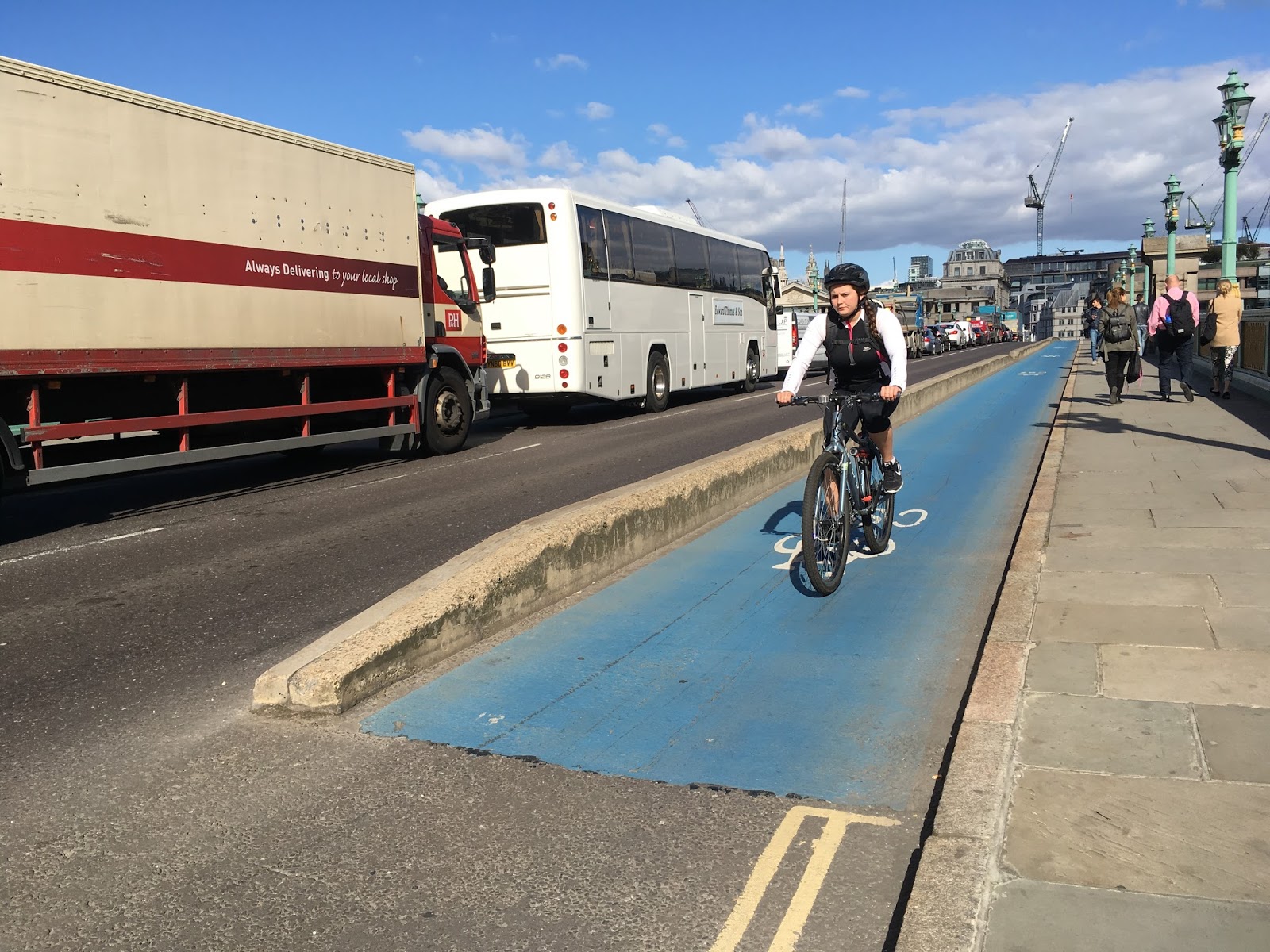
A rider uses the Southwark Bridge bike lane, one of those
singled out in the Daily Mail for paralysing Britain
The problem mirrors developments in the contemporary, polarised political scenes on both sides of the Atlantic. The echo chamber of Twitter feeds and Facebook pages full of like-minded people is gradually alienating many people from the idea that any sincere person could disagree with his or her point of view.

Such echo chambers encourage their inhabitants to feel particularly enraged at my fellow journalists. One Facebook thread I saw recently discussed how users might punish a reporter who had, the thread’s originator claimed, lied through the heinous act of reporting on the anti-cycling views of the London Chamber of Commerce and Industry. Yesterday, I saw two normally sensible Twitter users discussing how a well-regarded reporter who happens to write critically about cycling must be secretly in some sinister anti-cycling group’s pay. This afternoon, I’ve seen on Twitter a suggestion that an anti-cycling editorial in the Sunday Times might be a sign of a “concerted media campaign building”.

Sure, this space in Vauxhall is being very
well used: but how interesting is it to point
that out?
This imagining of sinister, hidden agendas behind newspaper articles betrays a frustrating lack of understanding of how actual journalists work. While I understand the London Taxi Drivers’ Association may have undertaken some lobbying and I know that some business groups oppose new cycling provision, it is naive and silly to imagine that reporters automatically bend to obvious efforts to influence them.

Nearly every reporter I know is driven by a desire to spot developing trends and to paint a picture of the world that will strike his or her readers as true and illuminating. Cycling campaigners should be far more concerned that large numbers of journalists are independently detecting a mood to dismantle or halt progress on cycling and far less concerned with finding a hidden force behind it.The truth, after all, is that progress on both sides of the Atlantic is fragile. There are strong reactionary movements in parts of Europe and North America. 

Many people see provision for cycling as part of a suspect, politically-correct effort to take away their cars. Governments and local authorities have often seemed sheepish about promoting their efforts to support cycling. The arguments for cycling - that it is more space-efficient than motor vehicles, that it causes no pollution, that it costs little to provide for and promotes health - are so obvious as to seem trite. Cycle campaigners would be better, it seems to me, to admit they have a vision for the future that’s different from that of their opponents and argue for their vision’s superiority.
Slow progress in Hyde Park: tangible evidence of the
fragile nature of recent gains
My ride home from Swiss Cottage made clear the costs of failing to get across the case for cycling. Wanting to see progress on the next sections of the east-west superhighway, I took a route through Hyde Park. I at first enjoyed riding down a completed superhighway section down the park’s western end. But then, abruptly, I not only came to the end of the open superhighway but encountered an unannounced closure of the whole southern road through the park.

After my queries about a route for cyclists round the closure drew blank looks from park staff, I instead headed reluctantly out onto the streets of Kensington, one of London’s least cycle-friendly areas. As I did so, the driver of a large Range Rover edged threateningly close to me. When that failed to elicit whatever panicked response the driver was seeking, he leaned long and hard on the vehicle’s horn, issuing a depressing reminder of where real power on the UK’s roads currently lies.

Sunday, 10 July 2016

A prosecutor's phone call, remembrance of stresses past - and why I'm glad of a public policy miracle

It was on Friday afternoon, as I was sitting at my new desk in my office in London, that a phone call took me lurching back into the stresses of my daily cycle commute in New York.

The North-South Cycle Superhighway, at Southwark Street: surprising balm for the soul.
The call came from a prosecutor at the New York Taxi and Limousine Commission who was dealing with a complaint I’d submitted in May. Within a few minutes, I was being sworn in and examined at a hearing of the commission’s tribunal. It was the first time, after a succession of driver no-shows and last-minute plea bargains, that I’ve actually had to testify against a driver. Then, I was cross-examined by the attorney for a driver who’d first tailgated me and a group of other cyclists then driven down a street yelling abuse at me. I felt my heart racing and my temper rise.

But it was only a little later, as I discussed the joys of London’s new cycle superhighways with colleagues, that it dawned on me why the call from New York had set off quite so many fight-or-flight responses. Having arrived back in the UK with my family early on Thursday, I’d had two days of mostly stress-free cycling riding on London’s new segregated cycle tracks. The experience, it dawned on me, had lifted a burden of anxiety that had sat on me all the time I battled with New York’s drivers. As I recounted the tailgating then dealt with the cross-examination from the driver’s attorney, the burden’s full weight came crushing down on me again.

That low-stress riding has produced in me - to my own surprise - an unusual feeling of lightness of spirit when I’m on my bike. This weekend, staying with my parents-in-law in rural Cheshire, I noticed when I took my bike on a muddy, sometimes hard-to-navigate country trail that I was willing to tackle trickier slopes and tougher surfaces than I had been when riding similar routes while living in New York. There are undoubtedly complex public policy questions about how much road space in London to allocate to bicycles and how much to other traffic. But, for me in the short term, the changes’ effect has been to liberate a little joy in my soul.

A muddy section of the Wirral Trail, in Cheshire:
site of my unaccustomed boldness

Even if I’d still been in New York, however, it would still have been stressful to relive the events of the morning of May 12 - all the more so because they reflected failings typical of New York’s streets. I’d complained about a taxi driver who drove close behind me and some other cyclists, trying to honk us out of his way, as we moved to turn left at the busy intersection of Canal and Allen Streets. After I photographed the driver so that I could report him, he drove parallel to me as I rode up Allen Street, shouting what sounded like abuse at me as I rode in the street’s - thankfully protected and segregated - bike lane.

The incident reflected many of the weaknesses of New York’s provision for cyclists. The two blocks of Canal St where I was riding connect the Manhattan Bridge bike path - one of the city’s busiest cycling locations - with the bike lanes on Allen St, a critical, high-quality, north-south route. Yet those two blocks are busy, chaotic and devoid of any cycling provision save for some rather optimistic “sharrow” markings. Those are generally obscured beneath double-parked vehicles.

Conditions were particularly challenging on the morning in question because Canal St had just been milled - had its surface removed prior to laying of new tarmac. The manhole covers and other ironwork - always potential landmines of the New York streetscape - were sticking up well above the temporary surface, presenting a high-stakes obstacle course for commuting cyclists.

The honking taxi driver of milled Canal St:
a picture to get the stress hormones racing
By contrast, the striking feature of my rides so far on London’s new cycle tracks is that they provide seamless journeys. The paths are generally continuous, mostly wide and, so far at least, have excellent, high-quality surfaces. I can think of almost no piece of cycling infrastructure in New York - including the Hudson River Greenway, the city’s best route - that so completely eliminates the challenge for cyclists of interacting with drivers.

The London routes don’t, like so much provision in New York, disappear at the points where conditions get most challenging. From my temporary accommodation in Limehouse, East London, I zipped to work on Thursday and Friday down Upper Thames Street, a traffic sewer through the City of London financial district. Riding there used to involve terrifying games of chicken with big trucks and black taxis. Last week, it was, for the first time I can recall, a positive pleasure to ride on, thanks to the east-west cycle superhighway, which bore me down towards Southwark Bridge untroubled by any interactions with the neighbouring vehicles. The contrast with the treatment of difficult areas in New York - say, the section of Second Avenue where cyclists have to deal with traffic turning into the Queens-Midtown Tunnel - could scarcely be more stark.
Upper Thames Street: a cycling paradise if not exactly
regained, at least found for the first time

Yet the grudging tone of those involved in the Taxi and Limousine Commission hearing was at least as depressing as the recollection of the incident itself. There seemed to be a general feeling that for a group of cyclists to be followed closely by an angrily honking taxi driver wasn’t really that big a deal. The defence attorney, meanwhile, demanded to know if I’d been in the bike lane when honked at. The question suggested the attorney didn’t know the street had no bike lane. It was built on the false assumption that bike lanes should serve as prisons for cyclists, not havens. It also entirely missed the point that a left-turning cyclist could scarcely stay in a bike lane on the right, even had one existed.
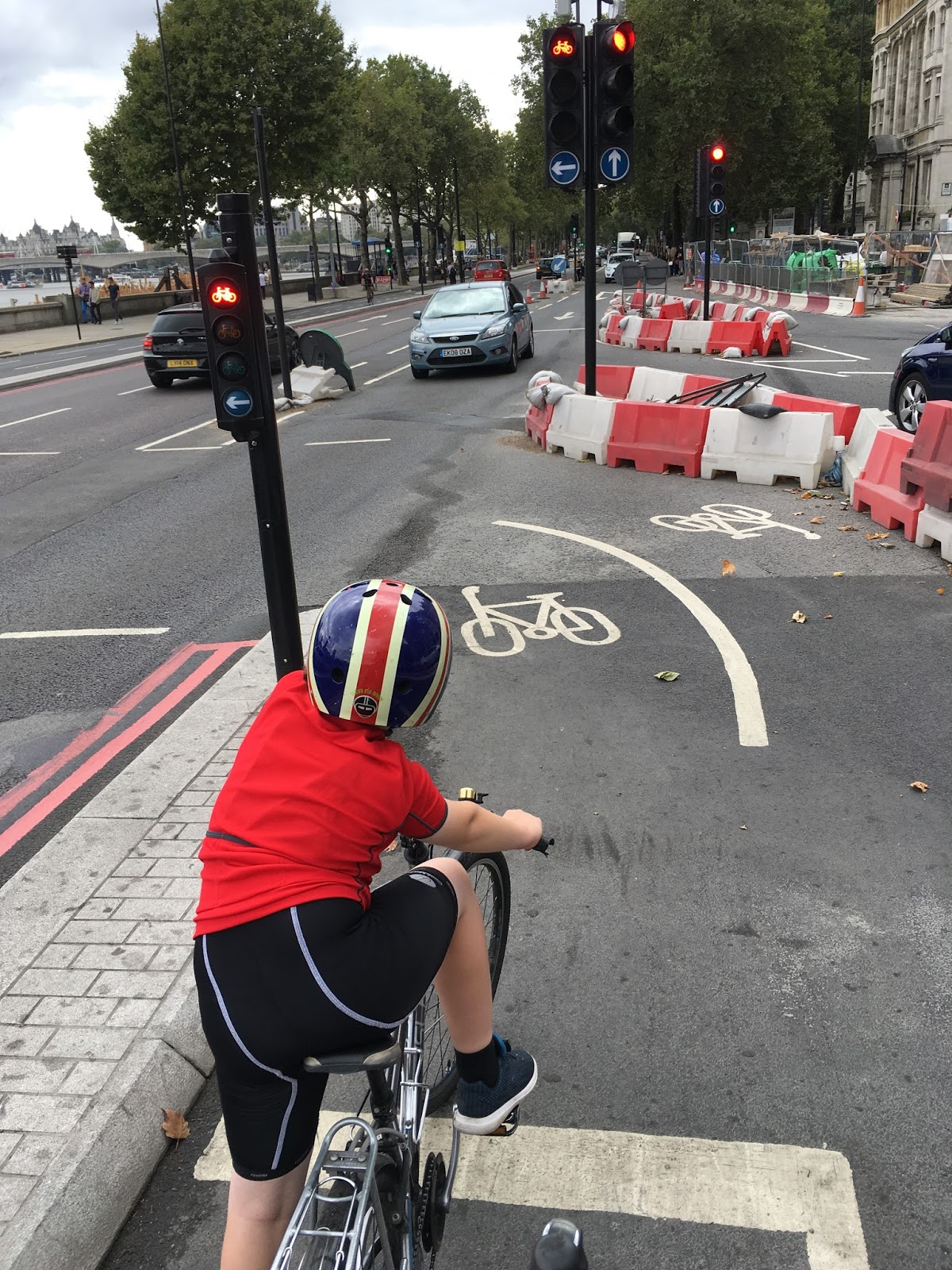
The Victoria Embankment not only hosts
those darling little lights - but an actual,
well-designed cycle track junction


London’s new cycle tracks, by contrast, feel like acts of generosity. They are mostly wide and those I’ve used so far seem well designed. My enthusiasm for them isn’t unique. One colleague - previously only an intermittent commuter cyclist - raved to me about how she could scarcely believe London had built such things. “They’ve got those little lights!” she squealed excitedly, referring to the small repeater traffic lights positioned at cyclists’ eye level. The other striking point is how quickly it’s possible to get around a city by bike when one isn’t constantly dodging around cars double-parked in bike lanes or grappling with “mixing zones” of vehicles trying to cross one’s path. My bike computer is consistently telling me I’m going around 1mph faster on average than I used to in New York.

The tracks’ building is clearly an act of political boldness that far outstrips even Janette Sadik-Khan’s efforts to put in cycling infrastructure in New York. The scale of that boldness was clear to me as my family and I rode on Thursday morning from Heathrow Airport to our temporary accommodation. At mid-morning, as we were making the trip, motor traffic remained heavy and very slow-moving while, next to us, wide, well-designed cycle lanes stood, getting only relatively light use.

It is hard to imagine any contemporary senior New York politicians’ having the nerve to try to push such a network not only through the city council but also through the myriad of community boards that are determined to obstruct progress. My experience of testifying before the taxi and limousine commission’s tribunal was certainly a reminder that there is so far not even the vaguest consensus in New York that cyclists have a legitimate place in urban transport.

In London, meanwhile, I share my colleague’s wonder at the cycle tracks’ construction. The tracks are associated closely with Boris Johnson, a bumbling mayor whose other contributions to British public life - including his role in the recent European Union referendum - have been almost entirely negative. The tracks were shepherded through by Andrew Gilligan, Johnson’s “cyclist tsar,” who received substantial, justified criticism for his shoddy methods in the 2004 Hutton Inquiry into the suicide of David Kelly, a government scientist whom Gilligan had used as a source.

London cyclists like these were yearning
for a miraculous transformation.
Astonishingly, they seem to have found one.
The tracks came to be built only after Johnson rashly built a network of extraordinarily dangerous “cycle superhighways” consisting only of paint on very busy main roads. The decision to build something better followed the justified outcry over the number of cyclists killed riding on the old super highways. That such a flawed process and flawed individuals could end up producing excellent, well-designed infrastructure feels like a public policy miracle.

But, of course, the miracle is a limited one. The cycle tracks cover only a relatively small area of central London. When not on them, I’ve already had some negative experiences. I was, for example, chased down a bus lane on Brixton Road on Thursday by an impatient van driver who should not have been in the lane at the time. This evening, as I cycled home from Euston station, on one of the few parts of the journey where I wasn’t using protected infrastructure, a minicab driver cut me off as I sought to pull out round a parked car. I can only hope that the cycle tracks are not so bold a step that they end up ripped out, as New York’s first experiments in segregated bike lanes were, when the complaints from motorists complaining about congestion became too much.

The other worries are for the future, however. I continue in many ways to pine for New York - its unique atmosphere, the open, friendly people, even the excitement of discovering the city by bike. But London’s bold cycling experiment makes me glad, at least when I’m on my bicycle, that I’m here.