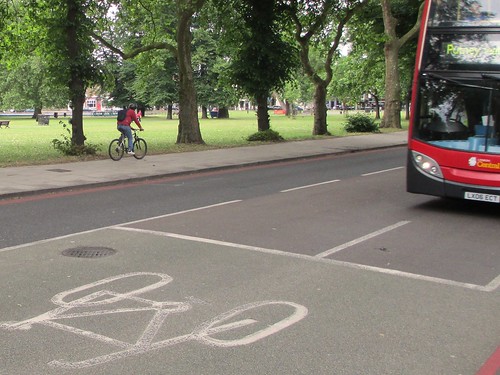
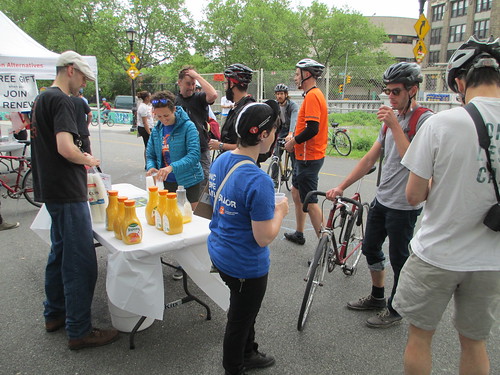
Showing posts with label anger. Show all posts

Sunday, 20 November 2016

Obstructive pedestrians, a crass video - and why your city's cyclists are the kind you don't like

If I’d gone out looking for evidence of how differently people regard cyclists from how I regard myself, I could scarcely have done better than my experience this Saturday. In the afternoon, as I rode with my wife and my son along the Embankment in Central London, we encountered a crowd of pedestrians crossing the cycle track against the signal. “Watch out in the cycle track, please!” I shouted.

The East-West Cycle Superhighway near Parliament Square:
site of the Invisible Visible Man's contretemps with
a group of pedestrians
Then, in the evening, I came across a trailer for Trigger Happy, a new series of Channel 4 comedy shorts. The first - Angry Cyclist - features helmet camera footage of the eponymous cyclist riding around streets. “Cycle lane!” he shouts at pedestrians, in imitation of precisely the tone I’d taken than afternoon. He then rides onto a section of pavement that is not, in fact, a cycle lane.

The video was only the latest evidence I’ve seen in recent weeks of how cyclists continue to be regarded in the UK - and possibly even more in the US - as a strange, fringe out-group whose behaviour is baffling and infuriating to others. Earlier in the week, I’d felt a similar sinking feeling when I saw Tweets by Mark Dennison, a presenter on BBC Nottingham, a local radio station, encouraging people to call his show. “Cyclists… what do they do that winds you up?” he asked. He later defended the transparently tendentious tweet as merely a way of encouraging a “balanced” debate.

The comedy short and Mark Dennison’s tweet both came across as belittling a group of people who, at least when sharing the roads with motor vehicles, are vulnerable and relatively powerless. They showed the depth of the chasm of misunderstanding between cyclists and others. While my request to the pedestrians on the Embankment would have seemed self-righteous or priggish to the makers of Trigger Happy, it was in fact motivated by fear. I was worried that, unless they got out of the way, my nine-year-old would be marooned in the roadway when motor vehicles restarted.
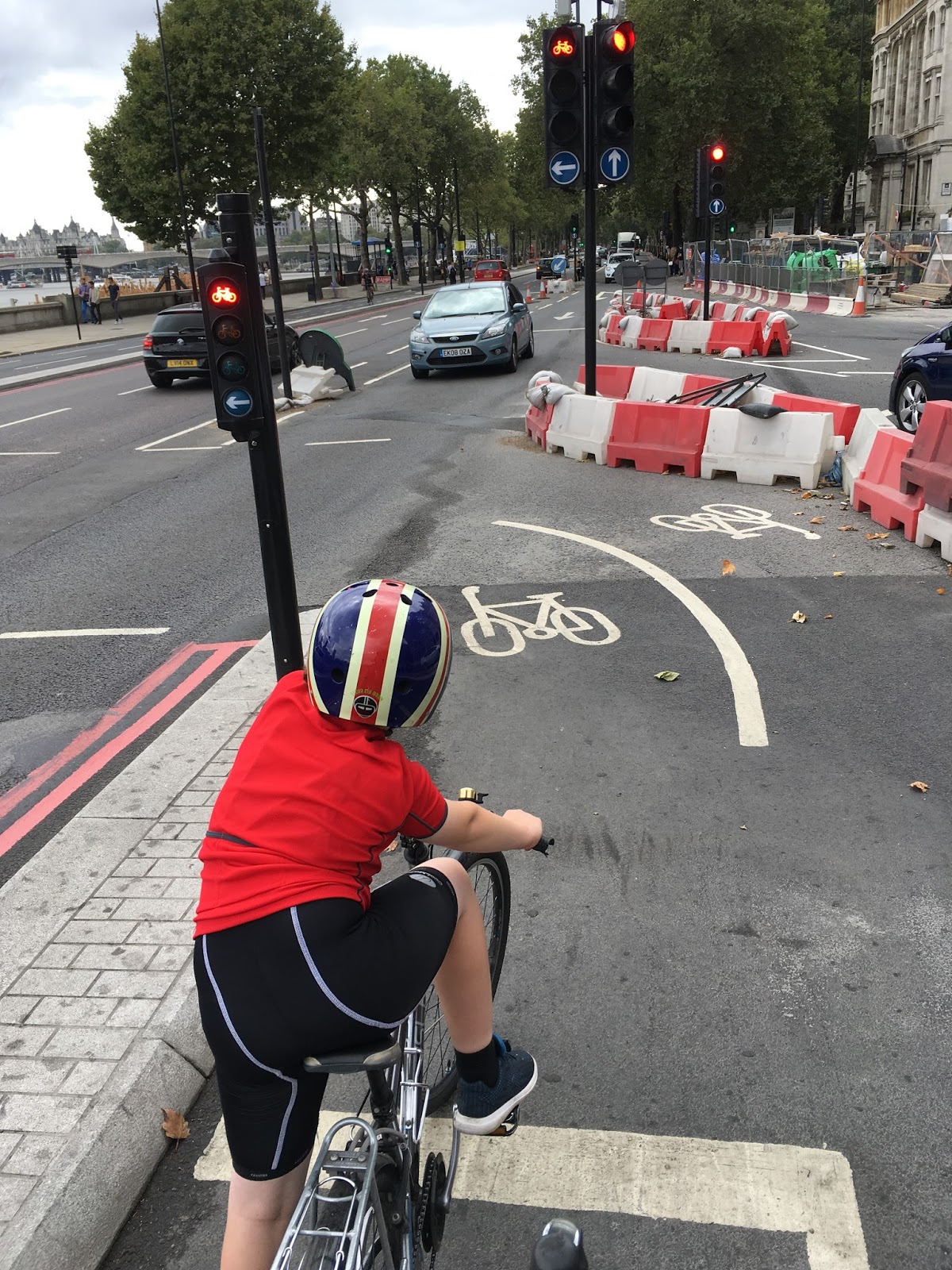
The Invisible Visible Boy on his bike
in central London: a reason for concern I hope
even the haters can understand

The incidents have led me to query why so many people continue to find me and other cyclists so bafflingly alienating. It strikes me as an especially important question given that many cyclists, like me, believe their countries’ transport systems would work better if more people joined them by starting cycling. Current attitudes appear to be both a symptom and a cause of cycling’s remaining a niche activity, practised by a relatively small group of people.

I should say, first of all, that I understand at least a little bit of why Trigger Happy finds some cyclist behaviour funny. There is an underlying similarity to a lot of helmet camera video footage that cyclists post on YouTube. The cyclist is riding along a road - often at some speed - when a motorist does something stupid, dangerous and possibly malevolent. The driver’s behaviour is then held up for general condemnation in a tone that generally suggests the poster is standing, hands-on-hips shaking his head in shocked but unsurprised disbelief. I am sure that, while I don’t use a camera, my complaints about bad driver behaviour have a similar, rather priggish tone. I can see how someone might find it so predictable that it starts to seem a little ridiculous.

But the jokes become far less funny, it seems to me, the moment one starts to think about what shapes the culture that Trigger Happy and others hold up to ridicule. I’m surrounded by fast, aggressive cyclists on my morning commute down Clapham Road not because Londoners are by nature fast and aggressive when cycling but because the conditions have selected both who rides and how they do it. People who don’t feel capable of maintaining a steady 20mph are unlikely to feel comfortable riding down a wide, straight road in close proximity to drivers driving at 30mph and faster.

Cyclists at the Oval on my route to work:
some clichés about London cyclists persist
because they're partly true.
The cyclists I see around me have been as surely shaped by their environment as giraffes have been by conditions on the savanna or the American bison by the high plains. People wear bright clothing and helmets because they hope they’ll help to prevent or ameliorate collisions with fast-moving motor vehicles. It takes both the skills of racing cycling and a road-racer’s appetite for risk truly to embrace this style of commuting. That point came home to me forcibly on Friday when a fellow cyclist, to my astonishment, slipped through the gap - of barely a metre - that I’d allowed myself when overtaking a bus. One especially stressful recent morning, I witnessed a blazing row between two fellow cyclists over an apparent near-collision caused, as far as I could tell, by excessive risk-taking by one of them. The argument continued over a considerable distance, being resumed as both stopped at successive junctions.

This environment explains one of the most frequently remarked upon issues about the demographics of London cycling - that cyclists disproportionately tend to be better off, whiter and more male than the city as a whole. In a car-centric city where people feel skill, knowledge and equipment are necessary to cycle commuting, it's hardly surprising that cycle commuters often come from the class of people who have the leisure and finance to develop the requisite cycling skills recreationally.

A fairly typical bike path in London's
Docklands: experts can't work out why
cycling hasn't taken off here.
I’ve been struck recently by how even I, someone who’s cycled an average of nearly 4,000 miles a year for the last 13 years, feel a little spooked by conditions on much of my commute. I’ve had so many close passes from drivers after pulling out round stopped buses that I find myself increasingly stopping to let buses pull away. On Friday morning, a beautiful morning with nearly ideal conditions, I remembered well over half-way into my commute that I’d forgotten my security pass. I felt a frisson of fear as well as excitement when I realised I’d have to turn around and head home for it, even though I’d normally welcome the excuse to put in some extra miles.

There have, undoubtedly, been efforts to widen cycling’s appeal, both in London and New York, where I lived for four years until July. But Trigger Happy’s scoffing at cyclists’ tendency to shout at other road users about their rights highlights the big problem with many of them. Inadequate on-road cycle lanes, areas where cyclists and pedestrians share space and some quiet routes down parking-clogged back streets build in a significant level of conflict between cyclists and others. It might seem irritating to pedestrians to be asked please not to walk in a bike lane. But it is profoundly frustrating regularly to have to use spaces whose use is so unclear that other users obstruct cyclists unless specifically asked not to do so.

It should certainly surprise no-one that, in existing conditions, some cyclists are apt to break the road rules. If one knows, after all, that the traffic lights on a certain road are timed to suit drivers, not cyclists, and that a phalanx of drivers will chase after one the moment the lights change, the temptation to ride off through a red light and get away in peace can be very strong.

Helmetless, relaxed tourists on the east-west cycle
superhighway: evidence of how conditions dictate who rides.
The way to shape this culture is not, it seems to me, to berate existing cyclists for being as they are but to create conditions that will encourage a different kind of cycling. I certainly feel very different during the brief period each day when I cycle on the protected north-south cycle superhighway from when I’m in a 20mph pack racing down a bus lane. Even small changes can have a big effect. While I still jostle drivers for most of my commute, there are now segregated bike lanes through Stockwell Cross and past Kennington Park, previously the riskiest parts of the route I take. It’s no coincidence, I think, that, since those improvements, I see the occasional couple cycling to work and holding hands at traffic lights. While lycra-clad men still predominate, I find my heart lifting over such normal, human moments.

Better conditions are even, I think, starting to generate different types of cyclists. For four weeks in July and August, when we first returned from New York, I rode each day from our temporary apartment down the Cable Street protected bike path in the East End and onto the east-west cycle superhighway. I couldn’t help noticing that, in a deprived area with such good facilities, I’d see some families of eastern European immigrants out getting about by bike. On Prudential Ride London weekend, when many streets in the capital were closed to motor vehicles, I vividly recall the sight that most raised my hopes for the future. Near Blackfriars Bridge, a Bangladeshi woman in Salwar Kameez clothes paused on her hire bike as she waited for her son to make his way up the hill from the Blackfriars underpass.

The East-West Cycle Superhighway in
Parliament Square: politicians will be slow
to build more such facilities while
cyclists remain alien
Yet the challenge remains that, for the moment, many existing cyclists fit into the kind of stereotypical pattern that can prompt others to label us as “them”. That makes politicians reluctant to provide the kinds of facilities that would produce more obviously non-alien cyclists. It is certainly not surprising that London’s new, left-wing mayor is back-pedalling on his predecessor’s plans to encourage cycling. It is easy to understand his concern that his natural constituency of poorer voters will find themselves stuck on the bus while middle-class cyclists such as I zip by on new facilities and vote for his rivals.

Until that impasse is broken, however, London and other big cities will find that most of its cyclists are people prepared to face down sometimes naked aggression from motorists and even, sometimes, from frustrated pedestrians.

The challenge was made brutally clear to me as I completed my lengthy commute on Friday. As I neared Elephant & Castle, a van driver deliberately pulled into my path. Then, apparently eager to ensure he cleared the junction before the traffic light changed, he tried, despite my clear signals to him, to turn across my path and force me to stop. It was hard not to be reminded of the most succinct answer to Mark Dennison’s question about what cyclists did that wound people up. “Breathe” was one of the very first responses.

Wednesday, 20 April 2016

An angry driver on 8th St, two tragedies - and why New York cyclists aren't meant to be really there

It wasn’t a surprise but it was a disappointment. As I rode my bike on Saturday, fast, down 8th Street in Park Slope, a driver, coming up from behind me, thought she knew better than I where in the street I should be riding. She started – as happens very frequently when one rides down these streets, correctly, in the middle of the road - trying to honk me out of her way.

I’d ridden down 8th St because neighbouring, busier 9th St’s bike lane – sandwiched in the dangerous door zone for parked cars – is invariably clogged with double-parked cars. It’s far more dangerous and stressful than its narrower, one-way neighbours.
 
8th St: not New York's narrowest street - but would you want a
car passing you at 30mph as you barreled down here?
But, when she caught up with me at the next intersection, the woman explained why she thought she had the right to breeze past as if I weren’t there.

“You shouldn’t be in the middle of the road,” the woman told me.

“I was stopping you from overtaking me until I could let you past safely,” I said.

“You don’t belong in the middle of the road,” she said.

“Yes I do,” I answered.

Then, inevitably, as I rode off, a bystander shouted after me.

“Hey, you need to be on a street with a bike lane! You should be on Ninth Street!”

The exchange illustrated, in part, people’s automatic, infuriating assumption that they are clever and sophisticated and cyclists are uninformed simpletons making stupid decisions for unfathomable reasons.
 
A cyclist dodges round a car parked in the 9th St bike lane:
this is the idyll one bystander recommended I use
instead of 8th St.
But it also shed light on a problem facing cyclists in many cities making half-hearted attempts at accommodating cyclists. I was struck, as I rode on, by how cycling had been shoe-horned into New York City in a way that’s meant to avoid inconveniencing anyone else. No-one had ever told this woman that, yes, she might occasionally have to wait a few seconds to get past a cyclist. The builders (more accurately, painters) of the 9th St bike lane had sought to make it barely impinge on drivers.

The designs betray a profound confusion in public policy. There’s a vague instinct that cyclists can’t be entirely denied better facilities. But that goes hand in hand with cowardice about the idea that promoting cycling is a public good. There’s no sense that sacrifices to encourage cycling might be worth everybody’s while. The unspoken sense is that cyclists should take up no space, have no momentum and cause no-one else to modify any part of their behaviour.

The inevitable result is that cyclists are forced into making the compromises that others get to avoid. As I rode down 8th St, I faced a choice between being harassed for riding down the middle of the street or taking the risk of being hit by an inattentive driver’s opening door and knocked into the path of a driver passing me at 30mph. Had I chosen instead to ride down 9th St, I’d have faced a combination of both dangers. I’d have had to ride in the parked cars’ door zone then pull out round the parked vehicles, being tailgated by drivers who thought I should somehow not be out of the bike lane.
The Jay St "bike lane" in downtown Brooklyn:
evidence on its own of why New York's bike commuting rate
is so low.

It’s no surprise under these circumstances that cycling in New York remains a fringe activity, confined to a relative handful of us who think the personal benefits of getting about by bike outweigh the costs. It’s a situation mirrored in the many cities across North America and some parts of Europe.

The current circumstances practically guarantee that the benefits the planners were seeking from cycling – cleaner air, safer streets, better use of road space – won’t materialise. The dominant surviving forms of cycling – fast riding by the young and fit, coupled with widespread rule-breaking by riders fleeing dangerous drivers – are used as evidence that promoting cycling is a Bad Thing. It’s time for such cities either to get serious about cycling provision or to stop the current dangerous and stressful pretence.

Not, I’m sure, that any of this  would make sense from the perspective of the Angry BMW Driver of 8th St. It must, I accept, seem odd when driving a large vehicle down a street to see a cyclist, a single person on a  narrow vehicle, taking up the centre of the lane. It must, in certain circumstances, feel like a theft of the road space.
 
My bike computer after one run-in with
an angry driver being held up:
unacceptably slow in a city with
a 25mph speed limit.
I don’t ride down the middle of the road to make some abstruse point, however. As I use these streets, my bike computer often tells me I’m going well over 20mph. As a large man on a heavy bike with luggage, I have significant momentum. If a driver opened a door into my path or pulled out of a parking space without looking, I would be sent flying over my handlebars. These aren’t marginal, theoretical risks. Only a few weeks ago on 8th St, I had to swerve at high speed after a driver pulled out, fast, from a parking space into my path. Had I been riding where the Angry Woman thought I should, I could easily have been killed.

Nor was I in any real sense inconveniencing the woman. Like other narrow Park Slope streets, 8th Street is regularly clogged by double-parkers. The next block downhill features two speed bumps, which I can take without slowing down and drivers can’t.

The woman’s inability to pass me was clearly, however, an affront to her sense of her rights. Her lack of human sympathy for me as a fellow road-user seemed to have bled over into a wider resentment at my having any physical presence at all.

It’s a feeling I encounter surprisingly frequently, from both drivers and pedestrians. I’ve recounted before a run-in with a pedestrian who insisted on obstructing the Grand St bike lane in Manhattan. The Saturday before my dispute with the angry woman on 8th Street, I was yelled at by a tourist who insisted that, because he wanted to walk on the Brooklyn Bridge’s bike lane, I too should walk, not ride, over the bridge. I’ve come to understand taxi drivers’ tendency to pull out of parking places into my path as more a mark of their sense that cyclists can and should yield to them at will, more than a mere symptom of inattention.
 
The Brooklyn Bridge, complete with the bike lane
one recent critic told me no cyclist should expect to use.
The misunderstanding extends to those meant to enforce New York’s traffic rules. There has been understandable outrage after it emerged that a right-turning police officer knocked a cyclist off his bike on 9th St in Gowanus, very near my apartment, then had a fellow-officer write that his turn had been perfectly legal. My sense is that the incident might partly reflect police officers’ genuine conviction that it’s a cyclist’s job to avoid traffic turning across his or her path, not a driver’s job to yield.

I used to encounter similar attitudes when I cycled in London – and I can’t imagine they’ll have disappeared entirely when I return there later this year.

But London has at least started groping towards an answer to the kinds of incidents I keep encountering. After the disaster of the initial, blue-painted Cycle Superhighways, Transport for London has finally been shamed into providing some decent, segregated cycle paths on some of its busiest streets. Even when I lived there, London was already far better than New York at providing calming on side streets like 8th St to avoid incidents like the one I suffered on Saturday. There’s tragically no sign at all that anyone in New York feels under pressure to provide anything like that on this side of the Atlantic.

Yet New York’s continuing state of cycling limbo isn’t a merely theoretical problem. Cyclists truly can’t screech instantly to a halt of float harmlessly away from vehicles that menace them. The day before my row with the Angry Driver, a driver a couple of miles away had killed a cyclist riding to work in Clinton Hill. This morning, a huge truck, driving on a street where it wasn’t permitted, killed a man on his bike in Park Slope only 15 blocks or so from where I had my row.

Pedestrians walk down a temporary bike lane on 8th Avenue -
in a city that tells you cyclists don't really matter,
why wouldn't you?
The police’s instinct in both cases was immediately to blame the cyclists, essentially, for being where they were. They claimed – improbably, given what is known about her – that Lauren Davis, the victim in Clinton Hill, had been riding against traffic. They have focused, still more improbably, in the Park Slope crash on the theory that James Gregg, the victim, was hanging onto the truck that killed him to hitch a ride. I have never seen a cyclist in New York City do such a thing.

The instinct to exonerate the truck driver is all the more extraordinary given that it is clear he was breaking the law just by driving down that street. Both victims seem to me to have died from the grubby compromises forced on cyclists by cowardly road designers and politicians.

I am fortunate indeed that I have so far derived only physical benefits and no serious harm from my New York cycling. Yet, just hours after the Park Slope tragedy, I encountered the kind of contemptuous attitude that makes such tragedies  all too common. Riding through Fort Greene and needing to turn left, I looked over my shoulder to see the driver in the next lane absorbed in his phone, rather than his driving. Fearful that he wouldn’t spot me as I pulled across, I rode for a second or two staring at him while signalling.

That turned out to be an indignity too far. He sped up for a second or two, to block my turn. Then, when I’d successfully pulled left and turned out of his way, he yelled abuse. He was furious that I’d made him momentarily take his mind off his text.

Tuesday, 9 July 2013

Free speech, tweeted threats and an angry Astoria van driver

It was one of my moral philosophy lecturers – I think it was Gordon Graham – who debunked for me an old – but rather flimsy – idea about the structure of the world. Addressing the idea that humans’ bodies and souls were somehow separate entities, he held up his hand, looked the other way and asked, “How do I know where my hand is?” The strong – unarguable, I think – contention was that people didn’t get their ideas about where their hands were across some barrier between the mind and the body. They knew where they were because their minds – which decided where they would put their hands – and their bodies – the hands that were moved – were the same things.

So I’ve been surprised over the last few weeks to notice a version of the mind-body separation hypothesis getting a new life among angry people on the Internet. I’ve pointed out to several people venting their frustration on Twitter that they’re potentially making their own lives difficult when they threaten (for example) to run over the next cyclist they see riding “in the middle of the road”. If they hit a cyclist with their car in the future – even unintentionally – the act will look deliberate and the charges will be more severe. Most prefer at that point not to reply. But a few have replied indignantly that nothing could be further from their mind when writing about crushing a cyclist beneath their car’s wheels than actually doing so. Their angry opinions and their blameless on-road actions are as separate as a classical philosopher would say a grubby body and a pure mind (or, in this case, a grubby mind and pure body) should be.

Angry Twitter users should love this rider on London's
Clapham Common. He's done as they've asked and got onto
the pavement to ride.
The incidents have made me ponder whether I’m somehow a humourless prude for failing to catch the innate hilariousness of someone’s warning that she’s going to “run over” the next cyclist she sees on the road rather than the pavement (sidewalk, American readers). Should I, as one of the “run over” woman’s friends suggested, simply “get a life”?

Or are these Tweets verbal expressions of attitudes that carry over into real-life driving behaviour and lead to real deaths and injuries? Are the opinions as inseparable from the drivers’ actions as Professor Graham’s hand and his mind?

The question is all the more pressing after a fortnight in the US when the Supreme Court has moved gays and lesbians a significant step forward in their struggle for equal rights, but moved black people several steps back. There’s no doubt that the growing unacceptability of racist and homophobic language has helped to move those groups’ struggles forward. Should it remain socially acceptable to threaten to drive one’s car over someone just because he or she has chosen to use a bicycle on a public road?

None of this, of course, is to deny Twitter’s ultimate triviality. For some time, the most retweeted message was a sickly sweet farewell by Justin Bieber to a six-year-old fan who'd died of cancer. The vast bulk of what appears there can be treated much as one might the rantings of the drunk at the next table in the pub. It’s mildly irritating - but something one can and should ignore.

There is, nevertheless, a direct, graphic quality to the threats some Twitter users make towards cyclists that makes them worthy of attention. In late June, one user, Ray O’Connor, tweeted this message for the next cyclist that he regarded as being too far out in the road: “I will buckle your back wheels c**ts #IWillRunYouOver.”. Another user, @brinky91, said in a now-inaccessible message around the same time that she would “run over” the next cyclist she found riding in the middle of the road. In April, another user, @LaurenKoerber tweeted: "I f***ing hate f***ing people that ride their bikes in the middle of the road.. Like you're not a car #iwillrunyouover."
 
Bad news for angry Twitter users: these riders on
the Manhattan Bridge have bikes and look likely to use them.
Good news: they're not on a road.
These are, I think, the kinds of threats that, expressed towards many other groups, would attract at least some attention from the police, interested to see how serious the threats’ makers were about carrying them out.

The threateners, however, seem almost as indignant at the idea that the threats are serious as I am at their making the threats. “I WASN’T REALLY GOING TO HIT A CYCLIST GEESH,” shouted one typical replier - @AMILLIAMELY - after I queried her suggestion that she might “gain points” in the game of road use by hitting cyclists who rode “in the middle of the street”. Others prefer self-pity, whining that they’re getting “grief” from “cycling fanatics”, as if that were an unusual result of making death threats to strangers in a public place. @brinky91 pleaded that her threats simply reflected her “opinion” to which she had a perfect right. People should leave her alone. @AMILLIAMELY went on to tell me that she simply liked to express her opinion about things that made her “mad” and that it helped her to feel better.

Yet the more I read such declarations of innocence the more I think about the fate of John Kelly, a cyclist who was riding his bike in Astoria, part of the New York borough of Queens in mid-March.  Mr Kelly was using a bike lane when witnesses saw a van come from behind him, swerve into the bike lane and hit him. He ended up clinging by the wipers to the windshield, the driver staring at him with what Mr Kelly called an “angry look” on his face. When Kelly managed to jump off, the driver escaped. Few regular urban cyclists will have been surprised at news of the van driver’s attack. It was merely an extension of the kind of aggressive, deliberately dangerous driving to which many of us are, unfortunately, used.
 
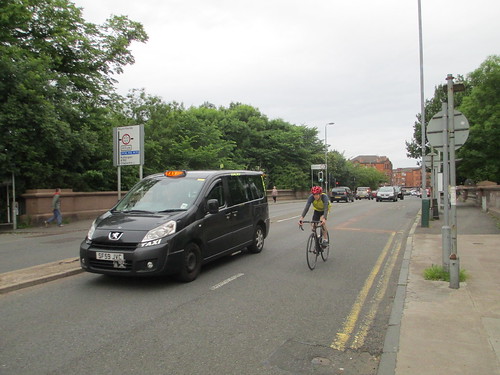
This cyclist on Glasgow's Cathcart Road is wearing
specialist clothes, is (rightly) well out in the road
and amid some traffic. He could be a perfect storm for
cyclist-haters' rage
The van driver’s attack so closely paralleled the kind of violent assault-by-motor-vehicle that I’ve seen Twitter users say they want to carry out that I can’t accept the two are entirely separate phenomena. It’s clearly better if the people with whom I’ve debated haven’t deliberately used their cars to hit people. But I found it hard to believe the claims of one indignant threat-maker that he was always a careful driver. Is it really credible that a driver who tweets after a trip that he would like to run over cyclists will carefully pass every cyclist he sees on his next trip patiently and at a safe distance? The threat-makers are almost certainly over-represented among people killing and injuring people riding on the roads.

Which leaves the question of @brinky91’s right to voice her opinion that she’d like to crush my body with her car.

There is no doubt that a civilised society has a huge interest in protecting the right to express a wide range of opinions – including ones that gravely offend other people. Free speech provides the fuel for the great race between ideas that makes free societies superior to closed ones. It mans the feeding stations in the great, ever-running stage race between ideologies. There need to be excellent reasons – protection of a person’s right not to be unjustly defamed, for example, the prevention of direct incitement to violence and the protection of a handful of official secrets – to put serious curbs on the right.

But it remains absurd for people voicing an opinion to complain that others loudly disagree. It is as if Chris Froome were to take to complaining in the coming weeks that other riders were attacking him on mountain stages of the Tour de France. There is occasionally an unpleasant whiff of bullying about the way Twitter users can round on someone indulging in unpopular speech, bombarding him or her with messages of protest. But, in cases where someone has threatened real, graphic violence as some of those I have mentioned did, it seems perfectly reasonable that he or she should understand how many of the verbal attack’s victims strongly resent that language.

Speech, after all, is valuable precisely because it is an echo-chamber, amplifying our thoughts and allowing us to try out ideas about the world before taking them from our brains to our hands. I feel constrained as I cycle around New York to behave well precisely because I have written here that everyone should do so. I can’t help thinking that motorists whose Tweets about maiming or killing cyclists have received only the sneering agreement of their friends will feel justified in driving far less carefully. If I have a choice between fending off dangerous driving with a swift brake application and evasive manoeuvring or a few strokes on a keyboard, I know which I’m going to choose.

You can follow the Invisible Visible Man - who promises never to threaten another road user's life - at @RKWInvisibleman