Showing posts with label victim-blaming. Show all posts

Wednesday, 20 April 2016

An angry driver on 8th St, two tragedies - and why New York cyclists aren't meant to be really there

It wasn’t a surprise but it was a disappointment. As I rode my bike on Saturday, fast, down 8th Street in Park Slope, a driver, coming up from behind me, thought she knew better than I where in the street I should be riding. She started – as happens very frequently when one rides down these streets, correctly, in the middle of the road - trying to honk me out of her way.

I’d ridden down 8th St because neighbouring, busier 9th St’s bike lane – sandwiched in the dangerous door zone for parked cars – is invariably clogged with double-parked cars. It’s far more dangerous and stressful than its narrower, one-way neighbours.
 
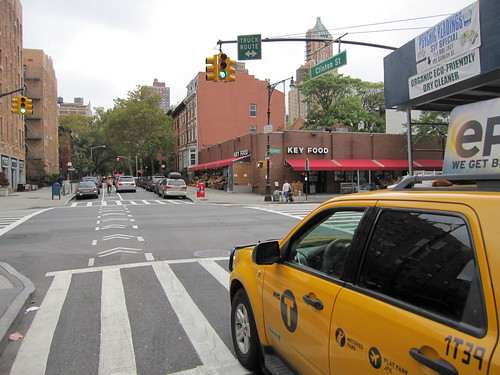
8th St: not New York's narrowest street - but would you want a
car passing you at 30mph as you barreled down here?
But, when she caught up with me at the next intersection, the woman explained why she thought she had the right to breeze past as if I weren’t there.

“You shouldn’t be in the middle of the road,” the woman told me.

“I was stopping you from overtaking me until I could let you past safely,” I said.

“You don’t belong in the middle of the road,” she said.

“Yes I do,” I answered.

Then, inevitably, as I rode off, a bystander shouted after me.

“Hey, you need to be on a street with a bike lane! You should be on Ninth Street!”

The exchange illustrated, in part, people’s automatic, infuriating assumption that they are clever and sophisticated and cyclists are uninformed simpletons making stupid decisions for unfathomable reasons.
 
A cyclist dodges round a car parked in the 9th St bike lane:
this is the idyll one bystander recommended I use
instead of 8th St.
But it also shed light on a problem facing cyclists in many cities making half-hearted attempts at accommodating cyclists. I was struck, as I rode on, by how cycling had been shoe-horned into New York City in a way that’s meant to avoid inconveniencing anyone else. No-one had ever told this woman that, yes, she might occasionally have to wait a few seconds to get past a cyclist. The builders (more accurately, painters) of the 9th St bike lane had sought to make it barely impinge on drivers.

The designs betray a profound confusion in public policy. There’s a vague instinct that cyclists can’t be entirely denied better facilities. But that goes hand in hand with cowardice about the idea that promoting cycling is a public good. There’s no sense that sacrifices to encourage cycling might be worth everybody’s while. The unspoken sense is that cyclists should take up no space, have no momentum and cause no-one else to modify any part of their behaviour.

The inevitable result is that cyclists are forced into making the compromises that others get to avoid. As I rode down 8th St, I faced a choice between being harassed for riding down the middle of the street or taking the risk of being hit by an inattentive driver’s opening door and knocked into the path of a driver passing me at 30mph. Had I chosen instead to ride down 9th St, I’d have faced a combination of both dangers. I’d have had to ride in the parked cars’ door zone then pull out round the parked vehicles, being tailgated by drivers who thought I should somehow not be out of the bike lane.
The Jay St "bike lane" in downtown Brooklyn:
evidence on its own of why New York's bike commuting rate
is so low.

It’s no surprise under these circumstances that cycling in New York remains a fringe activity, confined to a relative handful of us who think the personal benefits of getting about by bike outweigh the costs. It’s a situation mirrored in the many cities across North America and some parts of Europe.

The current circumstances practically guarantee that the benefits the planners were seeking from cycling – cleaner air, safer streets, better use of road space – won’t materialise. The dominant surviving forms of cycling – fast riding by the young and fit, coupled with widespread rule-breaking by riders fleeing dangerous drivers – are used as evidence that promoting cycling is a Bad Thing. It’s time for such cities either to get serious about cycling provision or to stop the current dangerous and stressful pretence.

Not, I’m sure, that any of this  would make sense from the perspective of the Angry BMW Driver of 8th St. It must, I accept, seem odd when driving a large vehicle down a street to see a cyclist, a single person on a  narrow vehicle, taking up the centre of the lane. It must, in certain circumstances, feel like a theft of the road space.
 
My bike computer after one run-in with
an angry driver being held up:
unacceptably slow in a city with
a 25mph speed limit.
I don’t ride down the middle of the road to make some abstruse point, however. As I use these streets, my bike computer often tells me I’m going well over 20mph. As a large man on a heavy bike with luggage, I have significant momentum. If a driver opened a door into my path or pulled out of a parking space without looking, I would be sent flying over my handlebars. These aren’t marginal, theoretical risks. Only a few weeks ago on 8th St, I had to swerve at high speed after a driver pulled out, fast, from a parking space into my path. Had I been riding where the Angry Woman thought I should, I could easily have been killed.

Nor was I in any real sense inconveniencing the woman. Like other narrow Park Slope streets, 8th Street is regularly clogged by double-parkers. The next block downhill features two speed bumps, which I can take without slowing down and drivers can’t.

The woman’s inability to pass me was clearly, however, an affront to her sense of her rights. Her lack of human sympathy for me as a fellow road-user seemed to have bled over into a wider resentment at my having any physical presence at all.

It’s a feeling I encounter surprisingly frequently, from both drivers and pedestrians. I’ve recounted before a run-in with a pedestrian who insisted on obstructing the Grand St bike lane in Manhattan. The Saturday before my dispute with the angry woman on 8th Street, I was yelled at by a tourist who insisted that, because he wanted to walk on the Brooklyn Bridge’s bike lane, I too should walk, not ride, over the bridge. I’ve come to understand taxi drivers’ tendency to pull out of parking places into my path as more a mark of their sense that cyclists can and should yield to them at will, more than a mere symptom of inattention.
 
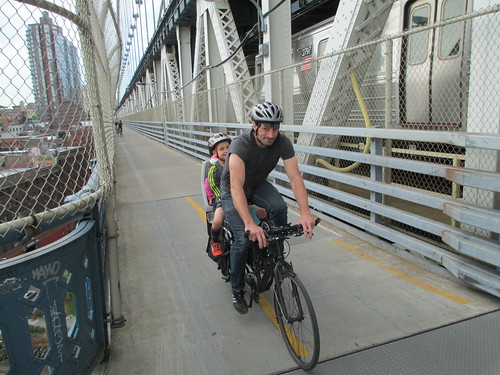
The Brooklyn Bridge, complete with the bike lane
one recent critic told me no cyclist should expect to use.
The misunderstanding extends to those meant to enforce New York’s traffic rules. There has been understandable outrage after it emerged that a right-turning police officer knocked a cyclist off his bike on 9th St in Gowanus, very near my apartment, then had a fellow-officer write that his turn had been perfectly legal. My sense is that the incident might partly reflect police officers’ genuine conviction that it’s a cyclist’s job to avoid traffic turning across his or her path, not a driver’s job to yield.

I used to encounter similar attitudes when I cycled in London – and I can’t imagine they’ll have disappeared entirely when I return there later this year.

But London has at least started groping towards an answer to the kinds of incidents I keep encountering. After the disaster of the initial, blue-painted Cycle Superhighways, Transport for London has finally been shamed into providing some decent, segregated cycle paths on some of its busiest streets. Even when I lived there, London was already far better than New York at providing calming on side streets like 8th St to avoid incidents like the one I suffered on Saturday. There’s tragically no sign at all that anyone in New York feels under pressure to provide anything like that on this side of the Atlantic.

Yet New York’s continuing state of cycling limbo isn’t a merely theoretical problem. Cyclists truly can’t screech instantly to a halt of float harmlessly away from vehicles that menace them. The day before my row with the Angry Driver, a driver a couple of miles away had killed a cyclist riding to work in Clinton Hill. This morning, a huge truck, driving on a street where it wasn’t permitted, killed a man on his bike in Park Slope only 15 blocks or so from where I had my row.

Pedestrians walk down a temporary bike lane on 8th Avenue -
in a city that tells you cyclists don't really matter,
why wouldn't you?
The police’s instinct in both cases was immediately to blame the cyclists, essentially, for being where they were. They claimed – improbably, given what is known about her – that Lauren Davis, the victim in Clinton Hill, had been riding against traffic. They have focused, still more improbably, in the Park Slope crash on the theory that James Gregg, the victim, was hanging onto the truck that killed him to hitch a ride. I have never seen a cyclist in New York City do such a thing.

The instinct to exonerate the truck driver is all the more extraordinary given that it is clear he was breaking the law just by driving down that street. Both victims seem to me to have died from the grubby compromises forced on cyclists by cowardly road designers and politicians.

I am fortunate indeed that I have so far derived only physical benefits and no serious harm from my New York cycling. Yet, just hours after the Park Slope tragedy, I encountered the kind of contemptuous attitude that makes such tragedies  all too common. Riding through Fort Greene and needing to turn left, I looked over my shoulder to see the driver in the next lane absorbed in his phone, rather than his driving. Fearful that he wouldn’t spot me as I pulled across, I rode for a second or two staring at him while signalling.

That turned out to be an indignity too far. He sped up for a second or two, to block my turn. Then, when I’d successfully pulled left and turned out of his way, he yelled abuse. He was furious that I’d made him momentarily take his mind off his text.

Sunday, 7 June 2015

A Twitter row, a gospel passage - and why victim-blaming keeps coming back

It’s not, I accept, a common outcome to a row on social media. But, as I was cycling home on May 20 past downtown Brooklyn’s Roman Catholic Cathedral, my mind turned from a row I’d been having on Twitter with Rory Lancman, a New York city council member, to the New Testament. Specifically, I thought about an incident in the 9th chapter of the Gospel ofJohn.
 
Jay St: not an obvious place, I accept, to start pondering
the Gospel of John
The passage came to mind because Councilman Lancman wants to amend key provisions of the council’s Right of Way law, passed last year. The amendments would shift from the driver to police and prosecutors the burden for proving violations of the law were avoidable. That would make it far harder to use the law for its intended purpose of charging drivers who hit pedestrians and cyclists who have the right of way. The councilman’s arguments to my mind suggest he thinks there are cases where motorists strike vulnerable road users acting legally and the crash is still ultimately somehow the vulnerable road user’s fault.

John Chapter 9 is a reminder of how long human beings have been battling that same instinct to assume people nearly always bring their misfortune on themselves. It details an encounter between Jesus and his disciples and a man born blind. The disciples assume the man must be suffering because of some wrongdoing either on his own or his parents’ part.

The efforts by Councilman Lancman and many others to shift the blame for crashes make far more sense, it seems to me, looked at in the context of millennia of instinctive victim-blaming than as a rational piece of public policy-making. The belief that victims deserve their fate continues to underlie thinking in a huge range of areas. While it clouds a huge amount of people’s thinking about road safety, it has still more invidious effects in thinking about class, race and, most obviously in the contemporary US, violence by the police. It is particularly invidious because it tends to be applied disproportionately to the powerless – the pedestrian or cyclist more than the motorist; the poor, unarmed black person killed by police more than the police officer.

“As Jesus went along, he saw a man blind from birth,” John Chapter 9 reads. “ His disciples asked him, ‘Rabbi, who sinned - this man or his parents - that he was born blind?’”

A crash I encountered on Friday: since it involved two
motor vehicles, Councilman Lancman is spared
the task of working out how to exonerate one party.
Councilman Lancman, of course, doesn’t accept my interpretation of his proposed amendments. He insists that his concern is a purely technical one – that the law passed last year is wrongly being interpreted as a “strict liability” law: that drivers are charged irrespective of the circumstances and their culpability in striking the victim of the crash. The police are wrongly failing before making arrests to analyse whether the crash was somehow unavoidable.

An email he sent to fellow council members explaining his proposed amendments, however, suggests he simply doesn't think drivers are truly to blame for many crashes.

“Adding a provision to the bill to require an analysis of due care will penalise drivers who hit pedestrians out of recklessness and gross negligence, while sparing drivers when accidents are caused by poor road conditions, bad weather and scofflaw pedestrians,” he wrote.

The email suggests strongly that many motorists who strike pedestrians and cyclists moving legally and with the right of way are somehow helpless victims either of circumstances on the roads or of the negligence of those they hit. Since it’s impossible that a pedestrian crossing the street with a walk signal can be crossing the street illegally, Councilman Lancman seems to be suggesting that, for example, a motorist might be let off charges for striking him or her if, say, the victim was talking on a mobile telephone.
Two pedestrians in this Meatpacking District crosswalk
are on their phones. That makes them fair game, right?

The email also suggests an entirely mistaken conception of a driver’s duty to exercise due care. In poor road conditions and bad weather, it’s a driver’s responsibility to drive more carefully. If a driver has blindspots, he has to compensate for them by looking more carefully. To assume that the vulnerable have to assume all the blame is to make a crude assumption that might is generally right.

The true obscenity of the councilman’s proposed amendment, meanwhile, is that it’s seeking to stamp out a “problem” that barely exists. According to Streetsblog, between the introduction of the Right of Way Law last August and the end of April, only 22 drivers had been charged under it, out of 8,000 collisions between motorists and pedestrians or cyclists. His proposed amendment would usher in a system where even that minuscule number of prosecutions would inevitably fall to nearly zero. It is no comfort at all that the councilman's proposed amendment and some other recent legislation aimed at gutting the Right of Way Law seem to be aimed at ensuring that more members of Transport Workers' Union Local 100, which represents New York bus drivers, escape arrest when they hit pedestrians.

It’s hardly as if, after all, there isn’t already a firmly-established paradigm in the heads of police officers and district attorneys that pedestrians and cyclists bring their fates on themselves. On May 18, for example, a driver struck and killed John Torson, 89, at the corner of 1st Avenue and 61st Street on Manhattan’s Upper East Side and claimed that, while she had done her best to stop, he had “just hobbled into the middle of the street”. Extraordinarily, the New York Police Department appears to have accepted this improbable excuse for hitting a man of 89 who was crossing with the right of way. The NYPD let it be known that Mr Torson had been “crossing outside the marked crosswalk”. Pictures of the scene showed the car stopped only just beyond the crosswalk, suggesting that he must at least have been very close to the marked lines.

Mr Torson was killed only a few blocks from where a turning cab driver killed Amelia Sterental, 76, on May 9 at 60th Street and Madison Avenue. That crash – which also involved a turning driver and someone crossing the street with the walk signal - has yet to produce any charges either, suggesting that the police in that case have also found some improbable excuse for the driver’s negligence.

A van driver swings through a crosswalk
on Sixth Avenue. If he hits a pedestrian,
in many circumstances, Rory Lancman
will have his back
New means of suggesting pedestrians and cyclists bring their fate on themselves are constantly emerging and need to be slapped down, like some strange game of cultural whack-a-mole. One snowy morning in early 2014, I shouted at a cab driver who honked at me to try to get me out of a crosswalk. When he got out to confront me, I told him impatient driving like his explained the city’s poor road safety record. He asserted – even though I had not been using a phone – that pedestrians’ mobile phone use that explained the spike in crashes. I have seen abundant commentary recently on the risks of pedestrians' mobile phone use - and far less on the far greater danger posed by distracted drivers.

In the UK, Bradley Wiggins - for whose sporting achievements I feel the greatest respect - recently made the latest of a series of poorly-judged interventions on cycling safety to say cyclists "have to help themselves" by wearing "helmets and things". The Metropolitan Police shamefully failed to charge the driver who fatally hit Michael Mason on Regent’s Street because, although his bike was well lit, he was wearing neither a helmet nor high-visibility clothing. Most dispiritingly, I once had a lunch with a UK road safety minister who, when asked about cyclist safety, said cyclists were "their own worst enemies".

The persistence of such thinking is all the more extraordinary given the mental leaps that should be required to accept this narrative. Research regularly places the main blame for between two-thirds and 80 per cent of crashes involving vulnerable road users on the driver involved. Yet the victim-blaming narrative suggests cyclists and pedestrians either don’t know themselves to be vulnerable or consistently throw themselves in front of deadly, speeding vehicles heedless of the dangers.

The desperation to exonerate motorists reflects not only a desire to blame victims but to exculpate the powerful of wrongdoing. Last week, for example, after a driver mounted a sidewalk in Sunset Park, Brooklyn, and mowed down Oscar Chen, four, the police were quick to dismiss this appalling piece of driving as “just an accident”. The four-year-old was saved, to judge by videos, only by being by a tree – which fell over and protected him – when the vehicle hit him. The distasteful rush to exonerate contrasts sharply with the police’s desperation to accept the false account of Ahmad Abu-Zayedeha, the driver who killed three-year-old Allison Liao in a crosswalk in Queens in 2013. The driver said Allison had “broken away” from her grandmother while crossing the street – a version of events that subsequent evidence has shown to be entirely misleading. Allison's family are constituents of Rory Lancman's.

There are similar forces at work in the effort to vilify Tamir Rice, the 12-year-old killed last year by Cleveland Police, and make excuses for the police officers who killed him. It’s not too much of a stretch, I think, to see the victim-blaming, power-exonerating dynamic at work in much of recent decades’ US economic policy. The rich need the carrot of lower taxes if they’re to be persuaded to work harder. The poor need the stick of withdrawn benefits.

The victim-blaming narrative, after all, has huge implications. If we all primarily determine our own fate on the roads, there should be a presumption of minimal intervention by the police, prosecutors and licensing authorities in drivers’ freedom to do as they please. If, however, people’s fates depend predominantly on the behaviour of others, the presumption in favour of freedom should be significantly eroded.

It’s striking for how long these moral and intellectual battles have been fought and refought, however. In the Jewish scriptures, the book of Job recounts a man suffering a series of afflictions whose friends falsely assume his own wrongdoing has somehow brought them on him. In John Chapter 9, meanwhile, Jesus firmly rebukes his disciples.
 
Parking outside Brooklyn Basilica: how would Jesus park,
do you think?
“Neither this man nor his parents sinned,” he says.

The story in John has a far happier ending than many collisions on New York’s or London’s streets or between angry police officers and vulnerable African-Americans. Jesus says that the blind man is blind "so that the works of God might be displayed in him". That is, I accept, a problematical idea. But Jesus goes on to put mud on the man’s eyes and have him wash it off. Afterwards, he can see.

Such a moment of eye-opening doesn’t yet seem to have come to Councilman Lancman or many other policy-makers or law enforcement officials worldwide. It hasn’t, sadly, even come to some of my fellow contemporary followers of Christ. As I cycled home on May 31, a little over a fortnight after my row with Councilman Lancman, I headed as usual down Jay St past St James’s Cathedral. I came up short when I found the bike lane was blocked. People attending an event at the cathedral had arrived by car in large numbers and decided, entirely illegally, to park diagonally to the kerb, blocking the bike lane in both directions. Cyclists were forced out into a busy stream of rush-hour traffic, endangered to provide more convenient parking for the congregation.

It’s a casual example of the arrogance of the powerful against the weak. Were Jesus present on earth in the same sense as 2,000 years ago, there would, I’m sure, be issues that would cause him still more concern. But there's a moral responsibility to park a car - just as there is to move it - in a way that poses the least possible risk to others. When people undertake even such minor acts in a fashion so casually contemptuous of the interests of others, it strikes me as deeply at odds with the solicitude for others that Christian faith – or the true practice of Judaism, humanism or any truly ethical belief system – should inspire.

Monday, 23 December 2013

A Brooklyn Heights commuter, an untimely Queens death - and how attitudes to roads might be the least of our problems

I’ve come across few sights on New York City streets that excited such mixed feelings in me as the one I encountered one morning last month on Clinton Street in Brooklyn Heights. Just in front of me in the cycle lane on the street, which fills up with cars and taxis every morning, was the only child – he was probably ten or 11 – I’ve ever encountered riding on his own to school in New York City on the road.

I was, on one level, hugely excited. It would be an enormous improvement for every city in the industrialised world if the queues outside schools in the morning were of children waiting to park their bikes, not sports utility vehicles waiting to double-park. The boy had clearly been thoroughly trained and looked attentively from side to side at every junction.
 
Clinton St at Atlantic Avenue: I was excited to see a child
cycling here - but also apprehensive
But I also, I’ll confess, felt fearful. Motorists are apt to turn left or right suddenly on Clinton St or lurch into the cycle lane to avoid a suddenly-stopped taxi.  Drivers are prone to driving through the slow-moving traffic texting or sending emails. Car doors are apt to spring open or pedestrians to step into the street without looking. Knowing my own concerns about using the street, I willed the young man to make it to school safely. He eventually did.

That young boy’s been back in my mind since I heard on Friday about another boy going to school elsewhere in New York who didn’t make it safely.

On Friday morning, Mauricio Osorio-Palaminos, a truck driver, drove his truck out of 61st street in Queens left onto Northern Boulevard, cut well onto the side of the street for oncoming traffic and caught Noshat Nahian, eight, with the trailer’s rear wheels. Noshat, who was hurrying to school with his 11-year-old sister, died shortly afterwards in hospital.

The street Osorio-Palaminos was leaving was not, as far as I can tell, a designated truck route. Pictures showed his truck far over to the wrong side of the road. The driver was also the second in recent weeks to kill a pedestrian in New York City while driving commercially with a suspended licence.
 
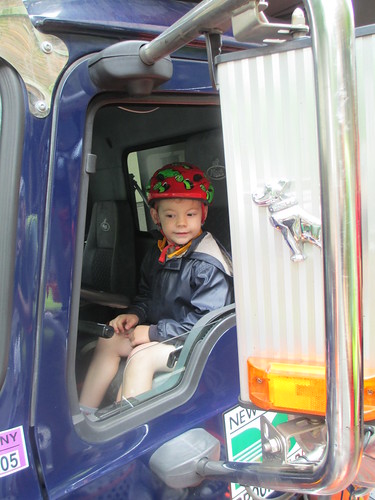
The Invisible Visible Boy on a truck
meant to show cyclists how hard they are
to see. Let's hope New York's DoT trains
its drivers in spotting cyclists too.
Yet commenters on online news reports about the death homed in instead on police reports that Noshat had his hood up and was looking down when hit. There was abuse for his parents. One commenter said Noshat must have been looking for “suicide by truck”.

Noshat’s death is at least the 11th of a pedestrian under 13 so far this year in New York. Many people’s instinctive reaction has been to blame the victims.

In November, I attended a rally in Fort Greene, Brooklyn, calling for enforcement of traffic laws after a speeding driver killed Lucian Merryweather, nine, on a sidewalk. The rally heard a brave and heartbreaking speech from the mother of Samuel Cohen Eckstein, 12, who died in October when a car hit him on a crosswalk on Prospect Park West in Brooklyn. She was speaking a few days after what should have been Samuel’s bar mitvah.

Many internet commenters on Samuel’s death focused on how he was hit after going after a ball that had bounced into the street. They ignored how he had the light when he entered the crosswalk. Several cars stopped for him before a speeding van hit him.
 
A memorial where Lucian Merryweather died. I'd love
to take half the internet commenters on road safety
to this unspeakably sad spot.
The father of Allison Liao, three, who was killed in October crossing the street in Flushing, Queens, looked on, weeping, as Samuel’s mother spoke. Initial reports on Allison’s death focused on how she had allegedly broken away while crossing the road from her grandmother, who was holding her hand. Yet Allison’s family insist she was holding her grandmother’s hand – and the driver who hit her barged through the crosswalk when he should have yielded.

The circumstances of Noshat’s death are very similar to those surrounding the death in East Harlem in February of Amar Diarassouba, a seven-year-old. He also died under a truck’s rear wheels as he headed to school. Erik Mayor, a restaurateur whose business is near the crash site, despicably tried to blame that crash on Amar’s older brother, saying he “wasn’t paying attention.” The driver involved had, as in other cases, driven through a crosswalk when he should have yielded.

They’re stories that won’t surprise many adults who walk or cycle around New York City – or any other big city in the United States. When I cross streets on foot, vehicles constantly barge through crosswalks when I have the light in my favour. I have found myself caught unawares by the line a truck’s rear wheels have taken through a crosswalk and been forced to jump backwards out of the way.

On my bike, on the 1st Avenue bike lane in Manhattan, I need constantly to look over my shoulder at westbound cross-streets, knowing that cars will try to turn across my path. I have to signal forcefully to drivers to stop if they’re behaving dangerously. I need the sixth sense of the experienced urban cyclist to spot the vehicles that are about to pull out without looking from a parking space.

There’s an invidious assumption that, if children can’t at least match my skills at navigating streets, they shouldn’t be on the streets at all. The attitude is sometimes reminiscent of the sexual harassment that faces single women in some places in southern Europe. Anyone silly enough to enter the environment, it seems to be assumed, is fair game for any untoward consequences. A responsible parent, it’s  assumed, transports his or her children by car, prioritising their safety over that of others.
A cyclist on 55th Street in Manhattan. Remember: if
anything bad happens to a kid in this traffic,
it's probably the kid's fault.

Looked at dispassionately, however, the adults are behaving like stereotypical children. Many of my closest calls are with drivers who simply lose patience with waiting and pull out without looking from a traffic line. Most parents try to teach their children the kind of patience that drivers who drive while using their mobile telephones haven’t learned. Children are encouraged to face up to their responsibilities – yet many commercial trucking companies seem to employ unlicensed drivers. The police seem to shirk their duty to hold the worst drivers accountable.

I’ve come across plenty of children taking road rules far more seriously than many adults. The boy pedalling down Clinton St was paying far more attention to road conditions than most of the motorists. Esme Bauer, a young woman from Fort Greene, was one of the most powerful speakers at the rally I attended in November.

Many of the adults seem to be products of recent decades when parents feared to teach their children to navigate the streets. Having grown up with parents scared to let them out on the streets, they now sit, sucking their teeth, in their cars. Why, they wonder, are these children wandering about on the streets? What are their parents thinking?
 
New York needs more children commuting like this -
but will it take the steps to get them?
It’s a cycle that it’s obvious needs to be broken. Enforcement, road layout and general attitudes all need to improve to rebalance streets policy in favour of the pedalling boy commuter of Clinton St and away from the bad drivers around him.

It’s a question that goes far beyond transport policy, however. The disdain with which I saw some internet commenters react to Noshat’s death toppled over, it seemed to me, into expressing a generalised contempt for the weak and powerless. It’s an ugly attitude at the best of times. In this case, it was being expressed the week before Christmas about a young Bangladeshi immigrant crushed by a truck as he headed to take part in his public school’s holiday play.

In a city where someone can accuse such a young man of wanting “suicide by truck,” I’m tempted to conclude that New York’s transport problems are, perhaps, only a symptom – albeit a serious one – of a wider social malaise.