I’ve come across few sights on New York City streets that excited such mixed feelings in
me as the one I encountered one morning last month on Clinton Street in Brooklyn Heights New York City on the road.
I was, on one level, hugely
excited. It would be an enormous improvement for every city in the
industrialised world if the queues outside schools in the morning were of
children waiting to park their bikes, not sports utility vehicles waiting to
double-park. The boy had clearly been thoroughly trained and looked attentively
from side to side at every junction.
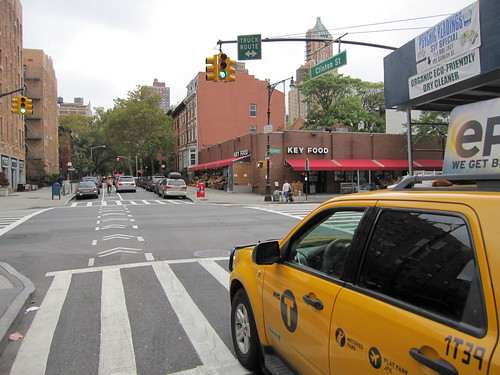 |
| Clinton St at Atlantic Avenue: I was excited to see a child cycling here - but also apprehensive |
But I also, I’ll confess, felt
fearful. Motorists are apt to turn left or right suddenly on Clinton St or lurch into the cycle lane
to avoid a suddenly-stopped taxi.
Drivers are prone to driving through the slow-moving traffic texting or
sending emails. Car doors are apt to spring open or pedestrians to step into
the street without looking. Knowing my own concerns about using the street, I willed
the young man to make it to school safely. He eventually did.
That young boy’s been back in my
mind since I heard on Friday about another boy going to school elsewhere in New York who didn’t make
it safely.
On Friday morning, Mauricio
Osorio-Palaminos, a truck driver, drove his truck out of 61st street
in Queens left onto Northern Boulevard, cut well onto the side of the street
for oncoming traffic and caught Noshat Nahian, eight, with the trailer’s rear wheels. Noshat, who was hurrying to school with his 11-year-old sister, died
shortly afterwards in hospital.
The street Osorio-Palaminos was
leaving was not, as far as I can tell, a designated truck route. Pictures
showed his truck far over to the wrong side of the road. The driver was also
the second in recent weeks to kill a pedestrian in New York City while driving commercially with
a suspended licence.
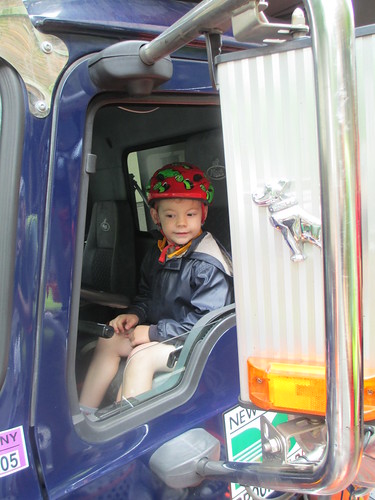 |
| The Invisible Visible Boy on a truck meant to show cyclists how hard they are to see. Let's hope New York's DoT trains its drivers in spotting cyclists too. |
Yet commenters on online news
reports about the death homed in instead on police reports that Noshat had his
hood up and was looking down when hit. There was abuse for his parents. One commenter
said Noshat must have been looking for “suicide by truck”.
Noshat’s death is at least the 11th
of a pedestrian under 13 so far this year in New York . Many people’s instinctive reaction
has been to blame the victims.
In November, I attended a rally in
Fort Greene ,
Brooklyn , calling for enforcement of traffic
laws after a speeding driver killed Lucian Merryweather, nine, on a sidewalk. The rally heard a brave and heartbreaking speech
from the mother of Samuel Cohen Eckstein, 12, who died in October when a car
hit him on a crosswalk on Prospect Park West in Brooklyn .
She was speaking a few days after what should have been Samuel’s bar mitvah.
Many internet commenters on Samuel’s
death focused on how he was hit after going after a ball that had bounced into
the street. They ignored how he had the light when he entered the crosswalk. Several
cars stopped for him before a speeding van hit him.
 |
| A memorial where Lucian Merryweather died. I'd love to take half the internet commenters on road safety to this unspeakably sad spot. |
The father of
Allison Liao, three, who was killed in October crossing the street in Flushing,
Queens , looked on, weeping, as Samuel’s mother
spoke. Initial reports on Allison’s death
focused on how she had allegedly broken away while crossing the road from her
grandmother, who was holding her hand. Yet Allison’s family insist she was
holding her grandmother’s hand – and the driver who hit her barged through the
crosswalk when he should have yielded.
The circumstances of Noshat’s
death are very similar to those surrounding the death in East
Harlem in February of Amar Diarassouba, a seven-year-old. He also died under a truck’s rear
wheels as he headed to school. Erik Mayor, a restaurateur whose business is near the
crash site, despicably tried to blame that crash on Amar’s older brother,
saying he “wasn’t paying attention.” The driver involved had, as
in other cases, driven through a crosswalk when he should have yielded.
They’re stories that won’t
surprise many adults who walk or cycle around New York City
– or any other big city in the United
States . When I cross streets on foot, vehicles
constantly barge through crosswalks when I have the light in my favour. I have
found myself caught unawares by the line a truck’s rear wheels have taken
through a crosswalk and been forced to jump backwards out of the way.
On my bike, on the 1st Avenue
bike lane in Manhattan ,
I need constantly to look over my shoulder at westbound cross-streets, knowing
that cars will try to turn across my path. I have to signal forcefully to drivers
to stop if they’re behaving dangerously. I need the sixth sense of the
experienced urban cyclist to spot the vehicles that are about to pull out
without looking from a parking space.
There’s an invidious assumption
that, if children can’t at least match my skills at navigating streets, they
shouldn’t be on the streets at all. The attitude is sometimes reminiscent of
the sexual harassment that faces single women in some places in southern Europe . Anyone silly enough to enter the environment, it
seems to be assumed, is fair game for any untoward consequences. A responsible
parent, it’s assumed, transports his or
her children by car, prioritising their safety over that of others.
 |
| A cyclist on 55th Street in Manhattan. Remember: if anything bad happens to a kid in this traffic, it's probably the kid's fault. |
Looked at dispassionately,
however, the adults are behaving like stereotypical children. Many of my
closest calls are with drivers who simply lose patience with waiting and pull
out without looking from a traffic line. Most parents try to teach their
children the kind of patience that drivers who drive while using their mobile
telephones haven’t learned. Children are encouraged to face up to their
responsibilities – yet many commercial trucking companies seem to employ
unlicensed drivers. The police seem to shirk their duty to hold the worst
drivers accountable.
I’ve come across plenty of
children taking road rules far more seriously than many adults. The boy
pedalling down Clinton St
was paying far more attention to road conditions than most of the motorists.
Esme Bauer, a young woman from Fort
Greene
Many of the adults seem to be
products of recent decades when parents feared to teach their children to
navigate the streets. Having grown up with parents scared to let them out on the
streets, they now sit, sucking their teeth, in their cars. Why, they wonder,
are these children wandering about on the streets? What are their parents
thinking?
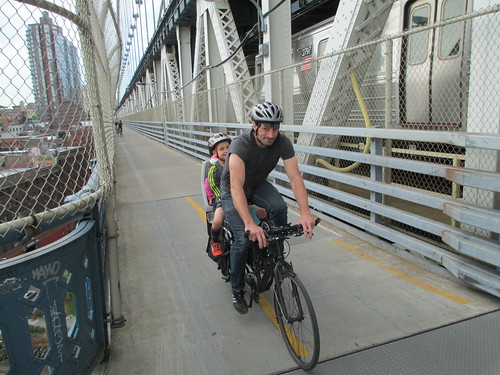 |
| New York needs more children commuting like this - but will it take the steps to get them? |
It’s a cycle that it’s obvious
needs to be broken. Enforcement, road layout and general attitudes all need to
improve to rebalance streets policy in favour of the pedalling boy commuter of Clinton St and away
from the bad drivers around him.
It’s a question that goes far
beyond transport policy, however. The disdain with which I saw some internet
commenters react to Noshat’s death toppled over, it seemed to me, into
expressing a generalised contempt for the weak and powerless. It’s an ugly
attitude at the best of times. In this case, it was being expressed the week
before Christmas about a young Bangladeshi immigrant crushed by a truck as he headed
to take part in his public school’s holiday play.
In a city where someone can accuse
such a young man of wanting “suicide by truck,” I’m tempted to conclude that
New York’s transport problems are, perhaps, only a symptom – albeit a serious
one – of a wider social malaise.
