Showing posts with label Lucian Merryweather. Show all posts

Monday, 23 December 2013

A Brooklyn Heights commuter, an untimely Queens death - and how attitudes to roads might be the least of our problems

I’ve come across few sights on New York City streets that excited such mixed feelings in me as the one I encountered one morning last month on Clinton Street in Brooklyn Heights. Just in front of me in the cycle lane on the street, which fills up with cars and taxis every morning, was the only child – he was probably ten or 11 – I’ve ever encountered riding on his own to school in New York City on the road.

I was, on one level, hugely excited. It would be an enormous improvement for every city in the industrialised world if the queues outside schools in the morning were of children waiting to park their bikes, not sports utility vehicles waiting to double-park. The boy had clearly been thoroughly trained and looked attentively from side to side at every junction.
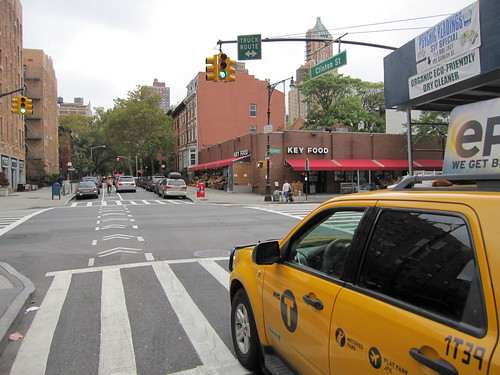
 
Clinton St at Atlantic Avenue: I was excited to see a child
cycling here - but also apprehensive
But I also, I’ll confess, felt fearful. Motorists are apt to turn left or right suddenly on Clinton St or lurch into the cycle lane to avoid a suddenly-stopped taxi.  Drivers are prone to driving through the slow-moving traffic texting or sending emails. Car doors are apt to spring open or pedestrians to step into the street without looking. Knowing my own concerns about using the street, I willed the young man to make it to school safely. He eventually did.

That young boy’s been back in my mind since I heard on Friday about another boy going to school elsewhere in New York who didn’t make it safely.

On Friday morning, Mauricio Osorio-Palaminos, a truck driver, drove his truck out of 61st street in Queens left onto Northern Boulevard, cut well onto the side of the street for oncoming traffic and caught Noshat Nahian, eight, with the trailer’s rear wheels. Noshat, who was hurrying to school with his 11-year-old sister, died shortly afterwards in hospital.

The street Osorio-Palaminos was leaving was not, as far as I can tell, a designated truck route. Pictures showed his truck far over to the wrong side of the road. The driver was also the second in recent weeks to kill a pedestrian in New York City while driving commercially with a suspended licence.
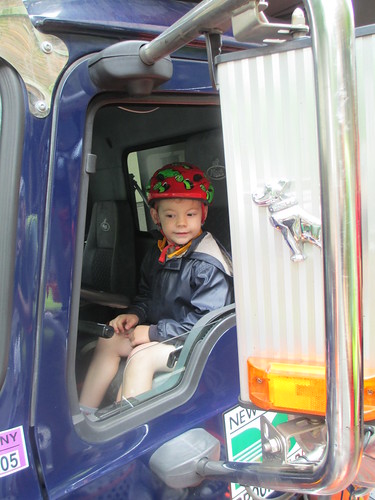
 
The Invisible Visible Boy on a truck
meant to show cyclists how hard they are
to see. Let's hope New York's DoT trains
its drivers in spotting cyclists too.
Yet commenters on online news reports about the death homed in instead on police reports that Noshat had his hood up and was looking down when hit. There was abuse for his parents. One commenter said Noshat must have been looking for “suicide by truck”.

Noshat’s death is at least the 11th of a pedestrian under 13 so far this year in New York. Many people’s instinctive reaction has been to blame the victims.

In November, I attended a rally in Fort Greene, Brooklyn, calling for enforcement of traffic laws after a speeding driver killed Lucian Merryweather, nine, on a sidewalk. The rally heard a brave and heartbreaking speech from the mother of Samuel Cohen Eckstein, 12, who died in October when a car hit him on a crosswalk on Prospect Park West in Brooklyn. She was speaking a few days after what should have been Samuel’s bar mitvah.

Many internet commenters on Samuel’s death focused on how he was hit after going after a ball that had bounced into the street. They ignored how he had the light when he entered the crosswalk. Several cars stopped for him before a speeding van hit him.
 
A memorial where Lucian Merryweather died. I'd love
to take half the internet commenters on road safety
to this unspeakably sad spot.
The father of Allison Liao, three, who was killed in October crossing the street in Flushing, Queens, looked on, weeping, as Samuel’s mother spoke. Initial reports on Allison’s death focused on how she had allegedly broken away while crossing the road from her grandmother, who was holding her hand. Yet Allison’s family insist she was holding her grandmother’s hand – and the driver who hit her barged through the crosswalk when he should have yielded.

The circumstances of Noshat’s death are very similar to those surrounding the death in East Harlem in February of Amar Diarassouba, a seven-year-old. He also died under a truck’s rear wheels as he headed to school. Erik Mayor, a restaurateur whose business is near the crash site, despicably tried to blame that crash on Amar’s older brother, saying he “wasn’t paying attention.” The driver involved had, as in other cases, driven through a crosswalk when he should have yielded.

They’re stories that won’t surprise many adults who walk or cycle around New York City – or any other big city in the United States. When I cross streets on foot, vehicles constantly barge through crosswalks when I have the light in my favour. I have found myself caught unawares by the line a truck’s rear wheels have taken through a crosswalk and been forced to jump backwards out of the way.

On my bike, on the 1st Avenue bike lane in Manhattan, I need constantly to look over my shoulder at westbound cross-streets, knowing that cars will try to turn across my path. I have to signal forcefully to drivers to stop if they’re behaving dangerously. I need the sixth sense of the experienced urban cyclist to spot the vehicles that are about to pull out without looking from a parking space.

There’s an invidious assumption that, if children can’t at least match my skills at navigating streets, they shouldn’t be on the streets at all. The attitude is sometimes reminiscent of the sexual harassment that faces single women in some places in southern Europe. Anyone silly enough to enter the environment, it seems to be assumed, is fair game for any untoward consequences. A responsible parent, it’s  assumed, transports his or her children by car, prioritising their safety over that of others.
A cyclist on 55th Street in Manhattan. Remember: if
anything bad happens to a kid in this traffic,
it's probably the kid's fault.

Looked at dispassionately, however, the adults are behaving like stereotypical children. Many of my closest calls are with drivers who simply lose patience with waiting and pull out without looking from a traffic line. Most parents try to teach their children the kind of patience that drivers who drive while using their mobile telephones haven’t learned. Children are encouraged to face up to their responsibilities – yet many commercial trucking companies seem to employ unlicensed drivers. The police seem to shirk their duty to hold the worst drivers accountable.

I’ve come across plenty of children taking road rules far more seriously than many adults. The boy pedalling down Clinton St was paying far more attention to road conditions than most of the motorists. Esme Bauer, a young woman from Fort Greene, was one of the most powerful speakers at the rally I attended in November.

Many of the adults seem to be products of recent decades when parents feared to teach their children to navigate the streets. Having grown up with parents scared to let them out on the streets, they now sit, sucking their teeth, in their cars. Why, they wonder, are these children wandering about on the streets? What are their parents thinking?
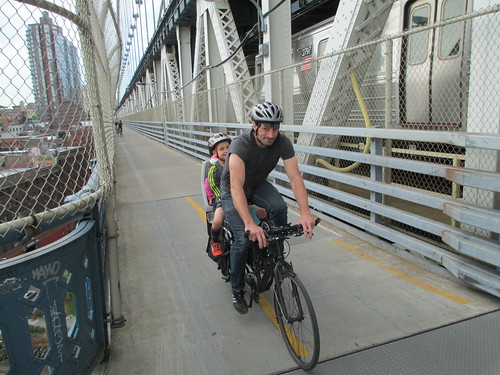
 
New York needs more children commuting like this -
but will it take the steps to get them?
It’s a cycle that it’s obvious needs to be broken. Enforcement, road layout and general attitudes all need to improve to rebalance streets policy in favour of the pedalling boy commuter of Clinton St and away from the bad drivers around him.

It’s a question that goes far beyond transport policy, however. The disdain with which I saw some internet commenters react to Noshat’s death toppled over, it seemed to me, into expressing a generalised contempt for the weak and powerless. It’s an ugly attitude at the best of times. In this case, it was being expressed the week before Christmas about a young Bangladeshi immigrant crushed by a truck as he headed to take part in his public school’s holiday play.

In a city where someone can accuse such a young man of wanting “suicide by truck,” I’m tempted to conclude that New York’s transport problems are, perhaps, only a symptom – albeit a serious one – of a wider social malaise.

Tuesday, 5 November 2013

A Fort Greene tragedy, London's missing road dead - and why New York's mayoral election matters

The Saturday before last, facing a day of boring but necessary chores, I persuaded my family that we could alleviate the tedium by going for lunch in Fort Greene, one of my favourite bits of Brooklyn. After I’d cycled there and everyone else had taken the G Train, we settled on eating in Black Iris, a middle eastern restaurant at the corner of DeKalb and Clermont Avenues. We ate looking out on the mixture of brownstone houses and fashionable businesses that makes Fort Greene such a likeable part of the city.
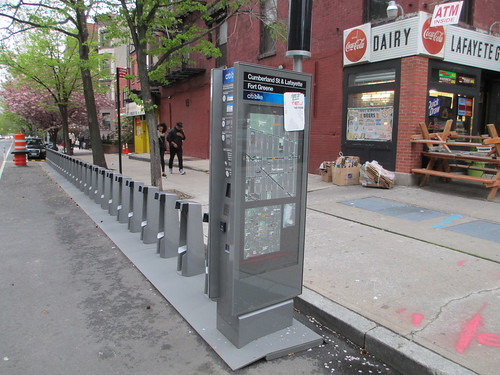
A bikeshare station near the site of Saturday's tragedy:
shamefully, where to position these stations has generated
far more debate in Fort Greene than the threat posed
by deadly drivers

I found myself looking at some of the same scenes again this past Saturday, in far less happy circumstances. Returning home from a bike ride with the children, I spotted on Twitter pictures of a pharmacy that I realised was diagonally opposite Black Iris. Next to it was a Ford sports utility vehicle on the sidewalk, with sheets covering a body and police tape cordoning off the scene.

Some poking around revealed that, around 12.45pm, a driver had crashed his SUV through the front of Black Iris – no doubt as diners like us tucked into the grilled meats and Mediterranean pizzas that our family had enjoyed a week before. After hitting the restaurant, the driver, Anthony Byrd, reversed at speed, made a U-Turn, swerved, hit some cars on the other side of the street by the pharmacy, mounted the sidewalk and hit a mother and her two boys. The sheet was covering the body of Lucian Merryweather, a nine-year-old, crushed on the sidewalk by the pharmacy. His five-year-old brother is in hospital. Byrd also hit a pedestrian in a crosswalk.
 
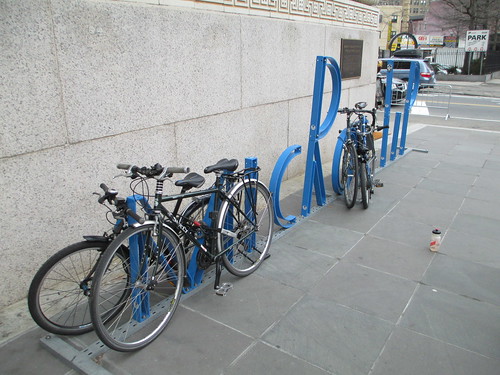
The Invisible Visible Family's bikes visit the Brooklyn
Academy of Music on a previous Fort Greene trip
It’s the kind of incident that ought – as multiple-victim public shootings once were – to be shocking, garner exceptional media attention and be fully investigated for lessons. But it’s actually depressingly routine. A Streetsblog post from September suggests that cars mounting sidewalks have already killed at least nine pedestrians so far this year in the city. Those figures don’t include Sian Green, the British tourist whose leg was severed in August when a taxi driver mounted the sidewalk while trying to ram a cyclist. Nor do they include Michael Gomez, who died of an asthma attack a few days after he was one of several children hit in Queens when a driver mounted a sidewalk.

Much coverage of these events has focused on their individual, exceptional circumstances and the culpability or otherwise of the drivers – and sometimes even the victims – involved. The attitude of New York's police has been reminiscent of the fatalism of some Hungarians when I lived in Budapest about the country's shortcomings. “Hat, mindenhol a vilagban (Well, everywhere in the world)” they would say over problems that were objectively, verifiably much worse in Hungary than elsewhere.

The folly of that complacency was exposed on Friday from the other side of the Atlantic when Transport for London published its annual health, safety and the environment report. The report – which was given a rough reception because it suggested safety for some categories of road user was falling - showed that 134 people died on London’s roads in 2012. That’s less than half the 271 who died on New York’s streets the same year, in a city with roughly the same population and traffic flows. New York killed more pedestrians in 2012 – 135 – than died on all modes of transport on London’s streets.
 
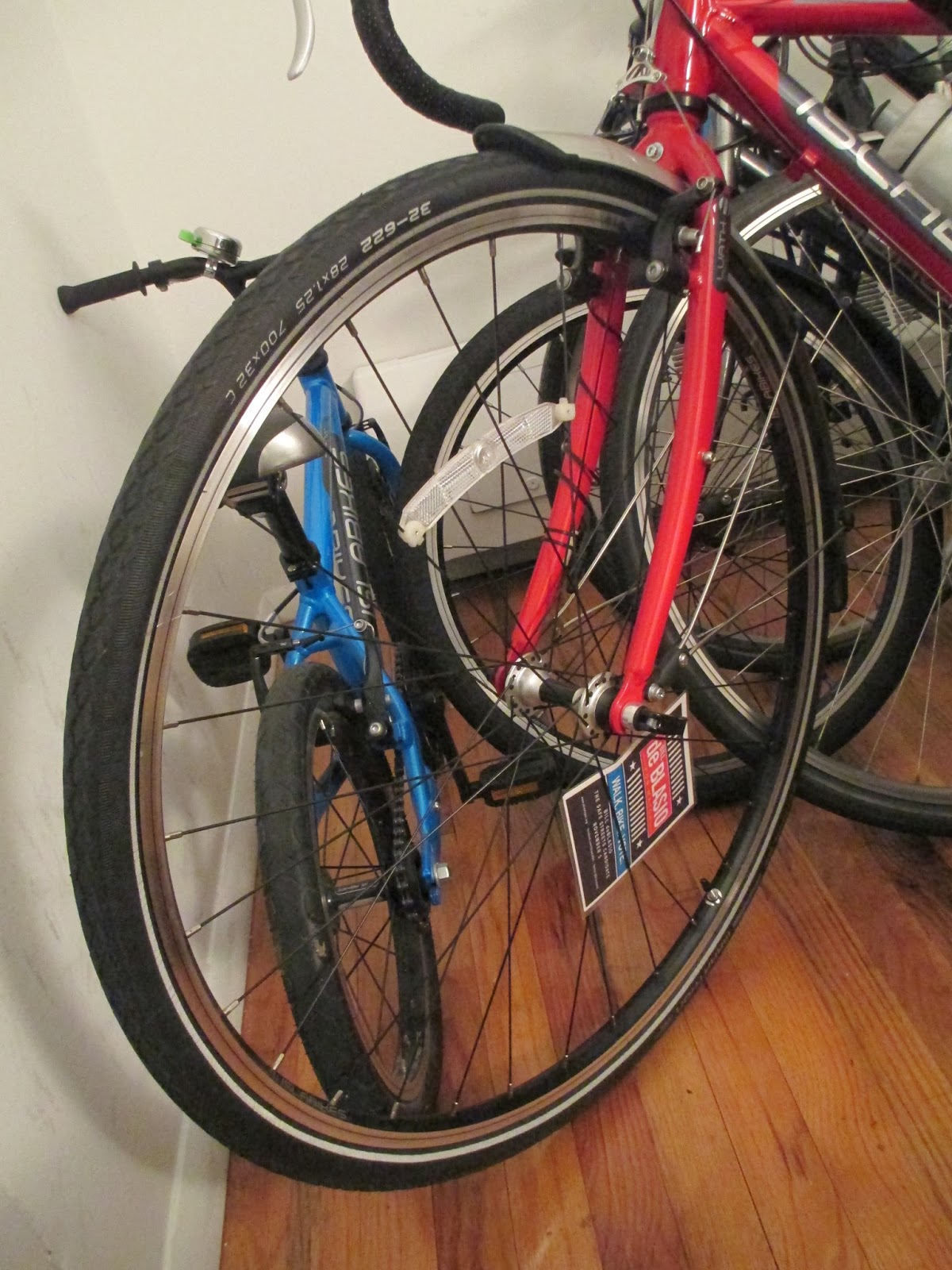
The Invisible Visible Girl's bike with its
Vote deBlasio spoke card. If any of us had
a US vote, we'd choose him, we promise.
Although it’s tragically too late for Lucian, New York this week has a chance of making a new start on road safety issues. The day after our visit to Fort Greene, our family emerged from church to find our bikes had been festooned with spoke cards suggesting we vote in the mayoral election – this Tuesday, November 5 – for Bill de Blasio, the Democratic candidate. During the Democratic primary, de Blasio loudly proclaimed his support for Vision Zero, a policy that targets eliminating city road deaths entirely.

If deBlasio does go for the systematic casualty-reduction technique of Vision Zero, it should, I think, prove far easier than anyone expects to bring down New York’s deaths to levels far closer to London’s. London’s figures, after all, are achieved in a city where some vehicles still speed, where the police response to many road incidents is grossly inadequate and where the poor design of parts of the mayor’s hurriedly-introduced cycling network has led to a series of appalling deaths. On the most basic levels in London, I suspect the superiority of its road safety record is down to drivers’ reasonable expectation that a speed camera will catch them if they speed, to the calming effect on traffic of the central London congestion charge and a total ban on vehicles’ turning through crosswalks when pedestrians have a green light.

There is also, I suspect, an effect of the reduced politicisation of policy-making compared with the US. The UK’s independent civil service tradition ensures that many of the senior officials grappling with road safety issues in London are the same people who have dealt with them for many years. There is less need to make the big policy splash that mayors in big North American cities crave when introducing an initiative. That civil service’s tradition is to work by producing dull, practical reports and recommending policy solutions mainly on a practical basis, often by formal cost-benefit analyses. A small group of officials, I suspect, will have had charge of producing TfL’s health, safety and the environment report. Their job prospects, I suspect, are closely tied to the health of the city’s road culture. It’s probably no coincidence that introduction of the poorly-designed Cycle Superhighways - one of London's worst-designed policies - is among those most closely associated with an individual politician.

In New York's case, it’s hard to imagine a man capable of running a slick election campaign can’t – if he’s willing – introduce fairly quickly policies to bring the city's road safety practices closer to London’s. Ideally, he'll choose somewhere still more safe.

It's a comparison of which I know the presumed mayor is aware. I saw him one morning campaigning outside my son’s school and forcefully told him about it. “I moved in August last year from London,” I said. “It has 100 fewer road deaths annually, with around the same population.”
Me and Bill deBlasio: I hope he remembers what I said
and wasn't too busy thinking, "Why is this strange man
shouting at me and gesticulating so hard?"

A picture that another parent took shows the candidate and his staff looking a little taken aback at the vehemence of my point-making. De Blasio’s body language looks a little defensive. There have been signs – including some remarks about pedestrian plazas in a debate that suggest an only partially-digested sense of his policy’s implications. The candidate nevertheless mentioned his support for Vision Zero when I spoke to him and trumpeted his Streetspac endorsement.

I remain nervous, nevertheless. I can only hope in light of the Merryweather family's appalling grief over a young life wasted that my parting shot to the future mayor will prove prophetic.

“You can fix this,” I said, jabbing my hand towards his chest. “You can do it.”