Showing posts with label Bradley Wiggins. Show all posts

Sunday, 7 June 2015

A Twitter row, a gospel passage - and why victim-blaming keeps coming back

It’s not, I accept, a common outcome to a row on social media. But, as I was cycling home on May 20 past downtown Brooklyn’s Roman Catholic Cathedral, my mind turned from a row I’d been having on Twitter with Rory Lancman, a New York city council member, to the New Testament. Specifically, I thought about an incident in the 9th chapter of the Gospel ofJohn.
 
Jay St: not an obvious place, I accept, to start pondering
the Gospel of John
The passage came to mind because Councilman Lancman wants to amend key provisions of the council’s Right of Way law, passed last year. The amendments would shift from the driver to police and prosecutors the burden for proving violations of the law were avoidable. That would make it far harder to use the law for its intended purpose of charging drivers who hit pedestrians and cyclists who have the right of way. The councilman’s arguments to my mind suggest he thinks there are cases where motorists strike vulnerable road users acting legally and the crash is still ultimately somehow the vulnerable road user’s fault.

John Chapter 9 is a reminder of how long human beings have been battling that same instinct to assume people nearly always bring their misfortune on themselves. It details an encounter between Jesus and his disciples and a man born blind. The disciples assume the man must be suffering because of some wrongdoing either on his own or his parents’ part.

The efforts by Councilman Lancman and many others to shift the blame for crashes make far more sense, it seems to me, looked at in the context of millennia of instinctive victim-blaming than as a rational piece of public policy-making. The belief that victims deserve their fate continues to underlie thinking in a huge range of areas. While it clouds a huge amount of people’s thinking about road safety, it has still more invidious effects in thinking about class, race and, most obviously in the contemporary US, violence by the police. It is particularly invidious because it tends to be applied disproportionately to the powerless – the pedestrian or cyclist more than the motorist; the poor, unarmed black person killed by police more than the police officer.

“As Jesus went along, he saw a man blind from birth,” John Chapter 9 reads. “ His disciples asked him, ‘Rabbi, who sinned - this man or his parents - that he was born blind?’”

A crash I encountered on Friday: since it involved two
motor vehicles, Councilman Lancman is spared
the task of working out how to exonerate one party.
Councilman Lancman, of course, doesn’t accept my interpretation of his proposed amendments. He insists that his concern is a purely technical one – that the law passed last year is wrongly being interpreted as a “strict liability” law: that drivers are charged irrespective of the circumstances and their culpability in striking the victim of the crash. The police are wrongly failing before making arrests to analyse whether the crash was somehow unavoidable.

An email he sent to fellow council members explaining his proposed amendments, however, suggests he simply doesn't think drivers are truly to blame for many crashes.

“Adding a provision to the bill to require an analysis of due care will penalise drivers who hit pedestrians out of recklessness and gross negligence, while sparing drivers when accidents are caused by poor road conditions, bad weather and scofflaw pedestrians,” he wrote.

The email suggests strongly that many motorists who strike pedestrians and cyclists moving legally and with the right of way are somehow helpless victims either of circumstances on the roads or of the negligence of those they hit. Since it’s impossible that a pedestrian crossing the street with a walk signal can be crossing the street illegally, Councilman Lancman seems to be suggesting that, for example, a motorist might be let off charges for striking him or her if, say, the victim was talking on a mobile telephone.
Two pedestrians in this Meatpacking District crosswalk
are on their phones. That makes them fair game, right?

The email also suggests an entirely mistaken conception of a driver’s duty to exercise due care. In poor road conditions and bad weather, it’s a driver’s responsibility to drive more carefully. If a driver has blindspots, he has to compensate for them by looking more carefully. To assume that the vulnerable have to assume all the blame is to make a crude assumption that might is generally right.

The true obscenity of the councilman’s proposed amendment, meanwhile, is that it’s seeking to stamp out a “problem” that barely exists. According to Streetsblog, between the introduction of the Right of Way Law last August and the end of April, only 22 drivers had been charged under it, out of 8,000 collisions between motorists and pedestrians or cyclists. His proposed amendment would usher in a system where even that minuscule number of prosecutions would inevitably fall to nearly zero. It is no comfort at all that the councilman's proposed amendment and some other recent legislation aimed at gutting the Right of Way Law seem to be aimed at ensuring that more members of Transport Workers' Union Local 100, which represents New York bus drivers, escape arrest when they hit pedestrians.

It’s hardly as if, after all, there isn’t already a firmly-established paradigm in the heads of police officers and district attorneys that pedestrians and cyclists bring their fates on themselves. On May 18, for example, a driver struck and killed John Torson, 89, at the corner of 1st Avenue and 61st Street on Manhattan’s Upper East Side and claimed that, while she had done her best to stop, he had “just hobbled into the middle of the street”. Extraordinarily, the New York Police Department appears to have accepted this improbable excuse for hitting a man of 89 who was crossing with the right of way. The NYPD let it be known that Mr Torson had been “crossing outside the marked crosswalk”. Pictures of the scene showed the car stopped only just beyond the crosswalk, suggesting that he must at least have been very close to the marked lines.

Mr Torson was killed only a few blocks from where a turning cab driver killed Amelia Sterental, 76, on May 9 at 60th Street and Madison Avenue. That crash – which also involved a turning driver and someone crossing the street with the walk signal - has yet to produce any charges either, suggesting that the police in that case have also found some improbable excuse for the driver’s negligence.

A van driver swings through a crosswalk
on Sixth Avenue. If he hits a pedestrian,
in many circumstances, Rory Lancman
will have his back
New means of suggesting pedestrians and cyclists bring their fate on themselves are constantly emerging and need to be slapped down, like some strange game of cultural whack-a-mole. One snowy morning in early 2014, I shouted at a cab driver who honked at me to try to get me out of a crosswalk. When he got out to confront me, I told him impatient driving like his explained the city’s poor road safety record. He asserted – even though I had not been using a phone – that pedestrians’ mobile phone use that explained the spike in crashes. I have seen abundant commentary recently on the risks of pedestrians' mobile phone use - and far less on the far greater danger posed by distracted drivers.

In the UK, Bradley Wiggins - for whose sporting achievements I feel the greatest respect - recently made the latest of a series of poorly-judged interventions on cycling safety to say cyclists "have to help themselves" by wearing "helmets and things". The Metropolitan Police shamefully failed to charge the driver who fatally hit Michael Mason on Regent’s Street because, although his bike was well lit, he was wearing neither a helmet nor high-visibility clothing. Most dispiritingly, I once had a lunch with a UK road safety minister who, when asked about cyclist safety, said cyclists were "their own worst enemies".

The persistence of such thinking is all the more extraordinary given the mental leaps that should be required to accept this narrative. Research regularly places the main blame for between two-thirds and 80 per cent of crashes involving vulnerable road users on the driver involved. Yet the victim-blaming narrative suggests cyclists and pedestrians either don’t know themselves to be vulnerable or consistently throw themselves in front of deadly, speeding vehicles heedless of the dangers.

The desperation to exonerate motorists reflects not only a desire to blame victims but to exculpate the powerful of wrongdoing. Last week, for example, after a driver mounted a sidewalk in Sunset Park, Brooklyn, and mowed down Oscar Chen, four, the police were quick to dismiss this appalling piece of driving as “just an accident”. The four-year-old was saved, to judge by videos, only by being by a tree – which fell over and protected him – when the vehicle hit him. The distasteful rush to exonerate contrasts sharply with the police’s desperation to accept the false account of Ahmad Abu-Zayedeha, the driver who killed three-year-old Allison Liao in a crosswalk in Queens in 2013. The driver said Allison had “broken away” from her grandmother while crossing the street – a version of events that subsequent evidence has shown to be entirely misleading. Allison's family are constituents of Rory Lancman's.

There are similar forces at work in the effort to vilify Tamir Rice, the 12-year-old killed last year by Cleveland Police, and make excuses for the police officers who killed him. It’s not too much of a stretch, I think, to see the victim-blaming, power-exonerating dynamic at work in much of recent decades’ US economic policy. The rich need the carrot of lower taxes if they’re to be persuaded to work harder. The poor need the stick of withdrawn benefits.

The victim-blaming narrative, after all, has huge implications. If we all primarily determine our own fate on the roads, there should be a presumption of minimal intervention by the police, prosecutors and licensing authorities in drivers’ freedom to do as they please. If, however, people’s fates depend predominantly on the behaviour of others, the presumption in favour of freedom should be significantly eroded.

It’s striking for how long these moral and intellectual battles have been fought and refought, however. In the Jewish scriptures, the book of Job recounts a man suffering a series of afflictions whose friends falsely assume his own wrongdoing has somehow brought them on him. In John Chapter 9, meanwhile, Jesus firmly rebukes his disciples.
 
Parking outside Brooklyn Basilica: how would Jesus park,
do you think?
“Neither this man nor his parents sinned,” he says.

The story in John has a far happier ending than many collisions on New York’s or London’s streets or between angry police officers and vulnerable African-Americans. Jesus says that the blind man is blind "so that the works of God might be displayed in him". That is, I accept, a problematical idea. But Jesus goes on to put mud on the man’s eyes and have him wash it off. Afterwards, he can see.

Such a moment of eye-opening doesn’t yet seem to have come to Councilman Lancman or many other policy-makers or law enforcement officials worldwide. It hasn’t, sadly, even come to some of my fellow contemporary followers of Christ. As I cycled home on May 31, a little over a fortnight after my row with Councilman Lancman, I headed as usual down Jay St past St James’s Cathedral. I came up short when I found the bike lane was blocked. People attending an event at the cathedral had arrived by car in large numbers and decided, entirely illegally, to park diagonally to the kerb, blocking the bike lane in both directions. Cyclists were forced out into a busy stream of rush-hour traffic, endangered to provide more convenient parking for the congregation.

It’s a casual example of the arrogance of the powerful against the weak. Were Jesus present on earth in the same sense as 2,000 years ago, there would, I’m sure, be issues that would cause him still more concern. But there's a moral responsibility to park a car - just as there is to move it - in a way that poses the least possible risk to others. When people undertake even such minor acts in a fashion so casually contemptuous of the interests of others, it strikes me as deeply at odds with the solicitude for others that Christian faith – or the true practice of Judaism, humanism or any truly ethical belief system – should inspire.

Sunday, 18 November 2012

My ride to work - and why the cars resemble little hurricanes

Very few of the runners, stroller-pushing parents, drunks and others who wander into my path each day on the cycle lane up New York’s Hudson River Greenway strike me as especially brilliant people. If they were, they might spot the signs telling them they’re not allowed on the path and stick to the rather pleasant waterside walkway that’s been provided for them.
The runner on the left has, remarkably, chosen the footpath on
the Hudson River Greenway. One can only hope she made
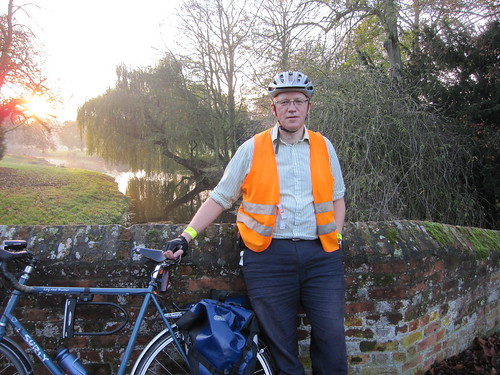
the kind of solid risk assessment the Invisible Visible Man advocates

But, disturbingly, the cycle lane obstructors (CLOs) seem to be better at prioritising the risks facing pedestrians than the head of the New York Police Department’s traffic squad. The CLOs have decided that, if they’re going to obstruct traffic, it’s many, many times safer to get in cyclists’ way than cars’. Having so far seen hundreds – possibly thousands – of CLOs in four months’ cycling in New York, I’ve yet to see one choosing to take his or her chances running down the fast-moving, multi-lane West Side Highway next to the cycle path.

Yet Brian McCarthy, a deputy chief of the NYPD with responsibility for traffic policing, explained in October to WNYC, the public radio station, why its ironically-named Operation Cycle Safe – the programme that focuses police resources on fining cyclists, rather than the road users that cause traffic deaths – was now mainly tackling riding on the sidewalk (pavement, British readers). This behaviour, he reasoned, posed particular dangers to pedestrians. But, while I can find no recent record of a cyclist’s killing a pedestrian on a New York City sidewalk, it is depressingly regular for motorists to do so through excessive speed or lack of attention. The NYPD barely ever prosecutes the motoring offences that lead to such deaths. Its prioritisation is so skewed that, for it to be correct, I should probably be spotting runners every morning taking their chances with speeding SUVs on the highway, away from the terrifying bicycles.

The contrast between the CLOs and Deputy Chief McCarthy illustrates something profound about the vagaries of human beings’ efforts to assess risks. Most humans are reasonably adept at spotting and assessing the most immediate dangers. It’s pretty clear even to a stupid, inconsiderate runner unconcerned about inconveniencing others that it’s less foolish to take the chance of a collision with a cyclist riding at 20mph than a motorist driving at 50mph (the West Side Highway speed limit is 35mph – fun fact that most motorists entirely ignore). Very few people, however, are good at assessing risks in an abstract context such as a decision about how to allocate police resources. The NYPD, as I pointed out in a previous post, hands out 5 per cent of its traffic violation tickets to cyclists, way out of proportion to cyclists’ roughly 1 per cent share of city traffic. But a cyclist last killed someone in New York City in March 2009 – and even that incident wasn’t on the sidewalk. Around 1,000 people have died in the time since at the hands of motor vehicles. A sober risk assessment aimed at bringing down the number of deaths in the city would target an entirely different set of behaviours.

The problem appears to be a widespread one. In the UK, newspaper reporting about the crash that injured Bradley Wiggins – one of my great heroes – ended up producing the same, predictable commentary claiming cyclists endanger pedestrians and, somehow, cars. That’s even though the Tour de France winner’s accident involved his colliding with a car that seems to have pulled out into his path from a filling station without looking. In other words, people started complaining on the basis of the kind of accident that happens quite a lot (one where a negligent motorist injures a cyclist) about things that hardly ever happen – accidents where cyclists hurt other road users.

The question is whether it’s possible to get better to get better at understanding the risks the roads and other places pose - and to start reacting to them more rationally.

A subway station closed for Hurricane Sandy. New York's subway
turned out to be better at assessing risk than many New Yorkers.
My mind’s been particularly drawn to risk assessment in the last three weeks because of events in my new home city. At the end of the week when superstorm Sandy hit New York, I took a trip to Staten Island to report on some of the damage there. Person after person told me they’d ignored the evacuation order for the area on the grounds that a previous hurricane last year – Hurricane Irene – had mostly turned out less damaging than expected. As the sea swept in and inundated their street, they found themselves cowering in their homes’ upper storeys, with waves lapping at the windows even there. A person died in the basement of one of the houses in the street I visited, electrocuted when he stepped into flood water that had electric current flowing through it. The storm was on an entirely different scale from Hurricane Irene.

That miscalculation, it seems to me, is of a piece with people’s miscalculations about road use. In both situations, people rely far too much on personal experience and the evidence of their own senses. In the run-up to the storm, it was clear that the city was very windy but not immediately obvious that the storm would cause historic levels of damage. To realise that, one had to pay attention to something one couldn’t see – the vast storm surge that forecasters were predicting that was preparing to push its way into New York Bay to flood large tracts of the city.

Many people assessing the risks of cycling, meanwhile, look at cyclists in traffic and conclude that the slender, unprotected machines among the big metal boxes are more vulnerable than most figures actually suggest them to be. They see a cyclist on a sidewalk and assume that his greater speed compared with the pedestrians makes him a significant risk to them. It only adds, it seems to me, to people’s irritation with cyclists that bikes are quiet and people tend to notice them only at the last minute. This seems certain to trigger the kind of last-minute, fight-or-flight response that must have been useful for vulnerable cavemen. It’s a far less reliable indicator than people think of the risks around in a complex, modern urban streetscape.

Most people have particular lacunae when it comes to rare events that pose catastrophic risks. A hurricane is precisely such an event. There are fine, hard-to-discern differences between a hurricane that will do little damage – as Hurricane Irene did – kill scores of people and do billions of dollars of damage – as superstorm Sandy did – and one that will kill many hundreds – as Hurricane Katrina did. It is far beyond a normal person’s gut instinct to discern which storms need special attention, yet ordinary people continue to use their gut instincts to assess how they should react.
The motorists are blocking the bike lane. The cyclist's too close to the cars.
And they'll probably all get away with the risks they're taking.

In a road context, the catastrophic events are crashes involving cars, buses and trucks. It’s so common to see motorists driving while ‘phoning, speeding, giving cyclists too little room and so forth that it’s easy to conclude that these behaviours are trivial and pose little risk. Many people compare them with the alarming experience of finding a cycle messenger rush past their nose on a pedestrian crossing and conclude that it’s the cyclist who poses the real danger. The truth is that each time a motorist drives too fast, drives while distracted or turns without looking for cyclists he or she is involved in profoundly risky behaviour – and it’s only the luck of the particular circumstances that divides the outcome from nothing at all and a multiple-fatality crash.

People are still more blind to their actions’ long-term consequences. Almost no-one sees a cyclist on a busy street and remembers that he or she is far less likely to die of heart disease or diabetes in several decades than the neighbouring motorist cursing him or her from the exercise-free cocoon of his or her motor car. The global warming that may be making hurricanes more frequent is a still more remote such risk.

None of this is to excuse stupid behaviour by cyclists. It’s worth stopping for red lights, giving pedestrians plenty of space and going the right way up one-way streets. It shows an example of good practice and avoids annoying one’s fellow citizens. I do my best to obey the rules.

But industries prone to catastrophic but rare risks – the nuclear power industry, for example, or railways – tackle them by looking for the near-misses and minor accidents that suggest people are indulging in risky behaviour. Police forces that hold off warning motorists about dangerous behaviour and minor accidents explicitly miss the chance to follow such a policy.

I at least can do my part. I accept that runners will bound into my path on the Hudson River Greenway and cycle at a speed and on a line that means I should avoid them. I know that cars sometimes sweep across even some lightly-used crossings on the route from angles that are hard to see. So I stop for those red lights as other cyclists and runners speed past me, no doubt thinking me an over-cautious worrier. I do my best to assess when I’ve done something foolish and to avoid repeating the mistake. I can only hope that, as New York and other cities start to grapple with a future made more complicated by extreme weather, far more of those around me start to give the matter the same consideration too.

Monday, 13 August 2012

Commuting, Racing - and the French col climb in our heads

For a week of the Invisible Visible Family’s recently-completed family holiday in France, I had the task every morning of going to fetch supplies of bread, croissants and other ingredients for a continental breakfast. Jumping aboard my bike, I’d sweep down a hill and around the series of turns that took the road through the nearby village. Hunched down on my drop handlebars, I was, of course, in my head leading some audacious breakaway on an etape of the Tour de France. I could almost see the smiles on the faces of the gap-toothed peasantry of Dampierre sur Boutonne lining the roads to cheer me on.
The chateau at Dampierre sur Boutonne: its townspeople
would have cheered the Invisible Visible Man on,
except that the race was only in his head.

But the illusion would quickly break down on the return journey as I ground my way back up the hill. A baguette would be protruding from a pannier bag and a load of jus d’orange and pains au raisin would be slowing me down. I felt again what I truly am – a person who gets about by bike, rather than a sportsman.

Following this year’s Tour de France and Olympics, there has been no shortage of opportunities for British cyclists to reflect on the links between our day-to-day cycling and how Bradley Wiggins rides a time trial or Chris Hoy attacks a track sprint. We’re engaged in many senses in entirely different activities. Bradley Wiggins and Chris Hoy shave their legs to achieve maximum aerodynamic efficiency. I cart around 10 kilos of spare weight just because I won’t lay off the beer in the evenings. It has nevertheless made me happier than perhaps any previous sporting result to see Bradley Wiggins – a cyclist intimately familiar with some of the same London roads that I have ridden so often – control so comprehensively the Tour de France. I couldn’t quite speak for choking up as I described to the Invisible Visible Woman how Chris Hoy from Edinburgh – a city whose streets I have cycled hundreds of times – had won the Olympic keirin.

The question is whether my reaction to British cyclists’ victories reflects anything at all in common between what we both do. Is cycling mainly a sport or just a way of getting about? Should it be mainly a sport or a way of getting about?

It’s worth stressing quite how miserably humiliating my efforts to coax my big, lumbering body into sporting activity have generally proved. I recall, for example, 30 years ago entering the back stroke at a Glasgow Boys’ Brigade swimming gala. It took my fellow competitors the same time to complete both lengths of the race as I did for my first. The difficulty in telling my back stroke from the thrashings of a drowning boy led one of the organisers to inquire after my wellbeing.

The Invisible Visible Man at play: does this honestly look to you
like a body that should be undertaking triathlons?
The swimming gala came back vividly to me when, a few years ago, a chirpy public relations man suggested that, since I was a keen cyclist, I should undoubtedly compete in triathlons, as he did. I also recalled how I had often accompanied my asthmatic and chronically obese classmates in the trailing group on my school year’s annual cross-country run. The run – which was sponsored - was perenially used to raise funding for a desperately-needed new drainage system for the school’s sports fields. Since the event was run mostly round said sports fields in the midst of a Glasgow winter, my group consisted predominantly of overweight, mud-spattered boys, many reaching for their asthma inhalers amid the gathering mid-afternoon gloom.

My automatic reaction when asked to participate in a sporting event is, in fact, to start feeling humiliated. That stems in part from an incident when a PE teacher taught me and my 12-year-old classmates how to throw a discus. We then each had a go to see which would go forward to the school sports day. Ever the optimist, I was convinced I could improve after my initial, laughable effort and put my hand up when the teacher asked if anyone wanted a second go. “Don’t waste your own and everyone else’s time,” he replied. I focused attention on the school choir and public speaking instead.

I should, in other words, be easy prey for the view - which I’ve seen expressed in the British Cyclists’ Touring Club magazine but which could equally apply to American cycling - that the focus on sport has been bad for cycling more widely. Visit a bike shop in Britain, so the argument goes, and most of the options on dipslay will have been designed primarily – with fancy gears, lightweight frames and no mudguards – to help people finish races more quickly than their rivals. According to this argument, there’d be more people cycling to work in Britain – or America – if the average bike shop resembled one in the Netherlands. They should be full of heavy, practical bikes with mudguards, upright riding positions and the gears hidden neatly inside the wheel hub. Cycling should be just a faster form of walking, proponents of this position sometimes suggest.

That view has the substantial merit that it explains why some sights I encounter as a commuter cyclist seem so absurd. Along the Hudson River Greenway in my new home in New York, I encounter many commuter cyclists engaging in the rough equivalent of driving a Formula 1 or Indy racing car to work. Perched on high-end road bikes costing thousands of dollars, they must end up splattered with muddy water when it rains and the bikes must suffer appalling damage from New York’s streets. It would be no surprise, after all, if it some New York road surfaces turned out to have been deliberately maintained by Nasa as test beds for new rovers destined for distant, crater-pocked planets.

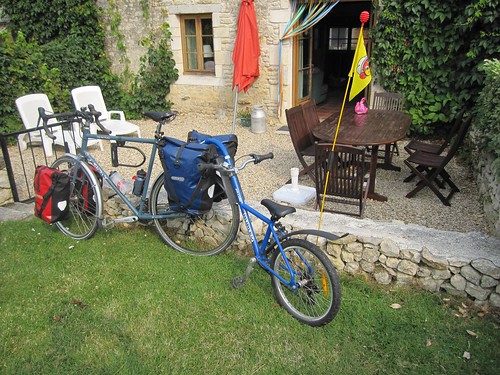
The Invisible Visible Man's bike, in France.
Sure, Bradley Wiggins, you can win the Tour de France.
But could you manage a load of four panniers,
a trailer bike and a four-year-old?
Yet, even for an ill-co-ordinated incompetent such as me, there remains far too much fun in riding a bike fast to reject the link with sport altogether. I can, after all, coax my touring bike into managing journeys in the countryside at an average of around 16mph (26kph) and can get up to around 50kph in favourable conditions. It’s not, I admit, much compared with Bradley Wiggins’ 49kph average for the whole Olympic time trial, but it gives me a sense of achievement. I even, in a moment to counterbalance the snarling of my school PE teachers, had the satisfaction four years ago of being complimented on my speed by a fellow cyclist. After I held off his efforts to overtake me for several miles of our joint commute home, he found me at some traffic lights and advised I try riding at the local velodrome. “You’ve got a fair turn of speed,” he said. If I can manage that, it seems sad to tell the many others with real sporting talent that they should be riding bikes incapable of a decent pace.

I’m sometimes baffled too by the idea that slow, Dutch-style bikes are a realistic option in the biggest cities. My new commute to work is around nine miles each way. Treat that as an opportunity for a slightly faster form of walking and I’ll be turning round to head home as soon as I arrive – for the few times I make the trip before they sack me.

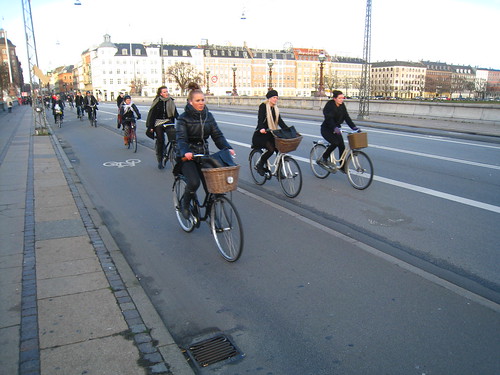
Bikes in Copenhagen: they're sensible, practical
- and barely any fun to ride at all
There isn’t, as far as I can see, much link between a country’s cycling sport success and its people’s propensity to use bikes for transport. Three of the countries with the most glittering records in the Tour de France – France, Italy and Spain – all have lower or similar proportions of journeys by bicycle than the scarcely cyclist-mobbed United Kingdom. The two countries with the highest cycling levels – Denmark and the Netherlands – have both produced distinguished riders in the Tour de France but have generally enjoyed less success in cycling sport than might be expected from the numbers riding a bike every day.

Nevertheless, I can’t help feeling that British cycling’s sporting success has to bring at least a small dividend for the country’s commuter cyclists. A few drivers may, perhaps, briefly regard cyclists not as worrisome obstacles to get past but future Victoria Pendletons or Laura Trotts whom they should respect instead of despising. I, like I suspect many other British cyclists, am holding my head a little higher – or perhaps lower, given the position’s superior aerodynamics – when cycling. I’m deeply proud to come from a country with such a powerful cycling sporting position.

It’s not, I suspect, the kind of benefit that many of Britain’s victorious cyclists were seeking when they underwent their years of painful training and conditioning. It is, however, one of many pleasures their achievements have given me. On behalf of every commuter who’s scaled an imaginary Col du Tourmalet while cycling to work, I salute them.