Showing posts with label motorists and cyclists. Show all posts

Sunday, 18 November 2012

My ride to work - and why the cars resemble little hurricanes

Very few of the runners, stroller-pushing parents, drunks and others who wander into my path each day on the cycle lane up New York’s Hudson River Greenway strike me as especially brilliant people. If they were, they might spot the signs telling them they’re not allowed on the path and stick to the rather pleasant waterside walkway that’s been provided for them.
The runner on the left has, remarkably, chosen the footpath on
the Hudson River Greenway. One can only hope she made
the kind of solid risk assessment the Invisible Visible Man advocates

But, disturbingly, the cycle lane obstructors (CLOs) seem to be better at prioritising the risks facing pedestrians than the head of the New York Police Department’s traffic squad. The CLOs have decided that, if they’re going to obstruct traffic, it’s many, many times safer to get in cyclists’ way than cars’. Having so far seen hundreds – possibly thousands – of CLOs in four months’ cycling in New York, I’ve yet to see one choosing to take his or her chances running down the fast-moving, multi-lane West Side Highway next to the cycle path.

Yet Brian McCarthy, a deputy chief of the NYPD with responsibility for traffic policing, explained in October to WNYC, the public radio station, why its ironically-named Operation Cycle Safe – the programme that focuses police resources on fining cyclists, rather than the road users that cause traffic deaths – was now mainly tackling riding on the sidewalk (pavement, British readers). This behaviour, he reasoned, posed particular dangers to pedestrians. But, while I can find no recent record of a cyclist’s killing a pedestrian on a New York City sidewalk, it is depressingly regular for motorists to do so through excessive speed or lack of attention. The NYPD barely ever prosecutes the motoring offences that lead to such deaths. Its prioritisation is so skewed that, for it to be correct, I should probably be spotting runners every morning taking their chances with speeding SUVs on the highway, away from the terrifying bicycles.

The contrast between the CLOs and Deputy Chief McCarthy illustrates something profound about the vagaries of human beings’ efforts to assess risks. Most humans are reasonably adept at spotting and assessing the most immediate dangers. It’s pretty clear even to a stupid, inconsiderate runner unconcerned about inconveniencing others that it’s less foolish to take the chance of a collision with a cyclist riding at 20mph than a motorist driving at 50mph (the West Side Highway speed limit is 35mph – fun fact that most motorists entirely ignore). Very few people, however, are good at assessing risks in an abstract context such as a decision about how to allocate police resources. The NYPD, as I pointed out in a previous post, hands out 5 per cent of its traffic violation tickets to cyclists, way out of proportion to cyclists’ roughly 1 per cent share of city traffic. But a cyclist last killed someone in New York City in March 2009 – and even that incident wasn’t on the sidewalk. Around 1,000 people have died in the time since at the hands of motor vehicles. A sober risk assessment aimed at bringing down the number of deaths in the city would target an entirely different set of behaviours.

The problem appears to be a widespread one. In the UK, newspaper reporting about the crash that injured Bradley Wiggins – one of my great heroes – ended up producing the same, predictable commentary claiming cyclists endanger pedestrians and, somehow, cars. That’s even though the Tour de France winner’s accident involved his colliding with a car that seems to have pulled out into his path from a filling station without looking. In other words, people started complaining on the basis of the kind of accident that happens quite a lot (one where a negligent motorist injures a cyclist) about things that hardly ever happen – accidents where cyclists hurt other road users.

The question is whether it’s possible to get better to get better at understanding the risks the roads and other places pose - and to start reacting to them more rationally.

A subway station closed for Hurricane Sandy. New York's subway
turned out to be better at assessing risk than many New Yorkers.
My mind’s been particularly drawn to risk assessment in the last three weeks because of events in my new home city. At the end of the week when superstorm Sandy hit New York, I took a trip to Staten Island to report on some of the damage there. Person after person told me they’d ignored the evacuation order for the area on the grounds that a previous hurricane last year – Hurricane Irene – had mostly turned out less damaging than expected. As the sea swept in and inundated their street, they found themselves cowering in their homes’ upper storeys, with waves lapping at the windows even there. A person died in the basement of one of the houses in the street I visited, electrocuted when he stepped into flood water that had electric current flowing through it. The storm was on an entirely different scale from Hurricane Irene.

That miscalculation, it seems to me, is of a piece with people’s miscalculations about road use. In both situations, people rely far too much on personal experience and the evidence of their own senses. In the run-up to the storm, it was clear that the city was very windy but not immediately obvious that the storm would cause historic levels of damage. To realise that, one had to pay attention to something one couldn’t see – the vast storm surge that forecasters were predicting that was preparing to push its way into New York Bay to flood large tracts of the city.

Many people assessing the risks of cycling, meanwhile, look at cyclists in traffic and conclude that the slender, unprotected machines among the big metal boxes are more vulnerable than most figures actually suggest them to be. They see a cyclist on a sidewalk and assume that his greater speed compared with the pedestrians makes him a significant risk to them. It only adds, it seems to me, to people’s irritation with cyclists that bikes are quiet and people tend to notice them only at the last minute. This seems certain to trigger the kind of last-minute, fight-or-flight response that must have been useful for vulnerable cavemen. It’s a far less reliable indicator than people think of the risks around in a complex, modern urban streetscape.

Most people have particular lacunae when it comes to rare events that pose catastrophic risks. A hurricane is precisely such an event. There are fine, hard-to-discern differences between a hurricane that will do little damage – as Hurricane Irene did – kill scores of people and do billions of dollars of damage – as superstorm Sandy did – and one that will kill many hundreds – as Hurricane Katrina did. It is far beyond a normal person’s gut instinct to discern which storms need special attention, yet ordinary people continue to use their gut instincts to assess how they should react.
The motorists are blocking the bike lane. The cyclist's too close to the cars.
And they'll probably all get away with the risks they're taking.

In a road context, the catastrophic events are crashes involving cars, buses and trucks. It’s so common to see motorists driving while ‘phoning, speeding, giving cyclists too little room and so forth that it’s easy to conclude that these behaviours are trivial and pose little risk. Many people compare them with the alarming experience of finding a cycle messenger rush past their nose on a pedestrian crossing and conclude that it’s the cyclist who poses the real danger. The truth is that each time a motorist drives too fast, drives while distracted or turns without looking for cyclists he or she is involved in profoundly risky behaviour – and it’s only the luck of the particular circumstances that divides the outcome from nothing at all and a multiple-fatality crash.

People are still more blind to their actions’ long-term consequences. Almost no-one sees a cyclist on a busy street and remembers that he or she is far less likely to die of heart disease or diabetes in several decades than the neighbouring motorist cursing him or her from the exercise-free cocoon of his or her motor car. The global warming that may be making hurricanes more frequent is a still more remote such risk.

None of this is to excuse stupid behaviour by cyclists. It’s worth stopping for red lights, giving pedestrians plenty of space and going the right way up one-way streets. It shows an example of good practice and avoids annoying one’s fellow citizens. I do my best to obey the rules.

But industries prone to catastrophic but rare risks – the nuclear power industry, for example, or railways – tackle them by looking for the near-misses and minor accidents that suggest people are indulging in risky behaviour. Police forces that hold off warning motorists about dangerous behaviour and minor accidents explicitly miss the chance to follow such a policy.

I at least can do my part. I accept that runners will bound into my path on the Hudson River Greenway and cycle at a speed and on a line that means I should avoid them. I know that cars sometimes sweep across even some lightly-used crossings on the route from angles that are hard to see. So I stop for those red lights as other cyclists and runners speed past me, no doubt thinking me an over-cautious worrier. I do my best to assess when I’ve done something foolish and to avoid repeating the mistake. I can only hope that, as New York and other cities start to grapple with a future made more complicated by extreme weather, far more of those around me start to give the matter the same consideration too.

Monday, 13 February 2012

Why no man is an island - even in his car


One day in 2001, I was standing by an intersection in Pristina, the monument to dingy Yugoslav urban design that serves as Kosovo’s capital. A souped-up saloon car squeezed inside a vehicle stopped by a set of traffic lights. Then, the moment the lights showed amber, the saloon car’s wheels screamed. It accelerated forward, then swung round in front of the other vehicle. The driver wanted to get ahead as the two cars turned left. The overtaking driver could easily have lost control of his vehicle and spun off the road; he could have hit the other driver as he swung round – and he moved himself only one place up a line of traffic that was probably just going to join a traffic jam further on.
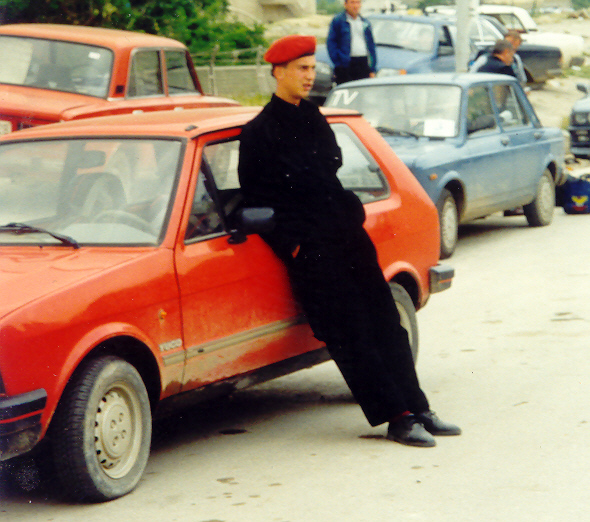
A KLA policeman: tellingly, not looking eager
to tackle Kosovo's traffic culture problem

The following year, I was cycling through the centre of Budapest, then my home city, when a car cut suddenly across my path. Shocked and thinking the driver might simply not have seen me, I slapped a side panel of his car. When the window wound down, the stream of words that issued started “a büdös anyád” (your stinking mother). A general tone thus established, the driver went on to suggest that I shouldn’t be on the road - and that he was well within his rights to act like a homicidal maniac.

The incidents in Pristina and Budapest helped to germinate the seed of an idea that was already planted in my mind. I began increasingly to pay close attention to what light the culture of a country’s roads shed on its wider society. It was illuminating precisely because, to people sitting inside cars, using a road often feels like a purely private enterprise. On busy roads, it is in fact one of the most complex social interactions many human beings undertake.

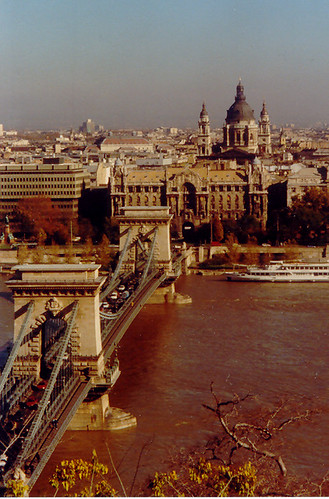
Budapest: beautiful - but one driver was
misinformed about my mother's personal hygiene
It perhaps wasn’t surprising that Kosovo’s road culture was fairly nihilistic. On a previous visit to Kosovo, shortly after the 1999 war, I had found a farm in western Kosovo whose courtyard was scattered with human ashes and bodies left for the dogs. According to local Albanians, it was the aftermath of a massacre by Serb forces. By the time I saw the bad driving just under two years later, most Kosovo Serbs had left either because of revenge attacks or the expectation of them. The callousness towards others and contempt for the rule of law that had marred Kosovo’s recent history carried straight over, it seemed to me, to how people drove.

Hungary was nothing like as damaged a society as Kosovo – despite the horrors of decades of first right-wing dictatorship and then Communism. But I would regularly report on the miserable living conditions of those who lived in dirty hovels on the edges of towns or run-down bits of Budapest – the country’s gypsies. My experience with the angry motorist – and the boorish tendency of drivers of the most powerful cars on the country’s motorways to drive at speeds that seriously endangered older, slower-moving cars – suggested vulnerable road users attracted similar contempt.

But in Hungary, Kosovo and many other long-misgoverned parts of the world, decades of misrule have discredited both the rule of law and any sense of a wider social good. In such societies, it became heroic to defy even good laws because those imposing them were so distrusted. The negative examples nevertheless suggest something about how road users should conduct themselves in healthier societies. Members of a well-ordered society abide not just by its agreed laws but also by the higher principle that they seek, as far as possible, to respect each other’s interests. They pay particular attention to the interests of the most vulnerable, who are least able to stand up for themselves. They restrain their exercise of their own rights to enhance others’ ability to enjoy theirs.

So we shouldn't be constantly worrying, it seems to me, what others might do to us if we break the rules or behave discourteously. We should all be thinking what our behaviour says about ourselves and our society. If we behave rudely or flout the rules, even if it does no direct harm, we tell those that see us that we are uninterested in their wellbeing. Every time we break road rules, we tell those that see us that we despise the rule of law generally. We’re slowly but surely corroding the bonds that ought to bind us together as a society – and as people who share the limited, precious space our society devotes to roads.

Those who regularly follow the developed world’s controversies over the role of cycling will by now think they know what’s coming. This could easily be the point where I start to bemoan the behaviour of some of my fellow cyclists, shaking my head metaphorically over how those that jump red lights, ride on pavements and so forth besmirch the good name of the rest of us.

My point is, I hope, a bit more subtle. To protect vulnerable road users, it's vital to pay most attention to the vehicles that do most harm. Politicians, police forces and journalists in many countries express outrage at cyclists’ alleged general disrespect for the law. But the less conspicuous law-breaking of motor vehicle drivers – the breaking of speed limits, the driving while distracted by a telephone and the contempt for measures meant to keep cyclists safe – kills thousands of people each year in most developed countries. Many motorists would be surprised how often their fellow motorists even ignore red lights - the failing often, in Britain at least, assumed to be particular to cyclists. I have twice narrowly avoided cars that were simply driving too fast to spot stop lights when I was heading across their paths. The depressing reluctance of many police forces to regard such behaviour as serious and criminal surely leaves vulnerable road users who try to stand up for their rights more exposed.

But there is no point pretending that some cyclists’ behaviour contributes nothing to the malaise. As I argued in a previous blog, cyclists generally harm no-one but themselves if they run red lights, ride on pavements or head the wrong way up a one-way street. Yet motorists or pedestrians seeing such behaviour must surely, to some extent, feel freer to disregard the rules or behave intolerantly themselves. Cyclists have so much potentially to gain from an improvement in road culture that it is surely worth each cyclist’s pondering which way his or her behaviour shifts the delicate balance between tolerance and intolerance on the roads.

It will not solve everything for cyclists to follow the rules. I have previously argued – and still believe – that much anti-cyclist behaviour stems from a simple irritation at cyclists’ choice of an obviously different way of doing things. I have also often been abused for alleged rule breaking when riding (perfectly properly) on on-pavement cycle paths or using one-way streets with a contraflow cycle lane. Some motorists fly into a rage at seeing a cyclist pulling ahead of them into the boxes that are meant to let cyclists leave traffic lights in most British cities ahead of the cars.

But there is a tendency on the part of all road user groups to criticise others for their failure to adhere to the fixed rules of the road – then make up their own minds which rules seriously apply to them. It is a system few people think appropriate with regard to the rules about assault or theft – and one that is no more appropriate about the rules for how people share the roads. Consequently, when I get on board my bike today, I will be looking out for - and trying to obey - traffic lights, one-way street signs and all the other myriad traffic symbols I see about me. It may not directly make my day better. It may not even make me directly safer. But it will reflect my conviction that, because my actions affect a far wider circle of people than myself, I have to respect the only commonly-agreed set of rules that we have.

Sunday, 29 January 2012

Why some people get angry with cyclists: and why it's time to do something about it

“What was the problem back there?” I asked the motorist who had sat behind my bike honking her horn. She said I’d been blocking the road. On a four-lane road, I pointed out, a cyclist riding a car door’s width from parked cars wasn't much of an obstruction. I also had as good a right as she to use the road. “You don’t pay road tax,” she answered. Roads were funded from general taxation, rather than a specific tax, I retorted – and, I added, no respectable transport economist believes motoring taxes cover all the costs of motoring pollution and other damage. As a higher-rate income tax payer, I was subsidising her driving. She changed tack. “F*** off back to Scotland,” she said – except that she didn’t use the stars.

A double provocation to the Angry Woman of Camberwell:
me, with my bike and still in England. While I am normally invisible,
sharp-eyed readers will spot me towards the centre of the bridge.
It would be tempting to describe my partner in this impromptu Socratic dialogue as typical of motorists in general – but unfair. There are, of course, many considerate, thoughtful motorists – it could hardly be otherwise in a decent, democratic country where cars account for the vast majority of personal journeys. But I have had enough ecounters with angry motorists – and read enough angry commentary from those exasperated with cyclists’ perceived shortcomings – to think that a sizeable minority share her feelings. I’ve seen no evidence attitudes elsewhere in the world are significantly different - and a fair amount that they’re much the same.

The woman’s mentioning of my ethnicity was suggestive. Cycling may be only a personal transport choice – but her attitude towards me as a cyclist seemed of a piece with her casual racism. Her comment about my going “back” also illustrated the dangers of jumping to conclusions about someone based on limited information. I was, despite my accent, born in west London. Even if one accepted the dubious idea that only Londoners should be in London, I probably had at least as strong a claim on citizenship of the Capital as the Angry Woman of Camberwell.

But the nature of some people’s feelings about cyclists is clear from what they write about us. In December 2007, Matthew Parris wrote in The Times that life in his village would be better if someone strung piano wire across the country lanes to decapitate passing cyclists. Cyclists, he said, were responsible for the litter found in local hedgerows because the litter was at cyclist, rather than runner, height. I’ve been trying ever since to work out how different a cyclist’s height is from a runner’s. Around the same time, a column in the Guardian – for which I can’t now find a precise reference – complained about cyclists in general and in particular their “pompous little plastic helmets”.

In September 2009, meanwhile, James Martin – a TV chef –wrote a car review for the Mail on Sunday of an electric sportscar. Having mentioned in the piece his irritation at the number of cyclists riding on the roads in his area, he wrote about how he had seen two cyclists ahead of him when driving the silent car. He had, he wrote, deliberately accelerated as he passed them - then honked the horn.

"The look of sheer terror as they tottered into the hedge was the best thing I've ever seen in my rear-view mirror,” he wrote.

Matthew Parris’s column, the Guardian piece, James Martin’s car review and Camberwell Motorist all seem to express an anger out of all proportions to the anger’s stated motive. I had delayed the woman by milliseconds from reaching the end of a traffic jam. Even if cyclists had been littering in Matthew Parris’s hedgerows, it’s hard to see death is a reasonable punishment. Helmets are no more capable of pomposity than any other inanimate object – the columnist who imagined it was expressing only his own rage. James Martin seemed content to describe himself committing a crime against cyclists for no other reason than that they were there and vulnerable.

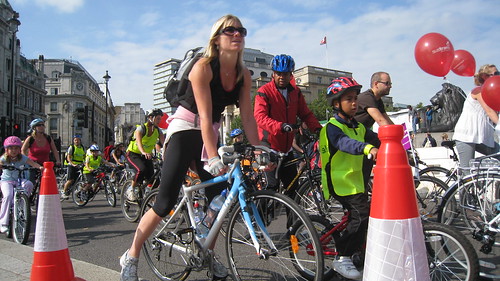
Thousands of cyclists at the 2009 London SkyRide:
decapitating them all would be messy -
but, according to Matthew Parris, fair
Parris and Martin subsequently half-apologised by saying their columns had been meant as jokes. What comfort one is meant to draw from the idea that Matthew Parris thinks it amusing to imagine cyclists being decapitated remains a mystery to me, however. I still wonder which other crimes against fellow citizens the conservative, bourgeois Mail on Sunday would have regarded it as a joke for one of its columnists to describe.

Such anti-cyclist anger reminds me in many ways of the feelings about gypsies that I would hear expressed when in lived in central Europe. In Hungary, people would tell me they disliked gypsies because they were lazy and dishonest. In Romania, some gypsy groups were unpopular because they were more successful than most Romanians, and built large, vulgar houses to show it. The truth was that gypsies – like, I would suggest, cyclists - were unpopular principally for being different.

Humans seem to feel a rage against those who get away with things they long to do – with the gypsies for seeming carefree and unconcerned about bourgeois norms, with gay men who flaunt their feminine side, with cyclists for skipping ahead of them to the front of the traffic queue. It would be wrong to claim that cyclists – mostly, in London, articulate, middle-class men - face anything like the problems that the perpetually victimised gypsies or blacks or gays face. But I think the instincts have a similar genesis.

None of this of course would matter much either if the sentiments expressed produced no real world consequences or if anything were being done to tackle the prejudices. Yet there are real-world consequences – and significant reluctance to tackle them.

Days after Matthew Parris’s Times column, I was cycling out of Hyde Park across Knightsbridge one Saturday, heading towards home. Seeing me heading towards a cycle-only section of road, a young man on the pavement aimed a punch at me. He then guffawed with his friends at how his gesture made me wobble. I met Ken Livingstone, the then mayor of London, a few days later when he announced plans for what is now the London Cycle Hire Scheme. I recounted my story and asked the mayor how he planned to stop such – fairly common – behaviour from putting new cyclists off. He brushed it aside. “Well, I’ve often felt like punching a journalist myself,” he droned, before launching into the story of a constituent who, in his days as a member of parliament, had been seriously injured when knocked down by a cyclist. Cyclists, he seemed to imply – against all the evidence – were the real menace.

As long as veteran left-wingers like London’s former mayor continue to make common cause with the worst parts of the right-wing press and the least reflective motorists on cyclists’ rights, cycling in London – and many other parts of the developed world – will remain an activity for the determined few. When it becomes as unthinkable to joke about cyclists deserving death as it rightly is about any other group, tempers on the roads might less easily get frayed.

Monday, 23 January 2012

The minister who made the Invisible Visible Man see red


It was the kind of reasoning you’d expect from someone who has spent so long trying to reconcile competing instincts and priorities that he’d lost all track of common sense. One summer several years ago, over lunch with a junior transport minister in the then UK government, I asked about the future of speed cameras - cameras for catching speeding motorists that his own government’s research showed saved more than a hundred lives every year. Putting on a serious voice and knitting his brows, the minister – who clearly disapproved of the official support for the cameras - told me that motorists were worried about speed cameras’ effectiveness because of the “regression to mean” effect. The effect describes how part of the fall in accidents at a given site after a camera’s installation is probably a statistical quirk, rather than a result of the camera’s presence.

I tried – but didn’t fully succeed – to control my irritation. I told the minister – forcefully – that in my experience far more motorists were simply worried about being caught speeding. They didn’t have intellectual doubts about speed cameras – they just thought they should be allowed to drive whatever speed they damn well pleased. The minister clearly didn’t think it was important to enforce speed limits.

Cyclists on Lower Thames Street, London Skyride 2009.
They're their "own worst enemies",  according to one minister -
yet they seem oblivious to the danger.
The minister’s understanding for rule-breaking motorists did not, however, extend to cyclists. I went on to ask what the government was doing to make roads safer for cyclists. “To be honest,” he replied, “I think cyclists are their own worst enemies”. I had little doubt I had much, much worse enemies on the roads than myself – and I had encountered several even during my short cycle ride to lunch. I nearly – but  didn’t quite – follow the inner urge to get myself out of the presence of someone who thought I wasn’t worth protecting. It would all have been less alarming if he hadn’t been the road safety minister.

The lunch was the moment when I started to realise how completely the thinking about road use of most people – even those who devote their days to deciding on road safety policy – comes from the gut, rather than the higher brain centres. The minister’s gut wanted to drive fast – I later discovered he had a number of convictions for speeding – and disliked cyclists. My gut, clearly, likes cycling and doesn’t care for driving. But I like to think my frontal cortex at least gets to review the gut’s decisions. I recognised – I still recognise – that lots of people need to drive, that motor vehicles are not about to stop being the main means of making most trips in the UK – or most other parts of the world – and that even the keenest cyclist has to find some modus vivendi with the dominant road users. It was depressing to find a government minister relying so thoroughly on the lower reaches of his abdomen that he was holding two utterly contradictory views.

But anyone who’s spent any significant time cycling anywhere where cycling is a fringe activity will know that cyclists scratch out feelings from well below some people's civilised veneers. Some motorists’ determination to get past cyclists just to reach the end of the traffic jam ahead faster; the curious determination of some pedestrians to step in front of cyclists even when they can see the cyclist clearly; the daily battles over precedence in the special boxes for cyclists at traffic lights: these all betoken a gut distaste for cyclists that doesn’t seem based on detailed perusal of road casualty rates.

Nevertheless, it is probably worth laying out clearly how intellectually disreputable the minister’s views were. In 2010, 1,850 people died on the UK’s roads – and only four were killed by cyclists. In each of 2008 and 2009, only a single pedestrian died after being hit by a bicycle. Cyclists – who account for just under 2 per cent of traffic but far more in the urban areas where most accidents occur – consequently were responsible for just 0.22 per cent of 2010’s road user fatalities. The proportion had been still lower the two preceding years. Even among pedestrians – the only group of road users that cyclists seriously threaten – cyclists accounted for fewer than 1 per cent of the 405 killed. Other road users, meanwhile, killed 111 cyclists.

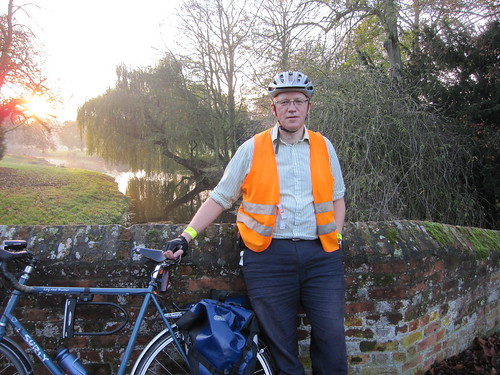
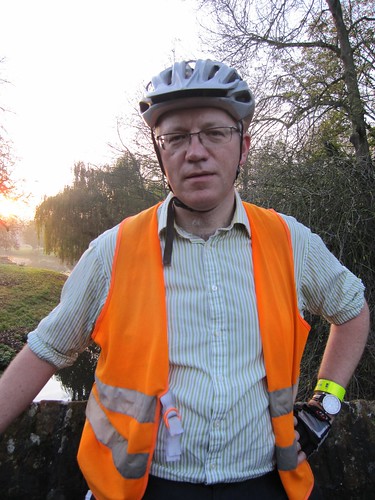
Me in cycling gear: a sight, one reporter says,
that ought to terrify pedestrians. Note to motorist
readers: since you won't be able to see me, I'm near
the picture's middle, wearing high-visibility clothing
These figures, of course, are rather as simple Newtonian physics would suggest. The energy released when a single cyclist hits a pedestrian at, say, 15mph and when a car, van or lorry hits a pedestrian at 30mph are many orders of magnitude different. I can testify to this point particularly congently after unwillingly conducting my own experiment in early 2009. On February 4, I was knocked off by a glancing blow from a minivan crossing my path on Brixton Road, south London. On March 13 the same year, I was hit squarely by a cyclist running a red light near Elephant & Castle. The minivan incident left me sore for a year – the collision with the cyclist only a few days. Cyclists running red lights, going the wrong way up one-way streets and mounting pavements are an irritation – but little more. Motorists who speed, talk on their telephones, fail to see red lights or deliberately drive dangerously regularly prove a lethal danger.

Politicians who want to make life safer for pedestrians and other road users should consequently be encouraging cycling, even if cyclists continue to run red lights (which I think they shouldn’t) or mount the occasional pavement. We cyclists represent far less of a danger to other road users than any other form of wheeled transport.

Yet, when I spoke to Lord Adonis, the then newly-appointed transport secretary, in mid-2009 along with another transport correspondent, the other reporter turned beetroot red when I asked about enhancing safety for cyclists. He interrupted before the minister could answer. “What are you going to do about aggressive cyclists?” he demanded. “What aggressive cyclists?” I retorted, pointing out that people perched on metal frames and two wheels were in a weak position to be truly, dangerously aggressive. My theories about what drives such anger will have to wait, however, for another post. It will take some space to explain why some people hate others simply for their choice of transport mode…