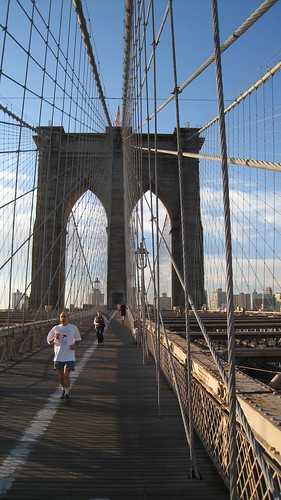
Even by the high standards of a fine, late summer morning in
New York , the
weather was remarkably pleasant on Friday – not too hot or too humid and with a
cloudless sky. The view from the Brooklyn Bridge as I rode down into Manhattan,
the Financial District’s skyscrapers glinting in the sun, seemed calculated to convince
even the most sceptical of the accuracy of New York’s claim to be the greatest
city on earth.
 |
| The Brooklyn Bridge's Manhattan off-ramp: an invitation to let one's momentum overtake one's manners |
But the cyclist who followed me down off the bridge was in
no mood to admire the view. As I sat towards the left of the stream of descending
bike traffic, seeking a safe opportunity to pass a slower rider I’d been
following, I heard a shout of “On Your Right!”
Suddenly confused, I nearly clattered into the rider squeezing between me and
the railings by the walkway edge. He zipped past me – at a fair rate, given my speedometer was reading 18mph – and swung into the walkway’s crowded
pedestrian side to round the guy in front. Then he disappeared off down the slope.
But he went on his way, I imagine, feeling a little more
stressed than he’d been anticipating. “Idiot!” I shouted at him as he sped
past. “You shouldn’t be…” he shouted before finishing the sentence with an
angry gesture towards where I’d been sitting in the lane as I tried to pass the
rider in front.
It was the kind of clash I’ve experienced a disproportionate
number of times over the last week, as I’ve returned to New
York cycle commuting after two weeks’ vacation on Cape Cod . Time and again, I’ve encountered people who’ve
been utterly determined to conserve the momentum of their car, or bicycle or
walking or running body at the expense of others’ safety and convenience. All
seemed caught up in the idea that the complex social activity of sharing a road
or path was a private enterprise, where one needn’t take account of others.
I’ve also, however, been struck by the power of fellow
feeling with the road users around me to influence my own and other people’s
behaviour. People caught up in the bubble of their own, desperate need to reach
their meeting or soccer practice or date or whatever can transform back into
normal, civil civilians the moment that they recognise how they're threatening someone else.
The contrast has been so striking that I’m currently seeing
nearly everything I encounter on the roads as a conflict between these two
instincts – to set one’s own pace and to treat others as one would like to be
treated oneself. Every journey, I’m spotting people caught up in the excitement
of their own speed and a reluctance to change it. Every journey, I’m spotting
how a glance into another person’s eyes brings daylight and a sense of the
wider world into that tunnel vision.
I’ve been reading some news items through the same prism. I
was horrified by how proud a driver calling himself Afroduck was of his “achievement”of driving a circuit round Manhattan’s expressways in 24 minutes. As a Christian – and currently an adherent of a
Presbyterian congregation – I was profoundly disappointed by reports of a lobby of Free Church of Scotland ministers to the Scottish government on widening of the A9 road serving some of the Free Church’s highland strongholds and the installation of speed cameras on the road. "Frustration" with slow cars
caused more accidents than fast ones, claimed Rev Colin Macleod, who I fear didn’t
ask himself how Jesus would drive a car. "Speed cameras... will lead to more frustration, more accidents and more funerals," Rev Macleod told The Scotsman.
However, it was an incident the night before that close Brooklyn
Bridge Warren St in
TriBeCa, I saw a BMW trying to cut across my path by pulling across the cycle
lane at an intersection and into the stream of cars. As I arrived at the traffic
lights, I pulled firmly into the driver’s path, looked down towards his open
window, signalled to him to stop and said, “Please wait.” Somewhat to my
surprise, he did.
 |
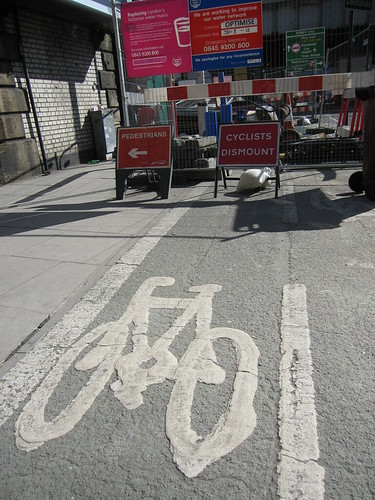
| A warning to cyclists on Kent Avenue, Williamsburg: a reluctance to yield at junctions comes from the same desire to conserve momentum as bad overtaking. |
But, after he passed me and we carried on down the street
towards City Hall, I noticed another cyclist riding into a temporarily narrowed
section of road by some road works. Unconstrained by any personal interaction, the BMW driver barged past him in the narrow section. The
rider’s arms flew up in exasperation and fear as the driver passed him with inches to
spare. It was only the rider’s quick reactions that prevented his being battered
into the concrete barriers, with potentially serious consequences.
It’s hardly surprising, however, that so many road users are
so keen to conserve their momentum. It’s one of the great joys of piloting any
vehicle – a car or especially a bicycle – to feel one’s moving at speed without
having to make an effort. It’s no coincidence that I regularly hear businessmen
speaking in the wooden-tongued jargon of contemporary American business
describing their company as having “momentum”. It’s what political campaigns
seek too. There’s a pleasure in that feeling of being carried along by the
effort one’s already made, or by gravity or the wind that adds up to far more
than merely the product of one’s mass multiplied by one’s velocity. I’ve
described myself the pleasure of a downhill run on one of New York’s East River bridges when
clear of obstructions. The desire to maintain one’s momentum comes, I suspect,
from some of the deepest, most primitive bits of the brain, which house our
deepest joys and fears.
There’s a serious discipline, meanwhile, involved in
applying one’s brakes to suit another person. All the pleasures of feeling that
onward progress disappear. It’s an effort to get going again. As the story of
the barging bicyclist of the Brooklyn
Bridge
 |
| Cars zip down 8th Avenue, in Park Slope: how conscious are the drivers of each others' humanity? |
There is, nevertheless, joy in exercising
that discipline. I’ve been trying especially hard since realising how much I
enjoy my own momentum to stop for pedestrian crosswalks even when most other
cyclists don’t. The tense faces of people glancing up and down the Hudson
Greenway waiting for a gap in the bike traffic melt into a smile when they
realise someone’s halted for them. There’s an inner satisfaction from knowing that
one isn’t going to pass another cyclist before there’s enough, safe room for it
and that one’s unlikely consequently to scare the other rider. I’ve long tried to exercise the same discipline on the rare occasions I drive a car, knowing
how fearful cars can make me when they pass too fast or close.
It’s a far less visceral pleasure than the rush that
Afroduck would have experienced from rounding Manhattan at an average speed of 66mph. It’s
the kind of behaviour that can exasperate people who feel they must get past at
any cost. Freud would have said it’s an action motivated by the superego, while
the pleasure of speed belongs to the id.
Yet to use one’s brakes to act considerately towards others
is also to recognise a profound truth about roads, cycle paths and all the
other places that people use vehicles close to each other. They’re places that
pitch us into some of the most complex social interactions possible. When so
many people treat those places as if they were their own private domains, it’s
no surprise so many of the people around them – the people whose reality they’re
ignoring – end up getting killed.