Showing posts with label speed. Show all posts

Monday, 22 September 2014

A fast riverside ride, a Central Park tragedy - and the need to ride ethically

­“Hey, that was a good run!” the person who’d been riding behind me down the Hudson River Greenway on Friday evening shouted to me. He’d cycled on my tail from 34th St, as I returned from giving a television interview about Scotland’s independence referendum, down as far as Warren St. Every time he’d come close to my rear wheel, I’d sped up a little and we’d done a steady 18mph – 19mph for three miles.
 
The Hudson River Greenway: easy to ride fast, harder
to ride ethically
“Safe ride home!” my travelling companion yelled as I turned off the path towards the Brooklyn Bridge and he continued on south.

Yet, on Friday, instead of feeling pleasure at the excitement of an enjoyable, fast-ish ride by the river, I felt a sharp stab of guilt. What if I’d been irresponsible? What if I’d been riding so fast that I’d have hit a pedestrian stepping onto the path? Did I risk running into one of the many stray runners on the cycleway?

I felt the guilt in the aftermath of a crash in Central Park on Thursday afternoon in which Jason Marshall, a cyclist on a fast training run round the park, hit Jill Tarlov, a 59-year-old woman from Connecticut who was crossing the road in front of him. Although she was on life support on Friday, she has since, very sadly, died.

News of the crash had left me with an acute sense of my responsibility towards other road users. I also anticipated – correctly – new calls for a crackdown on the menace of “killer cyclists”. As I was speeding down the Hudson River Greenway, I was feeling a strange mixture of unjustly put-upon and guilty over my complacency about the risks cyclists pose to others. Did I need to change the way I rode to ensure I kept other road users safer? Would everyone now assume I posed a deadly risk to them, just because one other cyclist had been involved in a high-speed crash?
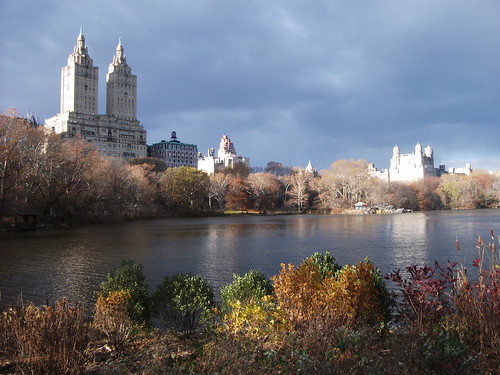
Central Park: spectacular setting for an appalling tragedy
The big challenge in understanding events like Thursday’s crash is precisely that they’re extremely rare, whether in New York, London or anywhere else. Thursday’s crash is the second fatal pedestrian-cyclist collision in New York in recent months – a crash with a 17-year-old cyclist, also in Central Park, killed Irvin Schachter, 75, in August. But the last fatal bike-pedestrian crash before that was in 2009. There have consequently been three pedestrian fatalities in bike crashes over a six year period when crashes involving motor vehicles have killed more than 1,500 people.

A competing challenge is that people get away so often with risky behaviour that nearly everyone is confused about which behaviour actually poses a risk. Motorists who drive down urban streets at 50mph or more seldom encounter a pedestrian unexpectedly stepping out from a kerb or a motorist unexpectedly in an intersection. They can consequently lapse into thinking that 50mph is a safe speed on an urban street. The speed’s effect on their stopping speed and the vehicle’s higher momentum nevertheless make it profoundly unsafe and deadly when something unexpected does occur.

Cyclists racing round Central Park – or Prospect Park, near my apartment – grow so used to dodging successfully round pedestrians that many must assume there’s little risk in doing so at the 25mph and higher speeds that I see many going. Many leave far too little margin for error.

To confuse matters still further, cyclist and motorist behaviour seems to feel different to pedestrians. Given that motor vehicles killed 168 pedestrians in New York last year, pedestrians are in some senses constantly at risk from negligent motorist behaviour. Yet the ubiquity of motor vehicles and the difficulty distinguishing the seriously risky behaviour from the less dangerous seem to stop many people from understanding the risk’s scale.

Fast-moving, quiet cyclists often take people by surprise, however, even when they’re behaving safely. This seems to lead many to perceive wrongly that the danger from bicyclists – who were involved in no fatal crashes with pedestrians between 2010 and last year – is on a comparable level to that from motorists.
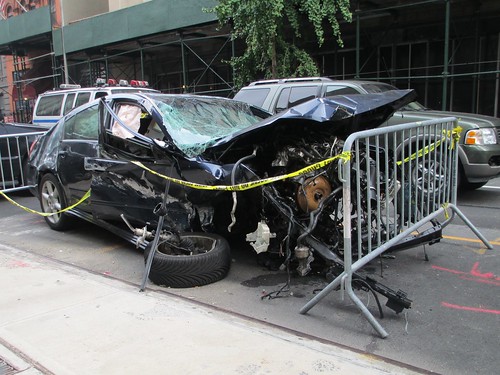
 
This car crashed at 100mph on the West Side Highway,
near where I worried my 18mph to 19mph speed was excessive.
However loud the understandable outcry, the Central Park crash hasn’t undermined the strong moral case for using a bicycle to get about, rather than a car. Cyclists are generally moving more slowly if they collide with people than motorists are. The lower weight of a bicycle and rider compared with a car and driver also reduces the energy released in a collision. I posed less risk to a pedestrian stepping out onto the Hudson Greenway than the scores of cars driving at 50mph, 60mph or more on the neighbouring, speeding-plagued West Side Highway.

There might not even, it seems to me as a layman, be a solid case for charging Jason Marshall with a serious criminal offence under New York's shockingly lax road safety laws. Newspaper reports gave lurid accounts of how Marshall “ploughed” into Ms Tarlov. But Marshall seems to have hit her after swerving to avoid other pedestrians and yelling out a warning that she seems not to have heard. He might – might – have been going below Central Park’s 25mph speed limit and doing his best to avoid people crossing the road against the pedestrian traffic signal. New York motorists would generally have to behave with far more obvious recklessness to face serious criminal sanctions. When I rode in Central Park one time recently at a time cars were allowed to use part of the park, few seemed to adhere to the 25mph speed limit.

Yet all of these caveats only go to underline the most critical lesson that anyone who ever uses a street for any purpose should take away from Thursday’s tragedy. It’s that everyone’s primary focus should be, as far as possible, to avoid unnecessarily harming others. However solitary one might feel riding a bicycle or driving a car, one’s involved in an intense and complex series of social interactions. The scope for misunderstanding is so vast that it is always imperative to act cautiously.
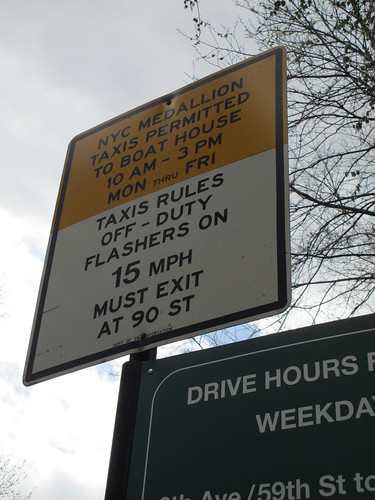
 
Taxis - and other users - face a barrage of rules
in Central Park. But the imperative to behave
ethically should be even stronger
Anyone who’s ridden a bicycle in Central Park, Prospect Park or some other big urban park - like London’s Hyde Park or Regent’s Park - knows that the park’s users are apt to behave far more unpredictably and casually than they would around a normal road. Many are oblivious to the presence of even large numbers of cyclists. On the rare occasions when I go to a park to ride in circles, I try to ensure I pick up speed only when I can be certain the road is clear of obstructions for a suitable distance ahead.

Under those circumstances, there can be no moral excuse, it seems to me, for riding round a park so set on achieving a set speed that one is reluctant to reduce speed or make space when passing other park users. To judge by accounts of Jason Marshall’s keen pursuit of records on Strava, the online bike-racing app, his overall, incautious determination to maintain his speed may have been far more culpable than anything specific about his reaction on encountering people crossing the road.

It is, of course, apt to sound like a counsel of despair to enjoin road users to behave more ethically towards each other. Many road users struggle to understand rules about yielding when turning and other straightforward road rules. Others display such failures of compassion towards other road users that it’s hard to imagine their taking a truly moral stance.

It doesn’t help that the traffic rules in most places fail to push people towards moral behaviour. Police enforcement in many places seems almost designed to reinforce the worst kinds of attitudes. The cry for road-users to act morally can easily sound like the helpless cry of Rodney King, victim of a police beating, as Los Angeles erupted in flames amid protests over the policemen’s acquittal: “Can’t we all just get along?”
The 1st Avenue Bike Lane: easy to feel frustrated,
vital to behave ethically

But any of us who thinks seriously about how we use the roads can set an example. I can avoid recklessly swerving into the oncoming lane to overtake slow cyclists in front on the blind bends on the Manhattan Bridge bike path. You can overtake carefully and with plenty of space even the infuriating runners who run down the Hudson Greenway’s bike lanes. I can slow even for pedestrians with the maddening habit of waiting to cross 1st avenue while standing in the busy, hard-to-negotiate segregated bike lane. You can wait until it's safe to pass that pedestrian who's insisting on walking down the narrow, constricted Allen St bike lanes.

Even on Friday evening, despite my guilt pangs, I had, looking back, kept looking carefully for pedestrians and runners and sought to take evasive action in good time when I saw one. I stopped for one crosswalk by the Chelsea Piers and so surprised one waiting pedestrian she took a moment actually to cross. I tried, albeit probably imperfectly, to live up to my moral principles.

It is, after all, the central tragedy of traffic in New York City and many other big cities that so many people walking and cycling – using the least harmful transport modes – end up in cold mortuaries and warm intensive care units. It’s a horror that’s no less intense for being widely taken for granted. I will do everything I reasonably can to ensure I’m not responsible for putting anybody else in those places.

Sunday, 8 September 2013

A speeding cyclist, momentum - and how sustained velocity is the enemy of consideration

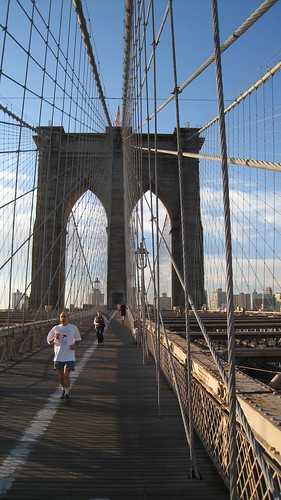
Even by the high standards of a fine, late summer morning in New York, the weather was remarkably pleasant on Friday – not too hot or too humid and with a cloudless sky. The view from the Brooklyn Bridge as I rode down into Manhattan, the Financial District’s skyscrapers glinting in the sun, seemed calculated to convince even the most sceptical of the accuracy of New York’s claim to be the greatest city on earth.
 
The Brooklyn Bridge's Manhattan
off-ramp: an invitation to let one's
momentum overtake one's manners
But the cyclist who followed me down off the bridge was in no mood to admire the view. As I sat towards the left of the stream of descending bike traffic, seeking a safe opportunity to pass a slower rider I’d been following, I heard a shout of “On Your Right!” Suddenly confused, I nearly clattered into the rider squeezing between me and the railings by the walkway edge. He zipped past me – at a fair rate, given my speedometer was reading 18mph – and swung into the walkway’s crowded pedestrian side to round the guy in front. Then he disappeared off down the slope.

But he went on his way, I imagine, feeling a little more stressed than he’d been anticipating. “Idiot!” I shouted at him as he sped past. “You shouldn’t be…” he shouted before finishing the sentence with an angry gesture towards where I’d been sitting in the lane as I tried to pass the rider in front.

It was the kind of clash I’ve experienced a disproportionate number of times over the last week, as I’ve returned to New York cycle commuting after two weeks’ vacation on Cape Cod. Time and again, I’ve encountered people who’ve been utterly determined to conserve the momentum of their car, or bicycle or walking or running body at the expense of others’ safety and convenience. All seemed caught up in the idea that the complex social activity of sharing a road or path was a private enterprise, where one needn’t take account of others.

I’ve also, however, been struck by the power of fellow feeling with the road users around me to influence my own and other people’s behaviour. People caught up in the bubble of their own, desperate need to reach their meeting or soccer practice or date or whatever can transform back into normal, civil civilians the moment that they recognise how they're threatening someone else.

The contrast has been so striking that I’m currently seeing nearly everything I encounter on the roads as a conflict between these two instincts – to set one’s own pace and to treat others as one would like to be treated oneself. Every journey, I’m spotting people caught up in the excitement of their own speed and a reluctance to change it. Every journey, I’m spotting how a glance into another person’s eyes brings daylight and a sense of the wider world into that tunnel vision.

I’ve been reading some news items through the same prism. I was horrified by how proud a driver calling himself Afroduck was of his “achievement”of driving a circuit round Manhattan’s expressways in 24 minutes. As a Christian – and currently an adherent of a Presbyterian congregation – I was profoundly disappointed by reports of a lobby of Free Church of Scotland ministers to the Scottish government on widening of the A9 road serving some of the Free Church’s highland strongholds and the installation of speed cameras on the road. "Frustration" with slow cars caused more accidents than fast ones, claimed Rev Colin Macleod, who I fear didn’t ask himself how Jesus would drive a car. "Speed cameras... will lead to more frustration, more accidents and more funerals," Rev Macleod told The Scotsman.

However, it was an incident the night before that close Brooklyn Bridge pass that made clear to me the tension between the two tendencies. As I rode up Warren St in TriBeCa, I saw a BMW trying to cut across my path by pulling across the cycle lane at an intersection and into the stream of cars. As I arrived at the traffic lights, I pulled firmly into the driver’s path, looked down towards his open window, signalled to him to stop and said, “Please wait.” Somewhat to my surprise, he did.
 
A warning to cyclists on Kent Avenue, Williamsburg:
a reluctance to yield at junctions comes from the same
desire to conserve momentum as bad overtaking.
But, after he passed me and we carried on down the street towards City Hall, I noticed another cyclist riding into a temporarily narrowed section of road by some road works. Unconstrained by any personal interaction, the BMW driver barged past him in the narrow section. The rider’s arms flew up in exasperation and fear as the driver passed him with inches to spare. It was only the rider’s quick reactions that prevented his being battered into the concrete barriers, with potentially serious consequences.

It’s hardly surprising, however, that so many road users are so keen to conserve their momentum. It’s one of the great joys of piloting any vehicle – a car or especially a bicycle – to feel one’s moving at speed without having to make an effort. It’s no coincidence that I regularly hear businessmen speaking in the wooden-tongued jargon of contemporary American business describing their company as having “momentum”. It’s what political campaigns seek too. There’s a pleasure in that feeling of being carried along by the effort one’s already made, or by gravity or the wind that adds up to far more than merely the product of one’s mass multiplied by one’s velocity. I’ve described myself the pleasure of a downhill run on one of New York’s East River bridges when clear of obstructions. The desire to maintain one’s momentum comes, I suspect, from some of the deepest, most primitive bits of the brain, which house our deepest joys and fears.

There’s a serious discipline, meanwhile, involved in applying one’s brakes to suit another person. All the pleasures of feeling that onward progress disappear. It’s an effort to get going again. As the story of the barging bicyclist of the Brooklyn Bridge shows, it’s a discipline that cyclists often struggle to exercise. Yet, of course, the danger from people driving motor cars is all the greater. Someone shut inside a metal box is apt to be insulated – as Afroduck seemingly was – from the sheer danger that his or her speed represents to others. Drivers are consequently likely to behave more dangerously.
Cars zip down 8th Avenue, in Park Slope:
how conscious are the drivers of each others' humanity?

There is, nevertheless, joy in exercising that discipline. I’ve been trying especially hard since realising how much I enjoy my own momentum to stop for pedestrian crosswalks even when most other cyclists don’t. The tense faces of people glancing up and down the Hudson Greenway waiting for a gap in the bike traffic melt into a smile when they realise someone’s halted for them. There’s an inner satisfaction from knowing that one isn’t going to pass another cyclist before there’s enough, safe room for it and that one’s unlikely consequently to scare the other rider. I’ve long tried to exercise the same discipline on the rare occasions I drive a car, knowing how fearful cars can make me when they pass too fast or close.

It’s a far less visceral pleasure than the rush that Afroduck would have experienced from rounding Manhattan at an average speed of 66mph. It’s the kind of behaviour that can exasperate people who feel they must get past at any cost. Freud would have said it’s an action motivated by the superego, while the pleasure of speed belongs to the id.

Yet to use one’s brakes to act considerately towards others is also to recognise a profound truth about roads, cycle paths and all the other places that people use vehicles close to each other. They’re places that pitch us into some of the most complex social interactions possible. When so many people treat those places as if they were their own private domains, it’s no surprise so many of the people around them – the people whose reality they’re ignoring – end up getting killed.