“Hey, that was a good run!” the person who’d been riding
behind me down the Hudson River Greenway on Friday evening shouted to me. He’d
cycled on my tail from 34th
St , as I returned from giving a television
interview about Scotland’s independence referendum, down as far as Warren St . Every time he’d come close to
my rear wheel, I’d sped up a little and we’d done a steady 18mph – 19mph for
three miles.
 |
| The Hudson River Greenway: easy to ride fast, harder to ride ethically |
“Safe ride home!” my travelling companion yelled as I turned
off the path towards the Brooklyn Bridge and he continued
on south.
Yet, on Friday, instead of feeling pleasure at the
excitement of an enjoyable, fast-ish ride by the river, I felt a sharp stab of
guilt. What if I’d been irresponsible? What if I’d been riding so fast that I’d
have hit a pedestrian stepping onto the path? Did I risk running into one of the many stray runners on
the cycleway?
I felt the guilt in the aftermath of a crash in Central Park
on Thursday afternoon in which Jason Marshall, a cyclist on a fast training run
round the park, hit Jill Tarlov, a 59-year-old woman from Connecticut who was crossing the road in
front of him. Although she was on life support on Friday, she has since, very sadly, died.
News of the crash had left me with an acute sense of my
responsibility towards other road users. I also anticipated – correctly – new
calls for a crackdown on the menace of “killer cyclists”. As I was speeding
down the Hudson River Greenway, I was feeling a strange mixture of unjustly
put-upon and guilty over my complacency about the risks cyclists pose to
others. Did I need to change the way I rode to ensure I kept other road users
safer? Would everyone now assume I posed a deadly risk to them, just because
one other cyclist had been involved in a high-speed crash?
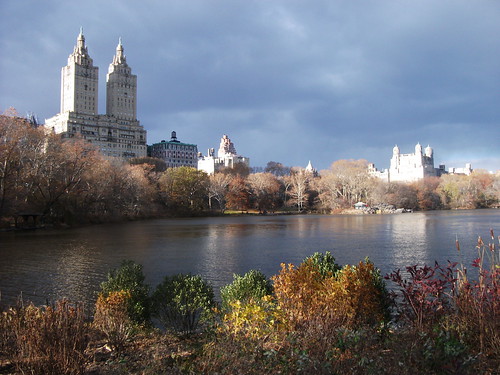 |
| Central Park: spectacular setting for an appalling tragedy |
The big challenge in understanding events like Thursday’s
crash is precisely that they’re extremely rare, whether in New
York , London
or anywhere else. Thursday’s crash is the second fatal pedestrian-cyclist
collision in New York in recent months – a
crash with a 17-year-old cyclist, also in Central Park ,
killed Irvin Schachter, 75, in August. But the last fatal bike-pedestrian crash
before that was in 2009. There have consequently been three pedestrian fatalities in bike crashes over a six year period
when crashes involving motor vehicles have killed more than 1,500 people.
A competing challenge is that people get away so often with
risky behaviour that nearly everyone is confused about which behaviour actually poses a risk. Motorists who drive down urban streets at 50mph or more seldom
encounter a pedestrian unexpectedly stepping out from a kerb or a motorist
unexpectedly in an intersection. They can consequently lapse into thinking that
50mph is a safe speed on an urban street. The speed’s effect on their stopping
speed and the vehicle’s higher momentum nevertheless make it profoundly unsafe
and deadly when something unexpected does occur.
Cyclists racing round Central Park – or Prospect Park
To confuse matters still further, cyclist and motorist
behaviour seems to feel different to pedestrians. Given that motor vehicles
killed 168 pedestrians in New York last year, pedestrians are in some senses constantly at risk from negligent
motorist behaviour. Yet the ubiquity of motor vehicles and the difficulty
distinguishing the seriously risky behaviour from the less dangerous seem to
stop many people from understanding the risk’s scale.
Fast-moving, quiet cyclists often take people by surprise, however,
even when they’re behaving safely. This seems to lead many to perceive wrongly that the
danger from bicyclists – who were involved in no fatal crashes with pedestrians
between 2010 and last year – is on a comparable level to that from motorists.
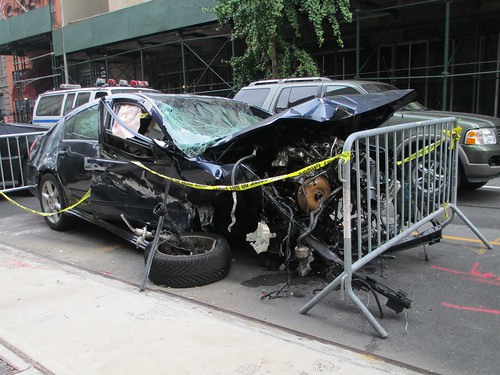 |
| This car crashed at 100mph on the West Side Highway, near where I worried my 18mph to 19mph speed was excessive. |
However loud the understandable outcry, the Central Park crash hasn’t undermined the strong moral case for using a bicycle to get about, rather than a car. Cyclists are
generally moving more slowly if they collide with people than motorists are.
The lower weight of a bicycle and rider compared with a car and driver also
reduces the energy released in a collision. I posed less risk to a pedestrian
stepping out onto the Hudson Greenway than the scores of cars driving at 50mph,
60mph or more on the neighbouring, speeding-plagued West Side Highway.
There might not even, it seems to me as a layman, be a solid
case for charging Jason Marshall with a serious criminal offence under New York's shockingly lax road safety laws. Newspaper reports gave lurid
accounts of how Marshall
“ploughed” into Ms Tarlov. But Marshall
seems to have hit her after swerving to avoid other pedestrians and yelling out
a warning that she seems not to have heard. He might – might – have been going
below Central Park ’s 25mph speed limit and
doing his best to avoid people crossing the road against the pedestrian traffic
signal. New York
motorists would generally have to behave with far more obvious recklessness to
face serious criminal sanctions. When I rode in Central Park one time recently at a time cars were allowed to use part of the park, few seemed to adhere to the 25mph speed limit.
Yet all of these caveats only go to underline the most
critical lesson that anyone who ever uses a street for any purpose should take
away from Thursday’s tragedy. It’s that everyone’s primary focus should be, as
far as possible, to avoid unnecessarily harming others. However solitary one
might feel riding a bicycle or driving a car, one’s involved in an intense and
complex series of social interactions. The scope for misunderstanding is so
vast that it is always imperative to act cautiously.
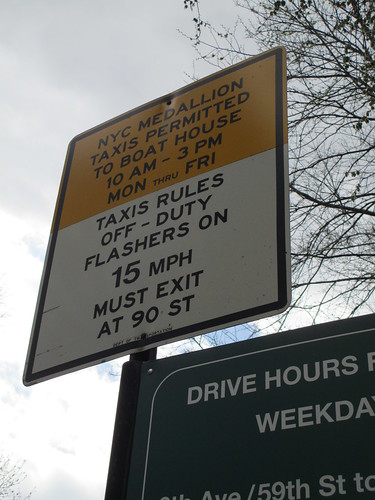 |
| Taxis - and other users - face a barrage of rules in Central Park. But the imperative to behave ethically should be even stronger |
Anyone who’s ridden a bicycle in Central Park, Prospect Park
or some other big urban park - like London ’s Hyde Park or Regent’s Park - knows that the park’s users
are apt to behave far more unpredictably and casually than they would around a
normal road. Many are oblivious to the presence of even large numbers of
cyclists. On the rare occasions when I go to a park to ride in circles, I try
to ensure I pick up speed only when I can be certain the road is clear of
obstructions for a suitable distance ahead.
Under those circumstances, there can be no moral excuse, it
seems to me, for riding round a park so set on achieving a set speed that one
is reluctant to reduce speed or make space when passing other
park users. To judge by accounts of Jason Marshall’s keen pursuit of records on
Strava, the online bike-racing app, his overall, incautious determination to maintain
his speed may have been far more culpable than anything specific about his
reaction on encountering people crossing the road.
It is, of course, apt to sound like a counsel of despair to
enjoin road users to behave more ethically towards each other. Many road users
struggle to understand rules about yielding when turning and other straightforward road rules. Others display such failures of compassion towards other
road users that it’s hard to imagine their taking a truly moral stance.
It doesn’t help that the traffic rules in most places fail to push people towards moral behaviour. Police
enforcement in many places seems almost designed to reinforce the worst kinds
of attitudes. The cry for road-users to act morally can easily sound
like the helpless cry of Rodney King, victim of a police beating, as Los Angeles erupted in
flames amid protests over the policemen’s acquittal: “Can’t we all just get
along?”
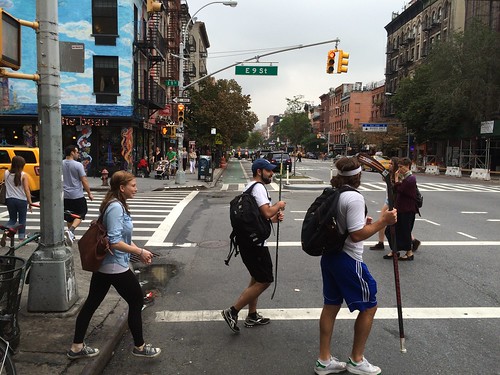 |
| The 1st Avenue Bike Lane: easy to feel frustrated, vital to behave ethically |
But any of us who thinks seriously about how we use the roads can set an example. I can avoid recklessly
swerving into the oncoming lane to overtake slow cyclists in front on the blind
bends on the Manhattan
Bridge 1st avenue while standing in
the busy, hard-to-negotiate segregated bike lane. You can wait until it's safe to pass that pedestrian who's insisting on walking down the narrow, constricted Allen St bike lanes.
Even on Friday evening, despite my guilt pangs, I had,
looking back, kept looking carefully for pedestrians and runners and sought to
take evasive action in good time when I saw one. I stopped for one crosswalk by
the Chelsea Piers and so surprised one waiting pedestrian she took a moment
actually to cross. I tried, albeit probably imperfectly, to live up to my moral
principles.
It is, after all, the central tragedy of traffic in New York City