For new residents of New
York City like me, there has been something almost
mind-bending about the last couple of days. Ever since Ed Koch, the city’s
mayor from 1977 to 1989, died in the early hours of Friday, obituaries have
been transporting us back to an unrecognisable city. Drug addicts lie prone on Manhattan streets,
looting breaks out when the power fails and the subway is celebrated mainly for
the range and inventiveness of its graffiti. It’s hardly surprising that the
person who pitted himself against this chaos had a personality as
pathologically extroverted as our current mayor’s is buttoned-up and controlled.
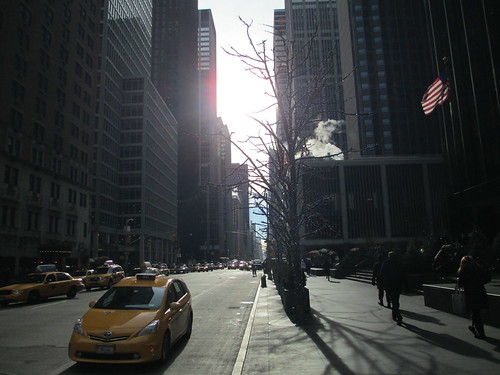 |
| Sixth Avenue: bike-lane-less, as Ed Koch preferred it on mature consideration |
But, for a newcomer who’s a cyclist, one detail of the Ed
Koch saga highlights a particularly striking change in the city. In 1980, at
the height of the second oil price shock, Koch ordered the installation of
segregated bike lanes on Fifth, Sixth and Seventh Avenues and Broadway in Manhattan . Then, only
weeks later, having been ridiculed for his bike lane “fetish,” Koch had the
lanes torn out again. He went on, in 1987, to try to ban cycling altogether
from mid-town Manhattan .
While that set-back took years to overcome, Koch nevertheless died in a city criss-crossed
by a growing network of bike lanes. Installation is moving – despite setbacks
as Nimbys in some neighbourhoods oppose new lanes - so fast that my 2012 NYC
cycling map already feels quite badly out of date.
Thinking about that sharp turnaround – a tribute to the
commitment of Michael Bloomberg, the current mayor, and Janette Sadik-Khan, his
transport commissioner - has linked up in my mind several hopeful signs for
cycling over the last couple of months. In both the US
and the UK
– the countries where I’ve done most cycling – cycling numbers are going up and
official acceptance of cycling appears to be growing.
The question is whether this is a fundamental, long-term
shift or just another short-term bit of faddism like Ed Koch's.
 |
| A Detroit Madison Street: borrowed chic for Lincoln |
The question brings to my mind a mental picture of a
copper-and-black Detroit Bicycle Company fixed-wheel bike. As someone who likes
both gears and highly practical bikes, it’s not a machine I aspire to own. But
I came across the bike – a Detroit
Madison Street , trivia fans – in the unlikely
setting of the Lincoln stand at Detroit ’s annual North American International
Auto Show. It was being held up as an example of the kind of finely-made luxury
product of which Lincoln
– which is trying to relaunch itself as a desirable luxury marque – approved.
Still more remarkably, it was one of quite a few bikes I
spotted around the show floor. The Smart
stand boasted an E-Bike, which the manufacturer will be selling, while Toyota displayed a
concept for a conventional bike. Kia was showing a small-wheeled
bike that it sells in Korea ,
while Hyundai had a fixed-wheel bike sticking out the back of a coupe. Subaru had stuck a couple of
mountain bikes on the roof rack of one of its vehicles.
The unmistakeable impression was that carmakers thought bikes
now had a certain cachet – which they wanted to borrow. Compare that with how
the UK ’s Raleigh in the 1960s felt it had to ape motorbike design to get kids to ride bikes.
The bikes’ presence on the automakers’ stands struck me all
the more forcibly because of an article I’d written in my day job just before
Christmas. It detailed how all the Detroit Three big automakers – General Motors,
Ford and Chrysler – were struggling to reverse or live with recent years’ steep decline in young people’s learning to drive and subsequent buying of cars. Part
of the carmakers’ problem stems from a gradual revival in recent years of the US ’s inner
cities – which are less littered than they once were with unconscious drug
addicts - and, for some of the residents, a drift away from cars and towards
bicycles. It’s the kind of gain for cycling that would have been scarcely
imaginable in most industrialised countries 25 years ago when Mayor Koch was
trying to ban cycling altogether.
A YouTube video posted by Gaz, a keen helmet-cam user reminded
me that the process has already gone far further in the UK . His video –
shot one recent January day – showed 50 cyclists on one short stretch of Cycle
Superhighway 7 (a former Roman road, as it happens). If so many people are
cycle commuting in January, Gaz suggests, the spring and summer are likely to
see London ’s
highest cycle commuting numbers in many years.
 |
| Kent Ave, Williambsurg: Denis Hamil wants those bike lanes gone |
The worry, of course, is that cycling also looked so much like
the coming thing in 1980 that a gadfly populist such as Ed Koch briefly took
the risk of backing it. If car companies thought there was a way other than
sticking two bikes on the roofrack to show their car was associated with an
outdoor, aspirational lifestyle, I’m sure they’d happily use it. Denis Hamil, a
columnist in the New York Daily News last week said he would support any mayoral candidate who promised to scrap the current crop of bike lanes.
One of the likeliest contenders for mayor – Christine Quinn, a Democrat – has
sought to appease bike lane haters by saying lanes are “controversial” and
advising people not to discuss them at dinner parties.
In London ,
even Boris Johnson, the mayor, who is a daily cyclist, fell before the last
mayoral election into the trap of caricaturing cyclists as dread-locked red-light jumpers. As with road safety – where the current UK government
has reversed years of steady improvements by cutting funding for speed cameras –
there is always a risk that someone will take steps that reverse apparently
inexorable progress in a positive direction.
It doesn’t, for what it’s worth, feel as if such a step is
coming immediately either here in New York or in
the UK .
Concern about the environment, changes in living patterns, concern about health
and cycle technology improvements are all conspiring to make this cycling boom
feel far more solid and longer-lasting than the second oil shock one.
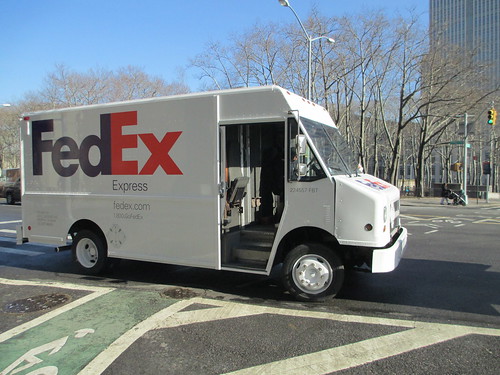 |
| Yes, cycling's made progress. But, as long as FedEx drivers think across one of New York's busiest bike lanes is a good place to park, it won't be mainstream |
But it’s worth remembering that, even after recent years’
quadrupling of New York cycling numbers and
the last decade’s doubling in London ,
riding a bike remains a fringe pursuit that’s far from winning mainstream
acceptance.
That point came home to me particularly clearly one Friday
night just before Christmas. Riding home around 10pm down W55th street from my office, I was
surprised to find a limousine pull up next to me and wind down its window.
Inside was a curious tourist who couldn’t understand what I was doing. No, I
told him, I wasn’t delivering anything. Yes, I was just riding home from my
office.
Recognising that he wasn’t going to get to the bottom of it,
he finally said: “Just seems kind of… European.”
The incident set a new mental benchmark for me for cycling
in New York
and other big cities where it’s still not one of the main modes of travel.
Cycling, I’ve decided, will finally be mainstream when an encounter with a
commuter cyclist is no longer one of the “darndest things about New York ” that a returning tourist recounts to his
friends in Peoria .