Showing posts with label crime. Show all posts

Sunday, 9 December 2012

Washington, a stabbing - and why an individual cyclist tells you nothing about the rest

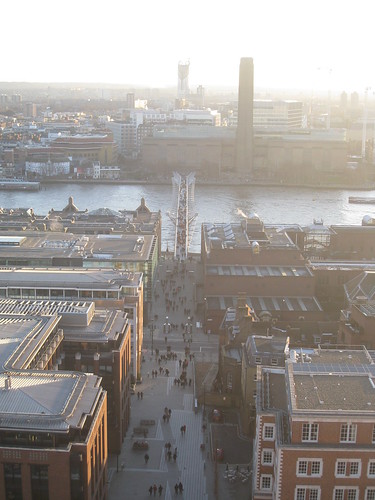
Washington, DC surprises me every time I visit. While New York feels just as bustling, large-scale and chaotic as the films and TV programmes would suggest, the US’s capital feels nothing like the West Wing. Sure, there are people influencing the whole world’s fate in lots of those neoclassical buildings – but Washington’s atmosphere most reminds me of other sleepy US administrative capitals like Richmond, Virginia or Harrisburg, Pennsylvania.

Washington, DC: provincial to me
- but full of cycling savages according to one Facebook user
During a visit last week, it nevertheless occurred what an advantage it was that Washington seemed a far calmer place than New York to ride a bike. The cyclists I saw during the visit mostly seemed to be riding sedately, calmly and in general harmony with other road users around them.

This was, however, entirely the wrong conclusion, according to at least one person I know. On Friday evening, two days after I came back from my DC daytrip, a Facebook friend commented on a story about an altercation between a cyclist and a motorist in North-West Washington the night I visited. The motorist appears to have somehow alarmed the cyclist, who responded by hitting the driver’s car with his D-Lock. The ensuing argument ended with the cyclist stabbing the motorist, who suffered rib injuries but looks likely to survive.

“Savages,” my Facebook friend commented. “Civility is an alien concept,” someone else replied in agreement. The clear implication was that I, as a cyclist, was complicit in an appalling, entirely unjustified assault of a kind I would never have contemplated.

My immediate instinct was to launch into an argument, pointing out the fatuousness of jumping from a single, knife-wielding cyclist to the implied generalisation – all cyclists are savages. Concluding that I was unlikely to change clearly entrenched attitudes, I limited myself to “unfriending” the person responsible.

But, as I cycled home that evening, a more mature reflection occurred to me – one sparked in part by the controversy in the UK over the inflammatory “War on Britain’s Roads” documentary. If it made no sense to draw a conclusion from a single stabbing - or the misleading footage of an alleycat race in the documentary  - to cyclists’ general behaviour, why did I feel free to criticise in general the culture of driving or the police? Was I making any more sense than my former Facebook friend?

One possible response to the “cyclists are savages” claim would, of course, have been to point to some of the numerous incidents of motorist-cyclist violence. In the space of a year of cycling in London, I suffered one actual – albeit mild – assault and had to make an emergency call to police to avert another. The first incident involved a bus driver who abandoned his bus – and passengers - to confront me because I’d photographed him blocking, illegally, a cyclist-only area at traffic lights. He smashed the mobile ‘phone I was using as a camera out of my hand. The second incident came as I tried to photograph a motorist I’d previously seen deliberately drive across the path of a cyclist who’d complained about his driving. He threatened – alarmingly convincingly - to smash up both me and my camera.

The most pertinent case I could have raised, however, was the stabbing in September of Colin Albright, a cyclist in Pittsburgh, whom a motorist pursued as he carried his bike away from a road up a set of steps. The motorist stabbed Albright repeatedly, including in the throat, possibly over some perceived slight involving a traffic incident.
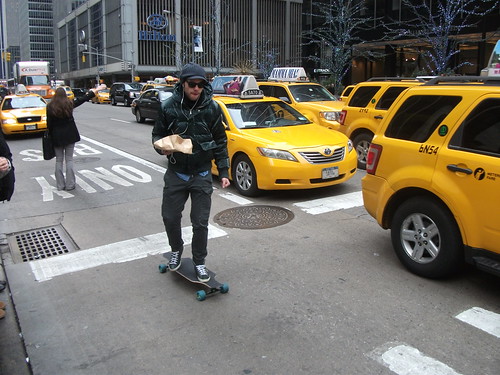
You might have prejudices about people who make strange
transport choices - like skateboarding down Sixth Avenue.
It doesn't mean you know anything about this individual skateboarder.

Albright’s case would have been pertinent precisely because it illustrates the absurdity of generalising from something extraordinarily rare – a stabbing over a disagreement on the roads – to the generality of day-by-day on-road relationships. In late October, Anthony Scholl confessed to attacking Albright. Scholl was already in custody over an alleged attempt to burn down his parents’ house. While there is little information so far on Scholl’s motive for stabbing Albright, the alleged arson attempt seems to have been aimed, in Scholl’s mind, at preventing his parents from killing him and feeding him to their (presumably imaginary) pet alligator.  Albright’s stabbing also looks likely to have stemmed from what Scholl’s mother has called his “psychological issues”. It seems similarly unlikely that the appalling Washington stabbing will turn out to involve an ordinary, mentally-balanced cycle commuter who just happens to pack a knife to mete out summary justice on uppity drivers.

That anyone could ever have thought the Washington stabbing had anything to do with broader cyclist behaviour, of course, stems from humans’ powerful desire to pin blame for problems on out-groups. The only thing so far known about the Washington motorist’s assailant is that he was on a means of transport against which large numbers of people have powerful prejudices. Few people have the mental self-discipline to avoid working on the basis of such limited information and their prejudices to jump to wholly unwarranted conclusions.

It’s telling, for example, that hardly anyone blames the antics of bank robbers’ getaway drivers purely on their being drivers. Drivers are too numerous and familiar to act as convenient out-group scapegoats. No-one sought to blame the assault I suffered or the threatened assault merely on the perpetrators’ status as motorists. I received, instead, some close questioning about the immigration status of the bus driver and the race of the man who threatened to assault me. Establish a link to immigrants or African-Caribbean men, the implication seemed to be, and the incidents were far more easily explained away.
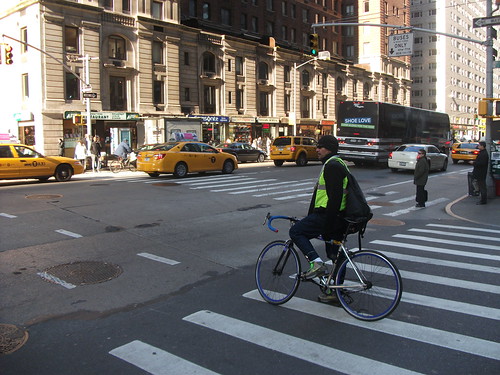
A cyclist, cars and pedestrians at 55th Street. Which of them
is a "savage" will be in the  eye of the beholder
The prejudices are all the more powerful for not appearing to the prejudiced to be prejudices at all. Have your eye out for poor cyclist behaviour in Washington and you’ll spot instances of such behaviour, rather than the courtesy and calm I witnessed. Assume the main road problem is the cyclists and you’re unlikely to spot the multiple ways motorists misbehave.

The truth is that, in all the incidents I’ve described, the attackers acted as individuals, rather than a member of a group. Their behaviour stemmed from their own characters or mental states, rather than their status as cyclists, motorists, bus drivers, immigrants or anything else. To imagine that the behaviour in a single instance of a single member of a large group has anything to say about the wider group as a whole is a thinking error of a kind that would be shocking were it not also fairly common.

That point could, of course, lay me open to the objection someone recently made in an online forum to my use of statistics to point out that cars generally posed a far greater danger to pedestrians than bikes. That was beside the point, the poster wrote. Each motorist or driver differs so much that it makes no sense to discuss a general level of risk from motorists or cyclists. A very poor cyclist could conceivably pose a greater danger to a pedestrian than an extremely careful, conscientious motorist. I am perhaps particularly vulnerable to such a charge because of my habit of illustrating points on this blog by reference to specific – usually extreme – incidents that I take to illuminate a wider truth.

Yet I have, I hope, been careful when complaining about general problems to have sought evidence that my experience speaks to a broader reality. It remains a verifiable fact, for example, that motorists kill a disproportionately high number of other road users in both the UK and New York City. Collisions with cyclists in both places account for a far lower proportion of road fatalities than cyclists make up of road traffic. Research in New York suggests motorists’ failure to yield as required to pedestrians is the biggest single cause of road deaths. Research in the UK suggests failure on motorists’ part to pay attention causes a disproportionate number of crashes.
Court Street at night. Just because most motorists speed here
doesn't mean they all do.

It makes sense on such a basis to say there is a general problem with motorists’ failure to yield to New York pedestrians or to pay proper attention in the UK. I am even confident enough in my own judgement to diagnose a few more local, unmeasured problems. There is, for example, a general problem that many motorists regard Brooklyn’s Court Street as an appropriate place for excessive speed and not somewhere where cyclists’ requirement for space on the roads need be considered. It just doesn’t make sense to predict on this basis that the next motorist one encounters on Court Street won’t be a model of caution, courtesy and respect.

I feel acutely sorry for the victim of the Washington stabbing. His experience last Wednesday must have been appallingly frightening. I trust the District of Columbia police will swiftly identify the attacker and bring him before the courts. I wish the victim a swift and smooth recovery. But I also devoutly hope that no-one in future will make the lazy and offensive mistake of imagining any of what happened had anything to do with me.

Saturday, 6 October 2012

Do as you like, motorists - and don't blame us for the deaths


It’s a disturbing scene to encounter on the way to work. Every morning recently that I’ve cycled to the office, I’ve come part way down West 54th Street on a badly-damaged airport shuttle minibus. The passenger doors on one side are mangled; the right-hand front wheelarch obviously took a heavy blow and the front radiator grille is nowhere to be seen. It was, I instantly recognised, the result of a crash with a large vehicle, travelling at high speed, hitting the bus then spinning round to hit it a second time. Some research suggests a Mercedes Benz sped up Sixth Avenue early on September 16 and hit the minibus as it crossed at 50th street. Some witnesses said the driver had been racing another vehicle. He was arrested on suspicion of drunken driving. Not surprisingly, given the vehicle’s condition, four passengers and the bus driver were badly hurt - one had a fractured skull, while others suffered head and neck injuries.
The crushed minibus of W54th street: yet more evidence
that cyclists are the true menace to New Yorkers

Injuries and deaths from traffic accidents like the one involving the minibus are growing more common after years of declines in New York. In the year to June, 291 people died in traffic accidents of various kinds in New York City, up 23 per cent from the previous year. The numbers of pedestrians and cyclists killed rose 11 per cent to 176. The same goes for the UK, from which I've just moved. Statistics released in the last week show 3 per cent more people died in road traffic accidents in the UK in 2011 than in 2010, well above the increase in traffic volumes. Civil servants and politicians in both places profess bemusement at the reversal of fortunes.

But it’s hard to believe the puzzlement is sincere. From a crime point of view, New York City has become a far, far safer place than a couple of decades ago – it's just the city won't use the policies it applied to crime to stamp out bad driving. In the UK, transport officials know that speed and traffic light cameras can sharply reduce road deaths – and have encouraged their removal because drivers don’t like them. The question is how many more minibus passengers and drivers have to be rushed to hospital on both sides of the Atlantic before the various authorities start to do something.

I’m lucky that both my encounters so far with officers of the New York Police Department have been fairly benign. On September 29, when I was riding across the Brooklyn Bridge towards Manhattan, I met a police officer leading thousands of people marching towards Brooklyn for a charity event. It wasn’t safe to cycle, he said, because of the numbers of people. I huffily dismounted and pushed my bike towards City Hall. A few weeks earlier, I’d passed a mounted policeman during my morning ride to work along the Hudson River Greenway. I then dutifully stopped at red traffic lights where a road crosses the path – only for the officer impatiently to tell me to get on with it and keep riding.

A typical Manhattan intersection, making it clear why the police
should prioritise cracking down on cyclists
Other cyclists' experience of the NYPD is very different. Last year, the NYPD issued 50,000 tickets of various kinds – for running red lights and so on – to cyclists, compared with only 25,000 for trucks. The division set up to get trucks to follow the law issued more tickets to cyclists than to trucks. Cyclists – who account for maybe 1 per cent of New York traffic and barely ever kill another road user – received around 5 per cent of all traffic tickets. Cyclists should follow the rules of the road, as should every other road user type. But the NYPD is so keen on ticketing cyclists that even perfectly legal cycling gets the treatment. At the height of the NYPD’s effort to intimidate cyclists last year, the filmmaker Casey Neistat received a ticket for cycling outside the cycle lane – which is simply not an offence.

The NYPD no doubt feels that its crackdown on poor cycling is simply bringing to road safety of the “broken windows” approach that’s generally thought to have helped to bring down other kinds of crime in New York. In the 1990s, Bill Bratton, then the police commissioner, and Rudy Giuliani, then New York’s mayor, told the police to tackle petty, “quality-of-life” pieces of anti-social behaviour, which they'd largely ignored before. Police started arresting vandals and the men who extorted money from motorists by cleaning their car windows at intersections. The approach is generally thought to have played at least some part in making the sitting a significantly less scary place to live. Cyclists certainly seem to be feeling the heat for some of the same reasons vandals and squeegee men started getting arrested. There are stories of community meetings with police where residents' top demand is a crackdown on allegedly scofflaw cyclists.

But it’s hard to imagine that broken windows would have been judged a success if the NYPD had concentrated on the squeegee men at the expense of going after murderers. It’s well documented that NYPD’s current policy for accidents involving cyclists is to investigate only if the cyclist has died or looks like doing so. Even then, the investigations seem to be perfunctory at best. While the fatality figures for the last year don’t give much detail on the nature of the fatal accidents, it’s clear that deaths of car occupants are the ones that are going up sharpest – and it’s essentially impossible that cyclists caused any of them. The city is determinedly not prosecuting motor vehicle crime.

A food delivery cyclist on 6th Avenue:
spreading fear, no doubt, among those he may imminently crush
That view seems in no danger of changing. Amid the alarming reversal in the safety statistics, New York’s latest transport safety crackdown is not on the trucks that I see careering at 50 mph up Sixth Avenue but on food delivery cyclists. I bow to no man in my irritation when I find a vacant-looking man on an electric-assist bike carrying chop suey the wrong way up a bike lane towards me. But, given the numbers of families losing fathers, mothers and children to bad driving, it’s mildly obscene that the focus is on a minor irritant of city life. I would feel even stronger, I imagine, were I, say, a relative of the woman killed in a particularly disturbing incident in late August in the West Village where the truck driver was so oblivious to the woman he hit that he dragged her body in his wheels for two blocks before stopping. The same must hold for the family of the young cyclist killed in an incident on Queens Boulevard on September 25, where the truck seems to have gone straight through a stop line. These are clearly incidents for which no food delivery bike, no matter how poorly ridden, could ever be responsible.

A well worked-out effort to tackle quality of life crime on roads in New York City  - or pretty much any big settlement - would concentrate on prosecuting motorists’ red-light jumping at the most dangerous intersections, failure to yield to pedestrians when required, illegal turning across other vehicles’ paths and excessive speed, especially at the most deadly junctions. Perhaps most importantly, it would try to stop people driving while distracted by their telephones or iPads - an area where prosecutions have fallen sharply even as the habit has become more and more widespread. The strategy, in other words, would seek to catch the kind of person who thinks it’s appropriate to race a Mercedes up Sixth Avenue - and address his behaviour before he ploughs into a minibus. The problem, of course, is that speeding motorists are, by their nature, hard to catch. It can be tough to gather the evidence to prosecute a car driver for dangerous but non-fatal behaviour such as deliberately driving intimidatingly close to a cyclist (a regular event in New York). Police forces everywhere have a predeliction for detecting offences that have a 100 per cent clear-up rate, of which cyclists’ light-jumping is a perfect example. The offence will almost never be reported except by a watching policeman. The offender is easy to catch and unlikely to argue his or her innocence successfully.

The change in tone in the 1990s in policing in New York City – and many other large cities worldwide that followed its lead – resulted from a revolution in thinking. City bosses realised it was no longer acceptable to let crime make parts of the city uninhabitable. The puzzle is why such thinking goes only as far as the kerb, and not onto the roads.

A van yields to pedestrians in mid-town Manhattan:
life would be better if this always happened
The British statistics, meanwhile, take me in my mind back to May 2010 and the day when I and other reporters were ushered into a room in the UK’s Department for Transport to meet Philip Hammond, the then-new UK transport secretary. “We will end the war on motorists,” Hammond told us, a keen glint in his eye no doubt reflecting his personal excitement at gaining greater freedom to drive his sport cars. One peace dividend for the motorists was a cut in funding for speed and traffic light cameras. Local authorities weren’t exactly told to take the things down – but the government did the next best thing. It stopped telling them they had to use some of their central government money for cameras - and cut the funding for road safety spending greatly.

The ensuing changes took me a little under a year later to the village of Nuneham Courtenay, on a stretch of the busy A4047 road just out side Oxford. Residents there had grown desperate enough to offer to pay to have their speed camera restarted. Cars that had been slowing down sharply through the village when there as a speed camera now swept through at 60mph. The same day I visited, Oxfordshire police were reintroducing speed cameras throughout the county after scraping together the money to pay for their operation. Because I knew plenty of places were simply abandoning speed cameras and I'd read research saying they saved 80 lives annually in the UK, I'd known for a long time that the UK's record of improving road safety was likely to be spoilt as it was by the recent statistics.

None of this is to say it's easy to stop future Mercedes bashing into minibuses. There's an urgent need to revise deep-seated attitudes about the priority given to cars and drivers’ rights. The driver who smashed into the minibus might, I suppose, have been a first-time offender whom an effort to target the riskiest drivers would have missed. But there’s a steady, demoralising stream of news at the moment on both sides of the Atlantic – a young musician killed on his bike in Queens, an elderly woman hit on a pedestrian crossings in London, a man hit on a crosswalk in Manhattan. As long as officials put off using speed cameras more and targetting the riskiest motorist behaviour, they're throwing away the chance to slow the flow at least a little.

Sunday, 20 May 2012

Why a cyclist must write London's answer to The Wire


It was as I prepared to turn into a side road near my house that I saw the young man tearing the other way on a mountain bike. His eyes were fixed ahead, his head was hunched over the handlebars and he was pedalling with an intensity that instantly struck me as strange. It was as if he was following Lance Armstrong’s famous advice to Floyd Landis on Stage 17 of the 2004 Tour de France: “Run like you stole something”.

Gentrified Fell's Point, Baltimore:
insulated from the ghetto.
This young man, however, had stolen something – or got involved in some other kind of trouble. As he swung round the corner, I noticed the first pursuing policeman, pedalling just as hard on his mountain bike. A second officer came up another road, also on his bike, radioing frantically for support. Before I could see precisely what had happened, they’d cornered him and started making the arrest.

The cycling police chase is one of many incidents I’ve encountered while cycling that I’ve filed mentally for my great writing project – a TV series telling contemporary London’s story as comprehensively as the epic series The Wire told Baltimore’s. I’m constantly straining as I ride around to pick up the little tell-tale snatches of dialogue that reveal the story of the Londoners around me.

"That's all she said to me,” I heard one builder say to another outside a house on my street recently. “If I get arrested again and do jail time, my mum won't have anything more to do with me".

Guildford Road: neo-classical gems on one side,
brutalist social housing on the other - and
a cultural chasm down the middle
Yet one street - Guildford Road, in Stockwell - illustrates perhaps the key thing that makes London - and some other big European cities - different from Baltimore. On the western side of the road – where I sometimes cycle on my way to work – lie the plush houses, most of them worth £1m each, of Landsdowne Gardens. The Landsdowne Gardens estate, centred on a pretty circular garden square, is a celebrated jewel of Victorian neo-classical architecture. On the eastern side lie the brick and sharp angles of the Spurgeon Estate. The Spurgeon, built in the 1960s with undoubtedly good intentions, has become a bleak place, blighted by crime, where few people would freely choose to live.

Four years ago, someone stabbed a young Ghanaian man from the Spurgeon Estate on Guildford Road. Paramedics struggled – ultimately unsuccessfully – to save his life. News accounts quoted residents from the Landsdowne Gardens side who had looked at the scene across the street in horror. Their near-neighbour’s short life was slipping away from him just yards from them physically, but on the other side of a cultural chasm.

The Guildford Road phenomenon is the same one that brings me face-to-face with cycle-borne police chases hard by where I live my respectable, middle-class existence. Inner London has few ghettoes to match Paris’s banlieues or west Baltimore. Instead, we all live, rich and poor, black and white, all but on top of each other. We largely segregate ourselves by using different schools, going to different churches or using different forms of transport. But on the roads we interact with each other, at least a little bit. Cyclists – the only group travelling long distance but not shut off by the shell of a car, a bus or a train – do more of that interacting than most.

A cyclist on Colliers Wood High Street. It shares a postcode
with the all-England lawn tennis club - but this part of SW19
features Tamil curries, not strawberries and cream.
It’s certainly no conventional idyll of peaceful coexistence. There are some roads through rough estates that I no longer use late at night. I’ve had bottles, and some unidentified substance that left a nasty stain on a pannier bag, thrown at me. It wasn’t easy to see the funny side of having a line of aggressive youths, with appropriately mean-looking dogs, block the road, as happened one night on the square in Landsdowne Gardens. Some youths take joy in trying to knock an earnest, middle-class cyclist off his bike by running out into the road, pretending to throw something at him or using some other trick. When hatched, the scheme probably feels like a quick, easy victory over a member of the pompous liberal middle classes. Maybe it even feels like that afterwards.

Cycling's role in the lives of people living on some of the rough estates can be very different from the one it plays in mine. One Sunday after stopping on our ride home from church to buy a newspaper, my wife and I watched a young man ride his mountain bike onto the pavement by some run-down social housing. A youngster was waiting on his BMX bike. A package changed hands and both pedalled off fast in different directions.

The scene made me wonder how many of the pavement cyclists who cause such tooth-sucking and headshaking in some parts of London are actually resupplying drug dealers. I also pondered what would happen if, as some suggest they should, the police were to crack down especially hard on such cyclists. Would the headshakers be happy if the resuppliers started arriving in equally poorly-driven cars?

Mist shrouds south London seen from the City's
St Paul's Cathedral. But the world's leading financial
centre is only a short cycle ride from
some of Europe's worst urban deprivation.
The risk amid this undoubted tension is that one ends up thinking like the colleague I told about a particularly nasty confrontation late one Friday night in Clapham. “Was he black?” he asked me about the car driver who threatened me. He had been – but I said I didn’t think how people drove reflected their race. I don’t think it reflects their religion or social class or membership of any other group either. The incident reflected the attitudes of a “certain type” of African-Carribean man, my colleague retorted. In Paris, no doubt similar theories circulate about north Africans. When I lived in Hungary, there was no shortage of lazy assumptions about gypsies.

The prejudice is, perhaps, understandable. In a city where we know that our neighbours lead very different lives from ours, it’s tempting to jump to conclusions. There is surely some human instinct when confronted with a potentially menacing driver or roadside group of teenage boys to gather as much information fast as possible. We end up fitting people into easy – and meaningless – categories.

Such stereotyping is hardly the kind of behaviour that cyclists appreciate when they’re on the receiving end. I’ve occasionally had drivers tell me when I’ve complained about their rule-breaking that, for example, they “see cyclists run red lights all the time”. Few seem to grasp that I have as little responsibility for other cyclists as the driver has for, say, other delivery van drivers, motorcyclists or white people.

The perpetual struggle of life in a city is to live beside groups that we may find alienating or strange and remember that each member is as much an individual and precisely as real as we ourselves are. It’s also the city’s joy. I remember my excitement on first coming during a ride that took me past Willesden Junction on a cluster of shops serving London’s Brazilian community. How refreshing to live in a city so rich in different ways of doing things.

It's also a personal protection measure to remember that not everybody's book reflects his or her cover. That’s the lesson of an incident one recent morning as I pedalled away from the Invisible Visible Boy’s nursery school in a plush corner of Clapham. The couple in the car's front seat had looked instantly like the kind of people I like – a couple in their sixties looking outwardly kind and driving a smart but sensible Audi estate. Yet my sitting in front of him on a road over a narrow bridge clearly enraged the man. The moment I was over, on a road section far too narrow for the maneouvre, he squeezed past me, far too fast, leaving inches to spare.

I had pictured the couple as resembling my wife’s parents or the other kindly, country-dwelling grandparents to whom my friends introduce me at church. My stereotyping led me to move over, trusting them to drive safely. For a different-looking couple, I might not have. In truth I knew no more about these people than I do when I look over my shoulder to see what I assume to be a menacing-looking African-Caribbean man. The good fortune is that my trust cost me no more than a nasty scare. I could easily have ended up crushed under the car wheels of a man who, no matter what we might seem to have in common, thought his petty irritation justification enough to risk killing me.