Showing posts with label cycling philosophy. Show all posts

Sunday, 19 May 2013

Routes - and Why I Prefer Developing my Hippocampus to my Quadriceps

It’s fairly easy for even a casual observer to spot what cycling does for some bits of my body. While I’m far less fit than I’d like to be, I boast thighs that some mature trees would be happy to call their trunks. Since moving to New York and cycling farther each day, I’ve also lost some weight, as testified to by the sag in my trousers’ waistbands below the belt loops.

I’ll probably never know, however, precisely what I’m doing to the posteriors of my hippocampi, two tiny glands on either side of my brain that help me to find my way around. I get just as much satisfaction, nevertheless, from the idea that I’m making them bigger, more complicated and more useful than they used to be as I do from my bulging thighs and slimming-if-still-overlarge waist.
 
The Invisible Visible Man's CaBi bike at Union Station:
mission accomplished
That satisfaction came home to me particularly forcefully this past week after I conquered my nervousness to have a go at cycling between Arlington, Virginia and my train home from Washington’s Union Station. I headed off tentatively on a Capital Bikeshare bike, worrying that my only rudimentary sense of the area’s geography would soon leave me hopelessly lost. I very nearly gave up immediately after getting the bike out of the docking station, alarmed at the bike’s handling when loaded with all my various bits of baggage.

An hour or so later, however, I was pushing the bike’s wheel into the Union Station docking station, feeling strangely elated. It was, it occurred to me, the kind of satisfaction that's soon going to be available to more people in New York, with the introduction of the Citibike bike share system. I’d tackled the mental puzzle of working out my way and reached a satisfactory conclusion.

My interest in the hippocampus dates back, however, to long before I ever set foot in the United States. I first heard of the brain structure while studying psychology at St Andrews University. I particularly associate it with a visit once with a friend to a room lined with cages full of rats. The friend was a PhD student working with the rats on neurophysiology, had gone in to check on them over the weekend and invited me along.

On the room’s ceiling, I could see the outline of a now-removed round disc. It marked, my friend told me, where Richard Morris, a neurophysiologist, had first conducted a famous experiment on the hippocampus’s role. He had set up a pool in the room with a hidden platform that the rats had to find. A video camera in the ceiling disc’s middle tracked their progress. Rats proved good at learning where the platform was. But, when Prof Morris injected a drug into their hippocampi to stop them working, they were no longer able reliably to locate it. The hippocampus seemed to organise their memory for direction.
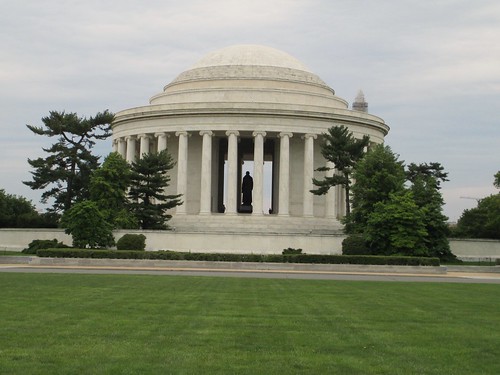
The Jefferson Memorial, during my great, trans-Washington
bike ride. Yeah, the picture's squint. I took it seated on a bike.
Get used to it already.

I made a connection between the hippocampus and my getting about by bike when I heard about Eileen Maguire’s research on taxi drivers. In a series of studies, Prof Maguire – of University College London - has examined changes in the posterior hippocampus in London taxi drivers as they first learn the Knowledge – the test they have to pass on the city’s geography – then apply it. The posterior hippocampus – the rear part of the structure - tended to be bigger and more complex in drivers who had passed the Knowledge than in would-be drivers who had failed it, she found.

My brain, I recognised, was probably undergoing similar changes to the taxi drivers’. The gradual trial-and-error process of learning how best to get to a place – the frustration at missing that vital turning again, the fear at suddenly finding oneself unintentionally on an over-busy road, the satisfaction on finally getting a route right – were playing themselves out in my hippocampi. New neurons were growing and new connections were forming as I gradually built up a more solid picture of the best ways to get about.
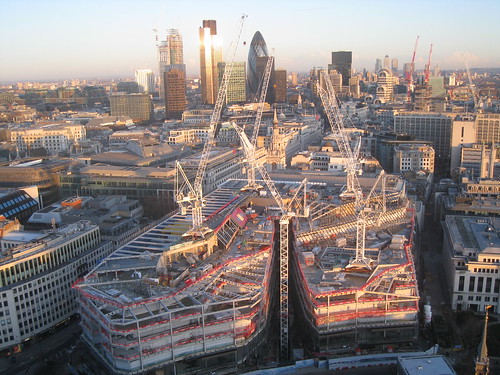
Streets in the City of London: it may look a mess to you -
but the Invisible Visible Man's mental maps can help you
round this maze

The process, however, has been nothing like as clinical as a neurophysiological description might imply. I recall, for example, how, shortly after moving south from Edinburgh in 1997, I set off, cycle map in pocket, to work out my route from home in Brixton to my employer’s offices. The 4½ mile journey took me 45 minutes of missing turnings in my bike route, failing to understand how traffic flows worked and repeatedly checking the map.

Latterly in London, I could make it home on a good night in 20 minutes – albeit down busier main roads. My mental map of South London’s cycling routes could switch more smoothly and efficiently than any satellite navigation device. By the time I left London, I knew every pothole and manhole cover of many of the roads I’d cycled most often, preparing to avoid them well before I had reached them.

My mental map spread well beyond my regular commuting area. I’d feel a little surge of excitement if, for example, I got invited to some press event 15 miles from the office in Wembley. Why, I hardly ever got to use my carefully-memorised route out to that area, I’d think to myself. I was surprised and delighted one time when I found another reporter had made the same decision as I to cycle from Central London. We earnestly swapped thoughts on busy roads and helpful shortcuts.
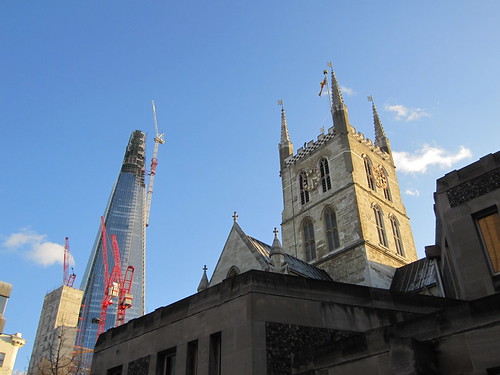
 
The Shard: on my route to City Airport
It was my enthusiasm for the route that gave me a bias in favour of flying from London City Airport. My route for the 13 or so miles from my house to the airport – which distinguished itself by having good bike parking – was, I often felt, something of a work of art. I would pedal across the Thames, down Cable Street in the densely-packed East End, past Canary Wharf, then out into the grim housing estates of still working-class docklands. I would encounter evidence of every period in London’s history, from the Romans to the new Shard skyscraper. There can be few better ways of feeling at one with a city than to know intimately a route like the one I used to reach City Airport. It would take me from a beautiful but obscure quiet Georgian Square then out across the internationally-recognised landmark of Tower Bridge.

I’ve experienced something similar in New York. When apartment hunting, I found myself a couple of times nastily off course – on the wrong side of a busy expressway from where I wanted to be or careering down a six-lane avenue of scary, fast-moving traffic. But I know my mental map of the city is slowly but surely stitching together, somewhere in the back of my hippocampi. Without thought, I head north a couple of blocks to avoid the most constricted sections of W54 street most mornings, then south again before the office. I’ve been trying out a route up the east side bike path some other mornings. I take joy in now knowing the Lexington-Park-Madison-5th sequence of avenues I cross as I head to work. But I shun that route in the evenings, well aware, after previous experience, of the miseries of trying to head southbound on 2nd avenue.

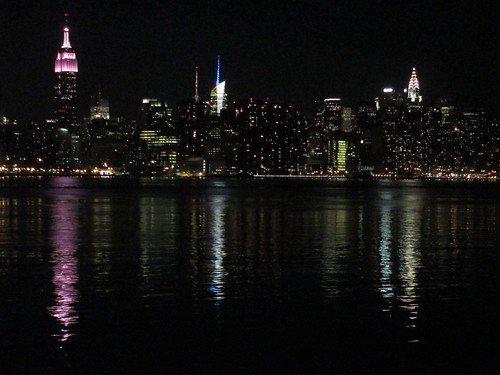
The Empire State Building in pink:
cycling to photograph it was more fun for me than a party
I felt that same sense of having access to secrets of the city closed to others when, one night recently, my employer organised on the Upper East Side a party to celebrate its 125th anniversary. As others headed off afterwards to an after-party, I made excuses – but knew my main motivation was my desire to try the way home I’d crafted in my head. Before long, I was bowling down from the top of the Queensboro Bridge’s bike path, which I last used regularly in the aftermath of Superstorm Sandy. Then I was into Queens and navigating streets under elevated subway lines so romantically urban they should have had a permanent Chicago Blues soundtrack.
 
I looked across as I headed down the East River at the Empire State building, lit up pink in honour of the anniversary. I was, I felt sure, enjoying myself far more on this solitary exploration of the city than anyone yelling at a colleague to be heard over the music at the party.

Which brings me back to Washington.

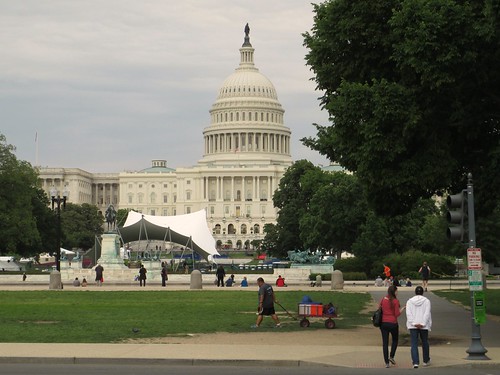
The US Capitol: how to get there by bike is now fixed in
the Invisible Visible Man's hippocampi
Whatever my initial misgivings, they disappeared immediately I found myself on a bike path by the Potomac and catching my first glimpse of the Jefferson memorial and US capitol sitting on the other side. I sped – as much as one can on a bikeshare bike – over the 14th street Bridge and slowly worked out the best route along the National Mall. A little bit of guesswork once I’d got north of Pennsylvania Avenue and I was finally at the station, embarrassed to find myself feeling little less elated than Edmund Hillary can have felt on his first conquest of Everest.

But there were, it came to me, few satisfactions in life more total than completing such a journey. I had set out to tackle a challenge and, as I pushed the bike back into the docking station, comprehensively conquered it. I had made the journey entirely on my own resources. And, somewhere in my two hippocampi, just as those rats in St Andrews learnt where the platform was, my mental maps for cycling in Washington and northern Virginia were starting to form.

Sunday, 20 January 2013

A blown nose, a blown world environment - and why some people confuse the two


It’s one of the few times I’ve managed seriously to annoy a motorist while stationary on my bike. One dark winter night a couple of years ago in London, I blew my nose while waiting at traffic lights. But, lacking the time to fish out a handkerchief, I snorted onto the road.

Traffic queuing in Miami Beach. Some of these cars might look to you
like polluters - but the drivers might think snot more offensive
It can’t, I accept, have made for a pretty sight. But the reaction of a woman in a car behind still surprised me. Leaning on her horn, she gesticulated her disgust wildly. The irony instantly struck me. In contemporary society, it’s regarded as entirely acceptable to make urban journeys in vehicles that spew out gases that will pollute and warm the atmosphere for a century or more. Clear one’s airways of a little biodegradable mucus, however, and one puts oneself entirely beyond the pale.

But the more I’ve thought about it since, the more I’ve realised the Outraged Driver of Kennington Park was exhibiting attitudes to environmental pollution and emissions very common in industrialised societies across the world. She regarded herself as having the right to an environment treated as she wanted. She felt perfectly entitled to criticise others’ treatment of that environment. Her attitudes, however, made no reference to any ultimate yardstick about the fate of the world environment as a whole.

I’ve said before on this blog that I am nothing like as exercised about environmental issues as many people assume cyclists are. I enjoy the overall sense that cycling is a rational way to get around – that it makes good use of scarce city space, that it contributes very little to congestion, that it keeps me healthy, that it’s enjoyable. It’s part of that picture that each trip contributes hardly at all to overall carbon emissions. But the environmental factors form only one corner of the overall scene.

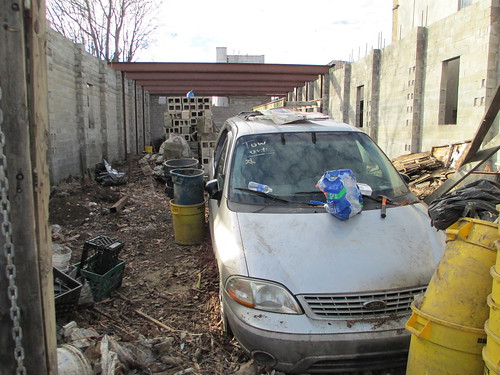
A car abandoned in the lot the Invisible Visible Man
helped to clear. Some scientists reckon the car's emissions
helped to cause the destruction in this corner of Brooklyn
That said, I regularly currently confront vivid evidence of the seriousness of the world’s environmental problems. Parts of the Hudson River Greenway, which I use for nearly half my daily commute in New York City, were under five feet – 1.6m – of water at the height of Superstorm Sandy in October. Many scientists think such extreme weather events are becoming more common as the world’s climate changes. Yesterday, I cycled down to Coney Island, one of the parts of the city worst-hit in the storm, to help clear out a vacant lot that was under seven feet of water on the night the record high water swept up New York Bay. The weather was so unseasonably mild that on the way home it felt oppressively warm. There’s an undeniable sense that climate change is becoming a more urgent, practical issue, which anyone who takes an interest in the wider world needs to address.

A modern, fuel-efficient container ship:
a surprisingly clean way to import food
Yet few of the responses to the issue rise much above the level of honking one’s horn at behaviour one dislikes. I’ve frequently heard it averred, for example, that it’s good for the environment to eat local, seasonal produce. But very few of the people who claim that can give a detailed accounting of local, seasonal produce’s carbon costs – even though the ships that import food to temperate, rich-world countries use remarkably little fuel. It’s certainly far from clear that buying fruit imported on such a ship from a country where it grows easily is worse than eating greenhouse-grown local fruit that’s come to the farmer’s market in a small, inefficient van.

Railway lobbyists also make blanket claims that their transport mode is invariably more environmentally friendly than using a car. But, while that is undoubtedly true for a well-filled train in the London rush hour, it isn’t true for a nearly-empty train spewing diesel fumes into the air to move a couple of passengers to their destinations. When I lived in the UK, my most regular long-distance rail journey was London to Chester on a Super Voyager diesel-powered train. I would give a rueful smile as I remembered that the complex, heavy but fast train issued much the highest level of emissions per seat mile of any UK train model. It was, on average, a better environmental bet to take the train for that journey than to hire a car. But the margin was not very wide at all.

There are some similarly questionable attitudes towards cycling’s environmental performance. I’ve recently come across a number of attacks on cycling’s environmental record that point out, for example, that manufacturing bikes produces carbon emissions – an undeniable point, which makes it clear that one shouldn’t replace one’s bike more often than necessary. Such attacks generally go on to point out that fuelling a bike involves carbon emissions. There are carbon costs to moving the extra food that cyclists eat that they otherwise wouldn’t. And the food generates emissions that the Outraged Driver of Kennington Park would presumably dislike even more than mucus – in the form of methane, a far more potent greenhouse gas than the carbon monoxide from cars.

The most entertainingly bonkers attack of this kind I’ve encountered was a recent blogpost from an Ian Pearson who claims to give “a more accurate guide to the future” (How can he tell?) on bikes’ carbon performance. Cycling might well, Mr Pearson accepts, produce next-to-no carbon emissions per kilometre. But, when a cyclist rides in traffic, he asserts, the extra carbon cost of attending to accidents – and the effect on cars’ carbon performance of slowing down then accelerating to overtake cyclists – probably produces so much extra carbon that it would have been more environmentally friendly for the cyclist to go by car.

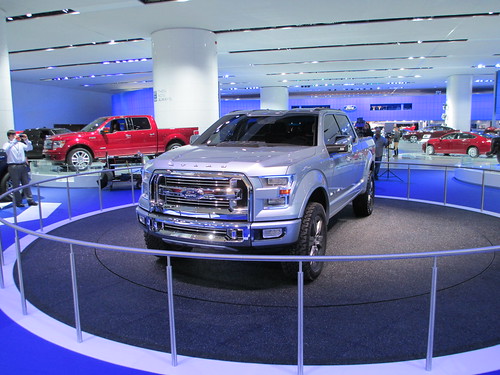
This new Ford pick-up truck concept will be more fuel-efficient
when it launches than its current equivalent.
But that won't make its drivers necessarily
friends of the environment.
The common thread between all these questionable assertions is that they treat the environment’s fate as an abstract matter – as susceptible to objective observation as the question of how to live the good life or whether God exists. People who profess concern about the environment often have a bias in favour of things that appear traditional and prepared without the benefit of complex, modern scientific advances. Many assume locally-produced food must be better for the environment because, well, it feels as if it should be. Similarly, people who are relatively unconcerned about environmental issues have a tendency to work back from their own behaviour to a spurious justification. “My car’s not as polluting as it might be” gets rationalised into “I am environmentally virtuous”. “I don’t like manoeuvring around these cyclists” becomes “these cyclists are bad for the environment”.

Yet, for the effects of air pollution and global warming, it is ultimately possible to estimate the effects objectively. Scientists now have a reasonable idea of what kind of damage different levels of carbon emissions produce. It is even possible to come up with rough figures for the costs that different kinds of emissions impose on wider society.

In a rational world, governments would now be rushing to take the guesswork out of estimating environmental impacts. Food products would include a label detailing the carbon costs of their production and include a tax reflecting them. Air tickets would include something similar, while the carbon costs of burning each unit of fuel would form a clear and distinct part of the petrol price at the pump. Past experiments with introducing new prices for previously-free goods – such as the Central London Congestion Charge – suggest consumers would move swiftly away from the most environmentally damaging behaviours towards less damaging ones.

I am robustly confident that such an exercise would make far clearer than the existing tax systems in most rich-world countries that bikes have big environmental advantages over most other transport modes. It is hard to imagine that the change would not significantly increase cycling levels.

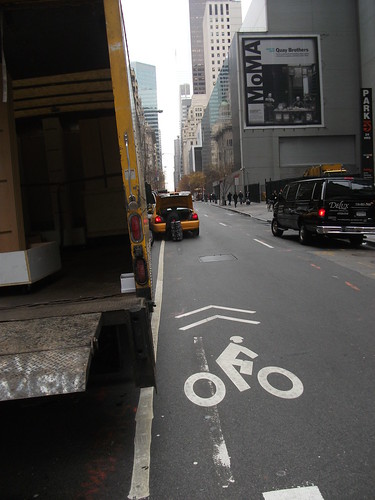
A bicycle sign on New York's W54th street:
the kind of decisive action on the environment
that many governments are taking
The challenge, however, is that such a move would upset groups commonly supposed to be hugely influential – motorists, regular air-travellers and the owners of big houses – while pleasing few others. Governments consequently lay down a few cycle lanes on the roads, offer some subsidies for electric cars, meet some of the cost of better home insulation and generally gesture vaguely in the environment’s direction. Action that would make a real difference remains resoundingly untaken.

Yet that, perhaps, should be no surprise. Across the industrialised world, governments depend on the votes of people as inconsistent as the Outraged Driver of Kennington Park, Ian Pearson and, come to that, each of us reading (and writing) this blog. There’s no firm consensus yet among all those people in favour of firm action to rein in the galloping horse of the worsening global climate. That many governments consequently seem little more rational on the issue than an irritated, late-night driver may be sad – but it is depressingly understandable.

Sunday, 9 December 2012

Washington, a stabbing - and why an individual cyclist tells you nothing about the rest

Washington, DC surprises me every time I visit. While New York feels just as bustling, large-scale and chaotic as the films and TV programmes would suggest, the US’s capital feels nothing like the West Wing. Sure, there are people influencing the whole world’s fate in lots of those neoclassical buildings – but Washington’s atmosphere most reminds me of other sleepy US administrative capitals like Richmond, Virginia or Harrisburg, Pennsylvania.

Washington, DC: provincial to me
- but full of cycling savages according to one Facebook user
During a visit last week, it nevertheless occurred what an advantage it was that Washington seemed a far calmer place than New York to ride a bike. The cyclists I saw during the visit mostly seemed to be riding sedately, calmly and in general harmony with other road users around them.

This was, however, entirely the wrong conclusion, according to at least one person I know. On Friday evening, two days after I came back from my DC daytrip, a Facebook friend commented on a story about an altercation between a cyclist and a motorist in North-West Washington the night I visited. The motorist appears to have somehow alarmed the cyclist, who responded by hitting the driver’s car with his D-Lock. The ensuing argument ended with the cyclist stabbing the motorist, who suffered rib injuries but looks likely to survive.

“Savages,” my Facebook friend commented. “Civility is an alien concept,” someone else replied in agreement. The clear implication was that I, as a cyclist, was complicit in an appalling, entirely unjustified assault of a kind I would never have contemplated.

My immediate instinct was to launch into an argument, pointing out the fatuousness of jumping from a single, knife-wielding cyclist to the implied generalisation – all cyclists are savages. Concluding that I was unlikely to change clearly entrenched attitudes, I limited myself to “unfriending” the person responsible.

But, as I cycled home that evening, a more mature reflection occurred to me – one sparked in part by the controversy in the UK over the inflammatory “War on Britain’s Roads” documentary. If it made no sense to draw a conclusion from a single stabbing - or the misleading footage of an alleycat race in the documentary  - to cyclists’ general behaviour, why did I feel free to criticise in general the culture of driving or the police? Was I making any more sense than my former Facebook friend?

One possible response to the “cyclists are savages” claim would, of course, have been to point to some of the numerous incidents of motorist-cyclist violence. In the space of a year of cycling in London, I suffered one actual – albeit mild – assault and had to make an emergency call to police to avert another. The first incident involved a bus driver who abandoned his bus – and passengers - to confront me because I’d photographed him blocking, illegally, a cyclist-only area at traffic lights. He smashed the mobile ‘phone I was using as a camera out of my hand. The second incident came as I tried to photograph a motorist I’d previously seen deliberately drive across the path of a cyclist who’d complained about his driving. He threatened – alarmingly convincingly - to smash up both me and my camera.

The most pertinent case I could have raised, however, was the stabbing in September of Colin Albright, a cyclist in Pittsburgh, whom a motorist pursued as he carried his bike away from a road up a set of steps. The motorist stabbed Albright repeatedly, including in the throat, possibly over some perceived slight involving a traffic incident.
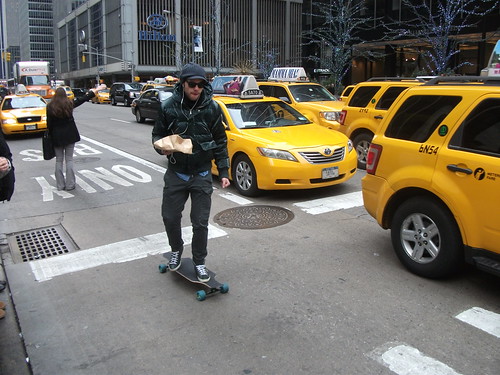
You might have prejudices about people who make strange
transport choices - like skateboarding down Sixth Avenue.
It doesn't mean you know anything about this individual skateboarder.

Albright’s case would have been pertinent precisely because it illustrates the absurdity of generalising from something extraordinarily rare – a stabbing over a disagreement on the roads – to the generality of day-by-day on-road relationships. In late October, Anthony Scholl confessed to attacking Albright. Scholl was already in custody over an alleged attempt to burn down his parents’ house. While there is little information so far on Scholl’s motive for stabbing Albright, the alleged arson attempt seems to have been aimed, in Scholl’s mind, at preventing his parents from killing him and feeding him to their (presumably imaginary) pet alligator.  Albright’s stabbing also looks likely to have stemmed from what Scholl’s mother has called his “psychological issues”. It seems similarly unlikely that the appalling Washington stabbing will turn out to involve an ordinary, mentally-balanced cycle commuter who just happens to pack a knife to mete out summary justice on uppity drivers.

That anyone could ever have thought the Washington stabbing had anything to do with broader cyclist behaviour, of course, stems from humans’ powerful desire to pin blame for problems on out-groups. The only thing so far known about the Washington motorist’s assailant is that he was on a means of transport against which large numbers of people have powerful prejudices. Few people have the mental self-discipline to avoid working on the basis of such limited information and their prejudices to jump to wholly unwarranted conclusions.

It’s telling, for example, that hardly anyone blames the antics of bank robbers’ getaway drivers purely on their being drivers. Drivers are too numerous and familiar to act as convenient out-group scapegoats. No-one sought to blame the assault I suffered or the threatened assault merely on the perpetrators’ status as motorists. I received, instead, some close questioning about the immigration status of the bus driver and the race of the man who threatened to assault me. Establish a link to immigrants or African-Caribbean men, the implication seemed to be, and the incidents were far more easily explained away.

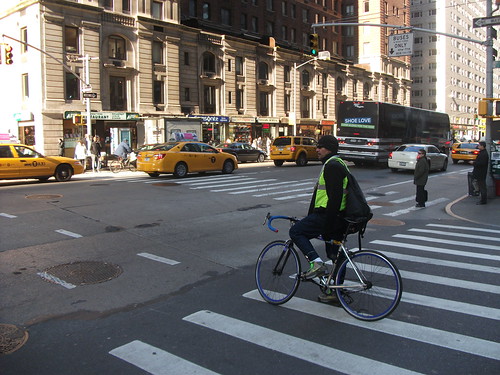
A cyclist, cars and pedestrians at 55th Street. Which of them
is a "savage" will be in the  eye of the beholder
The prejudices are all the more powerful for not appearing to the prejudiced to be prejudices at all. Have your eye out for poor cyclist behaviour in Washington and you’ll spot instances of such behaviour, rather than the courtesy and calm I witnessed. Assume the main road problem is the cyclists and you’re unlikely to spot the multiple ways motorists misbehave.

The truth is that, in all the incidents I’ve described, the attackers acted as individuals, rather than a member of a group. Their behaviour stemmed from their own characters or mental states, rather than their status as cyclists, motorists, bus drivers, immigrants or anything else. To imagine that the behaviour in a single instance of a single member of a large group has anything to say about the wider group as a whole is a thinking error of a kind that would be shocking were it not also fairly common.

That point could, of course, lay me open to the objection someone recently made in an online forum to my use of statistics to point out that cars generally posed a far greater danger to pedestrians than bikes. That was beside the point, the poster wrote. Each motorist or driver differs so much that it makes no sense to discuss a general level of risk from motorists or cyclists. A very poor cyclist could conceivably pose a greater danger to a pedestrian than an extremely careful, conscientious motorist. I am perhaps particularly vulnerable to such a charge because of my habit of illustrating points on this blog by reference to specific – usually extreme – incidents that I take to illuminate a wider truth.

Yet I have, I hope, been careful when complaining about general problems to have sought evidence that my experience speaks to a broader reality. It remains a verifiable fact, for example, that motorists kill a disproportionately high number of other road users in both the UK and New York City. Collisions with cyclists in both places account for a far lower proportion of road fatalities than cyclists make up of road traffic. Research in New York suggests motorists’ failure to yield as required to pedestrians is the biggest single cause of road deaths. Research in the UK suggests failure on motorists’ part to pay attention causes a disproportionate number of crashes.
Court Street at night. Just because most motorists speed here
doesn't mean they all do.

It makes sense on such a basis to say there is a general problem with motorists’ failure to yield to New York pedestrians or to pay proper attention in the UK. I am even confident enough in my own judgement to diagnose a few more local, unmeasured problems. There is, for example, a general problem that many motorists regard Brooklyn’s Court Street as an appropriate place for excessive speed and not somewhere where cyclists’ requirement for space on the roads need be considered. It just doesn’t make sense to predict on this basis that the next motorist one encounters on Court Street won’t be a model of caution, courtesy and respect.

I feel acutely sorry for the victim of the Washington stabbing. His experience last Wednesday must have been appallingly frightening. I trust the District of Columbia police will swiftly identify the attacker and bring him before the courts. I wish the victim a swift and smooth recovery. But I also devoutly hope that no-one in future will make the lazy and offensive mistake of imagining any of what happened had anything to do with me.

Sunday, 18 November 2012

My ride to work - and why the cars resemble little hurricanes

Very few of the runners, stroller-pushing parents, drunks and others who wander into my path each day on the cycle lane up New York’s Hudson River Greenway strike me as especially brilliant people. If they were, they might spot the signs telling them they’re not allowed on the path and stick to the rather pleasant waterside walkway that’s been provided for them.
The runner on the left has, remarkably, chosen the footpath on
the Hudson River Greenway. One can only hope she made
the kind of solid risk assessment the Invisible Visible Man advocates

But, disturbingly, the cycle lane obstructors (CLOs) seem to be better at prioritising the risks facing pedestrians than the head of the New York Police Department’s traffic squad. The CLOs have decided that, if they’re going to obstruct traffic, it’s many, many times safer to get in cyclists’ way than cars’. Having so far seen hundreds – possibly thousands – of CLOs in four months’ cycling in New York, I’ve yet to see one choosing to take his or her chances running down the fast-moving, multi-lane West Side Highway next to the cycle path.

Yet Brian McCarthy, a deputy chief of the NYPD with responsibility for traffic policing, explained in October to WNYC, the public radio station, why its ironically-named Operation Cycle Safe – the programme that focuses police resources on fining cyclists, rather than the road users that cause traffic deaths – was now mainly tackling riding on the sidewalk (pavement, British readers). This behaviour, he reasoned, posed particular dangers to pedestrians. But, while I can find no recent record of a cyclist’s killing a pedestrian on a New York City sidewalk, it is depressingly regular for motorists to do so through excessive speed or lack of attention. The NYPD barely ever prosecutes the motoring offences that lead to such deaths. Its prioritisation is so skewed that, for it to be correct, I should probably be spotting runners every morning taking their chances with speeding SUVs on the highway, away from the terrifying bicycles.

The contrast between the CLOs and Deputy Chief McCarthy illustrates something profound about the vagaries of human beings’ efforts to assess risks. Most humans are reasonably adept at spotting and assessing the most immediate dangers. It’s pretty clear even to a stupid, inconsiderate runner unconcerned about inconveniencing others that it’s less foolish to take the chance of a collision with a cyclist riding at 20mph than a motorist driving at 50mph (the West Side Highway speed limit is 35mph – fun fact that most motorists entirely ignore). Very few people, however, are good at assessing risks in an abstract context such as a decision about how to allocate police resources. The NYPD, as I pointed out in a previous post, hands out 5 per cent of its traffic violation tickets to cyclists, way out of proportion to cyclists’ roughly 1 per cent share of city traffic. But a cyclist last killed someone in New York City in March 2009 – and even that incident wasn’t on the sidewalk. Around 1,000 people have died in the time since at the hands of motor vehicles. A sober risk assessment aimed at bringing down the number of deaths in the city would target an entirely different set of behaviours.

The problem appears to be a widespread one. In the UK, newspaper reporting about the crash that injured Bradley Wiggins – one of my great heroes – ended up producing the same, predictable commentary claiming cyclists endanger pedestrians and, somehow, cars. That’s even though the Tour de France winner’s accident involved his colliding with a car that seems to have pulled out into his path from a filling station without looking. In other words, people started complaining on the basis of the kind of accident that happens quite a lot (one where a negligent motorist injures a cyclist) about things that hardly ever happen – accidents where cyclists hurt other road users.

The question is whether it’s possible to get better to get better at understanding the risks the roads and other places pose - and to start reacting to them more rationally.

A subway station closed for Hurricane Sandy. New York's subway
turned out to be better at assessing risk than many New Yorkers.
My mind’s been particularly drawn to risk assessment in the last three weeks because of events in my new home city. At the end of the week when superstorm Sandy hit New York, I took a trip to Staten Island to report on some of the damage there. Person after person told me they’d ignored the evacuation order for the area on the grounds that a previous hurricane last year – Hurricane Irene – had mostly turned out less damaging than expected. As the sea swept in and inundated their street, they found themselves cowering in their homes’ upper storeys, with waves lapping at the windows even there. A person died in the basement of one of the houses in the street I visited, electrocuted when he stepped into flood water that had electric current flowing through it. The storm was on an entirely different scale from Hurricane Irene.

That miscalculation, it seems to me, is of a piece with people’s miscalculations about road use. In both situations, people rely far too much on personal experience and the evidence of their own senses. In the run-up to the storm, it was clear that the city was very windy but not immediately obvious that the storm would cause historic levels of damage. To realise that, one had to pay attention to something one couldn’t see – the vast storm surge that forecasters were predicting that was preparing to push its way into New York Bay to flood large tracts of the city.

Many people assessing the risks of cycling, meanwhile, look at cyclists in traffic and conclude that the slender, unprotected machines among the big metal boxes are more vulnerable than most figures actually suggest them to be. They see a cyclist on a sidewalk and assume that his greater speed compared with the pedestrians makes him a significant risk to them. It only adds, it seems to me, to people’s irritation with cyclists that bikes are quiet and people tend to notice them only at the last minute. This seems certain to trigger the kind of last-minute, fight-or-flight response that must have been useful for vulnerable cavemen. It’s a far less reliable indicator than people think of the risks around in a complex, modern urban streetscape.

Most people have particular lacunae when it comes to rare events that pose catastrophic risks. A hurricane is precisely such an event. There are fine, hard-to-discern differences between a hurricane that will do little damage – as Hurricane Irene did – kill scores of people and do billions of dollars of damage – as superstorm Sandy did – and one that will kill many hundreds – as Hurricane Katrina did. It is far beyond a normal person’s gut instinct to discern which storms need special attention, yet ordinary people continue to use their gut instincts to assess how they should react.
The motorists are blocking the bike lane. The cyclist's too close to the cars.
And they'll probably all get away with the risks they're taking.

In a road context, the catastrophic events are crashes involving cars, buses and trucks. It’s so common to see motorists driving while ‘phoning, speeding, giving cyclists too little room and so forth that it’s easy to conclude that these behaviours are trivial and pose little risk. Many people compare them with the alarming experience of finding a cycle messenger rush past their nose on a pedestrian crossing and conclude that it’s the cyclist who poses the real danger. The truth is that each time a motorist drives too fast, drives while distracted or turns without looking for cyclists he or she is involved in profoundly risky behaviour – and it’s only the luck of the particular circumstances that divides the outcome from nothing at all and a multiple-fatality crash.

People are still more blind to their actions’ long-term consequences. Almost no-one sees a cyclist on a busy street and remembers that he or she is far less likely to die of heart disease or diabetes in several decades than the neighbouring motorist cursing him or her from the exercise-free cocoon of his or her motor car. The global warming that may be making hurricanes more frequent is a still more remote such risk.

None of this is to excuse stupid behaviour by cyclists. It’s worth stopping for red lights, giving pedestrians plenty of space and going the right way up one-way streets. It shows an example of good practice and avoids annoying one’s fellow citizens. I do my best to obey the rules.

But industries prone to catastrophic but rare risks – the nuclear power industry, for example, or railways – tackle them by looking for the near-misses and minor accidents that suggest people are indulging in risky behaviour. Police forces that hold off warning motorists about dangerous behaviour and minor accidents explicitly miss the chance to follow such a policy.

I at least can do my part. I accept that runners will bound into my path on the Hudson River Greenway and cycle at a speed and on a line that means I should avoid them. I know that cars sometimes sweep across even some lightly-used crossings on the route from angles that are hard to see. So I stop for those red lights as other cyclists and runners speed past me, no doubt thinking me an over-cautious worrier. I do my best to assess when I’ve done something foolish and to avoid repeating the mistake. I can only hope that, as New York and other cities start to grapple with a future made more complicated by extreme weather, far more of those around me start to give the matter the same consideration too.

Saturday, 6 October 2012

Do as you like, motorists - and don't blame us for the deaths


It’s a disturbing scene to encounter on the way to work. Every morning recently that I’ve cycled to the office, I’ve come part way down West 54th Street on a badly-damaged airport shuttle minibus. The passenger doors on one side are mangled; the right-hand front wheelarch obviously took a heavy blow and the front radiator grille is nowhere to be seen. It was, I instantly recognised, the result of a crash with a large vehicle, travelling at high speed, hitting the bus then spinning round to hit it a second time. Some research suggests a Mercedes Benz sped up Sixth Avenue early on September 16 and hit the minibus as it crossed at 50th street. Some witnesses said the driver had been racing another vehicle. He was arrested on suspicion of drunken driving. Not surprisingly, given the vehicle’s condition, four passengers and the bus driver were badly hurt - one had a fractured skull, while others suffered head and neck injuries.
The crushed minibus of W54th street: yet more evidence
that cyclists are the true menace to New Yorkers

Injuries and deaths from traffic accidents like the one involving the minibus are growing more common after years of declines in New York. In the year to June, 291 people died in traffic accidents of various kinds in New York City, up 23 per cent from the previous year. The numbers of pedestrians and cyclists killed rose 11 per cent to 176. The same goes for the UK, from which I've just moved. Statistics released in the last week show 3 per cent more people died in road traffic accidents in the UK in 2011 than in 2010, well above the increase in traffic volumes. Civil servants and politicians in both places profess bemusement at the reversal of fortunes.

But it’s hard to believe the puzzlement is sincere. From a crime point of view, New York City has become a far, far safer place than a couple of decades ago – it's just the city won't use the policies it applied to crime to stamp out bad driving. In the UK, transport officials know that speed and traffic light cameras can sharply reduce road deaths – and have encouraged their removal because drivers don’t like them. The question is how many more minibus passengers and drivers have to be rushed to hospital on both sides of the Atlantic before the various authorities start to do something.

I’m lucky that both my encounters so far with officers of the New York Police Department have been fairly benign. On September 29, when I was riding across the Brooklyn Bridge towards Manhattan, I met a police officer leading thousands of people marching towards Brooklyn for a charity event. It wasn’t safe to cycle, he said, because of the numbers of people. I huffily dismounted and pushed my bike towards City Hall. A few weeks earlier, I’d passed a mounted policeman during my morning ride to work along the Hudson River Greenway. I then dutifully stopped at red traffic lights where a road crosses the path – only for the officer impatiently to tell me to get on with it and keep riding.

A typical Manhattan intersection, making it clear why the police
should prioritise cracking down on cyclists
Other cyclists' experience of the NYPD is very different. Last year, the NYPD issued 50,000 tickets of various kinds – for running red lights and so on – to cyclists, compared with only 25,000 for trucks. The division set up to get trucks to follow the law issued more tickets to cyclists than to trucks. Cyclists – who account for maybe 1 per cent of New York traffic and barely ever kill another road user – received around 5 per cent of all traffic tickets. Cyclists should follow the rules of the road, as should every other road user type. But the NYPD is so keen on ticketing cyclists that even perfectly legal cycling gets the treatment. At the height of the NYPD’s effort to intimidate cyclists last year, the filmmaker Casey Neistat received a ticket for cycling outside the cycle lane – which is simply not an offence.

The NYPD no doubt feels that its crackdown on poor cycling is simply bringing to road safety of the “broken windows” approach that’s generally thought to have helped to bring down other kinds of crime in New York. In the 1990s, Bill Bratton, then the police commissioner, and Rudy Giuliani, then New York’s mayor, told the police to tackle petty, “quality-of-life” pieces of anti-social behaviour, which they'd largely ignored before. Police started arresting vandals and the men who extorted money from motorists by cleaning their car windows at intersections. The approach is generally thought to have played at least some part in making the sitting a significantly less scary place to live. Cyclists certainly seem to be feeling the heat for some of the same reasons vandals and squeegee men started getting arrested. There are stories of community meetings with police where residents' top demand is a crackdown on allegedly scofflaw cyclists.

But it’s hard to imagine that broken windows would have been judged a success if the NYPD had concentrated on the squeegee men at the expense of going after murderers. It’s well documented that NYPD’s current policy for accidents involving cyclists is to investigate only if the cyclist has died or looks like doing so. Even then, the investigations seem to be perfunctory at best. While the fatality figures for the last year don’t give much detail on the nature of the fatal accidents, it’s clear that deaths of car occupants are the ones that are going up sharpest – and it’s essentially impossible that cyclists caused any of them. The city is determinedly not prosecuting motor vehicle crime.

A food delivery cyclist on 6th Avenue:
spreading fear, no doubt, among those he may imminently crush
That view seems in no danger of changing. Amid the alarming reversal in the safety statistics, New York’s latest transport safety crackdown is not on the trucks that I see careering at 50 mph up Sixth Avenue but on food delivery cyclists. I bow to no man in my irritation when I find a vacant-looking man on an electric-assist bike carrying chop suey the wrong way up a bike lane towards me. But, given the numbers of families losing fathers, mothers and children to bad driving, it’s mildly obscene that the focus is on a minor irritant of city life. I would feel even stronger, I imagine, were I, say, a relative of the woman killed in a particularly disturbing incident in late August in the West Village where the truck driver was so oblivious to the woman he hit that he dragged her body in his wheels for two blocks before stopping. The same must hold for the family of the young cyclist killed in an incident on Queens Boulevard on September 25, where the truck seems to have gone straight through a stop line. These are clearly incidents for which no food delivery bike, no matter how poorly ridden, could ever be responsible.

A well worked-out effort to tackle quality of life crime on roads in New York City  - or pretty much any big settlement - would concentrate on prosecuting motorists’ red-light jumping at the most dangerous intersections, failure to yield to pedestrians when required, illegal turning across other vehicles’ paths and excessive speed, especially at the most deadly junctions. Perhaps most importantly, it would try to stop people driving while distracted by their telephones or iPads - an area where prosecutions have fallen sharply even as the habit has become more and more widespread. The strategy, in other words, would seek to catch the kind of person who thinks it’s appropriate to race a Mercedes up Sixth Avenue - and address his behaviour before he ploughs into a minibus. The problem, of course, is that speeding motorists are, by their nature, hard to catch. It can be tough to gather the evidence to prosecute a car driver for dangerous but non-fatal behaviour such as deliberately driving intimidatingly close to a cyclist (a regular event in New York). Police forces everywhere have a predeliction for detecting offences that have a 100 per cent clear-up rate, of which cyclists’ light-jumping is a perfect example. The offence will almost never be reported except by a watching policeman. The offender is easy to catch and unlikely to argue his or her innocence successfully.

The change in tone in the 1990s in policing in New York City – and many other large cities worldwide that followed its lead – resulted from a revolution in thinking. City bosses realised it was no longer acceptable to let crime make parts of the city uninhabitable. The puzzle is why such thinking goes only as far as the kerb, and not onto the roads.

A van yields to pedestrians in mid-town Manhattan:
life would be better if this always happened
The British statistics, meanwhile, take me in my mind back to May 2010 and the day when I and other reporters were ushered into a room in the UK’s Department for Transport to meet Philip Hammond, the then-new UK transport secretary. “We will end the war on motorists,” Hammond told us, a keen glint in his eye no doubt reflecting his personal excitement at gaining greater freedom to drive his sport cars. One peace dividend for the motorists was a cut in funding for speed and traffic light cameras. Local authorities weren’t exactly told to take the things down – but the government did the next best thing. It stopped telling them they had to use some of their central government money for cameras - and cut the funding for road safety spending greatly.

The ensuing changes took me a little under a year later to the village of Nuneham Courtenay, on a stretch of the busy A4047 road just out side Oxford. Residents there had grown desperate enough to offer to pay to have their speed camera restarted. Cars that had been slowing down sharply through the village when there as a speed camera now swept through at 60mph. The same day I visited, Oxfordshire police were reintroducing speed cameras throughout the county after scraping together the money to pay for their operation. Because I knew plenty of places were simply abandoning speed cameras and I'd read research saying they saved 80 lives annually in the UK, I'd known for a long time that the UK's record of improving road safety was likely to be spoilt as it was by the recent statistics.

None of this is to say it's easy to stop future Mercedes bashing into minibuses. There's an urgent need to revise deep-seated attitudes about the priority given to cars and drivers’ rights. The driver who smashed into the minibus might, I suppose, have been a first-time offender whom an effort to target the riskiest drivers would have missed. But there’s a steady, demoralising stream of news at the moment on both sides of the Atlantic – a young musician killed on his bike in Queens, an elderly woman hit on a pedestrian crossings in London, a man hit on a crosswalk in Manhattan. As long as officials put off using speed cameras more and targetting the riskiest motorist behaviour, they're throwing away the chance to slow the flow at least a little.

Sunday, 9 September 2012

Farewell to London - where cycling's popular, but just on paper

It was the closest I’ve come in the last little while to ending up under the wheels of a car. As I cycled home from work in London on July 20, just by the Oval cricket ground, a car passed me far, far too close. I pulled towards the kerb and jammed on my brakes. But, amid precisely the kind of light drizzle that makes roads treacherous, the slippery surface of one of the London Mayor’s ironically-named Cycle Superhighways nearly did for me. I started to skid alarmingly, swinging side to side in close proximity to the speeding car. It’s the kind of incident I’m sometimes inclined to think may reflect my cowardice rather than the actual danger. But, as I slithered to a stop and my right pedal skinned the back of my calf, a pedestrian came up to me, looking worried. “Did he hit you?” he asked.

Brooklyn Bridge: a new focus for
the Invisible Visible Man's frustrations
Nasty though it was, my sliding stop at the Oval would not have been especially notable – except that it took place on my last commute for the foreseeable future in London. My route-to-work gripes are now about the stupidity of tourists on the Brooklyn Bridge, the traffic snarl of downtown Brooklyn and when precisely the large model rat that protesters have placed in one lane of W54th Street in Manhattan might disappear for good. The London mayor’s superhighways and the Metropolitan Police’s indifference towards anti-cyclist crime are fast becoming a distant memory.

W54th street: rat trouble
But the incident seemed as neat a bookend as any to 11 years of cycling in London – nine years during my most recent stint and two years prior before our four-and-a-half years in Hungary. As I thought about it afterwards, my mind wandered back to a dark January night in 1997 when I swung my leg over my then Raleigh Mercury bicycle and set off for my first-ever bike ride in London. I was at a car rental depot in Catford and had just returned the rented van that had brought my and the Invisible Visible Woman’s belongings down from Edinburgh. I had to find my way across the alternately grim and genteel suburbs of south-east London to my new home.

To hear London’s politicians bragging about their recent achievements in encouraging cycling, one would imagine that my journey 15-odd years ago should have been nearly impossible. In fact, there were already some designated cycle routes to guide me across tracts of non-descript suburbia such as Forest Hill. The journey was about as pleasant as a ride on a cold January evening in a strange area could be.

The Invisible Visible Man's Raleigh Mercury:
gaudy-coloured veteran of his first ride in London.
The memory of cycling all that time ago nevertheless put a question in my mind. Are London and other cities enjoying fast-rising cycling numbers rising because cities are making progress, learning from their past mistakes, in their treatment of cyclists? Or are cycling numbers increasing despite city authorities’ failure to understand what cyclists need?

It would be silly, naturally, to claim London cycling had shown no improvement over my time. The biggest positive change has been the wholesale redesign of many urban London roads. The space at many junctions has been narrowed, to prevent cars swinging round them at high speed. Many streets have been made to look narrower, a step that has brought motorists’ speed down. Parking spaces in many places are now more clearly marked as an area off to the side of the main carriageway. I used, when I first cycled in London, inwardly to ask drivers who’d prevented my swinging round a parked car, “How did you think I’d get round it? Fly?” It’s a line that popped into my head far less often later in my time in London than in the late 1990s. That it’s coming back to me again regularly in New York illustrates how big a lesson the Big Apple’s traffic planners have to learn from London in this area.

Cycle Superhighway 7 at Southwark Bridge.
This part still has a slippery surface -
but is at least protected from poor drivers
There has been some modest improvement in the quality of cyclist-specific infrastructure in London too. The number of bike parking places has increased sharply – albeit not as fast in many areas as the demand to park bicycles. The number of markings telling motorists to leave space for cyclists at junctions has increased. The cycle superhighways have appeared along a number of main roads, although my experience in July illustrates the problems with putting routes with slippery surfaces along busy main roads where nothing is done to prevent cars driving poorly.

But the curious point that my July 20 experience illustrates is not how much has changed since 1997 but how much remains the same, despite 15 years when every senior politician associated with London has expressed devotion to improving the cyclist’s lot.

I’d seen the motorist that buzzed me behind me at traffic lights and, seeing that he was driving a black, souped-up saloon car, guessed that he was likely to overtake me dangerously. Sure enough, instead of waiting for a safe place and space, he barged through as if, essentially, I weren’t there. Looking at it from the motorist’s point of view, perhaps that isn’t surprising. The British Highway Code certainly tells motorists they should give cyclists as much passing space as another car. But who’s reminding motorists of that point? Aside from a half-hearted Transport for London campaign a few years ago urging motorists and cyclists to “share the road,” there’s been almost no effort to educate motorists over ten years when cyclist numbers have doubled.

Copenhagen: other cities want the sense of cool -
but not the messy reality of cyclists
Yet almost none of the politicians or officials I’ve heard talking about encouraging cycling has seemed to have cyclists and cycling as their focus. Cycling was meant to cut road congestion, or reduce pollution or increase people’s physical activity rates. With some politicians, it’s tempting to conclude that they want mass cycling almost as a sign of their city’s coolness – look, our people cycle just like people in Amsterdam! Look, you could barely tell us apart from Copenhagen! A few years ago, there was a similar craze in Europe for planning light rail systems. Bikes seem, in more straitened times, to have taken over.

The result is that the people who make decisions in big cities seem ill-prepared for cycling’s messy reality. Since 1997, tens of thousands more Londoners have started pedalling into central London every morning. Most of them are in a hurry; many are no more considerate of their fellow road users than the motorists alongside them and all of them take up at least some space on the roads. The picture of cycling in many politicians’ heads seems to be drawn from the architectural drawings they show off when boasting about a planned riverside park or other “green” amenity. The cyclists in those never look like they’re in a hurry or like they’re shouting at some idiot that’s stepped into the cycle lane without looking. Many policymakers – and plenty of motorists – seem affronted when cyclists diverge from this unrealistic ideal. Nobody wants to spell out to motorists that, in a given road space, more cyclists means less space for cars. We’re  meant to take as little effort to pass as the paper-thin, pencil-drawn cyclists in the politicians’ drawings. People are happy if their neighbours free up a parking space by taking up cycling – and furious if they ever get in their way on the road.

It’s certainly not a London-only problem. Ten days after my permanent move to New York, I was bowling fast down a marked cycle lane in Brooklyn, reflecting that the lane was far too close to the parked cars. A car door suddenly opened, I jammed on my brakes and, just as I had in London, lost traction and skidded – once again fairly safely – to a halt. New York cycle lanes’ placing reflects the same, apparently widespread delusions as policy in London – that cyclists should take up no space, have no momentum and always be ready to give way to pretty much any other road user.

It’s not inevitable, however, that every politician will always prefer to let motorists set the agenda. The change that has done most since 1997 in London to boost cycling numbers was introduction in 2003 of a charge for driving into central London during weekday peak hours. The decision, by making clear the costs of road use, instantly removed large numbers of vehicles from central London's roads. Cyclists took up some of the freed space. Advisers to Ken Livingstone, London’s then mayor, advised strongly against introduction of the congestion charge, on the grounds that no battle with London’s motorists could ever be won. In recent mayoral elections, while candidates have proposed modifications, no serious candidate has suggested ending the charge altogether.

It’s hard to foresee the circumstances that would prompt a future London leader – or a mayor of New York or any other similar world city – to take firm action finally to prioritise bicycles properly over cars. Until it happens, there may be further, incremental rises in cyclist numbers of the kind London has experienced since 2003. But proper progress will require real boldness.

Monday, 13 August 2012

Commuting, Racing - and the French col climb in our heads

For a week of the Invisible Visible Family’s recently-completed family holiday in France, I had the task every morning of going to fetch supplies of bread, croissants and other ingredients for a continental breakfast. Jumping aboard my bike, I’d sweep down a hill and around the series of turns that took the road through the nearby village. Hunched down on my drop handlebars, I was, of course, in my head leading some audacious breakaway on an etape of the Tour de France. I could almost see the smiles on the faces of the gap-toothed peasantry of Dampierre sur Boutonne lining the roads to cheer me on.
The chateau at Dampierre sur Boutonne: its townspeople
would have cheered the Invisible Visible Man on,
except that the race was only in his head.

But the illusion would quickly break down on the return journey as I ground my way back up the hill. A baguette would be protruding from a pannier bag and a load of jus d’orange and pains au raisin would be slowing me down. I felt again what I truly am – a person who gets about by bike, rather than a sportsman.

Following this year’s Tour de France and Olympics, there has been no shortage of opportunities for British cyclists to reflect on the links between our day-to-day cycling and how Bradley Wiggins rides a time trial or Chris Hoy attacks a track sprint. We’re engaged in many senses in entirely different activities. Bradley Wiggins and Chris Hoy shave their legs to achieve maximum aerodynamic efficiency. I cart around 10 kilos of spare weight just because I won’t lay off the beer in the evenings. It has nevertheless made me happier than perhaps any previous sporting result to see Bradley Wiggins – a cyclist intimately familiar with some of the same London roads that I have ridden so often – control so comprehensively the Tour de France. I couldn’t quite speak for choking up as I described to the Invisible Visible Woman how Chris Hoy from Edinburgh – a city whose streets I have cycled hundreds of times – had won the Olympic keirin.

The question is whether my reaction to British cyclists’ victories reflects anything at all in common between what we both do. Is cycling mainly a sport or just a way of getting about? Should it be mainly a sport or a way of getting about?

It’s worth stressing quite how miserably humiliating my efforts to coax my big, lumbering body into sporting activity have generally proved. I recall, for example, 30 years ago entering the back stroke at a Glasgow Boys’ Brigade swimming gala. It took my fellow competitors the same time to complete both lengths of the race as I did for my first. The difficulty in telling my back stroke from the thrashings of a drowning boy led one of the organisers to inquire after my wellbeing.

The Invisible Visible Man at play: does this honestly look to you
like a body that should be undertaking triathlons?
The swimming gala came back vividly to me when, a few years ago, a chirpy public relations man suggested that, since I was a keen cyclist, I should undoubtedly compete in triathlons, as he did. I also recalled how I had often accompanied my asthmatic and chronically obese classmates in the trailing group on my school year’s annual cross-country run. The run – which was sponsored - was perenially used to raise funding for a desperately-needed new drainage system for the school’s sports fields. Since the event was run mostly round said sports fields in the midst of a Glasgow winter, my group consisted predominantly of overweight, mud-spattered boys, many reaching for their asthma inhalers amid the gathering mid-afternoon gloom.

My automatic reaction when asked to participate in a sporting event is, in fact, to start feeling humiliated. That stems in part from an incident when a PE teacher taught me and my 12-year-old classmates how to throw a discus. We then each had a go to see which would go forward to the school sports day. Ever the optimist, I was convinced I could improve after my initial, laughable effort and put my hand up when the teacher asked if anyone wanted a second go. “Don’t waste your own and everyone else’s time,” he replied. I focused attention on the school choir and public speaking instead.

I should, in other words, be easy prey for the view - which I’ve seen expressed in the British Cyclists’ Touring Club magazine but which could equally apply to American cycling - that the focus on sport has been bad for cycling more widely. Visit a bike shop in Britain, so the argument goes, and most of the options on dipslay will have been designed primarily – with fancy gears, lightweight frames and no mudguards – to help people finish races more quickly than their rivals. According to this argument, there’d be more people cycling to work in Britain – or America – if the average bike shop resembled one in the Netherlands. They should be full of heavy, practical bikes with mudguards, upright riding positions and the gears hidden neatly inside the wheel hub. Cycling should be just a faster form of walking, proponents of this position sometimes suggest.

That view has the substantial merit that it explains why some sights I encounter as a commuter cyclist seem so absurd. Along the Hudson River Greenway in my new home in New York, I encounter many commuter cyclists engaging in the rough equivalent of driving a Formula 1 or Indy racing car to work. Perched on high-end road bikes costing thousands of dollars, they must end up splattered with muddy water when it rains and the bikes must suffer appalling damage from New York’s streets. It would be no surprise, after all, if it some New York road surfaces turned out to have been deliberately maintained by Nasa as test beds for new rovers destined for distant, crater-pocked planets.

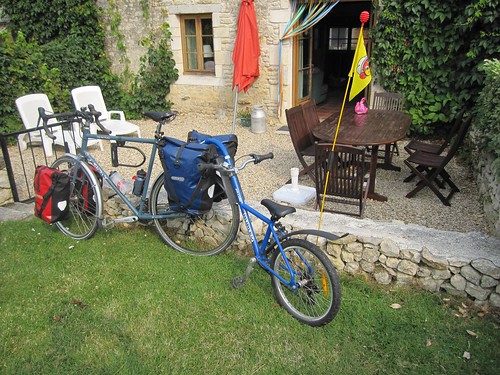
The Invisible Visible Man's bike, in France.
Sure, Bradley Wiggins, you can win the Tour de France.
But could you manage a load of four panniers,
a trailer bike and a four-year-old?
Yet, even for an ill-co-ordinated incompetent such as me, there remains far too much fun in riding a bike fast to reject the link with sport altogether. I can, after all, coax my touring bike into managing journeys in the countryside at an average of around 16mph (26kph) and can get up to around 50kph in favourable conditions. It’s not, I admit, much compared with Bradley Wiggins’ 49kph average for the whole Olympic time trial, but it gives me a sense of achievement. I even, in a moment to counterbalance the snarling of my school PE teachers, had the satisfaction four years ago of being complimented on my speed by a fellow cyclist. After I held off his efforts to overtake me for several miles of our joint commute home, he found me at some traffic lights and advised I try riding at the local velodrome. “You’ve got a fair turn of speed,” he said. If I can manage that, it seems sad to tell the many others with real sporting talent that they should be riding bikes incapable of a decent pace.

I’m sometimes baffled too by the idea that slow, Dutch-style bikes are a realistic option in the biggest cities. My new commute to work is around nine miles each way. Treat that as an opportunity for a slightly faster form of walking and I’ll be turning round to head home as soon as I arrive – for the few times I make the trip before they sack me.

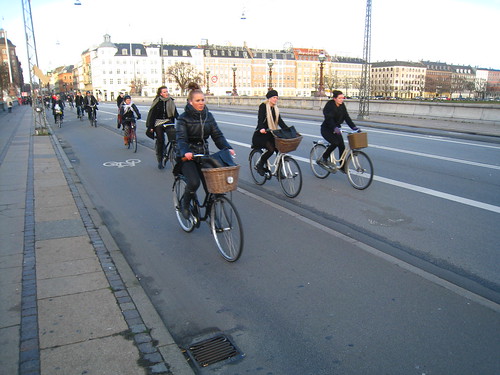
Bikes in Copenhagen: they're sensible, practical
- and barely any fun to ride at all
There isn’t, as far as I can see, much link between a country’s cycling sport success and its people’s propensity to use bikes for transport. Three of the countries with the most glittering records in the Tour de France – France, Italy and Spain – all have lower or similar proportions of journeys by bicycle than the scarcely cyclist-mobbed United Kingdom. The two countries with the highest cycling levels – Denmark and the Netherlands – have both produced distinguished riders in the Tour de France but have generally enjoyed less success in cycling sport than might be expected from the numbers riding a bike every day.

Nevertheless, I can’t help feeling that British cycling’s sporting success has to bring at least a small dividend for the country’s commuter cyclists. A few drivers may, perhaps, briefly regard cyclists not as worrisome obstacles to get past but future Victoria Pendletons or Laura Trotts whom they should respect instead of despising. I, like I suspect many other British cyclists, am holding my head a little higher – or perhaps lower, given the position’s superior aerodynamics – when cycling. I’m deeply proud to come from a country with such a powerful cycling sporting position.

It’s not, I suspect, the kind of benefit that many of Britain’s victorious cyclists were seeking when they underwent their years of painful training and conditioning. It is, however, one of many pleasures their achievements have given me. On behalf of every commuter who’s scaled an imaginary Col du Tourmalet while cycling to work, I salute them.