I've long been keen when reading history to study the people who were really, seriously wrong about things. The people who airily dismissed Charles Darwin seem almost as interesting in their pig-headedness as the great man was in his insightfulness. I'm interested in the prelates that persecuted Galileo or, on a smaller level, the Daily Mail editor who refused to believe his fashion editor the miniskirt would be a hit.
I'm consequently intrigued to think how fascinating Rod Liddle of the UK's Spectator magazine will seem to future generations. He has a remarkable knack of stating with verve, passion and an absence of judgement rotten
arguments that time will surely only make smell more putrid. It’s even a
matter of some pride to me that this blog provided the jumping-off point for a piece by Mr Liddle – think a low-rent, less-coherent PJ O’Rourke, American readers - that I predict could face ridicule for decades or even centuries to come.
 |
| The Invisible Visible Man's helmet: of note, a lack of pomposity and, come to that, points |
My first concern, however, is to ensure than no-one mistakes Liddle’s piece on cycling in the latest Spectator – entitled “Off
yer bikes! Cyclists are a menace to society — and self-righteous to boot” – for
a serious, thought-out argument about cycling’s merits. As with other recent
attacks on cyclists – including that by Dorothy Rabinowitz in May on the Wall Street Journal’s website - the piece’s few factual assertions crumble into nothing on any examination. The rest of the argument rests on allegations made noisily, in the apparent hope their volume will make them seem more convincing.
The nature of Liddle’s thinking is clear from his targets. There
are, to be sure, the now-traditional self-contradicting attacks on people who
cycle on pavements (sidewalks, American readers) as well as those who ride on
roads; attacks on cyclists who are too slow and hold up traffic as well as
those who “whizz” by him. But Liddle also refers to the ownership
by cyclists he dislikes of “a pompous little pointy plastic hat, hilarious
goggles, a fatuous water bottle”. By the time a writer is imputing motives to
inanimate objects and shouting at them, I could understand why readers might be pulling me away from Liddle shouting, "Leave him! He ain't worth it!"
Yet I feel compelled to respond to at least some of Liddle’s ravings because they start off with a typically selective, misleading quote an old post on this blog (which he erroneously calls "The Invisible Cyclist") examining why some people feel such anger
towards cyclists.
 |
| My water bottles. They're trying to be fatuous - but just can't get animated about it. |
My post begins with an account of a conversation with a driver who wanted to intimidate me off the road so that she could get to the end
of a traffic jam faster. When I (inevitably) caught up with her, she moved
quickly from leaning on misleading points about the financing of roads to
suggesting that I, as a Scot, shouldn’t be in London . The post links (reasonably, I think)
the woman’s intolerance of my ethnicity to her intolerance of my being on a
bike on a road. I suggest that people’s unreasonable intolerance of people on
bikes has points in common with other forms of intolerance – including
homophobia and anti-gypsy prejudice in Eastern Europe .
It seems to me they all reflect a general anger at anyone who’s seen to be
doing something different. I go out of my way to make clear that gypsies, gays and other oppressed groups face far more wide-ranging problems than mostly well-off cyclists. But I suggest the feelings have a similar genesis.
Liddle, on the other hand, says I think I’m “special” because I ride a bike
and hence a Victim, complete with sarcastic capital V. He goes on to regret
that fewer cyclists are being killed annually on the UK ’s roads and attributes it to the
dead hand of Political Correctness. He then goes on to show a bizarre lack of insight into other people's thinking by saying that – hahahahaha –
he’s only joking but humourless activist cyclists won’t realise that. He doesn't seem to realise that people know he thinks he's joking when he says hateful things. It’s just that only a seriously unpleasant, callous fool regards
it as funny to joke about wanting cars and trucks to crush more people annually from a group he's decided to find annoying.
There were, as it happens, 118 cyclists killed on Great Britain ’s
roads in 2012, a 10 per cent increase on the number in 2011, in a period where
other kinds of road user fatalities mostly fell sharply.
 |
| My new glasses. Are these goggles ridiculous enough for you, Mr Liddle? |
I've made unusual choices, rather than being special in the sense of being morally superior. Only between 1 and 2 per cent of
trips in the UK ,
where I lived when I wrote the piece Liddle attacks, are by bike. Only 0.6 per
cent of commuting in the US ,
where I’m now based, is on a bicycle. I’m interested in why I experience a level of
anger when I’m riding a bike that I simply wouldn’t while walking or taking
public transport. Someone, for example, threw a bottle at me as I rode home
from church on Sunday evening, something I’ve experienced several times while
cycling. I’m curious why some people, Liddle included, find cyclists self-evidently suitable targets for particularly intense scorn and rage.
The piece does at least make a pretense at wheeling out a few rather shop-worn facts to try to back up the simple assertions. Liddle writes, for example, that it’s more dangerous to be a pedestrian in theUK
than a cyclist. An examination of crash statistics for 2012 shows that the UK suffered an
average 38 fatalities for every billion miles cycled, against 37.6 fatalities
for every billion miles walked. Liddle also asserts that it’s necessary to pass laws to rein
in cyclists to protect pedestrians such as him. Yet of the 420 pedestrian
deaths in Great Britain
in 2012, only 2 – 0.48 per cent – were a result of collisions with cyclists,
which accounted for 0.11 per cent of all road deaths.
Given that bikes account for, say, 2 per cent of traffic – and far more in the busy places where most pedestrians are hit – it’s obviously disproportionately safe for pedestrians to be around cyclists. There is not the slightest evidence for Liddle’s assertion that injuries to pedestrians from cyclists are rising.
The piece does at least make a pretense at wheeling out a few rather shop-worn facts to try to back up the simple assertions. Liddle writes, for example, that it’s more dangerous to be a pedestrian in the
Given that bikes account for, say, 2 per cent of traffic – and far more in the busy places where most pedestrians are hit – it’s obviously disproportionately safe for pedestrians to be around cyclists. There is not the slightest evidence for Liddle’s assertion that injuries to pedestrians from cyclists are rising.
In a rational world, a Rod Liddle who was genuinely concerned
about pedestrian safety would be calling for far more journeys to transfer from
cars to bicycles, to protect people on foot. Even in the strange world of a conservative columnist's mind, it's hard to think of other areas where people rant about a group that are causing 0.11 per cent of the problems they profess worry them, while ignoring those causing 99.89 per cent.
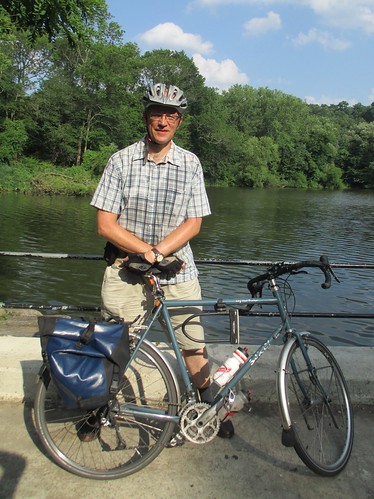 |
| An anonymous bike blogger, hiding in plain sight |
But Liddle’s writing sadly isn’t marked by any kind of
intellectual curiosity. He remarks, for example, that this blog is “anonymous”
as if that were inherently suspicious. Yet my identity is hidden only until one
reaches the bottom of the page and sees who owns the copyright. I suggested in
one recent post that readers follow me on Twitter – where I give my real name –
and some commenters address me as “Robert”. There's a picture of me on the blogpost he quotes.
On Friday, the day after Liddle's piece appeared, a stranger cycled up to me as I waited at traffic lights during my morning commute and asked, based on the work security pass hanging from my belt, if I was author of this blog. The contrast with Liddle's failure to spot the obvious was telling.
On Friday, the day after Liddle's piece appeared, a stranger cycled up to me as I waited at traffic lights during my morning commute and asked, based on the work security pass hanging from my belt, if I was author of this blog. The contrast with Liddle's failure to spot the obvious was telling.
There's a similar lack of originality. Liddle’s piece reflects
nearly perfectly the advice in a “terrible journalist’s guide to writing an article about cycling” that Mark Treasure, a British blogger, wrote more than a
year ago. Liddle even recycles some of his own, stale ideas. The original post
that he quotes mentions a previous attack he wrote on cyclist’s “pompous
plastic helmets”. He saves some time in getting the piece finished by reusing
pretty much exactly the same language.
It’s pretty clear that any purported facts – indeed any real
relationship to the outside world – are mere jewels encrusting an object made
up of bilious ventings from Liddle’s gut. His higher brain centres – which
might have over-ruled some of the absurdities – seem to have been given the day
off.
Yet there’s nowhere, it seems to me, where Liddle gets it as wrong as
he does when discussing cyclists’ characters.
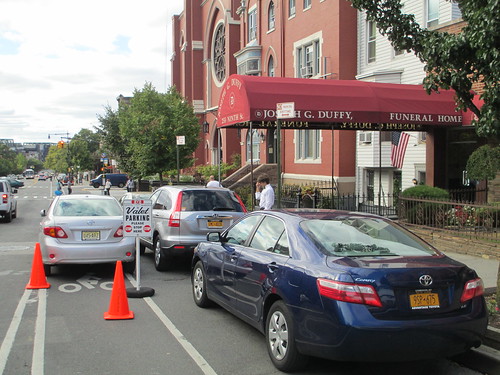 |
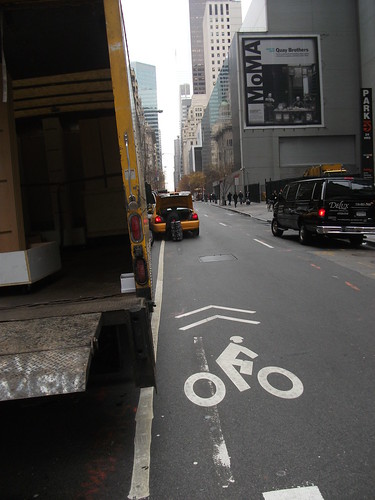
| Rod Liddle's angry cyclists sometimes don't use bike lanes. So here's a nice picture for him of a bike lane not being used by cyclists. |
It’s true, I’ll admit, that it can bring out a certain
defensiveness in cyclists to be constantly dealing with baseless rantings like
Liddle’s. It doesn’t help that those rantings seem to fuel unreasonable
behaviour on the street. As well as dodging the thrown bottle on Sunday, I had on the way to put up with a runner who insisted on
running in front of me down the 1st
Avenue bike lane. When I called out, “Watch out in
the bike lane, please!” behind him, he replied, “What the…f*** off!”
I don't repent either of liking cycling’s environmental credentials. Liddle dismisses cyclists as people who “think they’re saving the bloody planet”
and sneers at the idea. Yet it’s pretty hard to see how anyone who accepts the
reality of global warming – something many Spectator readers don’t, of course –
can dispute the idea that using an emissions-free means of transport has to be
some help in reducing global emissions.
It's obvious I'm a roundhead to Liddle's cavalier, just as I'm a cyclist and public transport user while he, I'm imagining, is a significant customer of London taxis.
It's obvious I'm a roundhead to Liddle's cavalier, just as I'm a cyclist and public transport user while he, I'm imagining, is a significant customer of London taxis.
But my moral convictions wouldn't have got me riding as much as I have round the three cities I’ve most recently lived – New
York , London and Budapest
Liddle’s rants at what he imagines to be the politically correct conspiracy of the British establishment seem weighed down with bitterness and cynicism. It's hard to imagine he couldn’t do with experiencing some of that youthful joy too.
Liddle’s rants at what he imagines to be the politically correct conspiracy of the British establishment seem weighed down with bitterness and cynicism. It's hard to imagine he couldn’t do with experiencing some of that youthful joy too.