It’s one of the few times I’ve managed seriously to annoy a
motorist while stationary on my bike. One dark winter night a couple of years
ago in London ,
I blew my nose while waiting at traffic lights. But, lacking the time to fish
out a handkerchief, I snorted onto the road.
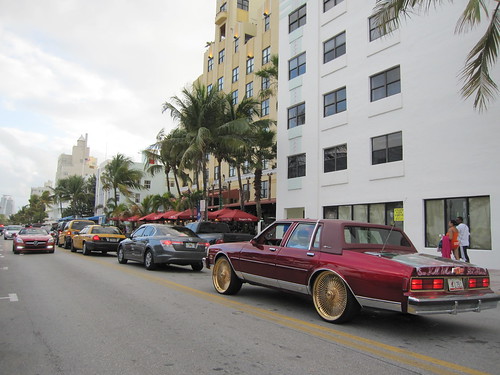 |
| Traffic queuing in Miami Beach. Some of these cars might look to you like polluters - but the drivers might think snot more offensive |
It can’t, I accept, have made for a pretty sight. But the reaction of a
woman in a car behind still surprised me. Leaning on her horn, she gesticulated
her disgust wildly. The irony instantly struck me. In contemporary society,
it’s regarded as entirely acceptable to make urban journeys in vehicles that
spew out gases that will pollute and warm the atmosphere for a century or more.
Clear one’s airways of a little biodegradable mucus, however, and one puts
oneself entirely beyond the pale.
But the more I’ve thought about it since, the more I’ve
realised the Outraged Driver of Kennington Park was exhibiting attitudes to
environmental pollution and emissions very common in industrialised societies
across the world. She regarded herself as having the right to an environment
treated as she wanted. She felt perfectly entitled to criticise others’
treatment of that environment. Her attitudes, however, made no reference to any
ultimate yardstick about the fate of the world environment as a whole.
I’ve said before on this blog that I am nothing like as exercised about environmental issues as many people assume cyclists are. I
enjoy the overall sense that cycling is a rational way to get around – that it
makes good use of scarce city space, that it contributes very little to
congestion, that it keeps me healthy, that it’s enjoyable. It’s part of that
picture that each trip contributes hardly at all to overall carbon emissions.
But the environmental factors form only one corner of the overall scene.
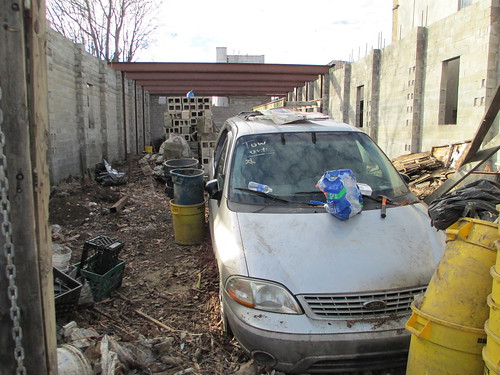 |
| A car abandoned in the lot the Invisible Visible Man helped to clear. Some scientists reckon the car's emissions helped to cause the destruction in this corner of Brooklyn |
That said, I regularly currently confront vivid evidence of
the seriousness of the world’s environmental problems. Parts of the Hudson
River Greenway, which I use for nearly half my daily commute in New York City , were under
five feet – 1.6m – of water at the height of Superstorm Sandy in October. Many
scientists think such extreme weather events are becoming more common as the
world’s climate changes. Yesterday, I cycled down to Coney Island, one of the
parts of the city worst-hit in the storm, to help clear out a vacant lot that
was under seven feet of water on the night the record high water swept up New York Bay . The weather was so unseasonably mild that
on the way home it felt oppressively warm. There’s an undeniable sense that climate
change is becoming a more urgent, practical issue, which anyone who takes an
interest in the wider world needs to address.
 |
| A modern, fuel-efficient container ship: a surprisingly clean way to import food |
Yet few of the responses to the issue rise much above the
level of honking one’s horn at behaviour one dislikes. I’ve frequently heard it
averred, for example, that it’s good for the environment to eat local, seasonal
produce. But very few of the people who claim that can give a detailed
accounting of local, seasonal produce’s carbon costs – even though the ships
that import food to temperate, rich-world countries use remarkably little fuel.
It’s certainly far from clear that buying fruit imported on such a ship from a
country where it grows easily is worse than eating greenhouse-grown local fruit
that’s come to the farmer’s market in a small, inefficient van.
Railway lobbyists also make blanket claims that their
transport mode is invariably more environmentally friendly than using a car. But,
while that is undoubtedly true for a well-filled train in the London rush hour, it isn’t true for a nearly-empty
train spewing diesel fumes into the air to move a couple of passengers to their
destinations. When I lived in the UK ,
my most regular long-distance rail journey was London
to Chester on a
Super Voyager diesel-powered train. I would give a rueful smile as I remembered
that the complex, heavy but fast train issued much the highest level of
emissions per seat mile of any UK
train model. It was, on average, a better environmental bet to take the train
for that journey than to hire a car. But the margin was not very wide at all.
There are some similarly questionable attitudes towards
cycling’s environmental performance. I’ve recently come across a number of
attacks on cycling’s environmental record that point out, for example, that
manufacturing bikes produces carbon emissions – an undeniable point, which
makes it clear that one shouldn’t replace one’s bike more often than necessary.
Such attacks generally go on to point out that fuelling a bike involves carbon
emissions. There are carbon costs to moving the extra food that cyclists eat
that they otherwise wouldn’t. And the food generates emissions that the
Outraged Driver of Kennington Park would presumably dislike even more than
mucus – in the form of methane, a far more potent greenhouse gas than the
carbon monoxide from cars.
The most entertainingly bonkers attack of this kind I’ve
encountered was a recent blogpost from an Ian Pearson who claims to give “a more accurate guide to the future”
(How can he tell?) on bikes’ carbon performance. Cycling might well, Mr Pearson
accepts, produce next-to-no carbon emissions per kilometre. But, when a cyclist
rides in traffic, he asserts, the extra carbon cost of attending to accidents –
and the effect on cars’ carbon performance of slowing down then accelerating to
overtake cyclists – probably produces so much extra carbon that it would have
been more environmentally friendly for the cyclist to go by car.
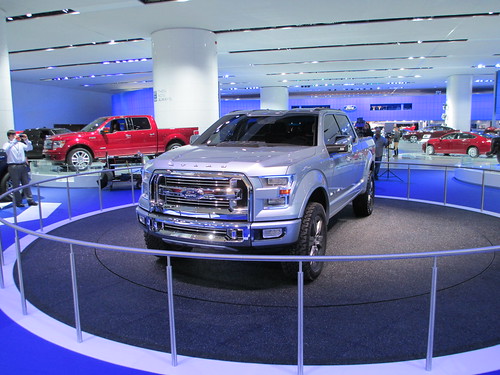 |
| This new Ford pick-up truck concept will be more fuel-efficient when it launches than its current equivalent. But that won't make its drivers necessarily friends of the environment. |
The common thread between all these questionable assertions is
that they treat the environment’s fate as an abstract matter – as susceptible
to objective observation as the question of how to live the good life or
whether God exists. People who profess concern about the environment often have
a bias in favour of things that appear traditional and prepared without the
benefit of complex, modern scientific advances. Many assume locally-produced
food must be better for the environment because, well, it feels as if it should
be. Similarly, people who are relatively unconcerned about environmental issues
have a tendency to work back from their own behaviour to a spurious
justification. “My car’s not as polluting as it might be” gets rationalised
into “I am environmentally virtuous”. “I don’t like manoeuvring around these
cyclists” becomes “these cyclists are bad for the environment”.
Yet, for the effects of air pollution and global warming, it
is ultimately possible to estimate the effects objectively. Scientists now have
a reasonable idea of what kind of damage different levels of carbon emissions
produce. It is even possible to come up with rough figures for the costs that
different kinds of emissions impose on wider society.
In a rational world, governments would now be rushing to
take the guesswork out of estimating environmental impacts. Food products would
include a label detailing the carbon costs of their production and include a
tax reflecting them. Air tickets would include something similar, while the
carbon costs of burning each unit of fuel would form a clear and distinct part
of the petrol price at the pump. Past experiments with introducing new prices
for previously-free goods – such as the Central London Congestion Charge –
suggest consumers would move swiftly away from the most environmentally
damaging behaviours towards less damaging ones.
I am robustly confident that such an exercise would make far
clearer than the existing tax systems in most rich-world countries that bikes
have big environmental advantages over most other transport modes. It is hard
to imagine that the change would not significantly increase cycling levels.
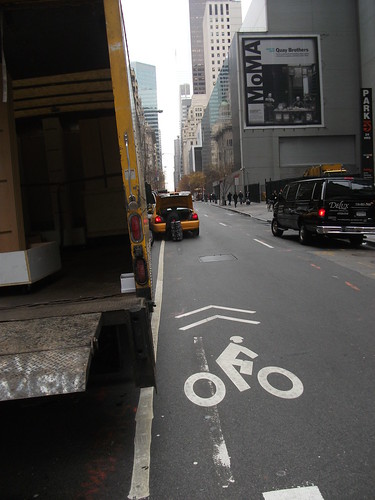 |
| A bicycle sign on New York's W54th street: the kind of decisive action on the environment that many governments are taking |
The challenge, however, is that such a move would upset groups
commonly supposed to be hugely influential – motorists, regular air-travellers
and the owners of big houses – while pleasing few others. Governments
consequently lay down a few cycle lanes on the roads, offer some subsidies for
electric cars, meet some of the cost of better home insulation and generally
gesture vaguely in the environment’s direction. Action that would make a real
difference remains resoundingly untaken.
Yet that, perhaps, should be no surprise. Across the industrialised
world, governments depend on the votes of people as inconsistent as the Outraged
Driver of Kennington Park, Ian Pearson and, come to that, each of us reading (and
writing) this blog. There’s no firm consensus yet among all those people in
favour of firm action to rein in the galloping horse of the worsening global climate.
That many governments consequently seem little more rational on the issue than
an irritated, late-night driver may be sad – but it is depressingly
understandable.