It’s fairly easy for even a casual observer to spot what
cycling does for some bits of my body. While I’m far less fit than I’d like to
be, I boast thighs that some mature trees would be happy to call their trunks.
Since moving to New York
and cycling farther each day, I’ve also lost some weight, as testified to by
the sag in my trousers’ waistbands below the belt loops.
I felt that same sense of having access to secrets of the
city closed to others when, one night recently, my employer organised on the Upper
East Side a party to celebrate its 125th anniversary. As others headed
off afterwards to an after-party, I made excuses – but knew my main motivation
was my desire to try the way home I’d crafted in my head. Before long, I was
bowling down from the top of the Queensboro Bridge’s bike path, which I last used regularly in the aftermath of Superstorm Sandy. Then I was into Queens and navigating streets under elevated subway lines so romantically urban they should have had a permanent Chicago
Blues soundtrack.
Whatever my initial misgivings, they disappeared immediately
I found myself on a bike path by the Potomac and catching my first glimpse of the
Jefferson memorial and US
capitol sitting on the other side. I sped – as much as one can on a bikeshare
bike – over the 14th street
Bridge and slowly worked out the best route along the National Mall. A little
bit of guesswork once I’d got north of Pennsylvania Avenue and I was finally at
the station, embarrassed to find myself feeling little less elated than Edmund
Hillary can have felt on his first conquest of Everest.
I’ll probably never know, however, precisely what I’m doing
to the posteriors of my hippocampi, two tiny glands on either side of my brain
that help me to find my way around. I get just as much satisfaction, nevertheless,
from the idea that I’m making them bigger, more complicated and more useful
than they used to be as I do from my bulging thighs and
slimming-if-still-overlarge waist.
 |
| The Invisible Visible Man's CaBi bike at Union Station: mission accomplished |
That satisfaction came home to me particularly forcefully
this past week after I conquered my nervousness to have a go at cycling between
Arlington , Virginia
and my train home from Washington ’s
Union Station. I headed off tentatively on a Capital Bikeshare bike, worrying
that my only rudimentary sense of the area’s geography would soon leave me
hopelessly lost. I very nearly gave up immediately after getting the bike out
of the docking station, alarmed at the bike’s handling when loaded with all my
various bits of baggage.
An hour or so later, however, I was pushing the bike’s wheel
into the Union Station docking station, feeling strangely elated. It was, it occurred to me, the kind of satisfaction that's soon going to be available to more people in New York, with the introduction of the Citibike bike share system. I’d tackled
the mental puzzle of working out my way and reached a satisfactory conclusion.
My interest in the hippocampus dates back, however, to long
before I ever set foot in the United
States . I first heard of the brain structure
while studying psychology at St Andrews University. I particularly associate it with a
visit once with a friend to a room lined with cages full of rats. The friend
was a PhD student working with the rats on neurophysiology, had gone in to
check on them over the weekend and invited me along.
On the room’s ceiling, I could see the outline of a
now-removed round disc. It marked, my friend told me, where Richard Morris, a
neurophysiologist, had first conducted a famous experiment on the hippocampus’s
role. He had set up a pool in the room with a hidden platform that the rats had
to find. A video camera in the ceiling disc’s middle tracked their progress. Rats
proved good at learning where the platform was. But, when Prof Morris injected
a drug into their hippocampi to stop them working, they were no longer able reliably to
locate it. The hippocampus seemed to organise their memory for direction.
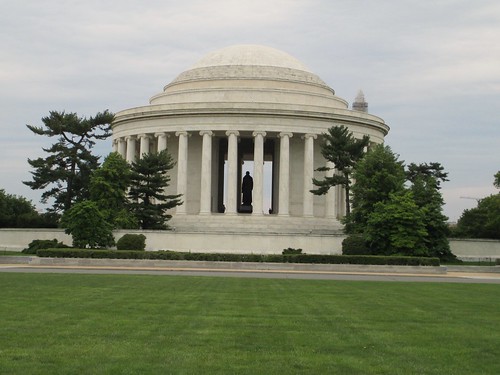 |
| The Jefferson Memorial, during my great, trans-Washington bike ride. Yeah, the picture's squint. I took it seated on a bike. Get used to it already. |
I made a connection between the hippocampus and my getting
about by bike when I heard about Eileen Maguire’s research on taxi drivers. In
a series of studies, Prof Maguire – of University College London - has examined
changes in the posterior hippocampus in London
taxi drivers as they first learn the Knowledge – the test they have to pass on
the city’s geography – then apply it. The posterior hippocampus – the rear part
of the structure - tended to be bigger and more complex in drivers who had
passed the Knowledge than in would-be drivers who had failed it, she found.
My brain, I recognised, was probably undergoing similar
changes to the taxi drivers’. The gradual trial-and-error process of learning
how best to get to a place – the frustration at missing that vital turning
again, the fear at suddenly finding oneself unintentionally on an over-busy
road, the satisfaction on finally getting a route right – were playing
themselves out in my hippocampi. New neurons were growing and new connections
were forming as I gradually built up a more solid picture of the best ways to
get about.
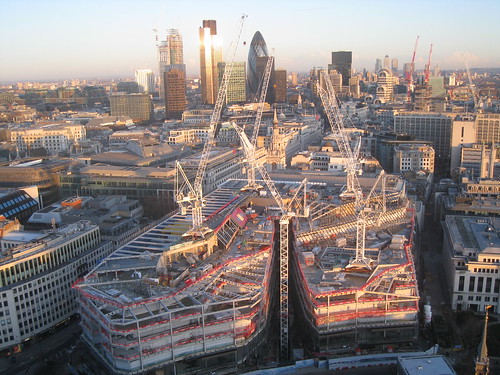 |
| Streets in the City of London: it may look a mess to you - but the Invisible Visible Man's mental maps can help you round this maze |
The process, however, has been nothing like as clinical as a
neurophysiological description might imply. I recall, for example, how, shortly
after moving south from Edinburgh
in 1997, I set off, cycle map in pocket, to work out my route from home in
Brixton to my employer’s offices. The 4½ mile journey took me 45 minutes of
missing turnings in my bike route, failing to understand how traffic flows worked
and repeatedly checking the map.
Latterly in London ,
I could make it home on a good night in 20 minutes – albeit down busier main roads.
My mental map of South London ’s cycling routes
could switch more smoothly and efficiently than any satellite navigation
device. By the time I left London ,
I knew every pothole and manhole cover of many of the roads I’d cycled most
often, preparing to avoid them well before I had reached them.
My mental map spread well beyond my regular commuting area. I’d feel a little
surge of excitement if, for example, I got invited to some press event 15 miles
from the office in Wembley. Why, I hardly ever got to use my
carefully-memorised route out to that area, I’d think to myself. I was
surprised and delighted one time when I found another reporter had made the
same decision as I to cycle from Central London .
We earnestly swapped thoughts on busy roads and helpful shortcuts.
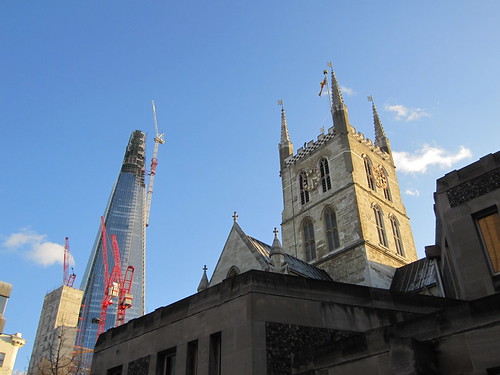 |
| The Shard: on my route to City Airport |
It was my enthusiasm for the route that gave me a bias in
favour of flying from London
City Airport Cable Street in the densely-packed East
End, past Canary Wharf Georgian Square then out across the internationally-recognised landmark of Tower Bridge
I’ve experienced something similar in New York . When apartment hunting, I found
myself a couple of times nastily off course – on the wrong side of a busy
expressway from where I wanted to be or careering down a six-lane avenue of
scary, fast-moving traffic. But I know my mental map of the city is slowly but
surely stitching together, somewhere in the back of my hippocampi. Without
thought, I head north a couple of blocks to avoid the most constricted sections
of W54 street most mornings, then south again before the office. I’ve been
trying out a route up the east side bike path some other mornings. I take joy in now knowing the Lexington-Park-Madison-5th sequence of avenues I cross as I head to work. But I shun that route in the evenings, well aware, after previous experience, of the miseries of
trying to head southbound on 2nd
avenue .
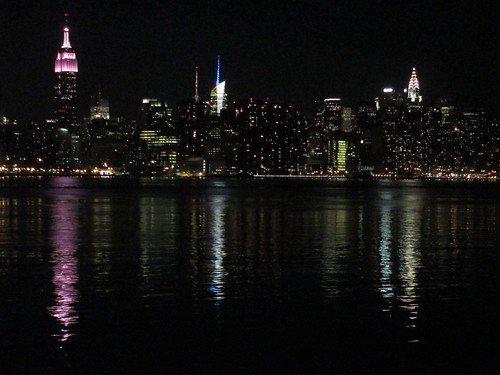 |
| The Empire State Building in pink: cycling to photograph it was more fun for me than a party |
I looked across as I headed down the East River at the Empire State
Which brings me back to Washington .
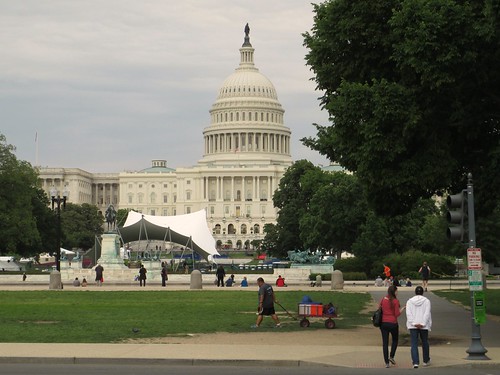 |
| The US Capitol: how to get there by bike is now fixed in the Invisible Visible Man's hippocampi |
But there were, it came to me, few satisfactions in life
more total than completing such a journey. I had set out to tackle a challenge
and, as I pushed the bike back into the docking station, comprehensively
conquered it. I had made the journey entirely on my own resources. And,
somewhere in my two hippocampi, just as those rats in St
Andrews learnt where the platform was, my mental maps for cycling
in Washington and northern Virginia were starting to form.