There are few New
York businesses that command as much of my loyalty as 718 Cyclery,
a friendly, specialist bike shop near where I live in Brooklyn .
But there’s no question that I’ve handed them a fair amount of my money lately.
A quick check through past bank statements suggests that in less than four
months since last October 30 I’ve given this deserving business around $270 in
spending on my own bicycle, plus another $14 or so on the Invisible Visible
Girl’s machine. That’s leaving aside another $30 or so on bicycle maintenance
at other bike shops and the $33 I shelled out yesterday for a replacement
clip-on light for one that had gone missing. It’s cost me, in other words,
around $80 a month over the last four months to keep my bike on the road.
New York is nevertheless an extreme example. According to the Tax
Foundation, a think-tank, taxes, tolls and other charges on motorists in New York State New York
subway’s running costs covered by fares is still lower – and the system is
visibly crumbling through lack of maintenance and upgrade expenditure. One
might think that, along with reducing the appalling death toll on the city’s streets, a comprehensive rethink of charging for and funding of the city’s
transport network would be the top subject for debate ahead of this year’s
mayoral elections.
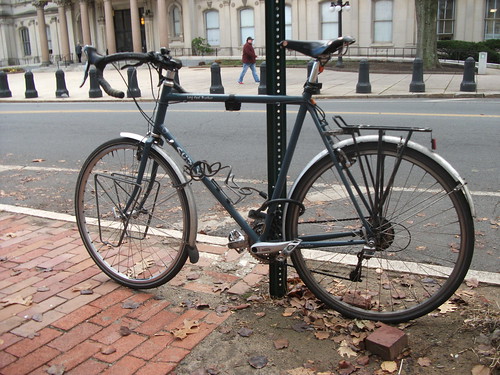 |
| The Invisible Visible Man's Surly Long Haul Trucker: fun to use - but not that cheap |
Some of that spending was certainly
making up for a near-absence of spending in the few months before October. But
add in the cost of the extra food I guzzle to fuel my
nine-miles-there-nine-miles-back commute and the cost of the higher wear and
tear on my clothes and it’s not clear I’m doing myself a financial favour by using
transport that I don’t pay for daily. At the current basic New York subway fare of $2.25 for a single
ride, four weeks’ commuting would cost me $90 – and there are numerous ways of
getting the rides cheaper than that. Even a looming – and highly controversial
– hike in the basic fare to $2.50 may not put me in the black.
But it’s not the bike shop’s fault
I’m getting a relatively raw deal. It’s noticeably cheaper to keep my bike
maintained in New York than it was when I
lived in London .
718 Cyclery has been more than generous in carrying out free adjustments and
calculating its labour charges. I’m at a disadvantage because pretty much every
other means of getting about New York
City gets a significant explicit or implicit subsidy
of some kind.
It’s not a purely New York City problem. Virtually no developed
country charges drivers enough in fuel taxes, tolls or car ownership fees to
cover the costs that congestion, crashes and pollution impose on everyone else.
Nearly every big international city tries to encourage commuters to shift to
other transport means by susbidising public transport.
Yet there have been only two big transport
talking points so far among the likely candidates to succeed Michael Bloomberg
as mayor. One is whether the city should hand over a few more slivers of its
vast road network to cyclists or, indeed, start taking out the bike lanes already in place. The other has been whether the city should turn its back
permanently on congestion charging – the one policy that any city has shown can
tackle problems like New York ’s.
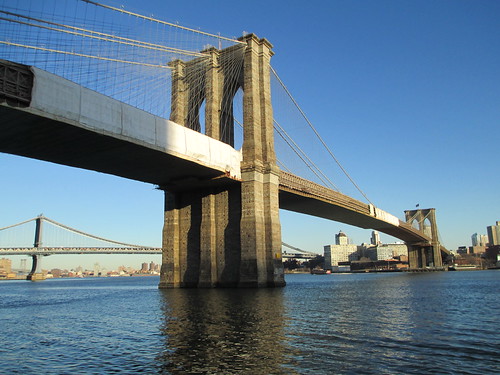 |
| The Brooklyn Bridge: majestic - and under repair after its pounding from all those New Jersey-bound drivers |
Those problems, meanwhile, are
immediate and practical. While the £10 ($16)
congestion charge used to funnel through traffic away from my cycle route to
work in central London , New York Manhattan , I
see swarms of New Jersey-registered cars heading from the Brooklyn
Bridge towards the Holland Tunnel going
to New Jersey Verrazano Narrows
Bridge further down New York Habour
linking Brooklyn, Staten Island and ultimately New Jersey Queensboro Bridge
Yet it’s hard to
imagine persuading men like the motorist I encountered on Vanderbilt Avenue Brooklyn
the other day that higher fuel taxes are the answer. Clambering out of his car
with a weary look, he cast a wary glance over my bike and said, “Well, you’re
certainly saving money on gas, buddy.” Precisely because US motorists pay far
lower taxes on fuel than road-users elsewhere, they’ve seen far bigger
percentage hikes in costs from recent years’ high oil prices. It’s impossible
to imagine any politician persuading a US
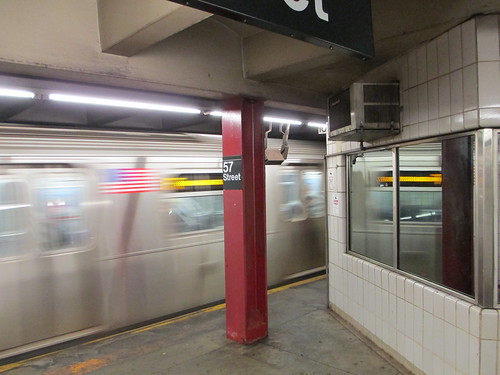 |
| The F Train at 57th street: cheap to use - but not much fun |
Nor is it easy to
imagine any politician raising subway fares to a level close to covering the
system’s high costs. Visiting the New York Transit Museum last Tuesday, I read
the grim story of how politicians have always struggled to raise fares on the
system, first from a nickel to a dime and then gradually upwards. The problem
is further exacerbated by the system’s inability to charge different fares for
different distances. Most people would surely agree that $2.25 is a bargain to
ride from Coney Island to the outer reaches of the Bronx .
But start talking about raising fares and people picture themselves paying $3
to ride from Penn Station to 59th street, a different prospect
altogether.
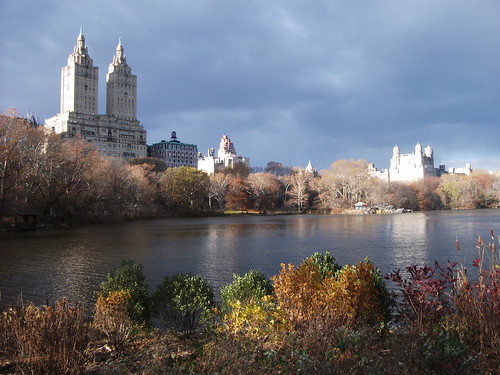 |
| Central Park: scenic - and a neat northern border for a charging zone |
The only feasible
answer, it’s clear, is for the successful mayoral candidate to resurrect plans
to charge cars to enter the area where they are least needed and do most damage
– Manhattan south of Central
Park . The area is well defined, excellently served by public
transport and currently blighted by vast quantities of traffic, much of which
could go elsewhere. A reasonable charge would not only raise badly-needed
revenue but also make a subway fare hike far more politically feasible. Those
two manoeuvres together could unclog Manhattan London New York
Yet Christine
Quinn, the city council speaker and the person many people expect to be elected
mayor later this year, earlier this month said she didn’t anticipate congestion
pricing’s “coming back around” after an effort she spearheaded to introduce the
policy in 2007. That effort died after state-level politicians in Albany
That leaves New York City in a far worse state transport-wise than London New York City
Future
generations will look back with amazement at such predicaments in New York and elsewhere,
shaking their heads and wondering why no-one had the courage to take the
obvious policy steps. Some kind of charge for road use in Manhattan and many other big centres will inevitably
come along. The spread of electric or partially electric vehicles – which pay
no fuel tax – ensures it. In London New York
The tragedy for New York is that the identity of its transport system's saviour looks set to remain a mystery for many more years - through the whole administration of Christine Quinn or whichever other uninspiring choice next sits in City Hall.
