Showing posts with label New York. Show all posts

Sunday, 3 February 2013

A dead mayor, a live cycling boom - and why cycling might be back to stay

For new residents of New York City like me, there has been something almost mind-bending about the last couple of days. Ever since Ed Koch, the city’s mayor from 1977 to 1989, died in the early hours of Friday, obituaries have been transporting us back to an unrecognisable city. Drug addicts lie prone on Manhattan streets, looting breaks out when the power fails and the subway is celebrated mainly for the range and inventiveness of its graffiti. It’s hardly surprising that the person who pitted himself against this chaos had a personality as pathologically extroverted as our current mayor’s is buttoned-up and controlled.
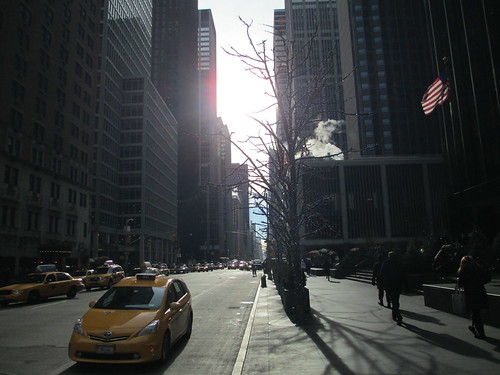
Sixth Avenue: bike-lane-less, as Ed Koch
preferred it on mature consideration

But, for a newcomer who’s a cyclist, one detail of the Ed Koch saga highlights a particularly striking change in the city. In 1980, at the height of the second oil price shock, Koch ordered the installation of segregated bike lanes on Fifth, Sixth and Seventh Avenues and Broadway in Manhattan. Then, only weeks later, having been ridiculed for his bike lane “fetish,” Koch had the lanes torn out again. He went on, in 1987, to try to ban cycling altogether from mid-town Manhattan. While that set-back took years to overcome, Koch nevertheless died in a city criss-crossed by a growing network of bike lanes. Installation is moving – despite setbacks as Nimbys in some neighbourhoods oppose new lanes - so fast that my 2012 NYC cycling map already feels quite badly out of date.

Thinking about that sharp turnaround – a tribute to the commitment of Michael Bloomberg, the current mayor, and Janette Sadik-Khan, his transport commissioner - has linked up in my mind several hopeful signs for cycling over the last couple of months. In both the US and the UK – the countries where I’ve done most cycling – cycling numbers are going up and official acceptance of cycling appears to be growing.

The question is whether this is a fundamental, long-term shift or just another short-term bit of faddism like Ed Koch's.

A Detroit Madison Street: borrowed chic for Lincoln
The question brings to my mind a mental picture of a copper-and-black Detroit Bicycle Company fixed-wheel bike. As someone who likes both gears and highly practical bikes, it’s not a machine I aspire to own. But I came across the bike – a Detroit Madison Street, trivia fans – in the unlikely setting of the Lincoln stand at Detroit’s annual North American International Auto Show. It was being held up as an example of the kind of finely-made luxury product of which Lincoln – which is trying to relaunch itself as a desirable luxury marque – approved.

Still more remarkably, it was one of quite a few bikes I spotted around the show floor.  The Smart stand boasted an E-Bike, which the manufacturer will be selling, while Toyota displayed a concept for a conventional bike. Kia was showing a small-wheeled bike that it sells in Korea, while Hyundai had a fixed-wheel bike sticking out the  back of a coupe. Subaru had stuck a couple of mountain bikes on the roof rack of one of its vehicles.

The unmistakeable impression was that carmakers thought bikes now had a certain cachet – which they wanted to borrow. Compare that with how the UK’s Raleigh in the 1960s felt it had to ape motorbike design to get kids to ride bikes.

The bikes’ presence on the automakers’ stands struck me all the more forcibly because of an article I’d written in my day job just before Christmas. It detailed how all the Detroit Three big automakers – General Motors, Ford and Chrysler – were struggling to reverse or live with recent years’ steep decline in young people’s learning to drive and subsequent buying of cars. Part of the carmakers’ problem stems from a gradual revival in recent years of the US’s inner cities – which are less littered than they once were with unconscious drug addicts - and, for some of the residents, a drift away from cars and towards bicycles. It’s the kind of gain for cycling that would have been scarcely imaginable in most industrialised countries 25 years ago when Mayor Koch was trying to ban cycling altogether.

A YouTube video posted by Gaz, a keen helmet-cam user reminded me that the process has already gone far further in the UK. His video – shot one recent January day – showed 50 cyclists on one short stretch of Cycle Superhighway 7 (a former Roman road, as it happens). If so many people are cycle commuting in January, Gaz suggests, the spring and summer are likely to see London’s highest cycle commuting numbers in many years.

Kent Ave, Williambsurg: Denis Hamil wants
those bike lanes gone
The worry, of course, is that cycling also looked so much like the coming thing in 1980 that a gadfly populist such as Ed Koch briefly took the risk of backing it. If car companies thought there was a way other than sticking two bikes on the roofrack to show their car was associated with an outdoor, aspirational lifestyle, I’m sure they’d happily use it. Denis Hamil, a columnist in the New York Daily News last week said he would support any mayoral candidate who promised to scrap the current crop of bike lanes. One of the likeliest contenders for mayor – Christine Quinn, a Democrat – has sought to appease bike lane haters by saying lanes are “controversial” and advising people not to discuss them at dinner parties.

In London, even Boris Johnson, the mayor, who is a daily cyclist, fell before the last mayoral election into the trap of caricaturing cyclists as dread-locked red-light jumpers. As with road safety – where the current UK government has reversed years of steady improvements by cutting funding for speed cameras – there is always a risk that someone will take steps that reverse apparently inexorable progress in a positive direction.

It doesn’t, for what it’s worth, feel as if such a step is coming immediately either here in New York or in the UK. Concern about the environment, changes in living patterns, concern about health and cycle technology improvements are all conspiring to make this cycling boom feel far more solid and longer-lasting than the second oil shock one.
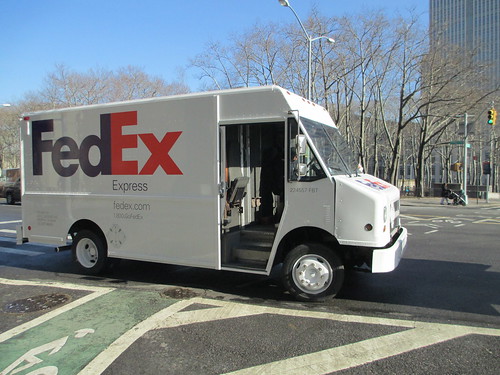
Yes, cycling's made progress. But, as long as FedEx drivers
think across one of  New York's busiest bike lanes is a good place
to park, it won't be mainstream
But it’s worth remembering that, even after recent years’ quadrupling of New York cycling numbers and the last decade’s doubling in London, riding a bike remains a fringe pursuit that’s far from winning mainstream acceptance.

That point came home to me particularly clearly one Friday night just before Christmas. Riding home around 10pm down W55th street from my office, I was surprised to find a limousine pull up next to me and wind down its window. Inside was a curious tourist who couldn’t understand what I was doing. No, I told him, I wasn’t delivering anything. Yes, I was just riding home from my office.

Recognising that he wasn’t going to get to the bottom of it, he finally said: “Just seems kind of… European.”

The incident set a new mental benchmark for me for cycling in New York and other big cities where it’s still not one of the main modes of travel. Cycling, I’ve decided, will finally be mainstream when an encounter with a commuter cyclist is no longer one of the “darndest things about New York” that a returning tourist recounts to his friends in Peoria.

Sunday, 18 November 2012

My ride to work - and why the cars resemble little hurricanes

Very few of the runners, stroller-pushing parents, drunks and others who wander into my path each day on the cycle lane up New York’s Hudson River Greenway strike me as especially brilliant people. If they were, they might spot the signs telling them they’re not allowed on the path and stick to the rather pleasant waterside walkway that’s been provided for them.
The runner on the left has, remarkably, chosen the footpath on
the Hudson River Greenway. One can only hope she made
the kind of solid risk assessment the Invisible Visible Man advocates

But, disturbingly, the cycle lane obstructors (CLOs) seem to be better at prioritising the risks facing pedestrians than the head of the New York Police Department’s traffic squad. The CLOs have decided that, if they’re going to obstruct traffic, it’s many, many times safer to get in cyclists’ way than cars’. Having so far seen hundreds – possibly thousands – of CLOs in four months’ cycling in New York, I’ve yet to see one choosing to take his or her chances running down the fast-moving, multi-lane West Side Highway next to the cycle path.

Yet Brian McCarthy, a deputy chief of the NYPD with responsibility for traffic policing, explained in October to WNYC, the public radio station, why its ironically-named Operation Cycle Safe – the programme that focuses police resources on fining cyclists, rather than the road users that cause traffic deaths – was now mainly tackling riding on the sidewalk (pavement, British readers). This behaviour, he reasoned, posed particular dangers to pedestrians. But, while I can find no recent record of a cyclist’s killing a pedestrian on a New York City sidewalk, it is depressingly regular for motorists to do so through excessive speed or lack of attention. The NYPD barely ever prosecutes the motoring offences that lead to such deaths. Its prioritisation is so skewed that, for it to be correct, I should probably be spotting runners every morning taking their chances with speeding SUVs on the highway, away from the terrifying bicycles.

The contrast between the CLOs and Deputy Chief McCarthy illustrates something profound about the vagaries of human beings’ efforts to assess risks. Most humans are reasonably adept at spotting and assessing the most immediate dangers. It’s pretty clear even to a stupid, inconsiderate runner unconcerned about inconveniencing others that it’s less foolish to take the chance of a collision with a cyclist riding at 20mph than a motorist driving at 50mph (the West Side Highway speed limit is 35mph – fun fact that most motorists entirely ignore). Very few people, however, are good at assessing risks in an abstract context such as a decision about how to allocate police resources. The NYPD, as I pointed out in a previous post, hands out 5 per cent of its traffic violation tickets to cyclists, way out of proportion to cyclists’ roughly 1 per cent share of city traffic. But a cyclist last killed someone in New York City in March 2009 – and even that incident wasn’t on the sidewalk. Around 1,000 people have died in the time since at the hands of motor vehicles. A sober risk assessment aimed at bringing down the number of deaths in the city would target an entirely different set of behaviours.

The problem appears to be a widespread one. In the UK, newspaper reporting about the crash that injured Bradley Wiggins – one of my great heroes – ended up producing the same, predictable commentary claiming cyclists endanger pedestrians and, somehow, cars. That’s even though the Tour de France winner’s accident involved his colliding with a car that seems to have pulled out into his path from a filling station without looking. In other words, people started complaining on the basis of the kind of accident that happens quite a lot (one where a negligent motorist injures a cyclist) about things that hardly ever happen – accidents where cyclists hurt other road users.

The question is whether it’s possible to get better to get better at understanding the risks the roads and other places pose - and to start reacting to them more rationally.

A subway station closed for Hurricane Sandy. New York's subway
turned out to be better at assessing risk than many New Yorkers.
My mind’s been particularly drawn to risk assessment in the last three weeks because of events in my new home city. At the end of the week when superstorm Sandy hit New York, I took a trip to Staten Island to report on some of the damage there. Person after person told me they’d ignored the evacuation order for the area on the grounds that a previous hurricane last year – Hurricane Irene – had mostly turned out less damaging than expected. As the sea swept in and inundated their street, they found themselves cowering in their homes’ upper storeys, with waves lapping at the windows even there. A person died in the basement of one of the houses in the street I visited, electrocuted when he stepped into flood water that had electric current flowing through it. The storm was on an entirely different scale from Hurricane Irene.

That miscalculation, it seems to me, is of a piece with people’s miscalculations about road use. In both situations, people rely far too much on personal experience and the evidence of their own senses. In the run-up to the storm, it was clear that the city was very windy but not immediately obvious that the storm would cause historic levels of damage. To realise that, one had to pay attention to something one couldn’t see – the vast storm surge that forecasters were predicting that was preparing to push its way into New York Bay to flood large tracts of the city.

Many people assessing the risks of cycling, meanwhile, look at cyclists in traffic and conclude that the slender, unprotected machines among the big metal boxes are more vulnerable than most figures actually suggest them to be. They see a cyclist on a sidewalk and assume that his greater speed compared with the pedestrians makes him a significant risk to them. It only adds, it seems to me, to people’s irritation with cyclists that bikes are quiet and people tend to notice them only at the last minute. This seems certain to trigger the kind of last-minute, fight-or-flight response that must have been useful for vulnerable cavemen. It’s a far less reliable indicator than people think of the risks around in a complex, modern urban streetscape.

Most people have particular lacunae when it comes to rare events that pose catastrophic risks. A hurricane is precisely such an event. There are fine, hard-to-discern differences between a hurricane that will do little damage – as Hurricane Irene did – kill scores of people and do billions of dollars of damage – as superstorm Sandy did – and one that will kill many hundreds – as Hurricane Katrina did. It is far beyond a normal person’s gut instinct to discern which storms need special attention, yet ordinary people continue to use their gut instincts to assess how they should react.
The motorists are blocking the bike lane. The cyclist's too close to the cars.
And they'll probably all get away with the risks they're taking.

In a road context, the catastrophic events are crashes involving cars, buses and trucks. It’s so common to see motorists driving while ‘phoning, speeding, giving cyclists too little room and so forth that it’s easy to conclude that these behaviours are trivial and pose little risk. Many people compare them with the alarming experience of finding a cycle messenger rush past their nose on a pedestrian crossing and conclude that it’s the cyclist who poses the real danger. The truth is that each time a motorist drives too fast, drives while distracted or turns without looking for cyclists he or she is involved in profoundly risky behaviour – and it’s only the luck of the particular circumstances that divides the outcome from nothing at all and a multiple-fatality crash.

People are still more blind to their actions’ long-term consequences. Almost no-one sees a cyclist on a busy street and remembers that he or she is far less likely to die of heart disease or diabetes in several decades than the neighbouring motorist cursing him or her from the exercise-free cocoon of his or her motor car. The global warming that may be making hurricanes more frequent is a still more remote such risk.

None of this is to excuse stupid behaviour by cyclists. It’s worth stopping for red lights, giving pedestrians plenty of space and going the right way up one-way streets. It shows an example of good practice and avoids annoying one’s fellow citizens. I do my best to obey the rules.

But industries prone to catastrophic but rare risks – the nuclear power industry, for example, or railways – tackle them by looking for the near-misses and minor accidents that suggest people are indulging in risky behaviour. Police forces that hold off warning motorists about dangerous behaviour and minor accidents explicitly miss the chance to follow such a policy.

I at least can do my part. I accept that runners will bound into my path on the Hudson River Greenway and cycle at a speed and on a line that means I should avoid them. I know that cars sometimes sweep across even some lightly-used crossings on the route from angles that are hard to see. So I stop for those red lights as other cyclists and runners speed past me, no doubt thinking me an over-cautious worrier. I do my best to assess when I’ve done something foolish and to avoid repeating the mistake. I can only hope that, as New York and other cities start to grapple with a future made more complicated by extreme weather, far more of those around me start to give the matter the same consideration too.

Thursday, 28 June 2012

Feeling the fear - and doing it in a scaredy way

As I wheeled my bike towards the junction of Reade Street and West Broadway in lower Manhattan, I looked round at the three lanes of traffic waiting at the intersection. Many of them were big, mean-looking concrete mixers and other trucks servicing the area’s post-9/11 reconstruction effort. They would be roaring after me the moment the lights changed. Then I glanced at the road surface – a peculiarly New York mixture of steel plates and potholes. The sky was so dark with a looming thunder storm that I’d put my lights on, at 11.30am on a summer’s day. I felt my lower stomach start to knot up as I fretted about whether, confronted by this, I’d remember to manoeuvre correctly. New York, after all, drives on the other side of the road from London, where I’ve done the vast bulk of my urban cycling. Long story short, I was scared.

The South Street bike lanes could seem scary -
or romantically urban, depending on mood
My moment of fear on Monday morning was not the first I’ve experienced over riding my bike in heavy traffic. Unless my fears were so well-founded I’m crushed tomorrow by a truck, it probably won’t be the last. Fear is, at the very least, an understandable emotion for a person riding a light, human-powered vehicle among big, heavy, fast-moving vehicles. It plays an even more important role in the thinking about cycling of people who don’t do it. In most countries with low cycling levels, non-cyclists give fears about safety as their main reason for refraining. Safety worries are a popular excuse at least partly because they sound less lame than admitting one’s lazy. But it’s also reasonable to assume that fear is paralysing a fair proportion of potential riders out of taking to the roads.

I didn’t, however, ditch my old hybrid for the subway. I instead swung my leg over the saddle, headed off down Reade and was soon enjoying a remarkably smooth and speedy ride by the Hudson River Greenway towards my new office.

Regular readers of this blog will be aware that I am impressed with human beings’ irrationality. They consistently let their emotional instincts – the feeling emanating from the guts that I felt knotting on Monday – dictate to higher brain centres.

People particularly consistently miscalculate the risks involved in getting about. Many pedestrians, for example, feel themselves genuinely at risk from cyclists. They vastly underestimate, meanwhile, the extent of the risks motor vehicles present to them.

Yet human beings enjoy such long lives partly because they also have some healthy fears – and strong instincts to avoid the biggest risks. The trick, it seems to me, is to sift the warnings from the useful instinct from the constraining voice of the irrational one.

It was after I narrowly avoided an inattentive car in London the weekend before last that the distinction between my own fear types struck me. I was cycling north through Tooting along part of one of London’s ironically-named Cycle Superhighways when a vehicle suddenly turned out of a traffic jam into my path. Jamming on my brakes, I screamed at the driver to watch, managed to swerve - and narrowly avoided being hit.

The physical danger bothered me far less than what followed, however. Surrounding motorists either shouted angrily at me for having stopped and held them up or shouted mocking abuse over how I had reacted. They were expressing the kind of unrestrained, uncivilised venom and cruelty that surfaces in the worst kind of school playground. Having comprehensively failed to handle such environments well as a child, I reverted to being the little boy of nearly 40 years ago. I felt a pathetic, weak instinct to curl up in a ball and weep. The personal cruelty and anger – which posed no real threat – had got to me far more than the physical danger.
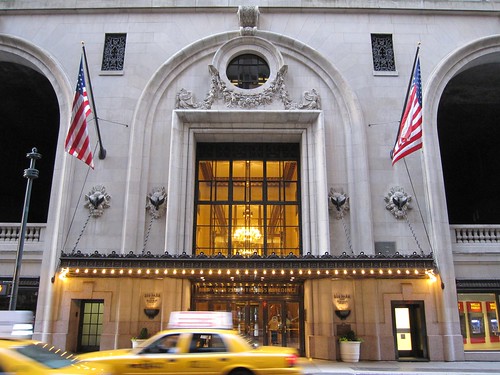
Taxis rush past the New York Central Building:
they're almost certainly not hurrying to the aid of a stricken cyclist,
the Invisible Visible Man can confirm.

Something similar was at work as I prepared to embark on my current house-hunting expedition to New York – and my forthcoming full-time move across the Atlantic. The sheer venom of most of the comments accompanying any article about New York cycling – including coverage of accidents affecting entirely blameless cyclists at the hands of hit-and-run drivers – has, I will admit, intimidated me. New York as a city seems still more irritated than London by the effrontery of anyone's trying to navigate the city on two, human-powered wheels. Many of its citizens seem openly to wish myself and my fellow cyclists harm. The emotion picked up from those comments played on my mind. It added to my long-standing feeling, engendered by the atmosphere of the deep, canyon-like streets, my nervousness over following a different set of traffic rules and the New York City police’s reputation as scourges of cyclists, to put me thoroughly on edge.

New York City's authorities seem, like so many city governments,
to have only imperfectly grasped the point
that cyclists need to ride their bikes on cycleways
At its very worst, such fear can be self-reinforcing. At one point yesterday evening, unsure both of the line I should be taking on the road and the behaviour of a looming taxi driver, I dithered, wobbling about – and succeeded in both irritating the driver and making myself feel more nervous still. It’s when intimidated like that that I sometimes let drivers force me too close to the side of the road, before passing aggressively and too close. Nervousness over the close pass then makes things still worse.

Yet I’ve been prepared to cope, I think, at least partly because of  past periods of deep, far more rational nervousness. Having long boasted I had never been knocked off my bike in London, I was hit twice in just over five weeks in early 2009, once by a motorist turning across my path without looking - and then by a cyclist running a red light. I found myself grasped by an almost paralysing sense of my own vulnerability, reaching for the brakes at the slightest provocation. I recalled, every time I did so, the sensation of being pitched suddenly down to the tarmac. I felt again the jolt that ripples through the muscles at meeting a sudden, unexpected physical force.

My fear gradually distilled, however, into a habit of looking still more carefully than before for signs of sudden, unexpected movements. Even on apparently quiet roads, I now look far more than before over my shoulder, scanning the road for the next motorist seeking to cut across my path. It was at least partly because of those experiences I was able to spot, and avoid, the Inattentive Turner of Tooting.

And, of course, if avoiding fearful situations were my main priority, I wouldn’t be here in New York tackling a new challenge. I’d probably never have lived in south London. I’d certainly never have lived in Budapest. I’d ride my bike only down dull little paths in the country, having brought it there specially on the roof of my car.

The truth is that fear plays a part in the tingling sensation one feels before embarking on something difficult and challenging – whether a difficult bike ride, a new job or some new relationship. It’s the risk of failure that creates the sense of intense alertness that makes them enjoyable. It’s the feeling of having conquered the fears and the difficulties that makes it satisfying to finish.

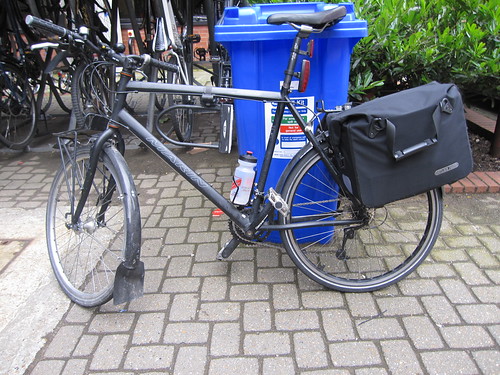
The Invisible Visible Man's Marin Muirwoods before
the Embarrassing Case of the Pedal Incompetence
The 65 miles or so I’ve so far cycled around Manhattan and Brooklyn certainly haven’t been trouble-free. It turned out, for example, that I’d messed up screwing on and off the pedals on my old, spare bike when bringing it on the ‘plane. A pedal fell off on Sunday in Prospect Heights, thanks to stripped screw threads where it attached to the pedal cranks. Much of the honking one hears in New York traffic turns out to be directed at blameless people who have merely chosen to use their bicycles in parts of the road clearly marked for doing so. I suffered a particularly long tirade of abuse from a man who thought I should squeeze against the cars on a narrow road in Carroll Gardens so that he could drive his RV a few inches from me. I was, after all, delaying by milliseconds his arrival at the end of a traffic jam. I’ve cycled more slowly and carefully than normal, listening to my useful fear about the limits of my proficiency so far in New York traffic.

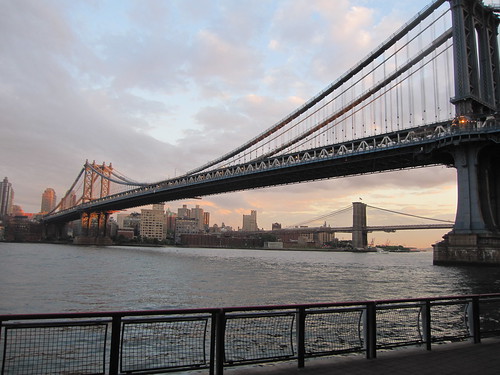
The Manhattan Bridge: a rare chance to race subway trains
But I’ve taken my old bike speeding in glorious sunlight up by the Hudson River, looking over to New Jersey. I’ve climbed up and over the Manhattan Bridge, relishing the rare prospect of racing subway trains as we both labour over the bridge then accelerate down the other side. I’m not yet regularly commuting over the Brooklyn Bridge, as the first ever post on this blog said I aspired to do. But I've enjoyed several times the beautiful vista from New York's oldest bridge towards the towers of lower Manhattan. I looked up the other day riding down second avenue to see the spire of the magnificent Chrysler Building looking down at me.

Those aren’t experiences I’ve enjoyed despite my fear. They’re not feats that have required any special bravery to accomplish. But they’ve been ones that have been all the more rewarding because I’ve overcome a slug of my own cowardice on the way.