Showing posts with label Michael Bloomberg. Show all posts

Sunday, 14 February 2016

Thick bridge cables, police placard abuse - and why you'll get nowhere without corrupting power

Amid the sudden, late onset of a proper winter in New York, I’ve ridden to work far more often than normal in recent weeks via a longer route over the Brooklyn Bridge. The route, as well as being a pleasant change from my normal ride over the Manhattan Bridge, cuts down sharply on the amount of time I spend sharing snow-clogged Manhattan cross streets with irritable, aggressive drivers.
The Brooklyn Bridge, with cables: New York City corruption,
dangling over the East River

Yet the ride also affords me a chance to ponder a deep and sometimes under-recognised truth about New York City. As I cross the bridge, I marvel at the thickness of the bundle of suspension cables that holds the bridge deck in place - and remember the story behind them. The bundle is much bigger than the bridge’s designer, John Roebling, originally intended. Extra, up-to-standard wire had to be added after Washington Roebling, John’s son, discovered that corrupt contractors had sneaked large quantities of sub-standard wire into cables that had already been painstakingly stretched across the East River. Graft is literally woven into this bit of the city’s fabric.

Corruption is far from being a mere historic issue, however. The more one grapples with the challenges facing New York City, the more one comes up against relationships that powerful people’s pursuit of money or power have skewed away from working as intended. These pieces of corruption range from relationships that are straightforwardly crooked, as the relationship between the bridge builders and the wire contractors was, through a series of more or less grubby compromises to relationships that seem like a form of democracy. At that end of the scale there are institutions like the Community Boards that are meant to protect communities’ interests in planning decisions but instead end up as the vehicle of noisy vested interests.

A bike lane built under Janette Sadik-Khan now:
the reversal of progress made visible.
Cyclists are peculiarly aware of this dysfunctionality, I think, because it is a profoundly conservative force. It seeks to entrench privileges and works against change. In a city that’s nominally trying to increase its cycle commuting rate from a modest 1 per cent, that means that many of these forces are aligned against making life easier for cyclists. If one doesn’t take into account how these fundamentally regressive relationships shape life in the city, it’s impossible to understand the near-halting of progress on cycling in the city since Janette Sadik-Khan, the city’s one-time transport commissioner, stood down at the end of Michael Bloomberg's time in office in 2013. Without an advocate as forceful and effective as Sadik-Khan, regressive, conservative, corrupt forces have largely overwhelmed the continuing faltering efforts under Bill de Blasio towards change.

The scale of the challenge is clear if one thinks carefully about one of the few pieces of progress to have been made recently – the decision on February 2 by Manhattan’s Community Board 7 to approve installation of a protected bike lane on Amsterdam Avenue on the Upper West Side. The decision followed years of study and months of blocking by the co-chairs of the Community Board’s transportation committee. It was passed only after hundreds of advocates turned up at both the February 2 meeting and one in November. If such a vast lobbying effort is required to win approval for a 38-block (less than two miles) project – one that everyone except a handful of angry carowners agrees is sensible and needed - it’s unsurprising that city-wide progress towards building a cycling network looks a distant prospect.
 
Your licence to park anywhere: the NYPD placard on an SUV
parked unnecessarily in the Hoyt St bike lane.
My mind started turning to the ubiquity of corruption in New York the night after the CB7 vote, as I rode home from work through a damp Brooklyn. As I rounded the corner from Schermerhorn Street into Hoyt Street in downtown Brooklyn, I was forced to brake suddenly on finding two big sports utility vehicles blocking the narrow street’s bike lane. Knowing that the area was a popular parking spot for police vehicles from the New York Police Department’s nearby transit bureau, I suspected these were officers’ private vehicles. Sure enough, on inspection the dashboards of both vehicles sported NYPD placards that police officers regard as essentially permission to park illegally wherever they choose. The following night, another private police vehicle was parked in exactly the same place. Tweets to the NYPD Transit Bureau about the issue went unanswered.
Sure, pedestrians and cyclists are having to avoid this
officer's car while legal parking spaces go unused across
the street. But what's the point in joining the NYPD
if you can't break the law with impunity?

The incident reveals a telling type of petty New York City corruption. Every morning as I battle my way down Jay St in Brooklyn to reach the Manhattan Bridge, I encounter scores of illegally-parked vehicles, obstructing turning lanes and other important places on the road. The police leave them untroubled because they bear some kind of official-looking placard – often of dubious provenance - identifying the owner as a police officer, corrections officer or firefighter. The problem illustrates the primacy of organisational culture – in this case, the feeling that emergency personnel should stick together, whatever civilians might say – in many areas of New York public life. Loyalty to the interests of one’s group – whether one’s fellow professionals,  members of the same ethnic group or people who want to defend some other privilege – exerts a far more powerful force in the city than most of the formal rules meant to govern it.

I also sometimes encounter on Jay St a red-light sting for cyclists, at the relatively quiet junction of Jay St and Concord St. The intersection is the only point on Jay St – where there is a daily riot of highly dangerous illegal double-parking, illegal U-Turns and crosswalk blocking – where I regularly see enforcement activity. In a city where motorists are still often portrayed as a proxy for ordinary, working-class New Yorkers, it is far easier for the police to pick on relatively powerless cyclists to make up their monthly ticket totals than to take the rational course of trying to stamp out the behaviour that does most damage. Since the police effectively wield far greater power than the mayor, there is little to stop police officers from engaging in this casual sleight of hand.
 
A scene from a Jay St commute: it's pretty obvious how
serious a problem cyclist behaviour is here.
None of this is to say, of course, that corruption both grave and petty is a uniquely US or New York phenomenon. When I lived in Budapest, I travelled around post-Communist societies far more scarred by corruption than the US. It is also clear that New York is far from being the US’s most corruptly-run city. It would seem almost rude to try to displace either Chicago or New Orleans from their hard-won places at the top of that league table.

Yet there is a peculiarly New York City combination of factors that works to overwhelm many positive initiatives, including efforts to promote more active transport.

Much of the power over the city is exercised by a legislature 150 miles away in Albany that often seems to view the city as little more than a source of funds. It is telling that in the recent corruption trial of Sheldon Silver, the former speaker of the state assembly, the defence’s (ultimately unsuccessful) case was essentially that the speaker had acted little differently from other members of the state legislature.
 
Police supervise blocking of the sidewalk and bike lanes
outside Satmar headquarters on a previous occasion, in
June 2014. This is what the privilege of being a powerful
voting bloc in New York City buys you.
New York’s diversity also means the city teems with different ethnic groups whom politicians can court in return for votes and money. This past Wednesday, for example, I noticed a (since-deleted) Tweet from the @HQSatmar account – from the headquarters of the powerful Satmar Hasidic Jewish community – thanking the local 90th NYPD precinct for allowing them to park their cars across the Kent Avenue two-way bike lane during a community wedding. The apparent official approval for this practice – which forces cyclists and pedestrians out into fast-moving traffic on a blind bend – illustrates how mere convenience for a powerful group can easily trump the law and the lives and health of less powerful groups.

A different version of a similar phenomenon was at work when a series of members of the New York City Council who had previously been supportive of safer streets legislation scurried to support amendments that would effectively have excused bus drivers who killed people. It is no coincidence, I suspect, that Transport Workers’ Union Local 100, the bus drivers’ union, is a significant funder of New York political races.

The presence of this mass of interest groups willing to defy the mayor’s formal authority has long made governing New York City one of the most formidable tasks in US politics. The Brooklyn Bridge corruption was a result, for example, of the presence on the bridge company’s board of directors of William Tweed, the famously corrupt boss of Tammany Hall, the hugely influential Irish-American political club. Vincent Impellitteri famously became leader of New York’s city council – and subsequently, by default, mayor when the incumbent resigned – simply because he was an Italian from Manhattan. He was needed to balance out a Democratic slate for top jobs that already had on it an Irishman from Brooklyn and a Jew from the Bronx.
 
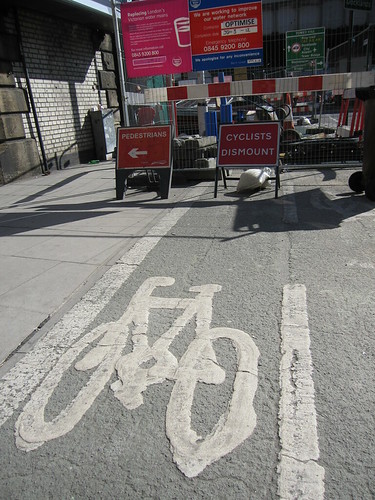
London's cycle facilities can also be imperfect,
but there is a less pervasive sense
of unaccountability
It is far easier, it seems to me, to work the levers of power in London, where identity politics plays a far smaller role, than in New York. It is no coincidence that cities in relatively uncorrupt northern Europe have had far more success in steering through complex transport projects such as cycling networks and high-quality public transit than southern European countries with a longer tradition of corruption.

The flipside of New York City’s ungovernability, meanwhile, is that it has been disproportionately shaped by the handful of people with the mix of skill and ruthlessness needed to get things done. In the 20th Century, tragically, the most notable such person was Robert Moses, the “master builder,” who, holding an unconstitutional mix of state and city jobs, promoted car-dependence by halting subway building and diverting resources to building a poorly-planned highway network, which wrecked many neighbourhoods.

So far in the 21st century, Sadik-Khan, who will celebrate her achievements in a new book out on March 8, has proved more adept than most at overcoming the city’s corrupt conservatism. She closed some of the streets through Times Square, put bike lanes down Broadway and many other important streets and forced a badly-needed bike lane down Prospect Park West in Brooklyn. The Prospect Park West project – over which a handful of rich locals continue to sue the city – went in over the noisy objections of, among others, the wife of New York’s senior US senator. Sadik-Khan oversaw huge increases in the numbers of people cycling, even if cycling’s share of trips remains negligible.

Yet it is clear that, while Sadik-Khan did a superb job of forcing through building projects, she was not able to make activists for cycling and walking a group that New York politicians genuinely had to fear. Transportation Alternatives and other lobbyists for a saner, more rational transport system remain supplicants to the city’s power brokers, rather than one of the successful groups that the power brokers have to court.

NYPD vehicles block the Broadway bike lane:
the lack of explanation is as eloquent as any explanation
One evening in early December, I encountered depressing evidence of the fate of groups who fail to get themselves into a sufficiently strong position in the city’s pecking order. I rode down the Broadway bike lanes as far as Herald Square, by Macy’s department store in midtown. But at Herald Square – which Sadik-Khan still holds up as an example of what can be achieved, with effort – I encountered two large police SUVs parked across the bike lane, closing it. I have heard so many reports since from other cyclists that I gather the police have more or less permanently barricaded the route.

There were no explanations, diversion signs or notices to alert cyclists to the change. The closure appeared to be a result of an entirely arbitrary police decision that cyclists could no longer use the route built for them only a few years ago. But, as I gazed at the police vehicles parked sullenly across my path, that almost seemed to be part of the point.

“We can do this to you whenever we want,” they seemed to be saying. “Now what are you going to do about it?”

Sunday, 17 May 2015

A changing junction, a political bike ride - and the progressive case for cycling

As I ride home from work in the evenings, an intersection in downtown Brooklyn often prompts me to ponder New York City’s attitude to cycling. The southbound bike lane on Smith St at Fulton St used to move out gracefully round a waiting area for taxis and car-service vehicles. Then, recognising that the lane was constantly blocked by parked vehicles, the city decided to repaint the lane so that the parked taxis would no longer block it – though cyclists would have to perform a dangerous swerve out into traffic to round the parked vehicles. More recently, it’s been repainted yet again – and the lane’s now back to guiding cyclists smoothly through the junction – and once again perpetually blocked.
Smith St at Fulton: as it was before it became a symbol
of the city's vacillation about cyclists.

The intersection is a beautiful concrete – or asphalt – illustration of New York City’s equivocal attitude towards encouraging cycling. The city has been prepared to paint bicycle lanes on streets – although it’s now retreating even from that in favour of the dreadful “extra-wide parking lane”. But the city has been far less ready – particularly since Janette Sadik-Khan left as transport commissioner at the end of 2013 – to recognise that to accommodate cyclists well in a given road space it is also often necessary to inconvenience motorists. There has lately seemed to be a waning of the confidence under Michael Bloomberg, the previous mayor, that by promoting cycling the city was making progress towards being a better city.

A bike ride last Thursday prompted me to ponder further the politics of this change. I rode with members of New York city council’s progressive caucus from Brooklyn Borough Hall across the Brooklyn Bridge to City Hall to highlight the importance of cycling. A Manhattan delegation, having ridden from Union Square, met us at City Hall. As I rode with Brad Lander, Carlos Menchaca and other left-leaning individuals, I got into discussion about the “progressive” agenda for transport in the city and how intimately cycling is linked to making the city better for all its inhabitants.
 
Brad Lander addresses the bike-to-work ride outside Borough
Hall: a reliable progressive enthusiast for cycling.
I came away convinced that there are many progressive politicians in the city who recognise that the way people get about significantly affects how equitable and safe a city is for all its inhabitants. But I also left worried that some other progressive politicians fail to grasp what a big role changes to those patterns of mobility could play in achieving their wider goals.

Even the term progress is a pretty significant stumbling-block when thinking about these issues. The term implies that humans are learning from previous generations’ mistakes to make the world a steadily better place. It’s a view of the world that sits uncomfortably with the multiple areas where the world appears to be going into reverse. Among those are the rise of vicious Islamist radicals like the Islamic State and the takeover of the US’s Republican Party by groups that appear to reject the reliability of the scientific method for deducing facts about the world. The term also calls into question what “progress” is. Does it entail everyone’s growing steadily richer and buying ever more cars and consumer goods? At its worst, the goal of pushing towards “progress” has justified appalling acts of political repression.

Nevertheless, I’m confident that in most industrialised societies people’s political instincts divide fairly neatly into conservative and progressive camps. Conservatives tend to believe the past was better than the present and that society’s existing power structures are there for fairly good reasons. Progressives tend to think the future can be better than the present and question the power structures currently in place.
 
I don't know the politics of these people waiting to participate
in last week's ride with progressive city council members -
but it's a fair guess many would call themselves progressives.
It’s no surprise that many cycling activists, as I do, place themselves broadly in the progressive political camp. Since cycling currently accounts for only a small proportion of journeys in many rich countries, arguments for cycling are by their nature arguments for building a future that’s better than the present. Conservatives such as Boris Johnson, London’s elected mayor, are rarer – but often seem to value the bicycle as a symbol of how things were done in the past. Far more conservatives - including Jeremy Clarkson, formerly of the BBC’s Top Gear franchise – seem to identify with car culture.

But that point doesn’t fit with recent shifts in attitudes towards cycling in New York. Following the election in late 2013 of Bill de Blasio – a Democratic mayor about as far left as any conceivable mayor of the US’s main financial centre – it’s clear that cycling has moved well down the city’s list of political priorities. Compared with Michael Bloomberg, his far more conservative predecessor, the current mayor seems to see little reason to encourage cycling to work or the completion of the city’s cycling network. In fact, the fading paint on many of the city’s cycle lanes is a neat illustration of how fragile progress in such an area can be. With less active support for cycling promotion, the previous gains are almost literally fading away.

It wouldn’t be surprising, in fact, if the mayor were a little distrustful of those of us who lobby for cycling. The mayor fought the election on the basis that he would campaign for the second New York that had been neglected during the Bloomberg years. From the perspective of poor neighbourhoods far out in Brooklyn, Queens and The Bronx, those of us from brownstone Brooklyn and nice parts of Manhattan who lobby for better cycling provision must seem like representatives of the elements in the city that are already well catered-to.
Poverty-stricken Coney Island after Superstorm Sandy:
cycling promotion probably wasn't on many locals' minds after
this catastrophe.


It must also make a great deal of sense looked at from poorer neighbourhoods for the mayor to focus much of his transport energy on the Vision Zero programme of reducing road deaths. A disproportionate number of those who die on the roads are people like Noshat Nahian, an eight-year-old child of Bangladeshi immigrants killed by a turning semi-trailer truck on Northern Boulevard in Queens, or Amar Diarrassouba, the six-year-old son of immigrants from Cote d’Ivoire killed by a truck in February 2013 as he walked to school in East Harlem. There’s no doubt that trucks and cars – which predominantly support the lifestyles of New York’s richer people – exact a disproportionate toll in death and injury on poorer New Yorkers. The mayor is quite right to try to address that.

Yet it’s a significant failure of imagination not to try to do more than that. Because New York state’s gas tax and other fees for driving cover only 56.1 per cent of the cost of providing the state’s road system, poor state taxpayers without cars are forced to pay much of the cost of maintaining the road system. That’s even before considering all the other costs that the road system imposes – the costs of crashes, congestion, atmospheric pollution and noise, all of which are shouldered by ordinary taxpayers. Any effort to make New York City less car-dependent is inevitably a progressive step away from the regressive effects of the current system of funding for roads. It would also make perfect sense for a progressive mayor to support Move New York’s sensible plans to charge all vehicles entering lower Manhattan a fee that would be used to support the city’s subways and other alternative means of transport. The higher charges would fall predominantly on the city’s wealthiest people, while a great many of the benefits would flow to the city’s poor.
The Manhattan Bridge bike lane on bike-to-work day:
I don't want to see more bike traffic jams like this - but there's
a clear progressive case for encouraging these people
to keep riding their bikes.

An increase in the number of people cycling would serve many of the political goals for which the mayor and many other progressives purport to be aiming. It would reduce the cost burden of maintaining the road system, reduce pollution – another ill that disproportionately harms the poor living by arterial roads – and improve New Yorkers’ overall health. Despite some high-profile incidents, it's also far safer for pedestrians to be around people using bicycles than people using cars.

There is no good reason either why, with better cycle provision, people in some of New York’s more central public housing projects should not take to cycling far more than at present.

Yet the scene at the corner of Smith and Fulton illustrates the challenge. The Department of Transportation was prevailed upon to change the bike lane arrangement at the corner in the interests of preserving a single parking space. The city’s willingness to get people cycling has melted in the face of a backlash by those who see parking spaces as their own private property. There could scarcely be a more reactionary force than groups determined to preserve the right to store their private luxury items on-street for free, but their indignation seems for now to have intimidated many progressive forces into leaving parking spaces well alone. Vested interests can also push the apparently progressive side towards reactionary stances. Both Ben Kallos and Robert Cornegy, council members who turned up at last weeks’ cycling event, have backed a bill supported by transport workers exempting them from legal penalties if they hit pedestrians and cyclists who have the right of way.
 
Whatever the precise politics of Jay St's cycle lanes,
they certainly feel regressive
Such equivocation about improving conditions for cycling explains a great deal of what the ride from Brooklyn Borough Hall experienced on the first section of our ride to the Brooklyn Bridge. We left the Borough Hall by way of Jay St and found ourselves jostling among heavy traffic, including at least one double-parked car in the bicycle lane. It wasn’t hard to see, taking in the scene, why only 1 per cent of New Yorkers’ commuting trips are currently by bicycle.

New York and many other cities would be a better, fairer place if more of its citizens were getting about by bicycle. Increasing the share of journeys made by bicycle should, consequently, be part of the progressive agenda alongside more obvious causes such as improving urban education and housing. But, if progressives continue to lack political courage when tackling car-dependency or conservatives stay entrenched in power, it’s hard to imagine conditions improving dramatically in the immediate future.

Sunday, 3 February 2013

A dead mayor, a live cycling boom - and why cycling might be back to stay

For new residents of New York City like me, there has been something almost mind-bending about the last couple of days. Ever since Ed Koch, the city’s mayor from 1977 to 1989, died in the early hours of Friday, obituaries have been transporting us back to an unrecognisable city. Drug addicts lie prone on Manhattan streets, looting breaks out when the power fails and the subway is celebrated mainly for the range and inventiveness of its graffiti. It’s hardly surprising that the person who pitted himself against this chaos had a personality as pathologically extroverted as our current mayor’s is buttoned-up and controlled.
Sixth Avenue: bike-lane-less, as Ed Koch
preferred it on mature consideration

But, for a newcomer who’s a cyclist, one detail of the Ed Koch saga highlights a particularly striking change in the city. In 1980, at the height of the second oil price shock, Koch ordered the installation of segregated bike lanes on Fifth, Sixth and Seventh Avenues and Broadway in Manhattan. Then, only weeks later, having been ridiculed for his bike lane “fetish,” Koch had the lanes torn out again. He went on, in 1987, to try to ban cycling altogether from mid-town Manhattan. While that set-back took years to overcome, Koch nevertheless died in a city criss-crossed by a growing network of bike lanes. Installation is moving – despite setbacks as Nimbys in some neighbourhoods oppose new lanes - so fast that my 2012 NYC cycling map already feels quite badly out of date.

Thinking about that sharp turnaround – a tribute to the commitment of Michael Bloomberg, the current mayor, and Janette Sadik-Khan, his transport commissioner - has linked up in my mind several hopeful signs for cycling over the last couple of months. In both the US and the UK – the countries where I’ve done most cycling – cycling numbers are going up and official acceptance of cycling appears to be growing.

The question is whether this is a fundamental, long-term shift or just another short-term bit of faddism like Ed Koch's.

A Detroit Madison Street: borrowed chic for Lincoln
The question brings to my mind a mental picture of a copper-and-black Detroit Bicycle Company fixed-wheel bike. As someone who likes both gears and highly practical bikes, it’s not a machine I aspire to own. But I came across the bike – a Detroit Madison Street, trivia fans – in the unlikely setting of the Lincoln stand at Detroit’s annual North American International Auto Show. It was being held up as an example of the kind of finely-made luxury product of which Lincoln – which is trying to relaunch itself as a desirable luxury marque – approved.

Still more remarkably, it was one of quite a few bikes I spotted around the show floor.  The Smart stand boasted an E-Bike, which the manufacturer will be selling, while Toyota displayed a concept for a conventional bike. Kia was showing a small-wheeled bike that it sells in Korea, while Hyundai had a fixed-wheel bike sticking out the  back of a coupe. Subaru had stuck a couple of mountain bikes on the roof rack of one of its vehicles.

The unmistakeable impression was that carmakers thought bikes now had a certain cachet – which they wanted to borrow. Compare that with how the UK’s Raleigh in the 1960s felt it had to ape motorbike design to get kids to ride bikes.

The bikes’ presence on the automakers’ stands struck me all the more forcibly because of an article I’d written in my day job just before Christmas. It detailed how all the Detroit Three big automakers – General Motors, Ford and Chrysler – were struggling to reverse or live with recent years’ steep decline in young people’s learning to drive and subsequent buying of cars. Part of the carmakers’ problem stems from a gradual revival in recent years of the US’s inner cities – which are less littered than they once were with unconscious drug addicts - and, for some of the residents, a drift away from cars and towards bicycles. It’s the kind of gain for cycling that would have been scarcely imaginable in most industrialised countries 25 years ago when Mayor Koch was trying to ban cycling altogether.

A YouTube video posted by Gaz, a keen helmet-cam user reminded me that the process has already gone far further in the UK. His video – shot one recent January day – showed 50 cyclists on one short stretch of Cycle Superhighway 7 (a former Roman road, as it happens). If so many people are cycle commuting in January, Gaz suggests, the spring and summer are likely to see London’s highest cycle commuting numbers in many years.

Kent Ave, Williambsurg: Denis Hamil wants
those bike lanes gone
The worry, of course, is that cycling also looked so much like the coming thing in 1980 that a gadfly populist such as Ed Koch briefly took the risk of backing it. If car companies thought there was a way other than sticking two bikes on the roofrack to show their car was associated with an outdoor, aspirational lifestyle, I’m sure they’d happily use it. Denis Hamil, a columnist in the New York Daily News last week said he would support any mayoral candidate who promised to scrap the current crop of bike lanes. One of the likeliest contenders for mayor – Christine Quinn, a Democrat – has sought to appease bike lane haters by saying lanes are “controversial” and advising people not to discuss them at dinner parties.

In London, even Boris Johnson, the mayor, who is a daily cyclist, fell before the last mayoral election into the trap of caricaturing cyclists as dread-locked red-light jumpers. As with road safety – where the current UK government has reversed years of steady improvements by cutting funding for speed cameras – there is always a risk that someone will take steps that reverse apparently inexorable progress in a positive direction.

It doesn’t, for what it’s worth, feel as if such a step is coming immediately either here in New York or in the UK. Concern about the environment, changes in living patterns, concern about health and cycle technology improvements are all conspiring to make this cycling boom feel far more solid and longer-lasting than the second oil shock one.

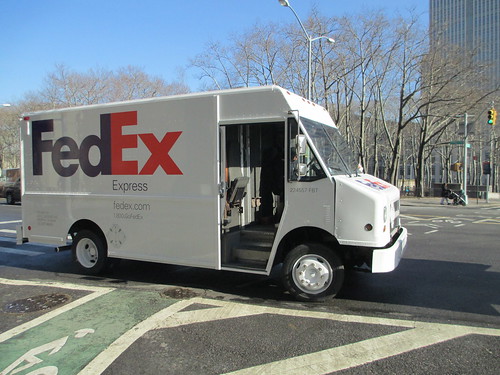
Yes, cycling's made progress. But, as long as FedEx drivers
think across one of  New York's busiest bike lanes is a good place
to park, it won't be mainstream
But it’s worth remembering that, even after recent years’ quadrupling of New York cycling numbers and the last decade’s doubling in London, riding a bike remains a fringe pursuit that’s far from winning mainstream acceptance.

That point came home to me particularly clearly one Friday night just before Christmas. Riding home around 10pm down W55th street from my office, I was surprised to find a limousine pull up next to me and wind down its window. Inside was a curious tourist who couldn’t understand what I was doing. No, I told him, I wasn’t delivering anything. Yes, I was just riding home from my office.

Recognising that he wasn’t going to get to the bottom of it, he finally said: “Just seems kind of… European.”

The incident set a new mental benchmark for me for cycling in New York and other big cities where it’s still not one of the main modes of travel. Cycling, I’ve decided, will finally be mainstream when an encounter with a commuter cyclist is no longer one of the “darndest things about New York” that a returning tourist recounts to his friends in Peoria.