Showing posts with label Ken Livingstone. Show all posts

Thursday, 5 February 2015

A barging garbage truck, a slippery Greenway - and why New York's bike routes are like a 747

It was far from being the most dignified manoeuvre I’ve ever made on a bicycle. Around 9.25am on January 29, as I rode to work down Prince St in lower Manhattan, I heard a garbage truck approaching me from behind, its driver blaring the horn. Since the bike lane was still full of snow and I was in the middle of the street’s single travel lane, I was immediately in the vehicle’s path – and fearful the driver wouldn’t stop before hitting me. I pulled over into a clear patch of the bike lane, jammed on my brakes and apologised to the cyclist following me for pulling across her path. The garbage truck careered past.
A bike on Vandam Street, SoHo, testifies to my fellow
cyclists' enthusiasm for tackling New York streets in the snow

The next morning, chastened by my experience and with fresh, light snow falling, I decided to mix with motor vehicles as little as practicable, to ride over the Brooklyn Bridge, through TriBeCa and up the Hudson River Greenway, which had been well cleared of snow the night before. But, when I pulled onto the Greenway, I found there had been no new treatment following the light overnight snow. I rode very gingerly uptown, worrying that the layer of slushy slow would cause my tyres to lose their grip.

The two experiences encapsulated the challenge that even I, a fairly hardy cycle commuter, face when trying to get around a city by bicycle, especially in winter. I need a network of viable routes I can follow to get places. I’m more likely than many people to regard a route that includes jostling with motorists or that isn’t marked as a bike route “viable”. Yet people unused to city cycling or in areas with poor infrastructure probably spend most of the time feeling the way I do when there’s snow and ice about. It’s as if the subway offered a choice of only highly circuitous routes or routes that stop every few blocks and required one to walk.
 
The Hudson Greenway after snow: a slippery connection in
the network
The realisation explains a fundamental disconnect I’ve noticed in perceptions of New York’s efforts to boost cycling. I regularly hear from cyclists in other places – particularly London – who’ve seen pictures of New York’s flagship cycle infrastructure projects and been impressed with the city’s apparent commitment to boost cycling. Few accept my reply that, since only 1 per cent of commuter trips in New York are by bicycle, the efforts are at least partially failing. “At least it’s better than we’ve got here,” they tend to reply, gazing longingly at pictures of the Prospect Park West bike lane or Allen St.

Still fewer correspondents contacting me from London accept my follow-up point. Although London currently lacks many showpiece, well-designed facilities to match the best in New York, I point out, 4 per cent of commuting trips in London are by bicycle. There is clearly some aspect of cycling policy in London – bedevilled as it has been by a lack of boldness and a reliance on dubiously effective road markings – that has proved vastly more successful than New York’s approach. The question is what’s making the difference.
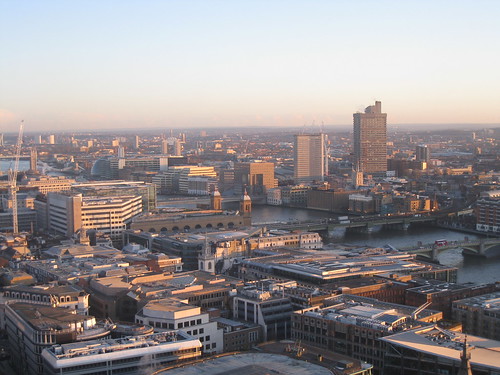
 
London from St Paul's Cathedral; there are networks there,
if you know where to find them
The answers, of course, don’t lie entirely in road layout. London has, for example, the Central London congestion charge, which over the last 12 years has sharply cut the numbers of vehicles entering Central London daily. Thanks partly to Sheldon Silver – the recently-disgraced former speaker of the New York state senate – New York lacks such a mechanism to keep through traffic out of lower Manhattan.

Public transport in London is also far more expensive than in New York, making a switch to cycling far more attractive financially.

London’s streets are, in addition, far safer than New York’s, even if that’s damning London with faint praise. For 2013, the last full year for which figures are available, there were 294 road fatalities in New York, which has a slightly lower population than London, including 168 pedestrians and 10 cyclists. In London in the same year, there were 132 road deaths in total, including 65 pedestrians and 14 cyclists. London’s far higher cycling rates make it clear that it’s a far safer place to ride per mile travelled than New York.

Yet one of the biggest parts of the answer, I’d suggest, can be found in thinking about the fate of the Boeing 747. The jumbo jet, hugely successful though it has been, faces phasing out at least partly because it was designed for an era when airlines sought consistently to operate “hub-and-spoke” services, feeding traffic from around a given region into a hub. Passengers would be transferred at those hubs onto long-haul flights on airlines’ hyper-efficient 747s.
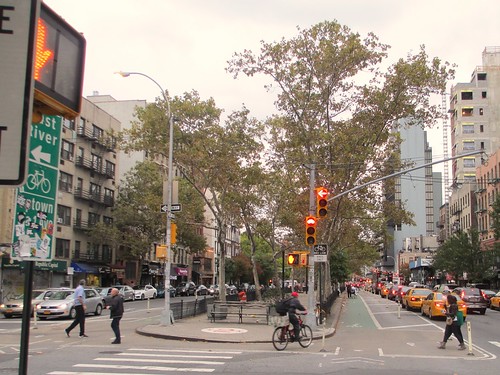
The Allen St bike lanes: enjoy the view, wistful Londoners -
but be sceptical this picture tells the whole story
The jumbo is suffering partly, analysts say, from improving efficiency - the biggest 777 aircraft can carry pretty much as many people with just two engines. But it is also losing out to aircraft such as the Boeing 787 and Airbus A350 that can fly long distances but are far easier to fill up. It’s much simpler with such aircraft to offer passengers direct flights from the city where they’re starting out to the city on another continent where they want to go. It turns out passengers don’t crave the excitement of running to transfer between flights at big hub airports, worrying whether their baggage is being treated with the same urgency. There's a growing preference for going the lowest-stress, most direct route.
 
New York, I’d suggest, has done an excellent job of sorting out a few key hubs for a network – protected lanes up Allen St and along Sands St sorting out some of the trickiest approaches to the Manhattan Bridge, for example. There’s a protected bike lane along Prospect Park West funnelling cyclists through Park Slope. There are bike paths along parts of the two sides of Manhattan. New York has provided the Atlanta-Hartsfield or London Heathrow type hubs and some of the routes that link them. But the system features too many disconnects – too many frantic dashes across the system’s gaps – to offer a full range of comfortable, point-to-point journeys.

First Avenue’s bike lane – often praised as a good example of recent improvements – disappears suddenly for 10 blocks (or half a mile) between the United Nations and 59th Street, pitching cyclists into chaotic motor traffic climbing towards the Queensboro Bridge. Worse still, anyone who has successfully cycled to the Upper East Side and is wondering how to head south again will find not even a painted bike lane for more than three miles on 2nd Avenue between 100th St and 34th St. The 8th Avenue bike lane disappears for five blocks around the Port Authority Bus Terminal, the chaotic point on the trip where cyclists are most in need of protection. The 9th Avenue bike lane disappears for a couple of blocks around Penn Station. There are more.
 
A sharrow marks a bike route in St George, Staten Island:
this look like part of a network to you?
Instead of a network, New York has built a series of sections of bike lane, with noisy objections to the loss of parking or some other complexity keeping the sections all too often separate from each other. The regular changes in colour of the routes on the city’s bike map – indicating a change from a protected lane to a painted lane, to mere “sharrows” then back – are testament to New York officials’ weakness in the face of noisy, local protest. Perhaps the emblematic failure relates to the Hudson River Greenway. It’s one of the safest, most comfortable to use bike facilities in the city. But nearly every means of accessing it south of 59th St involves a suicidally dangerous manoeuvre amid lines of fast-moving cars seeking to reach the West Side Highway.

It’s little surprise that, presented with confusing routes that disappear in the most dangerous places, relatively few New Yorkers are taking up the invitation to start cycling.

When I lived in London, by contrast, my head was full of the routes – often complex and roundabout, admittedly – of the London Cycle Network. The LCN – now out of fashion, since its introduction was overseen by Ken Livingstone, the former mayor - follows routes mainly along back streets across the city. It is so comprehensive that, by the time I left London, I could do 30-mile round trips on it without consulting a map. London’s existing Cycle Superhighways – appallingly designed as most are – at least seek to provide routes that take people to places. Both reflect what seems to me a greater tendency on the part of London’s planners than New York’s to think in terms of routes, not isolated projects.
Southwark Bridge, London: a key part of my mental map
of London's cycling networks

This week’s decision by Transport for London, the London mayor’s transport body, to go ahead with a comprehensive network of segregated bike paths should make the position far, far better. Unlike New York’s rather disjointed system, they should act more and more like the most efficient networks – like metro systems that draw commuters in from distant suburbs into heavily-used, highly-efficient core areas or express parcel networks. Such networks’ strength is their comprehensiveness – well-planned new metro lines generate disproportionately high numbers of journeys because they unlock new point-to-point journeys both on the existing network and the new line. London’s networks, at least in theory, aim to provide a reasonably consistent journey for a high proportion of the trips in the city that are possible by bicycle.
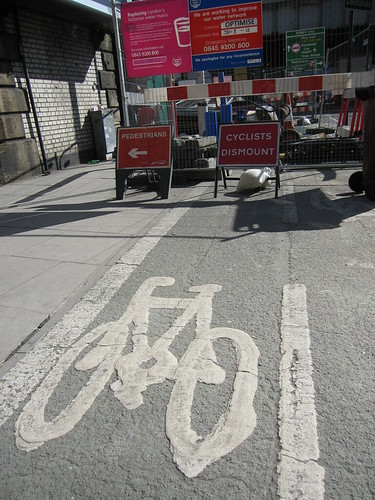
 
A London cycle path: an example of
the "infrastructure" that made me once
doubt infrastructure was the answer
Not, of course, that the simple dichotomies are the whole story. London’s cycle planners are, I know, prone to some of the same shortcomings as those in New York. I so despaired when I lived in London of the dire quality of much of the existing cycle infrastructure that I preferred an approach that sought to make onroad cycling safer. The roundabout, backstreet routes I often used are so circuitous that many simply won’t use them. In thousands of rides past South London’s busy Elephant & Castle interchange, I took one of the avoiding routes off the main roads every single time. To many other people, that route is so painfully slow that they prefer the main roads, where there are regular deaths.
New York’s project-based approach has at least improved some of the biggest barriers to cycling, even if it has always joined the bits together. I find the experience of mixing with fast-moving traffic on multi-lane New York streets sufficiently scary that I welcome any relief from it. I also understand, given the challenges of getting anything meaningful done in New York, why Janette Sadik-Khan - the city’s former, much missed, transportation commissioner – focused so hard on some flagship projects. The projects have proved resounding successes – had she sought to turn the projects into perfectly-realised networks, she could easily have become bogged down in the bureaucratic malaise that seems to have swallowed Polly Trottenberg, her well-meaning successor.
 
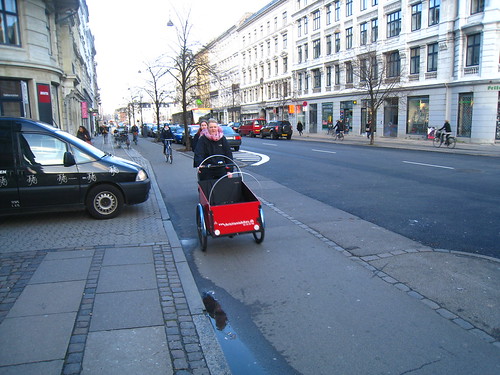
Copenhagen: an acutal cycle network, in magnificent action
Nevertheless, New York currently risks, it seems to me, watching from the sidelines as London’s new network of protected routes turns the city’s existing provision into a still more successful network. It’s hard to imagine New York’s achieving anywhere close to its target of having 6 per cent of trips by bikes by 2020 until it starts taking the challenges of providing a real network seriously.

Ms Trottenberg may be about to start tackling the issue in earnest, even if her department's record of retreat on markings for "slow zones" suggests otherwise. But the history of the Bleecker St – Broadway-Lafayette station on the New York City subway is a stark reminder that such changes don’t happen on their own in this city. The city’s IND subway network built Broadway-Lafayette station in 1936 immediately under Bleecker St station of the Interborough Rapid Transit Corporation. In 1940, the city subsequently took over the IRT and its rival BMT subway, forming them with the IND into an allegedly unified system enjoying the benefits of being a single network. Yet it was only in June 2012, after I arrived in New York, that a full connection between the two stations – which had sat immediately adjacent to each other for 76 years – was finally opened.

If New York is serious about encouraging more than a hardy band of souls to cycle round the city, changes to its cycling infrastructure cannot possibly take that long.

Sunday, 9 September 2012

Farewell to London - where cycling's popular, but just on paper

It was the closest I’ve come in the last little while to ending up under the wheels of a car. As I cycled home from work in London on July 20, just by the Oval cricket ground, a car passed me far, far too close. I pulled towards the kerb and jammed on my brakes. But, amid precisely the kind of light drizzle that makes roads treacherous, the slippery surface of one of the London Mayor’s ironically-named Cycle Superhighways nearly did for me. I started to skid alarmingly, swinging side to side in close proximity to the speeding car. It’s the kind of incident I’m sometimes inclined to think may reflect my cowardice rather than the actual danger. But, as I slithered to a stop and my right pedal skinned the back of my calf, a pedestrian came up to me, looking worried. “Did he hit you?” he asked.

Brooklyn Bridge: a new focus for
the Invisible Visible Man's frustrations
Nasty though it was, my sliding stop at the Oval would not have been especially notable – except that it took place on my last commute for the foreseeable future in London. My route-to-work gripes are now about the stupidity of tourists on the Brooklyn Bridge, the traffic snarl of downtown Brooklyn and when precisely the large model rat that protesters have placed in one lane of W54th Street in Manhattan might disappear for good. The London mayor’s superhighways and the Metropolitan Police’s indifference towards anti-cyclist crime are fast becoming a distant memory.

W54th street: rat trouble
But the incident seemed as neat a bookend as any to 11 years of cycling in London – nine years during my most recent stint and two years prior before our four-and-a-half years in Hungary. As I thought about it afterwards, my mind wandered back to a dark January night in 1997 when I swung my leg over my then Raleigh Mercury bicycle and set off for my first-ever bike ride in London. I was at a car rental depot in Catford and had just returned the rented van that had brought my and the Invisible Visible Woman’s belongings down from Edinburgh. I had to find my way across the alternately grim and genteel suburbs of south-east London to my new home.

To hear London’s politicians bragging about their recent achievements in encouraging cycling, one would imagine that my journey 15-odd years ago should have been nearly impossible. In fact, there were already some designated cycle routes to guide me across tracts of non-descript suburbia such as Forest Hill. The journey was about as pleasant as a ride on a cold January evening in a strange area could be.

The Invisible Visible Man's Raleigh Mercury:
gaudy-coloured veteran of his first ride in London.
The memory of cycling all that time ago nevertheless put a question in my mind. Are London and other cities enjoying fast-rising cycling numbers rising because cities are making progress, learning from their past mistakes, in their treatment of cyclists? Or are cycling numbers increasing despite city authorities’ failure to understand what cyclists need?

It would be silly, naturally, to claim London cycling had shown no improvement over my time. The biggest positive change has been the wholesale redesign of many urban London roads. The space at many junctions has been narrowed, to prevent cars swinging round them at high speed. Many streets have been made to look narrower, a step that has brought motorists’ speed down. Parking spaces in many places are now more clearly marked as an area off to the side of the main carriageway. I used, when I first cycled in London, inwardly to ask drivers who’d prevented my swinging round a parked car, “How did you think I’d get round it? Fly?” It’s a line that popped into my head far less often later in my time in London than in the late 1990s. That it’s coming back to me again regularly in New York illustrates how big a lesson the Big Apple’s traffic planners have to learn from London in this area.

Cycle Superhighway 7 at Southwark Bridge.
This part still has a slippery surface -
but is at least protected from poor drivers
There has been some modest improvement in the quality of cyclist-specific infrastructure in London too. The number of bike parking places has increased sharply – albeit not as fast in many areas as the demand to park bicycles. The number of markings telling motorists to leave space for cyclists at junctions has increased. The cycle superhighways have appeared along a number of main roads, although my experience in July illustrates the problems with putting routes with slippery surfaces along busy main roads where nothing is done to prevent cars driving poorly.

But the curious point that my July 20 experience illustrates is not how much has changed since 1997 but how much remains the same, despite 15 years when every senior politician associated with London has expressed devotion to improving the cyclist’s lot.

I’d seen the motorist that buzzed me behind me at traffic lights and, seeing that he was driving a black, souped-up saloon car, guessed that he was likely to overtake me dangerously. Sure enough, instead of waiting for a safe place and space, he barged through as if, essentially, I weren’t there. Looking at it from the motorist’s point of view, perhaps that isn’t surprising. The British Highway Code certainly tells motorists they should give cyclists as much passing space as another car. But who’s reminding motorists of that point? Aside from a half-hearted Transport for London campaign a few years ago urging motorists and cyclists to “share the road,” there’s been almost no effort to educate motorists over ten years when cyclist numbers have doubled.

Copenhagen: other cities want the sense of cool -
but not the messy reality of cyclists
Yet almost none of the politicians or officials I’ve heard talking about encouraging cycling has seemed to have cyclists and cycling as their focus. Cycling was meant to cut road congestion, or reduce pollution or increase people’s physical activity rates. With some politicians, it’s tempting to conclude that they want mass cycling almost as a sign of their city’s coolness – look, our people cycle just like people in Amsterdam! Look, you could barely tell us apart from Copenhagen! A few years ago, there was a similar craze in Europe for planning light rail systems. Bikes seem, in more straitened times, to have taken over.

The result is that the people who make decisions in big cities seem ill-prepared for cycling’s messy reality. Since 1997, tens of thousands more Londoners have started pedalling into central London every morning. Most of them are in a hurry; many are no more considerate of their fellow road users than the motorists alongside them and all of them take up at least some space on the roads. The picture of cycling in many politicians’ heads seems to be drawn from the architectural drawings they show off when boasting about a planned riverside park or other “green” amenity. The cyclists in those never look like they’re in a hurry or like they’re shouting at some idiot that’s stepped into the cycle lane without looking. Many policymakers – and plenty of motorists – seem affronted when cyclists diverge from this unrealistic ideal. Nobody wants to spell out to motorists that, in a given road space, more cyclists means less space for cars. We’re  meant to take as little effort to pass as the paper-thin, pencil-drawn cyclists in the politicians’ drawings. People are happy if their neighbours free up a parking space by taking up cycling – and furious if they ever get in their way on the road.

It’s certainly not a London-only problem. Ten days after my permanent move to New York, I was bowling fast down a marked cycle lane in Brooklyn, reflecting that the lane was far too close to the parked cars. A car door suddenly opened, I jammed on my brakes and, just as I had in London, lost traction and skidded – once again fairly safely – to a halt. New York cycle lanes’ placing reflects the same, apparently widespread delusions as policy in London – that cyclists should take up no space, have no momentum and always be ready to give way to pretty much any other road user.

It’s not inevitable, however, that every politician will always prefer to let motorists set the agenda. The change that has done most since 1997 in London to boost cycling numbers was introduction in 2003 of a charge for driving into central London during weekday peak hours. The decision, by making clear the costs of road use, instantly removed large numbers of vehicles from central London's roads. Cyclists took up some of the freed space. Advisers to Ken Livingstone, London’s then mayor, advised strongly against introduction of the congestion charge, on the grounds that no battle with London’s motorists could ever be won. In recent mayoral elections, while candidates have proposed modifications, no serious candidate has suggested ending the charge altogether.

It’s hard to foresee the circumstances that would prompt a future London leader – or a mayor of New York or any other similar world city – to take firm action finally to prioritise bicycles properly over cars. Until it happens, there may be further, incremental rises in cyclist numbers of the kind London has experienced since 2003. But proper progress will require real boldness.

Wednesday, 2 May 2012

How should cyclists pedal the electoral cycle?

There is a short stretch on one of my regular cycle routes – from central London down to the Canary Wharf financial district – that always reminds me of Boris Johnson, London’s mayor. I found myself riding there one morning three years ago with the mayor, who’s up for re-election this Thursday. He had spotted me overtaking him on my bike as we both cycled away from Canary Wharf after an early morning press event. Having become snarled in unpleasant, heavy traffic on the way to CanaryWharf, he asked if I knew a better route back. Given both human sympathy and the opportunity to bore my city’s leader with my views on his cycling policies, I naturally agreed.

Canary Wharf: start of my historic bike ride
But, as we cycled through Limehouse near the Rotherhithe Tunnel entrance, the mayor became agitated. The route I was following – part of the London Cycle Network initiated under Ken Livingstone, his predecessor - started to bend round to face back towards Canary Wharf. “We’re doubling back on ourselves!” the mayor exclaimed. Sure enough, when the route we were following was subsequently revamped as part of the mayor’s Cycle Superhighways programme, the brief double-back was eliminated, to be replaced with an awkward contraflow cycle path down the wrong side of a one-way street. I always wonder whether our ride produced it.

The incumbent London mayor’s very public identification as a cyclist has become one of the focuses of this year’s mayoral election campaign. The mayor has claimed to be championing cycling both with the introduction of “Cycle Superhighways” sweeping along some of London’s busiest roads and of an on-street cycle hire scheme based on Paris’s Velib. A growing cycling lobby has suggested that, despite his regular perch on a saddle, the mayor has done nothing like enough to produce the cycling revolution he claims to be instigating.

But Ken Livingtone, who’s standing again and is likely to be the mayor’s closest opponent, sometimes seems to feel positively hostile towards cyclists, even if his administration benefitted those of us on two wheels. I’ve recounted in a previous post how I once asked him, while mayor, what he would do to combat anti-cylist hostility. I told him how, a few days before, I’d had a young man aim a punch at me while cycling, in the hope of making  me fall off. “I’ve often felt like punching a journalist myself,” he droned back. He went on to recount the obviously sad but clearly unrepresentative of a young man in Brent who had seriously hurt an old woman while cycling.

The question consequently is whether a cycling London voter should vote for either of the two unpalatable leading candidates or veer off to support one of the myriad of other candidates available. There are options ranging the whole way from fascism (the BNP) and Euroscepticism (the UK Independence Party) to Jenny Jones’s Greens.

The question raises issues that go well beyond London’s narrow confines. Should cyclists decide their voting preferences based purely on candidates’ policies towards cycling? If they should, which policies are most worthy of support?

London cyclists gather for the Big Ride: aspirational figures
They were all questions I pondered last Saturday as I fixed the Invisible Visible Boy’s Burley Piccolo trailer bike onto my Surly Long Haul Trucker and headed into central London for a rare piece of cycling activism. In steady, cold rain, around 10,000 people (according to the organisers) or 5,000 people (according to the police) arrived by bike on Park Lane in central London to press the mayoral candidates to act on the principles of the London Cycle Campaign’s Love London, Go Dutch campaign for safer cycling conditions. I’m sceptical on many levels about the precise details of LCC’s campaign. I don’t think segregated lanes are the only realistic option for cyclists and I’m far from sure it’s sensible to hold up another, very different country as a model.

Nevertheless, the Invisible Visible Boy, four, and myself were keen to show there are large numbers of cyclists in London who want cycling to become a safer and more consistently pleasant experience. It did no harm that we got the chance to cycle down some normally forbiddingly busy central London streets unmolested by cars.

Yet the event swarmed with political activists who thought cyclists would be easy recruits to their wider causes. The Green Party was very clearly in evidence, suggesting their candidates were the only true friends of cycling. I even, depressingly, saw a high-vi vest advertising the Morning Star, “Daily Paper of the Left”. I prayed a silent prayer that cycling wasn’t as doomed as the Morning Star’s Communism. It’s just a blessing the event was too bourgeois for the Socialist Worker contingent customary around any progressive London protest – albeit their placards might have been entertaining. “Ped and bike, unite and fight!” might have been a suitable adaptation of their traditional, “Black and white – unite and fight!” slogan.

Other groups, meanwhile, prodded us towards identity politics. Londoners on Bikes distributed copious numbers of leaflets demanding we vote with our bikes. The Invisible Visible Girl, 10, expressed particular bemusement about how that might be accomplished.

The choices seemed clear. Cyclists were either political animals who just happened to arrive at the leftish party meetings on two wheels. Or we were apolitical animals picking and choosing candidates according to the number of bike hire stations they’d put in or the speed they’d let cars drive.

Open platform danger: the new bus
Yet it doesn’t take too much probing before the “Vote With Your Bike” thinking crumbles. How far, for example, does one regard cycling policy as stretching? Most cyclists would probably like to see more deliberately dangerous motorists losing their licences or going to jail. But what about policy on buses? One of Boris Johnson’s flagship transport policies has been to reintroduce buses with open rear platforms – a clear invitation for passengers to jump out into traffic without looking round for bikes. Is that a fit subject for a cyclist to consider when voting? The last decade’s big jump in cycling really started, meanwhile, with Ken Livingstone’s introduction of the Central London Congestion charge, which discouraged motor vehicles from coming into the city centre. Can we consider that? If so, can cyclists also take into account that Boris Johnson removed congestion charging from western central London, significantly worsening conditions there?

There are even subjects outside transport policy. One of the more sobering bike rides I’ve undertaken in the past year was a ride home from central London in the early evening of August 8 last year, the worst night of the rioting that erupted all over the city as a result of a whole range of issues, ranging from anger at the police’s behaviour to straightforward greed. Antipathy towards rioters might lead one to support Brian Paddick, the Liberal Democrat candidate, an ex-policeman who has campaigned as a crime-fighter. Is someone voting with their bike allowed to consider how a candidate’s propensity or otherwise to incite riots might affect cycling conditions? And are we allowed to consider how most fellow policemen probably regarded Commander Paddick a dangerous liberal for his tolerance of soft drugs in his area? Are we allowed to consider how Ken Livingstone’s sympathetic statements about some islamist radicals might relate to the threat of terrorism?
These Big Riders' children can grow up eccentric - but not dumb

The truth, of course, is that nearly all cyclists, save a fanatical few, rightly vote on a far broader range of issues than a narrow “vote bike” position. The mostly middle-class parents present at the Big Ride didn’t, for example, seem to want their children to grow up stupid thanks to lacklustre education. Nor are many of them likely to have felt comfortable either with a mayor – like Ken Livingstone – who sounds increasingly cranky or the foppish incumbent who describes the £250,000 he earns annually for his newspaper column as “chickenfeed”. There ought surely to be space for someone like me who can marvel at the free market’s ability to deliver marvellous bicycle products but still feel lefty bleeding-heart concern over nearly everything.

Very few of us cycle as part of an overall, hard-left political position. Many cyclists may be woolly liberal muesli-munchers. But we can surely comfort ourselves that we’re not single-mindedly obssessed woolly-minded liberal muesli-munchers.

Which brings us to how I actually cast my postal vote (since I’m currently in Leipzig and can’t vote in person). Ken Livingstone’s bold introduction of the congestion charge, his willingness to listen to advice and his eagerness to switch priorities away from smoothing traffic flow to people and cyclists all certainly recommended him. But the former mayor’s persistent bitterness and embrace of Hugo Chavez, some Islamists and other darlings of the radical left drove me away from endorsing him even with a clothespeg on my nose (the tactic that allowed me to support him in 2008).

The Invisible Visible Man Votes - with clothespeg
Instead, I held my nose at the more nutty elements of Green Party policy and gave my first preference to Jenny Jones, with Ken Livingstone second. I was swayed by her apparent personal decency – and her willingness to pledge a crackdown on lawbreaking motorists.

That leaves only the question of the fate of my partner in the Historic Bike Ride from Canary Wharf, Boris Johnson. Ever since my ride with him, I have been struck by how the mayor appears to be a cyclist but not of us. He rides a bike but can’t work out why many people dislike Cycle Superhighways that aren’t really for bikes, aren’t super and aren’t highways. His experience of cycling hasn’t taught him that it’s dangerous to have people jump off an open-backed bus in front of one - or that “smoothing traffic flow” might lead to high levels of dangerously fast, frightening traffic. My sense was confirmed on Monday, when the mayor lost his temper at hustings specifically to discuss cycling. He declared, "I may not conform to your stereotypical image of a cyclist. I do not have whippet-thin brown legs or dreadlocks or jump red lights."

The incident reminded me of part of our ride back from Canary Wharf. At a red light on Cable Street, the mayor sailed through, while I stopped. Not knowing where to go, he stopped further up the street, peering back to look for me. I was sitting by the junction, pointing piously up at the red light.

The mayor may, when the votes are counted on Friday evening, have cause to look similarly ruefully back on his campaign - and wonder where all those stereotypical cyclists’ votes have gone.