Showing posts with label motorists. Show all posts

Wednesday, 21 March 2012

In which our hero picks up cycling policy's hottest potato...

Most evenings, as I head home towards reunion with the Invisible Visible Woman, I pedal, as I’ve noted before, in the footsteps of Roman soldiers along London’s Cycle Superhighway 7. But, on nights of the light, misty rain that are a spring and autumn speciality of London’s weather, something unusual happens. As I and other cyclists swing onto a section of the Cycle Superhighway by Kennington Park, we veer out of the marked, blue-painted part of the road that’s meant to be reserved for us. We all know by now that the marking was done on the cheap with a simple layer of blue gloss paint. In such weather, it becomes scarily slippery. We consequently sit towards the outside of the near-side lane. The sight of the line of bikes, all frightened to use a dangerous facility intended to keep us safe, always leads me to raise at least a mental, mildly amused eyebrow.

Roadworks in the City: guess which transport mode
everyone decided was dispensable
I smile a similarly wry inward smile when cycling along any section of pavement (sidewalk, American readers) that’s been divided between pedestrians and cyclists. The standard UK practice is to mark the separate pedestrians and cyclist sides with ridged tiles (to help vision-impaired people). The ridged tiles on the cyclists’ side are laid parallel to the bike’s wheels, however. Those on the pedestrian side run acrossways. A reasonably cautious cyclist consequently has to veer onto the pedestrian side at the tiles, to avoid the small but real danger the ridges will catch his front wheel. Having narrowly missed crashing after catching my wheel a few times on such a tile, I’m unwilling to take more chances.

My main thought as I negotiate these obstacles (or, more properly, “cycle facilities”) is to wonder whether their designers are even vaguely familiar with a bicycle and its basic physical properties. I think we can dismiss out of hand the idea that they might actually regularly ride a velocipede.

However, there’s a second, more serious thought. If this is the rich world’s idea of cycling infrastructure, why are so many cycling organisations pressing for more of it?

Such a notion pitches me, of course, into a bitter intra-cyclist dispute. It echoes, in a way, the divisions everywhere among oppressed groups seeking greater freedom. Do we seek, like pedalling Malcolm Xs, the segregation of the separate cycle facility, using mainly lanes free of our motor-powered oppressors? Or do we pursue peacefully the dream of integration, winning the right to the respect we deserve on the wider, more diverse society of the road?

It’s worth saying, of course, that I am as open as the next person to enjoying a car-free environment. When visiting my parents-in-law, I cycle to their church in north Wales partly on a tarmac path along an old railway line. On a Sunday morning, with few runners or other cyclists about, it can be one of the purest, most uncomplicated bike-riding experiences available. One of the most enjoyable cycle facilities to use in London is a fully segregated cycle lane along Cable Street in the East End. The absence on most of the route of worries about car behaviour is undoubtedly one of its attractions.

It’s the difference in stress levels using such routes that leads admirable campaigners in many countries to demand better, separate cycle provision. In the UK, it’s currently common for such campaigners to say cycling will remain a niche activity for the eccentric few (such as the Invisible Visible Man) until the country boasts the same kind of network of segregated cycle routes as the mass-cycling Netherlands or Denmark. They look at people like me who think there are chances of forging a basic understanding between road users and shake their heads. Isn’t it sad how determined we are to restrict cycling to ourselves and a few other members of the privileged middle classes?

I have, as it happens, a fundamental distrust of the idea of segregating any groups of people that can’t seem to get along. But I’m worried about the practicality of cutting cyclists off from other traffic too.

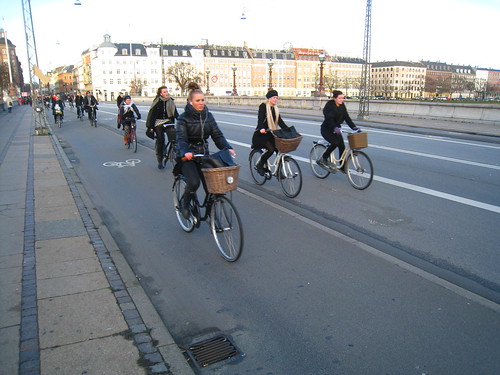
Nørrebrogade: exhibit A in the segregationists' case
It’s certainly hard to feel too sceptical about segregation standing in the morning on Nørrebrogade, in Copenhagen, the street that carries traffic from the west of Copenhagen over a string of lakes into the city centre. I went to look at it in late 2009 and, even towards the end of the rush hour, there were hundreds of bikes streaming down neat, segregated cycle lanes. Niels Tørsløv, the head of Copenhagen’s city traffic department, told me the city timed the traffic lights to fit in with the flow of bikes, rather than cars. One of the major controversies he was tackling was over the number of cargo bikes in the city. He was having to widen the cycle lanes to make it easier to overtake them. Such are the problems of directing traffic in a city where 37 per cent of people get to work, school or college by bike.

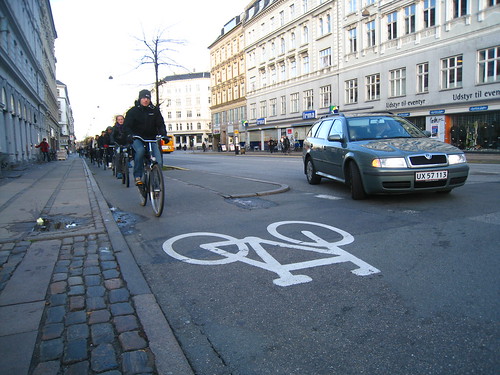
A Copenhagen motorist helpfully illustrates
the Invisible Visible Man's point about side-street conflicts
But, according to Mr Tørsløv, the segregated lanes only rearranged the accidents, putting them at the intersections between roads and cycle paths, rather than at even spaces along the roads. Copenhagen put in the cycle lanes, he said, only because they encouraged people to cycle – cycling numbers rose 10 per cent when a street gained a cycle lane. I happened later the same day to see a motorist knock off a cyclist using a segregated cycle lane.

After that visit, I started to notice, as I sped along Cable Street towards meetings in Canary Wharf, how disproportionately at risk I was from motorists pulling across my path at side streets. I was out of their eye line and difficult to see.

The Invisible Visible Man's hired cruiser bike.
He's not on it - but obviously
drivers saw it like this all the time
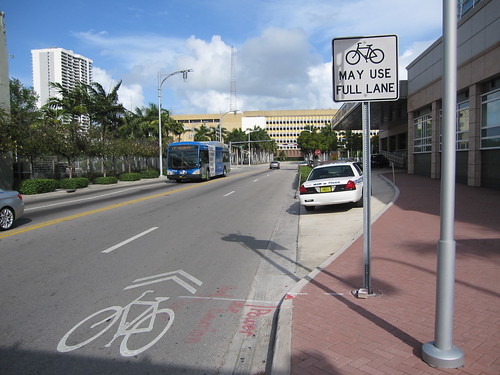
My experiences last week in the US (the reason, dear readers, for the late production of this latest blog post) underlined my worries about segregation. Unable to bear any longer missing my bike languishing across the Atlantic, I hired a cheap cruiser bike and headed across the causeway from Miami Beach into downtown Miami proper. I was encouraged at points to see cycle lanes marked on the road. But then I spotted a sign with a bike picture and the words “may use full lane”. This was a rare piece of permission, I realised. The painted lanes were less a facility than a prison, confining me to the fringes of the roads.

Given the number of motorists I’ve already had tell me in Britain that I shouldn’t be outside some rebranded gutter masquerading as a cycle lane, it made me worry what kind of message a heavy concentration on segregated lanes would send. Certain motorists would quickly come to think of on-road cycling as banned.
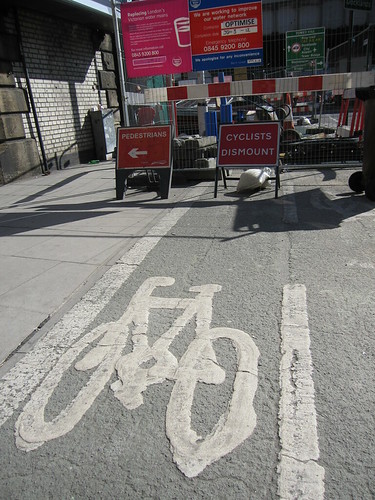
A whole lane? The City of Miami, for once, spoils cyclists
I’m consequently positioning myself in the middle of the lane, staring round at any potentially menacing drivers - and pedalling my way into the camp that says cyclists and motor vehicles broadly have to coexist in most city streets. This action will, I know, put me, to some advocates, irrevocably in the Not a Good Person camp. They will look upon me henceforth the way a reactionary newspaper columnist would if he had seen me cycle through a red light and mount a pavement, mouthing obscenities.

Yet I’m reluctant to side firmly with either camp because bike behaviour doesn’t seem to me the most important issue on the roads. Watching politicians’ obvious nervousness when discussing road funding in the UK this week has illustrated how fear of drivers continues to drive attitudes about how roads are used. The same fear holds back police forces from tackling speeding, driving while distracted and the other driver behaviour that puts some cyclists off.  After a driver threatened to assault me recently, the police showed no interest in investigating the driving offence that led to the confrontation. The driver had deliberately pulled his car across the path of a cyclist in, I suspect, full view of a CCTV camera. It would have been a “disproportionate use of police resources” to try to retrieve the film.

There doesn’t even seem to be an appetite for explaining the law. Many drivers, I suspect, don’t actually understand they’re not meant to intrude into cycle-only stop areas or that cyclists are allowed to ride outside cycle lanes. It would take too much courage to embark on a simple public information campaign.

Motorists’ attitudes are certainly not immutable – I’ve referred before to the transformation in views about drink driving in many countries as an example. It’s my guess that, if motorists were behaving better, far fewer people would yearn for the apparent sanctuary of segregated lanes. Meanwhile, if the apathetic planners currently in charge in many western countries set about building new cycle infrastructure, it’s a fair bet it would tend more to keep cyclists out of motorists’ way than to help cyclists.

It's unfortunate, too, if the debate polarises advocates into backing two separate approaches. Some places – the busy roads by the Thames in London, for instance – look perfectly set up for separate cycle lanes. The narrow streets in the City of London look best suited to assertive, on-the-road cycling. Many junctions need redesigning. Others would be fine if the current ignored rules were enforced.

But, for the moment, cyclists’ real needs are so far from policy makers’ minds that they’ve built a “Cycle Superhighway” out of stuff that makes bikes skid. I’d prioritise changing motorists’ and officials’ thinking over pressing the same people to build more of their flawed idea of cycling facilities.

Monday, 13 February 2012

Why no man is an island - even in his car


One day in 2001, I was standing by an intersection in Pristina, the monument to dingy Yugoslav urban design that serves as Kosovo’s capital. A souped-up saloon car squeezed inside a vehicle stopped by a set of traffic lights. Then, the moment the lights showed amber, the saloon car’s wheels screamed. It accelerated forward, then swung round in front of the other vehicle. The driver wanted to get ahead as the two cars turned left. The overtaking driver could easily have lost control of his vehicle and spun off the road; he could have hit the other driver as he swung round – and he moved himself only one place up a line of traffic that was probably just going to join a traffic jam further on.
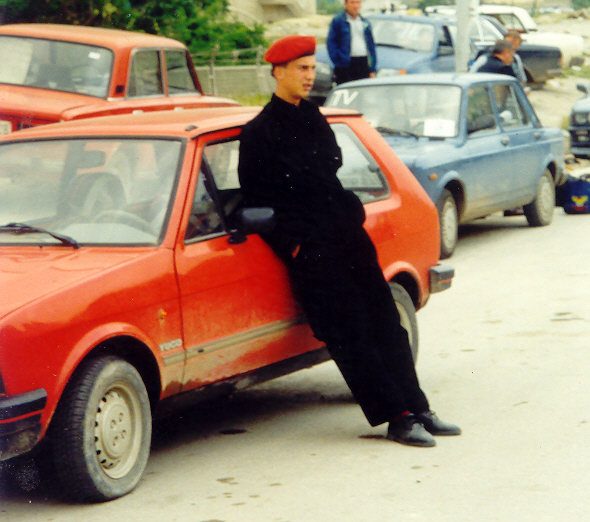
A KLA policeman: tellingly, not looking eager
to tackle Kosovo's traffic culture problem

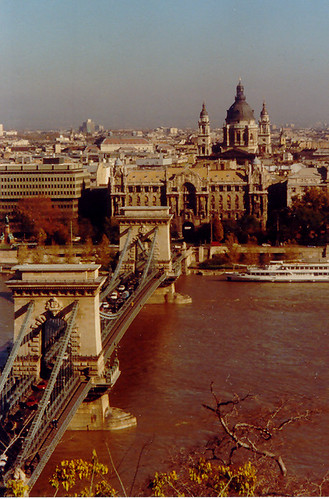
The following year, I was cycling through the centre of Budapest, then my home city, when a car cut suddenly across my path. Shocked and thinking the driver might simply not have seen me, I slapped a side panel of his car. When the window wound down, the stream of words that issued started “a büdös anyád” (your stinking mother). A general tone thus established, the driver went on to suggest that I shouldn’t be on the road - and that he was well within his rights to act like a homicidal maniac.

The incidents in Pristina and Budapest helped to germinate the seed of an idea that was already planted in my mind. I began increasingly to pay close attention to what light the culture of a country’s roads shed on its wider society. It was illuminating precisely because, to people sitting inside cars, using a road often feels like a purely private enterprise. On busy roads, it is in fact one of the most complex social interactions many human beings undertake.

Budapest: beautiful - but one driver was
misinformed about my mother's personal hygiene
It perhaps wasn’t surprising that Kosovo’s road culture was fairly nihilistic. On a previous visit to Kosovo, shortly after the 1999 war, I had found a farm in western Kosovo whose courtyard was scattered with human ashes and bodies left for the dogs. According to local Albanians, it was the aftermath of a massacre by Serb forces. By the time I saw the bad driving just under two years later, most Kosovo Serbs had left either because of revenge attacks or the expectation of them. The callousness towards others and contempt for the rule of law that had marred Kosovo’s recent history carried straight over, it seemed to me, to how people drove.

Hungary was nothing like as damaged a society as Kosovo – despite the horrors of decades of first right-wing dictatorship and then Communism. But I would regularly report on the miserable living conditions of those who lived in dirty hovels on the edges of towns or run-down bits of Budapest – the country’s gypsies. My experience with the angry motorist – and the boorish tendency of drivers of the most powerful cars on the country’s motorways to drive at speeds that seriously endangered older, slower-moving cars – suggested vulnerable road users attracted similar contempt.

But in Hungary, Kosovo and many other long-misgoverned parts of the world, decades of misrule have discredited both the rule of law and any sense of a wider social good. In such societies, it became heroic to defy even good laws because those imposing them were so distrusted. The negative examples nevertheless suggest something about how road users should conduct themselves in healthier societies. Members of a well-ordered society abide not just by its agreed laws but also by the higher principle that they seek, as far as possible, to respect each other’s interests. They pay particular attention to the interests of the most vulnerable, who are least able to stand up for themselves. They restrain their exercise of their own rights to enhance others’ ability to enjoy theirs.

So we shouldn't be constantly worrying, it seems to me, what others might do to us if we break the rules or behave discourteously. We should all be thinking what our behaviour says about ourselves and our society. If we behave rudely or flout the rules, even if it does no direct harm, we tell those that see us that we are uninterested in their wellbeing. Every time we break road rules, we tell those that see us that we despise the rule of law generally. We’re slowly but surely corroding the bonds that ought to bind us together as a society – and as people who share the limited, precious space our society devotes to roads.

Those who regularly follow the developed world’s controversies over the role of cycling will by now think they know what’s coming. This could easily be the point where I start to bemoan the behaviour of some of my fellow cyclists, shaking my head metaphorically over how those that jump red lights, ride on pavements and so forth besmirch the good name of the rest of us.

My point is, I hope, a bit more subtle. To protect vulnerable road users, it's vital to pay most attention to the vehicles that do most harm. Politicians, police forces and journalists in many countries express outrage at cyclists’ alleged general disrespect for the law. But the less conspicuous law-breaking of motor vehicle drivers – the breaking of speed limits, the driving while distracted by a telephone and the contempt for measures meant to keep cyclists safe – kills thousands of people each year in most developed countries. Many motorists would be surprised how often their fellow motorists even ignore red lights - the failing often, in Britain at least, assumed to be particular to cyclists. I have twice narrowly avoided cars that were simply driving too fast to spot stop lights when I was heading across their paths. The depressing reluctance of many police forces to regard such behaviour as serious and criminal surely leaves vulnerable road users who try to stand up for their rights more exposed.

But there is no point pretending that some cyclists’ behaviour contributes nothing to the malaise. As I argued in a previous blog, cyclists generally harm no-one but themselves if they run red lights, ride on pavements or head the wrong way up a one-way street. Yet motorists or pedestrians seeing such behaviour must surely, to some extent, feel freer to disregard the rules or behave intolerantly themselves. Cyclists have so much potentially to gain from an improvement in road culture that it is surely worth each cyclist’s pondering which way his or her behaviour shifts the delicate balance between tolerance and intolerance on the roads.

It will not solve everything for cyclists to follow the rules. I have previously argued – and still believe – that much anti-cyclist behaviour stems from a simple irritation at cyclists’ choice of an obviously different way of doing things. I have also often been abused for alleged rule breaking when riding (perfectly properly) on on-pavement cycle paths or using one-way streets with a contraflow cycle lane. Some motorists fly into a rage at seeing a cyclist pulling ahead of them into the boxes that are meant to let cyclists leave traffic lights in most British cities ahead of the cars.

But there is a tendency on the part of all road user groups to criticise others for their failure to adhere to the fixed rules of the road – then make up their own minds which rules seriously apply to them. It is a system few people think appropriate with regard to the rules about assault or theft – and one that is no more appropriate about the rules for how people share the roads. Consequently, when I get on board my bike today, I will be looking out for - and trying to obey - traffic lights, one-way street signs and all the other myriad traffic symbols I see about me. It may not directly make my day better. It may not even make me directly safer. But it will reflect my conviction that, because my actions affect a far wider circle of people than myself, I have to respect the only commonly-agreed set of rules that we have.

Monday, 23 January 2012

The minister who made the Invisible Visible Man see red


It was the kind of reasoning you’d expect from someone who has spent so long trying to reconcile competing instincts and priorities that he’d lost all track of common sense. One summer several years ago, over lunch with a junior transport minister in the then UK government, I asked about the future of speed cameras - cameras for catching speeding motorists that his own government’s research showed saved more than a hundred lives every year. Putting on a serious voice and knitting his brows, the minister – who clearly disapproved of the official support for the cameras - told me that motorists were worried about speed cameras’ effectiveness because of the “regression to mean” effect. The effect describes how part of the fall in accidents at a given site after a camera’s installation is probably a statistical quirk, rather than a result of the camera’s presence.

I tried – but didn’t fully succeed – to control my irritation. I told the minister – forcefully – that in my experience far more motorists were simply worried about being caught speeding. They didn’t have intellectual doubts about speed cameras – they just thought they should be allowed to drive whatever speed they damn well pleased. The minister clearly didn’t think it was important to enforce speed limits.

Cyclists on Lower Thames Street, London Skyride 2009.
They're their "own worst enemies",  according to one minister -
yet they seem oblivious to the danger.
The minister’s understanding for rule-breaking motorists did not, however, extend to cyclists. I went on to ask what the government was doing to make roads safer for cyclists. “To be honest,” he replied, “I think cyclists are their own worst enemies”. I had little doubt I had much, much worse enemies on the roads than myself – and I had encountered several even during my short cycle ride to lunch. I nearly – but  didn’t quite – follow the inner urge to get myself out of the presence of someone who thought I wasn’t worth protecting. It would all have been less alarming if he hadn’t been the road safety minister.

The lunch was the moment when I started to realise how completely the thinking about road use of most people – even those who devote their days to deciding on road safety policy – comes from the gut, rather than the higher brain centres. The minister’s gut wanted to drive fast – I later discovered he had a number of convictions for speeding – and disliked cyclists. My gut, clearly, likes cycling and doesn’t care for driving. But I like to think my frontal cortex at least gets to review the gut’s decisions. I recognised – I still recognise – that lots of people need to drive, that motor vehicles are not about to stop being the main means of making most trips in the UK – or most other parts of the world – and that even the keenest cyclist has to find some modus vivendi with the dominant road users. It was depressing to find a government minister relying so thoroughly on the lower reaches of his abdomen that he was holding two utterly contradictory views.

But anyone who’s spent any significant time cycling anywhere where cycling is a fringe activity will know that cyclists scratch out feelings from well below some people's civilised veneers. Some motorists’ determination to get past cyclists just to reach the end of the traffic jam ahead faster; the curious determination of some pedestrians to step in front of cyclists even when they can see the cyclist clearly; the daily battles over precedence in the special boxes for cyclists at traffic lights: these all betoken a gut distaste for cyclists that doesn’t seem based on detailed perusal of road casualty rates.

Nevertheless, it is probably worth laying out clearly how intellectually disreputable the minister’s views were. In 2010, 1,850 people died on the UK’s roads – and only four were killed by cyclists. In each of 2008 and 2009, only a single pedestrian died after being hit by a bicycle. Cyclists – who account for just under 2 per cent of traffic but far more in the urban areas where most accidents occur – consequently were responsible for just 0.22 per cent of 2010’s road user fatalities. The proportion had been still lower the two preceding years. Even among pedestrians – the only group of road users that cyclists seriously threaten – cyclists accounted for fewer than 1 per cent of the 405 killed. Other road users, meanwhile, killed 111 cyclists.

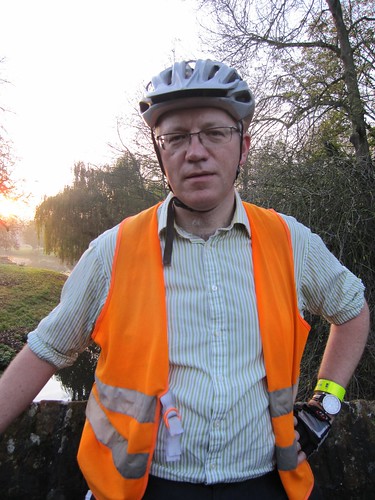
Me in cycling gear: a sight, one reporter says,
that ought to terrify pedestrians. Note to motorist
readers: since you won't be able to see me, I'm near
the picture's middle, wearing high-visibility clothing
These figures, of course, are rather as simple Newtonian physics would suggest. The energy released when a single cyclist hits a pedestrian at, say, 15mph and when a car, van or lorry hits a pedestrian at 30mph are many orders of magnitude different. I can testify to this point particularly congently after unwillingly conducting my own experiment in early 2009. On February 4, I was knocked off by a glancing blow from a minivan crossing my path on Brixton Road, south London. On March 13 the same year, I was hit squarely by a cyclist running a red light near Elephant & Castle. The minivan incident left me sore for a year – the collision with the cyclist only a few days. Cyclists running red lights, going the wrong way up one-way streets and mounting pavements are an irritation – but little more. Motorists who speed, talk on their telephones, fail to see red lights or deliberately drive dangerously regularly prove a lethal danger.

Politicians who want to make life safer for pedestrians and other road users should consequently be encouraging cycling, even if cyclists continue to run red lights (which I think they shouldn’t) or mount the occasional pavement. We cyclists represent far less of a danger to other road users than any other form of wheeled transport.

Yet, when I spoke to Lord Adonis, the then newly-appointed transport secretary, in mid-2009 along with another transport correspondent, the other reporter turned beetroot red when I asked about enhancing safety for cyclists. He interrupted before the minister could answer. “What are you going to do about aggressive cyclists?” he demanded. “What aggressive cyclists?” I retorted, pointing out that people perched on metal frames and two wheels were in a weak position to be truly, dangerously aggressive. My theories about what drives such anger will have to wait, however, for another post. It will take some space to explain why some people hate others simply for their choice of transport mode…