 |
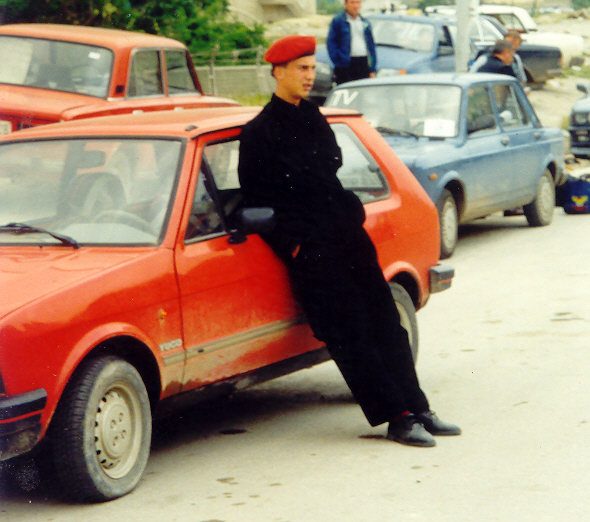
| A KLA policeman: tellingly, not looking eager to tackle Kosovo's traffic culture problem |
The following year, I was cycling through the centre of Budapest
The
incidents in Pristina and Budapest
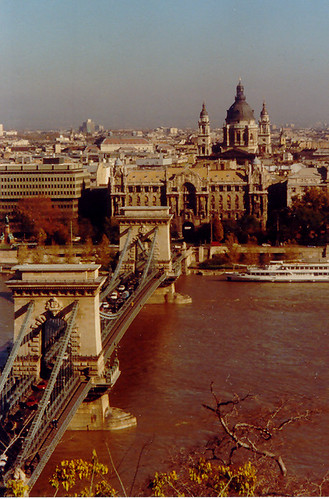 |
| Budapest: beautiful - but one driver was misinformed about my mother's personal hygiene |
But in Hungary
So we shouldn't be constantly worrying, it seems to me, what others might do to us if we break the rules or
behave discourteously. We should all be thinking what our behaviour says about ourselves and our
society. If we behave rudely or flout the rules, even if it does no direct
harm, we tell those that see us that we are uninterested in their wellbeing.
Every time we break road rules, we tell those that see us that we despise the
rule of law generally. We’re slowly but surely corroding the bonds that ought
to bind us together as a society – and as people who share the limited,
precious space our society devotes to roads.
Those who regularly
follow the developed world’s controversies over the role of cycling will by now
think they know what’s coming. This could easily be the point where I start to
bemoan the behaviour of some of my fellow cyclists, shaking my head
metaphorically over how those that jump red lights, ride on pavements and so
forth besmirch the good name of the rest of us.
My point is, I
hope, a bit more subtle. To protect vulnerable road users, it's vital to pay most attention to
the vehicles that do most harm. Politicians, police forces and journalists in
many countries express outrage at cyclists’ alleged general disrespect for the
law. But the less conspicuous law-breaking of motor vehicle drivers – the
breaking of speed limits, the driving while distracted by a telephone and the
contempt for measures meant to keep cyclists safe – kills thousands of people
each year in most developed countries. Many motorists would be surprised how
often their fellow motorists even ignore red lights - the failing often, in Britain
But there is no
point pretending that some cyclists’ behaviour contributes nothing to the
malaise. As I argued in a previous blog, cyclists generally harm no-one but
themselves if they run red lights, ride on pavements or head the wrong way up a
one-way street. Yet motorists or pedestrians seeing such behaviour must surely,
to some extent, feel freer to disregard the rules or behave intolerantly
themselves. Cyclists have so much potentially to gain from an improvement in road culture that it is surely worth each cyclist’s pondering
which way his or her behaviour shifts the delicate balance between tolerance
and intolerance on the roads.
It will not solve
everything for cyclists to follow the rules. I have previously argued – and
still believe – that much anti-cyclist behaviour stems from a simple irritation
at cyclists’ choice of an obviously different way of doing things. I have also
often been abused for alleged rule breaking when riding (perfectly properly) on on-pavement cycle
paths or using one-way streets with a contraflow cycle lane. Some motorists fly
into a rage at seeing a cyclist pulling ahead of them into the boxes that are
meant to let cyclists leave traffic lights in most British cities ahead of the
cars.
But there is a
tendency on the part of all road user groups to criticise others for their
failure to adhere to the fixed rules of the road – then make up their own minds
which rules seriously apply to them. It is a system few people think
appropriate with regard to the rules about assault or theft – and one that is
no more appropriate about the rules for how people share the roads.
Consequently, when I get on board my bike today, I will be looking out for - and trying to obey - traffic lights, one-way street signs and all the other myriad traffic symbols I
see about me. It may not directly make my day
better. It may not even make me directly safer. But it will reflect my
conviction that, because my actions affect a far wider circle of people than
myself, I have to respect the only commonly-agreed set of rules that we have.