It was one of my moral philosophy
lecturers – I think it was Gordon Graham – who debunked for me an old – but
rather flimsy – idea about the structure of the world. Addressing the idea that
humans’ bodies and souls were somehow separate entities, he held up his hand,
looked the other way and asked, “How do I know where my hand is?” The strong –
unarguable, I think – contention was that people didn’t get their ideas about
where their hands were across some barrier between the mind and the body. They
knew where they were because their minds – which decided where they would put
their hands – and their bodies – the hands that were moved – were the same
things.
The incidents have made me ponder whether
I’m somehow a humourless prude for failing to catch the innate hilariousness of
someone’s warning that she’s going to “run over” the next cyclist she sees on
the road rather than the pavement (sidewalk, American readers). Should I, as
one of the “run over” woman’s friends suggested, simply “get a life”?
So I’ve been surprised over the
last few weeks to notice a version of the mind-body separation hypothesis
getting a new life among angry people on the Internet. I’ve pointed out to several
people venting their frustration on Twitter that they’re potentially making
their own lives difficult when they threaten (for example) to run over the next
cyclist they see riding “in the middle of the road”. If they hit a cyclist with
their car in the future – even unintentionally – the act will look deliberate
and the charges will be more severe. Most prefer at that point not to reply. But
a few have replied indignantly that nothing could be further from their mind
when writing about crushing a cyclist beneath their car’s wheels than actually
doing so. Their angry opinions and their blameless on-road actions are as
separate as a classical philosopher would say a grubby body and a pure mind (or, in this case, a grubby mind and pure body) should be.
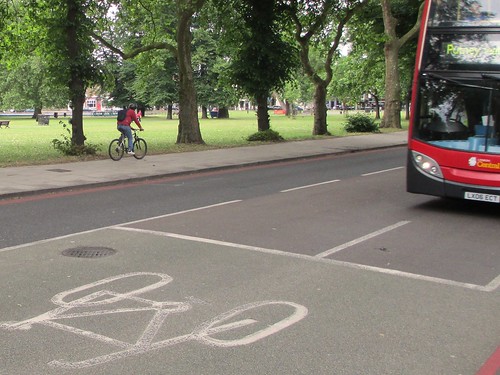 |
| Angry Twitter users should love this rider on London's Clapham Common. He's done as they've asked and got onto the pavement to ride. |
Or are these Tweets verbal
expressions of attitudes that carry over into real-life driving behaviour and
lead to real deaths and injuries? Are the opinions as inseparable from the
drivers’ actions as Professor Graham’s hand and his mind?
The question is all the more
pressing after a fortnight in the US when the Supreme Court has moved
gays and lesbians a significant step forward in their struggle for equal
rights, but moved black people several steps back. There’s no doubt that the
growing unacceptability of racist and homophobic language has helped to move
those groups’ struggles forward. Should it remain socially acceptable to threaten
to drive one’s car over someone just because he or she has chosen to use a
bicycle on a public road?
None of this, of course, is to deny
Twitter’s ultimate triviality. For some time, the most retweeted message was a sickly sweet farewell by Justin Bieber to a six-year-old fan who'd died of cancer. The vast bulk of what
appears there can be treated much as one might the rantings of the drunk at the
next table in the pub. It’s mildly irritating - but something one can and should
ignore.
There is, nevertheless, a direct,
graphic quality to the threats some Twitter users make towards cyclists that
makes them worthy of attention. In late June, one user, Ray O’Connor, tweeted
this message for the next cyclist that he regarded as being too far out in the
road: “I will buckle your back wheels c**ts #IWillRunYouOver.”. Another user, @brinky91, said
in a now-inaccessible message around the same time that she would “run over”
the next cyclist she found riding in the middle of the road. In April, another user, @LaurenKoerber tweeted: "I f***ing hate f***ing people that ride their bikes in the middle of the road.. Like you're not a car #iwillrunyouover."
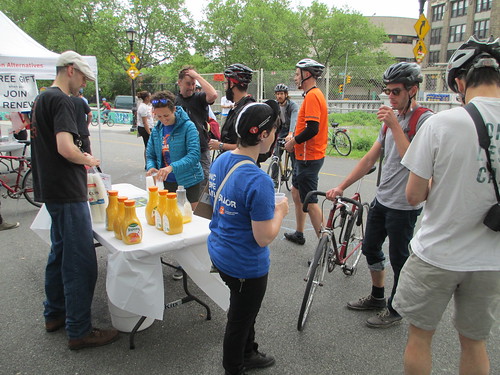 |
| Bad news for angry Twitter users: these riders on the Manhattan Bridge have bikes and look likely to use them. Good news: they're not on a road. |
These are, I think, the kinds of
threats that, expressed towards many other groups, would attract at least some
attention from the police, interested to see how serious the threats’ makers were
about carrying them out.
The threateners, however, seem
almost as indignant at the idea that the threats are serious as I am at their
making the threats. “I WASN’T REALLY GOING TO HIT A CYCLIST GEESH,” shouted one
typical replier - @AMILLIAMELY - after I queried her suggestion that she might
“gain points” in the game of road use by hitting cyclists who rode “in the
middle of the street”. Others prefer self-pity, whining that they’re getting
“grief” from “cycling fanatics”, as if that were an unusual result of making
death threats to strangers in a public place. @brinky91 pleaded that her
threats simply reflected her “opinion” to which she had a perfect right. People
should leave her alone. @AMILLIAMELY went on to tell me that she simply liked
to express her opinion about things that made her “mad” and that it helped her
to feel better.
Yet the more I read such
declarations of innocence the more I think about the fate of John Kelly, a
cyclist who was riding his bike in Astoria , part
of the New York borough of Queens
in mid-March. Mr Kelly was using a bike
lane when witnesses saw a van come from behind him, swerve into the bike lane and hit him. He ended up clinging by the wipers to the windshield, the driver
staring at him with what Mr Kelly called an “angry look” on his face. When
Kelly managed to jump off, the driver escaped. Few regular urban cyclists will
have been surprised at news of the van driver’s attack. It was merely an
extension of the kind of aggressive, deliberately dangerous driving to which
many of us are, unfortunately, used.
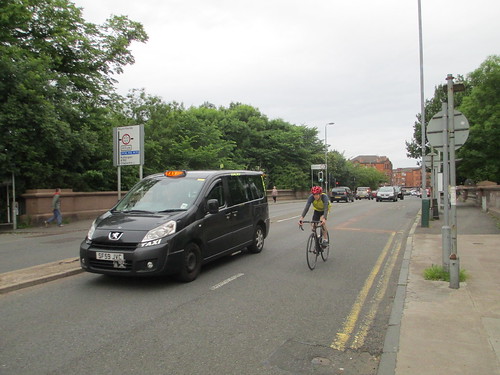 |
| This cyclist on Glasgow's Cathcart Road is wearing specialist clothes, is (rightly) well out in the road and amid some traffic. He could be a perfect storm for cyclist-haters' rage |
The van driver’s attack so closely
paralleled the kind of violent assault-by-motor-vehicle that I’ve seen Twitter
users say they want to carry out that I can’t accept the two are entirely
separate phenomena. It’s clearly better if the people with whom I’ve debated
haven’t deliberately used their cars to hit people. But I found it hard to
believe the claims of one indignant threat-maker that he was always a careful
driver. Is it really credible that a driver who tweets after a trip that he
would like to run over cyclists will carefully pass every cyclist he sees on
his next trip patiently and at a safe distance? The threat-makers are almost
certainly over-represented among people killing and injuring people riding on
the roads.
Which leaves the question of
@brinky91’s right to voice her opinion that she’d like to crush my body with
her car.
There is no doubt that a civilised
society has a huge interest in protecting the right to express a wide range of
opinions – including ones that gravely offend other people. Free speech
provides the fuel for the great race between ideas that makes free societies
superior to closed ones. It mans the feeding stations in the great,
ever-running stage race between ideologies. There need to be excellent reasons
– protection of a person’s right not to be unjustly defamed, for example, the
prevention of direct incitement to violence and the protection of a handful of
official secrets – to put serious curbs on the right.
But it remains absurd for people
voicing an opinion to complain that others loudly disagree. It is as if Chris
Froome were to take to complaining in the coming weeks that other riders were
attacking him on mountain stages of the Tour de France. There is occasionally
an unpleasant whiff of bullying about the way Twitter users can round on
someone indulging in unpopular speech, bombarding him or her with messages of
protest. But, in cases where someone has threatened real, graphic violence as some
of those I have mentioned did, it seems perfectly reasonable that he or she
should understand how many of the verbal attack’s victims strongly resent that
language.
Speech, after all, is valuable
precisely because it is an echo-chamber, amplifying our thoughts and allowing
us to try out ideas about the world before taking them from our brains to our
hands. I feel constrained as I cycle around New York to behave well precisely because I
have written here that everyone should do so. I can’t help thinking that
motorists whose Tweets about maiming or killing cyclists have received only the
sneering agreement of their friends will feel justified in driving far less
carefully. If I have a choice between fending off dangerous driving with a
swift brake application and evasive manoeuvring or a few strokes on a keyboard,
I know which I’m going to choose.
You can follow the Invisible Visible Man - who promises never to threaten another road user's life - at @RKWInvisibleman
You can follow the Invisible Visible Man - who promises never to threaten another road user's life - at @RKWInvisibleman
