Showing posts with label winter. Show all posts

Sunday, 29 March 2015

An unexpected rhythm, a stressful ride to Midtown - and why I feel I'm waltzing with the city

When I’m riding my bike home in the evenings and have come down the long, spiral ramp off the Manhattan Bridge into Brooklyn, I often find myself waiting at a pedestrian crossing nearly right under the bridge’s first girders. Given that the bridge carries four busy subway tracks as well as three roadways, a pedestrian path and a bike path, that means I frequently hear the ear-splitting din of a B, D, N or Q train crossing just above my head.
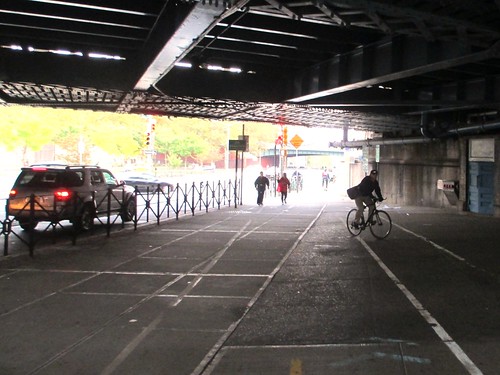
 
An unexpected source of syncopated rhythm: the bike path
under the Manhattan Bridge's Brooklyn end
But the noise’s effect isn’t what one might imagine. A joint in the tracks means that the wheels produce an exquisitely syncopated rhythm. A-ONE-and-a-two-and-THREE-and-a-four clack the four successive axles as the joins between the cars roll overhead. The rhythm is so compelling that sometimes, when no-one’s looking, I permit myself a little dance with my shoulders.

My jiggling shoulders generally prompt a second thought, however. The sound turns my mind to how cyclists in cities like New York or London or anywhere else where cycling’s an on-road, minority activity, have to attend closely to the rhythm of the city around them. In such an unforgiving environment, it's vital to pick up the cues from the surrounding, constantly-changing city about when and where to cycle fast and confidently and when to exercise maximum caution and restraint.
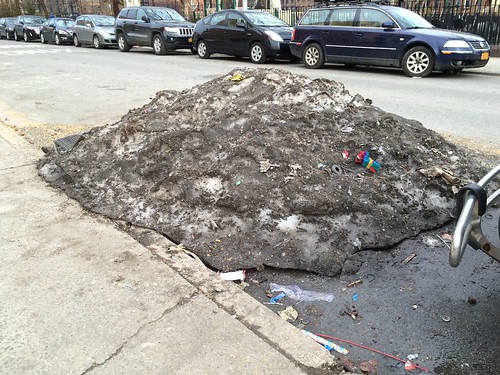
Call it snirt, call it snarbage: we New York City cyclists
have been dodging a lot of snowy, rubbishy mounds like
this in the last few weeks and months.
Many of the patterns I've come to recognise are things that restrict me. During the recent long, bitter winter, for example, I noticed myself learning after each snowfall the distinctive pattern of snow clearance and how it affected each cycle lane and where I positioned myself on the road. An event like last week’s sad gas explosion and fire in the East Village will suddenly paralyse traffic across vast swathes of the city. Light rain after a dry spell makes surfaces particularly treacherous – especially, ironically, those painted with the rather slippery green paint the city uses to mark cycle lanes.

Yet there’s a pleasure, after two-and-a-half years and at least 10,000 miles of New York City cycling, to having learned to recognise – and anticipate – so many of the city’s moods. The sudden surges in traffic in various places; traffic’s unexplained disappearance in others; the surge in grumpiness among drivers in certain conditions: all reflect, I know rationally, a multitude of individual decisions. But they can feel so concerted and sudden that they almost feel like the actions of New York City herself. A cyclist riding through the city has to undertake a kind of dance with her, getting in step and learning how she moves.

I had something of the same feeling about London when I lived there and enjoyed an encyclopaedic knowledge of much of its backstreet network of quiet cycle routes. But New York is a far more mercurial dance partner – hotter in summer, colder in winter, denser, with far more dangerous streets and more prone, it seems to me, to catastrophic mishaps. It feels far harder to learn to get in step with her – and a more satisfying achievement to have learned to do so.

That makes all the more enjoyable those moments of bliss one experiences from time to time riding a bicycle – the moments when the city seems to slip by and it is the other forms of transport that seem momentarily absurd.
 
The kind of weather that's slowing me down particularly
dramatically at present: Fifth Avenue in a light rain shower,
perfect for creating a treacherous surface
There is, nevertheless, a dissenting voice inside my head that wonders how much I’m dressing this phenomenon up. I sometimes wonder if my having got to know the city better simply means I’m growing more fearful. I notice how I’m increasingly stopping to let cars past on the narrowest roads where I know drivers are most aggressive. I’m less often taking the middle of the lane and forcing them to slow down to, say, a 20mph crawl in a 20mph limit. I noticed myself easing off significantly on my speed in some recent rain showers, feeling that the streets, still greasy with the detritus of winter, might be particularly treacherous. I find myself waiting behind motor vehicles as lines of other cyclists slip through narrow gaps between them and parked cars or the kerb.

Perhaps, a voice in my head says, I'm feeling the familiarity of the bullied with the bully. Maybe I’ve let the city’s toughness beat me into mental submission.

The dissenting voice grew particularly loud on March 23 when I had to cycle from home first thing in the morning to a conference right by the south-eastern corner of Central Park. I tried to fall in step with the city. I used my knowledge of the position of the many new potholes that have appeared over the winter to decide when to dodge out of the cycle lane and into the car lanes. I used my experience of the weather to look out for the inevitable ice patches, products of a mixture of the cold and a hundred little thoughtless sloshings out of buckets into the cold street or spillings of drinks.
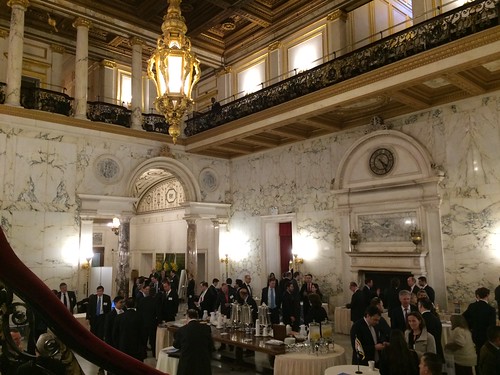
 
New York's Metropolitan Club: maginficent inside - but
a devil of a place to cycle to.
Already feeling slightly ill before I started, however, I began to feel a little defeated. The corner I was visiting – 5th Avenue and East 60th St – is one of New York’s least accessible by bike for anyone arriving from the south. Having prided myself on finding a viable but unconventional bike route up 1st avenue to 55th street then up Park Avenue to 60th – I found myself dismounting and pushing rather than deal with the gridlock (and yet more ice patches) on Park Avenue.

The experience was a useful reminder that, in an ideal New York City, there would be no real skill to cycling in step with the city’s gyrations. Far more experiences would be like riding along the best sections of the Hudson River Greenway – a chance to travel quickly around New York, put no strain on the city’s environment or infrastructure yet take in the city’s excitement. I was torn between cursing three things: my own cowardice in intimidating conditions, the city’s unwillingness to provide a joined-up cycling network and my own stubborn refusal to give up cycling in the face of these facts.
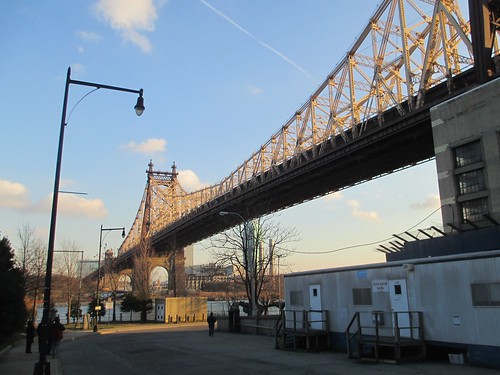
 
The Queensboro Bridge: where my journey started to go right.
Yet, as I pondered at the end of the day how to get home after my unpromising outbound trip, I realised I was only a few blocks from the Queensboro Bridge and its bike path. I set off and was soon barrelling at nearly 25mph down the bridge into Queens, under the elevated subway tracks then over another bridge into Brooklyn.

I covered the route, though it was long, quickly and efficiently. I took routes through Greenpoint and Park Slope that I’d devised only after many attempts and much trial-and-error. I was able to enjoy the grandeur of the panoramas over the East River and take in the city’s details. I saw the Polish shops in Greenpoint, the Yiddish writing on the buses for Hassidic Jewish schoolchildren in South Williamsburg and the soul food restaurants run by African-Americans in Fort Greene.

I grew briefly frustrated with a cluster of visiting-hour cars outside Methodist Hospital on 6th St in Park Slope but soon slipped past them too and sped, unmolested, down the hill towards home.

It was, in short, the kind of rare, transcendentally enjoyable trip that explains my refusal to give up. It’s the kind of experience I may, if anyone asks me soon if he or she should cycle in the city, recount as evidence for the “yes” side.

But I probably won’t dare articulate my true feeling about how such a near-perfect journey feels. In my head, New York City and I were, for that hour or so, spinning and whirling across the dancefloor in a rare, elegantly-executed and ecstatic waltz.

Monday, 17 February 2014

The C Train, my childhood - and why the subway still gets me excited

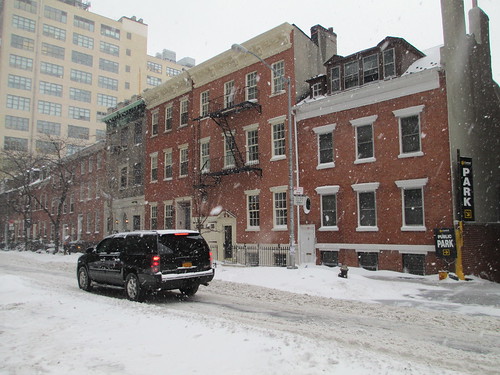
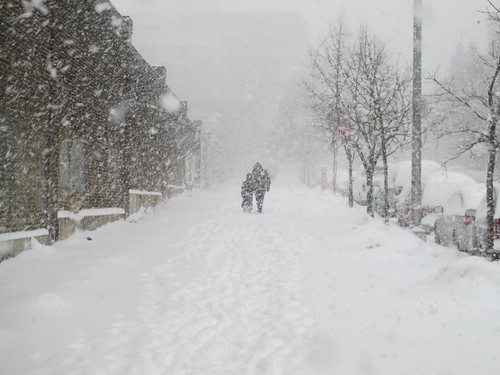
It’s not a term that many people would associate with a journey on the New York City subway. But, as I trudged up the steps on Thursday from the C Train station at Spring St, I felt a warm glow of admiration. I emerged onto Vandam St to find that day’s blizzard – which would eventually drop 14 inches (36cm) of snow on parts of the city – still in nearly full flow. The transit system had nevertheless transported me with what seemed to be insolent ease from an above-ground station in Carroll Gardens down into the tunnels to downtown Brooklyn then, on another train, across the east river to the west side of lower Manhattan.

Vandam St in a snowstorm: a contrast to the order
beneath the streets
The journey’s smoothness was a tribute to the virtues of forward planning, teamwork and operational excellence that make for a smoothly-running transit system. At street level, by contrast, a rental truck whose driver had got it stuck on a pile of snow was blocking the street, holding up a snow plough.

Yet, just the day before, it occurred to me, I’d been raving about how magnificently satisfying my cycle ride to work had been. I’d braved well-below-freezing temperatures and persisting patches of ice and snow to ride to work on both Tuesday and Wednesday, enjoying the challenge of the unpredictable conditions and taking in magnificent views of the city spread out before me.

Wasn’t there a contradiction, I thought to myself, about my two positions? If I enjoyed using perhaps the most individualistic of mechanised transport methods – the bicycle – wasn’t it odd I also admired such an obviously shared form of transport as the subway? Moreover, it occurred to me, why wasn’t I alone in my shared enthusiasm? Why did so many of the cyclists and cycling advocates I knew have a decided preference for subways and buses over cars in conditions when they couldn’t get about by bike?

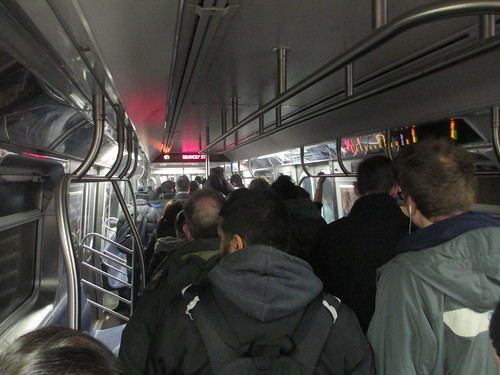
Trying to leave an F Train when the track ahead is on fire.
I can tell you what it felt like - just be grateful I can't
make you smell the acrid smoke.
I should start answering those questions by making it clear that not all – possibly not even most – of the subway journeys I’ve been forced to take for weather reasons in recent weeks have evoked the warm feelings that my trip on Thursday did. I’ve had plenty of long waits for trains and other disruptions, including the two-hour journey home I mentioned in a previous post. Worst of all was my experience on the morning of February 3. After unwisely guessing that the F Train to West 4th St would be my quickest route to SoHo, I found myself trapped underground for 40 minutes. The live rail in the station ahead was on fire and power to our train was cut while the fire department tackled it. I don’t especially recommend the experience of standing in a confined space with emergency lighting, no air-conditioning and a growing smell of acrid smoke in the air.
 
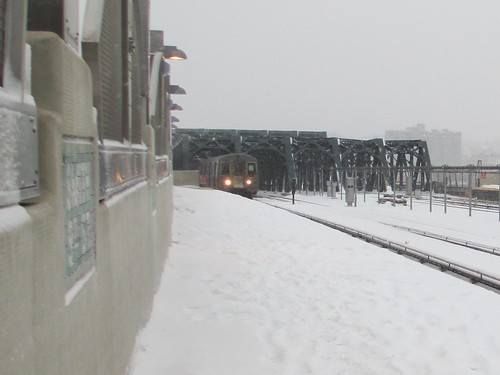
A G Train on a snowy day. My background tells me
it took teamwork and organisation to get this train running.
I should also confess that part of my feeling for subway systems stems from my background. My late father, who taught me to ride a bike, devoted his whole working life to subways – first in London, then in Glasgow. While my journey to work last Thursday might have seemed easy to me, I know that subways do anything but run themselves. My dad, I recall, diverted the taxi taking him and my mother to their 20th wedding anniversary dinner to the subway depot. A train had derailed at a critical point and he wasn’t going to relax until he was sure it was on its way to being put back.

I associate the New York subway also with my grandfather, who visited New York as a seafarer in the 1920s and told us wide-eyed children decades later about the marvels of express and local trains and the other complexities of the subway system.

As I spot some complicated bit of lineside equipment or work out some intricacy of the New York City subway system’s workings, I often feel a sharp pang at not being able to share it with my father, who died in 2002. “My train was diverted over the disused express tracks, dad!” “I got a good look at the snowblowing train!”

But there are also plenty of things about transit systems that cyclists can appreciate even if they haven't got my back story, I think. While many motorists seem to view their car as an extension of private space, I recognise clearly when I’m on my bike that I’m involved in a complex social interaction. The difficulty of communicating with other drivers is one of the things I least like about driving. It’s less of a stretch for me than for a driver or habitual taxi user to have to negotiate the scores of interpersonal transactions involved in using busy subway trains.
Copenhagen's cycle rush hour: they could have got
a nice train instead, lucky people.

It’s certainly no coincidence that cities that are good for cycling also tend to have good public transport. Copenhagen has a magnificent driverless metro system as well as good suburban S-Trains. Amsterdam has a formidable tram and suburban rail network. In the US, Portland, Oregon, has both some of the highest cycling and some of the highest transit ridership figures. Washington, DC, also enjoys a combination of relatively good cycling conditions and good public transit (even if the Washington metro’s train frequency and reliability could do with improvement). The careful planning and forward thinking required to build a good public transit network also tend to produce the kind of civic-minded thinking that prompts cities to curb car traffic, police streets well and put in good cycling facilties.

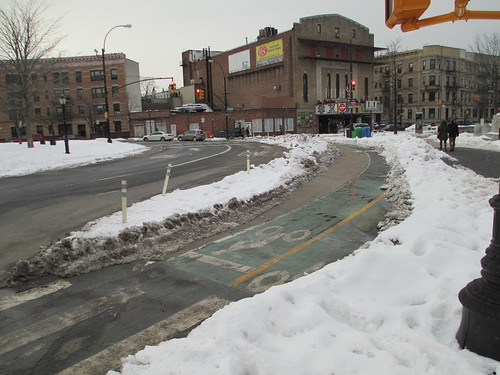
A partly-cleared bike lane: cyclists and transit users
have both been getting spotty service
New York and London, the two cities where I’ve most recently lived, fall in slightly odd places on the cycling-public transport continuum. Both suffered years of underinvestment. The 1930s-vintage lines that I use most heavily in New York are some of the city’s newest; London's underground steadily deteriorated between the 1960s and 1990s. Both cities veered off for decades in the direction of encouraging motor car use – under Robert Moses’ leadership in New York, inspired by his example in London. Moses fought to ensure badly-needed new transit lines were never included in his vast road-building projects.

There are days when, sorry, even I can't cycle
The spotty service I’ve experienced in recent weeks in New York is consequently an excellent summary of how the city is faring in both cycling and public transport. There are moments when the smoothness and progress from the worst times seems like a miracle. There are others when the main improvements from the city’s darkest days seem to be that the ageing trains are no longer covered with graffiti. The fire that kept me stuck underground isn't the only one I've encountered lately.

The subway's challenges regularly remind me that I prefer to cycle when I can. I also enjoy the exercise, the fresh air, the views from the Manhattan Bridge and cycling's relative reliability. Cyclists also avoid some of the hassles that come in winter as the homeless and disturbed crowd onto subway trains for warmth.

But, on days when the weather gives me no choice, the subway reminds me of the excitement I still feel at living in this mad experiment of a city, scattered on the islands and peninsulas around New York Harbour.

"This is a World Trade Center-bound E local train!" -
words that still sound oddly exciting to me.
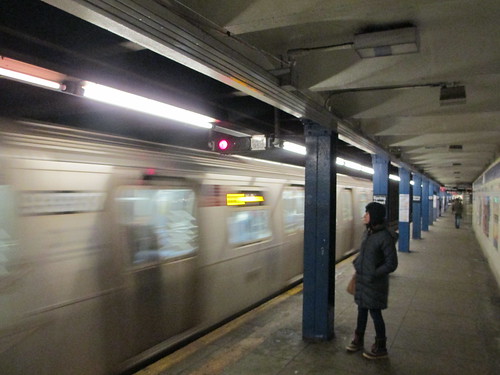
Even the littlest detail of the journey can send that welling up in me. There’s the rattling of an express train through a local station, its lights flashing as they pass the support pillars. There are the names that evoke a thousand novels, songs and films. There’s the bizarre mixture of all kinds of cultures and classes one finds crammed onto many subway cars.

All are summed up sometimes in the announcements that squawk out over the public address as I step onto the train.

“This is a Manhattan-bound A train,” I hear with childish excitement. “Next stop: High St-Brooklyn Bridge. Stand. Clear. Of the closing-doors!”