It was when I witnessed
the staff at Brixton Cycles standing worried by a distraught customer that I first
appreciated the intense human dramas played out at the bike shop. The
woman had just been given some bad news about the cost of fixing her bicycle –
or the impossibility of repair. She collapsed into such hysterical sobs that
someone scurried off to the back offices to find a chair, sit her down and
offer her whatever the bike-shop equivalent of grief counselling is. I’m sure
they’d done everything they could.
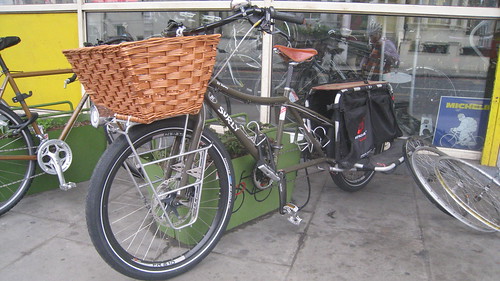 |
| A Surly Big Dummy outside Brixton Cycles: who knows what dramas lurk inside the doors? |
It was only the
messiest of countless collisions I’ve witnessed in bike shops between people’s expectations
about the economics of cycling and the reality. Because it costs nothing to jump on a bike in the morning - and people forget that assets
require regular maintenance and occasional replacement - many expect it to cost nothing at all. I can’t pretend to be entirely bemused.
I open my wallet with something like gay abandon for the bike shop. But I never
quite remember that the same money is no longer available to replace trousers worn out by catching on mudguards or shirt collars worn out by
over-optimism about my neck’s fatness. I wander round for the most part in the
clothing equivalent of the squeaking, buckled-wheel bikes I encounter on the
roads – shirt collars frayed, trouser seats nearly worn through.
Yet one doesn’t
need to cycle for long in most western countries to encounter someone who
thinks cycling should be costing far more. This was roughly the view of the SUV
driver who came crowding into the cyclist-only advance stop area at a set of
lights one night on south London’s Clapham Road. As I tried to turn right
across the oncoming traffic, he should, I pointed out, have been behind me,
giving me space. “You don’t pay road tax!” he leant out of his window to shout.
It was an only slightly less sophisticated version of the argument that John
Griffin, the chairman of Addison Lee, London’s biggest private-hire car
company, put forward in a recent issue of his company magazine where he ranted about the danger cyclists posed and their failure to pay road
tax. "It is time for us to say to cyclists 'You want to join our
gang, get trained and pay up'," the chairman opined.
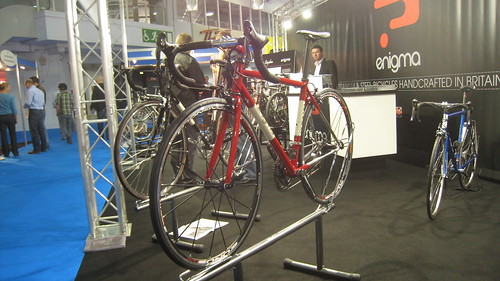 |
| A beautiful, up-to-date bike: all in a day's work for the market's invisible hand |
Cyclists
consequently find themselves in some dark middle ground between the
paid-for-but-well-funded city of Motoring and the free-but-clearly-unchargeable
village of Disregarded Pedestrianism. Most are paying out far more to the
private sector than they might like to keep their bikes on the road – but
getting ever-lighter, ever-faster, ever more beautiful bikes in return. They are
meanwhile paying, in many people’s view, nothing for use of road networks towards
whose uptake most motorised users pay substantial annual taxes. They get in
return roads built almost wholly for non-cyclists, and the contempt or
antipathy of the police forces meant to keep those roads safe. A powerful headlight
is needed to illuminate this road. Who, if anyone, is getting ripped off here?
Could there be a better arrangement?
There is certainly
an irony about watching the smashing of free-market capitalism’s carbon fibre
road bike into liberal cyclists’ custom-built retro roadster at Brixton Cycles,
the bike shop that attracts the vast bulk of the Invisible Visible Family’s
substantial bike expenditure. The shop avers itself an opponent of normal,
capitalistic ways of doing things and is a workers’ cooperative. It is
festooned with the paraphenalia of anti-establishment urban culture. I’ve grown
so used to them I barely notice them. But, recently, as we left the shop the
Invisible Visible Girl stayed, her 10-year-old faced glued to a sign in the
window. “Daddy, what’s a Dykes on Bikes ride?” she asked.
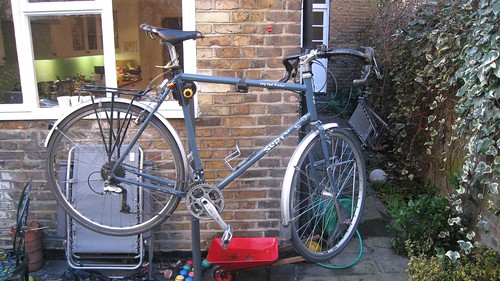 |
| The Invisible Visible Man's Surly Long Haul Trucker He knows he's used this picture before - but suspects others must enjoy gazing at it just as he does |
Yet capitalism’s
genius for parting people from their money screams so loud from every corner of
the shop that even adverts for biking Lesbians can’t drown it out. I used 15
years ago to reach down to the bike’s down tube to change gears on my early
road bikes. When I bought my Surly Long Haul Trucker touring bike in late 2007,
I was delighted to find I could change gears between a choice of 24 with a sideways
flick of either the brake levers or little switches beside them. Two years later, I found
shifters for a mere 24 gears were no longer available. Instead, for much the
same price, I was offered seamless shifting between 27 speeds.
When I first
brought a road bike from Edinburgh to London in 1997, I had to glue in ineffective
Kevlar linings to protect them against puncture risks. Now, thanks to the latest Schwalbe Marathon Plus tyres, punctures are rare, landmark events. My
early road bikes’ brakes were neither strong nor easy to service. My Long Haul
Trucker boasts easily adjustable brakes that stop me quickly and efficiently
from a substantial speed – and that even a mechanical know-nothing such as I
can adjust. Twenty years ago, I wrestled with dim lights demanding heavy
batteries and apt to stop working suddenly. I now attract complaints from those
around me for the dazzling brightness of far smaller, lighter, less
energy-hungry lights.
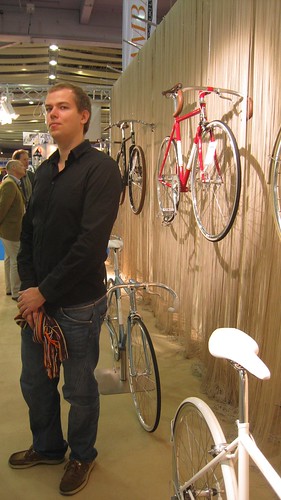 |
| Denmark's Henrik Norby with the Viva Bikes the market tells him to design |
The market’s
invisible hand has, in other words, fitted bike manufacturers’ products to
cyclists’ real needs as smoothly as a well-lubricated gear cable slips through
its cable housing. No mere bureaucrat, for example, could have anticipated the
sudden rush away from the order and progress of ever-improving gears into the
chaos of gearlessness. But the world has suddenly filled, without breakdowns in
supply or vast deliveries of unwanted bikes, the gearless, sometimes brakeless,
pared-down machines some of the public seem to want. Cycling advocates have no
need to pester the manufacturers to meet their needs. Whatever the market’s
shortcomings in, say, providing stable banks or creating just societies, it has
responded to cyclists’ changing whims as smoothly as a new chain and rear cassette mesh when bidden by STI shifters like those on my bike.
The transmission
between governments and cyclists’ needs works more like the
derailleurs on some unloved old mountain bike abandoned outside a town hall.
The reactions are either delayed or over-sudden, the outcome unpredictable and
everything accompanied by a great deal of squealing.
Rust clogs up the
mechanism. The sense that cyclists will never exist in large enough numbers to
justify significant spending fouls up many links along the chain. The feeling
that cycling is an optional extra sits like great blisters of rust on the rear
mechanism.
But undoubtedly the
most obstructive bit of rust - two great browny-red agglomerations around the wheels
that keep the chain taut - is the feeling that there somehow isn’t a stream of
money that justifies spending on cycling. It helps to make the police, largely
untroubled by insurance companies’ worries about the cost of cycle accidents,
apathetic. It helps to bore local politicians eager to shape dramatic new
junctions for cars, rather than dinky bike lanes. The outraged anger of people
like John Griffin or the man beside me on Clapham Road makes the politicians
scared of being seen to clean off the rust.
The problem takes
me on a mental journey to some outbuildings of Oregon State University, in the neat
college town of Corvallis. There the university some years ago devised equipment to charge cars for their road use in Oregon by a more rational method
than the simple gas tax. A meter, guided by a GPS beacon, would measure the car’s
mileage on Oregon’s roads and in the most congested area around Portland. Charges
would vary according to the time of day, the car’s carbon emissions and a range
of other factors. At fuel stations, an electronic pad would detect the meter,
knock the fuel duty charge off the driver’s bill and collect the required
road-user charge.
Oregon paid for the
apparatus I saw in Corvallis because fuel tax revenue, shrinking as car engines grew more efficient, no longer covered even the state roads' repair costs. Most
European countries try to cover the costs of new roads, accidents, pollution,
greenhouse gases and congestion as well. But, whatever the
approach, introduction of so much clearer and more
straightforward a charging system might, I think, have eased even the
Angry SUV Driver’s frustration. It would have been clear that he was paying for
the damage his SUV did – and that what he paid wasn’t covering everything. Most
transport economists even in heavily-taxed Britain think motoring tax receipts fall at
least £3bn short of covering all the costs motoring imposes. My taxes are already
helping to foot the bill for cars – it’s hard to see I should be charged, as Mr
Griffin wants, for using my bike as well.
 |
| An Addison Lee cab in traffic: price signals might keep him in line |
But it’s not
necessary to wait until everywhere adopts a system like the Oregon experiment –
which the state has now, sadly, abandoned – to see the magic of clear, strong
price signals working to protect cyclists. Cyclists swarmed on April 23 toAddison Lee’s offices to protest against Mr Griffin’s comments and demand
consumers boycott the company. The protest echoed a practice I’ve occasionally
adopted when harassed by a particularly aggressive taxi driver. If the driver
remains unrepentant after one complaint, I reach for the passenger window,
knock on it and shout to the occupant, “no tip!”.
It’s a tactic that’s never well-received and seldom calms down a confrontation.
But it’s hard to imagine that, if my knocking on the window prompts a stream of
passengers to leave a few more pounds in their purses, there won’t be at least
some change. The market’s invisible hand is unlikely immediately to make cars
as responsive to cyclists’ needs as bike manufacturers already are. But it could start nudging things imperceptibly towards the right direction.
