On April 25, instead of heading straight to the office, I
cycled up the Hudson River Greenway to the ghastly Javits Convention Center
 |
| The Hudson River Greenway: a ride up here put me in a sombre mood |
A scene I encountered as I cycled there shaped my experience
of the event, however. Around Pier 59 in Chelsea ,
I found a swarm of emergency vehicles blocking most of the cycle path, busy
working at something in the river. It wasn’t hard to work out that they were
retrieving something significant – probably a dead person – from the water.
The sense that I’d brushed someone’s tragedy on the way put
me in no mood to listen to the convenient messages that their public relations
departments had given the speakers to parrot about improving road safety. It
fuelled my conviction that their approach to road safety had been infected by one of
the signature thinking failures of the contemporary age. Faced with a big
problem with complex roots, they had decided – by stressing everyone’s
collective responsibility for safety - to blame everyone involved, rather than
the people most responsible.
The indignation that overtook me was similar to what I feel
when I hear or read, for example, that it’s impossible to tell whether Russia or Ukraine
is more to blame for Russia ’s
invasion of Ukraine .
In the wake of the revelations about the US National Security Agency’s
excessive spying, I’ve read suggestions that, since America
is less free than was previously supposed, it’s really no different from China or North Korea . Other cynics say that,
since it’s hard to tell which of the various UK political parties at present is
least bad, one might as well regard them as all the same.
Such ideas invariably serve to help the powerful and
ill-intentioned – an authoritarian Russia
against a democratic if flawed Ukraine ;
China ’s repressive government
against its own people and the UK
independence party against less nasty groups.
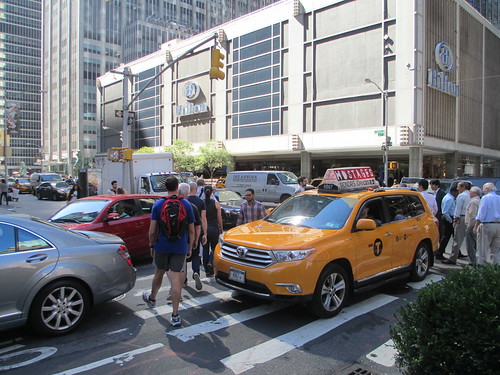 |
| Pedestrians in midtown Manhattan: crossing the street almost as if it weren't their personal responsibility to keep themselves safe from the poor cars. |
“It begins with personal responsibility,” Friedman said,
before going on to say how indispensable it was that everyone take ownership of his or her own safety.
“In a rush, we might cross against the light,” he said. “On
our bikes, we might not stop at every stop sign. As drivers, being late for
work can mean the temptation to rush into a crosswalk before the pedestrian
does to get across and save a bit of time instead of waiting for them to walk
safely by.”
Friedman invited us, in other words, to equate in blameworthiness nipping across
a pedestrian crossing against the light when no vehicles are around, jumping a
red light on a bike when one can see a phalanx of charging cars behind one and barging one’s car through a crosswalk of children walking to school.
 |
| Riding down the 9th St bike lane in Park Slope, Brooklyn? Don't forget to exercise your personal responsibility to keep yourself safe there. |
The effects of this misallocation of blame are real. Since New York embarked on its
effort to eliminate road crash deaths in January, police in many precincts have
stepped up harassment of cyclists and pedestrians but not policing of refusal
to yield or speeding. When a driver hit and killed Nicholas Soto, a 14-year-old boy, crossing the street in Red Hook, a few blocks from my house, last Monday,
the instant reaction was to blame the boy’s sweatshirt for obstructing his view.
But the car involved seems to have been going far too fast and the boy was in a
crosswalk. The implicit assumption that responsibility for road safety lies
equally with the driver of a speeding performance car and a schoolboy running
for the bus has led police to blame the victim, rather than the perpetrator.
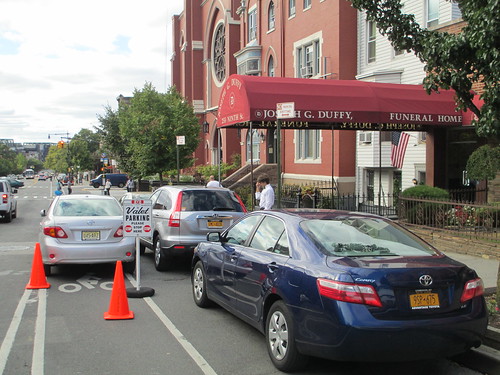
On a wider scale, both in New York and other parts of the world, failure to understand crashes’ causes leads police to harass groups that don’t cause crashes and leave alone others that do. In my native Scotland, the Scottish government last year embarked on an especially bizarre "mutual respect" campaign called "the Niceway Code". The evening before Nicholas' death, I'd even come across police supervising minivan drivers who were parking blocking a sidewalk and most of a two-way bike lane. It was as if they were trying to demonstrate unequivocally whose interests they represented.
 |
| Remember, folks: exercise your personal responsibility in getting around the cars the police have allowed to block the sidewalk and bike lane. |
On a wider scale, both in New York and other parts of the world, failure to understand crashes’ causes leads police to harass groups that don’t cause crashes and leave alone others that do. In my native Scotland, the Scottish government last year embarked on an especially bizarre "mutual respect" campaign called "the Niceway Code". The evening before Nicholas' death, I'd even come across police supervising minivan drivers who were parking blocking a sidewalk and most of a two-way bike lane. It was as if they were trying to demonstrate unequivocally whose interests they represented.
Nor is it adequate to claim that, somehow, the misleading
message about safety is effective because it overcomes drivers’ resistance to
being told it’s all their fault. After a taxi driver honked at me to hurry me
out of a crosswalk earlier this year, he told me that, no, it wasn’t the fault
of drivers like him that pedestrian deaths in the city remained high. It was
the fault of pedestrians distracted by their telephones. I wasn’t using a
mobile device as I crossed the street. I am confident that he is one of many
drivers who, when hearing that road safety is a shared responsibility,
concludes it isn’t really his at all. It’s hard not to be reminded of the way
some police forces used to combat sexual assault. Yes, men, you shouldn’t rape
women. But, come on women, watch how you dress and where you go. Any message
that disperses blame for a problem takes pressure off the most blameworthy party.
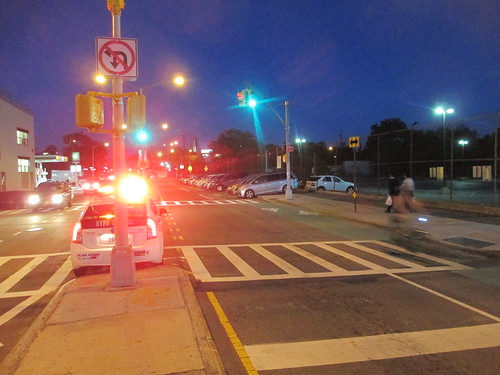
 |
| Cycle or walk responsibly through the intersection of 54th Street and Broadway. Otherwise you might not be safe. |
The only comfort I could draw was that the sums being put
into this new initiative are so small they’re unlikely to do much harm.
Friedman had come to New York to announce
awards of $1.6m – the price of a few rooms of a Brooklyn
brownstone – for pedestrian safety, split between three cities. New York was to receive $800,000 while the remainder
would be split between Philadelphia and Louisville , Kentucky
It was to be a memorable ride downtown. I reached
Pier 59 to find the emergency vehicles gone. Only two policemen remained,
seated at a picnic table playing cards. At their feet was a sheet, hiding the
unmistakeable outline of the body they’d hauled out of the river.
It was hard not to see the little tableau as a metaphor for
how New York
and many other cities treat deaths. We’re constantly surrounded by fatal
tragedies – a young man who’s jumped off a bridge, or another who’s been hit by
a car. Yet we seem all too often to be so distracted, impatient and easily bored
that we don’t give their deaths the respect and reflection they deserve.
There are no easy solutions. A patrol cop in the precincts
by the Hudson
probably sees enough bodies fished out of the river that he can be forgiven his
sense of ennui. It’s hard when driving to hold onto a full sense of one’s responsibility to those around.
But, at the moment, the rush after a fatal crash is all too often to assure the survivor that, no, he couldn't have done anything to avoid it, to heap the blame on the person whose life has just been taken away. As long as that's the instinct, there won't be much reduction in the numbers of the recently-deceased left lying in the street, hidden by only a sheet, for the medical examiner to take away.
But, at the moment, the rush after a fatal crash is all too often to assure the survivor that, no, he couldn't have done anything to avoid it, to heap the blame on the person whose life has just been taken away. As long as that's the instinct, there won't be much reduction in the numbers of the recently-deceased left lying in the street, hidden by only a sheet, for the medical examiner to take away.
