Showing posts with label Detroit. Show all posts

Monday, 19 January 2015

Some strolls in Detroit, a warning about safety - and how cars are keeping people apart

On Sunday, January 11, as I have done on the equivalent Sunday for three consecutive years, I flew from New York LaGuardia Airport to Detroit for the first day of events related to the annual North American International Auto Show. I took a taxi – the only really viable means of transport – to downtown Detroit for my first meeting. Then, lacking a bicycle – my preferred urban transport option - I started walking.
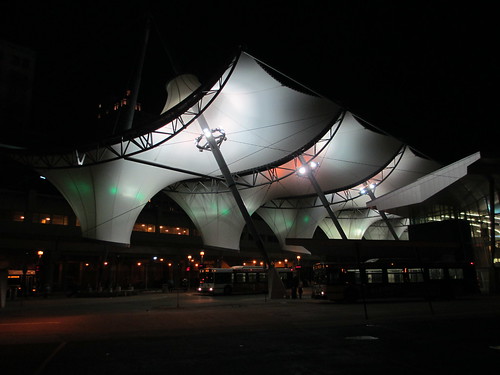
 
The Rosa Parks Transit Center: start and end of many of my
Detroit perambulations
I walked from Greektown to the Rosa Parks Transit Center to catch a bus to Windsor, Ontario, where my hotel was (there is, sadly, no way to walk across the Detroit River that marks the international frontier). I walked from Windsor bus station to my hotel and back. I walked from the Rosa Parks Transit Center to Detroit’s eastern market. I walked a mile back to Greektown and then I walked back to the Rosa Parks Transit Center in the evening.

I walked because I dislike being cooped up in cars and paying for taxis. I prefer to get some exercise and see cities on a human level. But an incident part way through the evening reminded me that walking can be a radical – almost political – act, just as cycling is in some circumstances. In cities that have been set up to suit only motor vehicles, someone who walks sets an example of how it’s possible to break established patterns. Each pedestrian on a once-deserted street helps to prove it can be safe to abandon the cocoon of a motor vehicle.
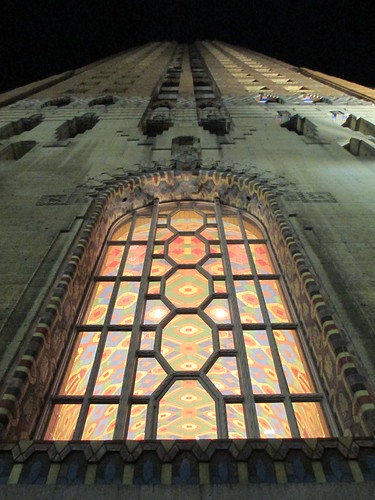
 
Detroit's magnificent, art deco Guardian Building:
the kind of detail it's worth taking a risk to see.
Yet many of the people I meet when I go to Detroit think I’m simply inviting a mugging or other violent crime by wandering through “dangerous” areas. Some of them, I suspect, would be far from sympathetic if my foolishness led to my being hurt or killed.

It’s an issue that resonates well beyond Detroit. On December 20, it emerged last week, police in Montgomery County, Maryland, forcibly picked up two children – Rafi Meitiv, 10, and Dvora Meitiv, six – whom their parents had allowed to walk home from a park a mile away. The local government’s child services division is investigating the parents for neglect. The numbers of children walking or cycling to and from school in the UK have plummeted.

The walk from the bus station to Eastern Market helped to remind me why walking remains a minority activity in many cities like Detroit. I walked on sidewalks that were in poor repair and closed in places. I passed whole blocks of empty, brownfield space. The motorists using the roads across these wastelands were driving at grossly excessive speeds that made crossing the road an uncomfortable experience. Although most of the sidewalks had been cleared of the recent snow, not all had.

A considerable part of the walk was blighted by the presence in the area of a vast cloverleaf interchange between the I-375 Interstate and the Fisher Freeway. I walked on bridges over each, noting how, as some of Robert Moses' roads did in Brooklyn, they had cut through formerly coherent, walkable communities. Other streets were effectively slip roads for the freeways, with vehicles driving at commensurate speeds. The walk was also, thanks to Detroit’s low-density, sprawling geography, a mile-and-a-half, even though the areas looked close to each other on the city map.
 
Holy Trinity Lutheran: a stirring reminder
of Detroit's better past
I nevertheless arrived safely and in good time for the event I was planning to cover – the unveiling of some new models by General Motors’ Buick brand. I had the chance along the way to appreciate the fine architecture of Trinity Lutheran Church, a rare surviving reminder on Gratiot Avenue of how this neighbourhood must once have thrived. I was able to marvel at the resilience of the Busy Bee hardware store at the corner of Gratiot and Russell, still standing and serving customers when much of the surrounding area was derelict. I was able to appreciate the skyline – a mixture of modern attempts and redevelopment and art deco from the city’s early 20th century heyday. I spotted how close my next appointment – with Volkswagen in Greektown – appeared to be. I resolved to walk there too.

That resolve remained when I got a call from a colleague who had been at another event and was being driven by its courtesy shuttle service to Volkswagen. “Can my driver stop by and pick you up?” he asked. It was fine, I replied – I would walk. My phone buzzed a few minutes later with a text message. “Driver insisting we pick u up – safety an issue,” it read. My head started whirling with the implications of what my colleague was saying, that the driver was implying my behaviour was so foolish I should be given no choice about persisting in it. “Tell him I walked here,” I texted back. I started on what turned out to be a long search for my coat, for which I’d lost my coatcheck ticket.

I considered, of course, the crime risks – the ones to which my colleague’s driver was referring. It’s undoubtedly true that the Motor City has a serious crime problem. Detroit, with a population of 700,000, in 2013 recorded 316 murders. That’s only just short of the 334 recorded that year in New York, which has a population of 8.4m. I kept my iPhone mostly hidden as I walked, recognising it was one of the most obviously stealable items in my possession. I kept my eyes wide open for any suspicious activity.
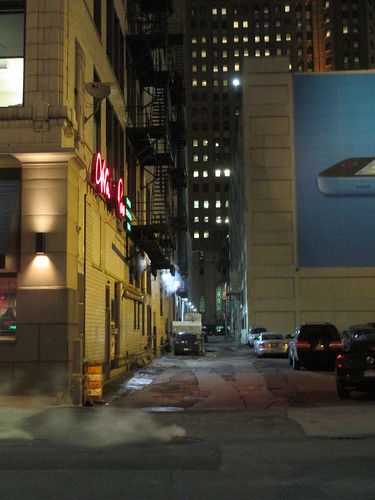
 
A downtown Detroit alleyway: no, even I
probably wouldn't stroll down there.
But warnings against walking in Detroit don’t often feel to me based on careful calculation of the crime risks in any given area. I once had an alarmed auto company executive offer to find me a hotel room somewhere other than touristy Greektown because she presumed the area so unsafe. The warnings tend to come disproportionately from white residents of Detroit’s outer suburbs who never venture into the city proper outside a motor vehicle. Many people’s fears seem to reflect the high numbers of homeless people panhandling for money in some areas. I had one such person shout at me as I walked from the bus station to the Eastern Market. But, while I’ve sometimes had such panhandlers follow me for considerable distances, I’ve never felt seriously in danger.

It is certainly not comfortable to encounter the myriad social problems from which Detroit – which is mainly poor, 85 per cent black and whose city government has only just emerged from bankruptcy - suffers. “It’s because of you I caught my domestic violence conviction!” I heard a man shouting into his iPhone one night at the Rosa Parks Transit Center. “I learnt from the way I saw you treating my mother!” It’s hard, however, to avoid the impression that many non-residents remain instinctively suspicious of the city out of proportion to the current, falling crime levels.

There is no doubt at all, meanwhile, that the thinking that constrains the lives of children like the Meitivs is seriously flawed. Parents typically give far less freedom of movement to children than 40 years ago, yet rates of crime against children are far lower than they were then.
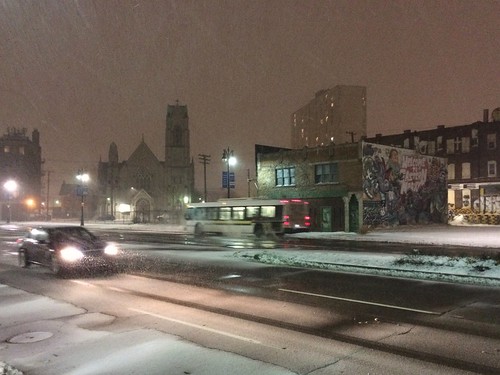
 
Gratiot Avenue in the snow: my colleague's driver understood
none of why I was prepared to walk in these conditions.
The empty sidewalks show how many people share his opinion.
It consequently felt like almost a moral imperative when the driver said I shouldn’t be walking to prove that it was indeed possible to do so. Having finally located my coat, I strode purposefully towards the exit. I kept striding even once I’d discovered, to my mild consternation, that it had started snowing steadily while I was inside. I was soon on my way back down Gratiot Avenue, face buried in my collar against the wind, towards the Volkswagen press event. Later that evening, my colleague and I both walked to the bus stop by the entrance to the cross-border tunnel. On the way, we saw almost no-one outside a motor vehicle. The walking felt mundane, rather than risk-laden.

In the days since, however, the experience of getting around Detroit and Windsor by bus and on foot has played on my mind. I’ve been considering it particularly over the past weekend, which includes a holiday to remember Martin Luther King, jr, the civil rights leader. In that context, the name of Detroit’s central bus station – the Rosa Parks Transit Center – has seemed especially apposite. It was Ms Parks – who spent the last several decades of her life in Detroit – who drew Dr King into the civil rights movement through her famous refusal to give up her seat on a bus in Montgomery, Alabama, for a white man.
 
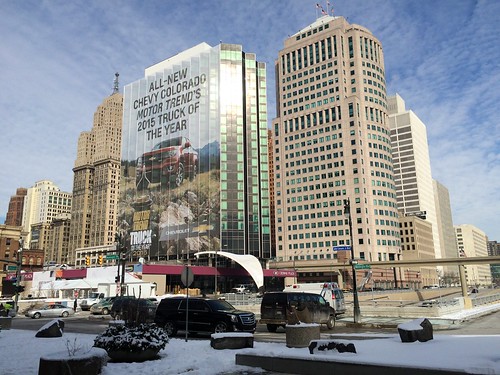
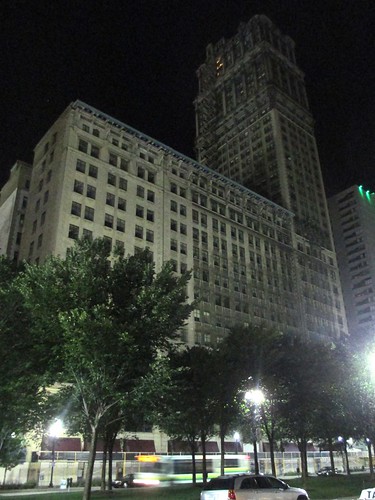
Downtown Detroit in auto show week: it looks smart -
but what would Martin Luther King make of the way
its people get about?
The battle over shared space on buses that Ms Parks set off was possible, it occurs to me, only because black and white people in Montgomery were indeed sharing space on public transport. Such a struggle is unthinkable in contemporary Detroit largely because white and black people so seldom share space when getting about. They are closeted either in private motor cars or on a bus system that almost no whites use

It would be fatuous, of course, to claim that my stubborn determination to walk a few times in Detroit did anything to alter those dynamics. The risks of crime in the city are real and substantially higher than in New York, which remains less safe on average than the UK. My stance will look less clever if, one day, I find myself beaten to a pulp over my phone or laptop – or worse.

But, as I walked past lonely, derelict buildings, I imagined how the now-abandoned stores must once have relied on passing foot traffic. The scaring away of pedestrians after Detroit’s 1967 riots must have marked the beginning of their end. It is hard to imagine the city’s reviving without its becoming far more comfortable for far more people, as I did, to devise a route to a destination a mere mile away, put his or her head down and get there under his or her own power.

Sunday, 11 May 2014

An unbridgeably wide road, a rush hour jam - and why I won't be leaving for the suburbs

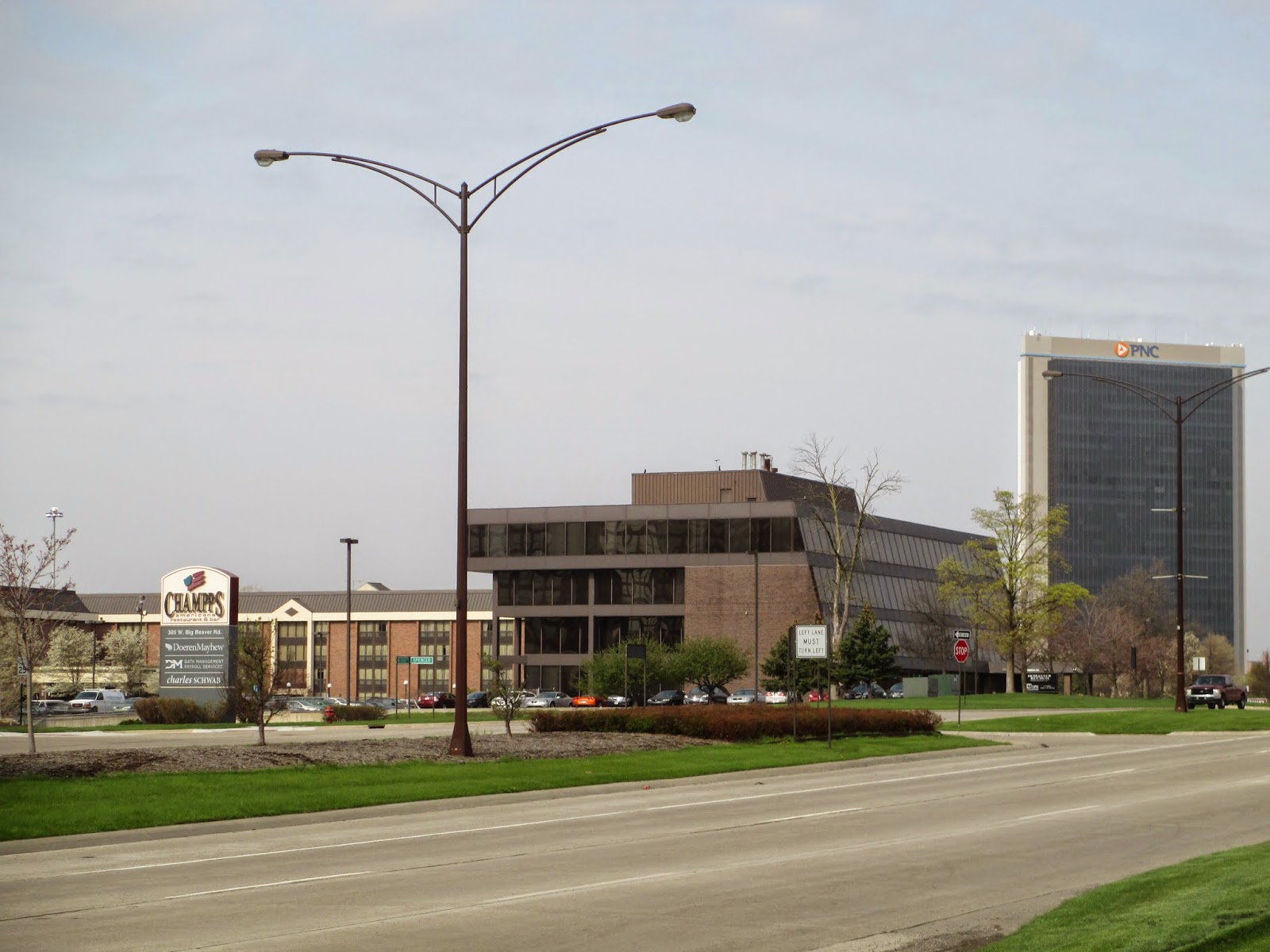
As the bus carrying me and a group of other journalists and analysts pulled up to the Troy Marriott hotel near Detroit last Monday night, I started doing what any self-respecting professional traveller would have done – looking for enticing dinner options. In an unpromising area, the only alternative I could see to the hotel’s own restaurant was a sports bar – imaginatively named “Champps” – just across Big Beaver Road. While it seemed unlikely to be a hidden gourmand treat, it seemed more enticing once I’d seen the hotel restaurant’s prices and depressing beer range.

Champps: enticing - sort-of - amid limited circumstances
Yet I ended up all three nights of my stay trooping down to the hotel’s restaurant and ordering mediocre, absurdly-priced food ($29 for a pork porterhouse cooked so that it’s almost impossible to cut, anyone?) rather than venturing out. Closer examination revealed that, while Champps was close geographically, without a car it might as well be in the next state. There was no pedestrian crossing to take me across Big Beaver Road’s six lanes of high-speed traffic. Big Beaver Road did have sidewalks, unlike some suburban American streets (or stroads, as such highway streets are sometimes known). But they were cut off from the road and appeared built on the principle that pedestrians walk only in straight lines. Champps didn’t look worth the risk of a dash across the traffic.

My near-yet-far experience with dinner options opened my eyes to how comprehensively some suburban areas of the US – and, to a lesser extent, some European countries too – are built around transport by car. I fully understood for the first time how oppressive the sheer lack of choice in such areas is. It made me appreciate how, whatever my gripes about London in the past and New York at present, I’ve at least lived in places that offer some transport freedom of choice.
Big Beaver Road: would you risk crossing?

Of course, many Americans would say I’m showing my East Coast elitist or European thought patterns by viewing such conditions as problematic. Suburbs are popular, some transport thinkers tell me, because Americans just plain want to live in single-family houses with a big area of land around them. It’s mere snobbery for those of us who live in big, cramped cities to expect those who prefer the lower-density suburbs to adapt to living lives more like our own. There are plenty of similar trends among pro-car thinkers in the UK.

But my experience last Wednesday – when I went on a coach trip with other reporters and analysts from Troy to Toledo, Ohio, to see a car plant – suggested that the current arrangement wasn’t even working on its own terms. Because rain had slowed traffic, the tour bus was a good hour late arriving to pick us up. The driver then spent a further hour or so fighting through nearly-stationary traffic heading for central Detroit before he could drive at any reasonable speed on the way to Toledo.
 
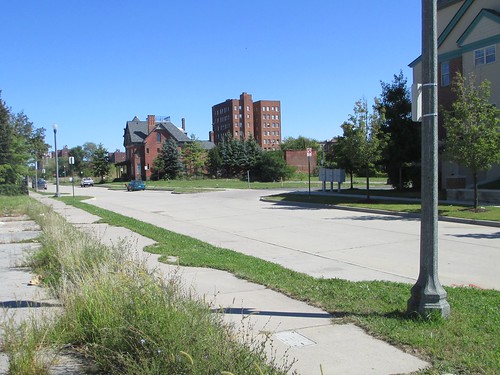
Near downtown Detroit: not obviously a draw for traffic
Our hosts felt under stress throughout the day – and curtailed one of the most interesting parts of our visit in Toledo – because of the problems of maintaining our visit schedules on roads that made travel times unpredictable. I, meanwhile, sat in something like awe of the quantity of traffic disruption related to traffic heading into central Detroit. “What would this be like if Detroit were still a healthy city?” I asked myself, staring at the ranks of red rear lights on the Interstate. The vehicles were heading for a city centre where many lots remain vacant and whose population is only a third of its more than 2m peak. It wasn’t the first time I’d experienced big, severe traffic jams in Detroit’s morning rush hour.

The problems I witnessed are only an extreme example of the pressures that any city with low-density, far-flung suburbs with poor public transport and a dense inner city will tend to face. I had a taste of how even high-density New York struggles with such flows one morning in early April when a truck crashed on the Brooklyn-Queens expressway and closed both carriageways. I was suddenly sharing our neighbourhood streets with the vast lines of slow-moving car commuter traffic that outer parts of Brooklyn, Queens, Staten Island and the Long Island suburbs generate. I normally see such traffic only from a distance, and generally only creeping towards its destination.

There’s a fundamental geographical problem. Distances in low-density suburbs are vast and forbidding for walking or cycling. But it’s hard to provide public transport for a place where the customers are all so far apart. When all those suburbanites jump into their cars to head for a city, the cars can’t all fit.
 
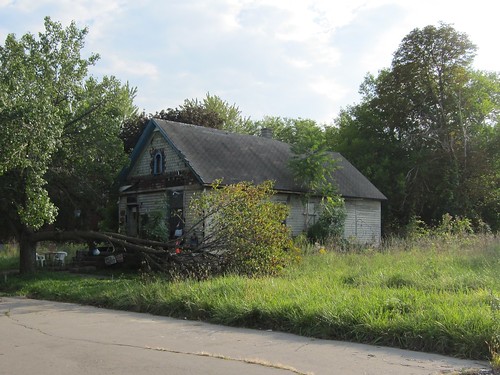
An abandoned Detroit house: can the people who left cross
the street where they live now?
The root of the problem is partly social. I was watching in the rainy Detroit rush hour partly a distant reverberation from the shattering explosion of Detroit’s 1967 race riots, which wrecked vast tracts of the city and sent many white people – and quite a few blacks too – scurrying for the perceived safety of places like Troy. It’s an essential part of the bargain of living in a big city like New York – or London – that one puts up with – maybe even celebrates – living cheek-by-jowl with people of different racial or economic backgrounds or very different outlooks on life. Race riots, second world war bombing or, in New York City’s case, the deliberate policies of Robert Moses have broken that contract down in the cities now facing the worst problems.
Downtown Detroit: hassly but hopeful

I’ve consistently voted with my feet on this issue. In my adult life, I’ve lived in dense, inner-urban areas of Edinburgh, London, Budapest and New York, prioritising convenience of walking, cycling and public transport over avoiding the hassles of inner-city life. Even when I visit the Detroit area or Fort Worth, Texas, I make a point of trying to stay in the inner city if I can. I’ve had aggressive panhandlers follow me and threaten me in downtown Detroit. But I still prefer the inner city’s challenges to the soullessness of the outer suburbs.

None of which would matter, conceivably, if the suburbs were actually satisfying suburbanites. But, even with the continued pull of better schools and leafy tranquillity, there’s mounting evidence that leafy places like Troy are losing out to asphalt-covered, brick-built places like downtown Detroit. New York City holds more people than it’s ever held, while suburban Long Island's population has grown more slowly in recent years than most of the rest of the region. It’s London – not the suburbs of Hertfordshire or Surrey – that’s looking to cater for millions of new residents over the next few years. Places whose residents don’t need cars are becoming more attractive.
 
My hotel window view: suburbanites' exercise yard.
I won’t pretend, of course, that inner-city Detroit – currently bankrupt, long corrupt and full of houses being reclaimed by the prairie – is a paragon that other cities should follow. But the growing activity in its downtown and the sprouting of cycle lanes and the sight of the occasional cyclist give me some optimism. It’s easier for me to see why the attractions of places like clean, leafy Troy – where the only walking most people do is across the parking lot – are starting to pale. It’s no surprise to me that the US’s most successful suburbs – the DC suburbs in northern Virginia – are working hard at putting in bike lanes, improving public transport and making people who want a congestion-free car commute pay for the privilege. It would be heartening to see suburbs elsewhere – like Troy or the most traffic-clogged bits of London’s commuter belt – following suit.

1st Avenue: sure, motorists don't know how to drive
there politely. But Big Beaver Road it ain't.
For me, meanwhile, the motor vehicle-dependence was at least temporary. I had a long wait on my return to LaGuardia Airport for a public bus but took pleasure in sharing it with others. I then transferred smoothly for my subway ride home, avoiding the chaos of the city streets above. I took still greater pleasure the next day in taking the day off work and heading out into the city under my own power.

The Queensboro Bridge: there are subways below, cars,
buses and bikes on the surface and even a cable car above.
It wasn’t, I admit, a complete joy interacting with New York City drivers as I headed north through Brooklyn towards Queens. My first ride up the new First Avenue bike lane on the Upper East Side was marred by the discovery that drivers are as reluctant to yield to cyclists there as elsewhere in the city. Even on my ride north and round the top of Central Park, I found myself sharing the roadway with cars whose drivers viewed the park’s speed limit as optional.

But, after spending most of the week by a road that was impossible to cross, I found it hard to feel truly angry. The best bits of the journey – the well-designed bike lanes up Kent Avenue, the bike and pedestrian lane over the Queensboro Bridge and the ride south by the Hudson – made me feel quite the opposite. What a privilege it was, I realised, to live in a city where few need feel wedded to their cars and growing numbers choose to get about by bike. As I embark on a new week of hustling for space and priority with the city’s drivers, I’ll do my very best to retain that feeling.

Friday, 4 October 2013

A Detroit trip, a TriBeCa greeting - and why driving leaves me feeling locked in

It wasn’t a great start to my first driving lesson. Aged 17, a minute into my introductory driving session with my dad on a local industrial estate, we came to a T-Junction, where he told me to turn left. Still unfamiliar with the accelerator pedal’s sensitivity and the steering required to turn a corner, I turned the wheels through 45 degrees and stepped – rather hard, it turned out – on the gas. Seconds later, having demolished a small tree on the way, I had wedged the car firmly onto a low wall round a nearby building.

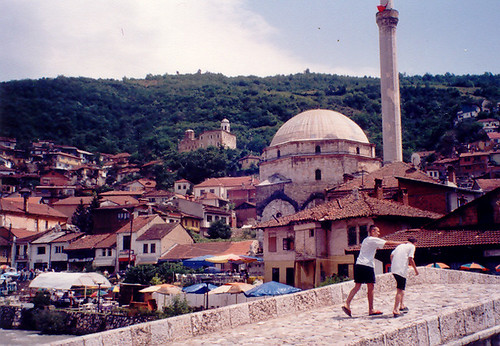
Prizren, Kosovo, just after the war: against the odds,
the Invisible Visible Man drove competently down
a recently-bombed road near here.
That still marks the only time in the many years since that I’ve caused direct (as opposed to environmental) damage or injury with a car. I’ve driven many thousands of miles, navigated cars down recently-bombed roads in Kosovo and survived an attempt by rioting youths in Belfast to hijack a car I was driving. Yet I can’t pretend I get on with cars the way I do with bikes. There are few feelings of relief greater for me than the moment I finally drop off a hire car, having damaged neither it nor anyone else during my time in charge.

It was consequently with a sinking heart that I recognised last week that, no, I was going to need a car to get to my meetings in Detroit. I headed to a downtown Enterprise rent-a-car branch with a feeling of dread.

Yet, while I was mentally prepared for many of the depressing aspects of driving a car, the overwhelming feeling I had while driving my Nissan Versa was not the one I'd been expecting. I found myself more struck than ever before at the sensation of being trapped in a metal box.

That sensation took a while to come over me, however. My first feeling after I climbed in, adjusted the mirrors and pulled out onto the wide, bleak expanse of E Jefferson Avenue was simple boredom.

I’m used to pedalling hard, looking over my shoulders, standing up at points and, on faster or windier bits of a ride, putting my hands down in the drop position on my handlebars. I shift gear regularly to match my pedalling to the bike’s speed. I push hard to restart from traffic lights. 
A Detroit streetscape: not a great compensation
for the stresses of driving

In the car, I was reduced to turning my head a little sometimes, glancing around in my mirrors, holding onto the steering wheel and alternately pushing the accelerator or brake pedals. Given that the car had an automatic transmission, there wasn’t even the modest physical activity of engaging the clutch and moving the gear stick.

That mixture of passivity and onerous but dull responsibility puts me in touch with all the things I hate about having reached middle age. Have I checked my mirrors and blind spots before starting to signal for this manoeuvre? Have I got enough money in the right bank account for this month’s mortgage payment? It’s the diametric opposite of the youthful optimism that wells up inside me most mornings as I ride my bike.

I’m almost overwhelmed when driving, meanwhile, by the challenge of navigating the thing safely. The morning after I picked up the hire car, I headed off for General Motors’ technical centre in Warren, outside Detroit. The freeway on-ramp pitched me straight into the fast lane, which I couldn't escape. I was hemmed in on one side by other vehicles and by impatient other drivers sitting right behind me. I pictured myself or one of the multiple vehicles around me making a small mistake and our slamming into the concrete barriers down the middle of the road. I had an almost tangible sense of how it would feel – the jolting, the tearing of muscles, the fear, the noises.
 
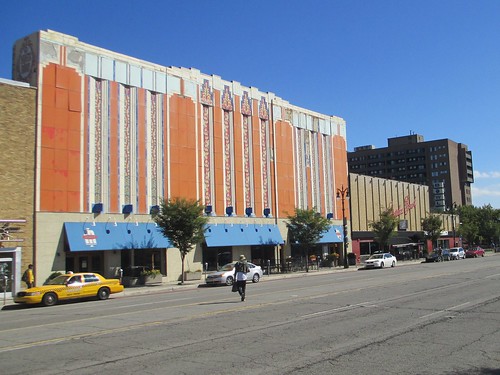
Woodward Avenue in midtown Detroit: the kind of street
that could have been designed - but probably wasn't -
to intimidate occasional drivers
like the Invisible Visible Man
It was one of several incidents that brought home to me how much bolder those around me are about speed, the time they need to switch lanes and so on. Although I think much of my caution is warranted, I feel within like a small, weak, rather scared person. It doesn’t help that when I’m on work trips I’m invariably tired, under pressure and running late. “Why did I sit up late writing that story last night?” I find myself asking as I struggle to shake off the cloudy fatigue in my brain. Then I notice that every time the car’s speed drops below 60mph the satellite navigation system’s estimated time of arrival at my destination slips a little further past the time I was meant to be there. I push myself mentally to focus harder, press down a little on the accelerator and carry on.

Yet the biggest shock to me on this trip was a result, I think, of a recent change in the way I’ve been cycling. I’ve been trying more and more to communicate with other road users, warning them of my presence, thanking them when they’ve acted safely or pointing out when I have a traffic light in my favour. It’s a habit I’ve developed partly in an effort to keep myself safe – but also because I want generally to communicate to others on the road our shared humanity. Most people find it harder to behave callously towards someone who’s made it obvious that he or she is as real and sensitive a human being as themselves.

When I found myself pitched into that highway fast lane, by contrast, I was struck dumb. The drivers around me could barely see me. They were aware only of how my slow-moving, poorly-positioned car was holding them up. My means of communicating were restricted to the use of two pathetic sets of blinking lights saying only, “I would like to turn left” or “I would like to turn right”. I could, I suppose, have honked the horn, as many New York City drivers do, but I never quite summoned up the aggression that seems to require.
 
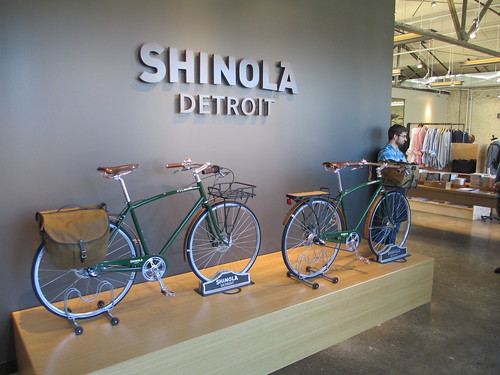
The Shinola bike works shop in Detroit. Can you guess
where the Invisible Visible Man ends up when
he feels homesick on a trip?
I consequently wandered the freeways of south-east Michigan a little bit lost, a little bit unsure of myself and a little bit anxious – but suffering a kind of automotive locked-in syndrome. “I’m a Nissan Versa and I would like to turn left” and “I’m a Nissan Versa and I would like to turn right” were the only two messages I could convey.

As a result, I had a particularly intense sense when I returned the hire car of how the stress hormones were withdrawing from my system. The attendant checked the car for new scratches, found none, and I handed back the keys for the next lucky driver. I climbed instead into the large and luxurious Jeep Grand Cherokee of the public relations executive with whom I was to lunch.

The Brooklyn Bridge Bike Lane: I ride so fast here, it seems,
I don't even recognise people I sweep past every morning.
The relief was all the greater the next morning when, back in New York, I returned to my normal routine, riding across the Brooklyn Bridge into lower Manhattan. The pleasure even cancelled out my irritation at finding building work was obstructing the “bike lane” – the space dedicated to double-parking and deliveries – on Reade Street in TriBeCa. Conscious that other riders would probably feel less cautious than I about squeezing through the remaining space, I nevertheless tried to wave the woman following me through ahead of me.

Her response illustrated precisely what I’d been missing locked up inside that car. She insisted I went ahead, saying, “You’re faster than me.” I didn’t understand why. I looked quizzically at her after we’d both reached the next set of traffic lights. “You’re faster than me,” she said. “I see you ride past me every morning on the bridge.”