As the bus carrying me and a group of other journalists and
analysts pulled up to the Troy Marriott hotel near Detroit last Monday night, I started doing
what any self-respecting professional traveller would have done – looking for
enticing dinner options. In an unpromising area, the only alternative I could
see to the hotel’s own restaurant was a sports bar – imaginatively named “Champps”
– just across Big Beaver Road .
While it seemed unlikely to be a hidden gourmand treat, it seemed more enticing
once I’d seen the hotel restaurant’s prices and depressing beer range.
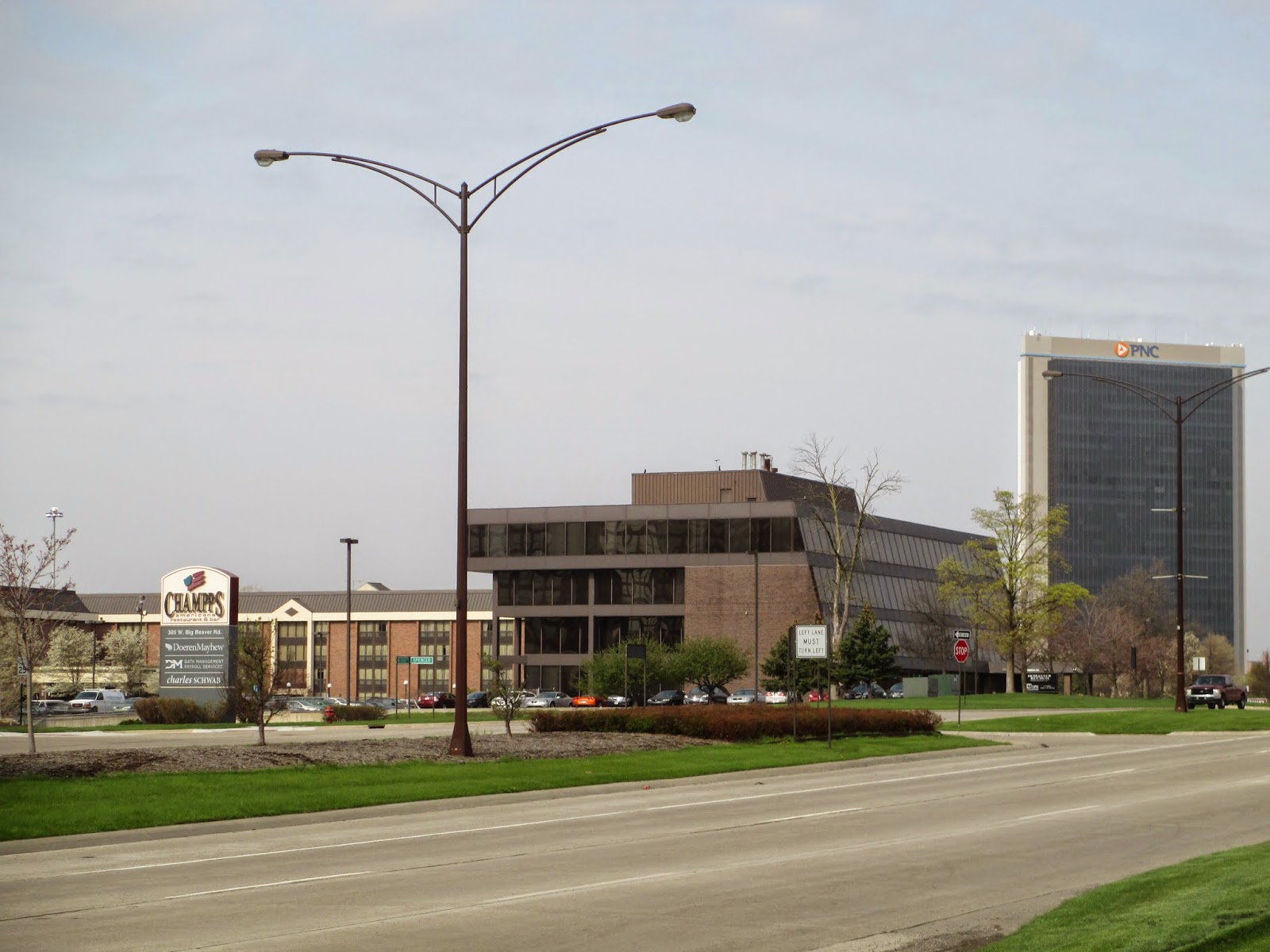 |
| Champps: enticing - sort-of - amid limited circumstances |
Yet I ended up all three nights of my stay trooping
down to the hotel’s restaurant and ordering mediocre, absurdly-priced food ($29
for a pork porterhouse cooked so that it’s almost impossible to cut, anyone?)
rather than venturing out. Closer examination revealed that, while
Champps was close geographically, without a car it might as well be in
the next state. There was no pedestrian crossing to take me across Big Beaver Road ’s
six lanes of high-speed traffic. Big Beaver
Road did have sidewalks, unlike some suburban American streets (or stroads, as such highway streets are sometimes known). But they were cut off from the road and appeared built on the
principle that pedestrians walk only in straight lines. Champps didn’t look
worth the risk of a dash across the traffic.
My near-yet-far experience with dinner options opened my
eyes to how comprehensively some suburban areas of the US – and, to a
lesser extent, some European countries too – are built around transport by car.
I fully understood for the first time how oppressive the sheer lack of choice
in such areas is. It made me appreciate how, whatever my gripes about London in the past and New York at present, I’ve at least lived in
places that offer some transport freedom of choice.
 |
| Big Beaver Road: would you risk crossing? |
Of course, many Americans would say I’m showing my East
Coast elitist or European thought patterns by viewing such conditions as
problematic. Suburbs are popular, some transport thinkers tell me, because
Americans just plain want to live in single-family houses with a big area of
land around them. It’s mere snobbery for those of us who live in big, cramped
cities to expect those who prefer the lower-density suburbs to adapt to living
lives more like our own. There are plenty of similar trends among pro-car
thinkers in the UK .
But my experience last Wednesday – when I went on a coach
trip with other reporters and analysts from Troy
to Toledo , Ohio Detroit before he
could drive at any reasonable speed on the way to Toledo .
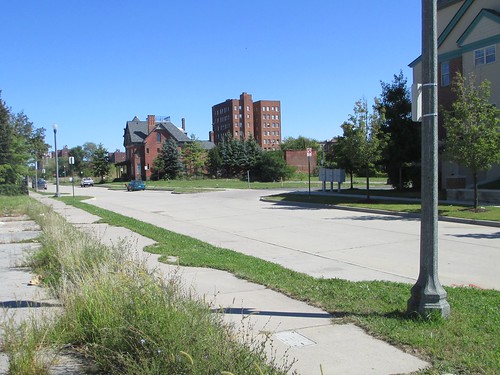 |
| Near downtown Detroit: not obviously a draw for traffic |
Our hosts felt under stress throughout the day – and
curtailed one of the most interesting parts of our visit in Toledo – because of the problems of maintaining
our visit schedules on roads that made travel times unpredictable. I,
meanwhile, sat in something like awe of the quantity of traffic disruption
related to traffic heading into central Detroit .
“What would this be like if Detroit
were still a healthy city?” I asked myself, staring at the ranks of red rear
lights on the Interstate. The vehicles were heading for a city centre where
many lots remain vacant and whose population is only a third of its more than 2m peak. It wasn’t the first time I’d experienced big, severe traffic jams in Detroit ’s morning rush
hour.
The problems I witnessed are only an extreme example of the
pressures that any city with low-density, far-flung suburbs with poor public
transport and a dense inner city will tend to face. I had a taste of how even
high-density New York
struggles with such flows one morning in early April when a truck crashed on
the Brooklyn-Queens expressway and closed both carriageways. I was suddenly
sharing our neighbourhood streets with the vast lines of slow-moving car
commuter traffic that outer parts of Brooklyn, Queens, Staten Island and the Long
Island suburbs generate. I normally see such traffic only from a distance,
and generally only creeping towards its destination.
There’s a fundamental geographical problem. Distances in
low-density suburbs are vast and forbidding for walking or cycling. But it’s
hard to provide public transport for a place where the customers are all so far
apart. When all those suburbanites jump into their cars to head for a city, the
cars can’t all fit.
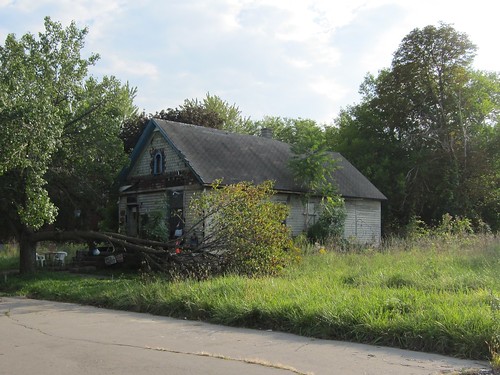 |
| An abandoned Detroit house: can the people who left cross the street where they live now? |
The root of the problem is partly social. I was watching in
the rainy Detroit rush hour partly a distant reverberation from the shattering
explosion of Detroit’s 1967 race riots, which wrecked vast tracts of the city
and sent many white people – and quite a few blacks too – scurrying for the
perceived safety of places like Troy. It’s an essential part of the bargain of
living in a big city like New York – or London – that one puts up with – maybe
even celebrates – living cheek-by-jowl with people of different racial or economic backgrounds or very different outlooks on life. Race riots, second world war bombing or, in New York City ’s
case, the deliberate policies of Robert Moses have broken that contract down in
the cities now facing the worst problems.
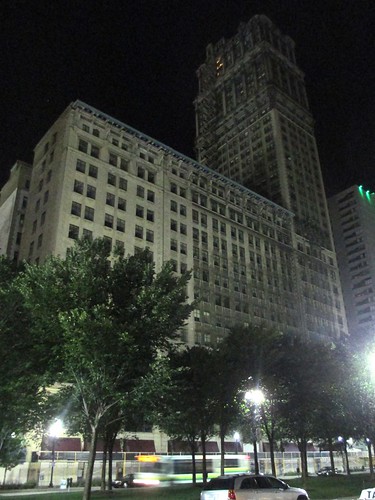 |
| Downtown Detroit: hassly but hopeful |
I’ve consistently voted with my feet on this issue. In my
adult life, I’ve lived in dense, inner-urban areas of Edinburgh ,
London , Budapest
and New York ,
prioritising convenience of walking, cycling and public transport over avoiding
the hassles of inner-city life. Even when I visit the Detroit
area or Fort Worth , Texas Detroit .
But I still prefer the inner city’s challenges to the soullessness of the outer
suburbs.
None of which would matter, conceivably, if the suburbs were
actually satisfying suburbanites. But, even with the continued pull of better
schools and leafy tranquillity, there’s mounting evidence that leafy places like
Troy are losing out to asphalt-covered,
brick-built places like downtown Detroit .
New York City holds more people than it’s ever held, while suburban Long Island's population has grown more slowly in recent years than most of the rest of the region. It’s London – not the suburbs of
Hertfordshire or Surrey – that’s looking to
cater for millions of new residents over the next few years. Places whose
residents don’t need cars are becoming more attractive.
 |
| My hotel window view: suburbanites' exercise yard. |
I won’t pretend, of course, that inner-city Detroit – currently bankrupt, long corrupt
and full of houses being reclaimed by the prairie – is a paragon that other
cities should follow. But the growing activity in its downtown and the
sprouting of cycle lanes and the sight of the occasional cyclist give me some
optimism. It’s easier for me to see why the attractions of places like clean,
leafy Troy – where the only walking most people do is across the parking lot –
are starting to pale. It’s no surprise to me that the US ’s most successful suburbs – the DC suburbs in
northern Virginia
– are working hard at putting in bike lanes, improving public transport and
making people who want a congestion-free car commute pay for the privilege. It
would be heartening to see suburbs elsewhere – like Troy
or the most traffic-clogged bits of London ’s
commuter belt – following suit.
 |
| 1st Avenue: sure, motorists don't know how to drive there politely. But Big Beaver Road it ain't. |
For me, meanwhile, the motor vehicle-dependence was at least
temporary. I had a long wait on my return to LaGuardia Airport
 |
| The Queensboro Bridge: there are subways below, cars, buses and bikes on the surface and even a cable car above. |
It wasn’t, I admit, a complete joy interacting with New York City drivers as I headed north through Brooklyn
towards Queens . My first ride up
the new First Avenue bike lane on the Upper East Side was marred by the
discovery that drivers are as reluctant to yield to cyclists there as elsewhere in the city. Even on my ride north and round the top of Central
Park , I found myself sharing the roadway with cars whose drivers
viewed the park’s speed limit as optional.
But, after spending most of the week by a road that was
impossible to cross, I found it hard to feel truly angry. The best bits of the
journey – the well-designed bike lanes up Kent Avenue, the bike and pedestrian
lane over the Queensboro Bridge and the ride south by the Hudson – made me feel
quite the opposite. What a privilege it was, I realised, to live in a city where
few need feel wedded to their cars and growing numbers choose to get about by
bike. As I embark on a new week of hustling for space and priority with the
city’s drivers, I’ll do my very best to retain that feeling.
