It was an
inconsequential incident, in an area where I’ve encountered the aftermath of several
nasty car crashes. The family in the crosswalk were not in any way seriously
endangered, while the cyclists were far from completely reckless. I partly
understood the cyclists’ behaviour. The crosswalk in question is lightly used –
and any cyclist who waits until the lights turn green risks either a long wait to
ride onto the Brooklyn
Bridge
But the family, I
suspect, will have gone home cursing “scofflaw” cyclists. Next time one of
their friends mentions the possibility of starting to cycle to work or to get
the kids to school, they’ll suck at their teeth and mention how that couple
totally blew through the lights by the federal court in front of them. When
they’re driving, they’ll perhaps be a little less inclined to see cyclists as
fellow human beings and a little more as the kindred of those people who rode
in front of the family (the closeness of the encounter may by now have become
considerably exaggerated).
 |
| The back of the New York City Cycling map: an impossibly obscure place, it seems, to hide from senior journalists what cyclists are told about the law. |
I’ve been
pondering the extraordinary mismatch between the irritation over cyclist
misbehaviour and the actual danger it poses over the past fortnight since the
Wall St Journal published a bizarre video featuring Dorothy Rabinowitz, a
member of its editorial board, sharing her thoughts on New York City New York City New York
City
I’ve felt
disinclined, however, to dismiss Ms Rabinowitz’s ravings entirely since a
discussion with a colleague in the wake of the video’s release. I related to
this colleague – who is certainly not unreasonable or poorly inclined towards
cyclists – how that morning I had seen police stopping a cyclist who was riding
recklessly. She expressed relief, on the grounds that more needed to be done to
stamp out bad cycling. New York
 |
| Since we're talking politeness, I could have done without the language on this parked single speed. Thank you. |
We had both, I
realised afterwards, started during our conversation to recall stressful incidents
we’d experienced on New York
Not, of course,
that people should surrender to mere gut instincts on these issues. No matter
how irritated Dorothy Rabinowitz feels if a cyclist passes her on the sidewalk,
she ought – particularly given her exalted position on a quality newspaper – to
recognise there’s no intellectual basis for saying cyclists pose a bigger
danger than yellow taxis. Incidents involving yellow cabs are often fatal in
New York City – the last one involving a cyclist was on June 6, while one last
killed a pedestrian (by mounting the kerb) on February 24. Livery cars (the New York
As the February 24 death suggests, even when walking
on a sidewalk (or pavement, for British readers) pedestrians are in far more
danger from motorists than from cyclists. I’ve mentioned before how I ride every morning past the site where a car on the sidewalk killed Martha Atwater on February 22. There have been many such incidents across the city since –
including the very sad death on June 4 of Ariel
Russo, a four-year-old hit by a 17-year-old involved in a chase with the police. Any pedestrian worried about his or her safety in New York City
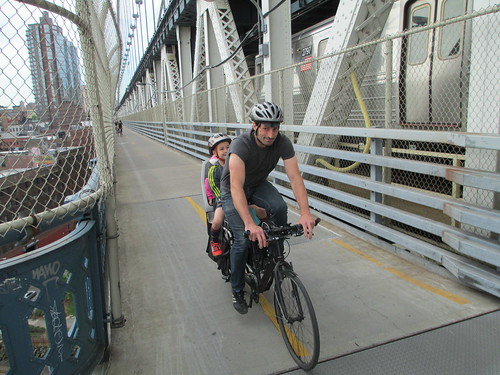 |
| A cyclist and his son on the lovely Manhattan Bridge bike lane: cyclists can't expect nice things like this, Sarah Goodyear says, if we keep being naughty. |
Nor
am I making a point like the one that Sarah Goodyear made in a now mildly notorious piece on the Atlantic Cities website about how cyclists allegedly
“wanted it both ways” demanding better enforcement against dangerous drivers
while being reluctant to behave better themselves. Cyclists couldn’t expect
better infrastructure, such as bike lanes, if they didn’t improve their
behaviour, she argued. It’s quite clear that, if officials’ willingness to give
a road user group infrastructure depended on the group’s behaviour, there
wouldn’t be much road space devoted to cars. There’s no evidence that cyclists’
rule-breaking (archetypally, red light-jumping and sidewalk riding) is more
widespread than motorists’ tendency to speed and pay insufficient attention.
There’s plentiful evidence that cyclists’ misbehaviour causes less harm to
others than motorists’.
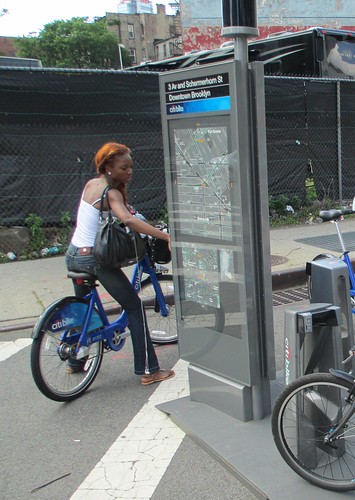 |
| A Citibike rider checks out the rules: bet she'll be nicer to cyclists next time she drives |
I
also stick to the view that many people’s views about cyclists are based on simple prejudice and irritation towards people who decide to do things differently, rather than either objective factual points or stress from
near-misses with negligent cyclists. It’s one of my hopes for the Citibike
scheme that, if it encourages more first-time New York cyclists to ride, it’s
going to create a new group of pedestrians and motorists who have some
understanding of the pressures on people who cycle.
But
I’ve personally taken the view for a long time that there’s little point in
antagonising pedestrians or motorists unnecessarily. It’s far simpler to take
the position that a red light means “stop” than to engage in some complex – and inevitably error-prone – risk assessment at every traffic light-controlled
junction. I don’t ever want to be in the position of being the cyclist who
crashed into me near Elephant & Castle in March 2009 after going through a
red light. “I didn’t see you,” he complained. “There was a red light to tell
you not to go,” I replied.
I
take that position not least because it’s such a distraction from the important
issues if I encourage people to complain even more about cyclists. There was a
chilling illustration of that on June 8, when the Wall Street Journal –
encouraged, perhaps, by the website traffic from Dorothy Rabinowitz’s original
rant – posted a second video featuring her views. Having considerably improved
her make-up and clothes, she launched into further strange denunciations based
on misunderstandings of the facts – and heaped abuse on a couple of fairly mild
questions from viewers about her opinions. Around my office, I spotted
headphones going on and browsers being directed to the Journal’s website as
even colleagues with no interest in cycling sought to gawp at the latest
episode.
Yet,
just as the Journal’s editorial staff were posting the video, on 5th Avenue
It’s
my goal, as far as I can, to cycle in such a way that I don’t cause unnecessary
stress to other people that I encounter. I don’t want to encourage them to
focus on the pointless ephemera that were the subject of Dorothy Rabinowitz’s
complaints. I hope to leave them at least a little freer to concentrate on the
hundreds of annual deaths from motor vehicle crashes in New York City
