The man looked me up and down and, mistaking my light grey,
Brooks Brothers suit for a sign I had an official role at the Taxi and
Limousine Commission tribunal, asked me, “Are you the lawyer?”
“No, I’m a witness,” I replied.
A brief, awkward silence ensued.
“You are in favour of the driver?” he asked, in the accent
of somewhere in South Asia .
“No,” I said. “The driver tried to assault me, so I’m very
much not in favour of the driver.”
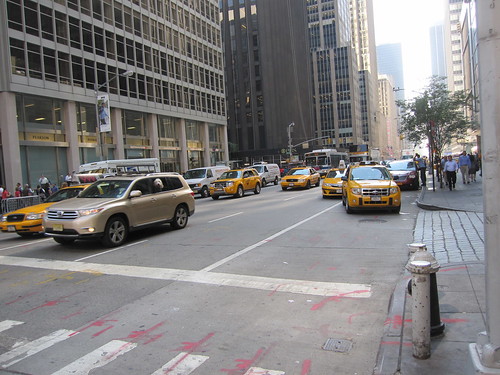 |
| New York City taxi drivers, before humanisation |
The man’s error, I realised during the 90 minutes I
spent this past Thursday at the New York Taxi and Limousine Commission, was an
understandable one. We were all at the TLC’s Office of Administrative Trials
and Hearings because of things that had happened somewhere on New York City ’s streets. The steady stream of
mainly South Asian men that trooped out of the elevators on the 19th
floor of the TLC’s building in the Financial District had all, presumably, done
something negligent or dangerous that would have infuriated or horrified me if
I’d witnessed it. There’s an equally strong chance that, had we encountered
each other on the street, we'd have been yelling at each other.
But, as I waited for my moment of courtroom drama, I found
myself viewing the drivers, shorn of their yellow cabs or Town Car limousines,
differently. They were hard-working immigrants worried about what their day at
the tribunal would mean for their livelihoods. Once there was no obvious sign
(apart from the pair of pannier bags at my seat) that I was a cyclist, I
suddenly turned into someone who might make this bad day better for
them. Off the roads, our shared humanity came to the surface.
 |
| The scene of, if not the crime, at least the breach of Taxi and Limousine Commission regulations |
Not that the reason I was there was touching or reassuring.
I was due to attend a hearing over my complaint against a car service driver
that I found one night in March blocking a cycle lane at a particularly dangerous junction in downtown Brooklyn. Since he was leaning against the car
and there were plenty of legal alternative places to park, I asked him to move.
After he angrily refused to do so, I tried to take a picture as evidence for
the TLC. That sent him spiralling into a far more intense fury and he not only
swore at me and called me a “white devil” but made grabs for both my camera and
bike.
When I arrived at the office at 8.50am on Thursday, however,
I recognised none of the drivers waiting anxiously for hearings. A short while
later, a TLC prosecuting attorney emerged to tell me my driver had so far not
turned up. If he hadn’t arrived by 10am, he would be in default and found
guilty of all the charges. He apologised for making me wait.
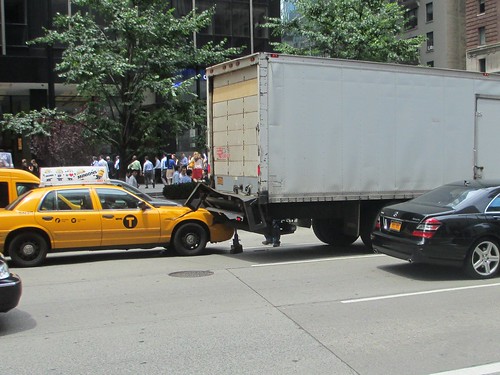 |
| A New York taxi cab in action: quiet professionalism |
But I was already growing interested in the transactions I
could hear taking place around me.
“OK, so the complaint’s withdrawn,” I heard a TLC official
telling a woman I took to be a driver’s lawyer. “So he doesn’t have the points.
You just have to make sure he doesn’t get two more points or he’ll get another
summons.”
Another driver was standing, head cocked, listening
carefully to a TLC attorney.
“This is the offer,” he was being told. “We give you a $300
fine and no points.”
There was then some discussion about whether the driver had
been given a previous chance to consider the offer, before it became clear that
he would accept it.
“If that’s what you want to do, we’ll go in front of the
judge and withdraw everything else,” the official told him.
 |
| Would you feel like veering left round a limo parked at this intersection? One evening back in March, I didn't. |
My mind went back to my most recent journey in a New York City taxi – my
first since I moved permanently to the city nearly two years ago. Arriving at
nearly midnight at LaGuardia
Airport
It was obviously dangerous driving – he tailgated other
vehicles, drove too close to the concrete dividing barriers and generally, I
eventually told him, drove like someone who would one day kill another road
user. He didn’t seem in any way a bad person, however. He was remarkably calm
and receptive once I started fully explaining to him why his driving terrified
me. I slightly reduced my tip in line with my previous advice on how to shape taxi driver behaviour. I couldn’t help wondering how well the endless transactions at the TLC fulfilled
the wider goal of persuading drivers like mine to use their vehicles more
safely.
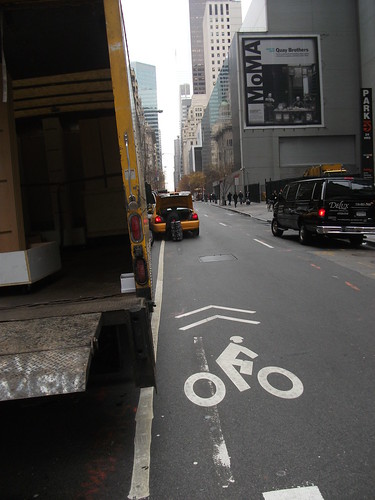 |
| Yeah, sure it looks like a clear rule breach to you. What will it look like after a plea bargain? |
Yet, as my hour ticked by, it became clear I’d got into a
row with one of the few for-hire drivers who didn’t understand how to play this
game. My driver had been charged with three counts – a parking violation;
harassment; and making threats of, or actual use of, physical violence. He
faced points on his licence for the parking, a $200 to $1,000 fine for the
harassment and a fine of up to $1,500 for the violence element. He could, in
theory, face a suspension or revocation of his licence but the prosecutor made
it clear the judges didn’t like using that.
Having listened to the other conversations, I’m confident
the prosecutors had foreseen a deal dropping the violent element in exchange
for guilty pleas to the two other charges. As it turned out, unless the driver
can provide a good reason why he didn’t attend, he’s been found guilty of all
the charges and could face the maximum penalties.
It was an outcome that initially pleased me. I headed back
outside to find the Financial District bathed in bright, warm sunshine I’d been
unable to see inside, unlocked my bike and prepared to head back to the office.
I remain grateful to the TLC for taking my complaint seriously and acting on
it. It’s better than the only previous time I complained to them, when they
insisted they couldn’t identify the driver involved based on his licence plate
number.
But Beaver St, outside the offices, was packed with cars,
their drivers leaning impatiently on their horns. As I headed north towards the
Hudson River Greenway, motorists were cutting inside each other, jostling for
minuscule advantages with little regard to the danger or inconvenience their
behaviour was creating for other people. As I rode home that evening, I once
again had to dodge round a for-hire vehicle parked exactly where the driver I
encountered had been. I hadn’t the heart to ask him to move.
I’d won one hollow, easy victory in the campaign for
more civilised streets. But I got home far from certain the war was being won.
Update, June 10: I've just heard that the driver was indeed found guilty. He will have to pay a $3,050 fine and have four points on his licence.
Update, June 10: I've just heard that the driver was indeed found guilty. He will have to pay a $3,050 fine and have four points on his licence.
