For years when I returned to Glasgow, the city where I lived on and off from the ages of four to 24, relatives and acquaintances would suck
their teeth as I mentioned how I cycled in Edinburgh, London or Budapest, the cities
where I’ve lived in the two intervening decades. Cycling would never take off
in Glasgow ,
they explained, because of the weather. The persistent, year-round rain would
make it impossible.
Glasgow , however, has more in
common with struggling cities across the North of England and the US ’s mid-west.
There’s a desperate edge to some of the transport policy decisions, a feeling
that the next city over might prove more car-friendly and attract a vital few
investors that could make all the difference. The cities consequently try a bit
of everything – some bike routes, some new rail lines, a hulking new urban
motorway slicing five miles through a reviving urban neighbourhood. I feel
enough affection for Glasgow
to hope that the strategy works better than I fear. The city’s continued
hollowing-out to facilitate car travel certainly isn’t preventing a revival in
vibrant areas such as Hillhead.
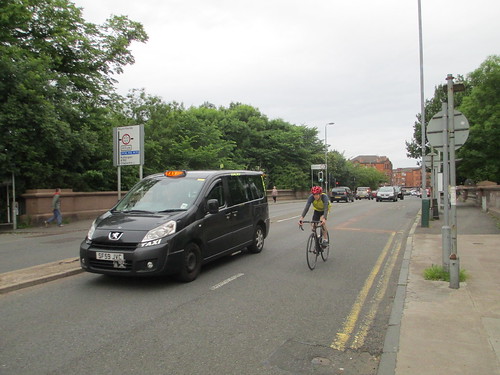 |
| A cyclist in Glasgow: doing his best to follow my lead from 20 years ago |
It was consequently a pleasant surprise when I enjoyed a few
days’ brief return home last week to discover that I’d been only 20 years or so
ahead of the times when I cycled regularly in Glasgow . I saw none of the large packs of
commuting cyclists that are becoming features of the London
and even sometimes the New York
streetscape. But there were undoubtedly far more noticeable numbers of cyclists
about on the streets, competing with double-deck buses, trucks and cars for
space on the roads.
Yet cyclists’ growing visibility is by no means the most
important recent transport change in the city. Across the Gorbals, a
notoriously rough area where I used to cycle between my parents’ home and my
postgraduate journalism course, there now strides a vast motorway viaduct,
opened two years ago in the name of relieving congestion on older, 1970s and
1980s motorways. The new road – an extension of the M74 motorway leading to England – was
built against planners’ advice and looks set to keep the Gorbals as depressing as in the 1990s.
My clearest memory of riding in the Gorbals then is of
jostling with cars while riding by a vast, wasteland lot. I knew it had, in
happier times, housed elegant tenements designed by Alexander “Greek” Thomson,
a 19th century architect dedicated to turning everyday Glasgow buildings into
visions of classical elegance.
The new road’s presence prompted me to notice quite how much
space Glasgow
devotes to the private car – and how far the priority cars receive helps to
sustain their dominance. I also noticed how much priority the city’s road
network gave to saving motorists time – at the expense of pedestrians and
cyclists. That in turn put me in mind of how much space and time both New York
– to which I’ve returned this week – and London – where I’ve lived 11 of my
post-Glasgow years – lavish on users of private cars.
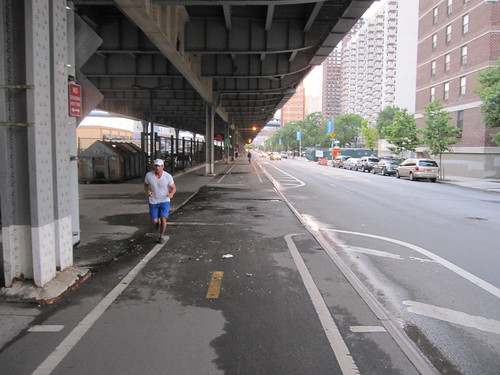 |
| The FDR Drive was one of the few New York highways not built by Robert Moses. But the neighbourng housing projects were - and illustrate precisely how much care the "master builder" took to create warm, vibrant neighbourhoods. |
All of those cities have made admirable strides in the last decade
towards enticing residents back onto the bicycles that had been abandoned as
urban transport tools. But the more I thought about practical conditions for
cycling in those places, the more it struck me that cyclists were often working
against the grain of the cities’ current structures. Their true inclinations
remained shaped by people like Robert Moses, the “master builder” who in the
1950s and 1960s sent road bridges springing across New York City ’s waterways, tunnels burrowing
under its harbour and expressways marching across many of its urban
neighbourhoods.
Not, I should add, that I envy the task of Glasgow ’s transport planners. The city, once
a thriving centre for shipbuilding, maritime trade and heavy industry, has
suffered from nearly every economic dislocation imaginable. Trade’s focus has
shifted from Britain ’s
Atlantic coast towards those near sea lanes to and from Asia .
Shipbuilding, undercut by Asia ’s low wages and
high efficiency, has all but disappeared. Other countries now make the huge
freight locomotives my mother recalls seeing heading down her street on their
way to haul goods across South Africa
or India .
The city could hardly have failed to hollow out as tens of thousands of its
working class citizens lost their jobs and left homes that had been clustered
around their workplaces. New York and London have undergone
similar changes following deindustrialisation, but haven’t quite so
comprehensively lost their senses of purpose.
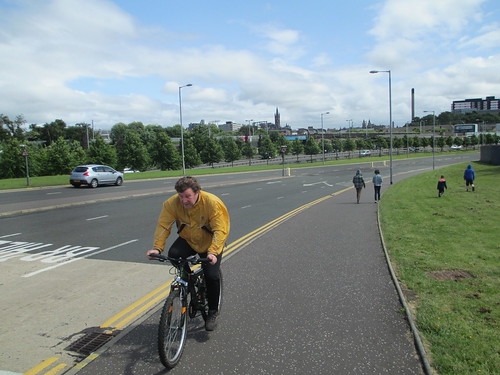 |
| A cyclist labours up the pedestrian/bike path near the Riverside Museum. You've certainly got to admire his determination when the city's so obviously telling him to go about by car |
Yet a family visit to the new Riverside Museum – part of an
attempt to revive one of the areas worst hit by recent decades’ changes –
revealed how far Glasgow goes out of its way to thwart anyone who abandons the
car. In a short walk from Partick railway station to the museum, we had to pick
our way across first a busy, two-lane road, then take a bridge across a
four-lane expressway, before immediately crossing a second, five-lane road. The
traffic lights’ pedestrian (and cyclist) phase took so long to come around it
seemed like a calculated insult.
The area is not the only one so thoroughly given over to
roads. Four thick, grey ribbons of tarmac – two carriageways of a trunk road
and two motorway carriageways – wind their way across one stretch of the city’s
south side that might, without them, stand some chance of revival as hip,
inner-city neighbourhoods. North American readers unfamiliar with the city
should picture the way Detroit ’s
urban freeways slice through its neighbourhoods to understand the effect.
 |
| A Glasgow-built Cunarder tram in the Riverside Museum: the acme of British tram design, from a city about to take a wholly different path |
The irony is that, on reaching the museum, visitors discover
how well Glasgow
once provided far more human-scale types of mobility. The Riverside Museum Carroll Gardens with the Brooklyn Queens Expressway, severed Manhattan
from its waterfront with the Henry Hudson Parkway and made suburban Long Island entirely car-dependent by building only expressways to serve new housing . There was certainly a need for some modernisation. In both Glasgow and New York, the post-war period saw the elimination of many notorious, dangerous, insanitary slums. It's simply hard looking at the end results to believe there wasn't a better way to achieve the goal.
I was particularly alive to the nature of Glasgow ’s
failure because during the trip I was reading 722 miles, Clifton Hood’s fine history of the building of New York’s subways. In it, he laments how after the first world war, John Hylan, the
then-mayor, sponsored subway construction within then-built-up parts of the
city but failed to keep extending the subways out to new, undeveloped areas.
The result was that areas like Staten Island
developed entirely differently from other bits of the city. As I can testify from personal experience, they remain dominated by wide roads full of fast-moving
cars. It wasn’t hard to spot a similar process at work in Glasgow . Roads blight swathes of places like
Partick, Kinning Park
It occurred to me this evening as I cycled home from work
that parts of New York remain as blighted by roads
as parts of Glasgow .
The thought came into my head as I pedalled frantically across the West Side highway – four carriageways of dense,
fast-moving traffic – to reach the Hudson River Greenway before the massed
ranks of cars started roaring towards me. Yet New York
enjoys the enormous benefit that no politician – even the most anti-cyclist,
pro-motorist – would seriously suggest building, say, a new arm of the Brooklyn
Queens Expressway devastating a new bit of booming Williamsburg . No-one would suggest
devastating Hoxton in London
with a new motorway.
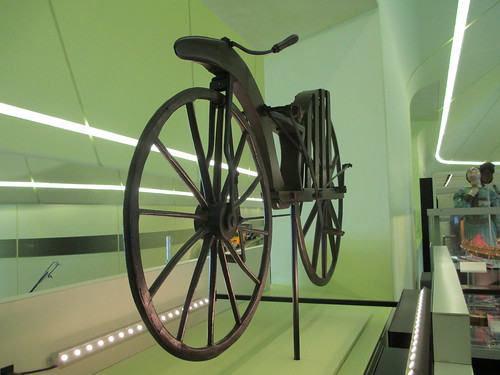 |
| Gavin Dalzell rode this, the world's oldest surviving pedal bicycle, now preserved in the Riverside Museum, in Glasgow. With admirable consistency, the city gave him a hard time for doing so. |
But I’d feel far more optimistic if I could picture myself
cycling from Glasgow ’s
south side to its city centre through the kind of bustling city streets where I’ll
ride tomorrow morning than under the looming viaduct that now bisects the
Gorbals.
