It was one Saturday in November that I happened upon one of South Brooklyn ’s most thoroughly dysfunctional streets.
Seeking to take the Invisible Visible Boy for a trip to Brooklyn’s shorefront
greenway, I naively followed the cycle route signs pointing me down Brooklyn ’s 3rd
Avenue towards the waterfront bike path. But,
after a little while, as I rode southward with the boy behind me on his trailer
bike, we found ourselves grappling with high-speed traffic heading onto and coming
off the highways around us.
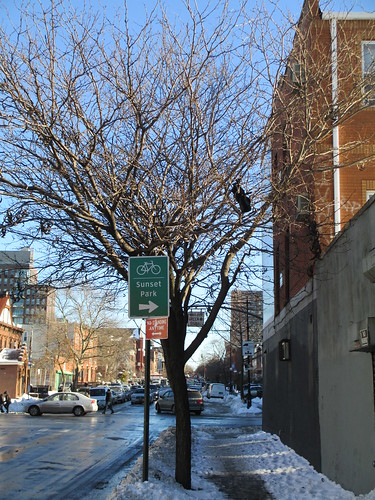 |
| The sign that tricked me into cycling down 3rd Avenue. To be fair, it doesn't read Sunset Park (via traffic dystopia). |
Then, as we rode into Sunset
Park – a stretch of Brooklyn along New York ’s harbour front, looking across to Staten Island - 3rd
avenue plunged into the shadow of the Gowanus
Expressway. The din of overhead traffic always in our ears, we found ourselves constantly
buzzed by high speed vehicles or cut off by cars turning into or out of auto
repair shops. The street seemed like as complete an example as one could
imagine of a street designed for motor vehicles with no thought for human
beings.
 |
| Look at this picture, readers. Then remember, with astonishment, that the man who forced this road down this route died feeling New York City was insufficiently grateful to him. |
So it was a shock when I discovered that, until 1941, 3rd avenue
in Sunset Park Norway , Sweden
and Finland . According to The Power Broker, Robert Caro’s classic biography of
Robert Moses, builder of much of modern New
York , it was only in 1941 with the opening of the Gowanus Parkway - since substantially widened and turned into an expressway - that it
started the decline into traffic-dominated squalor.
Moses insisted, despite pleas from the residents, on
building his parkway above 3rd
Avenue when it would have done far less damage
above 2nd avenue ,
nearer the already industrialised waterfront. Moses dismissed the poor but
proud community in Sunset
Park
I’ve been pondering the Moses story particularly intensely
recently as I've noticed how often powerful individuals shape places’ urban fabric – and particularly people’s ability to get around
those places easily and safely. That’s in part because of the end of the term
in power of Michael Bloomberg, mayor of New
York for 12 years until December 31, and the start of
the term of Bill de Blasio. Bloomberg’s transportation commissioner, Janette
Sadik-Khan, pushed strongly for the introduction of new, better bike lanes
and pedestrian plazas, chipping away at some of the damage Robert Moses did by
making the city so dependent on cars. Bloomberg’s successor has promised to
continue making decisive changes on the city’s streets. It was part of his
election platform – and critical to winning his endorsement by StreetsPac, the
safer streets action group – that he promised to work towards eliminating pedestrian deaths altogether.
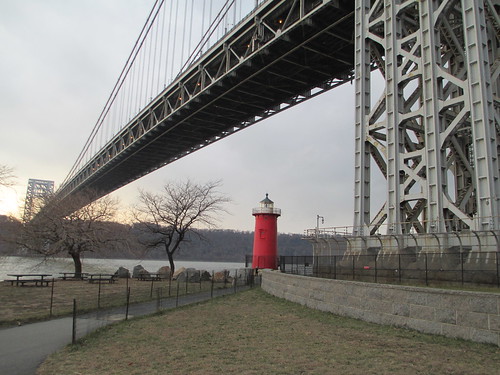 |
| The George Washington Bridge over the Hudson: the world's biggest political plaything? |
In London , it’s becoming steadily clearer that
the efforts of the mayor, Boris Johnson, to provide both better cycling and
walking conditions and faster journeys for motor vehicles are collapsing under
the weight of their internal contradictions. In Toronto ,
it’s one of the emblems of Toronto ’s
general civic tragedy that its clownish, crack-smoking mayor has ripped out
some important cycle lanes. Over the past week, I’ve been watching how
political operatives in New Jersey used traffic congestion to punish the mayor of Fort Lee, a small town by the George Washington
Bridge
Taken together, the various cases illuminate some core
principles. It’s important that leaders have a clear vision for how they want
their cities’ transport systems to work and that they’re prepared to tackle
forthrightly the kind of obstructionism that almost any significant change to
the urban fabric creates. But it’s also vital that those plans are based in a
real, solid understanding of what’s going on at street level, that
they’re flexible when there are serious concerns and that the plans are carried
out within the rules of the political game. Leaders need to exercise the
self-discipline to put long-term policy goals ahead of the need to have
concrete successes to show before the next election.
 |
| Traffic stuck bumper-to-bumper on the Gowanus Expressway on a quiet January Sunday: true testament to the success of Robert Moses' road-building |
Moses – who wielded power over aspects of transport and
planning in New York
State Sunset
Park 3rd
avenue because, he claimed, the existence there of
structures supporting a recently-demolished elevated rail line would make
construction along the avenue cheaper. But that probably wasn’t as decisive as
his simple conviction that the people of Sunset Park New York City and State when he encountered
people or environments for which he didn’t care. The more one knows about
Moses, the more one spots around the city problems – whether clogged,
disruptive freeways, crumbling subway lines or ugly, unsuitable public housing
projects – that could have been avoided if Robert Moses had been made to obey the
same rules about planning and due process that others followed.
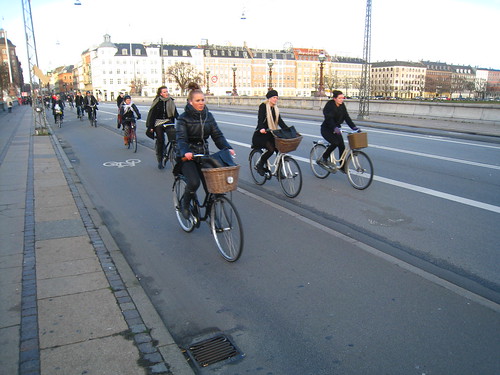 |
| Cyclists pedal on a dedicated lane over Copenhagen's Dronning Louise Bridge. Key difference between these lanes and London's Cycle "Superhighways": those in Copenhagen are good, effective public policy. |
On a far smaller scale, Boris Johnson’s initiative in London to build “Cycle Superhighways” along main roads exhibits a Moses-like deafness to criticism. No
cyclist shown plans for the “superhighways” – which are mostly simply painted blue strips along frighteningly busy roads – could have avoided concluding that riders using them would be terrifyingly vulnerable to the
neighbouring traffic. The desire to have achievements to show in the mayor’s
first term and a wish to devise a cycling policy distinctively different from
that of Ken Livingstone, Boris Johnson’s predecessor, seem to have trumped any urge for
mature reflection, however. Livingstone had developed the London Cycle Network of quiet routes along back streets.
The Cycle Superhighways look embarrassingly inadequate when
compared with the bike lane that Janette Sadik-Khan championed around a mile
away from the worst of 3rd
Avenue , along Prospect Park West in Park Slope. The
two-way protected lane illustrates, partly, the value of clear thinking and
good planning. The lane wasn’t built by pretending, as Boris Johnson has with the
Cycle Superhighways, that bike facilities can be built with no effect on motor
cars. It took away a lane of car traffic. Sadik-Khan, who had a strong record
of listening to the community boards that provide New York neighbourhoods with
a voice on planning issues, defended the decision to build the lane in the face
of legal action that has now rumbled on for years but served only to highlight
how well worked-out and widely supported the original policy was. Her stance
puts Boris Johnson’s insistence on following incompatible goals in his roads
policy to shame.
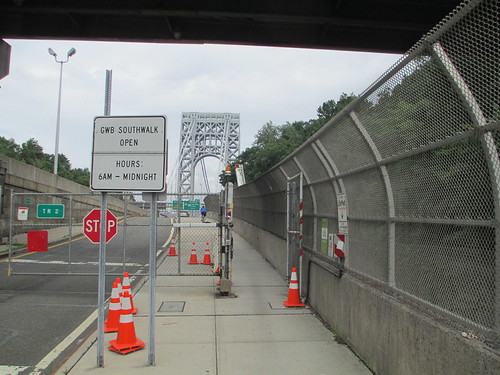 |
| The George Washington Bridge's Fort Lee entrance (albeit the bike, not car lanes). Taken last summer, before politicians realised the scene's full potential. |
Boris Johnson, however, has at least largely avoided the
ultimate transport policy error – of taking steps for purely short-term
political reasons. Those seem to have been the motives for the closure for four
days starting last September 9 of two of the three access lanes from the town
of Fort Lee , New Jersey ,
onto the busy George Washington Bridge
to New York City .
An official in the office of Chris Christie, New Jersey ’s
Republican governor, seems to have ordered the closures to choke Fort Lee with traffic after the town’s Democratic mayor
endorsed the Democratic gubernatorial candidate, Barbara Buono. The incident –
which held up school buses and emergency vehicles, as well as thousands trying
to get to work – was one of the most serious moral failings of transport policy
practice I’ve ever come across. New Jersey
appointees on the board of the Port Authority of New York and New Jersey , the bridge’s operators, seem
entirely to have lost sight of the reason for the bridge’s existence and seen
it purely as a political tool.
Bill de Blasio fortunately seems unlikely ever to lapse into
such downright political cynicism. It was in a supportive spirit that I and
some other people concerned about road safety turned up outside his
inauguration ceremony on January 1 to remind him of his commitment to cut road
deaths. There’s a clear sense of optimism abroad that Mr de Blasio and Bill
Bratton, his new police commissioner, might have the courage to start tackling
New York City’s appalling road safety record – at the time of writing, the city
has already suffered nine traffic fatalities this year. Polly Trottenberg, Sadik-Khan’s successor, even came out ahead of the inauguration to talk to the Vision Zero
activists and to hear the heart-rending stories of some of the bereaved parents
who were there.
 |
| Inwood Hill Park: Robert Moses couldn't really understand why anyone would think the road hadn't improved this last patch of primeval forest in Manhattan |
But, however optimistic the mood on January 1, I couldn’t
help wishing I’d been able to take Mr de Blasio with me on the trip I’d taken
the previous day, for a family trip to the New York Botanic Garden. To get to
the garden, more than 20 miles from my Brooklyn home, I rode up by Robert Moses’
Hudson River Parkway, taking in how it had cut nearly all western Manhattan off
from the city’s stunningly beautiful Hudson River waterfront.
I rode under the George
Washington Bridge
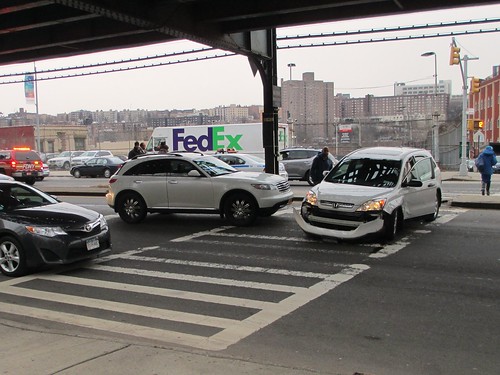 |
| Two of the three cars that crashed in northern Manhattan on Mike Bloomberg's last day as mayor: just another part of the legacy handed Mayor de Blasio |
A scene we would have encountered on the way back would have
been just as instructive. On Broadway, by the bridge leading from the Bronx – which Moses’ road was meant to free from traffic –
I found a long traffic jam. At its head were three cars, crashed into each
other.
This, I might have told the soon-to-be-mayor, is the legacy
you’ve been handed. It’s a city still reeling from a mad effort to make it
almost entirely dependent on the private car - and plagued by regular, serious
car crashes as a result.
“Please remember the lessons of all the bad and weak leaders
who made it like this,” I’d have begged him. “Please try to make it at least a
little better.”
