It was as I started pedalling across Southwark
Bridge from Lower Thames Street London
 |
| Southwark Bridge: the only place the police have ever pulled me over |
I hadn't broken any road rules, however, as the cyclophobes might assume. In fact, the policemen were angry that I’d signalled at them to leave me enough space to negotiate safely the junction I’d
just passed. A lively discussion ensued as they told me that I – the innocent
party – could have caused a crash by waving at them. They had obstructed the
junction, I pointed out. There had been nothing to tell them it was a junction,
they replied. “Except for the telltale meeting of two roads,” I retorted.
I would have minded the City of London Police's zeal far less, however, had it not contrasted so sharply with the attitude of the police officers I've asked to help me deal with far more serious wrongdoing by motorists. Having been knocked off once in London by a motorist paying no attention, assaulted once by a bus driver and threatened very frighteningly by another motorist, I’ve yet to see anyone lose so much as a single point on his licence as a result of illegal road behaviour around me. It has always been deemed “not in the public interest” to prosecute. Many British cyclists who’ve suffered far more serious incidents have been even worse served.
The emblematic episode for me was a journey home one summer evening alongBrixton Road
The question I would have loved to have asked the officers, however, would have been the key one to any discussion of cycling and policing: why do so many police officers worldwide seem to be so alive to the relatively harmless wrongdoing of cyclists and unaware of motorists' far more often deadly misdemeanours? It would have been no less worth asking, I think, because the police officers' faces would probably have looked back at me with blank incomprehension. The injustice, like many worldwide, is, I strongly suspect, mostly a result of subconscious attitudes rather than conscious prejudice.
I would have minded the City of London Police's zeal far less, however, had it not contrasted so sharply with the attitude of the police officers I've asked to help me deal with far more serious wrongdoing by motorists. Having been knocked off once in London by a motorist paying no attention, assaulted once by a bus driver and threatened very frighteningly by another motorist, I’ve yet to see anyone lose so much as a single point on his licence as a result of illegal road behaviour around me. It has always been deemed “not in the public interest” to prosecute. Many British cyclists who’ve suffered far more serious incidents have been even worse served.
The emblematic episode for me was a journey home one summer evening along
The question I would have loved to have asked the officers, however, would have been the key one to any discussion of cycling and policing: why do so many police officers worldwide seem to be so alive to the relatively harmless wrongdoing of cyclists and unaware of motorists' far more often deadly misdemeanours? It would have been no less worth asking, I think, because the police officers' faces would probably have looked back at me with blank incomprehension. The injustice, like many worldwide, is, I strongly suspect, mostly a result of subconscious attitudes rather than conscious prejudice.
At least part of the answer lies in the conversation I had
with the detective handling the last complaint I made to the Metropolitan
Police about a driver’s behaviour – when I reported earlier this year the case
of the driver who had threatened me with assault. I complained not only about
the driver’s threats but also about his deliberately driving across the path of
another cyclist. That incident – which struck me as far more dangerous than his
threats to assualt me – must, I’m sure, have been captured on a closed circuit
television camera.
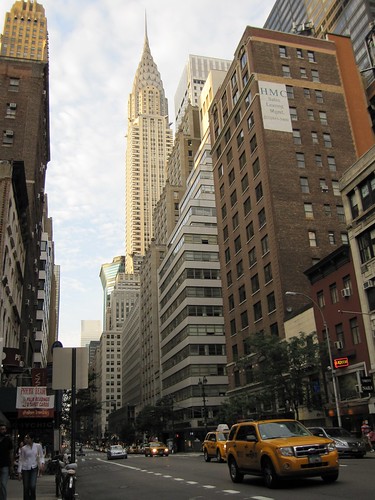 |
| New York City traffic. If one of those cars hits your bike without killing you, the NYPD's message is simple: fuggeddaboutit. |
Yet the detective replied that it would not be “an appropriate use of police resources” to
try to track down the footage. I didn't necessarily agree with his decision in my case. But his answer highlighted
how, however much one might like to see the police investigate and report to
prosecutors every offence they notice, not every red-light jumper will be tracked down, nor will every speeding
motorist. Every police force in the world has to make some calculation about where
the balance lies between tackling the crimes that most worry its political
masters, the concerns of the community it polices and the resources needed to
address them. Many of the outcomes are entirely rational. There aren’t many policemen worldwide happy to let murders go
unsolved. There are mercifully many who have made their peace with letting
litterbugs go unpunished.
The problem is that so few police forces worldwide seem to allocate resources for dealing with crime against cyclists in the way that natural justice for the victims - and the public interest in boosting cycling - would appear to demand. In New York – a
city whose affairs are engaging me particularly closely as I’m about to move
there – the police department’s policy is not to investigate crashes that look set merely to leave the victims maimed for life, rather than killing
them. There are almost no prosecutions in New York London, where the situation is less serious, i t remains tempting to conclude many British police forces have dealt with
the problem of prosecuting dangerous driving the way that Bunny Colvin,
fictional commander of Baltimore
The City policemen’s attitude towards me hinted, I think, at
the subconscious attitudes involved. They spoke to me on the assumption that I had
deliberately endangered myself and others out of ignorance. It took ten minutes
of arguing before they realised I had taken the most reasoned, sensible
approach I could to negotiating a junction where cyclists’ way across was
perpetually blocked by rule-breaking motorists. The starting point seemed to be
that I belonged to an out-group, beyond the civilised community they were
protecting and too ignorant to handle themselves properly. Most police officers I've encountered seem, by contrast, very alive to the pressures that might make motorists
break speed limits, take ‘phone calls while driving or commit other offences. That was certainly the message of the behaviour of the BTP officers I observed. The motorist rule-breaking that they ignored posed some significant threats to others. The cyclist they pursued was riding against the lights across a
junction unoccupied by motorists or pedestrians.
Such attitudes, nevertheless, aren’t immutable, to judge by the history of London's Gay Pride march. When the march was
first held in 1969 – at a time when nothing the organisers advocated was
illegal – police officers accompanying the parade disgracefully barracked those
taking part. A contingent of gay police
officers, in uniform, takes part in the march now. Cyclists face far less pervasive
discrimination than gay people – but a similarly comprehensive revolution in
attitudes is required.
The effects of the current attitudes came home to me only
last night as I cycled home. As I rode down a four-lane road, I spotted a white
van speeding down the kerbside lane towards me, at high speed, illegally
undertaking the vehicle in the offside lane. I swung in towards the kerb and
stopped, the van only just missing me. When I saw the vehicle again at the next
traffic lights, the driver shouted, “Sorry about that, mate”. When I pointed
out that he was driving illegally and dangerously, he retorted that I,
riding around a metre from the kerb, was to blame for “riding in the middle of
the road”.
The driver involved poses a clear danger to cyclists. A
rational system, aimed at reducing road deaths, would seek to discourage such
driving. A serious approach to complaints from cyclists would be a step in that
direction.
That, however, is utterly at odds with the approach
of any police force I’ve encountered. There was no prospect, I realised, that
the police would take any action against the driver. I decided against even
trying to photograph the offending vehicle for fear of provoking another
assault that the police would also ignore.
The driver involved might well one day soon kill a cyclist. An
open police approach to tackling driving like his might conceivably have
encouraged me to report him and led to his behaviour’s being addressed. For the moment, however, it remains far easier to chase after and catch a handful of slow-moving, vulnerable cyclists than tackle the sheer, overwhelming volume of motor vehicle
misbehaviour.
