When I was growing up in 1970s Glasgow, the more
worldly-wise boy three houses down had a far more obviously cool bike than
mine. It had a big, chunky back wheel, a cushioned saddle that curved up to
provide back support, high handlebars and a tiny front wheel. Anyone of a
certain age from the UK
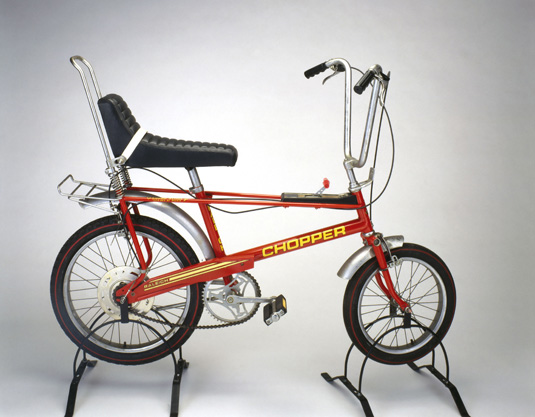 |
| A Raleigh Chopper: it was certainly popular - but are its riders still on bicycles now? |
There has been an outpouring of nostalgia in recent weeks in
the UK over the Chopper
after Alan Oakley, the man who designed the Chopper for Raleigh
The conspicuously absent stories, however, were of people
riding any great distance on the bike type that, for a while, pretty much every
young boy in Britain
The Chopper looked, to many people at the time, like the wave
of the future – but my suspicion is that it planted in many of my generation’s
heads the idea that a bike was a toy motor vehicle substitute, rather than a
means of transport. It was predicated on the principle that, to succeed, a bike
had to look like a motor vehicle – specifically the motorbike that Peter Fonda
rode in the film Easy Rider.
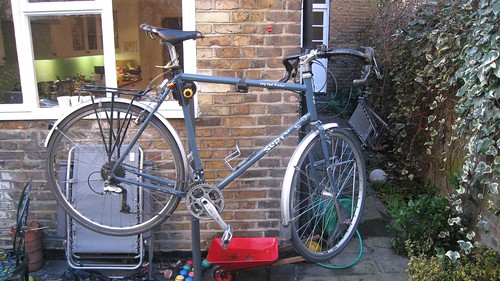 |
| The Invisible Visible Man's Surly Long Haul Trucker. This picture is making its third appearance on this blog - but it would be churlish to cheat readers of another chance to ogle it. |
The contrast between a Chopper and the bike I mount every
morning could hardly be starker. Despite being designed by the fairly “street”
Surly brand, my bike, with its drop handle bars, leather Brooks saddle and
conventional profile, looks as resolutely traditional as the Chopper tried to look radical and modern. But, as a machine
to ride, it boasts technology that strikes me as a miracle when I think about
it – and works so smoothly I barely ever do. I can flick between gears with
barely a thought, stop smartly and haul heavy loads.
Most novices nevertheless look at my bike, ask if they’ve
heard correctly what I paid for it, and struggle to work out where the money
went. Like the children who preferred the gimmicky Chopper to a bike that would
actually take one places, they prefer something cheaper but with the flashy
features that suggest the bike concerned is superior. It takes an experienced cyclist
to know the value of paying out for a bike that, while as uncomplicated as
possible, boasts the best possible components and materials.
But no owner of the superficially attractive but rubbishy
bikes of which the Chopper was a forerunner is likely ever to become an
experienced cyclist. Thousands of scrapyards’ worth of such bikes lie abandoned
in cellars, garden sheds or backyards worldwide. People who thought they’d try
cycling bought them because they seemed good value for money – then found the
tyres were prone to punctures, the frame was heavy and the poor-quality
suspension soaked up much of the effort that should have gone into moving them
forward.
 |
| Nasty bikes (on the right) on Glasgow's Nithsdale Road. WARNING: some readers may find the cheap disc brakes and nasty suspensions in this picture distressing. |
I encountered a rare excursion for a flock of such bikes on
a recent visit to my family in Glasgow Nithsdale Road
The question is what it is about bicycles’ aesthetics that
leads to such perverse outcomes.
It would be nice to say it didn’t matter how a bike looked –
but then I remember the reading party I attended during my third year at
university. There was a discussion one afternoon of aesthetics, where a
lecturer raised the question of whether it counted as art to hang a bicycle
wheel on a wall. I, already a little besotted with bicycles, launched into a speech
on the beauty of the relationship between the different spokes, the wheel’s
combination of strength and practicality and so on. The lecturer grudgingly
remarked that I might one day make a useful general cultural commentator.
It’s undoubtedly an attraction that many bicycles’ looks –
the combination of strength and lightness, clear lines and the delicate meshing
of a wheel’s spokes – are an uplifting example of economy and effectiveness in
industrial design.
But at the same time
there’s an attraction in seeing a bike that’s been fitted out neatly to do a
job. My bike has front and rear luggage racks, mudguards and a couple of
different hitches for hauling children. There’s an argument that the
paraphenalia represent unattractive clutter around the bike’s neat lines. But I
enjoy the feeling they’re there to do a job – that they make the bicycle
useful, rather than the kind of machine whose rider has to hang shopping off
his handlebars. Extras start looking like clutter to my eye when they stop
being useful. I experience an almost visceral aversion when I see a cheap
mountain bike with nasty, low-cost springs masquerading as a suspension. Look
closely enough and most such bikes feature somewhere a sticker warning the
rider that it can’t safely handle jumps or rough terrain. It doesn’t, in other
words, function as its form advertises it should.
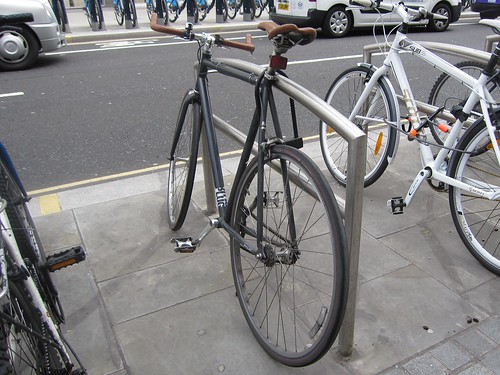 |
| A Charge Plug single-speed in the City of London. Sure, it's uncluttered. But how will its riders' knees feel in 20 years' time? |
I find the current vogue for stripped-down, single-speed or
fixed-wheel bikes depressing for similar reasons. The lines may be crisp and clean
– but I can’t help feeling they reflect the modern era’s pessimism about
progress. People seem to have grown tired of imperfect examples of multi-geared
bikes or bikes with suspension and given up on the possibility of ever doing
better. Fixed-wheel bikes’ recent popularity among commuters may not represent
quite the same kind of retreat from progress as radical Islamism or the US
Yet even my own main bike disguises its modernity with a
retro-ish cover. That’s the dominant current aesthetic for pretty much any kind
of decent bike not intended for top-level road or mountain bike racing. The
ironic result is that the more committed someone is to the idea that cycling has
a strong future the more likely his or her bike is to look like it comes from
the past. It is extraordinarily rare to see a practical, well-made utilitarian
bike whose designers had the confidence to make it look modern.
 |
| A Scott sub35 hybrid. It may not be perfect - but it features mudguards, hub gears, sensible brakes and looks, miracle of miracles, modern. |
Nevertheless, manufacturers like Surly making retro-ish but
effective bikes are unlikely to suffer as Raleigh Raleighs Raleigh
I’ve remarked before on this blog on how magnificently the free market serves cyclists, even if many are reluctant to recognise it. It may
mark a sad end for a proud British company. But, in ending the independence of Raleigh
Cycle, which sold hundreds of thousands of British youngsters a gimmick for a
bicycle, the market may have done cyclists yet another favour.
