Watching television some years ago, I happened upon an
advert that used home video footage from the childhood of Lance Armstrong, the
winner eventually of more Tours de France than any other cyclist. Young Lance was
receiving a birthday present of his first-ever bicycle. I am no doubt a sucker
for this kind of thing. Given the hostility Lance Armstrong seems to arouse, there
will probably be people who allege the footage was in some way faked. But I
suddenly found myself feeling overwhelmed.
It is surely one of the unalloyed joys of riding bicycles
that the habit tends to run in families. My father taught me the way to handle
myself on the road, to load luggage and the best way to fix a puncture. He, I
know, learnt many of those things from his own father. I recently had the
pleasure of explaining to my 10-year-old daughter the workings of a derailleur
gear, surely one of the world’s most beautiful marriages of mechanical
simplicity and efficiency.
It’s not, however, only that cycling is something we learn
from our parents and pass on to our children – it’s the time of life at which
we do it. We nurture children in the habit of cycling when they’re past the
point of childish helplessness but before the sourness of adolescence. It’s a
point at which parents are still heroes to their children and children still
distinguished by their potential rather than their shortcomings. I can’t be the
only one who experienced some of his most intimate moments with his father
while cycling with him.
The day of my tenth birthday was not normal. My parents were
being presented to the Queen during a visit to Glasgow
Yet it was the present waiting at home that made it a
red-letter day for me. It was a sit-up-and-beg Raleigh Glasgow
Never mind. My dad forced a wooden mallet underneath the
saddle for a handle and would run behind me, holding me upright, while I learnt
to ride. The skill mastered, I took to pootering around the neighbouring
streets and, every now and again, heading off on longer rides. My dad would
come with me, reaching down to the handlebars of an ancient Dawes tourer.
That bike – a present to my dad on his 15th
birthday 30 years before - had the same, inflexible three-speed Sturmey Archer
gear arrangement as my bike. My dad, I’ve since discovered from an old photo
album, once rode it alongside his father from Edinburgh to Cheltenham. It
wouldn’t look much of a thing now – but, to us, its classic road bike lines
made it possibly the coolest, most authentic bike ever.
I remain wary of being forced too close to the road edge
after catching the kerb on a down hill during one of those rides and somersaulting
head-first into a gravel driveway. My dad, far more anxiously and tenderly
solicitous than normal, bought me an ice lolly from a nearby shop. He wanted, I
think, to get the swelling in my upper lip down before my mum saw me.
I also remember receiving some of my first anti-cyclist
abuse. My dad, sister and I were out on our bikes one Sunday afternoon looking,
to the disdain of a local youth, unbearably middle-class. “The family ones on
bikes,” he sneered, in a la-di-dah voice.
Yet, even though my cycling tailed off for a while once I
outgrew that first bike, something
picked up on those outings told me bikes and I – and my family and bikes - belonged
together.
I took that old Dawes tourer to university when I started and
gradually destroyed it, testing components nearly 40 years old and finding them
wanting. I remember bowling down a footpath in St Andrews and screaming other
students out of the way after the brake blocks had failed and flown off. I
replaced it with, at last, a drop-bar road bike and rode it all over Scotland,
particularly the summer after my grandfather died. Some days I’d take my bike
through to Edinburgh and cycle to his old house to get on with the clearing up.
Other days, I’d head off in the morning and ride 70, 80, 100 miles, heading up
the side of Loch Lomond, across to Fife or down towards the southern uplands,
slogging my way through mile after mile of what seems looking back
extraordinarily uncomplicated, enjoyable cycling.
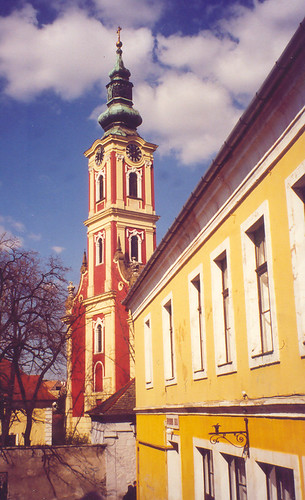 |
| Szentendre: I cycled a fair bit of the way there |
It was the last time I spoke to him. Later that week, his
already serious illness took a turn for the worse and, much faster than any of
us had anticipated, he died. Had I known we were saying goodbye, I would of
course have told him how, without my realising it, he had become my template
for how to be a man: I was as fixated as he on trying to do what I, in my
stubborn mind, saw as the Right Thing. I was trying to emulate his gentle
kindness towards the vulnerable. But, given that I would never have said such
things in what seemed like a normal, Sunday night telephone call, I still
regret not having mentioned the cycling. It was an activity that, whenever I
discussed it with my father, always seemed, even when we saw life very
differently, to revive the glow of those early rides together.
Why that particular regret nagged at me, however, wouldn’t
be entirely clear until my own children had bikes. Then, this past Christmas,
my daughter, having been given cycling clothes, demanded, at five o’clock on
Christmas Day, to go out for a ride. It was a demand that my dad, with his stubborn
individualism, would have well understood. Some weekends at present, I run
round the pavements behind my four-year-old son, holding him upright as he, as I
did before him, tries to learn to ride. Most weekends, we head off on some
trip, my son in his trailer behind me, my daughter behind that and my wife
bringing up the rear – a procession of a certain kind of British middle-class
eccentricity.
But cycling is a family activity for me at other times too.
My father barely ever cycled in his final decades but I still recall how he set
himself over his bike, pushed down with his right leg and set off. It’s much the
same way, I suspect, I do the same thing. His voice and attitudes echo around
my head. Even on the loneliest country roads and dark south London streets in the
early hours, I never seem to cycle entirely alone.
