It was 8.30pm on Friday and I was battling my way home from
Greenpoint, at Brooklyn’s northern tip, through a thunderstorm of the kind that
reminds one New York’s weather arrives partly from the tropics. I’d just got south of the Williamsburg Bridge Kent Avenue when, looking ahead, I could
see there was a car parked blocking most of the bike lane.
I naively assumed for a moment that perhaps the driver had
made a mistake. Perhaps, despite the clear markings, in the torrential rain the
driver just hadn’t spotted the bike lane.
 |
| The Kent Avenue bike lanes: a great place to park, if you're entitled and unpleasant. |
Instead, I was about to discover an almost beautifully
distilled summary of what remains wrong with attitudes to cycling and road law
enforcement in New York City .
Some of those attitudes are peculiar to this big, crazy malfunction of a
metropolis, while others are frustratingly widespread across the industrialised
world. Cyclists, according to this attitude, are an odd, fringe group whose
concerns needn’t be taken seriously.
But that’s putting the cart of theorising before the horse
of anecdotal evidence.
The car stood out because it was so obviously in the wrong
place. The parking spaces along Kent
Avenue are all in the road, while a two-way bike
lane runs along the kerb. The car’s headlights were glaring back at me, through
the rain, more or less right in my path. Every other car for blocks was neatly
parked outside the bike lane. As I approached, I expressed my irritation by
waving to the motorist to move. It was a waste of effort. Even so, I might have
said nothing if the motorist had not, as I rode slowly past in the remaining
portion of the southbound bike lane, rolled down his window and said something,
which I didn’t catch, but sounded abusive.
The insolence of the gesture switched me into “Invisible
Visible Avenger” mode. I rapped sharply on the now-closed window and told the
driver, “Shift! You’re in the bike lane.”
When the window rolled down again, the face looking back at me was a man, probably in his
thirties, solidly built and wearing a baseball cap. He looked unimpressed with being asked to move.
“I’ll park wherever I want,” he replied.
“It’s illegal,” I said. “You’re blocking the bike lane.”
His reply alone would make a fascinating blogpost on its own
– and certainly a fascinating contribution to Sarah Goodyear’s recent piece for
the Atlantic Cities about cycling and masculinity.
“I’m picking up my baby,” he said. There was a child in a
car seat in the back.
“What’s more important – my baby or your faggot-assed bike?”
The weight of his cultural assumptions was suddenly crashing
and swirling around inside my head as frantically as the rain was lashing down
outside it. There was the tone of injured innocence, so typical of a certain
kind of self-righteous motorist. “I’m trying to go about my life the way
normal, respectable people do,” he seemed to be telling me. “Yet here you,
cyclist, are trying to intrude and ruin it.”
The assumptions behind the “faggot-assed bike” comment are
even more breathtaking. He was driving a Dodge Avenger – a mid-size sedan with
a more powerful than normal engine and an aggressive look. The car was an
embodiment of his assumption that real men drive fast, aggressive cars. I, in
my human-powered earnestness, represented weakness so transgressive as not to be fully male. My behaviour was so strange that even my bicycle suddenly
assumed a sexual orientation.
And, of course, his attitude was turning this into a battle
of wills, which I wasn’t prepared to lose.
“What’s important is that you’re blocking the bike lane,” I
told him. “Look. I can call the police if you like.”
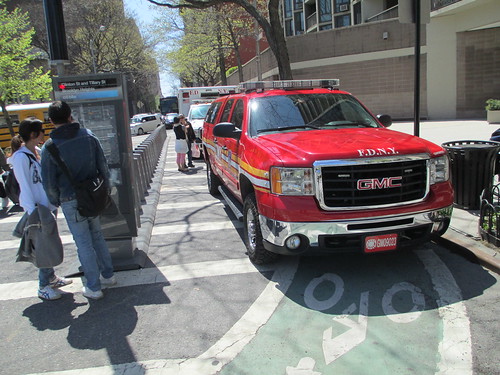 |
| I use this photo for balance. The NYPD isn't the only emergency service that ignores bike lanes |
It was a bluff, based on my knowledge that no NYPD officer
would deal with a call about a driver's obstructing a bike lane, particularly in
a thunderstorm. But it opened up a whole new front in the battle.
“Call the police if you like,” he said, grabbing a sheaf of
papers from his dashboard and shoving them towards me. They bore the logo of
the New York Police Department and looked like some internal police directory. “This is the police right here.”
It would be reasonable to ask at this point why I believed
him to be a police officer. Suffice it to say that I had a run-in once in London with someone who
claimed to be a Metropolitan Police community support officer. His claim never
rang true and, sure enough, when I complained to the police they said he was
nothing to do with them.
The arrogance, self-confidence and sense of entitlement of
the Angry Avenger Driver of Kent Avenue struck me as far more convincing.
It would be still more sensible to ask why, faced with a
homophobic, cyclist-hating police officer who thinks his role entitles him to
break the law, I didn’t cut my losses and leave. That, I imagine, is how a more
balanced, contented person might have behaved.
Yet by now the Invisible Visible Avenger was in sole charge.
“What’s your badge number?” I asked.
“You got room to pass, don’t you?” he asked. “I ain’t
stoppin’ you.”
“Are you a police officer?”
“Yes, I am. You shouldn’t be riding in the rain.”
 |
| There are two ways to read the NYPD's decision to put "Courtesy, Professionalism, Respect" on the side of their vehicles. They're either wholly out of touch or - which I prefer - have a brilliant satirist in their image department |
“Tell me your badge number.”
“Stop ridin’ in the rain.”
“What’s your badge number?”
“I don’t have to tell you shit.”
It was the last I heard from him. Silently, recognising
reason wouldn’t work, I strode over to a nearby wall, leaned my bike against it
and started to get my camera out of my pannier bag. Recognising, I suppose, that
his bosses might take a dim view of discovering his views on a whole range of
matters, the officer made off into the dark, rainy night. My sole sliver of
victory was that I’d got him out of the bike lane. I felt far less fearful than
after some previous confrontations with recalcitrant motorists.
But, as I headed on homeward, water squelching in my
waterlogged shoes, I felt depressed. The previous morning, I’d been delighted as I rode to work to see a police officer ticketing a driver parked in the bike lane on Jay St in downtown Brooklyn and had shouted my thanks to him. The Kent Avenue encounter
made me think that other reports I heard last week – of the police ticketing
cyclists for relatively harmless breaches of Prospect Park’s one-way rules, for
example – were more representative of current police attitudes.
The officer’s self-righteousness bothered me most. The
comment about how I shouldn’t be riding in the rain suggested a strong
underlying assumption that cycling was a trivial, leisure activity while
driving a car was the serious act of a responsible person. Illegal driving
consequently trumped perfectly legal cycling.
My mind went back to when two City of London
police officers stopped me in London ,
accusing me of cycling dangerously by squeezing past their vehicle. They and
other motorists had been illegally blocking an intersection where I had the
light. In both that and Friday’s incident, there was the sense that the police
officers, in their car, were implicitly the responsible grown-ups.
The officer’s arrogant assertion of his right to park
wherever he liked spoke to something similar to the previous day’s ticket blitz
in Prospect Park
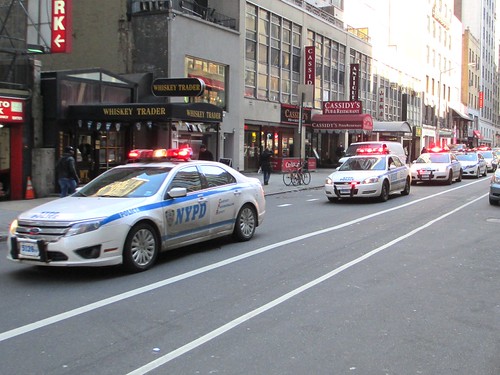 |
| NYPD cruisers in midtown: five carloads of suburban assumptions, coming your way |
The proliferation on New York City cars of stickers showing
the driver’s allegiance to this or that police benevolent association – lucky charms
to ward off the evil eye of an arbitrary traffic stop – suggests others share
my perception of police attitudes.
Not that, for me, the consequences were ultimately important.
As a middle-aged white professional, I’m self-evidently a poor target for a
harassment arrest. Had I been a younger black or Hispanic man, I would probably
have made off the moment I realised I was dealing with the police.
Blacks, Hispanics, gays and many other minority groups face
far worse than cyclists generally do at the hands of the NYPD. I’m certainly in
a far better position than the 28-year-old mentally ill man who used to live
round the corner from me. After he stabbed – but only lightly wounded – his uncle,
the police pumped seven bullets into him, killing him.
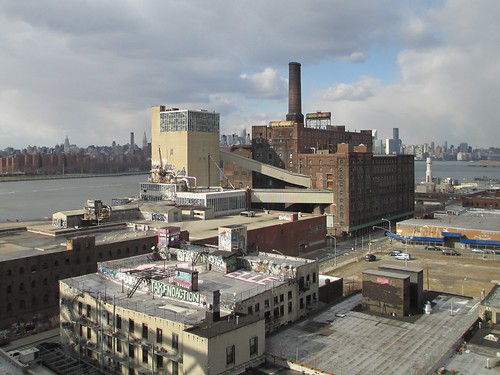 |
| Williamsburg, near the scene of my encounter: no vision of suburban respectability |
Yet I don’t think it’s a stretch to see in the dismissive attitude
of police in London and New York to cyclists’ complaints a symptom
of the disconnect between police and policed. In both cities, officers live in
outlying, suburban areas where car use is a symbol of a certain kind of
conventional respectability. It’s not hard to imagine such officers are
fundamentally at odds with much of the reality of the urban life they’re policing, from casual, harmless use of illegal drugs to rising levels of
cycling.
Both cities’ residents have fought long battles with their
police forces – over their racism, their homophobia, their sense they’re above
the law. Yawning gaps persist between police and public attitudes. This year in
New York
started with bold declarations about eradicating road deaths. I arrived home on
Friday discouraged, feeling that some of the police who should be helping towards that goal are part of the problem rather than the solution.
