Showing posts with label Williamsburg. Show all posts

Sunday, 25 May 2014

An angry off-duty policeman, a rainy night - and why the suburbs are coming for your bike lane

It was 8.30pm on Friday and I was battling my way home from Greenpoint, at Brooklyn’s northern tip, through a thunderstorm of the kind that reminds one New York’s weather arrives partly from the tropics. I’d just got south of the Williamsburg Bridge on Kent Avenue when, looking ahead, I could see there was a car parked blocking most of the bike lane.

I naively assumed for a moment that perhaps the driver had made a mistake. Perhaps, despite the clear markings, in the torrential rain the driver just hadn’t spotted the bike lane.
The Kent Avenue bike lanes: a great place to park,
if you're entitled and unpleasant.

Instead, I was about to discover an almost beautifully distilled summary of what remains wrong with attitudes to cycling and road law enforcement in New York City. Some of those attitudes are peculiar to this big, crazy malfunction of a metropolis, while others are frustratingly widespread across the industrialised world. Cyclists, according to this attitude, are an odd, fringe group whose concerns needn’t be taken seriously.

But that’s putting the cart of theorising before the horse of anecdotal evidence.

The car stood out because it was so obviously in the wrong place. The parking spaces along Kent Avenue are all in the road, while a two-way bike lane runs along the kerb. The car’s headlights were glaring back at me, through the rain, more or less right in my path. Every other car for blocks was neatly parked outside the bike lane. As I approached, I expressed my irritation by waving to the motorist to move. It was a waste of effort. Even so, I might have said nothing if the motorist had not, as I rode slowly past in the remaining portion of the southbound bike lane, rolled down his window and said something, which I didn’t catch, but sounded abusive.

The insolence of the gesture switched me into “Invisible Visible Avenger” mode. I rapped sharply on the now-closed window and told the driver, “Shift! You’re in the bike lane.”

When the window rolled down again, the face looking back at me was a man, probably in his thirties, solidly built and wearing a baseball cap. He looked unimpressed with being asked to move.

“I’ll park wherever I want,” he replied.

“It’s illegal,” I said. “You’re blocking the bike lane.”

His reply alone would make a fascinating blogpost on its own – and certainly a fascinating contribution to Sarah Goodyear’s recent piece for the Atlantic Cities about cycling and masculinity.

“I’m picking up my baby,” he said. There was a child in a car seat in the back.

“What’s more important – my baby or your faggot-assed bike?”

The weight of his cultural assumptions was suddenly crashing and swirling around inside my head as frantically as the rain was lashing down outside it. There was the tone of injured innocence, so typical of a certain kind of self-righteous motorist. “I’m trying to go about my life the way normal, respectable people do,” he seemed to be telling me. “Yet here you, cyclist, are trying to intrude and ruin it.”

The assumptions behind the “faggot-assed bike” comment are even more breathtaking. He was driving a Dodge Avenger – a mid-size sedan with a more powerful than normal engine and an aggressive look. The car was an embodiment of his assumption that real men drive fast, aggressive cars. I, in my human-powered earnestness, represented weakness so transgressive as not to be fully male. My behaviour was so strange that even my bicycle suddenly assumed a sexual orientation.

And, of course, his attitude was turning this into a battle of wills, which I wasn’t prepared to lose.

“What’s important is that you’re blocking the bike lane,” I told him. “Look. I can call the police if you like.”
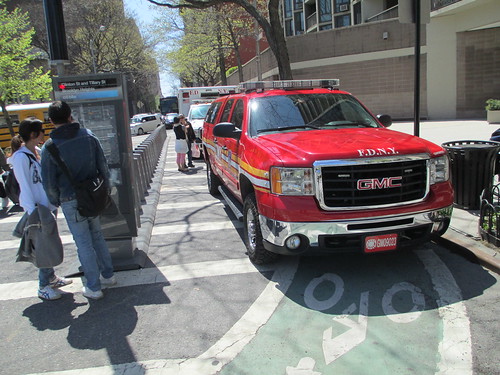
 
I use this photo for balance. The NYPD isn't the only
emergency service that ignores bike lanes
It was a bluff, based on my knowledge that no NYPD officer would deal with a call about a driver's obstructing a bike lane, particularly in a thunderstorm. But it opened up a whole new front in the battle.

“Call the police if you like,” he said, grabbing a sheaf of papers from his dashboard and shoving them towards me. They bore the logo of the New York Police Department and looked like some internal police directory. “This is the police right here.”

It would be reasonable to ask at this point why I believed him to be a police officer. Suffice it to say that I had a run-in once in London with someone who claimed to be a Metropolitan Police community support officer. His claim never rang true and, sure enough, when I complained to the police they said he was nothing to do with them.

The arrogance, self-confidence and sense of entitlement of the Angry Avenger Driver of Kent Avenue struck me as far more convincing.

It would be still more sensible to ask why, faced with a homophobic, cyclist-hating police officer who thinks his role entitles him to break the law, I didn’t cut my losses and leave. That, I imagine, is how a more balanced, contented person might have behaved.

Yet by now the Invisible Visible Avenger was in sole charge.

“What’s your badge number?” I asked.

“You got room to pass, don’t you?” he asked. “I ain’t stoppin’ you.”

“Are you a police officer?”

“Yes, I am. You shouldn’t be riding in the rain.”
 
There are two ways to read the NYPD's decision to put
"Courtesy, Professionalism, Respect" on the side of their
vehicles. They're either wholly out of touch or - which I
prefer - have a brilliant satirist in their image department
“Tell me your badge number.”

“Stop ridin’ in the rain.”

“What’s your badge number?”

“I don’t have to tell you shit.”

It was the last I heard from him. Silently, recognising reason wouldn’t work, I strode over to a nearby wall, leaned my bike against it and started to get my camera out of my pannier bag. Recognising, I suppose, that his bosses might take a dim view of discovering his views on a whole range of matters, the officer made off into the dark, rainy night. My sole sliver of victory was that I’d got him out of the bike lane. I felt far less fearful than after some previous confrontations with recalcitrant motorists.

But, as I headed on homeward, water squelching in my waterlogged shoes, I felt depressed. The previous morning, I’d been delighted as I rode to work to see a police officer ticketing a driver parked in the bike lane on Jay St in downtown Brooklyn and had shouted my thanks to him. The Kent Avenue encounter made me think that other reports I heard last week – of the police ticketing cyclists for relatively harmless breaches of Prospect Park’s one-way rules, for example – were more representative of current police attitudes.

The officer’s self-righteousness bothered me most. The comment about how I shouldn’t be riding in the rain suggested a strong underlying assumption that cycling was a trivial, leisure activity while driving a car was the serious act of a responsible person. Illegal driving consequently trumped perfectly legal cycling.

My mind went back to when two City of London police officers stopped me in London, accusing me of cycling dangerously by squeezing past their vehicle. They and other motorists had been illegally blocking an intersection where I had the light. In both that and Friday’s incident, there was the sense that the police officers, in their car, were implicitly the responsible grown-ups.

The officer’s arrogant assertion of his right to park wherever he liked spoke to something similar to the previous day’s ticket blitz in Prospect Park. The traffic rules for some police officers seem unimportant on their own terms – as a means to prevent people’s being harmed – but a series of traps, like the Russian tax code. They’re there to use as a stick to beat whatever group one wants to beat today or to fill up an unfilled quota of tickets.
 
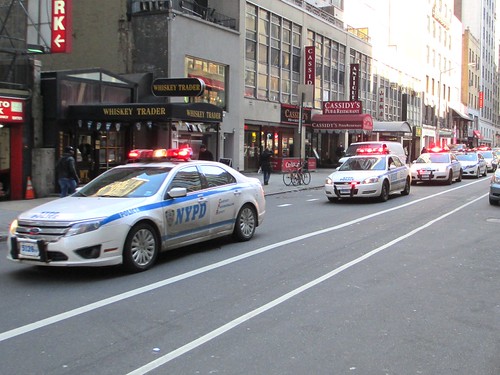
NYPD cruisers in midtown: five carloads of suburban
assumptions, coming your way
The proliferation on New York City cars of stickers showing the driver’s allegiance to this or that police benevolent association – lucky charms to ward off the evil eye of an arbitrary traffic stop – suggests others share my perception of police attitudes.

Not that, for me, the consequences were ultimately important. As a middle-aged white professional, I’m self-evidently a poor target for a harassment arrest. Had I been a younger black or Hispanic man, I would probably have made off the moment I realised I was dealing with the police.

Blacks, Hispanics, gays and many other minority groups face far worse than cyclists generally do at the hands of the NYPD. I’m certainly in a far better position than the 28-year-old mentally ill man who used to live round the corner from me. After he stabbed – but only lightly wounded – his uncle, the police pumped seven bullets into him, killing him.
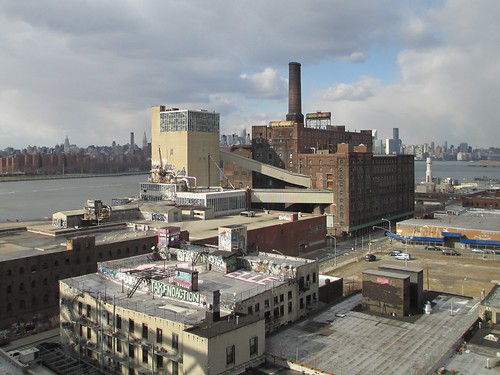
 
Williamsburg, near the scene of my encounter: no vision
of suburban respectability
Yet I don’t think it’s a stretch to see in the dismissive attitude of police in London and New York to cyclists’ complaints a symptom of the disconnect between police and policed. In both cities, officers live in outlying, suburban areas where car use is a symbol of a certain kind of conventional respectability. It’s not hard to imagine such officers are fundamentally at odds with much of the reality of the urban life they’re policing, from casual, harmless use of illegal drugs to rising levels of cycling.

Both cities’ residents have fought long battles with their police forces – over their racism, their homophobia, their sense they’re above the law. Yawning gaps persist between police and public attitudes. This year in New York started with bold declarations about eradicating road deaths. I arrived home on Friday discouraged, feeling that some of the police who should be helping towards that goal are part of the problem rather than the solution.

Sunday, 24 March 2013

Crashes - and communities' deadly preferences

At the foot of Wellington Street in London, where the busy cycle route from Waterloo Bridge heads into Covent Garden, there was, for a while when I lived there, a notice. The police had received numerous complaints, it said, from “the community” about standards of cyclist behaviour in Covent Garden. It suggested, essentially, that cyclists should smarten up their act or face unspecified consequences.

The notice irritated me on several levels – but the most profound was the notion that “the community” were the real people and the cyclists some alien, invasive species. The irritation was all the greater because as an area Covent Garden seldom showed much respect for cyclists’ rights. I have a vivid memory of cycling across the pavement (sidewalk, American readers) at the foot of Wellington Street with a drunk tourist yelling at me that I wasn’t allowed to ride there. He was standing directly on top of a bike symbol, on the clearly marked cycle lane.
A stencil marks where Martha Atwater died: one of
far too many such death sites in New York City

Questions about traffic and its relationship with communities have been occurring to me again over the last month as I’ve pondered a series of appalling tragedies on the streets of New York City, where I live now. The highest profile – the killing in a car crash in the early hours of March 3 of two expectant parents, Nachman and Raizel Glauber, and their baby son, delivered prematurely after the crash – raised the issue most clearly because of their own community’s very obvious reaction. The couple, only 21, belonged to prominent Hasidic Jewish families. Their deaths – a speeding, possibly drunk driver smashed into the livery cab they were using - were marked by a funeral that brought 1,000 men in dark coats and wide-brimmed hats onto the streets of Williamsburg, one of Hasidism’s Brooklyn strongholds.

But nearly any traffic tragedy – and there have been many in New York this past month besides the widely-noticed ones - raises at least some questions about how different communities relate to and use the street involved.
Potted plants show the grief of Martha Atwater's community

I’ve been thinking particularly deeply about the link each morning recently as I’ve cycled past the junction of Clinton Street and Atlantic Avenue in Brooklyn Heights on my way to work. A line of potted plants by a shop window and a stencilled outline on the sidewalk mark where, on the evening of February 22, a driver mounted the sidewalk in his speeding, out of control SUV. Martha Atwater, a 48-year-old writer and mother of two children, was emerging from a bagel shop and died on the sidewalk shortly after the vehicle hit her.

The regular arrival of fresh floral tributes testifies to what I read in the days after Ms Atwater’s death – that she was a well-known, well-liked participant in many local activities. She was the embodiment of the strong sense of mutual responsibility and joint action that makes the best New York neighbourhoods such desirable places to live.

But I saw little reflection amid the tragedy of Ms Atwater’s death on New York’s wider traffic culture, which claimed another high-profile victim less than six days later. On the morning of February 28, Amar Diarrassouba, 6, was crossing E117th street in East Harlem on his way to school when a huge truck drove through the crosswalk, killing him instantly as his 9-year-old brother, who was accompanying him, looked on.

The grief in Amar’s case focused not on the miserable, pointless loss of a bright young boy or the driver’s culpability but on Amar’s school crossing guard. The woman, who on a previous occasion reportedly snatched a child out of the path of an oncoming car, should have been present at the crossing when the collision occurred but wasn’t. Astonishingly, the police investigation of the truck driver appears to have concluded with his receiving traffic tickets for failure to yield and failure to execute due care – minor violations that nevertheless suggest he was entirely responsible for Amar’s death. The investigation into the crossing guard – someone who, whatever her shortcomings, did not negligently drive a huge truck over a blameless six-year-old – continues.

The attention on the crossing guard was typical of the focus after each of the tragedies on the crash’s individual circumstances and what made it exceptional. There has been very little reflection on how general traffic conditions in the areas concerned contributed to the deaths.

The intersection the driver that killed Martha Atwater crossed.
Traffic calming would do no good here, according to some residents
That omission struck me particularly in Martha Atwater’s case because of an online argument I entered a few months ago with a resident of Cobble Hill, just across Atlantic from the crash scene, about traffic calming. He was angrily complaining about how unsightly a projected traffic-calming scheme for the area would be and what congestion it would cause. But it seems fair to suspect that such traffic-calming would have made it much less likely a speeding SUV would shoot across Atlantic Avenue and kill someone.

The most shocking effort to shift blame came in Amar Diarrassouba’s case. The community board for the area where Amar died – the local body that has the final say on many local planning issues in New York – in late 2011 withdrew previous approval for a protected bike lane along First Avenue in the area. Most studies suggest such lanes, as well as benefitting cyclists, make crashes like the one that killed Amar less likely. Yet when Steve Vaccaro, a cycling lawyer and activist, pointed out the community board’s role on Twitter to Erik Mayor, a local restaurateur and community board member, Mayor preferred to put the blame on the least blameworthy actor in the entire episode. “The child was being walked by his nine-year-old brother, who did not pay attention,” Mayor wrote.

Kent Ave: a surviving Williamsburg bike lane,
which some Hasidim might prefer weren't there.
The truth is that road deaths all over the world nearly always result at least in part from failures of road governance. Those often result from local communities’ tendency to assume the main priority for roads is to meet the needs of the people that they regard as their “community” – people who have similar needs and habits to them.

That is particularly revealingly the case where the Glaubers’ community is concerned. Few Hasidic Jews cycle and some Williamsburg Hasidim successfully campaigned for removal of a cycle lane along Bedford Avenue through the heart of their community. One community spokesman said that, although the ostensible reason for the campaign was their disapproval of women cyclists’ “immodest” dress, it was also the case that “everyone” knew a bike lane was a “nuisance”. There have also been attempts to discourage cyclists from using bike lanes along Kent Avenue, the street where the Glaubers were killed, apparently because Hasidim wanted back the parking spaces that the bike lane took.

Erik Mayor’s reaction shows a similar myopia. He couched his original opposition to the first avenue bike lane in terms of the likely effect on local children. He claimed – improbably – that a bike lane would increase asthma among children because it would increase congestion and hence emissions from idling cars. But when the lane’s absence contributed to the crushing to death of a boy from the area’s distinctive west African community, his sympathy seems to have evaporated.

A strong theme running through many “community” expressions of concern about their local roads is that they focus on the problems that cause the most vocal complaints locally – the struggle to find parking places or local shopkeepers’ grumbles about business – rather than local roads’ role as thoroughfares.

Yet roads are inevitably the vehicle for the habits of one community, no matter how distinctive it might be in many things, to run – sometimes literally – into another’s. The wide, unobstructed local road might seem vital to you because it offers plenty of parking spaces. If it looks to people from neighbouring communities like an invitation to drive at twice the speed limit, your community is likely to pay a heavy price.

It’s for that reason that it makes little sense to hand governance over important issues of roads policy to bodies as locally focused as New York City’s community boards. The New York City cycling map testifies to their influence, with cycle lanes along long avenues changing in nature or disappearing altogether according to their whims. It’s an area where London, for all its drawbacks, seems largely to be doing better than New York. The boroughs of Wandsworth, Westminster and Barnet – all controlled by the Conservative Party – are undoubtedly less bike-friendly than Camden or Tower Hamlets, controlled by the Labour Party. But the overall strategy seems less likely than New York’s to be derailed in places because of loud, locally-focused complaints.

More generally, meanwhile, it’s always worth thinking when anyone talks about “the community” about whom their definition excludes. While “community” as a term comes wrapped in warm pictures of neighbours chatting and people banding together to do good, it often says as much – as in that Covent Garden notice – about who’s on the outside. The Covent Garden community clearly excluded people who rode bikes. The community board for East Harlem seems to have seen itself as more answerable to car-users than cyclists or people who might benefit from safer streets.

The Invisible Visible Man thinks this bike's rider
didn't feel like part of his community.
The police think we're all part of the same problem.
My own tendency to think sloppily on this topic came home to me on Thursday evening when I encountered the aftermath of a collision on my way home. An ambulance was taking away a cyclist whose mangled bike lay by the roadside. A quick scan of the machine – a nasty aluminium full-suspension mountain bike – led me to a quick conclusion. This was the machine of either a food-delivery cyclist or one of the youths from the local public housing. He wasn’t part of my cycling community.

That made little difference to one of the policemen at the scene, however. Having already apparently decided the cyclist’s failure to stop appropriately had caused the crash, he was keen to share the news with anyone else rash enough to ride a bicycle – even one dutifully stopped at the traffic lights. Looking towards me as he walked back towards his patrol car, he addressed me with a sneer in his voice. “I guess he just had to stop,” he said, shaking his head.