Monday, 17 February 2014

The C Train, my childhood - and why the subway still gets me excited

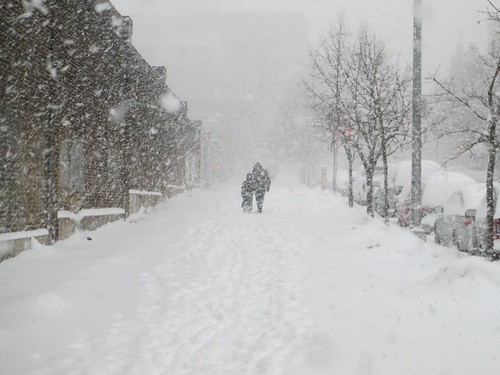
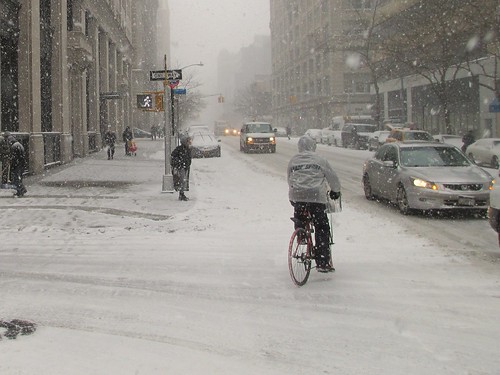
It’s not a term that many people would associate with a journey on the New York City subway. But, as I trudged up the steps on Thursday from the C Train station at Spring St, I felt a warm glow of admiration. I emerged onto Vandam St to find that day’s blizzard – which would eventually drop 14 inches (36cm) of snow on parts of the city – still in nearly full flow. The transit system had nevertheless transported me with what seemed to be insolent ease from an above-ground station in Carroll Gardens down into the tunnels to downtown Brooklyn then, on another train, across the east river to the west side of lower Manhattan.
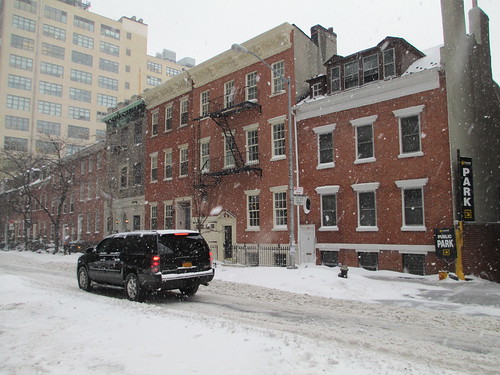
Vandam St in a snowstorm: a contrast to the order
beneath the streets
The journey’s smoothness was a tribute to the virtues of forward planning, teamwork and operational excellence that make for a smoothly-running transit system. At street level, by contrast, a rental truck whose driver had got it stuck on a pile of snow was blocking the street, holding up a snow plough.

Yet, just the day before, it occurred to me, I’d been raving about how magnificently satisfying my cycle ride to work had been. I’d braved well-below-freezing temperatures and persisting patches of ice and snow to ride to work on both Tuesday and Wednesday, enjoying the challenge of the unpredictable conditions and taking in magnificent views of the city spread out before me.

Wasn’t there a contradiction, I thought to myself, about my two positions? If I enjoyed using perhaps the most individualistic of mechanised transport methods – the bicycle – wasn’t it odd I also admired such an obviously shared form of transport as the subway? Moreover, it occurred to me, why wasn’t I alone in my shared enthusiasm? Why did so many of the cyclists and cycling advocates I knew have a decided preference for subways and buses over cars in conditions when they couldn’t get about by bike?
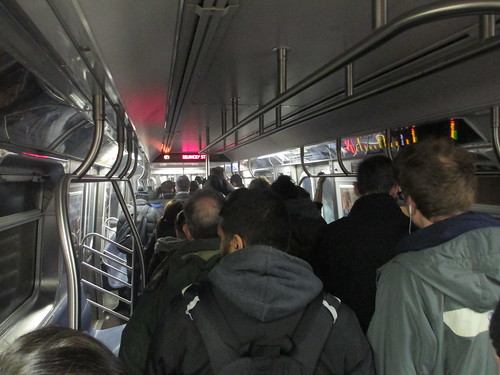
Trying to leave an F Train when the track ahead is on fire.
I can tell you what it felt like - just be grateful I can't
make you smell the acrid smoke.
I should start answering those questions by making it clear that not all – possibly not even most – of the subway journeys I’ve been forced to take for weather reasons in recent weeks have evoked the warm feelings that my trip on Thursday did. I’ve had plenty of long waits for trains and other disruptions, including the two-hour journey home I mentioned in a previous post. Worst of all was my experience on the morning of February 3. After unwisely guessing that the F Train to West 4th St would be my quickest route to SoHo, I found myself trapped underground for 40 minutes. The live rail in the station ahead was on fire and power to our train was cut while the fire department tackled it. I don’t especially recommend the experience of standing in a confined space with emergency lighting, no air-conditioning and a growing smell of acrid smoke in the air.
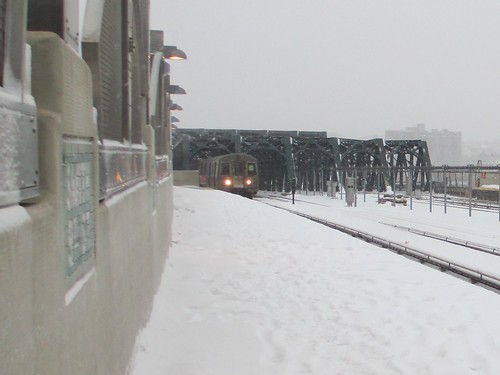
 
A G Train on a snowy day. My background tells me
it took teamwork and organisation to get this train running.
I should also confess that part of my feeling for subway systems stems from my background. My late father, who taught me to ride a bike, devoted his whole working life to subways – first in London, then in Glasgow. While my journey to work last Thursday might have seemed easy to me, I know that subways do anything but run themselves. My dad, I recall, diverted the taxi taking him and my mother to their 20th wedding anniversary dinner to the subway depot. A train had derailed at a critical point and he wasn’t going to relax until he was sure it was on its way to being put back.

I associate the New York subway also with my grandfather, who visited New York as a seafarer in the 1920s and told us wide-eyed children decades later about the marvels of express and local trains and the other complexities of the subway system.

As I spot some complicated bit of lineside equipment or work out some intricacy of the New York City subway system’s workings, I often feel a sharp pang at not being able to share it with my father, who died in 2002. “My train was diverted over the disused express tracks, dad!” “I got a good look at the snowblowing train!”

But there are also plenty of things about transit systems that cyclists can appreciate even if they haven't got my back story, I think. While many motorists seem to view their car as an extension of private space, I recognise clearly when I’m on my bike that I’m involved in a complex social interaction. The difficulty of communicating with other drivers is one of the things I least like about driving. It’s less of a stretch for me than for a driver or habitual taxi user to have to negotiate the scores of interpersonal transactions involved in using busy subway trains.
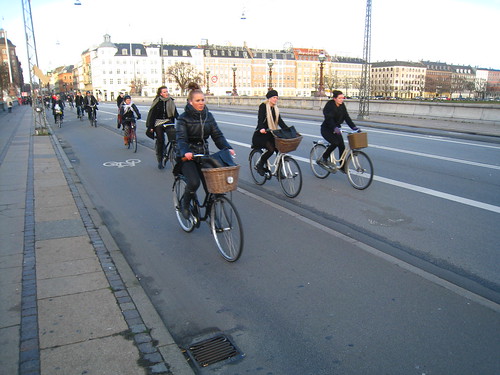
Copenhagen's cycle rush hour: they could have got
a nice train instead, lucky people.

It’s certainly no coincidence that cities that are good for cycling also tend to have good public transport. Copenhagen has a magnificent driverless metro system as well as good suburban S-Trains. Amsterdam has a formidable tram and suburban rail network. In the US, Portland, Oregon, has both some of the highest cycling and some of the highest transit ridership figures. Washington, DC, also enjoys a combination of relatively good cycling conditions and good public transit (even if the Washington metro’s train frequency and reliability could do with improvement). The careful planning and forward thinking required to build a good public transit network also tend to produce the kind of civic-minded thinking that prompts cities to curb car traffic, police streets well and put in good cycling facilties.
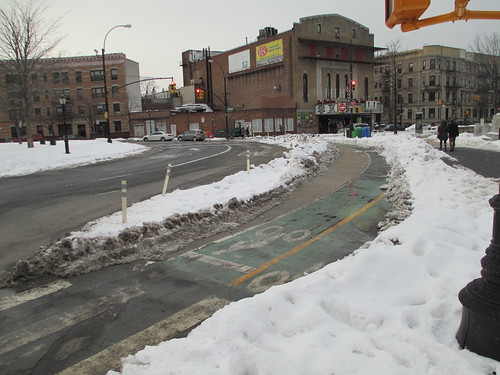
A partly-cleared bike lane: cyclists and transit users
have both been getting spotty service
New York and London, the two cities where I’ve most recently lived, fall in slightly odd places on the cycling-public transport continuum. Both suffered years of underinvestment. The 1930s-vintage lines that I use most heavily in New York are some of the city’s newest; London's underground steadily deteriorated between the 1960s and 1990s. Both cities veered off for decades in the direction of encouraging motor car use – under Robert Moses’ leadership in New York, inspired by his example in London. Moses fought to ensure badly-needed new transit lines were never included in his vast road-building projects.

There are days when, sorry, even I can't cycle
The spotty service I’ve experienced in recent weeks in New York is consequently an excellent summary of how the city is faring in both cycling and public transport. There are moments when the smoothness and progress from the worst times seems like a miracle. There are others when the main improvements from the city’s darkest days seem to be that the ageing trains are no longer covered with graffiti. The fire that kept me stuck underground isn't the only one I've encountered lately.

The subway's challenges regularly remind me that I prefer to cycle when I can. I also enjoy the exercise, the fresh air, the views from the Manhattan Bridge and cycling's relative reliability. Cyclists also avoid some of the hassles that come in winter as the homeless and disturbed crowd onto subway trains for warmth.

But, on days when the weather gives me no choice, the subway reminds me of the excitement I still feel at living in this mad experiment of a city, scattered on the islands and peninsulas around New York Harbour.

"This is a World Trade Center-bound E local train!" -
words that still sound oddly exciting to me.
Even the littlest detail of the journey can send that welling up in me. There’s the rattling of an express train through a local station, its lights flashing as they pass the support pillars. There are the names that evoke a thousand novels, songs and films. There’s the bizarre mixture of all kinds of cultures and classes one finds crammed onto many subway cars.

All are summed up sometimes in the announcements that squawk out over the public address as I step onto the train.

“This is a Manhattan-bound A train,” I hear with childish excitement. “Next stop: High St-Brooklyn Bridge. Stand. Clear. Of the closing-doors!”

Sunday, 2 February 2014

A frozen water bottle, a crisis of identity - and why winter cycling keeps winning me back

My neighbour looked at me aghast as I wheeled my bike in through the door of our apartment building, accompanied by a sharp blast of the well-below-freezing air outside. “You’re officially crazy,” he said. The guy who sits next to me at work took a similar view another day, “You didn’t bike in today, did you?” He was persuaded I had only when I shook my water bottle – with lumps of ice from the freezing journey - at him. Yet another day, a woman from another department of my company, who never talks to me, approached me to demand, “Bet you didn’t ride in today, did you?”

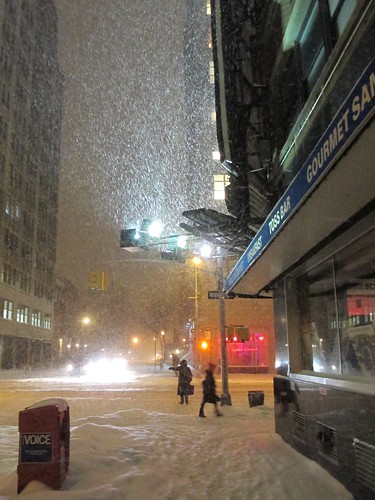
Snow swirls in SoHo: definitely a "defying
the laws of physics" day as far as I'm concerned
All of my interlocutors shared the view of probably the vast majority of New Yorkers about cycling in the depths of a harsh winter – that it’s not only impractical but a little bit wrong or insane even to try. The sentiment seems all the more dispiriting for being so often expressed with a kind of glee: “Ha! So that’s put a stop to your little cycling experiment, hasn’t it?” Riding to work is only a hobby, go the none-too-subtly expressed subtexts. It’s a lifestyle choice that I can and should reverse at the slightest provocation.

However, the ferocity of the current New York winter – which has seen me cycle to work in temperatures of -13C (9F), with windchill making it feel like -23C (-9F) - has forced me to re-examine my view that I can cycle to work pretty much every day during winter. For a solid week recently, slush lay stubbornly on the roads, unmelted as temperatures remained below freezing, making any attempt at cycle commuting feel foolhardy.

I’m consequently working on a new principle. I’m happy to fight the forces of nature, I’ve decided, but won’t defy the laws of physics. The challenge now is to work out which days fall into which categories.

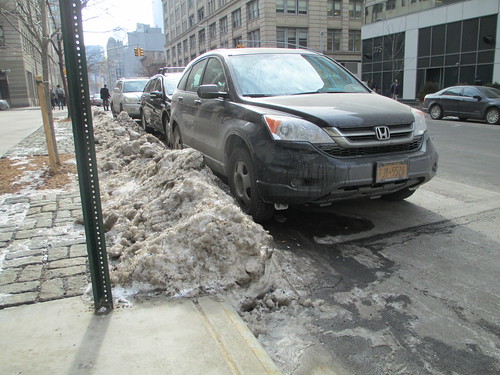
Piles of snow days after a snowfall. It's not
picturesque, but it's not dangerous either
It’s not all bad, after all, trying to ride a bike in winter in New York City. Last winter, my first as a New York resident, I was delighted to discover some advantages of the city’s winters over the less cold ones through which I’d cycled in London. Because the temperature would stay below freezing for days at a time, snow cleared from the roads generally stayed cleared rather than melting, refreezing and turning into icy slush. Because the air was less damp, on snowless days temperatures could plunge far below freezing without producing the thin coating of black ice customary on London streets in such weather.

Every night for a whole week last winter, I’d ride across the Brooklyn Bridge on the way home, glance at the big thermometer perched atop the Watchtower building by the bridge and see temperatures no higher than -8C (17F). I managed an 18-mile round trip in such temperatures by putting on more layers than normal, I told myself. What winter weather was likely to stop me?

It’s a question to which I’ve had a few clear answers this winter. One morning, for example, I decided that the previous snow was now so well cleared that it was safe to try riding to work. Part way across the Brooklyn Bridge, I discovered the peril of judging conditions by roads already warmed by hundreds of cars. The snow on the bridge, I discovered, had half-melted then frozen again as water on each of the hundreds of wooden boards making up the bridge’s walkway. Even walking the remaining mile or so across the ice sheet to Manhattan was a desperately slow, laborious process. Another morning, relieved to be cycling to work after a few days thwarted by snow and ice-covered roads, I emerged from my apartment to discover freezing rain was falling. The sidewalk below my feet was already slick with ice. Back to the apartment went the bike. Shoulders down and gingerly to the subway station went I. The morning my neighbour told me I was crazy, I was actually returning, crestfallen, from the briefest of attempts at cycle commuting. Finding that, three days after a big snowfall, residual snow on the road felt so slippery I was fearful of going any further, I was returning my bike to my apartment and heading, yet again, for the shelter of the F Train.

A delivery cyclist in the snow: oblivious to his effect
on my self-esteem.
At its worst, this run of weather has left me feeling something not far short of a crisis of identity. I feel like myself when I ride my bike to work and not when I don’t. “Ha, ha, ha!” say my nastiest inner demons. “You present yourself as a tough, bold fearless cyclist and you haven’t been on your bike in a week! You’re probably on the brink of ditching cycling forever and commuting all the time by subway!” The lack of my wonted exercise has certainly left me feeling fidgety and sluggish a lot of the time. I even had a day off sick last week – for the first time in at least two years. I am, I tell myself, just another unfit, middle-aged man resenting a commute in the kind of proximity to strangers that I’d normally consider with no-one but my wife. At lunchtime, I’ve looked mournfully at delivery cyclists, marvelling at their ability to handle their bikes on the snow and ice and cursed myself for not being prepared to do the same. I’m even cursing myself by comparison with my past self. Is this, I ask myself, the same man who rode home from work through a blizzard in London in January 2009? Or is it a mere pale imitation of him?

Two full months of harsh winter gone by, however, and I am, perhaps, finally coming to some kind of radical acceptance. My caution, I keep telling myself, is largely warranted. Men of six foot five on touring bikes have, after all, a high centre of gravity and limited purchase on the road. It’s probably a risk not worth taking.

My readiness to withstand the low temperatures is also, I tell myself, a bit beyond most other people’s. On that coldest morning, when it felt like -23 C, I not only found that my water bottle had frozen solid by the time I arrived but that my gears stopped working properly, as the grease I’d used to lubricate them started to freeze. Mornings such as that have counterbalanced the days I’ve felt a failure for slinking off to the subway. While they wouldn’t seem extraordinary to cyclists from cold-weather cycle-friendly countries such as Finland or Sweden, they give a temperate-climate cyclist such as me the illusion of having achieved something by riding to work. I was delighted in a recent Transportation Alternatives video to find some other cyclists feel the same.

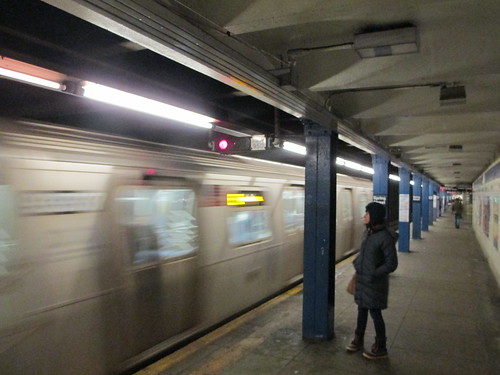
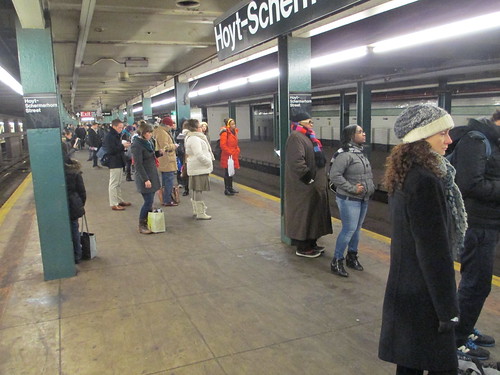
Hoyt-Schermerhorn station's A Train platform one recent,
snowy morning. This was on a morning when the subway
claimed to be offering "good service" on this line.
As for the feeling that I might be tempted to switch permanently to the subway, I’m always surprised by how quickly it evaporates. Certainly, the subway itself has done its part in that direction. On Friday, minor problems on the A Train produced vast crowds at the station where I needed to change trains. On the worst of the recent snow-affected nights, I found myself trapped for 40 minutes on a train stopped on a viaduct 50 yards from my house but unable to get off. The entire journey home – at most 45 minutes by bike – took two hours.

Yet being on my bike is a still bigger factor in changing my outlook. There remains a skill to riding in the cold even on the days when it’s not prohibitively dangerous. I’ll glide over this ice patch then swerve round the next one, I tell myself. I try to distinguish leftover snow from gritting salt. I devise strategies to get my gears moving again when they’re gumming up. Most of all, I enjoy how extreme cold brings out yet another face of the city. I see ice floes packed by the banks of the Hudson River and notice how professionally the city’s people wrap up for such weather.

Brooklyn in winter: sure, I took this picture from the subway
station. But days when I ride in winter I see far more
of this crisp, beautiful light.
It may, I suppose, seem a little crazy to far more people than just my neighbour and my gloating colleagues. There are mornings when I certainly feel less stressed to be letting the subway worry about the weather conditions for me. But there are other mornings. They’re mornings where I negotiate the ice patches at the start of the Manhattan Bridge bike path, ride out over the river and am confronted with New York in one of her most beautiful moods. Thin whisps of steam spiral up from chimneys into a clear blue sky and the low sun shines the crispest, clearest light imaginable on the city, casting buildings half into bright sunlight and half into deep shadow.
I ride over the crest of the bridge such mornings and down towards the star anise smell of Chinatown’s restaurants and tell myself: if this is crazy I barely really want to be sane.

Sunday, 19 January 2014

A new police commissioner, some dodgy statistics - and an open letter from me

William Bratton,
Commissioner,
New York Police Department,
1 Police Plaza,
New York,
NY 10038
January 19, 2014

Dear Commissioner Bratton,
Vision Zero and Statistics
            Congratulations on your appointment as NYPD commissioner. Like many New Yorkers, I feel optimistic based on most of your public statements that you’re determined to build on the progress made on public safety in your previous term at the department. I am particularly optimistic that you are determined, at last, to set about reducing the appalling toll of death and injury that motor vehicles exact from New Yorkers every year.
          I wanted to pick you up, however, on a puzzling statement on January 15 at the launch press conference for the mayor’s Vision Zero initiative. You said pedestrians contributed to causing 73 per cent of pedestrian-motor vehicle collisions last year and that pedestrian actions were directly responsible for 66 per cent of those collisions. It’s a figure that on my reading of the figures is demonstrably incorrect. I fear that, if the NYPD genuinely thinks this figure reflects reality, it could seriously distort the department’s efforts to reduce the grim toll of unnecessary suffering on our city’s streets.
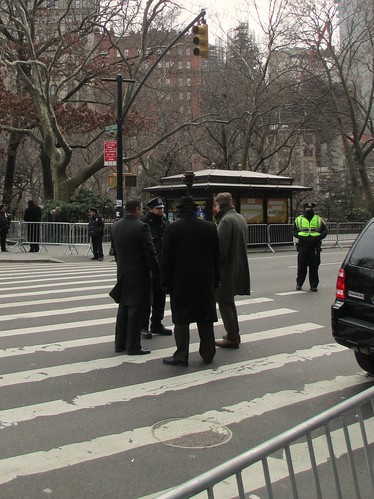
Waiting for a new boss: NYPD officers
outside the new mayor's inauguration
I would be interested to know the basis for your assertion – and grateful if you could put the figure right if, as I am sure it is, it is mistaken.
            Your figure is implausible to start with. It implies that motorists - who stand almost no chance of injury in a collision with a pedestrian, often drive at high speed and are easily distracted – are more solicitous of pedestrians’ safety than the pedestrians themselves. That seems at variance with my experience of human nature as well as with my observation that pedestrians are generally watchful when crossing city streets and motorists often cavalier when driving on them.
            The statistic is also starkly at odds with all the research I’ve read either in New York or elsewhere on the causes of crashes between motor vehicles and vulnerable road users – pedestrians and bicyclists. For example, a study published in 2013 by NYU Langone Medical Center found that 44 per cent of pedestrians treated for injuries after collisions had been hit in a crosswalk while crossing with the light. Another 6 per cent were hit on the sidewalk. Given that some of the other victims will also have been the victims of driver negligence – hit in unsignalised crosswalks, for example – it is clear the majority of studied crashes were mainly drivers’ fault.
Typically dangerous pedestrian behaviour:
midtown Manhattan
            A more comprehensive study, published in 2010 by the city’s own Department of Transportation, attributed blame for 36 per cent of crashes that killed or seriously injured pedestrians to driver inattention. It attributed another 27 per cent to motorists’ failure to yield and said vehicle speed was a major contributor to 21 per cent of crashes. The DoT study reinforces the impression that, while pedestrians undoubtedly cause some crashes, they are probably mainly to blame for only a quarter or so of incidents.
            Around the world, a number of research studies have reached strikingly similar conclusions. Many have attributed blame for crashes involving pedestrians and cyclists to motorists in around 75 per cent of cases. For example, in London, where I lived and cycled for nine years until August 2012, a Transport for London study of every reported motorist-cyclist collision in 2010 attributed blame for around 74 per cent of the crashes to motorists. Motorists’ inattentiveness, excessive speed and impatience are the main killers in every industrialised country of which I’m aware. It's unlikely New York City is a freakish exception.
It might look to you like the outcome of negligent speed:
but there's an NYPD statistician who probably thinks
some pedestrian caused this.
            Your assertion also seems at odds with the evidence of the fatal crashes involving pedestrians so far this year. I’ve been able to glean enough information about four of the fatal pedestrian crashes up until Friday 17 to guess how blame might be allocated. In only one – the death of Xiaoci Hu, killed on January 2 when a car ran into the back of another car that had slowed down to let him cross mid-block – does the pedestrian appear to have carried even a portion of the blame. The driver who struck Mosa Khatun on January 5 in Jamaica was charged with failure to yield; the driver who hit Nydja Herring on January 11 in Parkchester has reportedly been charged with aggravated driving while intoxicated; numerous witnesses attest that the driver who killed Cooper Stock on January 11 hit him and his father in a crosswalk as they crossed with the light.
            Streetsblog, the campaigning website, calculates your department coded only between 7 and 8 per cent of crashes involving pedestrians or cyclists in the first 11 months last year as having resulted from pedestrian or cyclist confusion or error.
            My concern is that a mistaken understanding of the present crisis’ causes could lead the NYPD to pursue mistaken or counterproductive measures to halt it. If pedestrian behaviour were indeed the cause of most pedestrian/car crashes, it would be worthwhile and effective to work harder at changing pedestrian behaviour. I note there are already reports of a police crackdown on “jaywalking” around the area on 96th street in Manhattan where there has been a cluster of casualties this year. I can imagine it will be tempting for local police precincts to seek in any crackdown to tackle pedestrians and cyclists since they are, by their nature, easier to catch and prosecute than drivers of fast-moving cars.
            If, however, cars cause the majority of crashes involving pedestrians and cyclists, it will make far more sense to work at controlling drivers’ speed and ensuring they yield when required to do so. I am worried that, with the crackdown on the Upper West Side, you are beginning to pursue a pedestrian-focused strategy – one that targets the victims and not the perpetrators.
The new mayor during his campaign: before he had a police
commissioner to explain how pedestrians were
killing themselves
            My personal conviction is that a concerted effort to tackle the traffic crisis’ real causes could yield dramatic results quickly. During my nine years in London, I covered transport issues in the UK and elsewhere for the Financial Times, winning several awards. London, which has a similar population to New York’s and similar traffic volumes, suffers only half the annual traffic fatalities that New York does. Motorists’ adherence to speed limits and other road rules is noticeably more lax in New York City than in London. I see no reason why the introduction to New York of systematic speed enforcement and a general culture of respect for road rules should not quickly bring New York’s fatality levels closer to London’s.
            I look forward to hearing from you about your figure’s origin and how it is affecting your policies. I would of course be delighted to speak with you or your officials about my concerns.
The NYPD and other city agencies have it within their grasp to save hundreds of New Yorkers’ lives every year. It would be a tragedy if apparently mistaken data led you to pass that opportunity up,
Yours Sincerely,

 Invisible

Monday, 13 January 2014

A terrifying avenue, a new mayor - and how leaders should be handling traffic problems

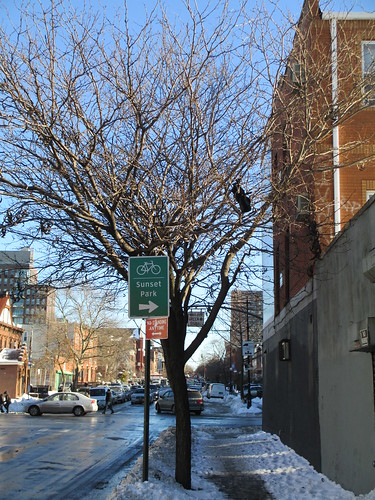
It was one Saturday in November that I happened upon one of South Brooklyn’s most thoroughly dysfunctional streets. Seeking to take the Invisible Visible Boy for a trip to Brooklyn’s shorefront greenway, I naively followed the cycle route signs pointing me down Brooklyn’s 3rd Avenue towards the waterfront bike path. But, after a little while, as I rode southward with the boy behind me on his trailer bike, we found ourselves grappling with high-speed traffic heading onto and coming off the highways around us.
The sign that tricked me into cycling down
3rd Avenue. To be fair, it doesn't read
Sunset Park (via traffic dystopia).

Then, as we rode into Sunset Park – a stretch of Brooklyn along New York’s harbour front, looking across to Staten Island - 3rd avenue plunged into the shadow of the Gowanus Expressway. The din of overhead traffic always in our ears, we found ourselves constantly buzzed by high speed vehicles or cut off by cars turning into or out of auto repair shops. The street seemed like as complete an example as one could imagine of a street designed for motor vehicles with no thought for human beings.

Look at this picture, readers. Then remember, with astonishment,
that the man who forced this road down this route died feeling
New York City was insufficiently grateful to him.
So it was a shock when I discovered that, until 1941, 3rd avenue in Sunset Park was the heart of a thriving community. The street was famous for its restaurants and the food shops that supplied the area’s people – who were mainly immigrants from Norway, Sweden and Finland. According to The Power Broker, Robert Caro’s classic biography of Robert Moses, builder of much of modern New York, it was only in 1941 with the opening of the Gowanus Parkway - since substantially widened and turned into an expressway - that it started the decline into traffic-dominated squalor.

Moses insisted, despite pleas from the residents, on building his parkway above 3rd Avenue when it would have done far less damage above 2nd avenue, nearer the already industrialised waterfront. Moses dismissed the poor but proud community in Sunset Park as a slum and consequently not worth saving.

I’ve been pondering the Moses story particularly intensely recently as I've noticed how often powerful individuals shape places’ urban fabric – and particularly people’s ability to get around those places easily and safely. That’s in part because of the end of the term in power of Michael Bloomberg, mayor of New York for 12 years until December 31, and the start of the term of Bill de Blasio. Bloomberg’s transportation commissioner, Janette Sadik-Khan, pushed strongly for the introduction of new, better bike lanes and pedestrian plazas, chipping away at some of the damage Robert Moses did by making the city so dependent on cars. Bloomberg’s successor has promised to continue making decisive changes on the city’s streets. It was part of his election platform – and critical to winning his endorsement by StreetsPac, the safer streets action group – that he promised to work towards eliminating pedestrian deaths altogether.
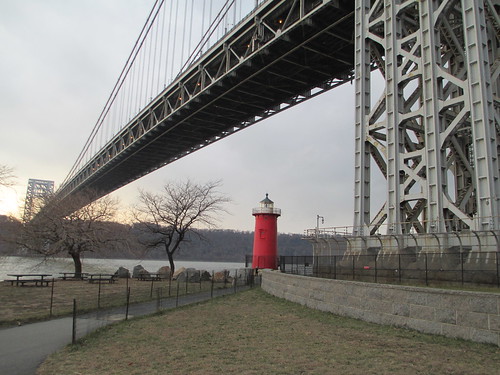
The George Washington Bridge over the Hudson:
the world's biggest political plaything?

In London, it’s becoming steadily clearer that the efforts of the mayor, Boris Johnson, to provide both better cycling and walking conditions and faster journeys for motor vehicles are collapsing under the weight of their internal contradictions. In Toronto, it’s one of the emblems of Toronto’s general civic tragedy that its clownish, crack-smoking mayor has ripped out some important cycle lanes. Over the past week, I’ve been watching how political operatives in New Jersey used traffic congestion to punish the mayor of Fort Lee, a small town by the George Washington Bridge, apparently for supporting the wrong candidate in the state’s gubernatorial election.

Taken together, the various cases illuminate some core principles. It’s important that leaders have a clear vision for how they want their cities’ transport systems to work and that they’re prepared to tackle forthrightly the kind of obstructionism that almost any significant change to the urban fabric creates. But it’s also vital that those plans are based in a real, solid understanding of what’s going on at street level, that they’re flexible when there are serious concerns and that the plans are carried out within the rules of the political game. Leaders need to exercise the self-discipline to put long-term policy goals ahead of the need to have concrete successes to show before the next election.

Traffic stuck bumper-to-bumper on the Gowanus Expressway
on a quiet January Sunday: true testament to the success
of Robert Moses' road-building
Moses – who wielded power over aspects of transport and planning in New York State and City in various forms from 1924 to 1968 – provides the most spectacular examples of what can go wrong. In Sunset Park, he pushed the elevated highway down 3rd avenue because, he claimed, the existence there of structures supporting a recently-demolished elevated rail line would make construction along the avenue cheaper. But that probably wasn’t as decisive as his simple conviction that the people of Sunset Park were dispensable. It’s a principle he followed all over New York City and State when he encountered people or environments for which he didn’t care. The more one knows about Moses, the more one spots around the city problems – whether clogged, disruptive freeways, crumbling subway lines or ugly, unsuitable public housing projects – that could have been avoided if Robert Moses had been made to obey the same rules about planning and due process that others followed.
 
Cyclists pedal on a dedicated lane over Copenhagen's
Dronning Louise Bridge. Key difference between these
lanes and London's Cycle "Superhighways": those in
Copenhagen are good, effective public policy.
On a far smaller scale, Boris Johnson’s initiative in London to build “Cycle Superhighways” along main roads exhibits a Moses-like deafness to criticism. No cyclist shown plans for the “superhighways” – which are mostly simply painted blue strips along frighteningly busy roads – could have avoided concluding that riders using them would be terrifyingly vulnerable to the neighbouring traffic. The desire to have achievements to show in the mayor’s first term and a wish to devise a cycling policy distinctively different from that of Ken Livingstone, Boris Johnson’s predecessor, seem to have trumped any urge for mature reflection, however. Livingstone had developed the London Cycle Network of quiet routes along back streets.

The Cycle Superhighways look embarrassingly inadequate when compared with the bike lane that Janette Sadik-Khan championed around a mile away from the worst of 3rd Avenue, along Prospect Park West in Park Slope. The two-way protected lane illustrates, partly, the value of clear thinking and good planning. The lane wasn’t built by pretending, as Boris Johnson has with the Cycle Superhighways, that bike facilities can be built with no effect on motor cars. It took away a lane of car traffic. Sadik-Khan, who had a strong record of listening to the community boards that provide New York neighbourhoods with a voice on planning issues, defended the decision to build the lane in the face of legal action that has now rumbled on for years but served only to highlight how well worked-out and widely supported the original policy was. Her stance puts Boris Johnson’s insistence on following incompatible goals in his roads policy to shame.
 
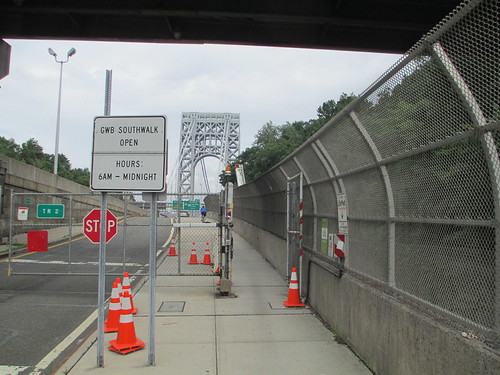
The George Washington Bridge's Fort Lee entrance
(albeit the bike, not car lanes). Taken last summer,
before politicians realised the scene's full potential.
Boris Johnson, however, has at least largely avoided the ultimate transport policy error – of taking steps for purely short-term political reasons. Those seem to have been the motives for the closure for four days starting last September 9 of two of the three access lanes from the town of Fort Lee, New Jersey, onto the busy George Washington Bridge to New York City. An official in the office of Chris Christie, New Jersey’s Republican governor, seems to have ordered the closures to choke Fort Lee with traffic after the town’s Democratic mayor endorsed the Democratic gubernatorial candidate, Barbara Buono. The incident – which held up school buses and emergency vehicles, as well as thousands trying to get to work – was one of the most serious moral failings of transport policy practice I’ve ever come across. New Jersey appointees on the board of the Port Authority of New York and New Jersey, the bridge’s operators, seem entirely to have lost sight of the reason for the bridge’s existence and seen it purely as a political tool.

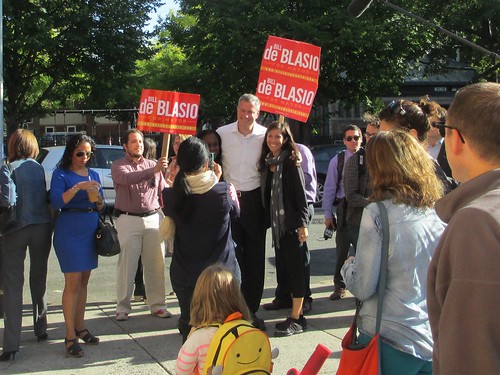
Bill de Blasio fortunately seems unlikely ever to lapse into such downright political cynicism. It was in a supportive spirit that I and some other people concerned about road safety turned up outside his inauguration ceremony on January 1 to remind him of his commitment to cut road deaths. There’s a clear sense of optimism abroad that Mr de Blasio and Bill Bratton, his new police commissioner, might have the courage to start tackling New York City’s appalling road safety record – at the time of writing, the city has already suffered nine traffic fatalities this year. Polly Trottenberg, Sadik-Khan’s successor, even came out ahead of the inauguration to talk to the Vision Zero activists and to hear the heart-rending stories of some of the bereaved parents who were there.
 
Inwood Hill Park: Robert Moses couldn't really understand
why anyone would think the road hadn't improved
this last patch of primeval forest in Manhattan
But, however optimistic the mood on January 1, I couldn’t help wishing I’d been able to take Mr de Blasio with me on the trip I’d taken the previous day, for a family trip to the New York Botanic Garden. To get to the garden, more than 20 miles from my Brooklyn home, I rode up by Robert Moses’ Hudson River Parkway, taking in how it had cut nearly all western Manhattan off from the city’s stunningly beautiful Hudson River waterfront.

I rode under the George Washington Bridge, glancing up to take in the traffic conditions. Then, towards Manhattan’s northernmost 
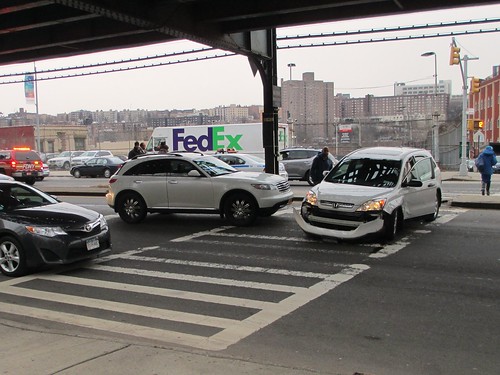
Two of the three cars that crashed in northern Manhattan
on Mike Bloomberg's last day as mayor: just another
part of the legacy handed Mayor de Blasio
tip, I encountered one of Moses’ most infamous pieces of civic vandalism – Inwood Hill Park, a stretch of primeval forest that he wrecked by needlessly driving a road right through its middle.

A scene we would have encountered on the way back would have been just as instructive. On Broadway, by the bridge leading from the Bronx – which Moses’ road was meant to free from traffic – I found a long traffic jam. At its head were three cars, crashed into each other.

This, I might have told the soon-to-be-mayor, is the legacy you’ve been handed. It’s a city still reeling from a mad effort to make it almost entirely dependent on the private car - and plagued by regular, serious car crashes as a result.

“Please remember the lessons of all the bad and weak leaders who made it like this,” I’d have begged him. “Please try to make it at least a little better.”

Monday, 23 December 2013

A Brooklyn Heights commuter, an untimely Queens death - and how attitudes to roads might be the least of our problems

I’ve come across few sights on New York City streets that excited such mixed feelings in me as the one I encountered one morning last month on Clinton Street in Brooklyn Heights. Just in front of me in the cycle lane on the street, which fills up with cars and taxis every morning, was the only child – he was probably ten or 11 – I’ve ever encountered riding on his own to school in New York City on the road.

I was, on one level, hugely excited. It would be an enormous improvement for every city in the industrialised world if the queues outside schools in the morning were of children waiting to park their bikes, not sports utility vehicles waiting to double-park. The boy had clearly been thoroughly trained and looked attentively from side to side at every junction.
 
Clinton St at Atlantic Avenue: I was excited to see a child
cycling here - but also apprehensive
But I also, I’ll confess, felt fearful. Motorists are apt to turn left or right suddenly on Clinton St or lurch into the cycle lane to avoid a suddenly-stopped taxi.  Drivers are prone to driving through the slow-moving traffic texting or sending emails. Car doors are apt to spring open or pedestrians to step into the street without looking. Knowing my own concerns about using the street, I willed the young man to make it to school safely. He eventually did.

That young boy’s been back in my mind since I heard on Friday about another boy going to school elsewhere in New York who didn’t make it safely.

On Friday morning, Mauricio Osorio-Palaminos, a truck driver, drove his truck out of 61st street in Queens left onto Northern Boulevard, cut well onto the side of the street for oncoming traffic and caught Noshat Nahian, eight, with the trailer’s rear wheels. Noshat, who was hurrying to school with his 11-year-old sister, died shortly afterwards in hospital.

The street Osorio-Palaminos was leaving was not, as far as I can tell, a designated truck route. Pictures showed his truck far over to the wrong side of the road. The driver was also the second in recent weeks to kill a pedestrian in New York City while driving commercially with a suspended licence.
 
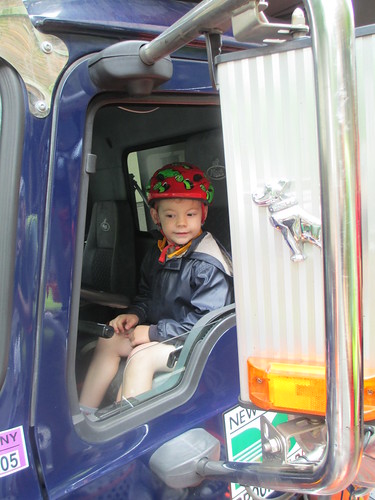
The Invisible Visible Boy on a truck
meant to show cyclists how hard they are
to see. Let's hope New York's DoT trains
its drivers in spotting cyclists too.
Yet commenters on online news reports about the death homed in instead on police reports that Noshat had his hood up and was looking down when hit. There was abuse for his parents. One commenter said Noshat must have been looking for “suicide by truck”.

Noshat’s death is at least the 11th of a pedestrian under 13 so far this year in New York. Many people’s instinctive reaction has been to blame the victims.

In November, I attended a rally in Fort Greene, Brooklyn, calling for enforcement of traffic laws after a speeding driver killed Lucian Merryweather, nine, on a sidewalk. The rally heard a brave and heartbreaking speech from the mother of Samuel Cohen Eckstein, 12, who died in October when a car hit him on a crosswalk on Prospect Park West in Brooklyn. She was speaking a few days after what should have been Samuel’s bar mitvah.

Many internet commenters on Samuel’s death focused on how he was hit after going after a ball that had bounced into the street. They ignored how he had the light when he entered the crosswalk. Several cars stopped for him before a speeding van hit him.
 
A memorial where Lucian Merryweather died. I'd love
to take half the internet commenters on road safety
to this unspeakably sad spot.
The father of Allison Liao, three, who was killed in October crossing the street in Flushing, Queens, looked on, weeping, as Samuel’s mother spoke. Initial reports on Allison’s death focused on how she had allegedly broken away while crossing the road from her grandmother, who was holding her hand. Yet Allison’s family insist she was holding her grandmother’s hand – and the driver who hit her barged through the crosswalk when he should have yielded.

The circumstances of Noshat’s death are very similar to those surrounding the death in East Harlem in February of Amar Diarassouba, a seven-year-old. He also died under a truck’s rear wheels as he headed to school. Erik Mayor, a restaurateur whose business is near the crash site, despicably tried to blame that crash on Amar’s older brother, saying he “wasn’t paying attention.” The driver involved had, as in other cases, driven through a crosswalk when he should have yielded.

They’re stories that won’t surprise many adults who walk or cycle around New York City – or any other big city in the United States. When I cross streets on foot, vehicles constantly barge through crosswalks when I have the light in my favour. I have found myself caught unawares by the line a truck’s rear wheels have taken through a crosswalk and been forced to jump backwards out of the way.

On my bike, on the 1st Avenue bike lane in Manhattan, I need constantly to look over my shoulder at westbound cross-streets, knowing that cars will try to turn across my path. I have to signal forcefully to drivers to stop if they’re behaving dangerously. I need the sixth sense of the experienced urban cyclist to spot the vehicles that are about to pull out without looking from a parking space.

There’s an invidious assumption that, if children can’t at least match my skills at navigating streets, they shouldn’t be on the streets at all. The attitude is sometimes reminiscent of the sexual harassment that faces single women in some places in southern Europe. Anyone silly enough to enter the environment, it seems to be assumed, is fair game for any untoward consequences. A responsible parent, it’s  assumed, transports his or her children by car, prioritising their safety over that of others.
A cyclist on 55th Street in Manhattan. Remember: if
anything bad happens to a kid in this traffic,
it's probably the kid's fault.

Looked at dispassionately, however, the adults are behaving like stereotypical children. Many of my closest calls are with drivers who simply lose patience with waiting and pull out without looking from a traffic line. Most parents try to teach their children the kind of patience that drivers who drive while using their mobile telephones haven’t learned. Children are encouraged to face up to their responsibilities – yet many commercial trucking companies seem to employ unlicensed drivers. The police seem to shirk their duty to hold the worst drivers accountable.

I’ve come across plenty of children taking road rules far more seriously than many adults. The boy pedalling down Clinton St was paying far more attention to road conditions than most of the motorists. Esme Bauer, a young woman from Fort Greene, was one of the most powerful speakers at the rally I attended in November.

Many of the adults seem to be products of recent decades when parents feared to teach their children to navigate the streets. Having grown up with parents scared to let them out on the streets, they now sit, sucking their teeth, in their cars. Why, they wonder, are these children wandering about on the streets? What are their parents thinking?
 
New York needs more children commuting like this -
but will it take the steps to get them?
It’s a cycle that it’s obvious needs to be broken. Enforcement, road layout and general attitudes all need to improve to rebalance streets policy in favour of the pedalling boy commuter of Clinton St and away from the bad drivers around him.

It’s a question that goes far beyond transport policy, however. The disdain with which I saw some internet commenters react to Noshat’s death toppled over, it seemed to me, into expressing a generalised contempt for the weak and powerless. It’s an ugly attitude at the best of times. In this case, it was being expressed the week before Christmas about a young Bangladeshi immigrant crushed by a truck as he headed to take part in his public school’s holiday play.

In a city where someone can accuse such a young man of wanting “suicide by truck,” I’m tempted to conclude that New York’s transport problems are, perhaps, only a symptom – albeit a serious one – of a wider social malaise.

Sunday, 8 December 2013

A Jersey City leaflet, an East New York death - and why police are bothering the wrong people

It was near a Path subway station in Jersey City that I encountered a ripple from a wave of sloppy thinking currently sweeping the English-speaking world. On a corner on Grove St, one of the city’s main thoroughfares, a woman wearing a high-visibility vest approached me and thrust a leaflet into my hand.

The pamphlet contained a series of safety rules for pedestrians – among them “Cross at corners and intersections” and “Before crossing look left, right,then left again”– and threats of fines for pedestrians who broke the rules. There were also instructions to drivers. But, even as motorists barged past people crossing right by her, the woman kept thrusting the leaflets solely on people walking.
 
Hey, pedestrians: you can't say
New Jersey hasn't warned you
New Jersey’s safety drive is one of many currently under way on both sides of the Atlantic aimed at improving vulnerable road users’ safety by getting them to take more care. In London, a big part of the response to a spate of cyclist deaths has been to station police officers at key intersections to harass cyclists not wearing high-visibility clothing or helmets. In Park Slope, near where I live in Brooklyn, the New York Police Department’s 78th precinct reacted to a series of recent pedestrian fatalities by posting a list of pedestrian safety tips. They included advice that pedestrians should carry flashlights (torches, British readers) at night. People shouldn’t walk in snow or rain, it added.

The implicit assumption is clear. Vulnerable road users are vulnerable not primarily because they lack protection from the behaviour of motor vehicles but through their own irrational actions. Pedestrians wander heedless, according to this analysis, into the path of cars, whose drivers can scarcely be expected to miss them. Cars hit cyclists primarily because cyclists ignore red lights. It’s a view one can find repeated online in the comments under pretty much any news article about road safety – especially if it concerns bikes.
 
Hey, be fair. The card mentions motorists.
It's just that they don't give it to them.
Yet the worry should be precisely that crashes occur despite the best efforts of vulnerable road users to behave rationally – and because motorists correctly feel themselves largely invulnerable. A study  by researchers at Melbourne University, in Australia, found that 88.9 per cent of cyclists in a study were behaving safely and legally before collisions, near-collisions or “incidents” recorded on their helmet cameras. The figures tally with those in a Transport for London study of all the recorded injuries and deaths of cyclists from collisions with cars during 2010. The London study suggests around 74 per cent were the motorist’s fault, while the Australian researchers blamed the motorists for 87 per cent of the incidents. Studies from around the world regularly seem to find motorists to blame in around 75 per cent of bike/car crashes.

For pedestrians, a study in New York found that 44 per cent of those injured by cars were hit when in a marked crosswalk while crossing with the light, while another 6 per cent were hit on the sidewalk. Given that many of the other crashes will also be a result of motorist negligence, a clear majority of crashes involving pedestrians also appear to be the fault of the motorist concerned.

Pedestrians and cyclists appear, in other words, to behave like people who have a lot at stake on the roads and to take their own safety seriously. The crash on November 25 in East New York that killed Maude Savage seems, according to these studies, to be fairly typical. A surveillance video shows Ms Savage, a 72-year-old pedestrian, waiting and looking carefully before crossing, with the lights in her favour. A van then speeds around the corner and through the crosswalk, hitting her at speed. Robert Brown, the van driver, seems, to judge by the video, to have been driving like someone who recognised that, for him, the consequences of hitting a pedestrian wouldn’t be that serious. As things stand, it probably makes more sense for a busy technician like him – he was working for a cable TV company - to prioritise speed over avoiding a crash.
Cars on a crosswalk in midtown Manhattan.
The cars realise it's vital not to impede uptown progress
on 6th Avenue. So they block the crosswalk.

As with many road safety issues, however, many politicians and police officers seem to base their reaction to vulnerable road users’ deaths mainly on gut instinct and intuition. It’s often easy to sense frustration – “Why won’t these cyclists just get in a car or ride on the subway like everyone else?” Lord James of Blackheath, a Conservative peer, took such thinking to its logical – and absurd – extreme on November 22 when he claimed in a House of Lords debate that cyclists longed to be knocked down – to get motorists into trouble.

Even among people trying to make ostensibly saner points than Lord James, there’s considerable misunderstanding about where the risks lie. Politicians and police officers regularly whine about how cyclists allegedly cause crashes by ignoring red lights – but the Transport for London study found cyclists’ failure to obey a light was a contributory factor in only 61 crashes – against 2,650 involving motorists’ failure to look properly. It wasn’t significantly more common for cyclists to cause crashes by running lights than motorists – a motorist’s failure to obey a light was a contributory factor in 36 crashes. There’s a powerful tendency for policymakers to connect behaviour they observe – “some cyclists run red lights!” – to the death toll, without any further examination.
 
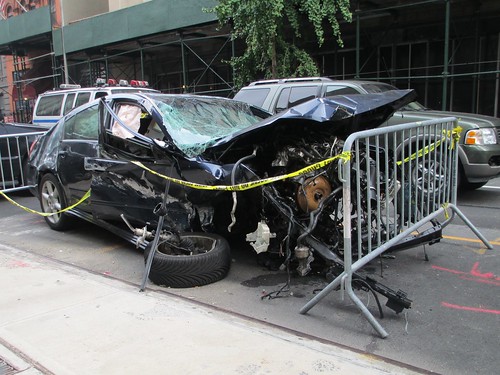
This car crashed at 100mph on West St in Manhattan.
How the NYPD thinks pedestrians can protect themselves
against such risks isn't clear.
There are certainly things that cyclists and pedestrians can do to protect themselves. In the Transport for London safety study, the top cause of crashes caused by cyclists was “failed to look properly,” just as it was for cars. “Failed to judge other person’s path or speed” was the second most common cause of crashes for both cyclists and drivers, while “careless/reckless/in a hurry” was number three for both. The Melbourne study of cycle crashes found that cyclists who looked over their shoulders a lot were least likely to be involved in crashes. There is clearly a great deal to be gained for any vulnerable road user through keeping keenly alert and watching out for the negligent behaviour of others.

Most people certainly make some trade-off in their road behaviour between convenience and safety. It’s surely worthwhile for the people with most to lose through a crash to let safety rule their judgement all the time – if only because it’s clear that people protected by metal shells feel free to prioritise their own convenience over other people’s lives. Last Sunday, riding down Garfield Place in Park Slope, I heard a woman in a car behind honking at me so violently that I, unusually, pulled over into the parked cars’ door zone so that she could squeeze past. “You should be over to one side!” she screamed at me as she zipped past too close, her face contorted with rage. The mismatch of concerns was precisely the one the TfL and Melbourne studies would suggest it might be. She was anxious I might hold her up by a few seconds. I was concerned her car might crush me to death.

Yet the fact remains that New Jersey’s police forces, the New York Police Department and Metropolitan Police are all placing a lot of the emphasis in their road policing efforts on berating the victims rather than the perpetrators of crashes. The tactic is reminiscent of the times – sadly, not too long ago in some places – where the answer to preventing sexual assault was meant to be to stop women walking alone at night or wearing “provocative” clothing. It’s a tactic that, by the nature of what causes the crashes, can never work. It’s patronising and demeaning.
 
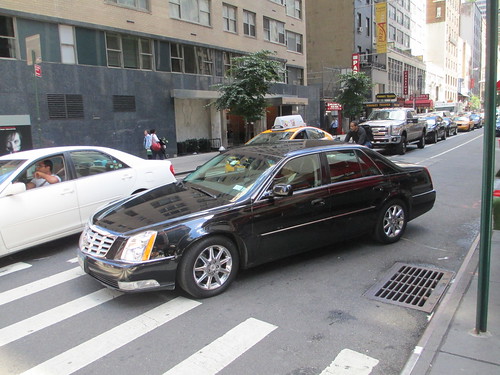
The true effectiveness of years of "Share the Road" efforts
is clear from this picture of a midtown Manhattan Street.
Note the Cadillac blocking the route of the cyclist
using the bike lane.
The correct solution is hiding in the plain sight of that TfL report and Melbourne University study. There simply aren’t enough incentives for motorists to care as much about vulnerable people’s safety as they care about, say, making that important ‘phone call. The driver who ran into Maude Savage appears, according to Streetsblog, the campaigning site, to face no more than a $500 fine or 30 days’ jail, for example.  He faces that only because he turned out not to have a driving licence. It will be only when drivers face a good chance of heavy fines, losing their licences or imprisonment for negligent driving that the convenience/safety trade-off will start favouring safety more often.

Yet the chances of a big change in attitude soon seem remote. Appeals for everyone to “share the road” have the advantage of seeming even-handed and fair. Pleas for vulnerable road users to look after themselves better have the advantage of addressing those with most interest in improving road safety, even if they miss those best placed to improve the position. The alternative is to start acting on the reality of the picture that the research paints. That is that private motor vehicles – the dominant form of transport in most developed countries – pose big risks to those around them, and most drivers drive as if they didn’t. That seems like the kind of truth that politicians will put off addressing for as long as they possibly can.

Saturday, 23 November 2013

A futurist, an urban bike ride - and why we're slaves to yesterday's vision of tomorrow

I’ve long enjoyed pondering how living today measures up to yesterday’s vision of tomorrow – and how it falls short. I can now receive wirelessly once-unimaginable volumes of information – but poor software makes the device responsible crash. I can find out almost whatever I want at the press of a button – and I get it surrounded by links to stories about how celebrities look without makeup. I can theoretically work as easily in a 150mph train as in my office – but humans overload every system they build, so I can’t. It was always smoother and cleaner in science fiction.

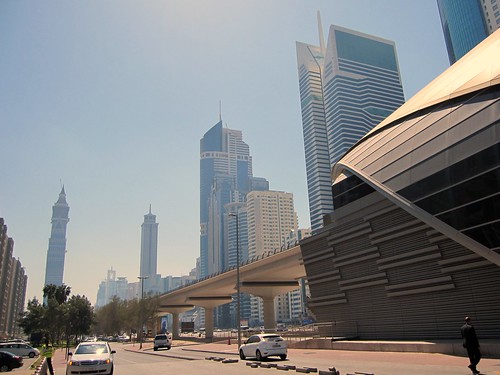
Sheikh Zayed Road: Bel Geddes' vision realised
in a dusty desert dystopia
Yet, even as a connoisseur of the former future’s shortcomings, I was taken aback when I visited an exhibition on the work of Norman Bel Geddes, an early to mid-20th century futurist. I went to the exhibition – at the fabulous Museum of the City of New York – largely to let the six-year-old Invisible Visible Boy gawp at Bel Geddes’ plans for streamlined bubble cars, vast flying boats carrying 500 passengers and a plan for a floating air terminal off the tip of southern Manhattan. But suddenly, as I looked at one of Bel Geddes’ plans for a future city, I saw a plan eerily similar to a place I know – Dubai’s Sheikh Zayed Road – staring back at me. The more I looked, the more I noticed how Bel Geddes’ strange, extreme visions for the future had shaped not only relatively exotic places like Dubai but the environment I could see outside the museum’s Upper East Side windows and that I’d known in other parts of the world.

The exhibition brought home to me a new version of a famous quote from John Maynard Keynes. Practical men who believed themselves to be quite exempt from any intellectual influence were “usually the slaves of some defunct economist,” Keynes said. Town planners, it occurred to me, were normally grappling similarly with some dead thinker’s vision of the future. The continuing legacy of people like Bel Geddes – and people he influenced, like Robert Moses, builder of much of contemporary New York and influencer of planners worldwide – explains why roads in so many cities cater so poorly to the full spectrum of users. I left struck with the obligation for the present to bequeath the future something better.
 
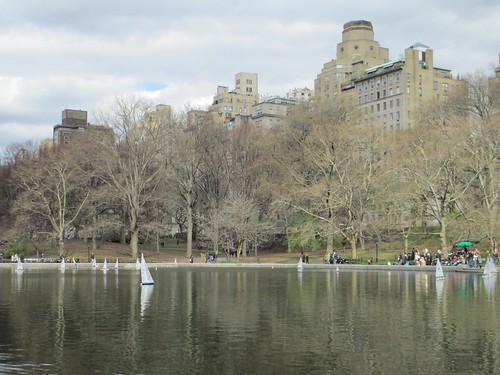
Central Park, near where I rode: cycling here didn't fit
with Norman Bel Geddes' vision
My revenge on Bel Geddes had started even before I got to the museum, though. Bel Geddes’ vision of the US in 1960 – unveiled at the 1939 World’s Fair in Queens and sponsored, tellingly, by General Motors – envisaged a country criss-crossed by highways with pretty much all transport provided by some form of motor vehicle. Bel Geddes specifically called for creation of urban motorways. “There should be no more reason for a motorist who is passing through a city to slow down than there is for an airplane which is passing over it,” Bel Geddes wrote. I scoffed at his ideas by enjoying a 12-mile cycle ride to the museum - over the Brooklyn Bridge, up the Hudson River Greenway and through Central Park.

But it was also clear once I’d visited the exhibition that I’d ridden through some concrete-and-steel expressions of Bel Geddes’ ideas. As I headed north of 59th street, my cycle route ran under the Henry Hudson Parkway, one of many freeways that Robert Moses designed to realise a vision similar to Bel Geddes’ to cater to motor cars. When I lived in London, I would sometimes cycle under the Westway, another urban motorway intended to speed motorists through an urban landscape as if it wasn’t there. Glasgow, where I grew up, has built so many urban motorways it sometimes feels as if there’s little city left.

Robert Moses' Verrazano Narrows Bridge across
the entrance to New York Harbour: typically bold and
audacious - and, equally typically, part of making Staten
Island New York's most car-dependent borough
All of those roads started out offering glamorous promises for a better, freer tomorrow and are now clogged up by congestion. When everyone tries to drive a car into a city, it turns out, they often end up slowing each other down.

Those visions of future utopias had become dystopias, it occurred to me as I rode home, because of shortcomings that become obvious on closer examination. In such visions of a smoothly-running automotive future, cars are only ever shown moving, not parked. That’s not an omission that seems credible to anyone who’s ever cycled around Brooklyn on a street-cleaning day. Street after street clogs up as drivers double-park their vehicles on the other side of the street to let the cleaning machine past.
 
The cycle and walkway by Robert Moses' Shore Parkway:
People squeezed into a space full of cars
The cars also run an orderly distance from each other in past visions of the future. At the World’s Fair, Bel Geddes made it clear that he thought radio control by 1960 would be preventing cars from crashing into each other. Pedestrians seem to have been out of the equation because Bel Geddes thought they would all be on elevated walkways. Although pedestrians are segregated on walkways in some places – like Hong Kong – his vision is laughably at odds with the honking, disorderly reality of contemporary urban roads.

However, the biggest failing of the former futurists’ vision is that they fail to recognise how the future has to fit into past visions of the present. It’s seldom possible to build a city from scratch with no regard to the existing buildings and streets – although, of course, many of the attempts to realise the futurists’ visions were made in cities razed by second world war bombing. Only Robert Moses’ remarkable political power allowed him to demolish so many New York neighbourhoods to accommodate his grand road schemes.


Varick Street, lower Manhattan:
Robert Moses would have liked to clear
these pesky pedestrians away.
It was the clash between the past and the future that finally put a stop to Moses’ drive in New York. A film at the Museum of New York describes how his attempt to build an expressway across lower Manhattan foundered on the unlikely rock of Jane Jacobs, a writer and theorist who organised opposition and had the scheme stopped. Jacobs loved the architecture and streets of Greenwich Village, where she lived, and thought the area’s townhouses and tenements worth preserving. There would be similar battles fought - some won, like the battle to stop Edinburgh's Old Town from being demolished for a motorway, and some lost - right across the developed world in the decades to come.

Even the United Arab Emirates has started to realise that car-dominated cities pose severe problems. There’s now a metro line along Sheikh Zayed Road, running above the cars. Last time I visited the UAE, I was also able to visit a more Jane Jacobs-ish model of a Gulf city in Masdar, outside Abu Dhabi. While it features a rather Bel Geddes-ish underground electric car system, Masdar is designed to replicate the traditional urban patterns of middle eastern cities, with fountains, high stone walls and structures designed to produce natural breezes. Cars are banned from the heart of the town and the planners intend that cycling will be one of the ways inhabitants get about.

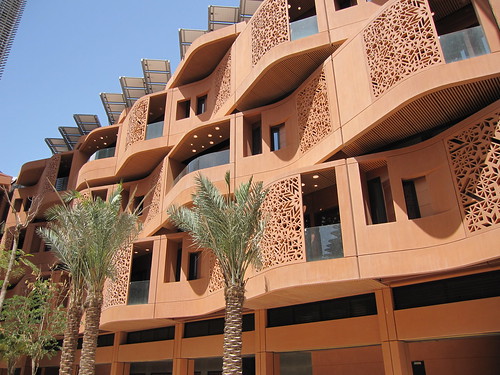
Masdar: a Gulf vision Bel Geddes didn't inspire
Few places, however, have the luxury of starting from scratch as the Masdar planners have done. New York and other big cities consequently live with some of the kind of old infrastructure that Jane Jacobs fought to preserve and some of the futurist infrastructure that Robert Moses promoted. The challenge is to work out how best to adapt both to fit the future.
 
The Williamsburg Bridge's bike and pedestrian lanes:
proof the future contains more bikes, but looks less neat,
than Norman Bel Geddes envisioned
The tension has struck me powerfully this week. There is some excellent, new provision for me and my bike in contemporary New York, built by city authorities who think the city in the future will need more people to get about roughly the way I do. I’ve also, however, attended this week a protest calling on the police to stop speeding drivers after the death on October 26 of Lucian Merryweather, hit by a speeding driver on a Fort Greene sidewalk. I’ve also a couple of times had to cycle down part of 2nd Avenue in Manhattan and then onto the East River bike path.

The cars on 2nd avenue, when not caught in a traffic jam, would buzz me at intimidating speeds. Then, as I sought to get onto the East River bike path, I had to cross an off-ramp from FDR Drive, the kind of urban expressway I’d seen staring back at me from Bel Geddes’ pictures.

The cars came roaring off the expressway into the city streets, most still running at a good 60mph. As I watched them, wondering when I would safely be able to cross, I thought of Norman Bel Geddes. Some of his vision now looks strange and much of it looks downright dangerous. But there remain many drivers who see no reason why a car should have to slow down just because it’s in a city.