Sunday, 27 April 2014

A stunning view, a midtown ride - and why speed is as much the problem as space

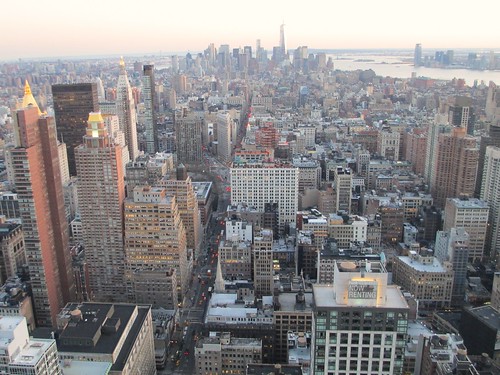
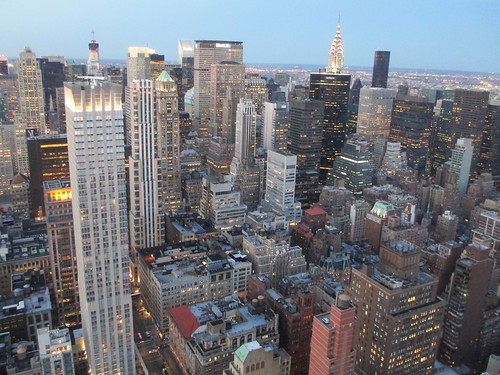
The Wednesday before Easter, thanks to a press event for a company I cover, I had my first chance since moving permanently to New York to go up the Empire State Building. Yet, as I gazed out from the 58th floor, I found myself struck by something other than the extraordinary forest of skyscrapers crowded, like trees straining towards the light, in midtown Manhattan. Looking south, it was clear how the forest canopy seemed to lower around Greenwich Village, SoHo and the Lower East Side into a less dense area of undergrowth or bush. It then rose again at the final, dense clump in the Financial District, teetering on Manhattan’s lower edge.
The Greenwich Village dip, seen from the midtown jungle
Midtown's skyscrapers: the lack of a "cyclists welcome"
sign, I'd suggest, is no coincidence

The view came to my mind the next day when I had to return to midtown for a television appearance at Fox News’ studios on Sixth Avenue. I rode up the Hudson River Greenway as far as 48th street. Then I started pedalling across town into the forest on which I’d been looking down the night before. The deeper I cycled into the mid-skyscraper canyon, the worse conditions became. I was constantly navigating around jammed-up traffic and dodging sites where workers were fixing pipes and cables. I was left wondering if, efficient though they can be, the densest parts of very dense cities such as New York are doomed to be fundamentally problematic places for human-powered transport.

The question’s relevant because many cities around the world are trying to accommodate their expanding population not, as New York City did for much of the 20th century, by sprawling outwards, but by becoming denser. There are calls for London to build new, higher buildings to absorb its growth. There is a similar movement in many parts of North America. It’s easier, so the thinking goes, to serve dense cities with public transport, since more journeys’ starting and end points can be an easy stroll from a station or bus stop. Wouldn’t it be ironic, I thought to myself, if such a movement – intended to make cities more environmentally friendly – made them worse for the bicycle, the most environmentally-friendly transport mode?
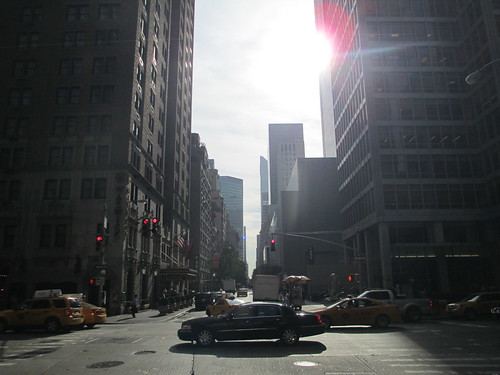
 
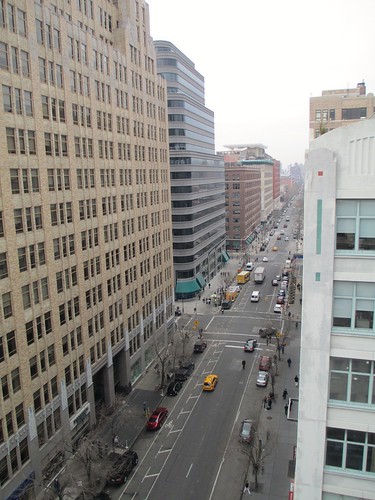
54th St, midtown. Look on this canyon, cyclists, and
at least consider despair.
It’s certainly tempting as one grapples with the reality of riding in midtown Manhattan – as I used to every day before my office moved downtown – to flirt with the idea that it’s a lost cause. The area crams into densities that in many cities would be associated with slums and squalor a mixture of high-end housing and offices teeming with some of the world’s best-paid professionals. No-one has the space or inclination to undertake a vast range of everyday activities but most have the money to pay to have them done. A stream of dry cleaners, express parcel services and food delivery cyclists consequently flows to and from the area’s offices and apartment complexes, giving the area the feel of being some vast apartment hotel crossed with a serviced office.

Since many of the best-off people feel themselves too important or fancy themselves in too much of a hurry to head into the subway, taxis and limousines buzz constantly around the doorways. The business of supplying food for the millions who swarm the area on a weekday would alone be enough to create a substantial traffic jam. The same goes for the business of keeping the people’s water, electricity, gas, sewage, hot water, internet, cable television and other services running smoothly. Almost none of the people engaged in the stressful business of meeting the area’s needs seems willing to take cyclists’ needs into account alongside the multiple other pressures they face. Cycling can be a slow, stressful business of zig-zagging around double-parked delivery vans, slipping past the edges of traffic jams and swerving to avoid the woman who leaps into the cycle lane to hail a taxi.
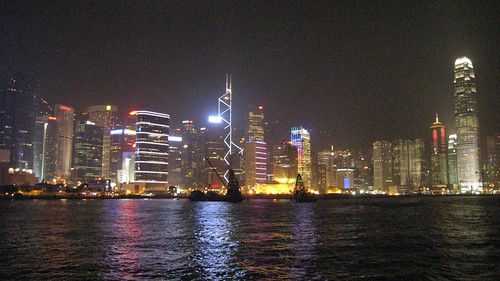
 
Hong Kong wasn't built specifically to make people feel
optimistic about cycling in midtown Manhattan. But
it serves the purpose very well
The intimidating atmosphere reminds me how I quailed, when it looked as if I might get a job in Hong Kong, at the thought of cycling there. Hong Kong has twice New York’s population density. I started to wonder if it might be London’s lower density – half New York’s level – that makes it generally an easier (if still severely flawed) place to cycle on-street.

Yet an incident later the day I appeared on Fox made me ponder how far space and density really were the problem. I cycled after work to Brooklyn to participate in a Maundy Thursday church service and headed off home afterwards down Garfield Place in Park Slope. I sped down the street, between rows of parked cars, at over 20mph, riding in the middle of the lane for fear a still-faster car would try to pass me. Sure enough, after a couple of blocks I noticed a Jeep Grand Cherokee close behind me, its driver clearly trying to barge me out of the way. I found myself, not for the first time, terrified of being hit from behind if I made a mistake but fearful also that, if I slowed down to pull out of the way, the driver would hit me before I was out of the way.
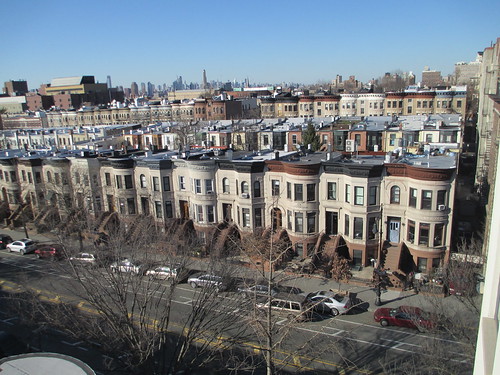
 
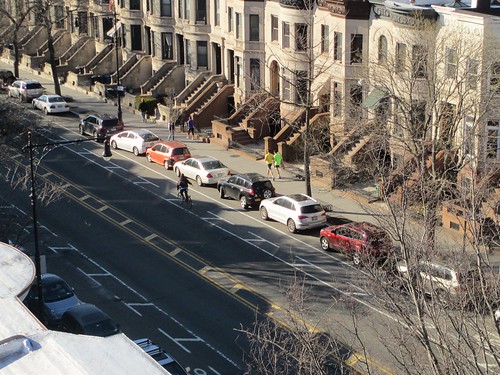
Park Slope: less dense, still speed-plagued
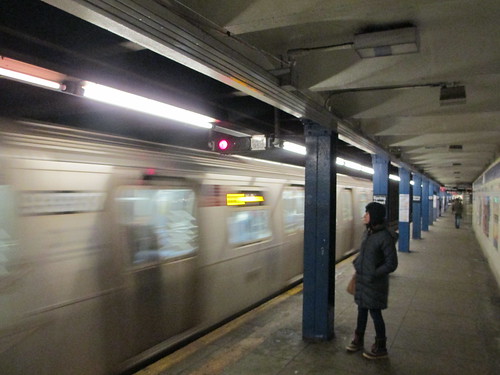
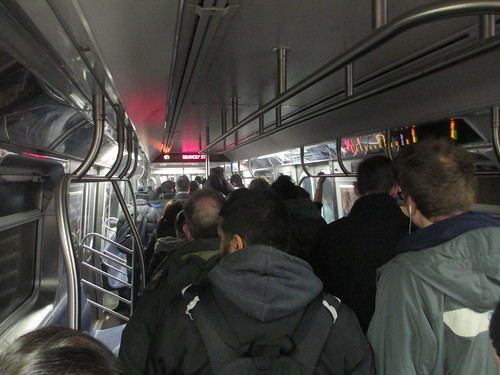
The New York City subway: speed, packaged and hidden away
I realised, instinctively, that the problem was less one of space and more one of speed. I am far happier to have a vehicle pass me on a narrow street at a reasonable speed because the scope for disaster, the room needed to correct a mistake, is so much smaller. I won’t let someone intent on breaking the speed limit on a narrow residential street pass me, because his speed has eaten up the room for error around his vehicle. We discussed some of these issues and a few more – including when he might learn to drive safely since he clearly didn’t know at present – at a red traffic light at Garfield and 5th Avenue.

When I factored speed into midtown conditions, I suddenly saw them in a very different light. The problem wasn’t so much, I realised, that there were so many delivery trucks and other commercial vehicles (although it wouldn’t hurt to switch some of these deliveries to cargo bikes). The problem was that those slow-moving vehicles had to stop every cross-town block to accommodate lines of vehicles sweeping up and down the avenues. I suddenly had a vision of a fast-moving taxi as taking up twice or three times its own road space as one that was stationary. The genius of the New York subway and other urban metro systems struck me. They take the problem of moving people fast – and consequently with lots of space around their vehicles – pack the people into space-efficient vehicles and bury the speed problem below the streets.
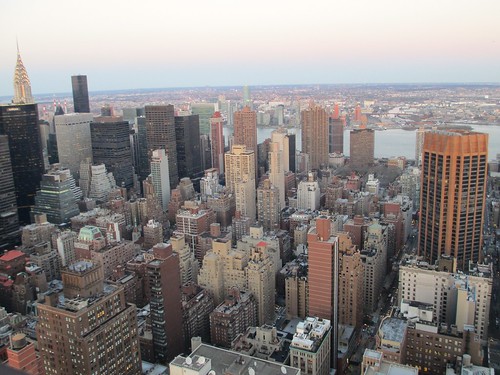
Beyond midtown east, out stretches low-rise Queens
Looked at it in that context, it becomes clearer that the real problem in New York lies not in midtown but in the low-rise areas I could see from the Empire State Building, stretching away towards the horizon. In New York and London – and even more so in many other big cities like Los Angeles and Houston – those distant suburbs were built with very little public transport provision. The only realistic way to get about, many residents feel, is to use a motor vehicle. To overcome their distance from the centre, the only way is to drive them fast. To cater to them, cities have built vast, space-eating high-speed roads. A significant part of midtown’s traffic problem is made up of people who drive all the way from those suburbs to work in the city centre.

The sheer unpleasantness of the world that way of living has created came home to me this Saturday as I cycled to meet my family for a day trip to the beach at Coney Island, on the edge of Brooklyn’s low-density sprawl. To cover the last stretch from a harbour-side cycle path to the beach, the marked cycle route heads onto Cropsey Avenue, a terrifying six lanes of suburban automotive culture full of vehicles seeking to drive at 40mph or faster. Far from taking the lane to tame these barrelling lumps of high-speed steel, I found myself letting my fear get the better of me. I cowered - as I once did when cycling in Staten Island - in side streets at each intersection, waited for the herd of charging cars to sweep past. Then I pedalled off after them as fast as I could, hoping to outrun the next charge.At the corner of Cropsey Avenue and Neptune Avenue - a few yards from the Invisible Visible Girl’s school – I shouted at motorists turning fast through a crossing where a man and his daughter were struggling to cross the street.
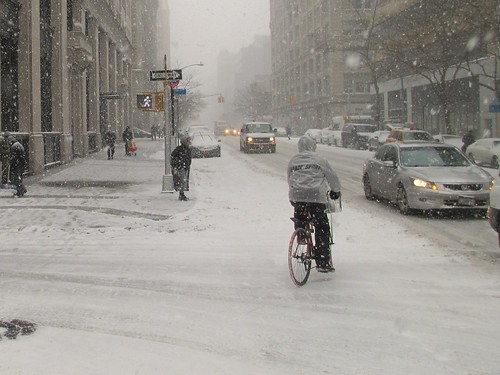
It's invidious to claim one's city has the worst cycle facility
anywhere. But is there a part of your city's cycle network
quite as grim as Cropsey Avenue?

It remains a stressful and forbidding experience to cycle in the heart of midtown Manhattan and in the densest parts of many other cities worldwide. Although I know space-efficient bicycles have many advantages as a means of urban transport, I don’t know precisely how I’d carve out space on the streets of midtown – or, come to that, the City of London or Hong Kong – to encourage people less hardened than I to cycle.

But, following Saturday’s experience, I feel confident on one point. While W48th St might be chaotic and stressful, it could yet become a healthy, functioning urban space. I’m far less confident the same can be said for Cropsey Avenue.

Monday, 7 April 2014

Miserable subway passengers, a grouchy runner - and a lesson from Bob Dylan

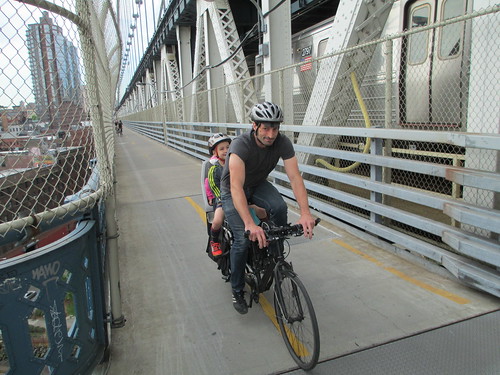
It’s one of those tasks that’s so difficult it’s become a kind of fascination to me. When I ride over the Manhattan Bridge towards work each morning, I’m generally passed, at a gap of just a few feet, by a B or D subway train taking commuters into Manhattan. The passengers stare out the window, blankly, apparently staring straight through those of us labouring up the slope to the bridge’s summit or speeding down from it. The stares are so blank that I’ve taken to waving at individual commuters to see if I can get a reaction.

A subway train passes a cyclist on the Manhattan Bridge:
the subway passengers can't see the cyclist. Fact.
The net result so far, from scores of waves, is one half-smile – and she might just have been reacting to a witty lyric on her iPod. The experience of being in a subway train seems to be so utterly different from the experience of riding a bike that the people on the subway trains can’t react to a human being outside their train on a bike.

Yet the reaction of the subway commuters to cyclists, it’s dawned on me, is only one example of a far more widespread city phenomenon. Big cities are full of people moving around conscious almost solely of their own environment, their own needs and their own sense of right and wrong behaviour. We’re mostly gliding around in little bubbles of our own distinct worlds, over and below each other, avoiding contact as far as possible. But quite a few of the crashes in cities, it strikes me, are cases where, almost literally, two worlds – two contrasting sets of expectations about norms and behaviours and who should give way to whom – collide. This makes it a phenomenon worth noticing and exploring.
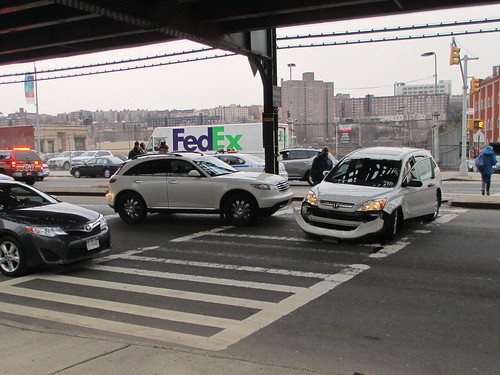
Two cars collide in Northern Manhattan - but so, quite
possibly, do two competing expectations about who
gives way to whom.

The driver I encountered on 55th street in Manhattan 10 days ago illustrates the most obvious form of the problem. I’d spotted that he was driving erratically as he left a parking space near Broadway. He then squeezed past me, dangerously, driving in a parking space, only for me to catch up with him at the traffic lights at 9th avenue. His window was rolled down and he was deep in a conversation on his mobile phone. “Stop talking on your phone!” I shouted at him. “It’s making you drive like an idiot.” He gave me a dirty look and slowly rolled up his heavily-tinted window. I was an unwelcome intrusion from outside the two worlds he was carrying around with him – the world inside his sports utility vehicle and his interaction with his interlocutor in the telephone call. His reaction was to close down his interaction with the place where he was physically present – and where his driving presented a serious danger.

There are multiple ways that people pursue the illusion that their cars are private spaces. They can blast out music so loud that any outside intrusion is inaudible. They can choose to drive a car so large or so fast that it intimidates other road users. They can talk incessantly on the telephone to people outside their immediate confines. People want to drown out the mixture of stress and boredom that comes from sharing a city street with a host of other people with competing claims on the space. Their desire to do so makes the street a little less safe for pedestrians, cyclists – everyone outside their world-in-a-car.

The little bubbles in which people move around also reflect their culture. At my son’s school, it’s mostly the parents with the mild, mid-western accents of hipster incomers that arrive bearing their children on long bikes, tandems and other unlikely bits of cycling apparatus. If I see children spilling out of some huge SUV – there’s a family that arrives daily in a Cadillac Escalade, one of the biggest vehicles on the road – I’m far more likely to hear a traditional Brooklyn accent calling out after them.

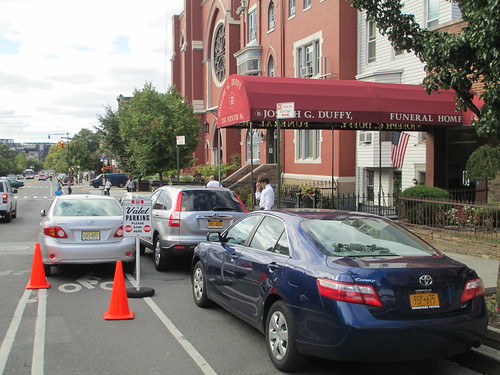
Inhabitants of Duffy Funeral Home's world worry about
where they're going to park. Other users of Park Slope's 9th
St worry where they'll ride their bikes. Here's where those
worlds collide.
The cyclists, I suspect, mainly mix with the other cycling-inclined families and have firm views about the environment, physical fitness and cluttering up the area with cars. The Italian-American SUV drivers come to the school from outlying areas of single-family homes. Many, I suspect, feel that a big car is both a status symbol and a way of keeping one’s loved ones safe. I'm sure they tut-tut quietly at the risks the rest of us are taking.

We maintain our contrasting cultures while sharing the same bits of road partly through the impermeability of a big car’s steel sides. It’s no coincidence in my view that cars that keep the outside world at bay are far more popular than, say, convertibles for city driving.

But it’s not only the motorists that are travelling around in little bubbles of their own worlds. Look on the average city street and nearly everyone is cutting him or herself off from the wider street. Headphones – once limited to discreet earbuds – are now often a large and obvious symbol that the wearer wants to be left alone. Mobile telephone calls and texting take the participant away from his or her immediate surroundings. For many runners, they seem to form an almost indispensable aspect of the experience, providing the rhythm and focus that interaction with the wider world might take away. A pedestrian cursed at me the other day on the Lower East Side for riding, perfectly legally and safely, onto a bike lane across a small city park. It's no coincidence, I think, she was a runner sequestered from reality by her headphones.
A cyclist, runners and motor cars in Park Slope: sure,
they look close together. But they could be worlds apart.

The question, of course, is how far any of this is a bad thing. Would New York City – or any other big city – be a better place if subway commuters were waving to me every morning? Should I expect that runners eschew headphones to try to make their runs as pure an experience as possible of interacting with the city? I’m inclined to say no. When a behaviour is as widespread as this retreat by city dwellers into their private worlds, it suggests a deep need. This is part of how inhabitants of big, densely-packed cities get by without assaulting each other or rioting more often than they currently do.

I'm struck, however, that it’s often the people least cut off from the reality of the city around them – cyclists out on the streets, intensely aware of all that’s going on – that are disproportionately involved in campaigns to make the streets safer. It’s a serious safety issue that so many vehicles allow their users to cut themselves off so thoroughly from events outside. It’s hard not to imagine that people with clearer views of pedestrians and cyclists and fewer barriers to hearing street sounds might be less likely to run them over.

I have no immediate policy magic wand to wave to bring about that change of perception.

But an idea came to me the other night as I undertook a late night ride home past the still-buzzing bars and music venues of Bleecker St, the Greenwich Village street where Bob Dylan performed many of his earliest gigs. In Talking World War III Blues, one of the songs from that early era, he describes a dream about being the lone survivor of a third world war. Then he remarks, in the last verse, that many other people seem to have similar dreams.

"Everybody sees themselves/ Walkin' around with no-one else," he says.

Not everybody’s dream can be right, he says.

"I'll let you be in my dreams if I can be in yours," he drawls.

That's the nearest I have to a solution. I'll let you be in my street-world if I can be in yours.

Wednesday, 26 March 2014

A frightened old man, an angry taxi driver - and why one big thing I fear is fearlessness

It was a rare moment when I felt sorry for a New York motorist. The elderly man, clearly confused about where to go, had got out of his car to assess where he was meant to turn at the Manhattan end of the Manhattan Bridge. But it was 11.30pm on a Friday; other drivers were impatient and he was blocking the left turn from Chrystie St into Canal St in Chinatown. “Honk!” “Hoooonk!” “Haaawnk!” His face expressed an emotion that’s all too familiar to me – fear of aggressively-driven cars. “What if one of these cars just slams into me?” he seemed to be thinking. “How can I most easily escape all this honking?”

New York City traffic: it certainly looks intimidating
The scene resonated with me. I’d not long before had an online conversation with someone who’d expressed regret that, although there was a new Citibike bikeshare station outside her house, she was too fearful to cycle in New York City. It just felt like far too great a risk, far too great a worry, she told me.

The exchange had heightened my awareness of the fundamental scariness of New York’s fast-moving traffic – and my own reaction to it. I feel concern when I hear a car speeding down a narrow, one-way street behind me. “Is it going to slow down when it reaches me?” I ask myself. “Will it tailgate me to intimidate me?” I worry when I ride through downtown Brooklyn in the mornings about anticipating the unpredictable behaviour of the drivers. The click in a car door that someone’s about to open sets off a spike of panic. People in other circumstances must feel something similar at hearing the cocking of an unseen gun. I used to feel similar alarm about cutting across the lanes of traffic around the Oval cricket ground in London during my commute to work there. “Get me out of here,” I’d think. “Any moment now, some idiot will come speeding round the blind corner.”

But my awareness of fear has also made me realise how year after year of daily cycle commuting in multiple different cities has changed my experience of the emotion. I’ve learned, I think, to manage my fear, to train it to push me towards the right decisions. I wish cycle commuting weren’t as stressful as it sometimes is and I know that riding a bike in a city isn’t nearly as dangerous as it sometimes feels. I also recognise that the health benefits from cycling on average outweigh the risks.

For the moment, however, I’m embracing the way my worries set off ancient fight-or-flight responses. I treasure how they keep me focused on riding as safely as I can amid what sometimes seems an almost unmanageably chaotic environment.

Smith St: challenging even on days without freezing rain.
That doesn't mean I wouldn't like a better cycling route to work, just as I yearned for improvements when I lived in South London. I head off each morning down Smith St in Brooklyn navigating round long lines of vehicles whose drivers clearly aren’t paying enough attention. They’ll lurch suddenly in or out of parking spaces. They’ll open doors unexpectedly. Drivers spot the side street they want and turn into it, oblivious to the idea they might be crossing someone else’s path.

The short – and generally less busy - section in Cobble Hill is still worse. Drivers floor their accelerators, speeding up like greyhounds released from traps. There, I look warily over my shoulder, knowing that, if I have to pull out of the narrow bike lane to avoid a car door, a pothole or a delivery truck, the cars could be moving too fast to avoid me. Then it’s back to a chaos of illegally double-parked cars, stray pedestrians and inattentive drivers. My stress levels and emotions swing wildly between the sections where I’m cut off from cars and can concentrate on riding – the Manhattan Bridge bike lane and Allen St in Manhattan – and the rest.
 
Allen St, Manhattan: believe it or not, this is one of the
least stressful spots on my daily commute
When I’m riding among motor vehicles, I enter a state that sometimes feels like hyper-consciousness. My attention has to dart from checking a set of traffic lights and the openness of the road ahead to focusing suddenly on the state of an individual car’s wheels. It’s badly parked and the driver’s just got in. Is it about to pull out in front of me? Oh, and just how deep is that new pothole? There’s no denying it’s so intense as sometimes to be invigorating.

I can't remember when the fear started pushing me towards safer, more sensible riding options. Once upon a time, I’d have let drivers scare me into riding right by the roadside even in the narrowest sections, where a passing car posed a serious danger. I’d let a car on my tail harass me into being uncertain about my line on the road, exasperating the impatient motorist more. I’d move back to the side of the road after swinging round a parked car as quickly as possible, without checking for obstacles in the bike lane or other riders. I’d ride in the door zone – the area where opening car doors are the biggest risk.

My anxiousness, I find now, makes me more resistant to shifting over to the side with a car on my tail, keeps me firmer in my line and makes me more cautious about making sudden changes of direction. My fear has become far better trained. It impels me constantly towards behaviour that every manual suggests is more likely to keep me safe than my former nervous, scared responses.
 
Hudson St, lower Manhattan: sure, you see
a magnificent urban thoroughfare. I see a
cycle lane I know is constantly blocked
by deliveries, food trucks and taxi drivers
So far from being a regrettable instinct in an urban cyclist, it strikes me, a well-trained fear is actually vital. It pushes me to go faster when the best way to avoid a motorist behind is to outrun him or her. It prompts me to go more slowly – with a better chance of stopping safely in an emergency – when in close proximity to seriously dangerous behaviour. It sometimes prompts me to pull over and let an aggressive motorist past on a narrow road – but only when I can safely do so.

My well-trained fear may even, it’s no exaggeration to say, have saved my life one morning in February. I was riding fast down Smith St’s cycle lane but scanning the cars. My gut instinct for when stupid behaviour is most likely had warned me of potential trouble. Sure enough, as I was almost upon it, the driver of a Ford Ranger pick-up truck pulled into my path, fast, without looking. Thanks to my inherent suspicion, I was already on my guard, aware of my surroundings and prepared to swerve left to get out of the way. I screamed “Stooooop!” at the top of my very loud voice. But I still felt a moment of certainty that I would land in the road. A mixture of my brakes, my screams and the driver’s belated response brought both of us to a halt only inches apart.

This well-trained fear, of course, isn’t going to keep me safe indefinitely. I already had it in 2009, when a car came from behind me in London, turned across my path and knocked me off. Most bike/car crashes are the motorist’s fault and there will be many circumstances where the cyclist can do nothing to avoid a motorist’s stupid behaviour.

Nor is there going to be mass cycling in rich world cities as long as things remain this intimidating. I’ve learnt how to train my fear because I have an itch to cycle. I might not have developed the itch to cycle if I’d known how scary it might sometimes feel.

But the most immediate downside to being hyper-aware of the risks one’s running is that it can produce a rather obsessive focus. That led me last Thursday into a position almost as dangerous as the ones I spend so much time avoiding.

Downtown Brooklyn, from afar. Not pictured:
homicidally negligent double parkers, furious limo drivers
Tired and frustrated as I rode home, I spotted a limousine parked blocking the bike lane at the corner of Smith and Fulton Streets. Since the driver was lounging on the vehicle, which he could easily have parked somewhere less dangerous, and since I was tired of pulling out round illegally-parked cars into traffic, I pulled up behind him and asked him to move.

Meeting a volley of abuse, including assertions that the United States was a “free country” and that I should “back the f*** off,” I decided to take a picture of the driver and licence plate, send it to the Taxi and Limousine Commission and leave it at that. I quickly found myself confronting a still angrier driver, who made grabs for both my camera and my bike.

Aware now of my misjudgement, I rode off to collect my thoughts. “You’re a white devil!” I could hear him shouting as I pulled out my phone to email myself his registration number. I was no longer feeling the constructive, focused, well-trained fear I experience when navigating the streets. I was undergoing the humiliating fear of someone who’s run away from a fight. My hands were shaking.

It was partly because of that experience I felt such fellow-feeling the following evening at seeing the frightened motorist. I wish big, western cities' traffic conditions weren't so apt to frighten people.

But somehow I still feel more dread in the pit of my stomach at the idea of a day when snow will stop me riding than at a repetition of the row with the Angry Limo Driver of Downtown Brooklyn. I even accept with some kind of resignation that I might, in future, not avoid a badly-driven car and might suffer another injury.

I shrink from some of the individual battles, it seems. But in the long run, in the war to keep riding, I don’t want to surrender.

Saturday, 8 March 2014

A snowy park, a wintry spin - and the joys of no longer being a flabby teenager

It’s not the kind of issue that normally preoccupies me while I’m cycling. But, glancing down at my bike computer, I could see my pace had dropped. Where shortly before the average speed figure had been showing 16.5mph, it was now showing 15.1. The dip gave me fresh determination. “Speed up!” I ordered myself. “Reach the top of the hill without dipping below 15!” A few seconds later, I crested the hill in Prospect Park, near my house in Brooklyn, with my computer still showing a 15mph average speed. Slipping my chain onto the biggest chainring, I sped up off down the hill towards Grand Army Plaza.
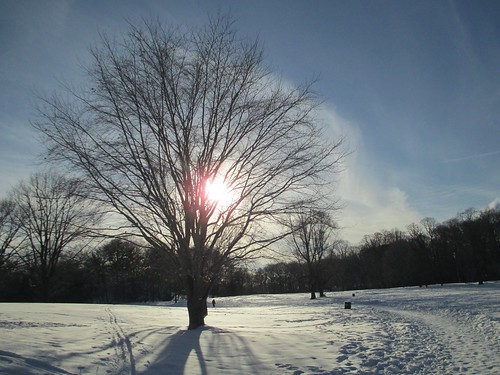
Prospect Park in the snow: however badly I ride round it,
it's a breathtaking backdrop for my humiliation

This wasn’t my normal kind of bike riding, however. I’d seen earlier in the day the forecast for yet more snow for New York City – it’s already the city’s seventh-snowiest winter on record – and I thought my chances of commuting by bike in the next few days were limited. I consequently decided, although I didn't have anywhere to go, to use a break in the weather to get some exercise. Checking that I had no immediate domestic responsibilities, I slipped off after church for a very brief bout of cycling purely for the physical activity.

I’ve found myself, when I’ve been undertaking these rides, involved in an activity that’s both entirely familiar to me and rather alien. I’m used, of course, to riding my bicycle (even if this winter has made that hard-going at times). I’m accustomed, however, to focusing on getting where I’m going in one piece – which can be demanding in a city full of angry drivers and bad road surfaces. I’m not used to focusing on the cycling – or its effect on my body – for its own sake.
 
A clear road amid deep snow: how Prospect Park has looked
for much of this miserable, long winter
I’ve been interested to discover how negative many of the associations in my mind of taking pure exercise are. As my pulse rises and my breath grows wheezier, I’m back amid the humiliations of a secondary school playing field. I feel the scorn of the teachers and my fellow, marginally less inept pupils for my uselessness at playing rugby union. As steely-faced weekend road warriors pass me, their wheels making the distinctive rumble of expensive carbon-fibre, I feel fat, lethargic and more than a little silly.

And, yet, I have to remind myself, it is this alien activity – rather than my daily transport cycling – that many people regard as the most authentic way to ride a bicycle.

This isn’t to say I’ve never cycled just for the sake of it before. My love for cycling developed substantially during my years at St Andrews University, when I’d ride off some Saturdays or Sundays towards Crail, Anstruther or one of the other nearby fishing villages. The whipping coastal winds would propel me one way. Then, after I started heading back, I’d have to dip my head down into the wind and speed along the quiet, undulating country roads across the moors.

That early, carefree exploration culminated in the summer of 1990, when I alternated between working at clearing out my recently-deceased grandfather’s house and spending days exploring Scotland. I’d head off in the morning for a ride that took me up the shore of the Gareloch – a ride made spookier by the area’s hosting the tightly-secured base for the UK’s nuclear missile submarines. I’d head back to Glasgow via the shores of Loch Lomond. I’d ride, pushed by the prevailing winds, from Glasgow to Dunfermline in the morning. Then I’d push down hard on the pedals and hunch down for a long ride back – via the Forth Road Bridge and into the wind - west.
 
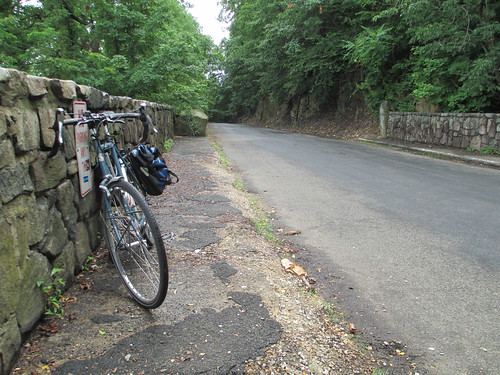
"It's nice out here," remarks my bike during a rare trip outside
New York. "Why don't we do this more often?"
I didn’t find things too complicated back then. I wore no helmet, carried no supplies, rode a very basic Raleigh bike and worried about pretty much nothing. Caught in a tropical-style West-of-Scotland summer downpour? Dry yourself off under the hand dryers in the lavatories at lunchtime. Bit off more than you could chew with this 100-mile ride? Stop in every other village for a pint of milk to glug down.

I’ve had occasional bouts of just-for-the-sake-of-it riding since then, albeit the time constraints and obligations of adult life have curtailed them. When I lived in London, I’d occasionally make it to Richmond Park – the vast royal park in south-west London - where rides are enlivened by the possibility of a collision with a big, wandering deer. Last summer, with the family absent, I took two long rides over New York City’s boundaries, over into New Jersey and up into Westchester.
 
Bored with just riding round the park in circles?
Why not ride round it on a tall bike, like this guy?
But there’s something about riding in circles in Prospect Park – Brooklyn’s smaller equivalent of Central Park, non-New Yorkers – that feels far more self-consciously like Exercise - or Training, as it's now been rebranded - than any long trip to the different scenery out of town. The other riders in Prospect Park mostly wear the set, grim expression of a person battling to wrest back top spot on some Strava segment. Most seem to form a spooky unity of body, bike and clothing. Shoes merge into pedals, gloves into handlebars. The helmet might as well be some final, elaborate cap on top of the whole bike, rider, clothes ensemble, rather than a separate piece of clothing.

No-one would make that mistake with me. I arrived in Prospect Park last Sunday wearing woollen trousers, a cotton shirt and leather shoes. My waterproof jacket, trouser straps, helmet and gloves were my only cycling-specific clothing. And, of course, I was not wearing my clothes over a body honed by constant training for some forthcoming triathlon. I carry about in my body the evidence of thousands of late nights at work, followed by dashes home and swallowings of hurried dinners with wine. My clothes and body were both as floppy and aerodynamically-inefficient as many other riders’ were taut and tight-fitting. I look what I am - like a cyclist whose rides are nearly all, in sports cyclists' dismissive term, "junk miles".

That self-consciousness only rose as I started to ride, heading down the hill towards Flatbush, and sped along the road between the lake and the parade grounds at the park’s lower end. It became clear as I started climbing the hill – the ridge over which British and American forces fought the battle of Brooklyn in 1776 – that I was making an effort. I started to breathe hard and wondered why I always seem to have a cold. I briefly felt myself once again 15 and on a mud-spattered, rain-soaked cross-country run.

But much of the reward of this exercise is that I’m avoiding not doing it. In weeks when it’s been hard or impossible to ride, I’ve built up a deep twitchiness at my lack of activity, the shortage of time spent outside, a feeling of being trapped when commuting, sedentary, on the subway. Even a short, fast ride starts to scratch that itch.
 
Me - and my body - in The Bronx. There are
no excuses for my beer belly,
so I'll make none.
And, as I powered up the hill, I remembered that I was no longer entirely the unfit, unco-ordinated teenager. While my flabby torso isn’t much of an advert for commuter cycling, it sits atop a pair of legs that have spent years propelling me to 4,000 miles or more a year of riding first through South London and, now, daily between Brooklyn and lower Manhattan. Even if some of the weekend warriors overtake me on a climb, I generally gain the occasional, minor victory, pumping my legs up the hill past one of them.

I started to feel the pleasure of how a bicycle magnifies one’s effort. Pumping my legs, I climbed the hill smoothly by my standards, at around a steady 14mph. Down the hill, my biggest gears propel me to close to the park’s 25mph limit and I felt the childish sense of joy that always comes with giving oneself over to gravity’s acceleration. I started to feel a deep sense of contentment - the result, I imagine, of the release of endorphins, the exercise-related high that people keener on exercise for its own sake chase so hard.

I realised after a while that that feeling of contentment wasn't unfamiliar. I recognised how much of the time when I’m riding I’m running late, pushing myself to reach the next lights before they turn red, powering up the Manhattan Bridge to avoid being late for a meeting, switching to the big chainring to get uptown faster, accelerating away from traffic lights to get out of the way of that badly-driven taxi.

There’s no immediate danger of commuter cycling’s turning me into a lean, efficient cycling machine like the ones whirling efficiently round Prospect Park each weekend. But, as I turned out of the park again and prepare once again to tackle the indifferent conditions of New York City’s streets, there was no doubting that I was feeling better.

I appreciate with my higher brain centres the many more and practical reasons why more and safer cycling would make the city a better place. But the deep satisfaction that I felt flooding through my body reminded me that, no matter how deep my embarrassment, I retain a childish joy at the simple act of riding a bicycle. The day it starts to fade will be the day I feel as old as I look.

Monday, 17 February 2014

The C Train, my childhood - and why the subway still gets me excited

It’s not a term that many people would associate with a journey on the New York City subway. But, as I trudged up the steps on Thursday from the C Train station at Spring St, I felt a warm glow of admiration. I emerged onto Vandam St to find that day’s blizzard – which would eventually drop 14 inches (36cm) of snow on parts of the city – still in nearly full flow. The transit system had nevertheless transported me with what seemed to be insolent ease from an above-ground station in Carroll Gardens down into the tunnels to downtown Brooklyn then, on another train, across the east river to the west side of lower Manhattan.

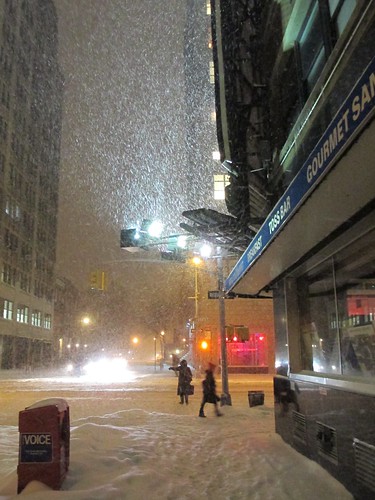
Vandam St in a snowstorm: a contrast to the order
beneath the streets
The journey’s smoothness was a tribute to the virtues of forward planning, teamwork and operational excellence that make for a smoothly-running transit system. At street level, by contrast, a rental truck whose driver had got it stuck on a pile of snow was blocking the street, holding up a snow plough.

Yet, just the day before, it occurred to me, I’d been raving about how magnificently satisfying my cycle ride to work had been. I’d braved well-below-freezing temperatures and persisting patches of ice and snow to ride to work on both Tuesday and Wednesday, enjoying the challenge of the unpredictable conditions and taking in magnificent views of the city spread out before me.

Wasn’t there a contradiction, I thought to myself, about my two positions? If I enjoyed using perhaps the most individualistic of mechanised transport methods – the bicycle – wasn’t it odd I also admired such an obviously shared form of transport as the subway? Moreover, it occurred to me, why wasn’t I alone in my shared enthusiasm? Why did so many of the cyclists and cycling advocates I knew have a decided preference for subways and buses over cars in conditions when they couldn’t get about by bike?

Trying to leave an F Train when the track ahead is on fire.
I can tell you what it felt like - just be grateful I can't
make you smell the acrid smoke.
I should start answering those questions by making it clear that not all – possibly not even most – of the subway journeys I’ve been forced to take for weather reasons in recent weeks have evoked the warm feelings that my trip on Thursday did. I’ve had plenty of long waits for trains and other disruptions, including the two-hour journey home I mentioned in a previous post. Worst of all was my experience on the morning of February 3. After unwisely guessing that the F Train to West 4th St would be my quickest route to SoHo, I found myself trapped underground for 40 minutes. The live rail in the station ahead was on fire and power to our train was cut while the fire department tackled it. I don’t especially recommend the experience of standing in a confined space with emergency lighting, no air-conditioning and a growing smell of acrid smoke in the air.
 
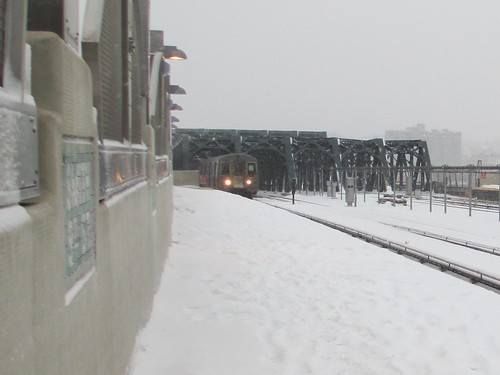
A G Train on a snowy day. My background tells me
it took teamwork and organisation to get this train running.
I should also confess that part of my feeling for subway systems stems from my background. My late father, who taught me to ride a bike, devoted his whole working life to subways – first in London, then in Glasgow. While my journey to work last Thursday might have seemed easy to me, I know that subways do anything but run themselves. My dad, I recall, diverted the taxi taking him and my mother to their 20th wedding anniversary dinner to the subway depot. A train had derailed at a critical point and he wasn’t going to relax until he was sure it was on its way to being put back.

I associate the New York subway also with my grandfather, who visited New York as a seafarer in the 1920s and told us wide-eyed children decades later about the marvels of express and local trains and the other complexities of the subway system.

As I spot some complicated bit of lineside equipment or work out some intricacy of the New York City subway system’s workings, I often feel a sharp pang at not being able to share it with my father, who died in 2002. “My train was diverted over the disused express tracks, dad!” “I got a good look at the snowblowing train!”

But there are also plenty of things about transit systems that cyclists can appreciate even if they haven't got my back story, I think. While many motorists seem to view their car as an extension of private space, I recognise clearly when I’m on my bike that I’m involved in a complex social interaction. The difficulty of communicating with other drivers is one of the things I least like about driving. It’s less of a stretch for me than for a driver or habitual taxi user to have to negotiate the scores of interpersonal transactions involved in using busy subway trains.
Copenhagen's cycle rush hour: they could have got
a nice train instead, lucky people.

It’s certainly no coincidence that cities that are good for cycling also tend to have good public transport. Copenhagen has a magnificent driverless metro system as well as good suburban S-Trains. Amsterdam has a formidable tram and suburban rail network. In the US, Portland, Oregon, has both some of the highest cycling and some of the highest transit ridership figures. Washington, DC, also enjoys a combination of relatively good cycling conditions and good public transit (even if the Washington metro’s train frequency and reliability could do with improvement). The careful planning and forward thinking required to build a good public transit network also tend to produce the kind of civic-minded thinking that prompts cities to curb car traffic, police streets well and put in good cycling facilties.

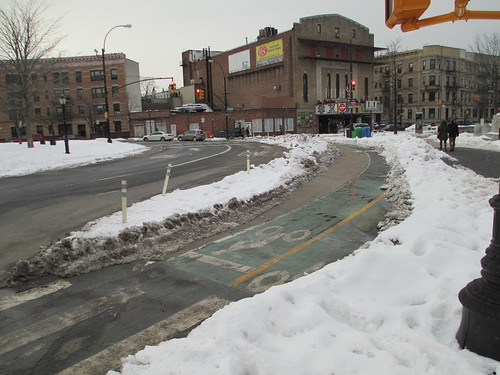
A partly-cleared bike lane: cyclists and transit users
have both been getting spotty service
New York and London, the two cities where I’ve most recently lived, fall in slightly odd places on the cycling-public transport continuum. Both suffered years of underinvestment. The 1930s-vintage lines that I use most heavily in New York are some of the city’s newest; London's underground steadily deteriorated between the 1960s and 1990s. Both cities veered off for decades in the direction of encouraging motor car use – under Robert Moses’ leadership in New York, inspired by his example in London. Moses fought to ensure badly-needed new transit lines were never included in his vast road-building projects.

There are days when, sorry, even I can't cycle
The spotty service I’ve experienced in recent weeks in New York is consequently an excellent summary of how the city is faring in both cycling and public transport. There are moments when the smoothness and progress from the worst times seems like a miracle. There are others when the main improvements from the city’s darkest days seem to be that the ageing trains are no longer covered with graffiti. The fire that kept me stuck underground isn't the only one I've encountered lately.

The subway's challenges regularly remind me that I prefer to cycle when I can. I also enjoy the exercise, the fresh air, the views from the Manhattan Bridge and cycling's relative reliability. Cyclists also avoid some of the hassles that come in winter as the homeless and disturbed crowd onto subway trains for warmth.

But, on days when the weather gives me no choice, the subway reminds me of the excitement I still feel at living in this mad experiment of a city, scattered on the islands and peninsulas around New York Harbour.

"This is a World Trade Center-bound E local train!" -
words that still sound oddly exciting to me.
Even the littlest detail of the journey can send that welling up in me. There’s the rattling of an express train through a local station, its lights flashing as they pass the support pillars. There are the names that evoke a thousand novels, songs and films. There’s the bizarre mixture of all kinds of cultures and classes one finds crammed onto many subway cars.

All are summed up sometimes in the announcements that squawk out over the public address as I step onto the train.

“This is a Manhattan-bound A train,” I hear with childish excitement. “Next stop: High St-Brooklyn Bridge. Stand. Clear. Of the closing-doors!”

Sunday, 2 February 2014

A frozen water bottle, a crisis of identity - and why winter cycling keeps winning me back

My neighbour looked at me aghast as I wheeled my bike in through the door of our apartment building, accompanied by a sharp blast of the well-below-freezing air outside. “You’re officially crazy,” he said. The guy who sits next to me at work took a similar view another day, “You didn’t bike in today, did you?” He was persuaded I had only when I shook my water bottle – with lumps of ice from the freezing journey - at him. Yet another day, a woman from another department of my company, who never talks to me, approached me to demand, “Bet you didn’t ride in today, did you?”

Snow swirls in SoHo: definitely a "defying
the laws of physics" day as far as I'm concerned
All of my interlocutors shared the view of probably the vast majority of New Yorkers about cycling in the depths of a harsh winter – that it’s not only impractical but a little bit wrong or insane even to try. The sentiment seems all the more dispiriting for being so often expressed with a kind of glee: “Ha! So that’s put a stop to your little cycling experiment, hasn’t it?” Riding to work is only a hobby, go the none-too-subtly expressed subtexts. It’s a lifestyle choice that I can and should reverse at the slightest provocation.

However, the ferocity of the current New York winter – which has seen me cycle to work in temperatures of -13C (9F), with windchill making it feel like -23C (-9F) - has forced me to re-examine my view that I can cycle to work pretty much every day during winter. For a solid week recently, slush lay stubbornly on the roads, unmelted as temperatures remained below freezing, making any attempt at cycle commuting feel foolhardy.

I’m consequently working on a new principle. I’m happy to fight the forces of nature, I’ve decided, but won’t defy the laws of physics. The challenge now is to work out which days fall into which categories.

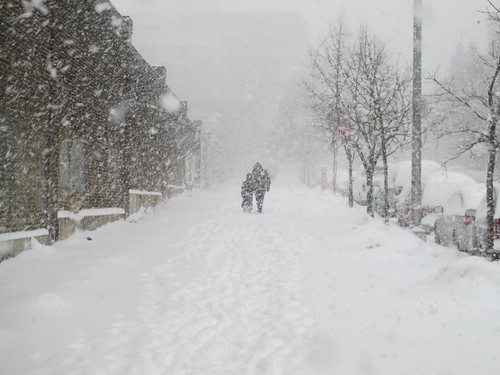
Piles of snow days after a snowfall. It's not
picturesque, but it's not dangerous either
It’s not all bad, after all, trying to ride a bike in winter in New York City. Last winter, my first as a New York resident, I was delighted to discover some advantages of the city’s winters over the less cold ones through which I’d cycled in London. Because the temperature would stay below freezing for days at a time, snow cleared from the roads generally stayed cleared rather than melting, refreezing and turning into icy slush. Because the air was less damp, on snowless days temperatures could plunge far below freezing without producing the thin coating of black ice customary on London streets in such weather.

Every night for a whole week last winter, I’d ride across the Brooklyn Bridge on the way home, glance at the big thermometer perched atop the Watchtower building by the bridge and see temperatures no higher than -8C (17F). I managed an 18-mile round trip in such temperatures by putting on more layers than normal, I told myself. What winter weather was likely to stop me?

It’s a question to which I’ve had a few clear answers this winter. One morning, for example, I decided that the previous snow was now so well cleared that it was safe to try riding to work. Part way across the Brooklyn Bridge, I discovered the peril of judging conditions by roads already warmed by hundreds of cars. The snow on the bridge, I discovered, had half-melted then frozen again as water on each of the hundreds of wooden boards making up the bridge’s walkway. Even walking the remaining mile or so across the ice sheet to Manhattan was a desperately slow, laborious process. Another morning, relieved to be cycling to work after a few days thwarted by snow and ice-covered roads, I emerged from my apartment to discover freezing rain was falling. The sidewalk below my feet was already slick with ice. Back to the apartment went the bike. Shoulders down and gingerly to the subway station went I. The morning my neighbour told me I was crazy, I was actually returning, crestfallen, from the briefest of attempts at cycle commuting. Finding that, three days after a big snowfall, residual snow on the road felt so slippery I was fearful of going any further, I was returning my bike to my apartment and heading, yet again, for the shelter of the F Train.

A delivery cyclist in the snow: oblivious to his effect
on my self-esteem.
At its worst, this run of weather has left me feeling something not far short of a crisis of identity. I feel like myself when I ride my bike to work and not when I don’t. “Ha, ha, ha!” say my nastiest inner demons. “You present yourself as a tough, bold fearless cyclist and you haven’t been on your bike in a week! You’re probably on the brink of ditching cycling forever and commuting all the time by subway!” The lack of my wonted exercise has certainly left me feeling fidgety and sluggish a lot of the time. I even had a day off sick last week – for the first time in at least two years. I am, I tell myself, just another unfit, middle-aged man resenting a commute in the kind of proximity to strangers that I’d normally consider with no-one but my wife. At lunchtime, I’ve looked mournfully at delivery cyclists, marvelling at their ability to handle their bikes on the snow and ice and cursed myself for not being prepared to do the same. I’m even cursing myself by comparison with my past self. Is this, I ask myself, the same man who rode home from work through a blizzard in London in January 2009? Or is it a mere pale imitation of him?

Two full months of harsh winter gone by, however, and I am, perhaps, finally coming to some kind of radical acceptance. My caution, I keep telling myself, is largely warranted. Men of six foot five on touring bikes have, after all, a high centre of gravity and limited purchase on the road. It’s probably a risk not worth taking.

My readiness to withstand the low temperatures is also, I tell myself, a bit beyond most other people’s. On that coldest morning, when it felt like -23 C, I not only found that my water bottle had frozen solid by the time I arrived but that my gears stopped working properly, as the grease I’d used to lubricate them started to freeze. Mornings such as that have counterbalanced the days I’ve felt a failure for slinking off to the subway. While they wouldn’t seem extraordinary to cyclists from cold-weather cycle-friendly countries such as Finland or Sweden, they give a temperate-climate cyclist such as me the illusion of having achieved something by riding to work. I was delighted in a recent Transportation Alternatives video to find some other cyclists feel the same.

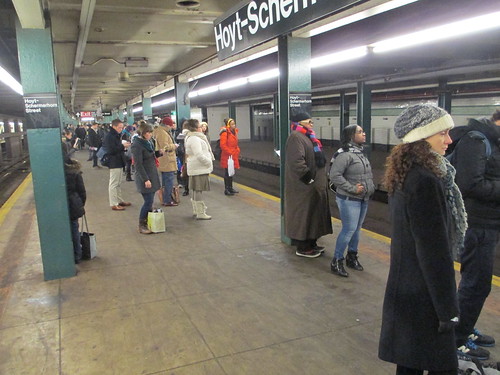
Hoyt-Schermerhorn station's A Train platform one recent,
snowy morning. This was on a morning when the subway
claimed to be offering "good service" on this line.
As for the feeling that I might be tempted to switch permanently to the subway, I’m always surprised by how quickly it evaporates. Certainly, the subway itself has done its part in that direction. On Friday, minor problems on the A Train produced vast crowds at the station where I needed to change trains. On the worst of the recent snow-affected nights, I found myself trapped for 40 minutes on a train stopped on a viaduct 50 yards from my house but unable to get off. The entire journey home – at most 45 minutes by bike – took two hours.

Yet being on my bike is a still bigger factor in changing my outlook. There remains a skill to riding in the cold even on the days when it’s not prohibitively dangerous. I’ll glide over this ice patch then swerve round the next one, I tell myself. I try to distinguish leftover snow from gritting salt. I devise strategies to get my gears moving again when they’re gumming up. Most of all, I enjoy how extreme cold brings out yet another face of the city. I see ice floes packed by the banks of the Hudson River and notice how professionally the city’s people wrap up for such weather.

Brooklyn in winter: sure, I took this picture from the subway
station. But days when I ride in winter I see far more
of this crisp, beautiful light.
It may, I suppose, seem a little crazy to far more people than just my neighbour and my gloating colleagues. There are mornings when I certainly feel less stressed to be letting the subway worry about the weather conditions for me. But there are other mornings. They’re mornings where I negotiate the ice patches at the start of the Manhattan Bridge bike path, ride out over the river and am confronted with New York in one of her most beautiful moods. Thin whisps of steam spiral up from chimneys into a clear blue sky and the low sun shines the crispest, clearest light imaginable on the city, casting buildings half into bright sunlight and half into deep shadow.

I ride over the crest of the bridge such mornings and down towards the star anise smell of Chinatown’s restaurants and tell myself: if this is crazy I barely really want to be sane.

Sunday, 19 January 2014

A new police commissioner, some dodgy statistics - and an open letter from me

William Bratton,
Commissioner,
New York Police Department,
1 Police Plaza,
New York,
NY 10038
January 19, 2014

Dear Commissioner Bratton,
Vision Zero and Statistics
            Congratulations on your appointment as NYPD commissioner. Like many New Yorkers, I feel optimistic based on most of your public statements that you’re determined to build on the progress made on public safety in your previous term at the department. I am particularly optimistic that you are determined, at last, to set about reducing the appalling toll of death and injury that motor vehicles exact from New Yorkers every year.
          I wanted to pick you up, however, on a puzzling statement on January 15 at the launch press conference for the mayor’s Vision Zero initiative. You said pedestrians contributed to causing 73 per cent of pedestrian-motor vehicle collisions last year and that pedestrian actions were directly responsible for 66 per cent of those collisions. It’s a figure that on my reading of the figures is demonstrably incorrect. I fear that, if the NYPD genuinely thinks this figure reflects reality, it could seriously distort the department’s efforts to reduce the grim toll of unnecessary suffering on our city’s streets.
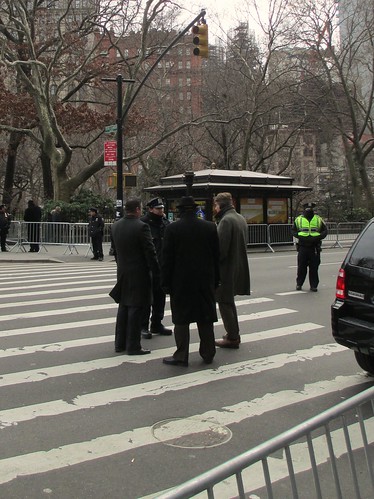
Waiting for a new boss: NYPD officers
outside the new mayor's inauguration
I would be interested to know the basis for your assertion – and grateful if you could put the figure right if, as I am sure it is, it is mistaken.
            Your figure is implausible to start with. It implies that motorists - who stand almost no chance of injury in a collision with a pedestrian, often drive at high speed and are easily distracted – are more solicitous of pedestrians’ safety than the pedestrians themselves. That seems at variance with my experience of human nature as well as with my observation that pedestrians are generally watchful when crossing city streets and motorists often cavalier when driving on them.
            The statistic is also starkly at odds with all the research I’ve read either in New York or elsewhere on the causes of crashes between motor vehicles and vulnerable road users – pedestrians and bicyclists. For example, a study published in 2013 by NYU Langone Medical Center found that 44 per cent of pedestrians treated for injuries after collisions had been hit in a crosswalk while crossing with the light. Another 6 per cent were hit on the sidewalk. Given that some of the other victims will also have been the victims of driver negligence – hit in unsignalised crosswalks, for example – it is clear the majority of studied crashes were mainly drivers’ fault.
Typically dangerous pedestrian behaviour:
midtown Manhattan
            A more comprehensive study, published in 2010 by the city’s own Department of Transportation, attributed blame for 36 per cent of crashes that killed or seriously injured pedestrians to driver inattention. It attributed another 27 per cent to motorists’ failure to yield and said vehicle speed was a major contributor to 21 per cent of crashes. The DoT study reinforces the impression that, while pedestrians undoubtedly cause some crashes, they are probably mainly to blame for only a quarter or so of incidents.
            Around the world, a number of research studies have reached strikingly similar conclusions. Many have attributed blame for crashes involving pedestrians and cyclists to motorists in around 75 per cent of cases. For example, in London, where I lived and cycled for nine years until August 2012, a Transport for London study of every reported motorist-cyclist collision in 2010 attributed blame for around 74 per cent of the crashes to motorists. Motorists’ inattentiveness, excessive speed and impatience are the main killers in every industrialised country of which I’m aware. It's unlikely New York City is a freakish exception.
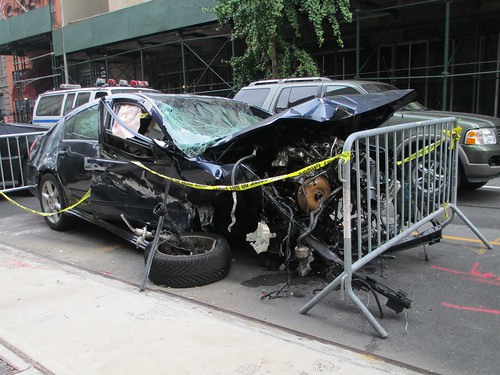
It might look to you like the outcome of negligent speed:
but there's an NYPD statistician who probably thinks
some pedestrian caused this.
            Your assertion also seems at odds with the evidence of the fatal crashes involving pedestrians so far this year. I’ve been able to glean enough information about four of the fatal pedestrian crashes up until Friday 17 to guess how blame might be allocated. In only one – the death of Xiaoci Hu, killed on January 2 when a car ran into the back of another car that had slowed down to let him cross mid-block – does the pedestrian appear to have carried even a portion of the blame. The driver who struck Mosa Khatun on January 5 in Jamaica was charged with failure to yield; the driver who hit Nydja Herring on January 11 in Parkchester has reportedly been charged with aggravated driving while intoxicated; numerous witnesses attest that the driver who killed Cooper Stock on January 11 hit him and his father in a crosswalk as they crossed with the light.
            Streetsblog, the campaigning website, calculates your department coded only between 7 and 8 per cent of crashes involving pedestrians or cyclists in the first 11 months last year as having resulted from pedestrian or cyclist confusion or error.
            My concern is that a mistaken understanding of the present crisis’ causes could lead the NYPD to pursue mistaken or counterproductive measures to halt it. If pedestrian behaviour were indeed the cause of most pedestrian/car crashes, it would be worthwhile and effective to work harder at changing pedestrian behaviour. I note there are already reports of a police crackdown on “jaywalking” around the area on 96th street in Manhattan where there has been a cluster of casualties this year. I can imagine it will be tempting for local police precincts to seek in any crackdown to tackle pedestrians and cyclists since they are, by their nature, easier to catch and prosecute than drivers of fast-moving cars.
            If, however, cars cause the majority of crashes involving pedestrians and cyclists, it will make far more sense to work at controlling drivers’ speed and ensuring they yield when required to do so. I am worried that, with the crackdown on the Upper West Side, you are beginning to pursue a pedestrian-focused strategy – one that targets the victims and not the perpetrators.
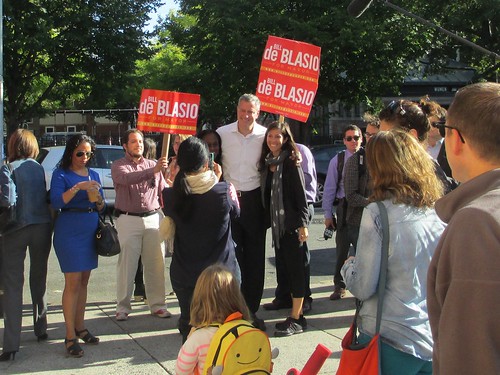
The new mayor during his campaign: before he had a police
commissioner to explain how pedestrians were
killing themselves
            My personal conviction is that a concerted effort to tackle the traffic crisis’ real causes could yield dramatic results quickly. During my nine years in London, I covered transport issues in the UK and elsewhere for the Financial Times, winning several awards. London, which has a similar population to New York’s and similar traffic volumes, suffers only half the annual traffic fatalities that New York does. Motorists’ adherence to speed limits and other road rules is noticeably more lax in New York City than in London. I see no reason why the introduction to New York of systematic speed enforcement and a general culture of respect for road rules should not quickly bring New York’s fatality levels closer to London’s.
            I look forward to hearing from you about your figure’s origin and how it is affecting your policies. I would of course be delighted to speak with you or your officials about my concerns.
The NYPD and other city agencies have it within their grasp to save hundreds of New Yorkers’ lives every year. It would be a tragedy if apparently mistaken data led you to pass that opportunity up,
Yours Sincerely,

 Invisible