Sunday, 26 May 2013

The delivery cyclist: an appreciation of the under-appreciated

It was one evening a few months ago that I encountered the cyclist with the battered road bike and back pack. I was shuttling my bike-cleaning equipment up bit by bit from the yard of our building when I found him sharing the elevator with me. I launched into the kind of small talk I’m practised at using on cycling neighbours. “Do you ride far?” I asked.

It was only after I left the elevator that I realised he wasn’t a neighbour. He had come from a Mexican restaurant in Red Hook, he said. They had a huge delivery area - but used specially-designed insulated back packs to keep the food warm. I had, it dawned on me, just for the first time talked to a New York food-delivery cyclist about subjects beyond which bag held the plum sauces or whether I could pay by credit card.
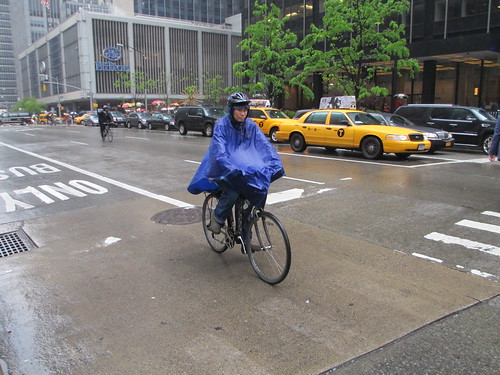
 
Delivery cyclist, rain, Sixth Avenue.
Sure, you might sometimes choose to ride in such weather.
But would you want to ride in it or be fired?
It’s probably revealing that I got into the discussion having mistaken the delivery biker for a neighbour. I regularly engage other commuter cyclists in chat at traffic lights. I remark on their bikes (especially if they’re fellow Surly owners) the weather (alternately superb or not a great advert for cycle commuting) or the behaviour of New York City drivers (on whom I don’t generally heap praise). I don’t on the other hand tend to strike up conversation if I find myself next to a man with bags of lo mein dangling from his handlebars or carrying a basketful of tacos. I don’t seem to regard these cyclists – or, to some extent, working cyclists generally – as part of my cycling tribe.

City authorities worldwide tend to be still less warm-hearted. The couriers that played a vital role in ferrying documents around the City of London were a still bigger target for the City Police’s ire than cyclists in general. New York City Council has a history of regarding the working cyclist – the person who delivers the documents and food that keep the city’s financial services and media industries functioning and fuelled – as a problem on a par with the city’s rat or bedbug problem. It probably can’t be stamped out but needs controlling by whatever means possible.

New York's City Council also seems to listen to working cyclists – who work long hours in far-from-safe conditions for minimal wages – about as attentively as it listens to the vermin. I’ve never seen any sign that the city councillors most vocal about the delivery bikers’ perceived shortcomings are pressing their employers significantly to improve their conditions. Nor have I heard of any taking any interest in the welfare of the bikers who deliver their own pizza or noodle boxes.

Yet working cyclists are the only cyclists in most big cities whose numbers and cycling conditions non-cyclists can directly influence. Call out for lunch and you’re pitching some poor Vietnamese or Mexican delivery cyclist onto the streets, regardless of whether or not you think they’re safe. Tell your secretary in Mayfair to get a document to Canary Wharf within an hour and you’re ensuring that some young man on a fixed wheel bike has to fight his way through Piccadilly’s traffic in a hurry.
 
Snow in March: Thoughtful New Yorkers preferred letting
cyclists riding in this to messing up their shoes
The working cyclist’s plight came home to me particularly starkly in March, when a surprise late snowfall blew in, turning midtown Manhattan into a miserable, low-visibility mess of slush and dampness. It was one of a handful of days since I arrived in New York that I decided cycling wasn’t the best way to get to work. Other commuter cyclists, I knew, were forsaking their normal means of transport for the comforts – if that isn’t too strong a word – of the subway. But, as I walked, head down, towards my lunchtime kebab cart, I noticed there seemed to be more delivery bikers than normal out there, not fewer. In the skyscrapers around me, office workers were looking out their windows, shuddering at the idea of subjecting their fancy shoes to the soggy sidewalks and phoning for some poor immigrant to bring them lunch on his bike instead.

But, while the delivery cyclist bringing food or documents to one’s own desk is performing a vital service, those serving other people’s needs seem to be a confounded nuisance. Bike couriers tend to be firmly among the "cyclists who get cycling a bad name" for the kind of person who sucks his or her teeth over the behaviour of London cyclists. In New York, it's axiomatic to complain that food delivery bikers all constantly ride the wrong way down one-way streets, terrorise pedestrians at red lights and ride on the sidewalks. New York City Council’s transport committee, putting to one side the challenges of tackling the city's 250 to 300 annual deaths in motor vehicle crashes, has passed a bill in the past year demanding, among other things, that delivery cyclists display a personal identification number and the identification of their business. There’s also been an attempt to crack down harder on e-assist bikes – a fairly transparent effort to get at a means of transport popular with delivery cyclists.

The very name of one piece of city council legislation raises questions about how big a problem delivery bikers really are. The law is named after Stuart Gruskin, who died after being hit by a delivery cyclist going the wrong way on a street in March 2009. Tragic and painful though Mr Gruskin’s loss undoubtedly must remain for his family, no-one has died after colliding with a cyclist in New York City in the four years since.

I certainly wouldn't defend all working cyclists' standards. I had a nasty near-miss in Cobble Hill late one night with a delivery cyclist who ran a red light into my path. I’m frequently unimpressed with the way some riders squeeze past me in the evening on the W55 street bike lane. The only other cyclist I’ve ever knocked off was a courier who made a foolhardy, last-minute swing in front of me at a junction in London just as the lights turned green.

I do, however, recognise that even I find New York's grid system frustrating as a cyclist - and I have the luxury of never riding in city traffic more than a few times a day and not losing any pay if I'm late.  Would I follow all the street direction rules if the restaurant where I worked were on a one-way street and it would add five minutes to every trip to go the right way round the block to reach it? Would I wait at the lights every time if I knew that doing so would leave me scores of times a day jostling with several streams of fast-moving, inconsiderate taxis? Would I expect my bosses to back me if I explained that my productivity was lower than other delivery bikers’ because unlike them I assiduously followed the rules?
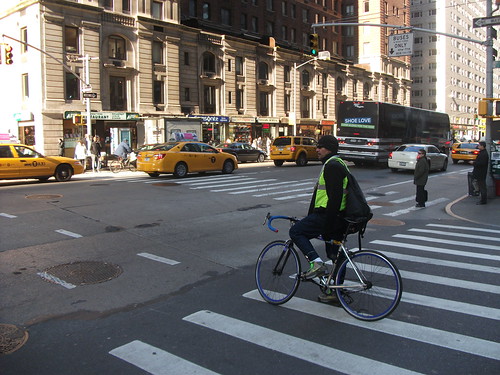
A courier on W55th street. It's the kind of day when
riding round the city must have its upsides.
But would you want to judge the traffic lights knowing
doing so all day could lob a fifth off your wages?


It would be easy to construct an alternative narrative about working cyclists. They are after all ready every day to take significant risks in traffic, get food and documents to people faster than a motor vehicle could and create virtually no carbon emissions or pollution in doing so. I admired how the delivery bikers in March's snow negotiated piles of slush that must be making conditions under their wheels treacherous. I tend to believe that a great deal of the anger directed at delivery cyclists reflects general prejudices against cyclists. In the case of food delivery bikers, there's the added element of the racism often directed at poor immigrants in unpopular, poorly-paid jobs.

There should certainly be some scope for cycling advocacy groups to stand alongside working cyclists on some issues. It's hard to imagine that a movement in the highly-fragmented, ultra-competitive New York catering industry will look quite the same but in New York in 1987 couriers and commuter cyclists stood together against efforts by Ed Koch, then mayor of New York, to ban day-time cycling in midtown Manhattan. The measure was intended mainly to make bike couriers' lives more difficult. The successful protest movement encouraged the development of some of the cycling advocacy groups still at work today in New York.

All delivery cyclists, meanwhile, can deploy the devastating argument that occurred to me when, one Saturday afternoon, my family and I were passed far too close in Brooklyn Heights by a poorly-driven car bearing the logo of a nearby pizza restaurant. The alternative to negligently, lawlessly handled delivery bicycles probably isn't polite, legal delivery bikes but negligently, lawlessly-driven motor vehicles. It may even - who knows? - have been that the restaurant turned to cars to avoid New York's new, strict delivery biker regulations.

Sure, it's annoying that the delivery guy from the local Mexican comes the wrong way down the bike lane at you. Sure, the pizza joint guy shouldn't have buzzed you in the crosswalk as you crossed. But thank goodness they didn't do it with a car.

Sunday, 19 May 2013

Routes - and Why I Prefer Developing my Hippocampus to my Quadriceps

It’s fairly easy for even a casual observer to spot what cycling does for some bits of my body. While I’m far less fit than I’d like to be, I boast thighs that some mature trees would be happy to call their trunks. Since moving to New York and cycling farther each day, I’ve also lost some weight, as testified to by the sag in my trousers’ waistbands below the belt loops.

I’ll probably never know, however, precisely what I’m doing to the posteriors of my hippocampi, two tiny glands on either side of my brain that help me to find my way around. I get just as much satisfaction, nevertheless, from the idea that I’m making them bigger, more complicated and more useful than they used to be as I do from my bulging thighs and slimming-if-still-overlarge waist.
 
The Invisible Visible Man's CaBi bike at Union Station:
mission accomplished
That satisfaction came home to me particularly forcefully this past week after I conquered my nervousness to have a go at cycling between Arlington, Virginia and my train home from Washington’s Union Station. I headed off tentatively on a Capital Bikeshare bike, worrying that my only rudimentary sense of the area’s geography would soon leave me hopelessly lost. I very nearly gave up immediately after getting the bike out of the docking station, alarmed at the bike’s handling when loaded with all my various bits of baggage.

An hour or so later, however, I was pushing the bike’s wheel into the Union Station docking station, feeling strangely elated. It was, it occurred to me, the kind of satisfaction that's soon going to be available to more people in New York, with the introduction of the Citibike bike share system. I’d tackled the mental puzzle of working out my way and reached a satisfactory conclusion.

My interest in the hippocampus dates back, however, to long before I ever set foot in the United States. I first heard of the brain structure while studying psychology at St Andrews University. I particularly associate it with a visit once with a friend to a room lined with cages full of rats. The friend was a PhD student working with the rats on neurophysiology, had gone in to check on them over the weekend and invited me along.

On the room’s ceiling, I could see the outline of a now-removed round disc. It marked, my friend told me, where Richard Morris, a neurophysiologist, had first conducted a famous experiment on the hippocampus’s role. He had set up a pool in the room with a hidden platform that the rats had to find. A video camera in the ceiling disc’s middle tracked their progress. Rats proved good at learning where the platform was. But, when Prof Morris injected a drug into their hippocampi to stop them working, they were no longer able reliably to locate it. The hippocampus seemed to organise their memory for direction.
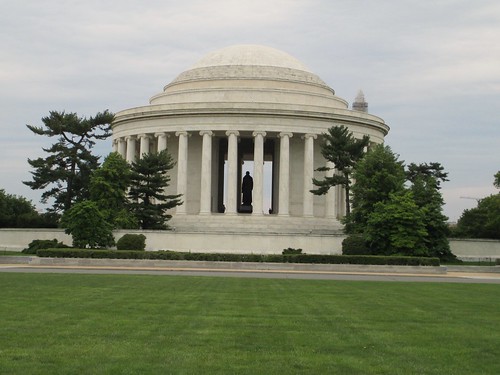
The Jefferson Memorial, during my great, trans-Washington
bike ride. Yeah, the picture's squint. I took it seated on a bike.
Get used to it already.

I made a connection between the hippocampus and my getting about by bike when I heard about Eileen Maguire’s research on taxi drivers. In a series of studies, Prof Maguire – of University College London - has examined changes in the posterior hippocampus in London taxi drivers as they first learn the Knowledge – the test they have to pass on the city’s geography – then apply it. The posterior hippocampus – the rear part of the structure - tended to be bigger and more complex in drivers who had passed the Knowledge than in would-be drivers who had failed it, she found.

My brain, I recognised, was probably undergoing similar changes to the taxi drivers’. The gradual trial-and-error process of learning how best to get to a place – the frustration at missing that vital turning again, the fear at suddenly finding oneself unintentionally on an over-busy road, the satisfaction on finally getting a route right – were playing themselves out in my hippocampi. New neurons were growing and new connections were forming as I gradually built up a more solid picture of the best ways to get about.
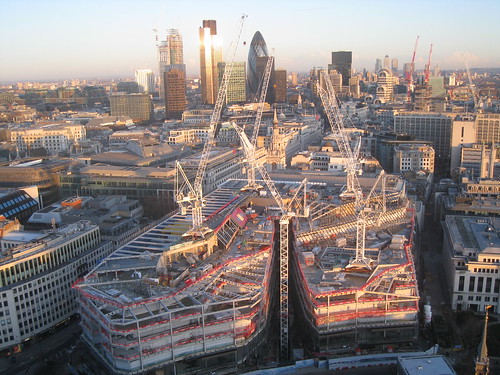
Streets in the City of London: it may look a mess to you -
but the Invisible Visible Man's mental maps can help you
round this maze

The process, however, has been nothing like as clinical as a neurophysiological description might imply. I recall, for example, how, shortly after moving south from Edinburgh in 1997, I set off, cycle map in pocket, to work out my route from home in Brixton to my employer’s offices. The 4½ mile journey took me 45 minutes of missing turnings in my bike route, failing to understand how traffic flows worked and repeatedly checking the map.

Latterly in London, I could make it home on a good night in 20 minutes – albeit down busier main roads. My mental map of South London’s cycling routes could switch more smoothly and efficiently than any satellite navigation device. By the time I left London, I knew every pothole and manhole cover of many of the roads I’d cycled most often, preparing to avoid them well before I had reached them.

My mental map spread well beyond my regular commuting area. I’d feel a little surge of excitement if, for example, I got invited to some press event 15 miles from the office in Wembley. Why, I hardly ever got to use my carefully-memorised route out to that area, I’d think to myself. I was surprised and delighted one time when I found another reporter had made the same decision as I to cycle from Central London. We earnestly swapped thoughts on busy roads and helpful shortcuts.
 
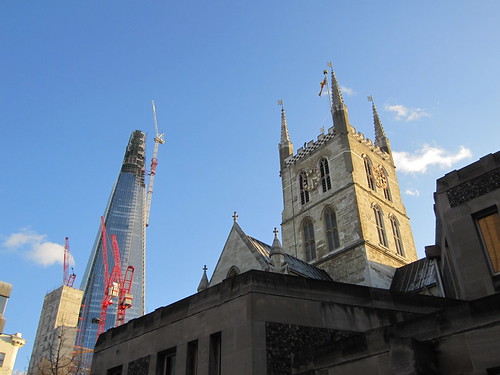
The Shard: on my route to City Airport
It was my enthusiasm for the route that gave me a bias in favour of flying from London City Airport. My route for the 13 or so miles from my house to the airport – which distinguished itself by having good bike parking – was, I often felt, something of a work of art. I would pedal across the Thames, down Cable Street in the densely-packed East End, past Canary Wharf, then out into the grim housing estates of still working-class docklands. I would encounter evidence of every period in London’s history, from the Romans to the new Shard skyscraper. There can be few better ways of feeling at one with a city than to know intimately a route like the one I used to reach City Airport. It would take me from a beautiful but obscure quiet Georgian Square then out across the internationally-recognised landmark of Tower Bridge.

I’ve experienced something similar in New York. When apartment hunting, I found myself a couple of times nastily off course – on the wrong side of a busy expressway from where I wanted to be or careering down a six-lane avenue of scary, fast-moving traffic. But I know my mental map of the city is slowly but surely stitching together, somewhere in the back of my hippocampi. Without thought, I head north a couple of blocks to avoid the most constricted sections of W54 street most mornings, then south again before the office. I’ve been trying out a route up the east side bike path some other mornings. I take joy in now knowing the Lexington-Park-Madison-5th sequence of avenues I cross as I head to work. But I shun that route in the evenings, well aware, after previous experience, of the miseries of trying to head southbound on 2nd avenue.

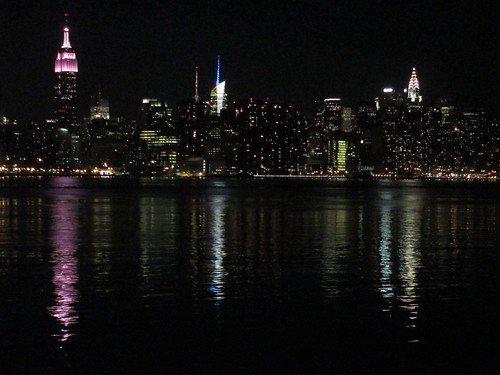
The Empire State Building in pink:
cycling to photograph it was more fun for me than a party
I felt that same sense of having access to secrets of the city closed to others when, one night recently, my employer organised on the Upper East Side a party to celebrate its 125th anniversary. As others headed off afterwards to an after-party, I made excuses – but knew my main motivation was my desire to try the way home I’d crafted in my head. Before long, I was bowling down from the top of the Queensboro Bridge’s bike path, which I last used regularly in the aftermath of Superstorm Sandy. Then I was into Queens and navigating streets under elevated subway lines so romantically urban they should have had a permanent Chicago Blues soundtrack.
 
I looked across as I headed down the East River at the Empire State building, lit up pink in honour of the anniversary. I was, I felt sure, enjoying myself far more on this solitary exploration of the city than anyone yelling at a colleague to be heard over the music at the party.

Which brings me back to Washington.

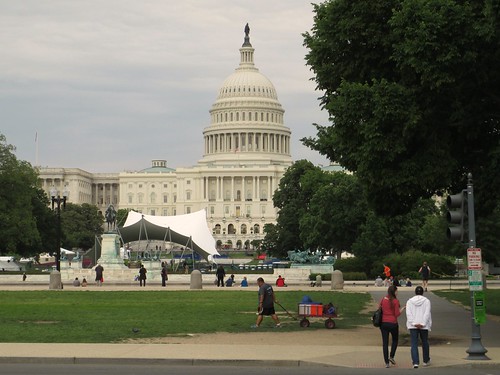
The US Capitol: how to get there by bike is now fixed in
the Invisible Visible Man's hippocampi
Whatever my initial misgivings, they disappeared immediately I found myself on a bike path by the Potomac and catching my first glimpse of the Jefferson memorial and US capitol sitting on the other side. I sped – as much as one can on a bikeshare bike – over the 14th street Bridge and slowly worked out the best route along the National Mall. A little bit of guesswork once I’d got north of Pennsylvania Avenue and I was finally at the station, embarrassed to find myself feeling little less elated than Edmund Hillary can have felt on his first conquest of Everest.

But there were, it came to me, few satisfactions in life more total than completing such a journey. I had set out to tackle a challenge and, as I pushed the bike back into the docking station, comprehensively conquered it. I had made the journey entirely on my own resources. And, somewhere in my two hippocampi, just as those rats in St Andrews learnt where the platform was, my mental maps for cycling in Washington and northern Virginia were starting to form.

Sunday, 28 April 2013

Boston, bikelessness and how cycling makes me feel at home

The policeman stood in the middle of Arsenal Street, the main road through Watertown, Massachusetts, and screamed at any vehicle that didn’t belong to some arm of law enforcement or the emergency services: “Turn round! You need to get turned round!” Either side of him in the 1am dark sped, flashed and wailed a procession of emergency vehicles of a variety and quantity that, even in a career where I’ve covered a reasonable amount of terrorism and other trouble, I had never before seen.

A little up the road, I now know, Tamerlan Tsarnaev, one of the presumed bombers of the Boston Marathon, already lay dead. Somewhere else in the nearby suburban streets, Dzhokhar Tsarnaev, his brother, was hiding, trying to evade the arrest that would come around 18 hours later. And my attention, for at least a few seconds, was focused on a bicycle.
 
Practicalities: a board in a Boston hotel gives
post-bombing advice
It was one of the themes of the week I spent in the Boston area, starting a week ago last Monday, covering the aftermath of the bombings at the annual marathon, that I often found myself staring longingly at bicycles. I missed my wife and children very much. I was moved at some of the expressions of shock and grief I encountered. But the sight of people on bicycles provided a persistent, nagging reminder of what I was missing about my everyday life. Those people, for that moment, could experience the uncomplicated feeling of freedom that so often comes from riding on a bicycle – and I couldn’t.

The whole episode started, however, with an unusually frantic bike ride – from my office in Manhattan across the Brooklyn Bridge home to Brooklyn, to pick up my laptop, a change of clothes and washbag. A little over two hours before, two bombs had gone off near the finish line for the Boston marathon. My bosses wanted someone to get up there and, after some discussion, it was decided the person would be I. I pedalled as fast a I could in the warm early evening sunshine, fretting all the while about whether I would have enough time to get back to Pennsylvania Station for my train. Then, having transferred a few notebooks, a rain jacket and some other essentials out of my pannier bags into my overnight case, I headed out for the subway station – and into what turned out to be a week of that sad state known as bikelessness.

I didn’t, of course, worry too much about my transit status in my initial panic as I rode north. I had been to Boston only once before, in 1999, and would, I knew, have to find a way to file some kind of story about the scene there immediately after I arrived at midnight. I scoured maps to work out where I’d be arriving and where the bombs had gone off. I arrived in a city still festooned with signs and portable toilets put out for the marathon. The discarded runners’ heat sheets, the heavy police and national guard presence and the chaotic pile of wheelchairs outside a medical tent testified to the chaos in which the event had ended.
 
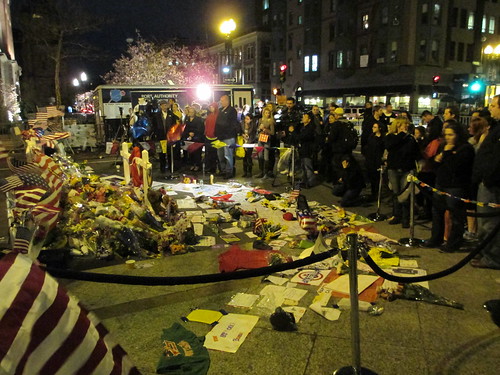
Grief: how Boston's people marked the bombings
Even as I took in the scene for my first piece, however, I found my gaze wandering. Two cyclists stopped at the junction of Arlington and Boylston streets to look in the darkness towards where the bombs had gone off. “Fixed wheel,” I thought to myself. “I wonder if they’re more popular in Boston than in New York.” They pedalled slowly off, their lights pin pricks in the darkness. I took a taxi to a distant, expensive hotel, filed a short piece about the scene, had a few hours’ sleep and woke up again, launching myself into several frantic days of rushing around the city on the tail of the latest overheated rumour about what was going on.

I got about a lot over the next couple of days by public transport. In my tired and over-emotional state, I felt a particular pang about not being able to discuss Boston’s subway – the T – with my late father, who worked on metros all his life. He would, it occurred to me, have enjoyed discussing the vagaries of the US’s oldest subway. I took the T on Wednesday to Boston’s federal court house, as a crowd gathered outside on false reports that two arrested suspects were about to arrive there.

I had spotted by this time the Hubway bikeshare station outside my new, downtown hotel. But it seemed a stretch to use it to reach Thursday’s post-bombing Service of Healing. I had no idea where the vast police cordon around Holy Cross Cathedral designed to protect the visiting President Obama would spread. So I walked that and many other trips over the week – peering at the cyclists, trying to work out how their journeys to work compared with mine, what the cyclists were making of the events in the city and whether Boston’s drivers were any more friendly to bikes than New York’s. I looked out, too, for Boston’s most celebrated cycle blogger – Bikeyface – but saw no-one who looked like a pen-and-ink drawing and gave up.
 
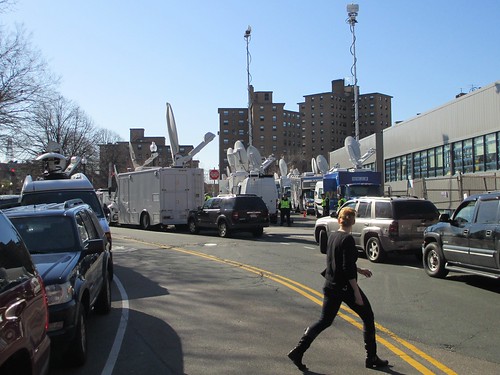
Satellite trucks outside the Service of Healing:
reporters kept finding something in their eyes
I reported on the service – inwardly noting how many fellow reporters, struggling with their feelings much as I was, were wiping something out of their eyes. Some even joined in the applause and standing ovation for the president. I prepared to write a long, considered piece for the weekend about the bombings’ impact on Boston. I made a mental note that, as interest in the attacks waned, some time over the next couple of days I would get out one of those Hubway bikes and take it for an explore of the city.

It wasn’t to work out like that. On Thursday evening, as I worked on my long, considered piece, an email from a colleague alerted me to an apparent disturbance over the Charles River on the campus of the Massachusetts Institute of Technology. Exhausted and preoccupied with the piece I was trying to write, I nevertheless caught a taxi to a site that turned out to be swarming with police. I started writing a story on my BlackBerry and talking to a news editor in Hong Kong. Then, seeing scores of police vehicles speeding away from MIT, I caught another taxi, with a French TV reporter, to Watertown, where I encountered the screaming, panicky policeman.

Yet, amid that chaos, the detail that caught my eye was the Hubway bike. Somehow, amid the chaos and confusion of one of Boston’s most extraordinary nights, a fellow reporter had responded to the injunction to get out to Watertown as fast as he could by hiring a Hubway bike and pedalling more than five miles by the Charles River out to this suddenly world-famous patch of suburbia. I felt an instant sense of fellowship with the person involved – I recalled how I had cycled across London to get to the site of the 2005 Edgware Road bombing during the July 7 attacks on London. I respected, too, his extraordinary bravery – scores of screaming emergency vehicles must have made even worse road-fellows than the worst New York City-area drivers. Then, before I could make my fellow reporter’s acquaintance, my mobile ‘phone died. I was forced to hail an arriving reporter’s taxi back into central Boston.

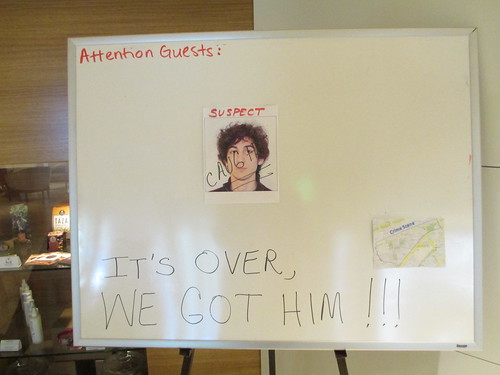
That hotel whiteboard after Dzhokhar's arrest:
because sometimes crass triumphalism just feels right
I recognised, nevertheless, the sense of community I’d felt on spotting another cyclist and sought it out again. I chatted amiably on Friday to two young reporters who had cycled to Watertown’s media staging area as we awaited news of the eventually successful hunt for Dzhokhar. I looked over the shoulder of a photographer who had reached near the site of his eventual arrest by bike and grabbed unusually good pictures. On Saturday, seeking out the opinion of people in Cambridge, Massachusetts, at having had two terrorists living in their midst, I went up to a woman practising in a park riding in clipless shoes. I felt an instant sense of warmth for each of these people – a knowledge that each of us knew the pleasure of getting about under one’s own power, the joy of speeding down a hill, the satisfaction of climbing one. Those moments of fellowship did a great deal to keep me going until the point last Sunday afternoon when I was finally able to return to Back Bay Station and put myself aboard a fast train bound for New York City.

That journey inevitably began a long unwinding process. I took the Monday off work, catching up with undone tasks and giving my bike an overdue degrease, clean and lubricate. A cycling neighbour chatted amiably as I worked at the task in our building’s back yard.

Come Tuesday morning, however, it came time to return to normal. Having dashed about for a week covering one of the world’s biggest news stories, I was back to the unforgiving schedule of writing up company results. The change of pace under such circumstances can be as wearing as the process of covering the big story itself.

But, for the first time in more than a week, I was swinging my leg over my Brooks saddle, pushing down on my pedals and rolling off onto New York City’s streets. There was a steady drizzle in the air and a blustery wind. It was far from an ideal day for cycling. A week away from it, however, had made me realise that this activity made me feel at home, regardless of where I undertook it.

This post is an entirely personal, private post and in no way reflects the views of my employer

Sunday, 14 April 2013

A broken-down church - and a broken, asymmetric flow of information

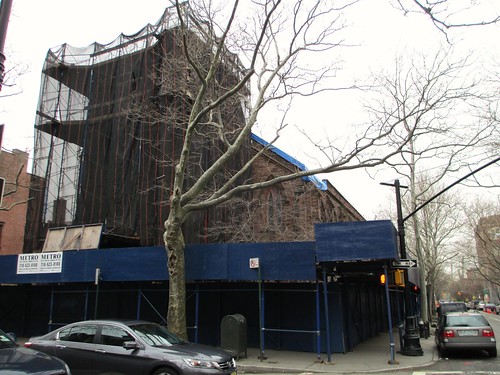
I was only a little way into my first ride to work after moving into my apartment in Brooklyn when I started to get into a terrible tangle. Trying to get down Kane Street, in Cobble Hill, I found the road marked closed. After heading past the road cones, I found it was a proper road closure, not the kind where one just wheels the bike on the sidewalk past the obstruction. The closure was absurd, I muttered to myself, as the one-way system pushed my route further and further from the one I’d planned. It was, I reasoned, probably some piece of stupidity on the part of the police, worried about being sued over an unlikely accident near some relatively innocuous building work.
Christ Church, Cobble Hill: source of frustration on
the Invisible Visible Man's commute

I calmed down considerably, however, after finding out via Google why the street was closed. On July 26, while I had been back in Europe, lightning had struck Christ Church, the Episcopal church at the junction of Clinton Street and Kane Street. The spectacular tower – and scaffolding around it – had come crashing down as Richard Schwartz, a pedestrian, was walking underneath. The falling scaffolding had killed him. The building was a serious danger – and hadn’t yet been made safe.

The incident helped to crystallise an idea that had been slopping in fluid form around my mind for a while. I’d never have been irritated about the Kane St closure, I realised, if I’d had better information in the first place. It was, it occurred to me, one of many instances where confusion arises because two different parties – the New York City Department of Transportation and myself, in the Kane Street case – have different understandings of what’s going on on a road. The asymmetric information sharing had at least left me only inwardly irritated, however. The more I thought about it, the more I realised there were times when such information asymmetry probably killed people.

I encountered one potentially serious example the other morning while riding to work. I waited at traffic lights by the start of the Tillary Street segregated bike lane near the Brooklyn Bridge. When the lights changed, I moved off, only to find turning across my path a car heading in the other direction that should have been yielding to me. The driver’s behaviour was entirely wrong, based on his failure to understand what I knew - that the bike lane was as much part of the traffic flow at the intersection as the roads he was using. But, as he moved across my path, he leant out of his window. “Green light!” he yelled at me, self-righteously.

Traffic on W54th street. Those tainted windows don't,
in the Invisible Visible Man's experience, conceal
motorists pondering hard what information they might lack
about other road users' rights
Cycle lanes can give rise to information asymmetry as well. As I approached my office one morning last month, a truck driver opened his door in my path as I made my way up the side of some stalled traffic. He didn’t need to look for cyclists on that side of W54th street, he argued, because there was a bike lane painted down the other. Because of our asymmetric understanding of cyclists’ road rights, he had understood the cycle lane – which I knew to be a refuge for cyclists that didn’t stop me from using the rest of the road – as a kind of prison, to which cyclists should be confined.

Perhaps the most striking and persistent problem of information asymmetry that I’ve come across, however, was in London, where I lived until last August. Most traffic lights at busy intersections in London feature an “advanced stop line” for cyclists – an area where cyclists are meant to wait ahead of the other traffic for the lights to change. Many cyclists value advance stop lines as an idea, since they should, in theory, allow cyclists to get away after lights change, get clipped back into their pedals and get back into a suitable line on the road before the motor traffic catches up. Few motorists, however, seem to have much idea either about the principles of the advanced stop areas or when they should stay out of them. At least one motorist informed me, indignantly, when I complained about his occupying the area that when he’d arrived there had been no cyclists waiting, so he’d simply driven into the bike area.

Advance stop lines were involved in all three of the worst confrontations I had with motorists in London. In one case, a motorist deliberately drove very close to me and then very dangerously overtook me after I remonstrated with him about his driving into the ASL area as I was using it. A bus driver assaulted me (abandoning a bus full of passengers to do so) after I photographed his occupying the ASL area at a particularly dangerous junction. I had to call the police to stave off a threatened assault from another motorist to whom I’d complained about his driving into the ASL area.

Leaving aside the more eye-catching incidents, ASLs were a daily source of tension and frustration. I’d often squeeze past a line of stationary traffic to reach what was meant to be a haven for cyclists – only to fill it full of motorists grumpy at one’s presumption in seeking to get a jump on them at the lights. It’s reasonable, I think, to assume that even a fairly modest publicity campaign might have let at least a little of the fresh air of information into the foetid atmosphere of confrontation surrounding ASLs. In New York, it surely wouldn’t take much of a campaign to educate drivers about the role of bike lanes and the dangers of passing bikes too close to improve driving standards at least a little bit. The New York cycling map, after all, features excellent advice for cyclists on how motorists should give cyclists at least three feet's clearance when passing.

It isn’t, after all, a neutral thing to encourage new cyclists onto a city’s streets and then not tell motorists how to behave around them. Nature seems to abhor an information vacuum just as much as a literal one. In the absence of the pure oxygen of accurate, well-founded information, the information vacuum fills up with the carbon-monoxide-laden air of motorists’ assumptions about cyclists’ rights and responsibilities. It’s perhaps hardly surprising, given that no-one’s telling them otherwise, that so many motorists assume cyclists who ride well outside the door zone away from cars are acting maliciously, rather than entirely sensibly. In New York, it’s still less surprising given how many bike lanes – including most of those I use every day – are painted in precisely the part of the road – next to the parked cars’ doors – that cyclists know to be the most dangerous.

The air has grown still more poisoned because the agency meant to set the limits of acceptable behaviour in most modern societies – the police force – so often seems to have abandoned that role with regard to the road rules. Motorists, after all, like most other people see what they see others doing unmolested and assume it’s acceptable. One telling recent case I spotted involved a police effort to start fining motorists who drove in a bike lane on a narrow street at Twickenham, in South-West London (I’ll give New York cyclists a moment here to come to terms with the idea that, just across the Atlantic, there’s a police force that has, at least once, acted against motorists using a bike lane). A local newspaper quoted Nick Blyth, an officer involved in the enforcement effort, as saying: “Most of the motorists tend to comment when stopped that everyone else does it and they were just following them.”
 
Park right across one of New York City's busiest bike lanes?
Until someone says you shouldn't, you probably will.
It’s hardly surprising, given the New York Police Department’s reluctance to enforce a wide swathe of road rules, that few motorists seem even to understand the harm they cause when double-parking in bike lanes or refusing to yield to a cyclist in a bike lane. Nor, in London, is it terribly surprising that ASL infringements continue at the rate they do when even the Metropolitan Police department charged with processing complaints against motorists from cyclists (normally backed by helmet camera evidence) is currently pleading with leading London cycle bloggers to tell people to send in no more pictures of ASL infringements. They say, to all intents and purposes, they’ve no interest in prosecuting them.

The police’s attitude reflects, in an understated way, the strangeness of the political discourse around cycling. Politicians are eager, when announcing new policies between elections, to borrow cycling’s mantle of greenness and modernity and to encourage its growth. Closer to election time, meanwhile, many seem to revert to a different type – to claiming, like one minister I met, that cyclists were“their own worst enemies” or claiming like Boris Johnson, London’s mayor, that “typical” cyclists had skinny legs and ran red lights. No politician engaged in this delicate dance between pro and anti-cycling positions is likely to back a public information campaign explaining to frustrated motorists why, yes, that cyclist who yelled at you about your dangerous driving actually had an excellent point.

However, until such information is made more widely available and police across the industrialised world are backing up the politicians’ line with proper enforcement, few people will experience the relief I felt at letting go of my frustration over the Kane St closure. Relief is certainly not the emotion that comes naturally to me each morning as I ride along the now-reopened Clinton St towards the Brooklyn Bridge. I am all too often forced into the narrow bike lane, in danger from car doors, as motorists seek to push past me. But, as I reach the Kane St intersection and see Christ Church, still wrecked but now made safe, I still recall at least a little bit of that feeling.

Sunday, 31 March 2013

A pain to use but a joy to be on: in praise of the Brooklyn Bridge

It was when my then 10-month-old son refused to go back to sleep one morning in July 2008 that I first crossed the Brooklyn Bridge. We were on holiday (vacation) staying in TriBeCa. On our second morning, the jetlag from flying from London not yet having worn off, he wouldn’t nod off again after waking up at 5am. I’d headed south with him the previous morning, down towards the Staten Island ferry terminal. This time, I decided, it was about time I saw this bridge across the East River that I hadn’t properly seen on any previous visit to New York.
 
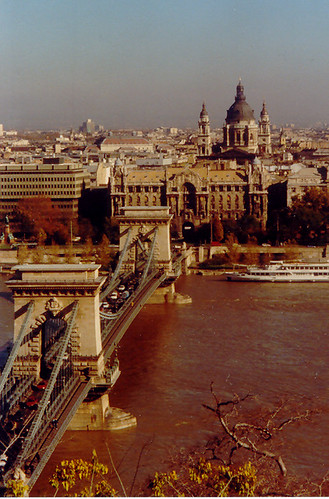
Budapest's Chain Bridge:
diminished my expectations
Other old bridges in cities had shaped my expectations. I’d cycled across the Chain Bridge in Budapest – another 19th century suspension bridge. I’d ridden over pretty much every Thames crossing between Tower Bridge and Windsor. I’d walked over the Clifton suspension bridge in Bristol. I had even noticed – with mild irritation – the numerous references in The Path Between the Seas, David McCullough’s fine history of the building of the Panama Canal, to the Brooklyn Bridge. He had written a previous book on the subject. How big a deal, I wondered, could a bridge across a river in the middle of a city be?

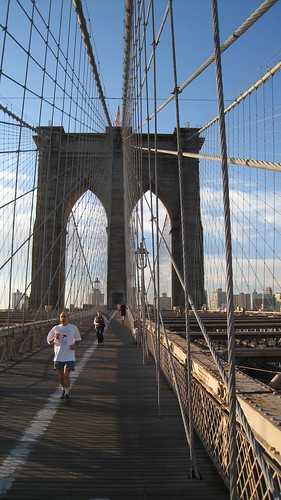
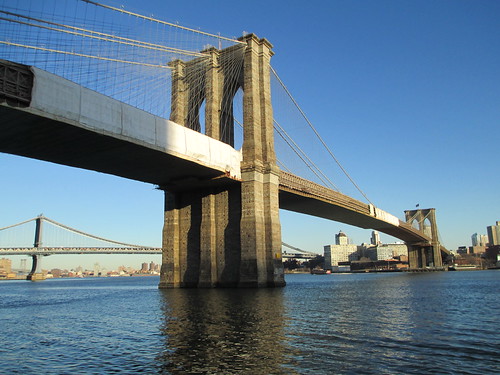
All of which meant I was unprepared for what I encountered as I pushed my little boy’s pushchair (stroller) over the road beyond City Hall Park and started out on the long, sloping walkway. The twin archways of the bridge’s Manhattan pier stood hundreds of yards away, towering over even many tall New York buildings. The four enormous main suspension cables reinforced the bridge’s scale.
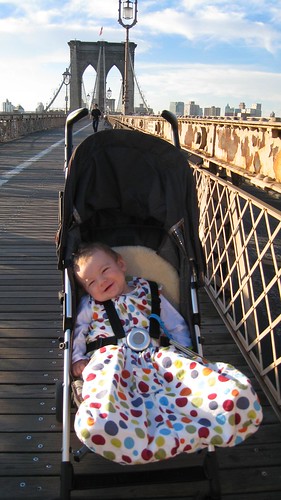
The Invisible Visible Boy:
wide awake on his first visit
to the Brooklyn Bridge
This, I suddenly realised, was more like some vast, cross-estuary bridge – I’ve ridden in the past over the Erskine, Forth and Tay bridges in Scotland – than almost anything I’d previously encountered in a city. Yet it was nearly 100 years older than most of those similar spans and taking off from the middle of one of the most densely-packed sections of one of the most densely-packed cities on earth.

I also, as I made my way out towards Brooklyn, started to notice the Manhattan-bound cyclists freewheeling down the slope. There were, it occurred to me, some lucky souls who got to commute by bike every morning over this marvel of engineering, taking in one of the world’s great views – lower Manhattan’s clustered skyscrapers. As I rolled the still wide-awake boy over the bridge, at an hour I’d normally still be sleeping, I started to imagine an alternative life from our existence in London. We would live in Brooklyn and I would get on my bike each morning and ride, amid the drama of the Brooklyn Bridge, to my job in Manhattan.

There will by this point be many people familiar with cycling in New York puzzled at my enconium for this particular bridge – and for good reason. The Brooklyn Bridge, oldest of the fixed East River crossings and the most distinctive, suffers as a place to cycle from its celebrity. I have endured journeys on sunny Saturdays when I’ve spent virtually every yard of the main crossing ringing my bell, shouting warnings or braking suddenly as heedless tourists have wandered into my path. I had a young woman shout at me, “This is a tourist area!” after I tutted at her dumping her suitcase right in the cycle lane by the Manhattan pier. Her view failed, I thought, to capture the structure's fundamental bridge-iness. Most bizarrely of all, I once had a wedding party remonstrate with me that I was cycling too fast (at a sedate 12mph) and had disrupted their efforts to pose for wedding photos in the bridge’s bike lane. I suggested that, if they didn’t mind obstructing traffic, the view from one of the adjacent car lanes might be even better.

But the challenges of using the bridge shouldn’t obscure how marvellous and unique a structure the bridge is. Using it can be one of those interactions with a city that cyclists are peculiarly privileged to enjoy. The bridge played a significant role in forming the current New York City. It's no accident that it was only in 1898, after the bridge's completion in 1883, that the cities of New York and Brooklyn merged to form one metropolis.
 
John Roebling's Gothic arches:
a bit mad when you think about it.
The aesthetics of the Great East River Bridge – as it was known during construction – also summarise something about the city itself. When John Roebling, the bridge’s designer, was planning it in the 1860s, he could easily have gone for a different look. There is, in retrospect, something eccentric about giving what was then the world’s most ambitious, modern bridge two twin stone archways in the European gothic style. The mixture of modern steel cables and gothic styling must initially have seemed as strange as, say, one of the modern-day shopping malls in Dubai themed around the medieval Muslim world.

Yet the slightly pompous adoption of European styles and modern construction techniques turned out to be the perfect mixture for a city taking over from Europe the mantle of world leadership. There were buildings in New York and Brooklyn in an archaic style before the Great Bridge. But it’s hard to believe that mixture of old and new would have become quite as prevalent without the Roeblings’ bridge. Look at the Brooklyn Bridge’s towers and you’re seeing, right there, where Gotham City’s Gothic aesthetic was born. It helps that the bridge's mix of styles is unique. As McCullough's book points out, it was one of the first suspension bridges on such a scale – but the last big one before steel towers became standard. None of the Great Bridge’s East River successors features the mixture of stone and steel.

The commemorative plaque: heroes and villains side by side
A stop I made one morning in early March, however, has prompted me also to think about the human stories behind the bridge's construction as I ride across. Stopping to change from my warm cycling jacket to a cooler high-visibility vest, I spotted above where I rested my bike, on the bridge’s Brooklyn tower, the plaque that was unveiled on May 24, 1883 when the bridge, after 14 years’ work, finally opened to the public. Having read McCullough’s The Great Bridge since that day in 2008, I found many of the names bringing incidents during its building vividly to mind.

The name John Roebling, the bridge’s original engineer, was marked with a small cross and the date 1869. He had, I knew, died slowly and painfully of tetanus after being injured surveying the bridge’s Brooklyn landing, on a spot almost precisely below where I stood. The cables above my head – a mixture of stays to hold the bridge deck steady and conventional suspension cables - bore testimony to his continuing influence. Such dual sets of cables were a trademark of his bridge designs – and testimony to his caution and thoroughness.

The name Washington Roebling, John’s son, below him, conjured up still more stories. He suffered terribly for years from the effects – both on his nerves and his body – of tackling a fierce fire in the caisson that formed the base of the bridge’s Brooklyn tower. The caisson, complete with the wood he personally repaired, was on the river bed, directly below my feet.
 
The bridge from Manhattan: dodgy wire and all
The list of the bridge’s trustees was less inspiring, meanwhile. Henry Murphy and William Kingsley, the president and vice-president of the board, had both been involved in awarding the contract to make wires for the suspension cable to J Lloyd Haigh, a shady Brooklyn contractor. Haigh perpetrated a long-running fraud to supply the bridge with sub-standard wire. It was thanks to them that the cables whose width I'd noticed in July 2008 were so thick. Washington Roebling had added extra wire to them to protect against weaknesses in the sub-standard wire, still in place more than 130 years on.

I looked at the plaque with far less insight back in 2008. My son had finally fallen asleep when I reached the Brooklyn pier and I turned back towards Manhattan, eager to suggest the Invisible Visible Woman and the Invisible Visible Girl come back with us for a second visit to the bridge. That second visit - and a picnic lunch the next day with two old friends in Fort Greene - further nurtured my growing idea of how we could live in New York. The notion of relocation to the Big Apple remained strong enough, even though the prospects of its happening seemed remote, that I rhapsodised on the possibility of commuting over the Brooklyn Bridge in the first post on this blog. The notion made me all the keener to apply when, unexpectedly, a suitable job with my employer in New York became available.

Yet there was no inevitability about my using the Brooklyn Bridge, even once we'd selected a Brooklyn apartment. My early research revealed a strong bias among cyclists in favour of using the pedestrian-free Manhattan Bridge bike path to travel between downtown Brooklyn and lower Manhattan. I’ve used all three other East River bridges – the Manhattan for trips to Lower East Side destinations, the Williamsburg for an occasional change and the Queensboro for a few days following Superstorm Sandy.
 
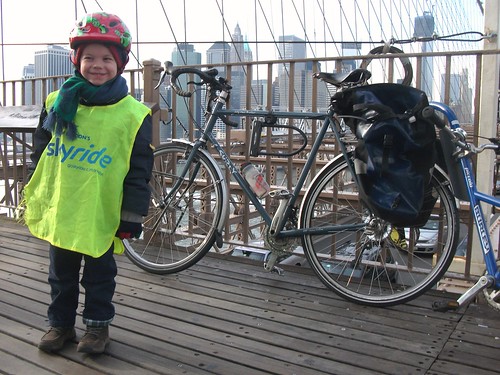
The Invisible Visible Boy, now a Brooklyn resident,
on the bridge last Christmas Eve
But, unlike the others, I eventually realised, the Brooklyn Bridge would land me in the middle of lower Manhattan, less than half a mile from the Hudson River Greenway and four miles of convenient, traffic-free riding uptown. As a result, I am now one of those lucky souls I spotted freewheeling off the bridge in 2008. I’ve ridden when snow is accumulating on the wooden walkway and in torrential rain, as well as suffocating heat and on days of such wind I’ve walked over the bridge’s centre. I’ve seen days when fog obscures Manhattan from Brooklyn, those when mist collects in the Manhattan streets and the skyscrapers poke out up above and days when rain on my glasses obscures the whole scene. I’ve cursed the wood's slipperiness on wet days and the walkway's narrowness on sunny days that bring out the tourists. On one especially memorable evening, I rode home over the bridge as spectacular thunderstorms broke over New York Harbour, periodically highlighting the buildings around me against great flashes of sheet lightning.

Through all of that, there are still days – frequent ones, in fact – when the highlight of my ride to work is the moment when I turn a corner on the walkway and the bridge first comes into view. The Roeblings’ twin gothic towers come into view against a backdrop of lower Manhattan skyscrapers glistening in the sunlight – and I remember what made me want to live in this city in the first place.

Sunday, 24 March 2013

Crashes - and communities' deadly preferences

At the foot of Wellington Street in London, where the busy cycle route from Waterloo Bridge heads into Covent Garden, there was, for a while when I lived there, a notice. The police had received numerous complaints, it said, from “the community” about standards of cyclist behaviour in Covent Garden. It suggested, essentially, that cyclists should smarten up their act or face unspecified consequences.

The notice irritated me on several levels – but the most profound was the notion that “the community” were the real people and the cyclists some alien, invasive species. The irritation was all the greater because as an area Covent Garden seldom showed much respect for cyclists’ rights. I have a vivid memory of cycling across the pavement (sidewalk, American readers) at the foot of Wellington Street with a drunk tourist yelling at me that I wasn’t allowed to ride there. He was standing directly on top of a bike symbol, on the clearly marked cycle lane.
A stencil marks where Martha Atwater died: one of
far too many such death sites in New York City

Questions about traffic and its relationship with communities have been occurring to me again over the last month as I’ve pondered a series of appalling tragedies on the streets of New York City, where I live now. The highest profile – the killing in a car crash in the early hours of March 3 of two expectant parents, Nachman and Raizel Glauber, and their baby son, delivered prematurely after the crash – raised the issue most clearly because of their own community’s very obvious reaction. The couple, only 21, belonged to prominent Hasidic Jewish families. Their deaths – a speeding, possibly drunk driver smashed into the livery cab they were using - were marked by a funeral that brought 1,000 men in dark coats and wide-brimmed hats onto the streets of Williamsburg, one of Hasidism’s Brooklyn strongholds.

But nearly any traffic tragedy – and there have been many in New York this past month besides the widely-noticed ones - raises at least some questions about how different communities relate to and use the street involved.
Potted plants show the grief of Martha Atwater's community

I’ve been thinking particularly deeply about the link each morning recently as I’ve cycled past the junction of Clinton Street and Atlantic Avenue in Brooklyn Heights on my way to work. A line of potted plants by a shop window and a stencilled outline on the sidewalk mark where, on the evening of February 22, a driver mounted the sidewalk in his speeding, out of control SUV. Martha Atwater, a 48-year-old writer and mother of two children, was emerging from a bagel shop and died on the sidewalk shortly after the vehicle hit her.

The regular arrival of fresh floral tributes testifies to what I read in the days after Ms Atwater’s death – that she was a well-known, well-liked participant in many local activities. She was the embodiment of the strong sense of mutual responsibility and joint action that makes the best New York neighbourhoods such desirable places to live.

But I saw little reflection amid the tragedy of Ms Atwater’s death on New York’s wider traffic culture, which claimed another high-profile victim less than six days later. On the morning of February 28, Amar Diarrassouba, 6, was crossing E117th street in East Harlem on his way to school when a huge truck drove through the crosswalk, killing him instantly as his 9-year-old brother, who was accompanying him, looked on.

The grief in Amar’s case focused not on the miserable, pointless loss of a bright young boy or the driver’s culpability but on Amar’s school crossing guard. The woman, who on a previous occasion reportedly snatched a child out of the path of an oncoming car, should have been present at the crossing when the collision occurred but wasn’t. Astonishingly, the police investigation of the truck driver appears to have concluded with his receiving traffic tickets for failure to yield and failure to execute due care – minor violations that nevertheless suggest he was entirely responsible for Amar’s death. The investigation into the crossing guard – someone who, whatever her shortcomings, did not negligently drive a huge truck over a blameless six-year-old – continues.

The attention on the crossing guard was typical of the focus after each of the tragedies on the crash’s individual circumstances and what made it exceptional. There has been very little reflection on how general traffic conditions in the areas concerned contributed to the deaths.

The intersection the driver that killed Martha Atwater crossed.
Traffic calming would do no good here, according to some residents
That omission struck me particularly in Martha Atwater’s case because of an online argument I entered a few months ago with a resident of Cobble Hill, just across Atlantic from the crash scene, about traffic calming. He was angrily complaining about how unsightly a projected traffic-calming scheme for the area would be and what congestion it would cause. But it seems fair to suspect that such traffic-calming would have made it much less likely a speeding SUV would shoot across Atlantic Avenue and kill someone.

The most shocking effort to shift blame came in Amar Diarrassouba’s case. The community board for the area where Amar died – the local body that has the final say on many local planning issues in New York – in late 2011 withdrew previous approval for a protected bike lane along First Avenue in the area. Most studies suggest such lanes, as well as benefitting cyclists, make crashes like the one that killed Amar less likely. Yet when Steve Vaccaro, a cycling lawyer and activist, pointed out the community board’s role on Twitter to Erik Mayor, a local restaurateur and community board member, Mayor preferred to put the blame on the least blameworthy actor in the entire episode. “The child was being walked by his nine-year-old brother, who did not pay attention,” Mayor wrote.

Kent Ave: a surviving Williamsburg bike lane,
which some Hasidim might prefer weren't there.
The truth is that road deaths all over the world nearly always result at least in part from failures of road governance. Those often result from local communities’ tendency to assume the main priority for roads is to meet the needs of the people that they regard as their “community” – people who have similar needs and habits to them.

That is particularly revealingly the case where the Glaubers’ community is concerned. Few Hasidic Jews cycle and some Williamsburg Hasidim successfully campaigned for removal of a cycle lane along Bedford Avenue through the heart of their community. One community spokesman said that, although the ostensible reason for the campaign was their disapproval of women cyclists’ “immodest” dress, it was also the case that “everyone” knew a bike lane was a “nuisance”. There have also been attempts to discourage cyclists from using bike lanes along Kent Avenue, the street where the Glaubers were killed, apparently because Hasidim wanted back the parking spaces that the bike lane took.

Erik Mayor’s reaction shows a similar myopia. He couched his original opposition to the first avenue bike lane in terms of the likely effect on local children. He claimed – improbably – that a bike lane would increase asthma among children because it would increase congestion and hence emissions from idling cars. But when the lane’s absence contributed to the crushing to death of a boy from the area’s distinctive west African community, his sympathy seems to have evaporated.

A strong theme running through many “community” expressions of concern about their local roads is that they focus on the problems that cause the most vocal complaints locally – the struggle to find parking places or local shopkeepers’ grumbles about business – rather than local roads’ role as thoroughfares.

Yet roads are inevitably the vehicle for the habits of one community, no matter how distinctive it might be in many things, to run – sometimes literally – into another’s. The wide, unobstructed local road might seem vital to you because it offers plenty of parking spaces. If it looks to people from neighbouring communities like an invitation to drive at twice the speed limit, your community is likely to pay a heavy price.

It’s for that reason that it makes little sense to hand governance over important issues of roads policy to bodies as locally focused as New York City’s community boards. The New York City cycling map testifies to their influence, with cycle lanes along long avenues changing in nature or disappearing altogether according to their whims. It’s an area where London, for all its drawbacks, seems largely to be doing better than New York. The boroughs of Wandsworth, Westminster and Barnet – all controlled by the Conservative Party – are undoubtedly less bike-friendly than Camden or Tower Hamlets, controlled by the Labour Party. But the overall strategy seems less likely than New York’s to be derailed in places because of loud, locally-focused complaints.

More generally, meanwhile, it’s always worth thinking when anyone talks about “the community” about whom their definition excludes. While “community” as a term comes wrapped in warm pictures of neighbours chatting and people banding together to do good, it often says as much – as in that Covent Garden notice – about who’s on the outside. The Covent Garden community clearly excluded people who rode bikes. The community board for East Harlem seems to have seen itself as more answerable to car-users than cyclists or people who might benefit from safer streets.

The Invisible Visible Man thinks this bike's rider
didn't feel like part of his community.
The police think we're all part of the same problem.
My own tendency to think sloppily on this topic came home to me on Thursday evening when I encountered the aftermath of a collision on my way home. An ambulance was taking away a cyclist whose mangled bike lay by the roadside. A quick scan of the machine – a nasty aluminium full-suspension mountain bike – led me to a quick conclusion. This was the machine of either a food-delivery cyclist or one of the youths from the local public housing. He wasn’t part of my cycling community.

That made little difference to one of the policemen at the scene, however. Having already apparently decided the cyclist’s failure to stop appropriately had caused the crash, he was keen to share the news with anyone else rash enough to ride a bicycle – even one dutifully stopped at the traffic lights. Looking towards me as he walked back towards his patrol car, he addressed me with a sneer in his voice. “I guess he just had to stop,” he said, shaking his head.

Sunday, 24 February 2013

Subway fares, gas tax - and why it's too expensive to cycle in New York

There are few New York businesses that command as much of my loyalty as 718 Cyclery, a friendly, specialist bike shop near where I live in Brooklyn. But there’s no question that I’ve handed them a fair amount of my money lately. A quick check through past bank statements suggests that in less than four months since last October 30 I’ve given this deserving business around $270 in spending on my own bicycle, plus another $14 or so on the Invisible Visible Girl’s machine. That’s leaving aside another $30 or so on bicycle maintenance at other bike shops and the $33 I shelled out yesterday for a replacement clip-on light for one that had gone missing. It’s cost me, in other words, around $80 a month over the last four months to keep my bike on the road.
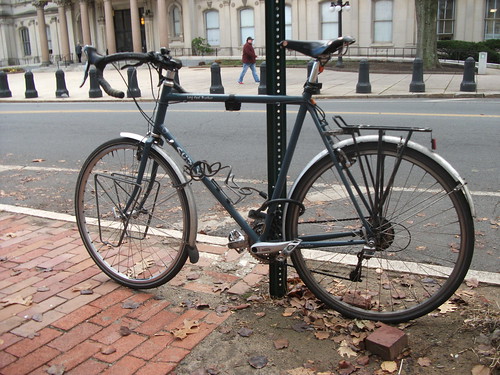
The Invisible Visible Man's Surly Long Haul Trucker:
fun to use - but not that cheap

Some of that spending was certainly making up for a near-absence of spending in the few months before October. But add in the cost of the extra food I guzzle to fuel my nine-miles-there-nine-miles-back commute and the cost of the higher wear and tear on my clothes and it’s not clear I’m doing myself a financial favour by using transport that I don’t pay for daily. At the current basic New York subway fare of $2.25 for a single ride, four weeks’ commuting would cost me $90 – and there are numerous ways of getting the rides cheaper than that. Even a looming – and highly controversial – hike in the basic fare to $2.50 may not put me in the black.

But it’s not the bike shop’s fault I’m getting a relatively raw deal. It’s noticeably cheaper to keep my bike maintained in New York than it was when I lived in London. 718 Cyclery has been more than generous in carrying out free adjustments and calculating its labour charges. I’m at a disadvantage because pretty much every other means of getting about New York City gets a significant explicit or implicit subsidy of some kind.

It’s not a purely New York City problem. Virtually no developed country charges drivers enough in fuel taxes, tolls or car ownership fees to cover the costs that congestion, crashes and pollution impose on everyone else. Nearly every big international city tries to encourage commuters to shift to other transport means by susbidising public transport.

New York is nevertheless an extreme example. According to the Tax Foundation, a think-tank, taxes, tolls and other charges on motorists in New York State cover only 43.8 per cent of spending on the state’s roads. The proportion of the New York subway’s running costs covered by fares is still lower – and the system is visibly crumbling through lack of maintenance and upgrade expenditure. One might think that, along with reducing the appalling death toll on the city’s streets, a comprehensive rethink of charging for and funding of the city’s transport network would be the top subject for debate ahead of this year’s mayoral elections.

Yet there have been only two big transport talking points so far among the likely candidates to succeed Michael Bloomberg as mayor. One is whether the city should hand over a few more slivers of its vast road network to cyclists or, indeed, start taking out the bike lanes already in place. The other has been whether the city should turn its back permanently on congestion charging – the one policy that any city has shown can tackle problems like New York’s.

The Brooklyn Bridge: majestic - and under repair after
its pounding from all those New Jersey-bound drivers
Those problems, meanwhile, are immediate and practical. While the £10 ($16) congestion charge used to funnel through traffic away from my cycle route to work in central London, New York’s current financing arrangements actually push such traffic towards me. Every morning in TriBeCa, one of the most densely-packed areas of lower Manhattan, I see swarms of New Jersey-registered cars heading from the Brooklyn Bridge towards the Holland Tunnel going to New Jersey. Many seem to be avoiding the $13 toll charged westbound on the Verrazano Narrows Bridge further down New York Habour linking Brooklyn, Staten Island and ultimately New Jersey. Further uptown, the streets east of Central Park swarm with the traffic that pours from Queens across the free Queensboro Bridge to avoid the tolled alternative routes.

Yet it’s hard to imagine persuading men like the motorist I encountered on Vanderbilt Avenue in Brooklyn the other day that higher fuel taxes are the answer. Clambering out of his car with a weary look, he cast a wary glance over my bike and said, “Well, you’re certainly saving money on gas, buddy.” Precisely because US motorists pay far lower taxes on fuel than road-users elsewhere, they’ve seen far bigger percentage hikes in costs from recent years’ high oil prices. It’s impossible to imagine any politician persuading a US electorate in the foreseeable future of the case for increased fuel taxes.

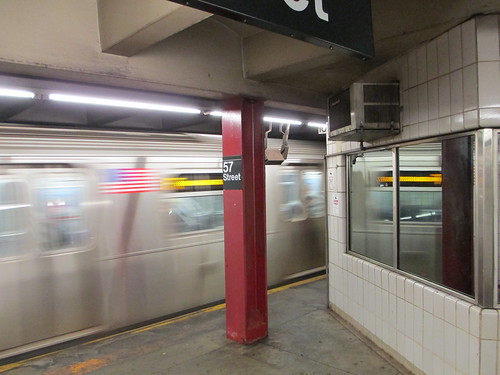
The F Train at 57th street: cheap to use - but not much fun
Nor is it easy to imagine any politician raising subway fares to a level close to covering the system’s high costs. Visiting the New York Transit Museum last Tuesday, I read the grim story of how politicians have always struggled to raise fares on the system, first from a nickel to a dime and then gradually upwards. The problem is further exacerbated by the system’s inability to charge different fares for different distances. Most people would surely agree that $2.25 is a bargain to ride from Coney Island to the outer reaches of the Bronx. But start talking about raising fares and people picture themselves paying $3 to ride from Penn Station to 59th street, a different prospect altogether.

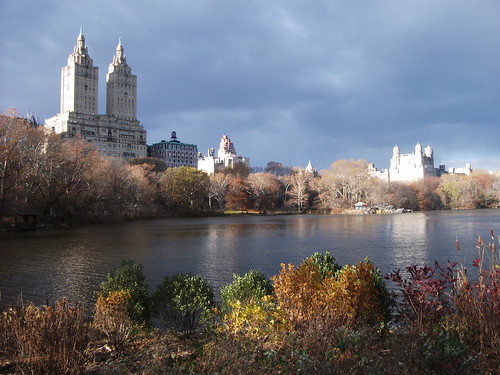
Central Park: scenic - and a neat northern border
for a charging zone
The only feasible answer, it’s clear, is for the successful mayoral candidate to resurrect plans to charge cars to enter the area where they are least needed and do most damage – Manhattan south of Central Park. The area is well defined, excellently served by public transport and currently blighted by vast quantities of traffic, much of which could go elsewhere. A reasonable charge would not only raise badly-needed revenue but also make a subway fare hike far more politically feasible. Those two manoeuvres together could unclog Manhattan’s streets, increase the incentives for drivers to switch to other modes and actually make it financially advantageous for commuters to switch to walking and cycling – the only modes doing virtually no damage to the city's environment or infrastructure. There’s no mystery about such a policy’s effectiveness. Congestion charging has reduced sharply and continuously the number of cars entering central London since its introduction 10 years ago. New York could surely come up with a more cost-effective charging system than the British capital.

Yet Christine Quinn, the city council speaker and the person many people expect to be elected mayor later this year, earlier this month said she didn’t anticipate congestion pricing’s “coming back around” after an effort she spearheaded to introduce the policy in 2007. That effort died after state-level politicians in Albany vetoed it. She has subsequently recanted slightly, saying she still supports the policy but doubts it can be successfully introduced.

That leaves New York City in a far worse state transport-wise than London before its congestion charge’s introduction. The Metropolitan Transportation Authority spends much of its income servicing its growing burden of debt, rather than improving the subway. New York City’s roads are crumbling under the weight of cars that pay far too little to make the damage good. The incentives for other mugs to join me on a less damaging transport mode remain negligible.

Future generations will look back with amazement at such predicaments in New York and elsewhere, shaking their heads and wondering why no-one had the courage to take the obvious policy steps. Some kind of charge for road use in Manhattan and many other big centres will inevitably come along. The spread of electric or partially electric vehicles – which pay no fuel tax – ensures it. In London’s story we already know it was the unlikely figure of Ken Livingstone – left-wing firebrand and scourge of Margaret Thatcher – who finally had the courage to bring in such a policy. For New York, it remains a mystery which visionary mayor will have his or her picture in the museums as the transport system’s saviour.

The tragedy for New York is that the identity of its transport system's saviour looks set to remain a mystery for many more years - through the whole administration of Christine Quinn or whichever other uninspiring choice next sits in City Hall.