Sunday, 8 September 2013

A speeding cyclist, momentum - and how sustained velocity is the enemy of consideration

Even by the high standards of a fine, late summer morning in New York, the weather was remarkably pleasant on Friday – not too hot or too humid and with a cloudless sky. The view from the Brooklyn Bridge as I rode down into Manhattan, the Financial District’s skyscrapers glinting in the sun, seemed calculated to convince even the most sceptical of the accuracy of New York’s claim to be the greatest city on earth.
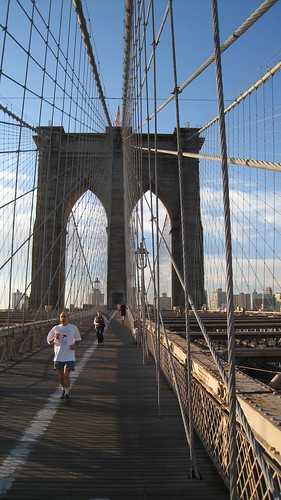
 
The Brooklyn Bridge's Manhattan
off-ramp: an invitation to let one's
momentum overtake one's manners
But the cyclist who followed me down off the bridge was in no mood to admire the view. As I sat towards the left of the stream of descending bike traffic, seeking a safe opportunity to pass a slower rider I’d been following, I heard a shout of “On Your Right!” Suddenly confused, I nearly clattered into the rider squeezing between me and the railings by the walkway edge. He zipped past me – at a fair rate, given my speedometer was reading 18mph – and swung into the walkway’s crowded pedestrian side to round the guy in front. Then he disappeared off down the slope.

But he went on his way, I imagine, feeling a little more stressed than he’d been anticipating. “Idiot!” I shouted at him as he sped past. “You shouldn’t be…” he shouted before finishing the sentence with an angry gesture towards where I’d been sitting in the lane as I tried to pass the rider in front.

It was the kind of clash I’ve experienced a disproportionate number of times over the last week, as I’ve returned to New York cycle commuting after two weeks’ vacation on Cape Cod. Time and again, I’ve encountered people who’ve been utterly determined to conserve the momentum of their car, or bicycle or walking or running body at the expense of others’ safety and convenience. All seemed caught up in the idea that the complex social activity of sharing a road or path was a private enterprise, where one needn’t take account of others.

I’ve also, however, been struck by the power of fellow feeling with the road users around me to influence my own and other people’s behaviour. People caught up in the bubble of their own, desperate need to reach their meeting or soccer practice or date or whatever can transform back into normal, civil civilians the moment that they recognise how they're threatening someone else.

The contrast has been so striking that I’m currently seeing nearly everything I encounter on the roads as a conflict between these two instincts – to set one’s own pace and to treat others as one would like to be treated oneself. Every journey, I’m spotting people caught up in the excitement of their own speed and a reluctance to change it. Every journey, I’m spotting how a glance into another person’s eyes brings daylight and a sense of the wider world into that tunnel vision.

I’ve been reading some news items through the same prism. I was horrified by how proud a driver calling himself Afroduck was of his “achievement”of driving a circuit round Manhattan’s expressways in 24 minutes. As a Christian – and currently an adherent of a Presbyterian congregation – I was profoundly disappointed by reports of a lobby of Free Church of Scotland ministers to the Scottish government on widening of the A9 road serving some of the Free Church’s highland strongholds and the installation of speed cameras on the road. "Frustration" with slow cars caused more accidents than fast ones, claimed Rev Colin Macleod, who I fear didn’t ask himself how Jesus would drive a car. "Speed cameras... will lead to more frustration, more accidents and more funerals," Rev Macleod told The Scotsman.

However, it was an incident the night before that close Brooklyn Bridge pass that made clear to me the tension between the two tendencies. As I rode up Warren St in TriBeCa, I saw a BMW trying to cut across my path by pulling across the cycle lane at an intersection and into the stream of cars. As I arrived at the traffic lights, I pulled firmly into the driver’s path, looked down towards his open window, signalled to him to stop and said, “Please wait.” Somewhat to my surprise, he did.
 
A warning to cyclists on Kent Avenue, Williamsburg:
a reluctance to yield at junctions comes from the same
desire to conserve momentum as bad overtaking.
But, after he passed me and we carried on down the street towards City Hall, I noticed another cyclist riding into a temporarily narrowed section of road by some road works. Unconstrained by any personal interaction, the BMW driver barged past him in the narrow section. The rider’s arms flew up in exasperation and fear as the driver passed him with inches to spare. It was only the rider’s quick reactions that prevented his being battered into the concrete barriers, with potentially serious consequences.

It’s hardly surprising, however, that so many road users are so keen to conserve their momentum. It’s one of the great joys of piloting any vehicle – a car or especially a bicycle – to feel one’s moving at speed without having to make an effort. It’s no coincidence that I regularly hear businessmen speaking in the wooden-tongued jargon of contemporary American business describing their company as having “momentum”. It’s what political campaigns seek too. There’s a pleasure in that feeling of being carried along by the effort one’s already made, or by gravity or the wind that adds up to far more than merely the product of one’s mass multiplied by one’s velocity. I’ve described myself the pleasure of a downhill run on one of New York’s East River bridges when clear of obstructions. The desire to maintain one’s momentum comes, I suspect, from some of the deepest, most primitive bits of the brain, which house our deepest joys and fears.

There’s a serious discipline, meanwhile, involved in applying one’s brakes to suit another person. All the pleasures of feeling that onward progress disappear. It’s an effort to get going again. As the story of the barging bicyclist of the Brooklyn Bridge shows, it’s a discipline that cyclists often struggle to exercise. Yet, of course, the danger from people driving motor cars is all the greater. Someone shut inside a metal box is apt to be insulated – as Afroduck seemingly was – from the sheer danger that his or her speed represents to others. Drivers are consequently likely to behave more dangerously.
Cars zip down 8th Avenue, in Park Slope:
how conscious are the drivers of each others' humanity?

There is, nevertheless, joy in exercising that discipline. I’ve been trying especially hard since realising how much I enjoy my own momentum to stop for pedestrian crosswalks even when most other cyclists don’t. The tense faces of people glancing up and down the Hudson Greenway waiting for a gap in the bike traffic melt into a smile when they realise someone’s halted for them. There’s an inner satisfaction from knowing that one isn’t going to pass another cyclist before there’s enough, safe room for it and that one’s unlikely consequently to scare the other rider. I’ve long tried to exercise the same discipline on the rare occasions I drive a car, knowing how fearful cars can make me when they pass too fast or close.

It’s a far less visceral pleasure than the rush that Afroduck would have experienced from rounding Manhattan at an average speed of 66mph. It’s the kind of behaviour that can exasperate people who feel they must get past at any cost. Freud would have said it’s an action motivated by the superego, while the pleasure of speed belongs to the id.

Yet to use one’s brakes to act considerately towards others is also to recognise a profound truth about roads, cycle paths and all the other places that people use vehicles close to each other. They’re places that pitch us into some of the most complex social interactions possible. When so many people treat those places as if they were their own private domains, it’s no surprise so many of the people around them – the people whose reality they’re ignoring – end up getting killed.

Tuesday, 27 August 2013

A midtown tragedy, a TriBeCa run-in - and taxi drivers' economic incentives

It’s a key survival skill for a New York city cyclist to learn to spot the looming lurch-out-of-the-lane – the manoeuvre whereby a frustrated motorist, tired of waiting for an obstruction to clear, pulls out of the line of cars into the bike lane without checking his mirrors. But, even by such moves’ poor standards, the sudden turn into my path late last year by a yellow taxi cab one evening in TriBeCa was a close-run thing. I managed to swerve round the cab into a delivery bay before getting back into the bike lane and catching up with the offending driver.

When I told the driver that he’d nearly knocked me off, however, he was not only indifferent but chased after me for a block, driving deliberately close to me and taunting me. So, at the next traffic lights, I took a different tack. I knocked on the passenger door. When the occupants – who turned out to be a group of fairly terrified-looking tourists – wound down the window, I told them: “Please don’t tip this man. He’s a dangerous driver. He needs to learn a lesson.”

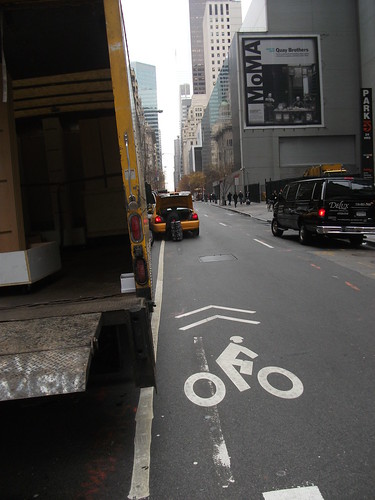
A taxi blocks a cycle route on W54th street.
Who knows whether he'd do this if his fares
kept withholding tips when he did?
The incident in TriBeCa has been in my mind this week because of the grim series of events  last Tuesday in midtown Manhattan that led a taxi driver to drive his vehicle onto a 6th Avenue sidewalk with a cyclist on the hood. He then slammed into a couple of British tourists, severing the leg of one of them, Sian Green, a 23-year-old woman.

My experience has made me look at the horrible, apparently deliberate crash a little differently from some other commentators, however. It is entirely true, as many commentators have said, that Tuesday’s crash would probably have been avoided if either the New York Police Department or the city’s Taxi and Limousine Commission had taken seriously their duties to police motorist behaviour in New York City. It’s also true that, were it not for the widespread demonisation of cyclists and the poor understanding of their rights, the taxi driver - Mohammed Himon – probably wouldn’t have felt the same outrage at Kenneth Olivo, the cycle courier whom he knocked onto his vehicle’s hood. It’s certainly deplorable that some sections of the media have used the incident’s circumstances as yet another opportunity to vilify cyclists, claiming that Olivo, who was arguing with Himon about his efforts to pass him near a busy crosswalk, played a “big part” in causing the crash.

Yet that incident in TriBeCa - along with others where I’ve taken a similar approach – has also made me realise that it’s far easier to reach across the steel barrier separating taxi drivers and other paid drivers from those around them than it is with other drivers. All over the world, such drivers are open to price signals that anyone who cares about road safety can send or ask other people to send. The weak official response to Sian Green’s maiming – the taxi and limousine commission has so far suspended Himon’s licence for only 30 days – underlines how urgent it is that people in New York in particular start using such signals more regularly and concertedly.
 
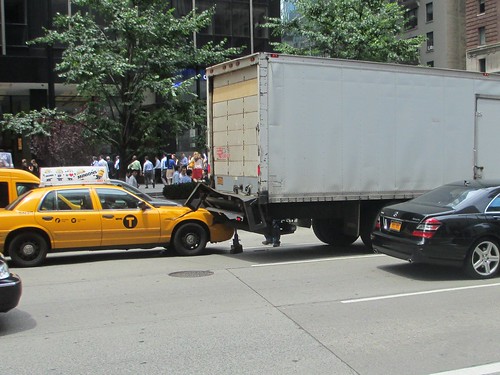
A cab on Sixth Avenue illustrates the high driving standards
for which the profession is known in New York. Thankfully,
everyone in this incident seems to have kept their limbs.

It’s unfair, of course, as I’ve argued in the past when cyclists have done bad things, to extrapolate from a single incident to the behaviour of a whole wider class of people. There are many charming, considerate taxi drivers. Shortly after my run-in with the terrible turning taxi-driver of TriBeCa, I found myself riding one evening down W55th street with a taxi behind me. The driver not only let me pull over to take the lane at a point where the road narrowed but told me at the next traffic lights to “take it easy” after I’d visibly hurried up to avoid slowing him down.

It’s also worth pointing out that, just as minicab drivers in London appear to be on a collective mission to make black cab drivers seem courteous and sensible, New York’s limousine services make yellow cab drivers seem like airline pilots in their regard for safety. There’s a particular limo service operating near where I live in Brooklyn whose drivers I’ve given an especially wide berth ever since I saw one of their drivers dump a package out of the vehicle one Saturday lunchtime. It turned out to contain an empty spirits bottle. Shortly before my TriBeCa run-in with the cabbie, a limo driver had squeezed past me one morning on a wet, slippery W54th street when it clearly wasn’t safe to do so. When I told him he could have killed me, he answered laconically, “I still can.”

Nevertheless, in cities where roads policing and taxi regulation have been made lower priorities than they should have been it’s not unreasonable to expect the drivers putting in the longest hours in the most congested places to pick up bad habits. Serious crashes involving yellow cabs – many of them fatal – are a regular, depressing feature of New York life. Himon’s cab wasn’t even the only one to end up on a sidewalk on Sixth Avenue last week. Two days after Sian Green was maimed, two taxi drivers racing to get to the same fare collided with each other at 37th street, sending one cab onto the sidewalk.
 
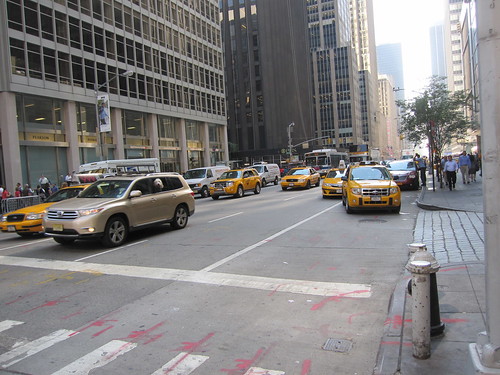
Taxis on Sixth Avenue, not far from where Sian Green was hit:
sheer numbers make regulation both difficult and vital.
The sheer volume of yellow cabs in New York makes its challenges particularly acute. There are serious issues with cab driver behaviour nearly everywhere, however. The strict licensing requirements for black cabs in London - where drivers have to pass such a rigorous test that it changes their brain structure - make serious crashes less common than in New York. But I still had some seriously frightening run-ins with black cab drivers when I lived and cycled in London. The occasional helpful response to complaints from London’s Public Carriage Office only made its other complacent efforts to shrug off responsibility more frustrating.

Which brings me back to my experience in TriBeCa.

I have no idea whether the tourists I accosted withheld the driver’s tip, as I requested. The chances are that they didn’t. Even I when in a motor vehicle with a taxi driver tend to feel a certain fellow feeling with him or her that makes it awkward to criticise the driver’s conduct. The emotional cost of the conflict with an unhappy driver refused a tip can certainly seem higher than the few bucks’ cost of peace.

But the fate of poor Sian Green and the crash later the same week on Sixth Avenue are both reminders of where the economic incentives for drivers currently point. Under current circumstances, higher speeds and refusal to yield when required to pedestrians merely get taxi drivers faster through their current fare or to the next fare more quickly. Only a change in the value of the tip – a higher tip for good driving, a lower one for poor behaviour – can shift the balance in the other direction.

All that would change, of course, if city authorities were to start enforcing traffic rules in a systematic, sensible way. Speeding would become a costly activity for taxis. The price of blowing through a crowded crosswalk might be permanent loss of a licence.
 
The taxi driver who nearly doored me. His intense interest
in my comments on his conduct is evident
But two scenes I encountered in the week before Sian Green was maimed illustrate how far New York City at least is from such a logical system. On Wednesday, August 14, as I cycled to work, Sebastian Delmont, a safer streets activist who was commuting south on the Hudson Greenway, warned me that police were stopping cyclists further up. Sure enough, at 39th street police were stopping cyclists who failed to stop for the red light by an exit from a ferry terminal where most of the time barely any traffic crosses. They were ignoring the next intersection, at 40th street, where taxis and buses regularly refuse to yield to bikes and pedestrians.

The following morning, meanwhile, I was forced to brake hard as I rode to work when a taxi driver opened his door into the bike lane on Clinton Street in Brooklyn Heights. His response when I asked him what was wrong with him was to reply, “I saw you.”

As long as traffic police in big cities worldwide think cyclist harassment a better use of their time than policing speeding and taxi drivers have no fear of the consequences of bad behaviour, it’s incumbent on everyone else to act. I plan to step up my efforts to make professional drivers’ tips reflect how they respect other road users. I hope other readers of this blog will do the same.

Sunday, 4 August 2013

A ride past City Hall, a rally - and why I probably should have joined in

As I peered through the arches at the bottom of Manhattan’s imposing borough hall the other Saturday, I could hear a distinctive voice echoing round the area inside, outside the New York Police Department headquarters. Al Sharpton - who is, depending on one's point of view either a veteran civil rights campaigner or a rabble-rouser – was addressing a rally of thousands of people. They included Sybrina Fulton, mother of Trayvon Martin, the young, black teenager murdered last year in Florida. The rally was protesting over the trial of Trayvon’s killer, which a week earlier had led to the killer’s acquittal on all charges.

Manhattan Borough Hall: its design alone
shows how close the city wants to be to
street-level concerns
My better self – which is even more outraged at the continued racist treatment of many black people in the United States than the rest of me – urged me to lock up my bike and join the protest, changing my plans to cycle in the day's stifling heat up to Westchester County. The rest of me was bearing in mind that it was already nearly lunchtime and, if I was to complete my planned 50-mile round-trip, I’d better keep riding onward. My least noble side wondered whether a rally over the fate of a young, black man in Florida was really the most relevant protest for a middle-aged white Briton resident in New York to join. The rest of me won the latest of many easy victories over my better self and we all rode on.

Yet, on the day of the protest, I was feeling so profoundly exercised about another issue that I would gladly have abandoned my ride to Yonkers to protest about it. The previous evening, Hilda Cohen, a New York cycle activist whom I’ve had the pleasure of meeting a couple of times, had described online the series of events that led to her receiving two criminal charges over her cycling on her way home. Her crime had, essentially, been to encounter a police trap for cyclists and two officers frustrated at her failure to do anything wrong. When she protested that, no, they couldn’t charge her for riding through a yellow light, they charged her for reckless operation of a bicycle and obstructing traffic – because she had left the street’s narrow (non-compulsory) bike lane to navigate round their police car.

The treatment of Hilda – a conscientious cyclist known for her enthusiastic opposition to bad cycling behaviour – filled me with the mixture of rage and personal fear that only a deep injustice that impinges on one personally can. “If it can happen to her, it can happen to you,” the Invisible Visible Woman pointed out to me.
 
On my way back from Westchester:
Not shown, my better self (absent)
Hilda’s treatment crystallised for me a sense that just by riding a bike daily in New York I was putting myself in the way of harassment from the city’s police department. Since the launch of the city’s Citibike bikeshare scheme, the police have increased the number of ticket traps they operate to catch cyclists, often stationing themselves on, for example, quiet sidewalks by uneven, cobbled streets. The clear intention has been to maximise the number of tickets issued, regardless of the relative innocuousness of the targeted behaviour.

A series of events since have reinforced my sense that there are many people worldwide – in positions of varying authority – who feel towards cyclists the mixture of resentment and violent rage that racists feel about those different from them. The Friday after my ride to Westchester, I was disturbed to read another account of anti-cyclist harassment from London – this time from Elisabeth Anderson, a young London cycle blogger – describing how two cars drove straight at a group of cyclists towards the end of that evening’s Critical Mass ride in central London. One motorist deliberately drove over one of the victims “like a speed bump,” Anderson recounted.

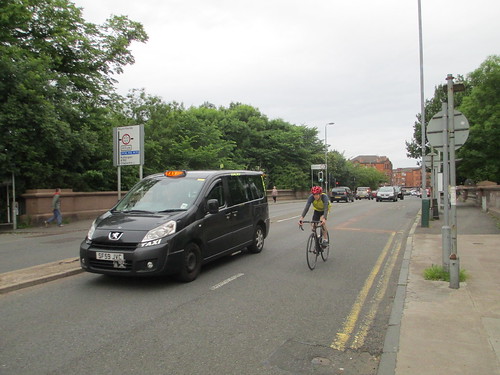
A street in Cathcart, Glasgow. The cyclist here has
the same obligation to keep this road safe as all the cars,
according to a breathtakingly misguided campaign.
My anger hasn’t been at all assuaged by the launch last Monday in Scotland, my home country, of a bizarre “road safety” campaign, known as the Nice Way Code, paid for from the Scottish government’s cycling budget, urging all road users to show each other “mutual respect”. The campaign, which claims that all road users have an equal duty to make the roads safe, is a stinging slap in the face for the relatives of most vulnerable road users killed on Scotland’s roads. However little role their loved one’s own behaviour had in his or her death, it seems to suggest, maybe it wouldn’t have happened if the victim had shown the perpetrator more “mutual respect”.

The question, consequently, is: how far I was right to think the Trayvon Martin rally wasn’t my personal battle? Don't civil rights issues affect me?

The clearest point to make is that, as a cyclist, I have the distinct advantage over other groups the police and politicians don’t like. I – and the vast majority of cyclists in the UK and US – am able most of the time to exercise the privileges of being a reasonably well-off, articulate, well-connected member of the professional classes. Were I to be shot dead on the street tomorrow by a vigilante, provided my bike wasn’t involved, my death would be treated very differently from that of Trayvon Martin. My assailant’s murder trial probably wouldn’t be allowed to turn into a trial of my posthumous reputation.

It consequently makes little sense to put cyclists’ problems in the same bracket as those of, say, the non-white people rounded up on the street in the UK for no reason other than their having no immediate way of proving their right to be in the country. I would expect, through legal due process or moral persuasion, to be able to get out of patently unjust, trumped-up charges such as those Hilda Cohen faces. I will be still more alarmed about the general state of New York justice if Hilda doesn't succeed in having her charges overturned.
 
A New York food delivery biker. Want to know how the
authorities would like to treat you, New York cyclists?
Look at how they regulate this guy.
In fact, however unfair the harassment that commuter cyclists can face, the plight of New York’s food delivery cyclists shows how much worse things could be. A city council that frequently seems bored by the challenges of New York’s high road deaths rate seems never to tire of thinking up new regulations to make the already trying lives of the delivery cyclists - mostly poor immigrants - more difficult. New York's articulate bike lobby might not be, as the bizarre Dorothy Rabinowitz has claimed, "all-powerful" but it has at least saved commuter cyclists from food delivery rider style registration and over-regulation.

Nevertheless, it’s hard not to see striking similarities between aspects of some drivers' and police forces' stances towards cyclists and the general climate of prejudice that some racial and other minorities face. It’s hard, for example, not to see the police’s harassment of Hilda Cohen and disproportionate ticketing of cyclists as another expression of the attitudes that have made the NYPD such enthusiastic advocates of “stop and frisk” – the department’s tactic of stopping and searching large numbers of young, mostly black males on minimal pretexts. It’s hard to escape the idea that some policemen’s instincts are that both minorities and cyclists represent potential trouble, needing constant reminders to keep in their place.

The violence of many people’s language when talking about cyclists and their desire to run them over is also clearly reminiscent of racism. Incidents like the one Elisabeth Anderson witnessed, where drivers use their vehicles as weapons, are a still more disgusting expression of that same kind of impotent, incoherent rage against the different.

The Nice Way Code, meanwhile, is a reminder of prejudice’s insidiousness. The campaign’s authors have been busy protesting since its launch that its intentions are good. But it’s hard not also to see their insistence that cyclists can’t expect to be respected until they behave better as a new expression of old kinds of prejudice. Yes, rape is awful – but why did she wear such a short skirt? Hey, we’re letting you vote in Mississippi – now forget the uppity manners that Dr King taught you, boy.

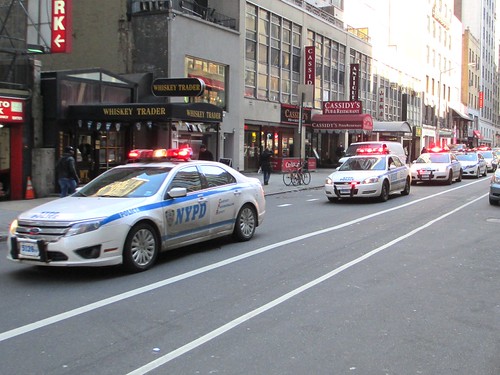
NYPD squad cars: when I'm on my bike, I think the
"Courtesy, Professionalism, Respect" motto on the side is
satire. When I'm walking, I see it as a reassuring promise
The cyclist’s plight, in other words, reflects a rottenness in some police and public attitudes with, it seems to me, similar roots to racism, homophobia and misogyny. It reflects a refusal to extend equal legal protection to all that should worry even people who never ride a bicycle. In the worst cases, anti-cyclist attitudes can leave a person dead, as Trayvon Martin is, yet failed by the legal system, as he has been.

There needs, however, to be some other word – “justice-denied groups,” perhaps? – for those of us fortunate enough to be able to choose our fate. I might wince when I see an NYPD squad car while cycling, fearing the officers will invent a crime for me to have committed. My experience of that feeling should, perhaps, have made me dismount and stand with Trayvon Martin’s mother. But I must also bear in mind that I have the privilege of putting my bike away and walking down the street. As a middle-aged, affluent white man, I can at least choose to have less to fear from the police than many millions of less fortunate fellow UK citizens and inhabitants of New York.

Monday, 22 July 2013

A heatwave - and the urban nature it lets cyclists sniff out

A few nights in the last few weeks, I’ve been working late and, realising I needed groceries but would miss the closing time of stores near my apartment, I’ve opted to make a treat out of a chore. I’ve headed five blocks north from my office and ridden into Central Park, heading for the Fairway Market on Broadway. I’ve swept downhill from Central Park South, leaving behind the oppressive heat thrown off by New York’s buildings and streets in the current heatwave for the marginally cooler park, surrounded by trees yet overlooked by skyscrapers.

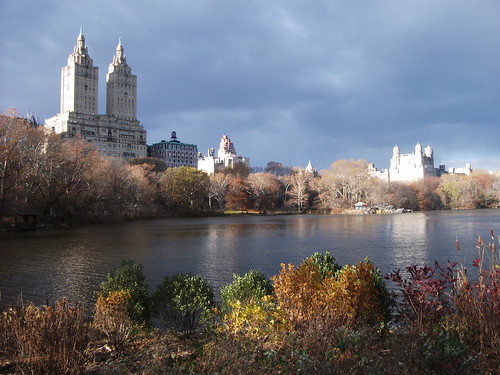
Central Park: a treat to ride in - for those with a taste in
heated manure
But on Thursday night, after a particularly sulphurously hot day, the experience had an unexpected, added edge. Almost as if I’d ridden into a cloud of some pollutant, I found myself inhaling as thick a concentration of horse manure smells as I’ve ever experienced. The tourist carriages that I often follow in the morning from their stables on the lower west side had clearly been busy that day, I realised. That had left a generous coating of manure baking on the asphalt in 100F heat, with predictably stinky results.

The experience brought home to me how vital a part smell plays in the full-frontal assault of riding a bike in any large city during a heatwave. In New York, however, it currently plays a particularly special role. The city has been better in its gentrification push over the last 20 years at improving how it looks than how it smells. Many of the odours consequently represent the forces that even so controlling an administration as Michael Bloomberg’s still hasn't managed to rein in. They tell a story about the city that’s wafted only into the nostrils of the still fairly select bunch of people prepared to ride a bike in New York on a day when the thermometer is showing over 90F and one’s glasses steam up instantly one steps outdoors.
 
The East River: tell-tale salty smells
There are, of course, some smells that persist year-round. Sometimes when I'm riding by the East or Hudson Rivers, a boat's wash slaps into the promenade. As the spray splashes against the railings, there’s a salty smell in the air, an unmistakeable reminder that New York is a maritime city and that the rivers, as well as carrying water from upstate, are inlets of the sea. It’s the smell of the secret of New York’s success – a gateway between the interior that vessels sailing up the Hudson River serve and the wide Atlantic Ocean out beyond the harbour.

The same goes for the smell that meets me as I speed on my bike down the western side of the Manhattan Bridge. I think it’s a mixture of boiled duck, five-spice mixture and plum sauce, but there’s an unmistakeable smell to areas with a high concentration of Cantonese restaurants, like Chinatown, where the bridge emerges in Manhattan. In my mind’s eye, the smell forever has me sitting in one of the countless eating places in the heart of Hong Kong, at a Spartan formica table, with plates of steaming food being brought to me. The two places smell exactly the same.

Then there are the smells that testify to how my fellow New Yorkers’ behaviour changes as the heat rises.

Earlier in the summer, when the Hudson River Park was still closed off firmly every night at dusk, a late night ride down the neighbouring bike path was apt to prove a trial. As I passed groups of people congregated along the low stone wall by the path, the distinct, herbal smell of the marijuana they were smoking would tickle the upper reaches of the inside of my nose. By very late on a Friday night or early Saturday morning, the path was apt to become an obstacle course, as happy dope smokers milled around, their risk perceptions – seldom a strong point of path users – worsened still further by the weed.

The path is at least less cluttered now that the park is generally open late into the night. But, as I ride by the park’s helpfully-placed bushes, the strong smell bears testimony to park users’ continued desire to smoke dope while watching New Jersey’s lights becoming fuzzier and fuzzier.
 
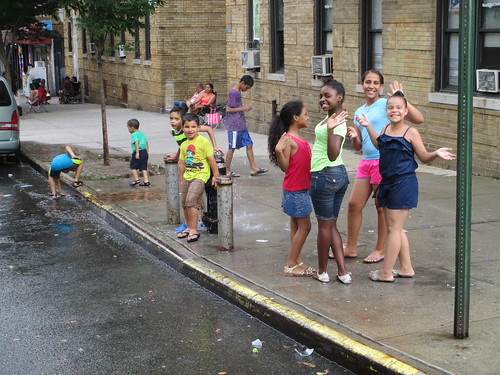
Children play round a fire hydrant in The Bronx:
they'll be off for a barbecue later in the park
The city’s public parks smell different in daytime heat too. Taking myself once again out of the city on Saturday, I rode up (for the first time) to The Bronx, bound over the city line to Westchester County. In The Bronx, I found children playing in the water from opened fire hydrants. In Van Cortlandt Park, my nostrils and ears encountered a distinctive mixture: firelighter liquid, loud Latin music and the smell of barbecued meat, wafting from the elaborate set-ups that scores of families had lugged into the park.

But probably the most telling smells are the ones that testify to how much organic matter still lies festering, largely unnoticed, round the greatest city on earth.

It’s tempting to think of New York as forged out of concrete and steel, an entirely manmade creation. I’ve recently discovered that that’s not entirely fanciful. Midtown and lower Manhattan sprouted their skyscrapers precisely because the bedrock there is close to the surface. Many of the buildings there are plugged straight into the solid, unyielding bedrock, with no messy soil in between.

But the stench in Central Park is a reminder how the city continues to consume vast quantities of organic materials. Horses’ oats and hay end up caked on Central Park’s asphalt. The smell of rotting food from humans’ garbage, which I often smell as I cycle past the sanitation department depot in Chelsea, is far more widespread in summer. It hangs around the big piles of garbage bags piled on the sidewalk as the sun makes the discarded fruit and vegetables inside decay all the faster.
 
A New Yorker shelters from the glare of the sun:
and the smell of the sewers
Worse still is the stink emanating from some of the drains. The city might have eliminated graffiti and broken windows above ground. But there’s something far less readily controllable about the life of a drain. The whiff that wafts up from some gratings puts me in mind of a slum in Mumbai or Kolkata, where the same malodorous ingredients mingle in the open air.

Yet the smelly life that springs forth when the mercury jumps to 90 is far less surprising to a cyclist than to most people. Cyclists are close enough to see the rat dart across the cycle path, smell the garbage truck that’s blocking the road and notice year-round the surprising number of horses still at work in the city. All testify to a secret, natural life that teems under the city’s streets, in its open places and in hidden-away stables. Cities have been giving off these smells since the dawn of civilisation - the odour of people living close together satisfying their various natural needs. However much he or she might smarten up the city's look, no future mayor looks likely to eliminate them.

Sunday, 14 July 2013

Cute deer, nature - and the fragility of civilisation

It’s perhaps because I normally ride nearly exclusively in cities that I initially assumed the heads I could see poking over the brow of the hill were other cyclists. But, as I got closer, it became clearer. Standing to one side of Henry Hudson Drive, in the Palisades Park in New Jersey, a couple of small deer were eyeing me warily. Taken aback at encountering such a sight barely 20 miles from my front door in Brooklyn, I stopped to watch them back. Then, after a moment, a car came the other way, the deer took fright and bounded off into the undergrowth.
 
Cute baby deer express their shock at seeing a genuine
urban cyclist out here in the New Jersey countryside

However brief, the encounter was the kind of experience that makes some people insist that cycling in the countryside is the only “real” cycling – that urban cycling, to get one from A to B, is a poor substitute. It’s a view that I resist so strongly that I’m sometimes almost reluctant to leave the city. “Go somewhere upstate? But the buildings will all be boring.”

Yet it wasn’t only the deer during my ride on Saturday – the first time I’ve ridden over New York City’s boundaries since moving here – that made my ride to the Palisades a fine advert for the rigours of cycling outside a city. It’s an opportunity to stretch oneself in ways that would be illegal or anti-social in a city. It offers a chance to wonder at sights one never sees in the city. It offers a fresh perspective on city life. But, for me, it's light relief from the serious business of using a bike to get about. I will never be one of the grim-faced riders I passed in the Palisades for whom recreational riding was clearly a serious End in Itself.

As with quite a lot of things I do, part of the reason I headed for the Palisades – an “interstate” park, since it stretches north from New Jersey into the New York State counties west of the Hudson – was negative. Many work colleagues, neighbours and so on, on learning I am a cyclist, immediately start raving about the attractions of the Palisades and how I really must go there. It was becoming frankly embarrassing to keep explaining that, no, what with working all hours and having two children whose idea of fun wasn’t riding 17 miles to reach a park with nice cycling routes, I hadn’t yet got round to riding there. I wanted to join in those conversations better.

There was also the relish for a new challenge. I’ve written before about the pleasure of finding one’s way in a new place. A ride to the Palisades would take me north of the furthest north point I’d ridden in Manhattan and across the dramatic George Washington Bridge. Hitherto, I’d only seen it straddling the Hudson in the distance.

Most powerfully of all, perhaps, I’d told people this was one of the things I’d do with a free Saturday in July, when the family were going to be away for three weeks. I was going to feel frankly foolish if by the time they returned I, er, hadn’t got round to it.
 
Midtown Manhattan does its best to imitate grease spots on a
paper bag, in this picture from the George Washington Bridge
So, despite humidity so oppressive the air outside felt no fresher than my apartment’s bathroom after my morning shower, I headed out just before noon. I lunched by the river in the Upper West Side and found my way, heaving myself up some steep and awkward slopes on the way, onto the George Washington Bridge. The bridge was a product of New York City’s building boom in the era of Robert Moses – whose legacy I only recently criticised – albeit built by another authority. It offers remarkable drama for a humdrum link in the interstate highway system, leaping between high cliffs on either side of the Hudson River, taking vehicles hundreds of feet over the water down below. Looking down the river, the heat haze spread a white, translucent curtain over midtown Manhattan. A series of grey shapes loomed out of the haze, like the outline of greasy goodies seeping through a paper bag from a patisserie. It was beginning to feel as if I’d got myself properly away from my normal surroundings.

The view, however, didn’t prepare me for one of the great pleasures of countryside cycling – that there are greater extremes involved. It was a point I’d almost forgotten before, 17 miles into my trip, I passed the park entrance and reached Henry Hudson Drive, which snakes between areas well up on the riverside cliffs and areas right down by the river’s edge. Suddenly, I was using capabilities of my bike and myself that I’d almost forgotten were there. On the downhills, I was riding for long stretches at more than 20mph, looking out for rough patches of road surface, using my largest chainring to push that bit harder. On the steepest uphills, I was occasionally onto the smallest – hardly ever used – chainring, straining to climb in air so humid it felt as if I was hauling the water in it uphill along with me.
 
A snake skin - which the Invisible Visible Man was surprised
to see didn't occur naturally only on handbags or boots
The nature was a more unexpected surprise. Having ridden five-and-three-quarter miles from the entrance, I decided to turn round at a little bridge. In contrast with the sounds of city cycling, I could hear nothing but a waterfall splashing down the cliffs behind. It was a little startling to look out across the river and see The Bronx, a part of New York City so thoroughly urban it was the birthplace of rap music. It felt still stranger when I noticed that, at one end of the bridge, a snake had recently shed its skin, leaving a long, patterned, transparent sleeve among the ivy.

The deer, encountered on the way home, only confirmed my sense of wonder. They were a reminder of how wild this part of the United States naturally is. The surprise should perhaps not be that there are deer wandering around within sight of The Bronx but that nature has been so thoroughly eradicated in the built-up parts. As recently as the early years of the 20th century, after all, Jackson Heights in Queens, where I catch the bus when I use LaGuardia Airport, was Trains Meadow, a marsh area noted for its richness in waterfowl. It’s now as densely-populated an area as any in the United States.

Yet, however magical some of my experiences in this potted little bit of countryside might have been, I didn’t feel any reluctance about returning to the city. I hauled myself back up the hill to the bridge and once again over the Hudson. I navigated the unfamiliar streets of Manhattan’s northern tip and was soon pedalling along a path beside the river I’d just passed so high overhead.
 
The Invisible Visible Man freely admits he'd happily ride
on more roads with this many cars on them
Many of the other cyclists I’d seen in the Palisades wouldn’t, I suspect, have enjoyed the urban portion of my journey. I know at least one person who declines to ride his bike in New York City except to reach the bridge and the purer cycling experiences in northern New Jersey. Many of the other cyclists I saw wore the fixed expressions of men and women locked in their own personal battles over a Strava segment.

The rigours of urban cycling bring their own rewards, however, even if they're not measurable on a competitive cycling website. As I made my way down by the Hudson, I had to stay alert, speeding up and slowing down as I made my way round other path users. I had the pleasure of seeing how other people were interacting along the path, the ways people from different cultures were using the open spaces to barbecue or talk or flirt.

There were also, as ever, the awe-inspiring monuments of New York’s built environment, constructed on a scale to match the grandness of the Hudson’s cliffs. I remember particularly spotting the Italianate spire of Riverside Church poking above the trees of Riverside Drive.

My pleasure in such sights was all the greater for the sense of how thin a veneer such signs of civilisation have laid over nature, even in the area around greater New York. It would take very little, I realised, if human beings stopped maintaining this place before deer were again leaping and snakes sunning themselves amid the ruins on this eastern side of the Hudson too.

Tuesday, 9 July 2013

The Gorbals, Robert Moses and the hometown blues

For years when I returned to Glasgow, the city where I lived on and off from the ages of four to 24, relatives and acquaintances would suck their teeth as I mentioned how I cycled in Edinburgh, London or Budapest, the cities where I’ve lived in the two intervening decades. Cycling would never take off in Glasgow, they explained, because of the weather. The persistent, year-round rain would make it impossible.
 
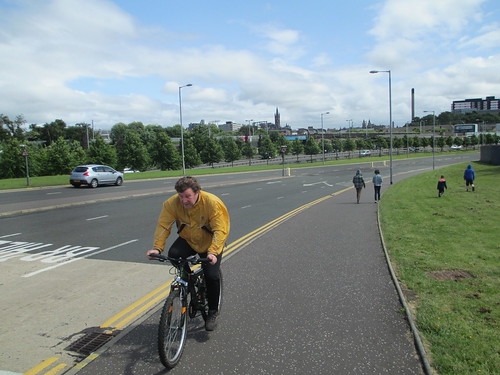
A cyclist in Glasgow: doing his best to follow my lead
from 20 years ago
It was consequently a pleasant surprise when I enjoyed a few days’ brief return home last week to discover that I’d been only 20 years or so ahead of the times when I cycled regularly in Glasgow. I saw none of the large packs of commuting cyclists that are becoming features of the London and even sometimes the New York streetscape. But there were undoubtedly far more noticeable numbers of cyclists about on the streets, competing with double-deck buses, trucks and cars for space on the roads.

Yet cyclists’ growing visibility is by no means the most important recent transport change in the city. Across the Gorbals, a notoriously rough area where I used to cycle between my parents’ home and my postgraduate journalism course, there now strides a vast motorway viaduct, opened two years ago in the name of relieving congestion on older, 1970s and 1980s motorways. The new road – an extension of the M74 motorway leading to England – was built against planners’ advice and looks set to keep the Gorbals as depressing as in the 1990s.

My clearest memory of riding in the Gorbals then is of jostling with cars while riding by a vast, wasteland lot. I knew it had, in happier times, housed elegant tenements designed by Alexander “Greek” Thomson, a 19th century architect dedicated to turning everyday Glasgow buildings into visions of classical elegance.

The new road’s presence prompted me to notice quite how much space Glasgow devotes to the private car – and how far the priority cars receive helps to sustain their dominance. I also noticed how much priority the city’s road network gave to saving motorists time – at the expense of pedestrians and cyclists. That in turn put me in mind of how much space and time both New York – to which I’ve returned this week – and London – where I’ve lived 11 of my post-Glasgow years – lavish on users of private cars.

The FDR Drive was one of the few New York highways
not built by Robert Moses. But the neighbourng housing projects
were - and illustrate precisely how much care the
"master builder" took to create warm, vibrant neighbourhoods.
All of those cities have made admirable strides in the last decade towards enticing residents back onto the bicycles that had been abandoned as urban transport tools. But the more I thought about practical conditions for cycling in those places, the more it struck me that cyclists were often working against the grain of the cities’ current structures. Their true inclinations remained shaped by people like Robert Moses, the “master builder” who in the 1950s and 1960s sent road bridges springing across New York City’s waterways, tunnels burrowing under its harbour and expressways marching across many of its urban neighbourhoods.

Not, I should add, that I envy the task of Glasgow’s transport planners. The city, once a thriving centre for shipbuilding, maritime trade and heavy industry, has suffered from nearly every economic dislocation imaginable. Trade’s focus has shifted from Britain’s Atlantic coast towards those near sea lanes to and from Asia. Shipbuilding, undercut by Asia’s low wages and high efficiency, has all but disappeared. Other countries now make the huge freight locomotives my mother recalls seeing heading down her street on their way to haul goods across South Africa or India. The city could hardly have failed to hollow out as tens of thousands of its working class citizens lost their jobs and left homes that had been clustered around their workplaces. New York and London have undergone similar changes following deindustrialisation, but haven’t quite so comprehensively lost their senses of purpose.
 
A cyclist labours up the pedestrian/bike path near the
Riverside Museum. You've certainly got to admire
his determination when the city's so obviously telling him
to go about by car
Yet a family visit to the new Riverside Museum – part of an attempt to revive one of the areas worst hit by recent decades’ changes – revealed how far Glasgow goes out of its way to thwart anyone who abandons the car. In a short walk from Partick railway station to the museum, we had to pick our way across first a busy, two-lane road, then take a bridge across a four-lane expressway, before immediately crossing a second, five-lane road. The traffic lights’ pedestrian (and cyclist) phase took so long to come around it seemed like a calculated insult.

The area is not the only one so thoroughly given over to roads. Four thick, grey ribbons of tarmac – two carriageways of a trunk road and two motorway carriageways – wind their way across one stretch of the city’s south side that might, without them, stand some chance of revival as hip, inner-city neighbourhoods. North American readers unfamiliar with the city should picture the way Detroit’s urban freeways slice through its neighbourhoods to understand the effect.
 
A Glasgow-built Cunarder tram in the Riverside Museum:
the acme of British tram design, from a city about to take
a wholly different path
The irony is that, on reaching the museum, visitors discover how well Glasgow once provided far more human-scale types of mobility. The Riverside Museum is full of tramcars (trolleys, American readers) dating back to the days when the city’s public transport system was noted for its modernity and comfort. Exhibits are devoted to the city’s subway, opened in 1896, only the third urban underground anywhere in the world, to which my late father devoted the prime of his life. That public transport allowed the city to support large numbers of people in neighbourhoods densely-packed enough to support large numbers of shops, cinemas and other amenities. The tram tracks were ripped out and the urban motorways built in the same wave of modernisation during which Moses slashed Red Hook from Carroll Gardens with the Brooklyn Queens Expressway, severed Manhattan from its waterfront with the Henry Hudson Parkway and made suburban Long Island entirely car-dependent by building only expressways to serve new housing. There was certainly a need for some modernisation. In both Glasgow and New York, the post-war period saw the elimination of many notorious, dangerous, insanitary slums. It's simply hard looking at the end results to believe there wasn't a better way to achieve the goal.

I was particularly alive to the nature of Glasgow’s failure because during the trip I was reading 722 miles, Clifton Hood’s fine history of the building of New York’s subways. In it, he laments how after the first world war, John Hylan, the then-mayor, sponsored subway construction within then-built-up parts of the city but failed to keep extending the subways out to new, undeveloped areas. The result was that areas like Staten Island developed entirely differently from other bits of the city. As I can testify from personal experience, they remain dominated by wide roads full of fast-moving cars. It wasn’t hard to spot a similar process at work in Glasgow. Roads blight swathes of places like Partick, Kinning Park and other areas of the city that once held far higher numbers of people. The populations of those areas are now further away from the city centre in areas so thinly-spread it’s far easier for people to get about by car than by public transport or bicycle.

It occurred to me this evening as I cycled home from work that parts of New York remain as blighted by roads as parts of Glasgow. The thought came into my head as I pedalled frantically across the West Side highway – four carriageways of dense, fast-moving traffic – to reach the Hudson River Greenway before the massed ranks of cars started roaring towards me. Yet New York enjoys the enormous benefit that no politician – even the most anti-cyclist, pro-motorist – would seriously suggest building, say, a new arm of the Brooklyn Queens Expressway devastating a new bit of booming Williamsburg. No-one would suggest devastating Hoxton in London with a new motorway.
 
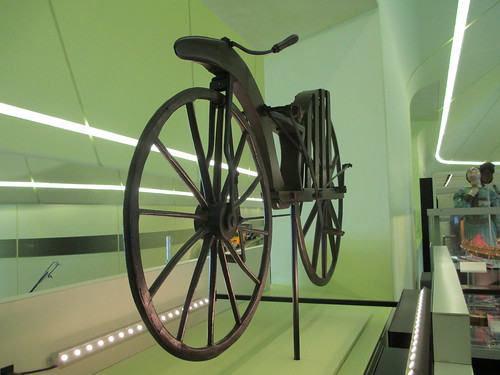
Gavin Dalzell rode this, the world's oldest surviving pedal
bicycle, now preserved in the Riverside Museum, in Glasgow.
With admirable consistency, the city gave him a hard time for doing so.
Glasgow, however, has more in common with struggling cities across the North of England and the US’s mid-west. There’s a desperate edge to some of the transport policy decisions, a feeling that the next city over might prove more car-friendly and attract a vital few investors that could make all the difference. The cities consequently try a bit of everything – some bike routes, some new rail lines, a hulking new urban motorway slicing five miles through a reviving urban neighbourhood. I feel enough affection for Glasgow to hope that the strategy works better than I fear. The city’s continued hollowing-out to facilitate car travel certainly isn’t preventing a revival in vibrant areas such as Hillhead.

But I’d feel far more optimistic if I could picture myself cycling from Glasgow’s south side to its city centre through the kind of bustling city streets where I’ll ride tomorrow morning than under the looming viaduct that now bisects the Gorbals.

Free speech, tweeted threats and an angry Astoria van driver

It was one of my moral philosophy lecturers – I think it was Gordon Graham – who debunked for me an old – but rather flimsy – idea about the structure of the world. Addressing the idea that humans’ bodies and souls were somehow separate entities, he held up his hand, looked the other way and asked, “How do I know where my hand is?” The strong – unarguable, I think – contention was that people didn’t get their ideas about where their hands were across some barrier between the mind and the body. They knew where they were because their minds – which decided where they would put their hands – and their bodies – the hands that were moved – were the same things.

So I’ve been surprised over the last few weeks to notice a version of the mind-body separation hypothesis getting a new life among angry people on the Internet. I’ve pointed out to several people venting their frustration on Twitter that they’re potentially making their own lives difficult when they threaten (for example) to run over the next cyclist they see riding “in the middle of the road”. If they hit a cyclist with their car in the future – even unintentionally – the act will look deliberate and the charges will be more severe. Most prefer at that point not to reply. But a few have replied indignantly that nothing could be further from their mind when writing about crushing a cyclist beneath their car’s wheels than actually doing so. Their angry opinions and their blameless on-road actions are as separate as a classical philosopher would say a grubby body and a pure mind (or, in this case, a grubby mind and pure body) should be.

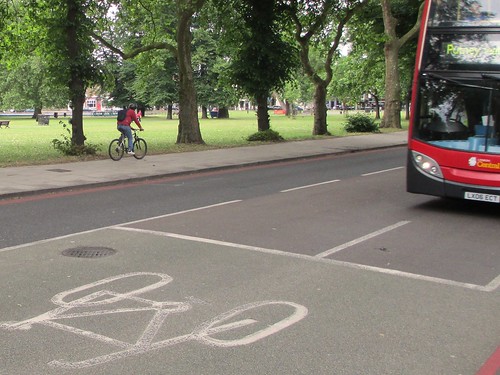
Angry Twitter users should love this rider on London's
Clapham Common. He's done as they've asked and got onto
the pavement to ride.
The incidents have made me ponder whether I’m somehow a humourless prude for failing to catch the innate hilariousness of someone’s warning that she’s going to “run over” the next cyclist she sees on the road rather than the pavement (sidewalk, American readers). Should I, as one of the “run over” woman’s friends suggested, simply “get a life”?

Or are these Tweets verbal expressions of attitudes that carry over into real-life driving behaviour and lead to real deaths and injuries? Are the opinions as inseparable from the drivers’ actions as Professor Graham’s hand and his mind?

The question is all the more pressing after a fortnight in the US when the Supreme Court has moved gays and lesbians a significant step forward in their struggle for equal rights, but moved black people several steps back. There’s no doubt that the growing unacceptability of racist and homophobic language has helped to move those groups’ struggles forward. Should it remain socially acceptable to threaten to drive one’s car over someone just because he or she has chosen to use a bicycle on a public road?

None of this, of course, is to deny Twitter’s ultimate triviality. For some time, the most retweeted message was a sickly sweet farewell by Justin Bieber to a six-year-old fan who'd died of cancer. The vast bulk of what appears there can be treated much as one might the rantings of the drunk at the next table in the pub. It’s mildly irritating - but something one can and should ignore.

There is, nevertheless, a direct, graphic quality to the threats some Twitter users make towards cyclists that makes them worthy of attention. In late June, one user, Ray O’Connor, tweeted this message for the next cyclist that he regarded as being too far out in the road: “I will buckle your back wheels c**ts #IWillRunYouOver.”. Another user, @brinky91, said in a now-inaccessible message around the same time that she would “run over” the next cyclist she found riding in the middle of the road. In April, another user, @LaurenKoerber tweeted: "I f***ing hate f***ing people that ride their bikes in the middle of the road.. Like you're not a car #iwillrunyouover."
 
Bad news for angry Twitter users: these riders on
the Manhattan Bridge have bikes and look likely to use them.
Good news: they're not on a road.
These are, I think, the kinds of threats that, expressed towards many other groups, would attract at least some attention from the police, interested to see how serious the threats’ makers were about carrying them out.

The threateners, however, seem almost as indignant at the idea that the threats are serious as I am at their making the threats. “I WASN’T REALLY GOING TO HIT A CYCLIST GEESH,” shouted one typical replier - @AMILLIAMELY - after I queried her suggestion that she might “gain points” in the game of road use by hitting cyclists who rode “in the middle of the street”. Others prefer self-pity, whining that they’re getting “grief” from “cycling fanatics”, as if that were an unusual result of making death threats to strangers in a public place. @brinky91 pleaded that her threats simply reflected her “opinion” to which she had a perfect right. People should leave her alone. @AMILLIAMELY went on to tell me that she simply liked to express her opinion about things that made her “mad” and that it helped her to feel better.

Yet the more I read such declarations of innocence the more I think about the fate of John Kelly, a cyclist who was riding his bike in Astoria, part of the New York borough of Queens in mid-March.  Mr Kelly was using a bike lane when witnesses saw a van come from behind him, swerve into the bike lane and hit him. He ended up clinging by the wipers to the windshield, the driver staring at him with what Mr Kelly called an “angry look” on his face. When Kelly managed to jump off, the driver escaped. Few regular urban cyclists will have been surprised at news of the van driver’s attack. It was merely an extension of the kind of aggressive, deliberately dangerous driving to which many of us are, unfortunately, used.
 
This cyclist on Glasgow's Cathcart Road is wearing
specialist clothes, is (rightly) well out in the road
and amid some traffic. He could be a perfect storm for
cyclist-haters' rage
The van driver’s attack so closely paralleled the kind of violent assault-by-motor-vehicle that I’ve seen Twitter users say they want to carry out that I can’t accept the two are entirely separate phenomena. It’s clearly better if the people with whom I’ve debated haven’t deliberately used their cars to hit people. But I found it hard to believe the claims of one indignant threat-maker that he was always a careful driver. Is it really credible that a driver who tweets after a trip that he would like to run over cyclists will carefully pass every cyclist he sees on his next trip patiently and at a safe distance? The threat-makers are almost certainly over-represented among people killing and injuring people riding on the roads.

Which leaves the question of @brinky91’s right to voice her opinion that she’d like to crush my body with her car.

There is no doubt that a civilised society has a huge interest in protecting the right to express a wide range of opinions – including ones that gravely offend other people. Free speech provides the fuel for the great race between ideas that makes free societies superior to closed ones. It mans the feeding stations in the great, ever-running stage race between ideologies. There need to be excellent reasons – protection of a person’s right not to be unjustly defamed, for example, the prevention of direct incitement to violence and the protection of a handful of official secrets – to put serious curbs on the right.

But it remains absurd for people voicing an opinion to complain that others loudly disagree. It is as if Chris Froome were to take to complaining in the coming weeks that other riders were attacking him on mountain stages of the Tour de France. There is occasionally an unpleasant whiff of bullying about the way Twitter users can round on someone indulging in unpopular speech, bombarding him or her with messages of protest. But, in cases where someone has threatened real, graphic violence as some of those I have mentioned did, it seems perfectly reasonable that he or she should understand how many of the verbal attack’s victims strongly resent that language.

Speech, after all, is valuable precisely because it is an echo-chamber, amplifying our thoughts and allowing us to try out ideas about the world before taking them from our brains to our hands. I feel constrained as I cycle around New York to behave well precisely because I have written here that everyone should do so. I can’t help thinking that motorists whose Tweets about maiming or killing cyclists have received only the sneering agreement of their friends will feel justified in driving far less carefully. If I have a choice between fending off dangerous driving with a swift brake application and evasive manoeuvring or a few strokes on a keyboard, I know which I’m going to choose.

You can follow the Invisible Visible Man - who promises never to threaten another road user's life - at @RKWInvisibleman