Wednesday, 30 October 2013

A SoHo epiphany, a South London mugging - and the loneliness of the small-hours cyclist

It was around 12.45 in the early hours of last Thursday morning, as I bounced and dodged along the rutted, uneven surface of Grand St, my new route home through SoHo, that I came across an obstacle of the kind one’s apt to encounter at that time of night in a big city. Workmen had closed the street as they moved equipment into and out of the work sites that have been dotted along much of that street for the last year or so. A big sewer underneath is being replaced. I picked up my bike and, eager to get home after a 16-and-a-half hour work day, wheeled it along the sidewalk past the obstruction. Then I got back on, cycled a block and waited for a red light.
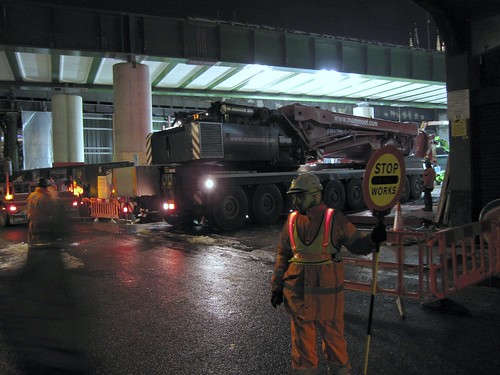
 
A late-night workman bars my way by London's Southwark
Cathedral: similar to my Grand St experience,
if less poetically picturesque
As I paused, however, I experienced one of those moments on a bike that takes the mind racing off to all kinds of other places. To my left, peering into one of the holes for the sewer, was a safety-helmeted workman. The man, who looked to be of Amerindian descent, looked weather-beaten and sad. I could see his wizened, resigned face in minute detail because of the lights shining up from the work site down in the hole. The expression and unusual lighting gave the picture a timeless feeling. The scene I was witnessing on a New York city street in 2013 could almost as easily have been from some 17th century painting depicting shepherds peering from the dark into a lit stable to adore the newborn Christ.

It was also, it occurred to me, the kind of encounter that’s more common when one’s cycling very late at night or very, very early in the morning – the times when one’s out on one’s bike and most of the rest of the world is asleep. The few people one sees are out for some specific purpose – fixing the streets or transit system, disposing of yesterday’s detritus, delivering the coming day’s food, continuing a celebration that started the previous evening or ensuring public safety. The encounters take on a far more intense flavour than the countless interactions of a bike journey at a more normal time of day. I’ve had things thrown at me at those times of day, helped a mugging victim and come upon a lone woman jogging through an entirely darkened city park.
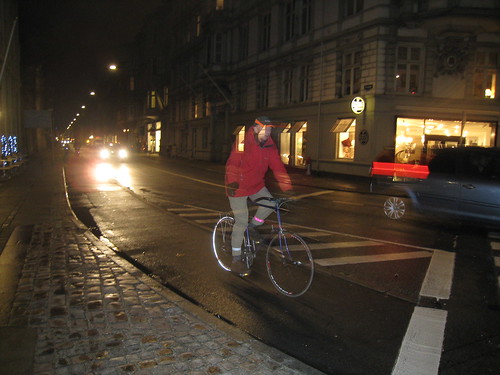
 
Cycling late at night can feel ghostly quiet. But I've never
felt quite as ethereal as I made this Copenhagen cyclist look.
However, my main memories are of the peculiar euphoria that comes from rushing (as one often can) through a city that’s so calm and devoid of its usual sounds as to seem like an entirely different place.

It’s a form of riding of which I have disproportionate experience. Early in my career, when I worked for The Scotsman in Edinburgh, I had bursts of working as the late-shift reporter. I’d come into the office for 6pm, work until the paper’s final edition was done at 1am then head home by bike through the Scottish capital’s old town. I remember bowling across the Meadows – a rough Edinburgh mixture of Central Park and Boston Common, American readers – on crisp, clear nights, along lines of trees, speeding towards home.
 
A lit-up building by Park Lane: a scene
I'd witness looming across the road at me
as I cycled early morning or late at night
to or from Paddington Station.
When I moved later to London, I often had to catch early-morning trains or flights. Quite the most challenging were the times I had to go to Paris for the day and catch the 5:25am train from St Pancras, eight miles from my house, checking in at 4.55am. I’d dash across town in the early morning quiet, down roads that a few hours later would be prohibitively busy, at a steady 20mph. On arrival, I’d often wonder that I’d dared go as fast as I had, given the load of laptop, washbag and so on often weighing down my panniers, threatening to pitch me into the road if I hit a pothole.

On such journeys, the loudest sound to be heard was often the long rattle as some early morning shopkeeper or underground station manager lifted up his security roller shutter. The rat-a-rat-a-rat-a-rat-a sound would echo off the face of the opposite buildings, disturbing the dawn stillness. There was also sometimes, on side streets, the distinctive hum-and-rattling-bottles of a British electric milk float doing its rounds.

Other than that, there was a strange feeling that this was a world with its mute button on. Police vans or ambulances would often rush by, at speed, but on empty roads only the lights would flash and the engine emit the slightly higher-pitched hurry-hurry-hurry sound that says the driver has his foot firmly to the floor. There would be a gentle “whoosh!” sound as the vehicle passed, then a resumption of the quiet.

But one would also come upon people. One frosty morning in February 2006, I cycled from Brixton to Shepherd’s Bush to give a 6.30am interview at BBC Television Centre. As I rode shortly after 5am through a pitch-black Battersea Park, I was surprised to find I was not alone. There, running along entirely unlit roads, was a woman I took to be London’s most dedicated fitness fanatic.

A couple of years before, cycling home late on a Friday night through Camberwell, South London, I noticed a woman hunched over on the pavement by the roadside shouting, “They got all my money!” Looking down the road, I saw the silhouettes of three young men running away across the street. I talked to her and took her into a neighbouring ambulance station while we waited for the police. The incident – along with the time I heard the smash of a thrown bottle that had just missed me at midnight in a public housing estate – persuaded me to stick mainly to main roads at such times of the night.

The ambulance crews offered the woman tea and very British calming words as she sobbed hysterically about how she was meant to be at a friend’s wedding the next day. It was another scene played out in a mixture of darkness and the warm light from inside the ambulance station. The picture – the ambulance drivers gathered in quiet concern round the seated, weeping victim – had an Old Master timelessness similar to the scene I would much later witness by the hole in Grand St.
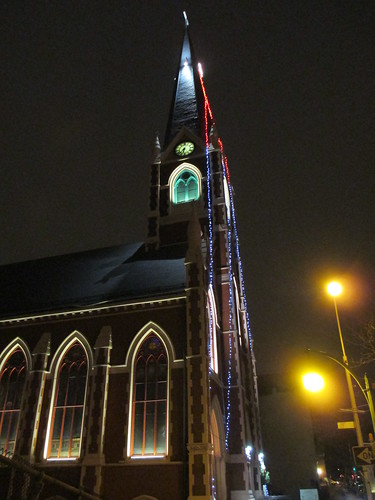
 
A night-time church spire in Carroll Gardens,
Brooklyn: home - who knows - to depictions
of magical scenes similar to those the
Invisible Visible Man has encountered late
at night on New York's streets
But the level of activity I encountered last week on Grand St – and the fact I was also recently stopped there late at night for a filmshoot – illustrate something rather different about cycling late at night in New York. The subways don’t stop just after midnight as the London Underground does. One’s apt to come upon sudden busy scenes even in the small hours of the morning. A couple of times recently, I've cycled across the Manhattan Bridge at 12.30am and seen below me three lanes of traffic on FDR Drive. How strange, it seems to me, cycling on my own a hundred feet above them, to be stuck as 1am approaches, staring at the rear lights of the car in front.

There are, however, subtle signs in New York when it’s late. One’s more likely to pass a work train rumbling behind a diesel engine along the Manhattan Bridge subway tracks than during the day. The garbage trucks are more likely to be private operators picking up restaurants’ potato peelings and empty bottles than city trucks picking up every house’s refuse.
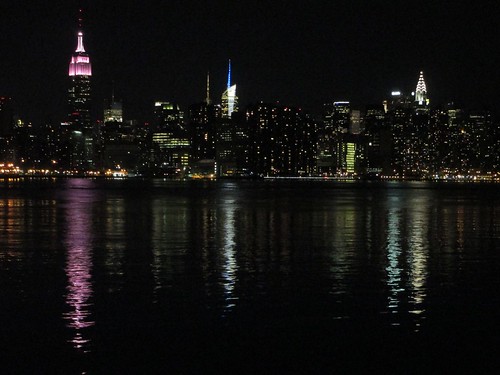
 
A late-night New York City skyline: fine fingers of Art Deco
elegance from the Empire State and Chrysler buildings.
But there is still a special magic about riding when most people are sleeping, even in the city that itself never does so. I saw one woman striding down Boerum Place in downtown Brooklyn at 11.30pm, holding a small child’s hand and yelling accusations desperately at whoever was on the other end of her cellphone. There was the guy I encountered one night recently so drunk that I feared I’d be obliged to accompany him all the way home.

The most striking moments, however, are the ones where the dark and the shafts of light interact to pick out a startling detail. One’s eye will catch the lights on the Chrysler Building’s spire, fine fingers of art deco elegance pointing into the night sky. Or one will find a man who’s peering into a sewer - but providing for a brief moment a reminder of some of the most sublime moments in western art.

Sunday, 20 October 2013

A Film Set, a New Route - and the Joy of Rediscovering Urban Cycling

It’s the kind of intervention in one’s journey home that’s never normally welcome. As I rode my way down Grand St in lower Manhattan around 10.30 in the evening, I found a skinny young man wearing a headset blocking my way. No-one was allowed onto the next block, he said, until the film crew had finished this take. It took only a couple of minutes – although the time felt longer, given that I’d rashly for the time of year put on only a t-shirt on my top half.
 
Grand St in Chinatown: city street, film set or cyclocross
track - it can't settle on a single role
But, despite the inconvenience, I felt a little thrill at being stopped on my way home on Friday. That a film crew was filming on a road on my way home was confirmation that I was, once again, the kind of cyclist whose routes lay along grittily interesting urban streets. For more than a year since moving to New York, I’ve done the majority of my Manhattan cycling on the waterfront greenways, riding often at speed but grappling only in little bites with the serious urban cycling of riding on a street with traffic. Following a move in my employer’s office, I now ride across lower Manhattan from the Manhattan Bridge to Hudson St in SoHo, on city streets for nearly all the distance.

The change has reminded me of some of the sheer pleasures of being an urban cyclist. My riding patterns far more closely resemble those I had in London, where I’d ride mostly along the London Cycle Network of routes along quiet back streets. I’m catching once again little vignettes of city life – I notice, for example, how oddly resigned and depressed the faces of the people waiting each morning for the opening of the Prince Street Apple store are. Pushing a hot dog cart to its place in the morning looks like really hard work.

The contrast between midtown and the relatively relaxed cycling environment in lower Manhattan – where there’s motor traffic, but not on the same scale as further uptown - has also highlighted another truth. Cycling in any place where cars dominate the public space can be pretty dispiriting. I’m missing the last mile of my old work route – where I’d battle my way up 54th street from the Hudson River to my office – not at all. If big cities want to encourage cycling, conditions in such forbidding areas need to be addressed.

The USS Intrepid: just one of the Hudson River landmarks
no longer on the Invisible Visible Man's daily route.
Yet these aren't the reactions I'd expected. For months before the move, I’d been telling anyone who’d listen – and a fair few that wouldn’t – how I was dreading the move. I’d grown used to commuting nine miles each way to and from work, including a four-mile sprint up the Hudson River Greenway along the west side of Manhattan. I was particularly concerned about my waistline. Within a few months of undertaking a daily 18-mile round-trip commute, I was noticing the difference when I stood on the bathroom scales in the morning. I’d dropped a good five or six kilos compared with when I moved in August 2012 from London.

There are certainly sad points about no longer having a daily ride by the Hudson. On my last morning on my old route, I was looking wistfully across at the buildings in New Jersey, glittering in the autumn sun on the river's far bank. I cast a sentimental glance to my right up at the Empire State Building, which I now see only in the distance. I took a picture of the USS Intrepid as I passed it for the last time as a commuter. I was dreading not only the new route’s reduced riding but also the stresses of the new route I’d planned. To the west of the new office – the angle from which I planned to approach – streets buzz with high traffic volumes, pouring into and spewing out of the cross-river Holland Tunnel.
 
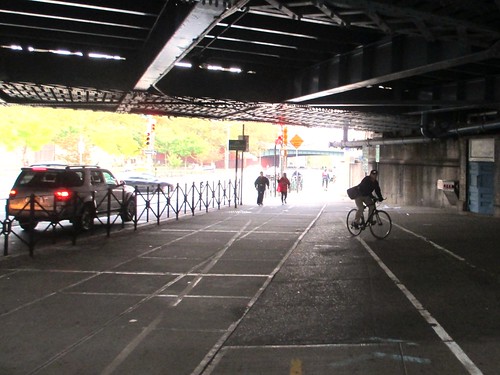
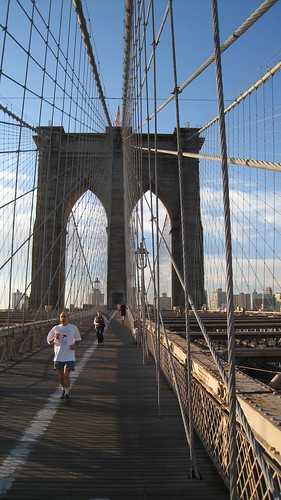
The bike route onto the Manhattan Bridge: a quick route
to lower Manhattan streets - and romantically urban to a fault.
But, on my second morning in the new office, it occurred to me that it was worth trying the simplest, straightest route across town to the new site. I sped over the Manhattan Bridge, instead of the Brooklyn Bridge, dropped down into Chinatown and navigated my way across to Prince St. I discovered how the old, muddled-up street plan meant no-one expected to speed across SoHo. More to the point, I arrived with a smile on my face. The route had been chaotic, grimy and a little bit noisy – far more unmistakeably a ride through New York than my former ride on a calm, orderly path up by the Hudson.

I also, I’ll admit, felt a little bit cooler than before. For the last 14 months as I’ve fulminated about this or that aspect of New York’s road culture, I’ve had a sneaking feeling that maybe I wasn’t quite getting it. Nearly two-thirds of my ride to work was car-free and I’d found some of my efforts at on-street riding pretty terrifying. I’d watched on Twitter the discussions between more seasoned New York cyclists of their experience in the lower east side, SoHo, Chelsea and elsewhere in the island’s lower reaches and suspected they were simply cooler, more sophisticated, bolder people than I. Most of them remain, no doubt, cooler and more sophisticated than I – but I have less awe of their willingness to ride on these areas’ streets.

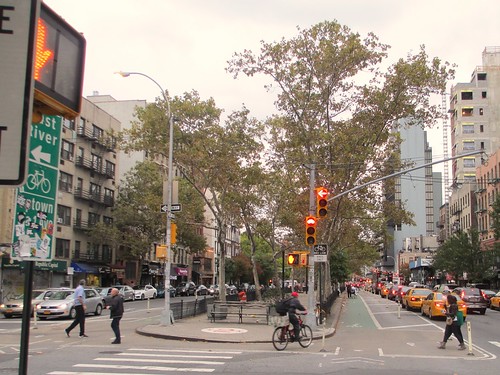
Bike lanes on Allen St at the Rivington St intersection:
a small-time entrepreneur wheeling goods down the bike
lane adds an authentic detail.
It’s certainly not a perfect experience. The journey would be more fun still if more New Yorkers had a better understanding of where the stress in the phrase “bike lanes” is meant to lie. Many seem to hear the term “lanes” and adopt them as the ideal spot to wheel their food truck, haul their suitcase or park their police car. Better protection for many bike lanes would be welcome, as would a reining-in of many vehicles’ speed. I’ve also yet to find an ideal route home. One of those cooler, more experienced cyclists, Joanna Oltman Smith, warned me before the move to avoid Grand St, the most direct route, which extensive sewer works have turned into a cross between a slalom course and a rutted country track. I’ve not yet found a better alternative – and, truth to tell, am enjoying the sense that I might be quietly training for unexpected stardom on the seniors cyclocross circuit.

On the other hand, I now look almost fondly on the elderly Chinese woman I see each morning blocking the Rivington Street bike lane stuffing her bags full of recycling. I marvel at the Beaux Arts magnificence of the Little Singer Building as I cross Broadway. I note how adept the city – like London, my former home – has been at reinventing itself. I see neglected-looking synagogues built for a Jewish community now mainly departed from Chinatown. Factories that once made clothing have been transformed into trendy offices for those of us in the media set. I hear even more of the city's sounds. Next summer, I expect to be still more aware of its smells. I was cycling round New York City on my old route. Now I arrive at the office, a smile on my face, excited at how I've been riding in it.

Wednesday, 16 October 2013

A crash on Brixton Road, backsliding on Shap - and why crashes are so poorly understood

First thing on the morning of February 4, 2009, I took my bike after dropping my daughter at school and headed off to a meeting in Central London. Unusually, because there was still snow and ice on many of the side streets, I headed along the busy, main Brixton Road. Then, around 9.45am, as I approached a street called Grove Way, a silver van suddenly appeared in my path as the driver made a sudden turn from behind me into a side street. I grabbed my brakes in a panicky effort to stop - but was too late. The van caught the front of the bike, knocking it to the left. The impact sent me tumbling off to the right. I landed in the road on my elbow and right hip.

I don't, however, know much more about the crash than that. Although I called the police and there was - officially, at least - some kind of investigation, I have no idea how the driver either failed to see me or miscalculated his turn so badly. I know, in fact, far less about this crash - which affected me personally - than I do about scores of crashes and other mishaps on other transport modes, where societies in Europe, North America and many other parts of the world have decided almost no mishaps are tolerable.

The Metropolitan Police justified their failure to do anything meaningful about the driver who knocked me off my bike on the basis that I hadn’t suffered “life-changing injuries” - even though that was pure chance. In air travel, the maritime industry and railways, meanwhile, any failure or misbehaviour that could have posed a risk of danger to life, limb or property is thoroughly investigated and the report published, in an effort to reduce the chances of the same circumstances’ recurring. I’ve read scores of such reports over the years, awestruck by their meticulousness.
On another mode, they'd find out what was causing all this

The gap in standards is particularly glaring in the United States, where I now live. I’ve spent a fair amount of time this year reporting on the exhaustive efforts of the US’s National Transportation Safety Board to discover what caused the overheating of batteries on two Boeing 787 airliners in January. Although no cause was ever discovered, the incidents – which caused no injuries except a very minor one to an airport fireman – led to the grounding of the entire 787 fleet for several months.

By contrast, collisions involving road vehicles – including incidents where there’s substantial evidence of criminal intent – are regarded much the same way as the weather - with an accepting, resigned shrug and a “What Can You Do?” Ray Kelly, the commissioner of the New York Police Department, made the official complacency over traffic deaths unusually explicit last week when he told Sarah Goodyear, a reporter, that traffic deaths in New York City were essentially inevitable.

"We do have 8.4 million people," Kelly told Ms Goodyear. "We do have a daytime population that’s over 10 million people. You’re going to have a lot of traffic and you’re going to have accidents."

Such complacency is surely a huge part of the reason why the US - which in most years suffers no passenger deaths in commercial aviation - still suffers around 33,000 road fatalities annually.

It's safe to say that Ray Kelly wouldn't have thought it worth his officers' while to draw up one of the no-injury-but-potentially-serious accident reports I best remember reading. The report, by the UK's Rail Accident Investigation Branch, explores in painstaking detail what led a freight train to roll backwards for several miles in the early hours of August 17, 2010. It unearths a potentially widespread safety problem that would otherwise have gone unnoticed until something far worse happened.

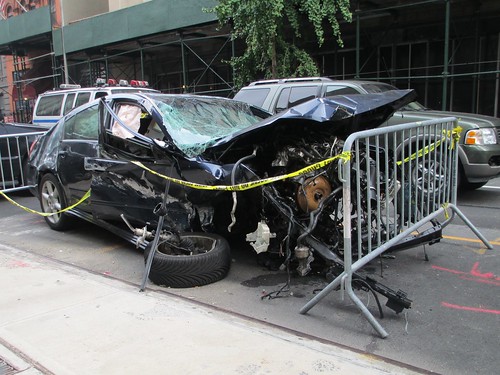
A Nissan Maxima whose driver killed himself crashing
at 100mph in Manhattan. "Hey," asks Ray Kelly.
"What else do you expect in a big, busy city?"
The driver involved was on the first of a series of night shifts and had struggled to get enough sleep before starting work, according to the RAIB. After encountering caution signals, he slowed his train – a load of shipping containers – as he climbed the Shap incline in north-west England. He seems to have become drowsy and, at 2.04am, the train came to a complete halt before starting to roll backwards. The driver was still alert enough to keep cancelling warnings that he had been inactive too long or that he was passing signals. After five minutes, noticing that he had just passed a signal the wrong way at speed – the train reached 51mph – the driver applied the brakes and halted the train.

Such no-injury incidents are almost never investigated on the roads. In New York, even when drivers kill people after “losing consciousness” as the freight train driver did, the police don’t seem very interested. I pass every morning on my cycle ride to work the site in Brooklyn Heights where on February 22 an SUV driver veered off the road and hit and killed Martha Atwater, a 48-year-old writer, who was coming out of a shop with bagels for her family. The driver has never, as far as I know, faced any charges. I know of no explanation as to why he swerved off the road, beyond some vague mutterings about a "medical condition".

The RAIB justifies its concern about the Shap incident by its potential to have caused serious death or injury if circumstances had been only slightly different. Had the train travelled a little further backwards, it would have hit a turnout into a siding a speed, potentially derailing and blocking the busy main line. “The incident caused no injuries or damage,” it says. “However, the consequences could have been worse.”

The report eventually singles out as critical to the incident's cause a factor that a typical police investigation would never turn up. It identifies that the standard railway industry model for predicting how tired certain shift patterns would make staff were out of date. It recommends that train operators scheduling staff shift patterns change them to alleviate the risk. It is entirely possible that that recommendation has prevented a serious crash since.

A driver builds up to the 186mph top speed on a Eurostar
London to Paris train. Imagine if his actions faced as
little scrutiny as a motorist's.
There’s no doubting the wider effectiveness of rigorous investigation and identification of the causes of crashes. On the UK rail system, for example, only one passenger has died in the last 10 years in an accident caused by the railway (another five passengers and a train driver died in a crash in 2004 when a driver committed suicide by driving his car onto a level crossing). The system carries well over 1bn passengers a year. Causes of scores of incidents that Ray Kelly would dismiss as “accidents” have been singled out and dealt with.

Compare that with how many questions remain unanswered about what happened to me that day in 2009. The most obvious is how the driver apparently failed to see a six foot five inch man in a red jacket on an empty road, against a background that was partly white with snow. I suggested to the police that they check the driver’s mobile phone records. Only those who suffer "life-changing injuries" or death merit the cost of such a check, however.

The driver who hit me was working as a contractor installing a new radio system for the police. Did his bosses expect him to answer the ‘phone when driving? How quickly did his bosses expect him to get between different police stations? Had they made reasonable accommodation for that day’s bad weather in what they were asking of him? Had they given him navigation equipment that required him to take his eyes off the road too long?

The answers wouldn’t just satisfy my curiosity. They would show the driver’s fitness or otherwise for a job involving substantial driving around London, when he could threaten other people. They’re questions that relate to the working practices of everyone driving for the same employer and on the same project.

New questions about traffic crashes go unanswered by the day. In New York, where I now live, the police seem to have accepted at face value the word of the driver who maimed a group of children in Queens, New York in September that he mounted a sidewalk because he mistook the accelerator for the brake. That might, however, mean that car brand has particularly confusing pedals – a fault that should be rectified. Alternatively, he might have been on his telephone, or something else entirely. It’s worth noting that the driver in the West Coast Main Line incident originally blamed an equipment fault for what happened, before investigation produced a more detailed picture.

There are even more obvious questions about the suitability to drive of Mohammed Himon, the driver whose taxi severed the leg of Sian Green, a British tourist, on a sidewalk in midtown New York in August. Green herself has said Himon – who had a bad driving record to begin with – was trying to ram Kenneth Olivo, a cycle messenger, when he mounted the kerb. Himon has faced no charges of any kind and has had his taxi licence returned.

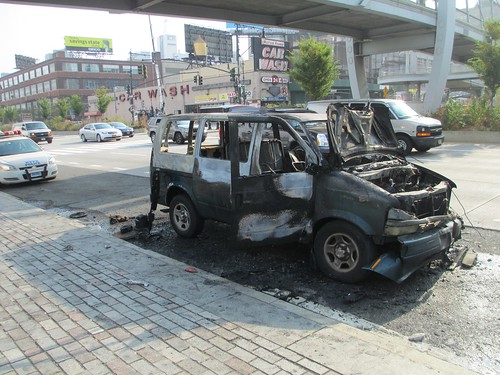
A burnt-out minivan on the West Side Highway:
just one of those things, Ray Kelly thinks

Society has good reason to regulate some means of transport more tightly than others. The incident in July where a runaway crude oil train crashed and exploded in Lac-Mégantic, Quebec, wiping out much of the town and killing 47 people, illustrates the catastrophic potential of freight train runaways such as that on August 17, 2010.

There are also substantial benefits to having personal motorised transport widely available to private individuals. They probably couldn’t survive regulation as tight as that of the aviation or rail industries.

But there surely has to be a case for showing at least a little more curiosity about why the roads of increasingly risk-averse rich countries continue to kill so many thousands of people annually. I suspect greater investigation would show that far more crashes are avoidable than Ray Kelly or many other do-nothings suggest. I doubt public tolerance for current levels of road deaths – around 2,000 annually in Great Britain and 33,000 in the US – would survive long amid a more rigorous effort to understand the reasons behind them.

Friday, 4 October 2013

A Detroit trip, a TriBeCa greeting - and why driving leaves me feeling locked in

It wasn’t a great start to my first driving lesson. Aged 17, a minute into my introductory driving session with my dad on a local industrial estate, we came to a T-Junction, where he told me to turn left. Still unfamiliar with the accelerator pedal’s sensitivity and the steering required to turn a corner, I turned the wheels through 45 degrees and stepped – rather hard, it turned out – on the gas. Seconds later, having demolished a small tree on the way, I had wedged the car firmly onto a low wall round a nearby building.

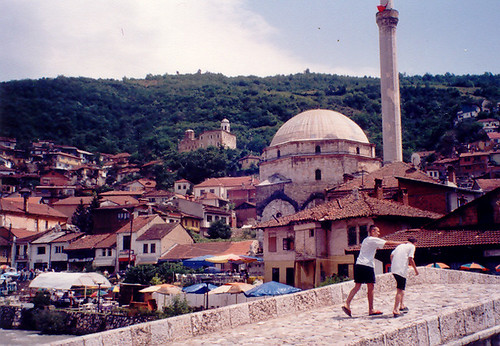
Prizren, Kosovo, just after the war: against the odds,
the Invisible Visible Man drove competently down
a recently-bombed road near here.
That still marks the only time in the many years since that I’ve caused direct (as opposed to environmental) damage or injury with a car. I’ve driven many thousands of miles, navigated cars down recently-bombed roads in Kosovo and survived an attempt by rioting youths in Belfast to hijack a car I was driving. Yet I can’t pretend I get on with cars the way I do with bikes. There are few feelings of relief greater for me than the moment I finally drop off a hire car, having damaged neither it nor anyone else during my time in charge.

It was consequently with a sinking heart that I recognised last week that, no, I was going to need a car to get to my meetings in Detroit. I headed to a downtown Enterprise rent-a-car branch with a feeling of dread.

Yet, while I was mentally prepared for many of the depressing aspects of driving a car, the overwhelming feeling I had while driving my Nissan Versa was not the one I'd been expecting. I found myself more struck than ever before at the sensation of being trapped in a metal box.

That sensation took a while to come over me, however. My first feeling after I climbed in, adjusted the mirrors and pulled out onto the wide, bleak expanse of E Jefferson Avenue was simple boredom.

I’m used to pedalling hard, looking over my shoulders, standing up at points and, on faster or windier bits of a ride, putting my hands down in the drop position on my handlebars. I shift gear regularly to match my pedalling to the bike’s speed. I push hard to restart from traffic lights. 
A Detroit streetscape: not a great compensation
for the stresses of driving

In the car, I was reduced to turning my head a little sometimes, glancing around in my mirrors, holding onto the steering wheel and alternately pushing the accelerator or brake pedals. Given that the car had an automatic transmission, there wasn’t even the modest physical activity of engaging the clutch and moving the gear stick.

That mixture of passivity and onerous but dull responsibility puts me in touch with all the things I hate about having reached middle age. Have I checked my mirrors and blind spots before starting to signal for this manoeuvre? Have I got enough money in the right bank account for this month’s mortgage payment? It’s the diametric opposite of the youthful optimism that wells up inside me most mornings as I ride my bike.

I’m almost overwhelmed when driving, meanwhile, by the challenge of navigating the thing safely. The morning after I picked up the hire car, I headed off for General Motors’ technical centre in Warren, outside Detroit. The freeway on-ramp pitched me straight into the fast lane, which I couldn't escape. I was hemmed in on one side by other vehicles and by impatient other drivers sitting right behind me. I pictured myself or one of the multiple vehicles around me making a small mistake and our slamming into the concrete barriers down the middle of the road. I had an almost tangible sense of how it would feel – the jolting, the tearing of muscles, the fear, the noises.
 
Woodward Avenue in midtown Detroit: the kind of street
that could have been designed - but probably wasn't -
to intimidate occasional drivers
like the Invisible Visible Man
It was one of several incidents that brought home to me how much bolder those around me are about speed, the time they need to switch lanes and so on. Although I think much of my caution is warranted, I feel within like a small, weak, rather scared person. It doesn’t help that when I’m on work trips I’m invariably tired, under pressure and running late. “Why did I sit up late writing that story last night?” I find myself asking as I struggle to shake off the cloudy fatigue in my brain. Then I notice that every time the car’s speed drops below 60mph the satellite navigation system’s estimated time of arrival at my destination slips a little further past the time I was meant to be there. I push myself mentally to focus harder, press down a little on the accelerator and carry on.

Yet the biggest shock to me on this trip was a result, I think, of a recent change in the way I’ve been cycling. I’ve been trying more and more to communicate with other road users, warning them of my presence, thanking them when they’ve acted safely or pointing out when I have a traffic light in my favour. It’s a habit I’ve developed partly in an effort to keep myself safe – but also because I want generally to communicate to others on the road our shared humanity. Most people find it harder to behave callously towards someone who’s made it obvious that he or she is as real and sensitive a human being as themselves.

When I found myself pitched into that highway fast lane, by contrast, I was struck dumb. The drivers around me could barely see me. They were aware only of how my slow-moving, poorly-positioned car was holding them up. My means of communicating were restricted to the use of two pathetic sets of blinking lights saying only, “I would like to turn left” or “I would like to turn right”. I could, I suppose, have honked the horn, as many New York City drivers do, but I never quite summoned up the aggression that seems to require.
 
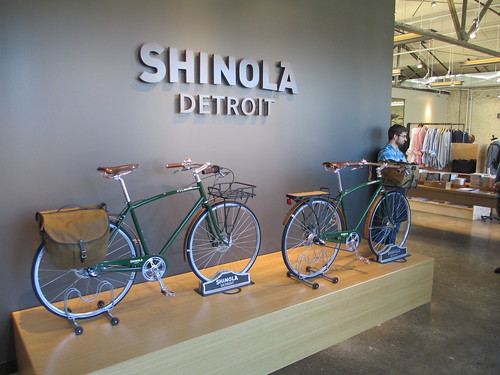
The Shinola bike works shop in Detroit. Can you guess
where the Invisible Visible Man ends up when
he feels homesick on a trip?
I consequently wandered the freeways of south-east Michigan a little bit lost, a little bit unsure of myself and a little bit anxious – but suffering a kind of automotive locked-in syndrome. “I’m a Nissan Versa and I would like to turn left” and “I’m a Nissan Versa and I would like to turn right” were the only two messages I could convey.

As a result, I had a particularly intense sense when I returned the hire car of how the stress hormones were withdrawing from my system. The attendant checked the car for new scratches, found none, and I handed back the keys for the next lucky driver. I climbed instead into the large and luxurious Jeep Grand Cherokee of the public relations executive with whom I was to lunch.

The Brooklyn Bridge Bike Lane: I ride so fast here, it seems,
I don't even recognise people I sweep past every morning.
The relief was all the greater the next morning when, back in New York, I returned to my normal routine, riding across the Brooklyn Bridge into lower Manhattan. The pleasure even cancelled out my irritation at finding building work was obstructing the “bike lane” – the space dedicated to double-parking and deliveries – on Reade Street in TriBeCa. Conscious that other riders would probably feel less cautious than I about squeezing through the remaining space, I nevertheless tried to wave the woman following me through ahead of me.

Her response illustrated precisely what I’d been missing locked up inside that car. She insisted I went ahead, saying, “You’re faster than me.” I didn’t understand why. I looked quizzically at her after we’d both reached the next set of traffic lights. “You’re faster than me,” she said. “I see you ride past me every morning on the bridge.”

Tuesday, 24 September 2013

Falling scaffolding, a sidewalk driver and how safe it's your job to be

Unusually early for a Saturday, I cycled off September 14 towards Sheepshead Bay, a distant corner of Brooklyn, to help out with a relief project dealing with the continuing unrepaired damage from last year’s Superstorm Sandy. Running late as ever, I started off at a sprint over a lift bridge near our apartment that takes Brooklyn’s 9th street over the Gowanus Canal and under Smith and 9th street subway station. The subway sits high on a viaduct above.
 
The great 9th Street scaffolding collapse: I can't think how
anyone would have blamed me if I'd got caught up in this.
But I'm sure they'd have found a way.
A couple of hours later, a large truck carrying building materials made the same journey over the bridge as I - but with a crane on its back sitting a little higher than it should have done. The crane caught a piece of corrugated iron on a vast network of scaffolding erected for a renovation project on the subway station. I returned from Sheepshead Bay to find 9th street barred to me and police and fire officers milling around a tangled mess of truck, corrugated iron and other bits of the scaffolding. Had I been riding over the bridge at the same time as the truck, I would have been helpless. Sheets of metal and steel poles would have tumbled on top of me, while the driver, protected by his cab, was unhurt.

Yet, had I found myself crushed under the scaffolding, at least some people, I’ve come to realise, would have blamed me for not looking after myself better. That’s the implication of the response to an appalling incident on September 12 when a motorist in Maspeth, part of the New York borough of Queens, drove onto a sidewalk and hit five children, three of whom are seriously injured. One child, although initially regarded as only slightly hurt, has since died of an asthma flare-up which, the laws of probability suggest, was probably related to the crash.

In the wake of the incident - captured on the disturbing video below - the school’s principal wrote to parents asking them to ensure their children avoided wearing earphones or using mobile devices when walking to school. The suggestion – not borne out by the horrific, disturbing video of the incident – was that the hospitalised children should somehow have avoided the speeding vehicle by paying greater attention.

The letter – which education officials seem to have insisted the principal sent, over his objections – is all the more astounding since it makes no suggestion that parents drive more carefully – and the driver responsible seems to have been dropping his own child at the school.

The education system’s reaction was far from unique. I recently read with dismay the comments under an old news article about the death in 2011 of Johannah Bailey, a cyclist hit by a van driver on Cavendish Road, part of London’s South Circular in Clapham, that I’ve often ridden myself. The van driver, Andrei Dulgher, rounded a bend in the road so fast that he drove over a traffic island before hitting Ms Bailey – on a turning lane in the centre of the road - and sending her body flying high into the air.

One ostensibly sympathetic comment from someone who’d witnessed the horrific incident – which came to my attention when Dulgher was cleared of causing death by dangerous driving – expressed horror at what happened and appealed to all cyclists to “take care” when riding. How cyclists were meant to “take care” around vehicles coming round blind bends at speed in the wrong part of the road was not made clear.

The scaffolding incident and the strange comment on Ms Bailey’s death have prompted me to think hard not only about how other people think vulnerable road users should behave but how I myself think. Where is the line between a crash that the victims clearly couldn’t have avoided – such as that in Maspeth or Johanna Bailey’s killing – and an incident where the victim’s negligence clearly contributed to what happened? Why do so many people place the blame so firmly on the vulnerable? How does that affect my own road behaviour?

The Invisible Visible Man is comfortable with fewer risks
than this helmetless, dark-clothed midtown Manhattan
cyclist. But he still recognises it's the cars that pose the
main risk
I don’t, unfortunately, need to think too hard to imagine the circumstances of a crash for which I’d blame a cyclist. It happened at 1.30am one Saturday a few months ago as I cycled home from a very late night at work. Tired and feeling stressed by the speed and volume of traffic in downtown Brooklyn, I took a rare opportunity when no traffic was on my tail to make a rapid left turn across Boerum Place’s six lanes, into quiet State Street. I’d forgotten that traffic heading the other way along Boerum Place wouldn’t have a red light. Suddenly, an SUV came tearing around the corner from Atlantic Avenue, the next intersection along, and hurtling towards me. I jammed on my brakes and the SUV swerved and also braked. Catastrophe was averted – but I could have had little complaint, despite the road’s confusing layout and the driver’s speed, if the car had hit me. I’d made a stupid – negligent – mistake.

Yet, if the SUV had hit me, it would have been a relatively unusual type of crash. Every survey I’ve read, including a very detailed one from Transport for London, attributes most crashes involving cyclists to a relatively small number of causes – motorists’ failure to look properly, motorists’ failure to judge cyclists’ speed or direction and motorists’ passing cyclists too fast and/or too close. It’s not, in other words, that common for cyclists or other vulnerable road users to take suicidally silly risks or make utterly inept mistakes. The people who are hidden inside steel shells so have least to risk tend to be the biggest risk takers.
 
I ride in such a way as to reduce my risks. I wear – unlike many of my fellow New York cyclists – a high-visibility vest and even a reflective snap bracelet, intended to help drivers to see when I’m signalling left. Convinced that protection for my body’s densest, most sensitive part must do some good, I use a helmet. I also – again, unlike a puzzlingly high proportion of New York cyclists – use lights at night, two at the rear and one at the front. When riding on a cycle lane between a line of halted or slow-moving cars and parked vehicles, I ride slowly, aware that a door could suddenly fly open or a car lurch suddenly into my lane.

Possibly most importantly of all, I try to communicate with drivers. “I’ll be going straight ahead here, OK?” I occasionally say through an open window. “Stop! Wait there!” I’ll tell one who’s turning illegally across my path. “Please stop using your phone,” I’ll tell another. “It’s making you drive badly.”

It’s no coincidence, however, that my efforts are designed either to help me to react in circumstances where I know drivers are likely to be negligent or actually to influence drivers’ behaviour. I concentrate on taking reasonable steps to mitigate the most serious risks. I don’t pretend that, walking on a sidewalk, I could protect myself against an out-of-control SUV hurtling towards me. I don’t believe I – or the poor children so horribly hurt in Maspeth – bear responsibility for crashes where the driver has been negligent and the victim wasn't.

These drivers blocking a crosswalk on W54th street know
who's boss: and it ain't the pesky people on foot
But the reaction to Johannah Bailey’s death perhaps explains why so much thinking on this subject is so woolly. Both the commenter and, perhaps, the jury that acquitted Andrei Dulgher probably thought of themselves mainly as drivers. That seems to create a barrier as impermeable as a car’s body shell between the driver and the complex reality of life outside the car, including its destructive potential. When that destructive power crushes a pedestrian or throws a cyclist 30ft into the air, it can be hard for motorists not to put themselves mainly in the place of the driver, rather than the cyclist or pedestrian. No matter the circumstances, there seems to be a thought that motorists drive of necessity and are a fact of life. Others have made a conscious, eccentric decision to walk or cycle – and can’t complain too much when a motorist’s negligence makes it go wrong.
 
That thinking, it seems to me, lies behind responses like that of the New York Department of Education to the Maspeth tragedy. Many people seem to see cars as the natural, inalienable rights-holders in public places. Cyclists and pedestrians are the parent-in-law house guests – just about tolerated, but only with the poorest of graces. The streets would surely be safer if more people thought of roads as places where multiple types of road users mixed, rather than places where cars drive and others fit around them.

It will, ironically, be when most people think automatically on hearing of incidents like the Maspeth crash, “How negligent of the careless driver” rather than, “How negligent of the walking teenagers” that people will start to hear of far fewer happening.

Sunday, 8 September 2013

A speeding cyclist, momentum - and how sustained velocity is the enemy of consideration

Even by the high standards of a fine, late summer morning in New York, the weather was remarkably pleasant on Friday – not too hot or too humid and with a cloudless sky. The view from the Brooklyn Bridge as I rode down into Manhattan, the Financial District’s skyscrapers glinting in the sun, seemed calculated to convince even the most sceptical of the accuracy of New York’s claim to be the greatest city on earth.
 
The Brooklyn Bridge's Manhattan
off-ramp: an invitation to let one's
momentum overtake one's manners
But the cyclist who followed me down off the bridge was in no mood to admire the view. As I sat towards the left of the stream of descending bike traffic, seeking a safe opportunity to pass a slower rider I’d been following, I heard a shout of “On Your Right!” Suddenly confused, I nearly clattered into the rider squeezing between me and the railings by the walkway edge. He zipped past me – at a fair rate, given my speedometer was reading 18mph – and swung into the walkway’s crowded pedestrian side to round the guy in front. Then he disappeared off down the slope.

But he went on his way, I imagine, feeling a little more stressed than he’d been anticipating. “Idiot!” I shouted at him as he sped past. “You shouldn’t be…” he shouted before finishing the sentence with an angry gesture towards where I’d been sitting in the lane as I tried to pass the rider in front.

It was the kind of clash I’ve experienced a disproportionate number of times over the last week, as I’ve returned to New York cycle commuting after two weeks’ vacation on Cape Cod. Time and again, I’ve encountered people who’ve been utterly determined to conserve the momentum of their car, or bicycle or walking or running body at the expense of others’ safety and convenience. All seemed caught up in the idea that the complex social activity of sharing a road or path was a private enterprise, where one needn’t take account of others.

I’ve also, however, been struck by the power of fellow feeling with the road users around me to influence my own and other people’s behaviour. People caught up in the bubble of their own, desperate need to reach their meeting or soccer practice or date or whatever can transform back into normal, civil civilians the moment that they recognise how they're threatening someone else.

The contrast has been so striking that I’m currently seeing nearly everything I encounter on the roads as a conflict between these two instincts – to set one’s own pace and to treat others as one would like to be treated oneself. Every journey, I’m spotting people caught up in the excitement of their own speed and a reluctance to change it. Every journey, I’m spotting how a glance into another person’s eyes brings daylight and a sense of the wider world into that tunnel vision.

I’ve been reading some news items through the same prism. I was horrified by how proud a driver calling himself Afroduck was of his “achievement”of driving a circuit round Manhattan’s expressways in 24 minutes. As a Christian – and currently an adherent of a Presbyterian congregation – I was profoundly disappointed by reports of a lobby of Free Church of Scotland ministers to the Scottish government on widening of the A9 road serving some of the Free Church’s highland strongholds and the installation of speed cameras on the road. "Frustration" with slow cars caused more accidents than fast ones, claimed Rev Colin Macleod, who I fear didn’t ask himself how Jesus would drive a car. "Speed cameras... will lead to more frustration, more accidents and more funerals," Rev Macleod told The Scotsman.

However, it was an incident the night before that close Brooklyn Bridge pass that made clear to me the tension between the two tendencies. As I rode up Warren St in TriBeCa, I saw a BMW trying to cut across my path by pulling across the cycle lane at an intersection and into the stream of cars. As I arrived at the traffic lights, I pulled firmly into the driver’s path, looked down towards his open window, signalled to him to stop and said, “Please wait.” Somewhat to my surprise, he did.
 
A warning to cyclists on Kent Avenue, Williamsburg:
a reluctance to yield at junctions comes from the same
desire to conserve momentum as bad overtaking.
But, after he passed me and we carried on down the street towards City Hall, I noticed another cyclist riding into a temporarily narrowed section of road by some road works. Unconstrained by any personal interaction, the BMW driver barged past him in the narrow section. The rider’s arms flew up in exasperation and fear as the driver passed him with inches to spare. It was only the rider’s quick reactions that prevented his being battered into the concrete barriers, with potentially serious consequences.

It’s hardly surprising, however, that so many road users are so keen to conserve their momentum. It’s one of the great joys of piloting any vehicle – a car or especially a bicycle – to feel one’s moving at speed without having to make an effort. It’s no coincidence that I regularly hear businessmen speaking in the wooden-tongued jargon of contemporary American business describing their company as having “momentum”. It’s what political campaigns seek too. There’s a pleasure in that feeling of being carried along by the effort one’s already made, or by gravity or the wind that adds up to far more than merely the product of one’s mass multiplied by one’s velocity. I’ve described myself the pleasure of a downhill run on one of New York’s East River bridges when clear of obstructions. The desire to maintain one’s momentum comes, I suspect, from some of the deepest, most primitive bits of the brain, which house our deepest joys and fears.

There’s a serious discipline, meanwhile, involved in applying one’s brakes to suit another person. All the pleasures of feeling that onward progress disappear. It’s an effort to get going again. As the story of the barging bicyclist of the Brooklyn Bridge shows, it’s a discipline that cyclists often struggle to exercise. Yet, of course, the danger from people driving motor cars is all the greater. Someone shut inside a metal box is apt to be insulated – as Afroduck seemingly was – from the sheer danger that his or her speed represents to others. Drivers are consequently likely to behave more dangerously.
Cars zip down 8th Avenue, in Park Slope:
how conscious are the drivers of each others' humanity?

There is, nevertheless, joy in exercising that discipline. I’ve been trying especially hard since realising how much I enjoy my own momentum to stop for pedestrian crosswalks even when most other cyclists don’t. The tense faces of people glancing up and down the Hudson Greenway waiting for a gap in the bike traffic melt into a smile when they realise someone’s halted for them. There’s an inner satisfaction from knowing that one isn’t going to pass another cyclist before there’s enough, safe room for it and that one’s unlikely consequently to scare the other rider. I’ve long tried to exercise the same discipline on the rare occasions I drive a car, knowing how fearful cars can make me when they pass too fast or close.

It’s a far less visceral pleasure than the rush that Afroduck would have experienced from rounding Manhattan at an average speed of 66mph. It’s the kind of behaviour that can exasperate people who feel they must get past at any cost. Freud would have said it’s an action motivated by the superego, while the pleasure of speed belongs to the id.

Yet to use one’s brakes to act considerately towards others is also to recognise a profound truth about roads, cycle paths and all the other places that people use vehicles close to each other. They’re places that pitch us into some of the most complex social interactions possible. When so many people treat those places as if they were their own private domains, it’s no surprise so many of the people around them – the people whose reality they’re ignoring – end up getting killed.

Tuesday, 27 August 2013

A midtown tragedy, a TriBeCa run-in - and taxi drivers' economic incentives

It’s a key survival skill for a New York city cyclist to learn to spot the looming lurch-out-of-the-lane – the manoeuvre whereby a frustrated motorist, tired of waiting for an obstruction to clear, pulls out of the line of cars into the bike lane without checking his mirrors. But, even by such moves’ poor standards, the sudden turn into my path late last year by a yellow taxi cab one evening in TriBeCa was a close-run thing. I managed to swerve round the cab into a delivery bay before getting back into the bike lane and catching up with the offending driver.

When I told the driver that he’d nearly knocked me off, however, he was not only indifferent but chased after me for a block, driving deliberately close to me and taunting me. So, at the next traffic lights, I took a different tack. I knocked on the passenger door. When the occupants – who turned out to be a group of fairly terrified-looking tourists – wound down the window, I told them: “Please don’t tip this man. He’s a dangerous driver. He needs to learn a lesson.”

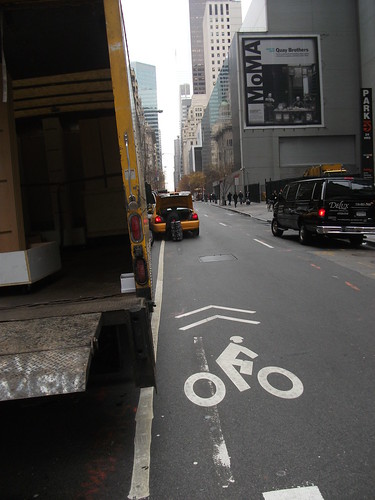
A taxi blocks a cycle route on W54th street.
Who knows whether he'd do this if his fares
kept withholding tips when he did?
The incident in TriBeCa has been in my mind this week because of the grim series of events  last Tuesday in midtown Manhattan that led a taxi driver to drive his vehicle onto a 6th Avenue sidewalk with a cyclist on the hood. He then slammed into a couple of British tourists, severing the leg of one of them, Sian Green, a 23-year-old woman.

My experience has made me look at the horrible, apparently deliberate crash a little differently from some other commentators, however. It is entirely true, as many commentators have said, that Tuesday’s crash would probably have been avoided if either the New York Police Department or the city’s Taxi and Limousine Commission had taken seriously their duties to police motorist behaviour in New York City. It’s also true that, were it not for the widespread demonisation of cyclists and the poor understanding of their rights, the taxi driver - Mohammed Himon – probably wouldn’t have felt the same outrage at Kenneth Olivo, the cycle courier whom he knocked onto his vehicle’s hood. It’s certainly deplorable that some sections of the media have used the incident’s circumstances as yet another opportunity to vilify cyclists, claiming that Olivo, who was arguing with Himon about his efforts to pass him near a busy crosswalk, played a “big part” in causing the crash.

Yet that incident in TriBeCa - along with others where I’ve taken a similar approach – has also made me realise that it’s far easier to reach across the steel barrier separating taxi drivers and other paid drivers from those around them than it is with other drivers. All over the world, such drivers are open to price signals that anyone who cares about road safety can send or ask other people to send. The weak official response to Sian Green’s maiming – the taxi and limousine commission has so far suspended Himon’s licence for only 30 days – underlines how urgent it is that people in New York in particular start using such signals more regularly and concertedly.
 
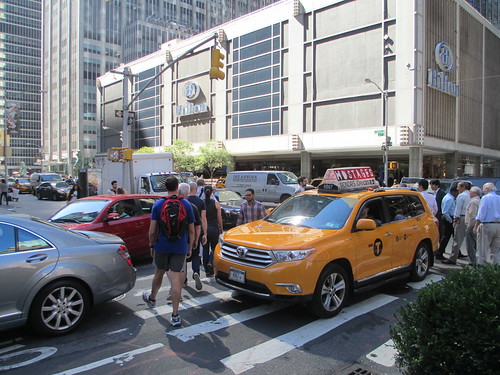
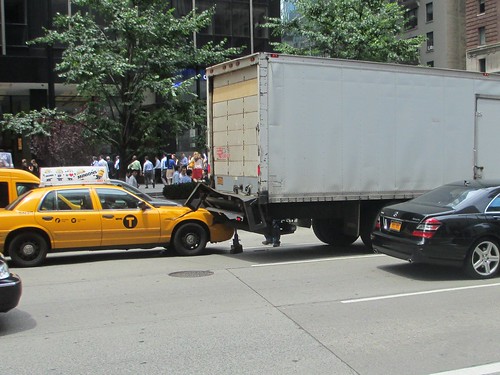
A cab on Sixth Avenue illustrates the high driving standards
for which the profession is known in New York. Thankfully,
everyone in this incident seems to have kept their limbs.

It’s unfair, of course, as I’ve argued in the past when cyclists have done bad things, to extrapolate from a single incident to the behaviour of a whole wider class of people. There are many charming, considerate taxi drivers. Shortly after my run-in with the terrible turning taxi-driver of TriBeCa, I found myself riding one evening down W55th street with a taxi behind me. The driver not only let me pull over to take the lane at a point where the road narrowed but told me at the next traffic lights to “take it easy” after I’d visibly hurried up to avoid slowing him down.

It’s also worth pointing out that, just as minicab drivers in London appear to be on a collective mission to make black cab drivers seem courteous and sensible, New York’s limousine services make yellow cab drivers seem like airline pilots in their regard for safety. There’s a particular limo service operating near where I live in Brooklyn whose drivers I’ve given an especially wide berth ever since I saw one of their drivers dump a package out of the vehicle one Saturday lunchtime. It turned out to contain an empty spirits bottle. Shortly before my TriBeCa run-in with the cabbie, a limo driver had squeezed past me one morning on a wet, slippery W54th street when it clearly wasn’t safe to do so. When I told him he could have killed me, he answered laconically, “I still can.”

Nevertheless, in cities where roads policing and taxi regulation have been made lower priorities than they should have been it’s not unreasonable to expect the drivers putting in the longest hours in the most congested places to pick up bad habits. Serious crashes involving yellow cabs – many of them fatal – are a regular, depressing feature of New York life. Himon’s cab wasn’t even the only one to end up on a sidewalk on Sixth Avenue last week. Two days after Sian Green was maimed, two taxi drivers racing to get to the same fare collided with each other at 37th street, sending one cab onto the sidewalk.
 
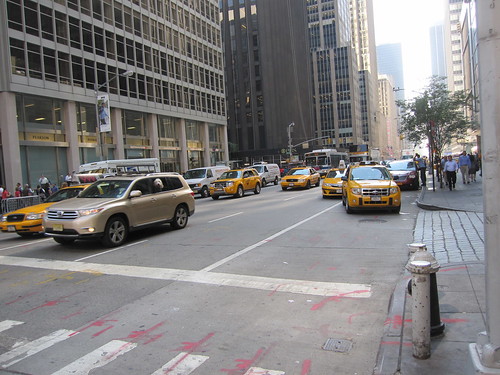
Taxis on Sixth Avenue, not far from where Sian Green was hit:
sheer numbers make regulation both difficult and vital.
The sheer volume of yellow cabs in New York makes its challenges particularly acute. There are serious issues with cab driver behaviour nearly everywhere, however. The strict licensing requirements for black cabs in London - where drivers have to pass such a rigorous test that it changes their brain structure - make serious crashes less common than in New York. But I still had some seriously frightening run-ins with black cab drivers when I lived and cycled in London. The occasional helpful response to complaints from London’s Public Carriage Office only made its other complacent efforts to shrug off responsibility more frustrating.

Which brings me back to my experience in TriBeCa.

I have no idea whether the tourists I accosted withheld the driver’s tip, as I requested. The chances are that they didn’t. Even I when in a motor vehicle with a taxi driver tend to feel a certain fellow feeling with him or her that makes it awkward to criticise the driver’s conduct. The emotional cost of the conflict with an unhappy driver refused a tip can certainly seem higher than the few bucks’ cost of peace.

But the fate of poor Sian Green and the crash later the same week on Sixth Avenue are both reminders of where the economic incentives for drivers currently point. Under current circumstances, higher speeds and refusal to yield when required to pedestrians merely get taxi drivers faster through their current fare or to the next fare more quickly. Only a change in the value of the tip – a higher tip for good driving, a lower one for poor behaviour – can shift the balance in the other direction.

All that would change, of course, if city authorities were to start enforcing traffic rules in a systematic, sensible way. Speeding would become a costly activity for taxis. The price of blowing through a crowded crosswalk might be permanent loss of a licence.
 
The taxi driver who nearly doored me. His intense interest
in my comments on his conduct is evident
But two scenes I encountered in the week before Sian Green was maimed illustrate how far New York City at least is from such a logical system. On Wednesday, August 14, as I cycled to work, Sebastian Delmont, a safer streets activist who was commuting south on the Hudson Greenway, warned me that police were stopping cyclists further up. Sure enough, at 39th street police were stopping cyclists who failed to stop for the red light by an exit from a ferry terminal where most of the time barely any traffic crosses. They were ignoring the next intersection, at 40th street, where taxis and buses regularly refuse to yield to bikes and pedestrians.

The following morning, meanwhile, I was forced to brake hard as I rode to work when a taxi driver opened his door into the bike lane on Clinton Street in Brooklyn Heights. His response when I asked him what was wrong with him was to reply, “I saw you.”

As long as traffic police in big cities worldwide think cyclist harassment a better use of their time than policing speeding and taxi drivers have no fear of the consequences of bad behaviour, it’s incumbent on everyone else to act. I plan to step up my efforts to make professional drivers’ tips reflect how they respect other road users. I hope other readers of this blog will do the same.