Sunday, 18 November 2012

My ride to work - and why the cars resemble little hurricanes

Very few of the runners, stroller-pushing parents, drunks and others who wander into my path each day on the cycle lane up New York’s Hudson River Greenway strike me as especially brilliant people. If they were, they might spot the signs telling them they’re not allowed on the path and stick to the rather pleasant waterside walkway that’s been provided for them.
The runner on the left has, remarkably, chosen the footpath on
the Hudson River Greenway. One can only hope she made
the kind of solid risk assessment the Invisible Visible Man advocates

But, disturbingly, the cycle lane obstructors (CLOs) seem to be better at prioritising the risks facing pedestrians than the head of the New York Police Department’s traffic squad. The CLOs have decided that, if they’re going to obstruct traffic, it’s many, many times safer to get in cyclists’ way than cars’. Having so far seen hundreds – possibly thousands – of CLOs in four months’ cycling in New York, I’ve yet to see one choosing to take his or her chances running down the fast-moving, multi-lane West Side Highway next to the cycle path.

Yet Brian McCarthy, a deputy chief of the NYPD with responsibility for traffic policing, explained in October to WNYC, the public radio station, why its ironically-named Operation Cycle Safe – the programme that focuses police resources on fining cyclists, rather than the road users that cause traffic deaths – was now mainly tackling riding on the sidewalk (pavement, British readers). This behaviour, he reasoned, posed particular dangers to pedestrians. But, while I can find no recent record of a cyclist’s killing a pedestrian on a New York City sidewalk, it is depressingly regular for motorists to do so through excessive speed or lack of attention. The NYPD barely ever prosecutes the motoring offences that lead to such deaths. Its prioritisation is so skewed that, for it to be correct, I should probably be spotting runners every morning taking their chances with speeding SUVs on the highway, away from the terrifying bicycles.

The contrast between the CLOs and Deputy Chief McCarthy illustrates something profound about the vagaries of human beings’ efforts to assess risks. Most humans are reasonably adept at spotting and assessing the most immediate dangers. It’s pretty clear even to a stupid, inconsiderate runner unconcerned about inconveniencing others that it’s less foolish to take the chance of a collision with a cyclist riding at 20mph than a motorist driving at 50mph (the West Side Highway speed limit is 35mph – fun fact that most motorists entirely ignore). Very few people, however, are good at assessing risks in an abstract context such as a decision about how to allocate police resources. The NYPD, as I pointed out in a previous post, hands out 5 per cent of its traffic violation tickets to cyclists, way out of proportion to cyclists’ roughly 1 per cent share of city traffic. But a cyclist last killed someone in New York City in March 2009 – and even that incident wasn’t on the sidewalk. Around 1,000 people have died in the time since at the hands of motor vehicles. A sober risk assessment aimed at bringing down the number of deaths in the city would target an entirely different set of behaviours.

The problem appears to be a widespread one. In the UK, newspaper reporting about the crash that injured Bradley Wiggins – one of my great heroes – ended up producing the same, predictable commentary claiming cyclists endanger pedestrians and, somehow, cars. That’s even though the Tour de France winner’s accident involved his colliding with a car that seems to have pulled out into his path from a filling station without looking. In other words, people started complaining on the basis of the kind of accident that happens quite a lot (one where a negligent motorist injures a cyclist) about things that hardly ever happen – accidents where cyclists hurt other road users.

The question is whether it’s possible to get better to get better at understanding the risks the roads and other places pose - and to start reacting to them more rationally.

A subway station closed for Hurricane Sandy. New York's subway
turned out to be better at assessing risk than many New Yorkers.
My mind’s been particularly drawn to risk assessment in the last three weeks because of events in my new home city. At the end of the week when superstorm Sandy hit New York, I took a trip to Staten Island to report on some of the damage there. Person after person told me they’d ignored the evacuation order for the area on the grounds that a previous hurricane last year – Hurricane Irene – had mostly turned out less damaging than expected. As the sea swept in and inundated their street, they found themselves cowering in their homes’ upper storeys, with waves lapping at the windows even there. A person died in the basement of one of the houses in the street I visited, electrocuted when he stepped into flood water that had electric current flowing through it. The storm was on an entirely different scale from Hurricane Irene.

That miscalculation, it seems to me, is of a piece with people’s miscalculations about road use. In both situations, people rely far too much on personal experience and the evidence of their own senses. In the run-up to the storm, it was clear that the city was very windy but not immediately obvious that the storm would cause historic levels of damage. To realise that, one had to pay attention to something one couldn’t see – the vast storm surge that forecasters were predicting that was preparing to push its way into New York Bay to flood large tracts of the city.

Many people assessing the risks of cycling, meanwhile, look at cyclists in traffic and conclude that the slender, unprotected machines among the big metal boxes are more vulnerable than most figures actually suggest them to be. They see a cyclist on a sidewalk and assume that his greater speed compared with the pedestrians makes him a significant risk to them. It only adds, it seems to me, to people’s irritation with cyclists that bikes are quiet and people tend to notice them only at the last minute. This seems certain to trigger the kind of last-minute, fight-or-flight response that must have been useful for vulnerable cavemen. It’s a far less reliable indicator than people think of the risks around in a complex, modern urban streetscape.

Most people have particular lacunae when it comes to rare events that pose catastrophic risks. A hurricane is precisely such an event. There are fine, hard-to-discern differences between a hurricane that will do little damage – as Hurricane Irene did – kill scores of people and do billions of dollars of damage – as superstorm Sandy did – and one that will kill many hundreds – as Hurricane Katrina did. It is far beyond a normal person’s gut instinct to discern which storms need special attention, yet ordinary people continue to use their gut instincts to assess how they should react.
The motorists are blocking the bike lane. The cyclist's too close to the cars.
And they'll probably all get away with the risks they're taking.

In a road context, the catastrophic events are crashes involving cars, buses and trucks. It’s so common to see motorists driving while ‘phoning, speeding, giving cyclists too little room and so forth that it’s easy to conclude that these behaviours are trivial and pose little risk. Many people compare them with the alarming experience of finding a cycle messenger rush past their nose on a pedestrian crossing and conclude that it’s the cyclist who poses the real danger. The truth is that each time a motorist drives too fast, drives while distracted or turns without looking for cyclists he or she is involved in profoundly risky behaviour – and it’s only the luck of the particular circumstances that divides the outcome from nothing at all and a multiple-fatality crash.

People are still more blind to their actions’ long-term consequences. Almost no-one sees a cyclist on a busy street and remembers that he or she is far less likely to die of heart disease or diabetes in several decades than the neighbouring motorist cursing him or her from the exercise-free cocoon of his or her motor car. The global warming that may be making hurricanes more frequent is a still more remote such risk.

None of this is to excuse stupid behaviour by cyclists. It’s worth stopping for red lights, giving pedestrians plenty of space and going the right way up one-way streets. It shows an example of good practice and avoids annoying one’s fellow citizens. I do my best to obey the rules.

But industries prone to catastrophic but rare risks – the nuclear power industry, for example, or railways – tackle them by looking for the near-misses and minor accidents that suggest people are indulging in risky behaviour. Police forces that hold off warning motorists about dangerous behaviour and minor accidents explicitly miss the chance to follow such a policy.

I at least can do my part. I accept that runners will bound into my path on the Hudson River Greenway and cycle at a speed and on a line that means I should avoid them. I know that cars sometimes sweep across even some lightly-used crossings on the route from angles that are hard to see. So I stop for those red lights as other cyclists and runners speed past me, no doubt thinking me an over-cautious worrier. I do my best to assess when I’ve done something foolish and to avoid repeating the mistake. I can only hope that, as New York and other cities start to grapple with a future made more complicated by extreme weather, far more of those around me start to give the matter the same consideration too.

Sunday, 4 November 2012

Whatever the weather, cycling's proved a post-Sandy surprise

Most mornings, as I cycle to work, I smile to myself as it occurs to me that my children and I both start the day by looking at the American flag. But, while the Invisible Visible Children are taking the Pledge of Allegiance at the start of their school day, I’m looking to the flag for a more practical reason. The stars and stripes that fly from the top of the Brooklyn Bridge tell me which way and how strongly the wind is blowing. Since I moved to New York in the summer, it’s been the direction and strength of the wind on the main section of my morning cycle commute – north up the Hudson River Greenway – that’s been the biggest single determinant of how quickly I can make the journey. A following wind can get me there as much as five minutes faster than the prevailing headwind, I estimate.
The Hudson River Greenway: wind challenge

It’s one of countless ways that moving to New York has reminded me of how cycling makes me far more aware than any other way I might travel of nature’s forces. The summer heat is hotter here than in London, where I lived before, and the humidity higher. The rain is less frequent but the cloudbursts more intense. The winter, when it comes, will be more likely to bring very low temperatures and heavy snowfall. But the last week has made me realise that it’s only my constant awareness of the conditions around me that sets me apart from my fellow New Yorkers. Living for the most part on islands on the edge of a bay vulnerable to storm surges, we’re all to some extent going about our business at the pleasure of the elements. And it’s turning out that when nature really pays us back for the presumption of living in such an exposed position bicycles have a rather important role to play.

It was when I saw the mixture of embarrassment and pity on the CEO’s face that I realised I would need to change some of my cycling routines to fit New York’s weather. It was late June, I had just cycled briskly to my office in nearly 40 centigrade heat amid high humidity to encounter a colleague unexpectedly asking me to join his meeting with an important visiting chief executive. I had ridden – as I used to do in London – in my work shirt with the sleeves rolled up. In the greater New York heat, I was dripping with perspiration. My shirt was damp enough that my chest hairs were visible. I did my best to make myself look respectable. But, when I entered the meeting, it was clear I was still looking rather freakish. “Looks like you’ve done a hard day’s work already,” the CEO said. The next day, I started cycling in a T-Shirt and changing on reaching the office.

The heat and humidity, however, are nothing compared with getting caught in a proper New York downpour. Having cycled regularly in rain in London, I thought myself ready to face the worst a temperate-climate city could produce in the way of rain. Then I set out for home one evening in mid-September amid a deluge that would not have disgraced monsoon-season Chennai. A gutter running downhill on Ninth Avenue had turned into a respectable-sized, fast-flowing, deep river. Every surface was slick with water. The mixture of high humidity, torrential rain and darkness left me struggling to see where I was going. My waterproof jacket became so thoroughly soaked that my BlackBerry, tucked inside a pocket, got fatally wet. It was one of the rare occasions when I regretted the folly of my determination to get about by bike.

9th Street, Brooklyn during Sandy:
the Invisible Visible Man is invisible in this picture for a simple reason
- he wasn't riding when it got like this
As a result of that experience, I resigned myself, when I heard that a tropical storm was approaching New York, to weather that would stop me cycling for a few days. On the Saturday evening before superstorm Sandy hit, I took the Invisible Visible Girl by bike to a friend’s house for a Halloween sleepover. By the time I went to pick her up the next morning, the wind was up enough to send leaf debris stinging into our eyes. By late in the afternoon, as I ferried the Invisible Visible Boy on his trailerbike to a playdate with a friend, I was beginning to doubt the wisdom of being out. Every other means of transport gradually came to a halt too. The Monday was a rare day when I dared not cycle anywhere. I monitored the storm’s progress by walking cautiously down to the canal near our apartment. By the evening, I could see water up to the rooves of nearby buildings where we’d walked around earlier in the day.

But the same surge of water I could see in the canal was devastating many areas I couldn’t see. Water was pouring into subway, commuter rail and road tunnels all round the city. It was pouring through the Staten Island ferry terminal in Manhattan and carrying onto the shore the large ship I would see later in the week beached in Staten Island. It was, in other words, knocking out pretty much every means of transport that depends on any complex electrical or electronic control system. It was even shutting down the pipeline that supplied fuel to the city, laying the groundwork for queues hundreds of yards long to appear by gas stations later in the week.

As a result, I found myself in an unusual position among my colleagues over the next few days, possessed of the one means of transport that enabled me to consider a lengthy commute into Manhattan. I abandoned an initial attempt to reach the office on Tuesday, discovering in still-powerless lower Manhattan the value of the traffic lights whose numbers in New York City I’ve previously decried. But, skirting round the powerless section via Greenpoint and Queens, I found myself back in the office on Wednesday, able to slip past traffic jams and wheel my bike round downed trees. By Friday, I was volunteering to report from Staten Island, putting my bike on the first ferry after the service resumed. I pedalled my way down to bits of the island where the surge had come up to the ceilings of residents’ ground floors. My main thought was that I was fortunate to live in a part of the city where our main moan was a brief Internet outage and a shortage of bread in the shops. While a man had died in his basement in one street I visited in Staten Island, we had never been in serious danger.

But, as I cycled past queues for fuel so long that different gas stations’ lines met each other in the middle and heard anguished stories of islanders’ four-hour journeys to work, I also felt a new appreciation of my bike. New York largely depends on transport systems so overstretched that every extra journey puts a strain on them. I needed little more than a solid surface under my wheels and made few demands on anyone else as I used it.

I don’t know how long my bravado in the face of bad weather will continue into the coming, probably harsh winter. The weather is already making it feel more comfortable to be inside than out. But the past week has made me appreciate afresh the flipside of a cyclist’s vulnerability to the elements. I might have felt dangerously exposed at points on Sunday – more exposed than someone using other means of transport. Yet that also reflects cycling’s simplicity – the thing that’s allowed me to keep skipping round the city in a week when others have spent hours in traffic jams or waiting for shuttle buses.
The Manhattan Bridge bike lane:
this climb's a Mont Ventoux to a novice

New York’s most pressing problem is that thousands of my fellow New Yorkers remain without heat, light and, in many cases, shelter as the weather gets colder. But some hopeful signs are emerging from the post-Sandy gloom. The most impressive is undoubtedly New Yorkers’ willingness to help each other – the pile of donations I saw in church this evening, ready to go from well-off Brooklyn Heights a couple of miles down the road to inundated Red Hook. But there was also something stirring about watching the inexperienced cyclists on the Manhattan Bridge on Friday. One knew so little about his cruiser bike he was riding with the kickstand down. Others felt the need for a breather only a third of the way across the bridge. All seemed possessed of a sense that their work or some other business was so important that their physical limitations or experience of cycling shouldn’t stand in the way.

As the city rebuilds, one can only hope that at least some of those forced converts experienced at least a little of the satisfaction of experiencing and overcoming the power of nature while cycling. Having seen the vulnerability of the city’s overstretched transport systems to disaster, I harbour at least a hope that some of them might choose to stay on their bikes and keep battling the elements with me.

Saturday, 6 October 2012

Do as you like, motorists - and don't blame us for the deaths


It’s a disturbing scene to encounter on the way to work. Every morning recently that I’ve cycled to the office, I’ve come part way down West 54th Street on a badly-damaged airport shuttle minibus. The passenger doors on one side are mangled; the right-hand front wheelarch obviously took a heavy blow and the front radiator grille is nowhere to be seen. It was, I instantly recognised, the result of a crash with a large vehicle, travelling at high speed, hitting the bus then spinning round to hit it a second time. Some research suggests a Mercedes Benz sped up Sixth Avenue early on September 16 and hit the minibus as it crossed at 50th street. Some witnesses said the driver had been racing another vehicle. He was arrested on suspicion of drunken driving. Not surprisingly, given the vehicle’s condition, four passengers and the bus driver were badly hurt - one had a fractured skull, while others suffered head and neck injuries.
The crushed minibus of W54th street: yet more evidence
that cyclists are the true menace to New Yorkers

Injuries and deaths from traffic accidents like the one involving the minibus are growing more common after years of declines in New York. In the year to June, 291 people died in traffic accidents of various kinds in New York City, up 23 per cent from the previous year. The numbers of pedestrians and cyclists killed rose 11 per cent to 176. The same goes for the UK, from which I've just moved. Statistics released in the last week show 3 per cent more people died in road traffic accidents in the UK in 2011 than in 2010, well above the increase in traffic volumes. Civil servants and politicians in both places profess bemusement at the reversal of fortunes.

But it’s hard to believe the puzzlement is sincere. From a crime point of view, New York City has become a far, far safer place than a couple of decades ago – it's just the city won't use the policies it applied to crime to stamp out bad driving. In the UK, transport officials know that speed and traffic light cameras can sharply reduce road deaths – and have encouraged their removal because drivers don’t like them. The question is how many more minibus passengers and drivers have to be rushed to hospital on both sides of the Atlantic before the various authorities start to do something.

I’m lucky that both my encounters so far with officers of the New York Police Department have been fairly benign. On September 29, when I was riding across the Brooklyn Bridge towards Manhattan, I met a police officer leading thousands of people marching towards Brooklyn for a charity event. It wasn’t safe to cycle, he said, because of the numbers of people. I huffily dismounted and pushed my bike towards City Hall. A few weeks earlier, I’d passed a mounted policeman during my morning ride to work along the Hudson River Greenway. I then dutifully stopped at red traffic lights where a road crosses the path – only for the officer impatiently to tell me to get on with it and keep riding.

A typical Manhattan intersection, making it clear why the police
should prioritise cracking down on cyclists
Other cyclists' experience of the NYPD is very different. Last year, the NYPD issued 50,000 tickets of various kinds – for running red lights and so on – to cyclists, compared with only 25,000 for trucks. The division set up to get trucks to follow the law issued more tickets to cyclists than to trucks. Cyclists – who account for maybe 1 per cent of New York traffic and barely ever kill another road user – received around 5 per cent of all traffic tickets. Cyclists should follow the rules of the road, as should every other road user type. But the NYPD is so keen on ticketing cyclists that even perfectly legal cycling gets the treatment. At the height of the NYPD’s effort to intimidate cyclists last year, the filmmaker Casey Neistat received a ticket for cycling outside the cycle lane – which is simply not an offence.

The NYPD no doubt feels that its crackdown on poor cycling is simply bringing to road safety of the “broken windows” approach that’s generally thought to have helped to bring down other kinds of crime in New York. In the 1990s, Bill Bratton, then the police commissioner, and Rudy Giuliani, then New York’s mayor, told the police to tackle petty, “quality-of-life” pieces of anti-social behaviour, which they'd largely ignored before. Police started arresting vandals and the men who extorted money from motorists by cleaning their car windows at intersections. The approach is generally thought to have played at least some part in making the sitting a significantly less scary place to live. Cyclists certainly seem to be feeling the heat for some of the same reasons vandals and squeegee men started getting arrested. There are stories of community meetings with police where residents' top demand is a crackdown on allegedly scofflaw cyclists.

But it’s hard to imagine that broken windows would have been judged a success if the NYPD had concentrated on the squeegee men at the expense of going after murderers. It’s well documented that NYPD’s current policy for accidents involving cyclists is to investigate only if the cyclist has died or looks like doing so. Even then, the investigations seem to be perfunctory at best. While the fatality figures for the last year don’t give much detail on the nature of the fatal accidents, it’s clear that deaths of car occupants are the ones that are going up sharpest – and it’s essentially impossible that cyclists caused any of them. The city is determinedly not prosecuting motor vehicle crime.

A food delivery cyclist on 6th Avenue:
spreading fear, no doubt, among those he may imminently crush
That view seems in no danger of changing. Amid the alarming reversal in the safety statistics, New York’s latest transport safety crackdown is not on the trucks that I see careering at 50 mph up Sixth Avenue but on food delivery cyclists. I bow to no man in my irritation when I find a vacant-looking man on an electric-assist bike carrying chop suey the wrong way up a bike lane towards me. But, given the numbers of families losing fathers, mothers and children to bad driving, it’s mildly obscene that the focus is on a minor irritant of city life. I would feel even stronger, I imagine, were I, say, a relative of the woman killed in a particularly disturbing incident in late August in the West Village where the truck driver was so oblivious to the woman he hit that he dragged her body in his wheels for two blocks before stopping. The same must hold for the family of the young cyclist killed in an incident on Queens Boulevard on September 25, where the truck seems to have gone straight through a stop line. These are clearly incidents for which no food delivery bike, no matter how poorly ridden, could ever be responsible.

A well worked-out effort to tackle quality of life crime on roads in New York City  - or pretty much any big settlement - would concentrate on prosecuting motorists’ red-light jumping at the most dangerous intersections, failure to yield to pedestrians when required, illegal turning across other vehicles’ paths and excessive speed, especially at the most deadly junctions. Perhaps most importantly, it would try to stop people driving while distracted by their telephones or iPads - an area where prosecutions have fallen sharply even as the habit has become more and more widespread. The strategy, in other words, would seek to catch the kind of person who thinks it’s appropriate to race a Mercedes up Sixth Avenue - and address his behaviour before he ploughs into a minibus. The problem, of course, is that speeding motorists are, by their nature, hard to catch. It can be tough to gather the evidence to prosecute a car driver for dangerous but non-fatal behaviour such as deliberately driving intimidatingly close to a cyclist (a regular event in New York). Police forces everywhere have a predeliction for detecting offences that have a 100 per cent clear-up rate, of which cyclists’ light-jumping is a perfect example. The offence will almost never be reported except by a watching policeman. The offender is easy to catch and unlikely to argue his or her innocence successfully.

The change in tone in the 1990s in policing in New York City – and many other large cities worldwide that followed its lead – resulted from a revolution in thinking. City bosses realised it was no longer acceptable to let crime make parts of the city uninhabitable. The puzzle is why such thinking goes only as far as the kerb, and not onto the roads.

A van yields to pedestrians in mid-town Manhattan:
life would be better if this always happened
The British statistics, meanwhile, take me in my mind back to May 2010 and the day when I and other reporters were ushered into a room in the UK’s Department for Transport to meet Philip Hammond, the then-new UK transport secretary. “We will end the war on motorists,” Hammond told us, a keen glint in his eye no doubt reflecting his personal excitement at gaining greater freedom to drive his sport cars. One peace dividend for the motorists was a cut in funding for speed and traffic light cameras. Local authorities weren’t exactly told to take the things down – but the government did the next best thing. It stopped telling them they had to use some of their central government money for cameras - and cut the funding for road safety spending greatly.

The ensuing changes took me a little under a year later to the village of Nuneham Courtenay, on a stretch of the busy A4047 road just out side Oxford. Residents there had grown desperate enough to offer to pay to have their speed camera restarted. Cars that had been slowing down sharply through the village when there as a speed camera now swept through at 60mph. The same day I visited, Oxfordshire police were reintroducing speed cameras throughout the county after scraping together the money to pay for their operation. Because I knew plenty of places were simply abandoning speed cameras and I'd read research saying they saved 80 lives annually in the UK, I'd known for a long time that the UK's record of improving road safety was likely to be spoilt as it was by the recent statistics.

None of this is to say it's easy to stop future Mercedes bashing into minibuses. There's an urgent need to revise deep-seated attitudes about the priority given to cars and drivers’ rights. The driver who smashed into the minibus might, I suppose, have been a first-time offender whom an effort to target the riskiest drivers would have missed. But there’s a steady, demoralising stream of news at the moment on both sides of the Atlantic – a young musician killed on his bike in Queens, an elderly woman hit on a pedestrian crossings in London, a man hit on a crosswalk in Manhattan. As long as officials put off using speed cameras more and targetting the riskiest motorist behaviour, they're throwing away the chance to slow the flow at least a little.

Sunday, 9 September 2012

Farewell to London - where cycling's popular, but just on paper

It was the closest I’ve come in the last little while to ending up under the wheels of a car. As I cycled home from work in London on July 20, just by the Oval cricket ground, a car passed me far, far too close. I pulled towards the kerb and jammed on my brakes. But, amid precisely the kind of light drizzle that makes roads treacherous, the slippery surface of one of the London Mayor’s ironically-named Cycle Superhighways nearly did for me. I started to skid alarmingly, swinging side to side in close proximity to the speeding car. It’s the kind of incident I’m sometimes inclined to think may reflect my cowardice rather than the actual danger. But, as I slithered to a stop and my right pedal skinned the back of my calf, a pedestrian came up to me, looking worried. “Did he hit you?” he asked.

Brooklyn Bridge: a new focus for
the Invisible Visible Man's frustrations
Nasty though it was, my sliding stop at the Oval would not have been especially notable – except that it took place on my last commute for the foreseeable future in London. My route-to-work gripes are now about the stupidity of tourists on the Brooklyn Bridge, the traffic snarl of downtown Brooklyn and when precisely the large model rat that protesters have placed in one lane of W54th Street in Manhattan might disappear for good. The London mayor’s superhighways and the Metropolitan Police’s indifference towards anti-cyclist crime are fast becoming a distant memory.

W54th street: rat trouble
But the incident seemed as neat a bookend as any to 11 years of cycling in London – nine years during my most recent stint and two years prior before our four-and-a-half years in Hungary. As I thought about it afterwards, my mind wandered back to a dark January night in 1997 when I swung my leg over my then Raleigh Mercury bicycle and set off for my first-ever bike ride in London. I was at a car rental depot in Catford and had just returned the rented van that had brought my and the Invisible Visible Woman’s belongings down from Edinburgh. I had to find my way across the alternately grim and genteel suburbs of south-east London to my new home.

To hear London’s politicians bragging about their recent achievements in encouraging cycling, one would imagine that my journey 15-odd years ago should have been nearly impossible. In fact, there were already some designated cycle routes to guide me across tracts of non-descript suburbia such as Forest Hill. The journey was about as pleasant as a ride on a cold January evening in a strange area could be.

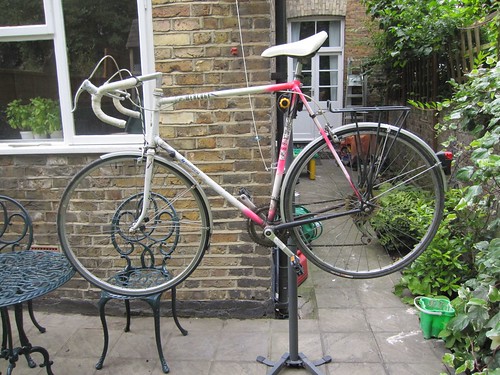
The Invisible Visible Man's Raleigh Mercury:
gaudy-coloured veteran of his first ride in London.
The memory of cycling all that time ago nevertheless put a question in my mind. Are London and other cities enjoying fast-rising cycling numbers rising because cities are making progress, learning from their past mistakes, in their treatment of cyclists? Or are cycling numbers increasing despite city authorities’ failure to understand what cyclists need?

It would be silly, naturally, to claim London cycling had shown no improvement over my time. The biggest positive change has been the wholesale redesign of many urban London roads. The space at many junctions has been narrowed, to prevent cars swinging round them at high speed. Many streets have been made to look narrower, a step that has brought motorists’ speed down. Parking spaces in many places are now more clearly marked as an area off to the side of the main carriageway. I used, when I first cycled in London, inwardly to ask drivers who’d prevented my swinging round a parked car, “How did you think I’d get round it? Fly?” It’s a line that popped into my head far less often later in my time in London than in the late 1990s. That it’s coming back to me again regularly in New York illustrates how big a lesson the Big Apple’s traffic planners have to learn from London in this area.

Cycle Superhighway 7 at Southwark Bridge.
This part still has a slippery surface -
but is at least protected from poor drivers
There has been some modest improvement in the quality of cyclist-specific infrastructure in London too. The number of bike parking places has increased sharply – albeit not as fast in many areas as the demand to park bicycles. The number of markings telling motorists to leave space for cyclists at junctions has increased. The cycle superhighways have appeared along a number of main roads, although my experience in July illustrates the problems with putting routes with slippery surfaces along busy main roads where nothing is done to prevent cars driving poorly.

But the curious point that my July 20 experience illustrates is not how much has changed since 1997 but how much remains the same, despite 15 years when every senior politician associated with London has expressed devotion to improving the cyclist’s lot.

I’d seen the motorist that buzzed me behind me at traffic lights and, seeing that he was driving a black, souped-up saloon car, guessed that he was likely to overtake me dangerously. Sure enough, instead of waiting for a safe place and space, he barged through as if, essentially, I weren’t there. Looking at it from the motorist’s point of view, perhaps that isn’t surprising. The British Highway Code certainly tells motorists they should give cyclists as much passing space as another car. But who’s reminding motorists of that point? Aside from a half-hearted Transport for London campaign a few years ago urging motorists and cyclists to “share the road,” there’s been almost no effort to educate motorists over ten years when cyclist numbers have doubled.

Copenhagen: other cities want the sense of cool -
but not the messy reality of cyclists
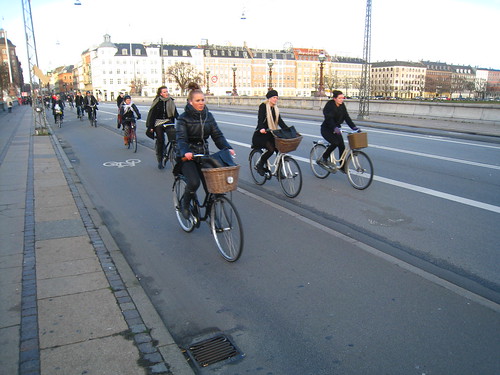
Yet almost none of the politicians or officials I’ve heard talking about encouraging cycling has seemed to have cyclists and cycling as their focus. Cycling was meant to cut road congestion, or reduce pollution or increase people’s physical activity rates. With some politicians, it’s tempting to conclude that they want mass cycling almost as a sign of their city’s coolness – look, our people cycle just like people in Amsterdam! Look, you could barely tell us apart from Copenhagen! A few years ago, there was a similar craze in Europe for planning light rail systems. Bikes seem, in more straitened times, to have taken over.

The result is that the people who make decisions in big cities seem ill-prepared for cycling’s messy reality. Since 1997, tens of thousands more Londoners have started pedalling into central London every morning. Most of them are in a hurry; many are no more considerate of their fellow road users than the motorists alongside them and all of them take up at least some space on the roads. The picture of cycling in many politicians’ heads seems to be drawn from the architectural drawings they show off when boasting about a planned riverside park or other “green” amenity. The cyclists in those never look like they’re in a hurry or like they’re shouting at some idiot that’s stepped into the cycle lane without looking. Many policymakers – and plenty of motorists – seem affronted when cyclists diverge from this unrealistic ideal. Nobody wants to spell out to motorists that, in a given road space, more cyclists means less space for cars. We’re  meant to take as little effort to pass as the paper-thin, pencil-drawn cyclists in the politicians’ drawings. People are happy if their neighbours free up a parking space by taking up cycling – and furious if they ever get in their way on the road.

It’s certainly not a London-only problem. Ten days after my permanent move to New York, I was bowling fast down a marked cycle lane in Brooklyn, reflecting that the lane was far too close to the parked cars. A car door suddenly opened, I jammed on my brakes and, just as I had in London, lost traction and skidded – once again fairly safely – to a halt. New York cycle lanes’ placing reflects the same, apparently widespread delusions as policy in London – that cyclists should take up no space, have no momentum and always be ready to give way to pretty much any other road user.

It’s not inevitable, however, that every politician will always prefer to let motorists set the agenda. The change that has done most since 1997 in London to boost cycling numbers was introduction in 2003 of a charge for driving into central London during weekday peak hours. The decision, by making clear the costs of road use, instantly removed large numbers of vehicles from central London's roads. Cyclists took up some of the freed space. Advisers to Ken Livingstone, London’s then mayor, advised strongly against introduction of the congestion charge, on the grounds that no battle with London’s motorists could ever be won. In recent mayoral elections, while candidates have proposed modifications, no serious candidate has suggested ending the charge altogether.

It’s hard to foresee the circumstances that would prompt a future London leader – or a mayor of New York or any other similar world city – to take firm action finally to prioritise bicycles properly over cars. Until it happens, there may be further, incremental rises in cyclist numbers of the kind London has experienced since 2003. But proper progress will require real boldness.

Monday, 13 August 2012

Commuting, Racing - and the French col climb in our heads

For a week of the Invisible Visible Family’s recently-completed family holiday in France, I had the task every morning of going to fetch supplies of bread, croissants and other ingredients for a continental breakfast. Jumping aboard my bike, I’d sweep down a hill and around the series of turns that took the road through the nearby village. Hunched down on my drop handlebars, I was, of course, in my head leading some audacious breakaway on an etape of the Tour de France. I could almost see the smiles on the faces of the gap-toothed peasantry of Dampierre sur Boutonne lining the roads to cheer me on.
The chateau at Dampierre sur Boutonne: its townspeople
would have cheered the Invisible Visible Man on,
except that the race was only in his head.

But the illusion would quickly break down on the return journey as I ground my way back up the hill. A baguette would be protruding from a pannier bag and a load of jus d’orange and pains au raisin would be slowing me down. I felt again what I truly am – a person who gets about by bike, rather than a sportsman.

Following this year’s Tour de France and Olympics, there has been no shortage of opportunities for British cyclists to reflect on the links between our day-to-day cycling and how Bradley Wiggins rides a time trial or Chris Hoy attacks a track sprint. We’re engaged in many senses in entirely different activities. Bradley Wiggins and Chris Hoy shave their legs to achieve maximum aerodynamic efficiency. I cart around 10 kilos of spare weight just because I won’t lay off the beer in the evenings. It has nevertheless made me happier than perhaps any previous sporting result to see Bradley Wiggins – a cyclist intimately familiar with some of the same London roads that I have ridden so often – control so comprehensively the Tour de France. I couldn’t quite speak for choking up as I described to the Invisible Visible Woman how Chris Hoy from Edinburgh – a city whose streets I have cycled hundreds of times – had won the Olympic keirin.

The question is whether my reaction to British cyclists’ victories reflects anything at all in common between what we both do. Is cycling mainly a sport or just a way of getting about? Should it be mainly a sport or a way of getting about?

It’s worth stressing quite how miserably humiliating my efforts to coax my big, lumbering body into sporting activity have generally proved. I recall, for example, 30 years ago entering the back stroke at a Glasgow Boys’ Brigade swimming gala. It took my fellow competitors the same time to complete both lengths of the race as I did for my first. The difficulty in telling my back stroke from the thrashings of a drowning boy led one of the organisers to inquire after my wellbeing.

The Invisible Visible Man at play: does this honestly look to you
like a body that should be undertaking triathlons?
The swimming gala came back vividly to me when, a few years ago, a chirpy public relations man suggested that, since I was a keen cyclist, I should undoubtedly compete in triathlons, as he did. I also recalled how I had often accompanied my asthmatic and chronically obese classmates in the trailing group on my school year’s annual cross-country run. The run – which was sponsored - was perenially used to raise funding for a desperately-needed new drainage system for the school’s sports fields. Since the event was run mostly round said sports fields in the midst of a Glasgow winter, my group consisted predominantly of overweight, mud-spattered boys, many reaching for their asthma inhalers amid the gathering mid-afternoon gloom.

My automatic reaction when asked to participate in a sporting event is, in fact, to start feeling humiliated. That stems in part from an incident when a PE teacher taught me and my 12-year-old classmates how to throw a discus. We then each had a go to see which would go forward to the school sports day. Ever the optimist, I was convinced I could improve after my initial, laughable effort and put my hand up when the teacher asked if anyone wanted a second go. “Don’t waste your own and everyone else’s time,” he replied. I focused attention on the school choir and public speaking instead.

I should, in other words, be easy prey for the view - which I’ve seen expressed in the British Cyclists’ Touring Club magazine but which could equally apply to American cycling - that the focus on sport has been bad for cycling more widely. Visit a bike shop in Britain, so the argument goes, and most of the options on dipslay will have been designed primarily – with fancy gears, lightweight frames and no mudguards – to help people finish races more quickly than their rivals. According to this argument, there’d be more people cycling to work in Britain – or America – if the average bike shop resembled one in the Netherlands. They should be full of heavy, practical bikes with mudguards, upright riding positions and the gears hidden neatly inside the wheel hub. Cycling should be just a faster form of walking, proponents of this position sometimes suggest.

That view has the substantial merit that it explains why some sights I encounter as a commuter cyclist seem so absurd. Along the Hudson River Greenway in my new home in New York, I encounter many commuter cyclists engaging in the rough equivalent of driving a Formula 1 or Indy racing car to work. Perched on high-end road bikes costing thousands of dollars, they must end up splattered with muddy water when it rains and the bikes must suffer appalling damage from New York’s streets. It would be no surprise, after all, if it some New York road surfaces turned out to have been deliberately maintained by Nasa as test beds for new rovers destined for distant, crater-pocked planets.

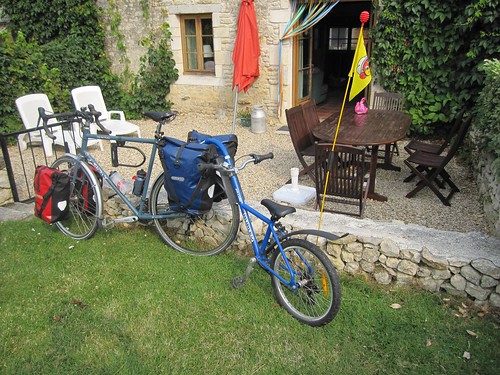
The Invisible Visible Man's bike, in France.
Sure, Bradley Wiggins, you can win the Tour de France.
But could you manage a load of four panniers,
a trailer bike and a four-year-old?
Yet, even for an ill-co-ordinated incompetent such as me, there remains far too much fun in riding a bike fast to reject the link with sport altogether. I can, after all, coax my touring bike into managing journeys in the countryside at an average of around 16mph (26kph) and can get up to around 50kph in favourable conditions. It’s not, I admit, much compared with Bradley Wiggins’ 49kph average for the whole Olympic time trial, but it gives me a sense of achievement. I even, in a moment to counterbalance the snarling of my school PE teachers, had the satisfaction four years ago of being complimented on my speed by a fellow cyclist. After I held off his efforts to overtake me for several miles of our joint commute home, he found me at some traffic lights and advised I try riding at the local velodrome. “You’ve got a fair turn of speed,” he said. If I can manage that, it seems sad to tell the many others with real sporting talent that they should be riding bikes incapable of a decent pace.

I’m sometimes baffled too by the idea that slow, Dutch-style bikes are a realistic option in the biggest cities. My new commute to work is around nine miles each way. Treat that as an opportunity for a slightly faster form of walking and I’ll be turning round to head home as soon as I arrive – for the few times I make the trip before they sack me.

Bikes in Copenhagen: they're sensible, practical
- and barely any fun to ride at all
There isn’t, as far as I can see, much link between a country’s cycling sport success and its people’s propensity to use bikes for transport. Three of the countries with the most glittering records in the Tour de France – France, Italy and Spain – all have lower or similar proportions of journeys by bicycle than the scarcely cyclist-mobbed United Kingdom. The two countries with the highest cycling levels – Denmark and the Netherlands – have both produced distinguished riders in the Tour de France but have generally enjoyed less success in cycling sport than might be expected from the numbers riding a bike every day.

Nevertheless, I can’t help feeling that British cycling’s sporting success has to bring at least a small dividend for the country’s commuter cyclists. A few drivers may, perhaps, briefly regard cyclists not as worrisome obstacles to get past but future Victoria Pendletons or Laura Trotts whom they should respect instead of despising. I, like I suspect many other British cyclists, am holding my head a little higher – or perhaps lower, given the position’s superior aerodynamics – when cycling. I’m deeply proud to come from a country with such a powerful cycling sporting position.

It’s not, I suspect, the kind of benefit that many of Britain’s victorious cyclists were seeking when they underwent their years of painful training and conditioning. It is, however, one of many pleasures their achievements have given me. On behalf of every commuter who’s scaled an imaginary Col du Tourmalet while cycling to work, I salute them.

Saturday, 14 July 2012

Grids, lights and why New York's traffic should be less metronomic

All day long, as I look from the 14th floor window of my new office in midtown Manhattan, a hypnotic scene plays out in the streets below. As one set of traffic lights turns green, vehicles – sometimes swarmed four or five deep across the street – resume their journey, like so many multi-coloured woodlice, north up sixth avenue towards Central Park. Then the lights change and two ant-like swarms of pedestrians march out from either side of Sixth Avenue and merge in the middle. One swarm of woodlouse-cars meanwhile makes its way west along 51st street and a second heads east along 50th. Then, at a regular tempo, the pattern starts again, changing only when some oddity comes along. I watched one day as a food vendor pushing his cart across the intersection was marooned mid-crossing by a change of lights. Cars nudged up against the unexpected obstruction and pedestrians marched round it, like water finding its way around a rock newly fallen into a stream.

Then, every now and again, between the woodlice and the ants appears a gnat – a bicycle picking its way around the parked cars and zig-zagging between the pedestrians. Both the pedestrian-ants and the woodlouse-cars seem impatient with them. It is, after all, especially clear from my vantage point that the bicycles – dodging out behind stopped cars, darting between the ranks of cars stopped at lights – travel in very different lines from the straight up-and-down or across-town of most other Manhattan traffic. Every now and again, some sudden lurch by a taxi or truck has me fearing I’ll need to run to the elevator, head down to the street and act as a witness on some prone cyclist’s behalf.

West 15th Street: Orderly, but not in a very human way
The view from my window has sprinkled yeast on an idea that’s been fermenting in my mind all the three weeks I’ve so far been cycling around New York. It’s that the shape of a city’s infrastructure does more than anything else to forge the culture of its roads. New York’s infrastructure, moreover, seeks a lot of the time to force human beings into the neat patterns that sprang from the minds of its 19th century planners. It was a bold idea, a refreshing change from the haphazard patterns of a city like London, whose street plan in parts dates back as far as Roman times. But it’s hardly suprising that the less-than-straight lines of most humans’ attitudes and behaviour sometimes lead them to burst out of the grid’s constraints.

When I tell people I’m cycling in New York, it conjures up a mental picture for most of my pedalling down some vast Manhattan avenue, skyscrapers towering over me and threatening streams of cars, trucks and buses roaring past. In fact, most of my Manhattan cycling has involved my making my way to the car-free Hudson River Greenway, cycling to the appropriate cross street then cutting across the island to my destination. A brief ride this week was a rare exception. Keen to pick up a train ticket quickly from Pennsylvania station, I headed down Broadway, through Times Square and on down 7th Avenue.

I was suddenly after leaving the Broadway bike lane one of the gnats I could see from my office window, navigating along the line of parked cars to the side of four roaring streams of traffic. At cross streets where the lights were in my favour, I would still frequently face obstruction from a turning car, trying to nose its way through the cross-street pedestrians but stuck in my path. I had to maneouvre out round each, trusting that I wouldn’t find myself, if one of the vehicles made a sudden change of course, heading for a collision.

The 7th avenue experience was almost wholly a product of the city’s decisions about how to use its space. Seventh Avenue could have been a perfectly adequate – and probably far less intimidating – two-way street, with traffic forced into the relatively narrow confines of most London thoroughfares. Cars would then have been far less inclined to swing wildly across the lanes, ignoring general traffic law and the speed limit. Someone preferred, many years ago, to prioritise the swift passage of cars on the avenues over making them feel more human-scale. It created vast tarmac tracts that, when empty, must feel to a driver like some huge auto playground.

The West Side highway, with the Hudson River Greenway:
a chance to watch nearly every road user type breaking rules.
I face a different set of challenges using the Hudson River Greenway. The Greenway may, as I’ve noted before, be the finest piece of cycling infrastructure in the English-speaking world. It’s spacious, largely unaffected by traffic and offers fine vistas across the river to New Jersey. It even afforded me, one recent morning, the chance to race a ship. The general cargo vessel was heading up the Hudson at, I think, a speed of around 15 knots – more or less the perfect pacer for a cyclist heading into the wind on an old hybrid. I was able to catch up at points but held back now and again by traffic lights.

Yet, despite the numerous signs telling them to follow their own path, the cycle track is thick with runners, often pushing strollers (baby buggies, for British readers). Overtaking them safely requires a swing into the opposite lane, often into the face of an oncoming cyclist intent on maintaining the appropriate tempo for his triathlon training. The Greenway is also, while less stop-and-start than a Manhattan Avenue, dotted with traffic lights, protecting turnings across the path into the police department’s pound for towed vehicles, the city’s cruise terminal, the 30th street heliport and others.  A number of these lights spend much of their time showing red for cyclists and green for cars, even though motor vehicles are rare. The pattern at the cruise terminal remains unchanged, for example, whether a ship is disembarking or the terminal’s gates are locked. Even a cyclist as rules-obsessed as I finds it impossible to stop at these junctions, sticking pointlessly to the letter of the law while around motorists zip at 50mph down the 35mph westside highway, cyclists buzz pedestrians and runners jog, talking on their iPhones, down a path meant only for cyclists and skaters.

The traditional response to all these different forms of chaos is to bemoan road users’ failure to obey the rules. The still-more traditional response is to berate cyclists as if they were the only ones breaking them. There is obviously some merit in wishing road users were generally more careful of others’ needs. I was certainly embarrassed on behalf of cyclists generally when, one Sunday morning, I watched a string of speeding cyclists yell out of the way cruise passengers trying entirely legitimately to use a crossing on the Greenway.

But it’s more interesting, I think, to examine why New York’s traffic system seems to encourage possibly even more widespread rule-flouting than London’s more chaotic sprawl.

Police horses on Sixth Avenue:
not every animal in the traffic is metaphorical
The answer, I’d suggest, lies in the similarities between renting a New York apartment and riding in the city. Both exhibit America’s tendency to make every rule clear and unambiguous – for the avoidance of doubt, as a very American phrase puts it. Large British corporations may, I suspect, have been bought and sold with less paperwork than was required for me to rent a Brooklyn loft for my family. Everything from whether the building had ever had a bed bug infestation to whether we needed guards on the windows to protect the children was carefully and methodically spelt out. On the roads, a far higher proportion of intersections in New York are traffic light controlled than in London. There’s far less reliance than in London on allowing road users’ good sense and public spirit work out the best traffic flows at less busy junctions.

That stems in part from an admirable instinct. The United States, a country founded by dissidents and populated by immigrants, recognises that not everyone implicitly shares the same approach to problems. It codifies nearly everything. That has many undoubted strengths over the British assumption that good chaps will have the common sense to understand how things should be done. One country has a hallowed constitution whose workings are overseen by nine learned justices. The other has never even written its constitution down. The American principle, as laid down by John Adams, the second president, is “the rule of laws, not the rule of men”.

Yet there’s a risk, as with any regulation, that it becomes like the Russian tax system – so onerous that, because no-one can fully follow it, it hands arbitrary power to the rule-enforcers. With the apartment, the bureaucratic problems seemed insurmountable until I threatened to take my business elsewhere and the formalities concluded suspiciously speedily. As a cyclist, it is surprisingly difficult heading along a Manhattan avenue not at least to rush through traffic lights as they’re changing. The blocks’ shape – shorter north-south than they are east-west – and the lights’ timing to suit motor vehicle, rather than cyclist, speed mean one can face a red light close to every 100 yards. With the short time pedestrians have to cross, it’s small wonder so many start crossing streets with lights on red, neglecting to look out for cyclists following behind the mass of traffic. The police effectively have free rein to issue violation notices to pretty much any road user they choose – and cyclists, who are far less likely to cause fatalities than motorists, are often the target.

Greeley Square, in midtown: tailored to motorists' speed,
rather than cyclists' comfort
Even more corrosively, the burden of rules can send a message to road users to abandon judgement and good sense. The red lights protecting roads on the Greenway seem to me a subtle message that the rules are arbitrary and weighted against cyclists. While it’s unfortunate, it’s small wonder that so many then go on to ignore the rules designed to protect pedestrians at crossings.

None of this is to say that New York doesn’t work for cyclists. I’ve encountered, I think, less straightforward aggression from motorists than in London. With the competition for road space less frantic, fewer drivers seem to feel quite as embattled as the worst in London. I’ve had no-one deliberately try to intimidate me with his or her driving yet – a fairly regular occurrence in London. Many of the cycle facilities are excellent.

But I can’t help thinking a slight change in New York’s approach might produce some surprising results. A few less traffic lights and I would certainly be looking down from my window at a less metronomically regular scene. I might even be observing one where the woodlice and gnats were willing to let the ants cross - and the woodlice less prone to cutting across the zig-zagging gnats’ paths.

Thursday, 28 June 2012

Feeling the fear - and doing it in a scaredy way

As I wheeled my bike towards the junction of Reade Street and West Broadway in lower Manhattan, I looked round at the three lanes of traffic waiting at the intersection. Many of them were big, mean-looking concrete mixers and other trucks servicing the area’s post-9/11 reconstruction effort. They would be roaring after me the moment the lights changed. Then I glanced at the road surface – a peculiarly New York mixture of steel plates and potholes. The sky was so dark with a looming thunder storm that I’d put my lights on, at 11.30am on a summer’s day. I felt my lower stomach start to knot up as I fretted about whether, confronted by this, I’d remember to manoeuvre correctly. New York, after all, drives on the other side of the road from London, where I’ve done the vast bulk of my urban cycling. Long story short, I was scared.

The South Street bike lanes could seem scary -
or romantically urban, depending on mood
My moment of fear on Monday morning was not the first I’ve experienced over riding my bike in heavy traffic. Unless my fears were so well-founded I’m crushed tomorrow by a truck, it probably won’t be the last. Fear is, at the very least, an understandable emotion for a person riding a light, human-powered vehicle among big, heavy, fast-moving vehicles. It plays an even more important role in the thinking about cycling of people who don’t do it. In most countries with low cycling levels, non-cyclists give fears about safety as their main reason for refraining. Safety worries are a popular excuse at least partly because they sound less lame than admitting one’s lazy. But it’s also reasonable to assume that fear is paralysing a fair proportion of potential riders out of taking to the roads.

I didn’t, however, ditch my old hybrid for the subway. I instead swung my leg over the saddle, headed off down Reade and was soon enjoying a remarkably smooth and speedy ride by the Hudson River Greenway towards my new office.

Regular readers of this blog will be aware that I am impressed with human beings’ irrationality. They consistently let their emotional instincts – the feeling emanating from the guts that I felt knotting on Monday – dictate to higher brain centres.

People particularly consistently miscalculate the risks involved in getting about. Many pedestrians, for example, feel themselves genuinely at risk from cyclists. They vastly underestimate, meanwhile, the extent of the risks motor vehicles present to them.

Yet human beings enjoy such long lives partly because they also have some healthy fears – and strong instincts to avoid the biggest risks. The trick, it seems to me, is to sift the warnings from the useful instinct from the constraining voice of the irrational one.

It was after I narrowly avoided an inattentive car in London the weekend before last that the distinction between my own fear types struck me. I was cycling north through Tooting along part of one of London’s ironically-named Cycle Superhighways when a vehicle suddenly turned out of a traffic jam into my path. Jamming on my brakes, I screamed at the driver to watch, managed to swerve - and narrowly avoided being hit.

The physical danger bothered me far less than what followed, however. Surrounding motorists either shouted angrily at me for having stopped and held them up or shouted mocking abuse over how I had reacted. They were expressing the kind of unrestrained, uncivilised venom and cruelty that surfaces in the worst kind of school playground. Having comprehensively failed to handle such environments well as a child, I reverted to being the little boy of nearly 40 years ago. I felt a pathetic, weak instinct to curl up in a ball and weep. The personal cruelty and anger – which posed no real threat – had got to me far more than the physical danger.
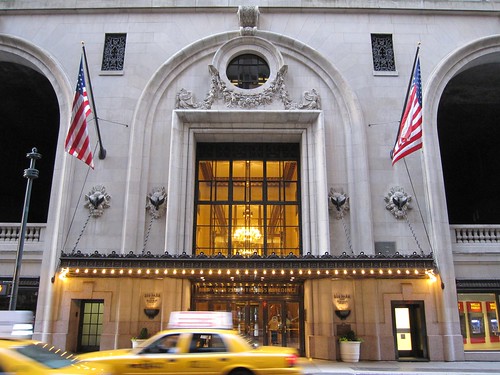
Taxis rush past the New York Central Building:
they're almost certainly not hurrying to the aid of a stricken cyclist,
the Invisible Visible Man can confirm.

Something similar was at work as I prepared to embark on my current house-hunting expedition to New York – and my forthcoming full-time move across the Atlantic. The sheer venom of most of the comments accompanying any article about New York cycling – including coverage of accidents affecting entirely blameless cyclists at the hands of hit-and-run drivers – has, I will admit, intimidated me. New York as a city seems still more irritated than London by the effrontery of anyone's trying to navigate the city on two, human-powered wheels. Many of its citizens seem openly to wish myself and my fellow cyclists harm. The emotion picked up from those comments played on my mind. It added to my long-standing feeling, engendered by the atmosphere of the deep, canyon-like streets, my nervousness over following a different set of traffic rules and the New York City police’s reputation as scourges of cyclists, to put me thoroughly on edge.

New York City's authorities seem, like so many city governments,
to have only imperfectly grasped the point
that cyclists need to ride their bikes on cycleways
At its very worst, such fear can be self-reinforcing. At one point yesterday evening, unsure both of the line I should be taking on the road and the behaviour of a looming taxi driver, I dithered, wobbling about – and succeeded in both irritating the driver and making myself feel more nervous still. It’s when intimidated like that that I sometimes let drivers force me too close to the side of the road, before passing aggressively and too close. Nervousness over the close pass then makes things still worse.

Yet I’ve been prepared to cope, I think, at least partly because of  past periods of deep, far more rational nervousness. Having long boasted I had never been knocked off my bike in London, I was hit twice in just over five weeks in early 2009, once by a motorist turning across my path without looking - and then by a cyclist running a red light. I found myself grasped by an almost paralysing sense of my own vulnerability, reaching for the brakes at the slightest provocation. I recalled, every time I did so, the sensation of being pitched suddenly down to the tarmac. I felt again the jolt that ripples through the muscles at meeting a sudden, unexpected physical force.

My fear gradually distilled, however, into a habit of looking still more carefully than before for signs of sudden, unexpected movements. Even on apparently quiet roads, I now look far more than before over my shoulder, scanning the road for the next motorist seeking to cut across my path. It was at least partly because of those experiences I was able to spot, and avoid, the Inattentive Turner of Tooting.

And, of course, if avoiding fearful situations were my main priority, I wouldn’t be here in New York tackling a new challenge. I’d probably never have lived in south London. I’d certainly never have lived in Budapest. I’d ride my bike only down dull little paths in the country, having brought it there specially on the roof of my car.

The truth is that fear plays a part in the tingling sensation one feels before embarking on something difficult and challenging – whether a difficult bike ride, a new job or some new relationship. It’s the risk of failure that creates the sense of intense alertness that makes them enjoyable. It’s the feeling of having conquered the fears and the difficulties that makes it satisfying to finish.

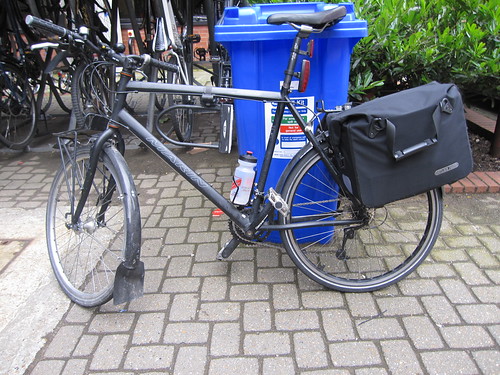
The Invisible Visible Man's Marin Muirwoods before
the Embarrassing Case of the Pedal Incompetence
The 65 miles or so I’ve so far cycled around Manhattan and Brooklyn certainly haven’t been trouble-free. It turned out, for example, that I’d messed up screwing on and off the pedals on my old, spare bike when bringing it on the ‘plane. A pedal fell off on Sunday in Prospect Heights, thanks to stripped screw threads where it attached to the pedal cranks. Much of the honking one hears in New York traffic turns out to be directed at blameless people who have merely chosen to use their bicycles in parts of the road clearly marked for doing so. I suffered a particularly long tirade of abuse from a man who thought I should squeeze against the cars on a narrow road in Carroll Gardens so that he could drive his RV a few inches from me. I was, after all, delaying by milliseconds his arrival at the end of a traffic jam. I’ve cycled more slowly and carefully than normal, listening to my useful fear about the limits of my proficiency so far in New York traffic.

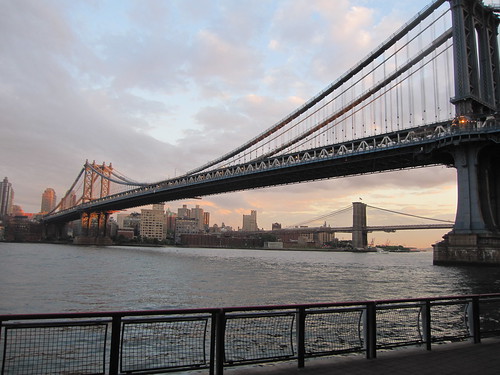
The Manhattan Bridge: a rare chance to race subway trains
But I’ve taken my old bike speeding in glorious sunlight up by the Hudson River, looking over to New Jersey. I’ve climbed up and over the Manhattan Bridge, relishing the rare prospect of racing subway trains as we both labour over the bridge then accelerate down the other side. I’m not yet regularly commuting over the Brooklyn Bridge, as the first ever post on this blog said I aspired to do. But I've enjoyed several times the beautiful vista from New York's oldest bridge towards the towers of lower Manhattan. I looked up the other day riding down second avenue to see the spire of the magnificent Chrysler Building looking down at me.

Those aren’t experiences I’ve enjoyed despite my fear. They’re not feats that have required any special bravery to accomplish. But they’ve been ones that have been all the more rewarding because I’ve overcome a slug of my own cowardice on the way.