Monday, 2 June 2014

An idle hour, worried taxi drivers - and why only the dumbest don't plea bargain

The man looked me up and down and, mistaking my light grey, Brooks Brothers suit for a sign I had an official role at the Taxi and Limousine Commission tribunal, asked me, “Are you the lawyer?”

“No, I’m a witness,” I replied.

A brief, awkward silence ensued.

“You are in favour of the driver?” he asked, in the accent of somewhere in South Asia.

“No,” I said. “The driver tried to assault me, so I’m very much not in favour of the driver.”
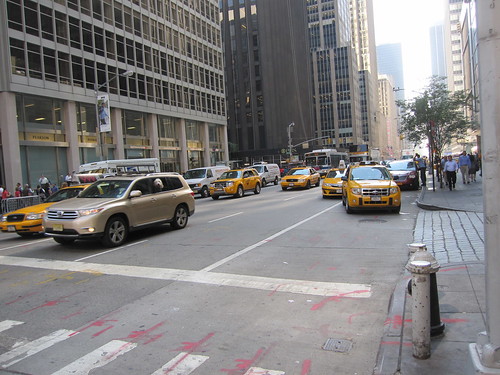
 
New York City taxi drivers, before humanisation
The man’s error, I realised during the 90 minutes I spent this past Thursday at the New York Taxi and Limousine Commission, was an understandable one. We were all at the TLC’s Office of Administrative Trials and Hearings because of things that had happened somewhere on New York City’s streets. The steady stream of mainly South Asian men that trooped out of the elevators on the 19th floor of the TLC’s building in the Financial District had all, presumably, done something negligent or dangerous that would have infuriated or horrified me if I’d witnessed it. There’s an equally strong chance that, had we encountered each other on the street, we'd have been yelling at each other.

But, as I waited for my moment of courtroom drama, I found myself viewing the drivers, shorn of their yellow cabs or Town Car limousines, differently. They were hard-working immigrants worried about what their day at the tribunal would mean for their livelihoods. Once there was no obvious sign (apart from the pair of pannier bags at my seat) that I was a cyclist, I suddenly turned into someone who might make this bad day better for them. Off the roads, our shared humanity came to the surface.
 
The scene of, if not the crime, at least the breach
of Taxi and Limousine Commission regulations
Not that the reason I was there was touching or reassuring. I was due to attend a hearing over my complaint against a car service driver that I found one night in March blocking a cycle lane at a particularly dangerous junction in downtown Brooklyn. Since he was leaning against the car and there were plenty of legal alternative places to park, I asked him to move. After he angrily refused to do so, I tried to take a picture as evidence for the TLC. That sent him spiralling into a far more intense fury and he not only swore at me and called me a “white devil” but made grabs for both my camera and bike.

When I arrived at the office at 8.50am on Thursday, however, I recognised none of the drivers waiting anxiously for hearings. A short while later, a TLC prosecuting attorney emerged to tell me my driver had so far not turned up. If he hadn’t arrived by 10am, he would be in default and found guilty of all the charges. He apologised for making me wait.
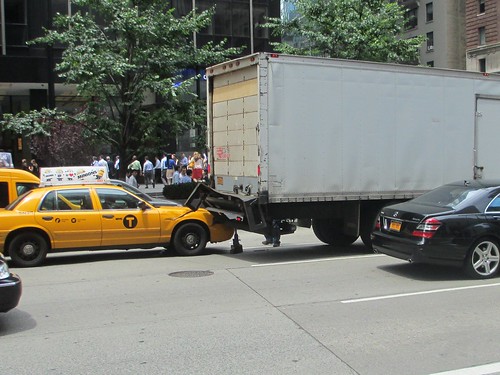
A New York taxi cab in action: quiet professionalism

But I was already growing interested in the transactions I could hear taking place around me.

“OK, so the complaint’s withdrawn,” I heard a TLC official telling a woman I took to be a driver’s lawyer. “So he doesn’t have the points. You just have to make sure he doesn’t get two more points or he’ll get another summons.”

Another driver was standing, head cocked, listening carefully to a TLC attorney.

“This is the offer,” he was being told. “We give you a $300 fine and no points.”
 
There was then some discussion about whether the driver had been given a previous chance to consider the offer, before it became clear that he would accept it.

“If that’s what you want to do, we’ll go in front of the judge and withdraw everything else,” the official told him.

Would you feel like veering left round a limo parked
at this intersection? One evening back in March, I didn't.
The tribunal, I started to realise, seldom dealt in courtroom drama of the To Kill a Mocking Bird kind. I’d carefully taken pictures of the intersection involved to show the judge how dangerous it was to park in that bike lane. But I’d never been likely to get my moment in court. The tribunal dealt instead in the kind of mildly unsatisfactory plea-deal compromise that Maurice Levy would persuade a drug gang’s members to accept in The Wire. The transactional nature of the interactions was such that I even heard someone who seemed to work at the TLC shouting cheerily to someone who appeared to be a driver, “Nice to see you here again!”

My mind went back to my most recent journey in a New York City taxi – my first since I moved permanently to the city nearly two years ago. Arriving at nearly midnight at LaGuardia Airport ten days ago, I opted for a taxi over the late-night vagaries of bus and subway. I found myself hurtling at 70mph along the uneven surfaces of the Brooklyn Queens Expressway. The driver hunched over the wheel of his Ford Escape, a hunted look in his eyes.

It was obviously dangerous driving – he tailgated other vehicles, drove too close to the concrete dividing barriers and generally, I eventually told him, drove like someone who would one day kill another road user. He didn’t seem in any way a bad person, however. He was remarkably calm and receptive once I started fully explaining to him why his driving terrified me. I slightly reduced my tip in line with my previous advice on how to shape taxi driver behaviour. I couldn’t help wondering how well the endless transactions at the TLC fulfilled the wider goal of persuading drivers like mine to use their vehicles more safely.
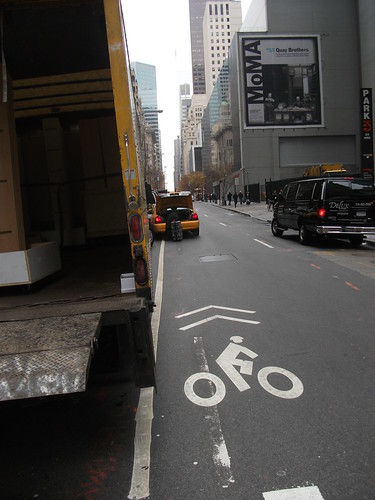
Yeah, sure it looks like a clear rule breach
to you. What will it look like after a
plea bargain?
Yet, as my hour ticked by, it became clear I’d got into a row with one of the few for-hire drivers who didn’t understand how to play this game. My driver had been charged with three counts – a parking violation; harassment; and making threats of, or actual use of, physical violence. He faced points on his licence for the parking, a $200 to $1,000 fine for the harassment and a fine of up to $1,500 for the violence element. He could, in theory, face a suspension or revocation of his licence but the prosecutor made it clear the judges didn’t like using that.

Having listened to the other conversations, I’m confident the prosecutors had foreseen a deal dropping the violent element in exchange for guilty pleas to the two other charges. As it turned out, unless the driver can provide a good reason why he didn’t attend, he’s been found guilty of all the charges and could face the maximum penalties.

It was an outcome that initially pleased me. I headed back outside to find the Financial District bathed in bright, warm sunshine I’d been unable to see inside, unlocked my bike and prepared to head back to the office. I remain grateful to the TLC for taking my complaint seriously and acting on it. It’s better than the only previous time I complained to them, when they insisted they couldn’t identify the driver involved based on his licence plate number.

But Beaver St, outside the offices, was packed with cars, their drivers leaning impatiently on their horns. As I headed north towards the Hudson River Greenway, motorists were cutting inside each other, jostling for minuscule advantages with little regard to the danger or inconvenience their behaviour was creating for other people. As I rode home that evening, I once again had to dodge round a for-hire vehicle parked exactly where the driver I encountered had been. I hadn’t the heart to ask him to move.

I’d won one hollow, easy victory in the campaign for more civilised streets. But I got home far from certain the war was being won.

Update, June 10: I've just heard that the driver was indeed found guilty. He will have to pay a $3,050 fine and have four points on his licence.

Sunday, 25 May 2014

An angry off-duty policeman, a rainy night - and why the suburbs are coming for your bike lane

It was 8.30pm on Friday and I was battling my way home from Greenpoint, at Brooklyn’s northern tip, through a thunderstorm of the kind that reminds one New York’s weather arrives partly from the tropics. I’d just got south of the Williamsburg Bridge on Kent Avenue when, looking ahead, I could see there was a car parked blocking most of the bike lane.

I naively assumed for a moment that perhaps the driver had made a mistake. Perhaps, despite the clear markings, in the torrential rain the driver just hadn’t spotted the bike lane.
The Kent Avenue bike lanes: a great place to park,
if you're entitled and unpleasant.

Instead, I was about to discover an almost beautifully distilled summary of what remains wrong with attitudes to cycling and road law enforcement in New York City. Some of those attitudes are peculiar to this big, crazy malfunction of a metropolis, while others are frustratingly widespread across the industrialised world. Cyclists, according to this attitude, are an odd, fringe group whose concerns needn’t be taken seriously.

But that’s putting the cart of theorising before the horse of anecdotal evidence.
The car stood out because it was so obviously in the wrong place. The parking spaces along Kent Avenue are all in the road, while a two-way bike lane runs along the kerb. The car’s headlights were glaring back at me, through the rain, more or less right in my path. Every other car for blocks was neatly parked outside the bike lane. As I approached, I expressed my irritation by waving to the motorist to move. It was a waste of effort. Even so, I might have said nothing if the motorist had not, as I rode slowly past in the remaining portion of the southbound bike lane, rolled down his window and said something, which I didn’t catch, but sounded abusive.

The insolence of the gesture switched me into “Invisible Visible Avenger” mode. I rapped sharply on the now-closed window and told the driver, “Shift! You’re in the bike lane.”

When the window rolled down again, the face looking back at me was a man, probably in his thirties, solidly built and wearing a baseball cap. He looked unimpressed with being asked to move.

“I’ll park wherever I want,” he replied.

“It’s illegal,” I said. “You’re blocking the bike lane.”

His reply alone would make a fascinating blogpost on its own – and certainly a fascinating contribution to Sarah Goodyear’s recent piece for the Atlantic Cities about cycling and masculinity.

“I’m picking up my baby,” he said. There was a child in a car seat in the back.

“What’s more important – my baby or your faggot-assed bike?”

The weight of his cultural assumptions was suddenly crashing and swirling around inside my head as frantically as the rain was lashing down outside it. There was the tone of injured innocence, so typical of a certain kind of self-righteous motorist. “I’m trying to go about my life the way normal, respectable people do,” he seemed to be telling me. “Yet here you, cyclist, are trying to intrude and ruin it.”

The assumptions behind the “faggot-assed bike” comment are even more breathtaking. He was driving a Dodge Avenger – a mid-size sedan with a more powerful than normal engine and an aggressive look. The car was an embodiment of his assumption that real men drive fast, aggressive cars. I, in my human-powered earnestness, represented weakness so transgressive as not to be fully male. My behaviour was so strange that even my bicycle suddenly assumed a sexual orientation.

And, of course, his attitude was turning this into a battle of wills, which I wasn’t prepared to lose.

“What’s important is that you’re blocking the bike lane,” I told him. “Look. I can call the police if you like.”
 
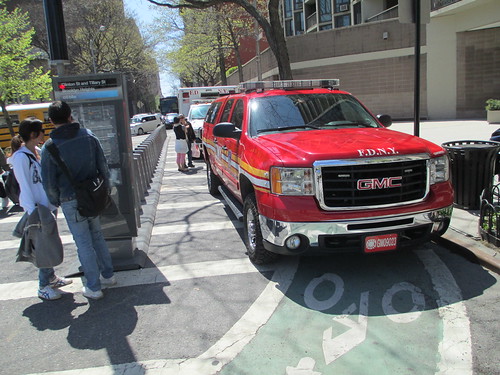
I use this photo for balance. The NYPD isn't the only
emergency service that ignores bike lanes
It was a bluff, based on my knowledge that no NYPD officer would deal with a call about a driver's obstructing a bike lane, particularly in a thunderstorm. But it opened up a whole new front in the battle.

“Call the police if you like,” he said, grabbing a sheaf of papers from his dashboard and shoving them towards me. They bore the logo of the New York Police Department and looked like some internal police directory. “This is the police right here.”

It would be reasonable to ask at this point why I believed him to be a police officer. Suffice it to say that I had a run-in once in London with someone who claimed to be a Metropolitan Police community support officer. His claim never rang true and, sure enough, when I complained to the police they said he was nothing to do with them.

The arrogance, self-confidence and sense of entitlement of the Angry Avenger Driver of Kent Avenue struck me as far more convincing.

It would be still more sensible to ask why, faced with a homophobic, cyclist-hating police officer who thinks his role entitles him to break the law, I didn’t cut my losses and leave. That, I imagine, is how a more balanced, contented person might have behaved.

Yet by now the Invisible Visible Avenger was in sole charge.

“What’s your badge number?” I asked.

“You got room to pass, don’t you?” he asked. “I ain’t stoppin’ you.”

“Are you a police officer?”

“Yes, I am. You shouldn’t be riding in the rain.”
 
There are two ways to read the NYPD's decision to put
"Courtesy, Professionalism, Respect" on the side of their
vehicles. They're either wholly out of touch or - which I
prefer - have a brilliant satirist in their image department
“Tell me your badge number.”

“Stop ridin’ in the rain.”

“What’s your badge number?”

“I don’t have to tell you shit.”

It was the last I heard from him. Silently, recognising reason wouldn’t work, I strode over to a nearby wall, leaned my bike against it and started to get my camera out of my pannier bag. Recognising, I suppose, that his bosses might take a dim view of discovering his views on a whole range of matters, the officer made off into the dark, rainy night. My sole sliver of victory was that I’d got him out of the bike lane. I felt far less fearful than after some previous confrontations with recalcitrant motorists.

But, as I headed on homeward, water squelching in my waterlogged shoes, I felt depressed. The previous morning, I’d been delighted as I rode to work to see a police officer ticketing a driver parked in the bike lane on Jay St in downtown Brooklyn and had shouted my thanks to him. The Kent Avenue encounter made me think that other reports I heard last week – of the police ticketing cyclists for relatively harmless breaches of Prospect Park’s one-way rules, for example – were more representative of current police attitudes.

The officer’s self-righteousness bothered me most. The comment about how I shouldn’t be riding in the rain suggested a strong underlying assumption that cycling was a trivial, leisure activity while driving a car was the serious act of a responsible person. Illegal driving consequently trumped perfectly legal cycling.

My mind went back to when two City of London police officers stopped me in London, accusing me of cycling dangerously by squeezing past their vehicle. They and other motorists had been illegally blocking an intersection where I had the light. In both that and Friday’s incident, there was the sense that the police officers, in their car, were implicitly the responsible grown-ups.

The officer’s arrogant assertion of his right to park wherever he liked spoke to something similar to the previous day’s ticket blitz in Prospect Park. The traffic rules for some police officers seem unimportant on their own terms – as a means to prevent people’s being harmed – but a series of traps, like the Russian tax code. They’re there to use as a stick to beat whatever group one wants to beat today or to fill up an unfilled quota of tickets.
 
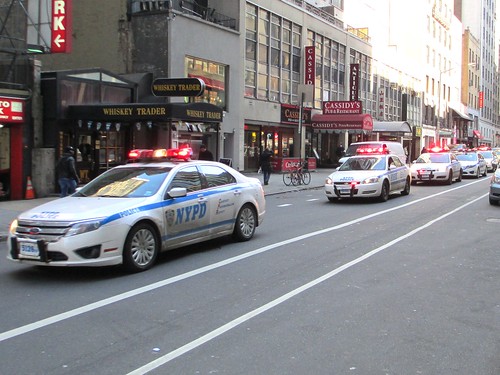
NYPD cruisers in midtown: five carloads of suburban
assumptions, coming your way
The proliferation on New York City cars of stickers showing the driver’s allegiance to this or that police benevolent association – lucky charms to ward off the evil eye of an arbitrary traffic stop – suggests others share my perception of police attitudes.

Not that, for me, the consequences were ultimately important. As a middle-aged white professional, I’m self-evidently a poor target for a harassment arrest. Had I been a younger black or Hispanic man, I would probably have made off the moment I realised I was dealing with the police.
Blacks, Hispanics, gays and many other minority groups face far worse than cyclists generally do at the hands of the NYPD. I’m certainly in a far better position than the 28-year-old mentally ill man who used to live round the corner from me. After he stabbed – but only lightly wounded – his uncle, the police pumped seven bullets into him, killing him.
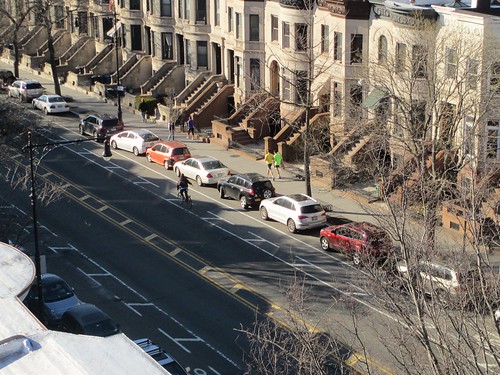
 
Williamsburg, near the scene of my encounter: no vision
of suburban respectability
Yet I don’t think it’s a stretch to see in the dismissive attitude of police in London and New York to cyclists’ complaints a symptom of the disconnect between police and policed. In both cities, officers live in outlying, suburban areas where car use is a symbol of a certain kind of conventional respectability. It’s not hard to imagine such officers are fundamentally at odds with much of the reality of the urban life they’re policing, from casual, harmless use of illegal drugs to rising levels of cycling.

Both cities’ residents have fought long battles with their police forces – over their racism, their homophobia, their sense they’re above the law. Yawning gaps persist between police and public attitudes. This year in New York started with bold declarations about eradicating road deaths. I arrived home on Friday discouraged, feeling that some of the police who should be helping towards that goal are part of the problem rather than the solution.

Sunday, 11 May 2014

An unbridgeably wide road, a rush hour jam - and why I won't be leaving for the suburbs

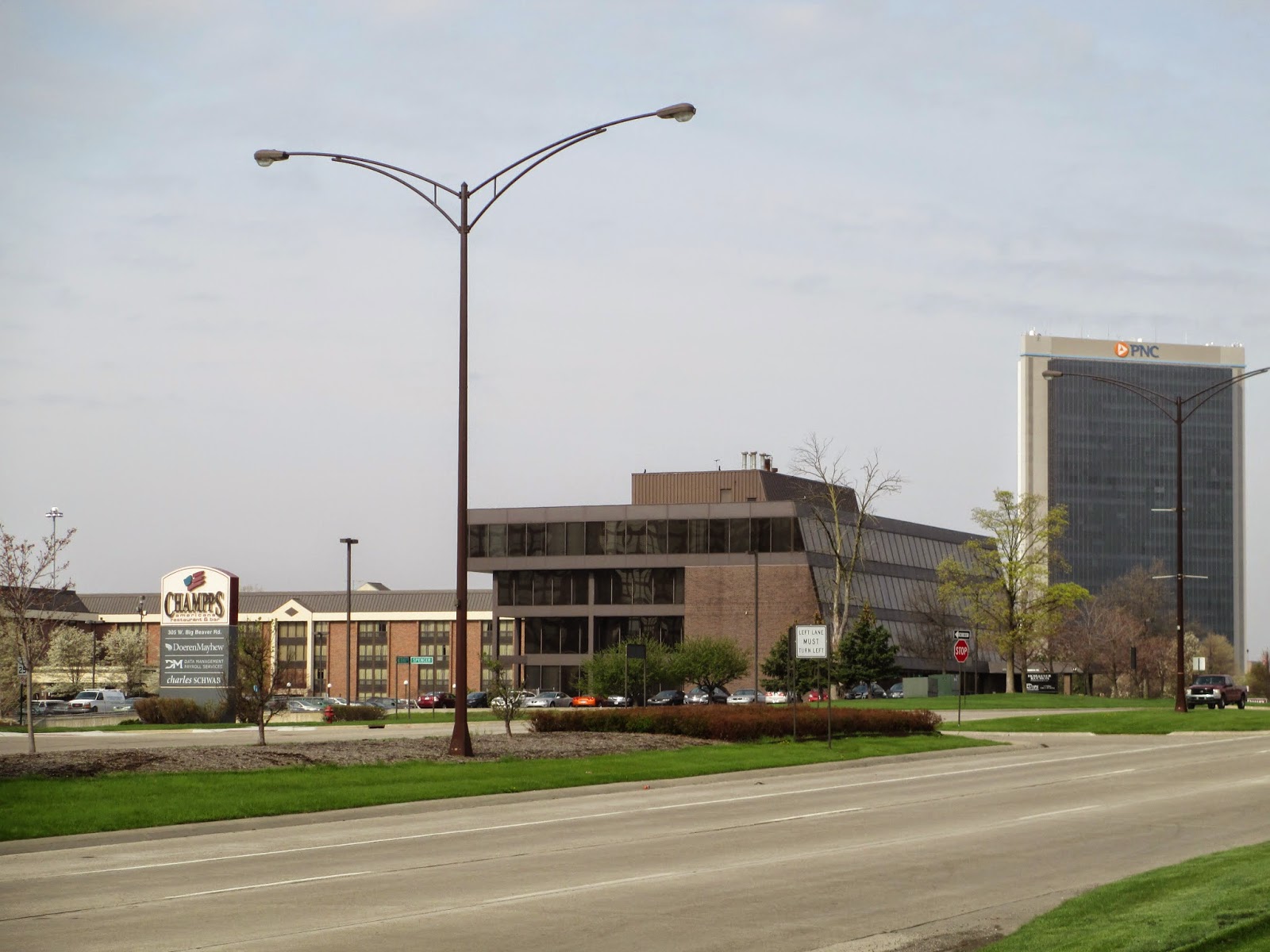
As the bus carrying me and a group of other journalists and analysts pulled up to the Troy Marriott hotel near Detroit last Monday night, I started doing what any self-respecting professional traveller would have done – looking for enticing dinner options. In an unpromising area, the only alternative I could see to the hotel’s own restaurant was a sports bar – imaginatively named “Champps” – just across Big Beaver Road. While it seemed unlikely to be a hidden gourmand treat, it seemed more enticing once I’d seen the hotel restaurant’s prices and depressing beer range.

Champps: enticing - sort-of - amid limited circumstances
Yet I ended up all three nights of my stay trooping down to the hotel’s restaurant and ordering mediocre, absurdly-priced food ($29 for a pork porterhouse cooked so that it’s almost impossible to cut, anyone?) rather than venturing out. Closer examination revealed that, while Champps was close geographically, without a car it might as well be in the next state. There was no pedestrian crossing to take me across Big Beaver Road’s six lanes of high-speed traffic. Big Beaver Road did have sidewalks, unlike some suburban American streets (or stroads, as such highway streets are sometimes known). But they were cut off from the road and appeared built on the principle that pedestrians walk only in straight lines. Champps didn’t look worth the risk of a dash across the traffic.

My near-yet-far experience with dinner options opened my eyes to how comprehensively some suburban areas of the US – and, to a lesser extent, some European countries too – are built around transport by car. I fully understood for the first time how oppressive the sheer lack of choice in such areas is. It made me appreciate how, whatever my gripes about London in the past and New York at present, I’ve at least lived in places that offer some transport freedom of choice.
Big Beaver Road: would you risk crossing?

Of course, many Americans would say I’m showing my East Coast elitist or European thought patterns by viewing such conditions as problematic. Suburbs are popular, some transport thinkers tell me, because Americans just plain want to live in single-family houses with a big area of land around them. It’s mere snobbery for those of us who live in big, cramped cities to expect those who prefer the lower-density suburbs to adapt to living lives more like our own. There are plenty of similar trends among pro-car thinkers in the UK.

But my experience last Wednesday – when I went on a coach trip with other reporters and analysts from Troy to Toledo, Ohio, to see a car plant – suggested that the current arrangement wasn’t even working on its own terms. Because rain had slowed traffic, the tour bus was a good hour late arriving to pick us up. The driver then spent a further hour or so fighting through nearly-stationary traffic heading for central Detroit before he could drive at any reasonable speed on the way to Toledo.
 
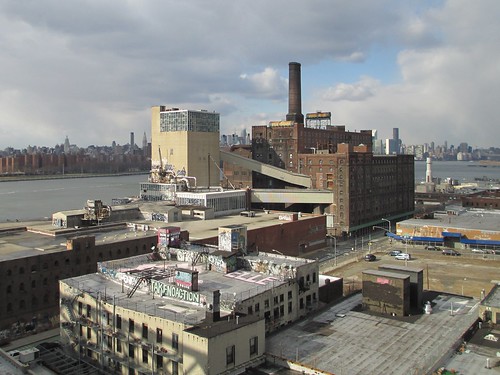
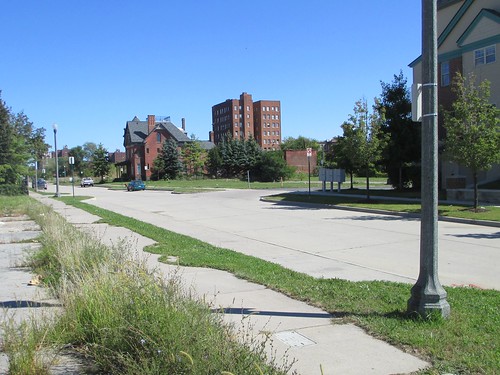
Near downtown Detroit: not obviously a draw for traffic
Our hosts felt under stress throughout the day – and curtailed one of the most interesting parts of our visit in Toledo – because of the problems of maintaining our visit schedules on roads that made travel times unpredictable. I, meanwhile, sat in something like awe of the quantity of traffic disruption related to traffic heading into central Detroit. “What would this be like if Detroit were still a healthy city?” I asked myself, staring at the ranks of red rear lights on the Interstate. The vehicles were heading for a city centre where many lots remain vacant and whose population is only a third of its more than 2m peak. It wasn’t the first time I’d experienced big, severe traffic jams in Detroit’s morning rush hour.

The problems I witnessed are only an extreme example of the pressures that any city with low-density, far-flung suburbs with poor public transport and a dense inner city will tend to face. I had a taste of how even high-density New York struggles with such flows one morning in early April when a truck crashed on the Brooklyn-Queens expressway and closed both carriageways. I was suddenly sharing our neighbourhood streets with the vast lines of slow-moving car commuter traffic that outer parts of Brooklyn, Queens, Staten Island and the Long Island suburbs generate. I normally see such traffic only from a distance, and generally only creeping towards its destination.

There’s a fundamental geographical problem. Distances in low-density suburbs are vast and forbidding for walking or cycling. But it’s hard to provide public transport for a place where the customers are all so far apart. When all those suburbanites jump into their cars to head for a city, the cars can’t all fit.
 
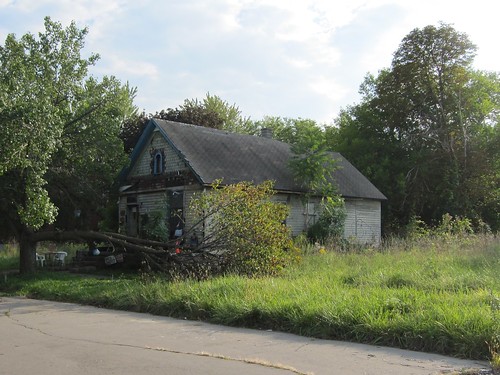
An abandoned Detroit house: can the people who left cross
the street where they live now?
The root of the problem is partly social. I was watching in the rainy Detroit rush hour partly a distant reverberation from the shattering explosion of Detroit’s 1967 race riots, which wrecked vast tracts of the city and sent many white people – and quite a few blacks too – scurrying for the perceived safety of places like Troy. It’s an essential part of the bargain of living in a big city like New York – or London – that one puts up with – maybe even celebrates – living cheek-by-jowl with people of different racial or economic backgrounds or very different outlooks on life. Race riots, second world war bombing or, in New York City’s case, the deliberate policies of Robert Moses have broken that contract down in the cities now facing the worst problems.
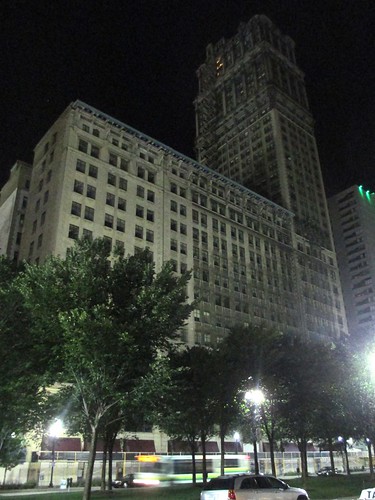
Downtown Detroit: hassly but hopeful

I’ve consistently voted with my feet on this issue. In my adult life, I’ve lived in dense, inner-urban areas of Edinburgh, London, Budapest and New York, prioritising convenience of walking, cycling and public transport over avoiding the hassles of inner-city life. Even when I visit the Detroit area or Fort Worth, Texas, I make a point of trying to stay in the inner city if I can. I’ve had aggressive panhandlers follow me and threaten me in downtown Detroit. But I still prefer the inner city’s challenges to the soullessness of the outer suburbs.

None of which would matter, conceivably, if the suburbs were actually satisfying suburbanites. But, even with the continued pull of better schools and leafy tranquillity, there’s mounting evidence that leafy places like Troy are losing out to asphalt-covered, brick-built places like downtown Detroit. New York City holds more people than it’s ever held, while suburban Long Island's population has grown more slowly in recent years than most of the rest of the region. It’s London – not the suburbs of Hertfordshire or Surrey – that’s looking to cater for millions of new residents over the next few years. Places whose residents don’t need cars are becoming more attractive.
 
My hotel window view: suburbanites' exercise yard.
I won’t pretend, of course, that inner-city Detroit – currently bankrupt, long corrupt and full of houses being reclaimed by the prairie – is a paragon that other cities should follow. But the growing activity in its downtown and the sprouting of cycle lanes and the sight of the occasional cyclist give me some optimism. It’s easier for me to see why the attractions of places like clean, leafy Troy – where the only walking most people do is across the parking lot – are starting to pale. It’s no surprise to me that the US’s most successful suburbs – the DC suburbs in northern Virginia – are working hard at putting in bike lanes, improving public transport and making people who want a congestion-free car commute pay for the privilege. It would be heartening to see suburbs elsewhere – like Troy or the most traffic-clogged bits of London’s commuter belt – following suit.

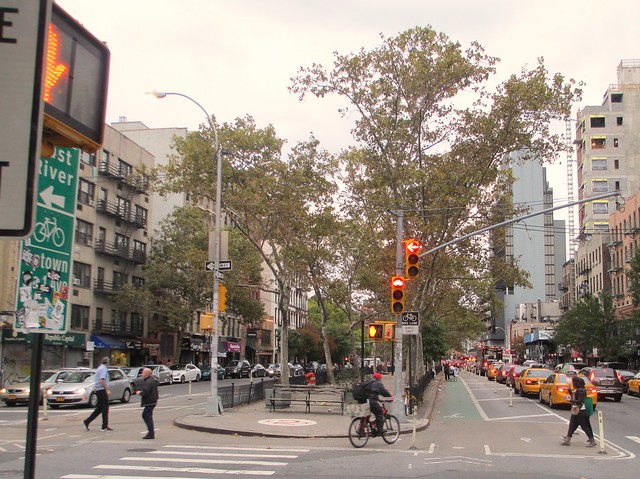
1st Avenue: sure, motorists don't know how to drive
there politely. But Big Beaver Road it ain't.
For me, meanwhile, the motor vehicle-dependence was at least temporary. I had a long wait on my return to LaGuardia Airport for a public bus but took pleasure in sharing it with others. I then transferred smoothly for my subway ride home, avoiding the chaos of the city streets above. I took still greater pleasure the next day in taking the day off work and heading out into the city under my own power.

The Queensboro Bridge: there are subways below, cars,
buses and bikes on the surface and even a cable car above.
It wasn’t, I admit, a complete joy interacting with New York City drivers as I headed north through Brooklyn towards Queens. My first ride up the new First Avenue bike lane on the Upper East Side was marred by the discovery that drivers are as reluctant to yield to cyclists there as elsewhere in the city. Even on my ride north and round the top of Central Park, I found myself sharing the roadway with cars whose drivers viewed the park’s speed limit as optional.

But, after spending most of the week by a road that was impossible to cross, I found it hard to feel truly angry. The best bits of the journey – the well-designed bike lanes up Kent Avenue, the bike and pedestrian lane over the Queensboro Bridge and the ride south by the Hudson – made me feel quite the opposite. What a privilege it was, I realised, to live in a city where few need feel wedded to their cars and growing numbers choose to get about by bike. As I embark on a new week of hustling for space and priority with the city’s drivers, I’ll do my very best to retain that feeling.

Sunday, 4 May 2014

Brooklyn, a bridge, Manhattan - and the voice every morning in my head

Huh. Morning came around soon. Put bike into road. Swing leg over. Left shoulder? Nothing. Pull out. Brake again. Look right. Goodness that SUV’s coming fast. Swish. Swish. Swish. All gone? Start pedalling. Start pedalling, turn left, into the bike lane. Here we go.

Yeah, I like this first bit on Smith St. Head down. Bit of a slope. Get moving as fast as I can. 16mph. 17mph. Feels like skipping sometimes, pushing down hard each stroke of the pedals.

Here we go. Yup. Here we go.
Oh. Big Toyota SUV poking out from the sidestreet. Wheels? Not moving. Check over shoulder. Signal. Pull out round him. Stern look. What do I think that’s achieving? Driver probably hates me. Maybe just shakes his head.

Traffic backed up to lights. Slip down the bike lane. Car doors? Wheels moving? Doors? Wheels moving? Which way’s this guy gonna turn at these lights? Pull left round him. Stop.

Kind of like what they’ve done with Carroll St subway station. Simple. Modern. Red hand for pedestrians still flashing, flashing. Just red. So look up at lights, look up at lights, green. Go!

Move legs fast, pedal, swing right before the cars catch up. Oops. Car poking into bike lane. Brake. Look over shoulder, pull round it.

There’s the school. I wonder what Alexander’s doing in his class. What’s it like to play out in that little playground?

But yikes. Car turning right in front of me. Brake, signal left to go round turning car. Carroll Gardens festival of dangerous and negligent driving this morning. Funny how they never send me the memo about that. Scary.

But now it’s clear. Pump, pump, pump, pump legs. Slip onto the big chainring. Left shoulder? Clear. Left round that pothole. Car at the sidestreet, creeping forward slowly. Firm finger pointed at him. Eye contact. Ooh – fierce glare, driver. But you stopped, didn’t you?
Spot the gap. Head for it.

Here we go again, though. Huge truck, narrow gap letting me through to the lights. Look up at the driver. Seen me? Seen me? Good. Thumbs up. So off again. Yeah, Mr limo driver, I do need to pull out round this delivery truck. I do and that’s why I’m pulling into the middle of the lane. No, I’m sure you don’t like it.

Oh there’s that guy.

“Hi, Robert. Nice one they’ve laid on for us today.”

“I think it’s something to do with the Pulaski Skyway’s being closed.”

“Yeah, have a nice ride.”
 
Atlantic Avenue in sight. Jails, courts, chaos.
So now Atlantic Avenue.

Yes, Mr Driver: I know you want to turn right. But I’m to your right and I’m going straight on. So hold on a moment. What was that swishing sound? Oh, that cyclist thought that gap was big enough to pass on my right? How many bikes are there at this light now? One, two, three, four, five, six, seven, eight…

Green. Pedal fast, check left shoulder, guy’s not turning through me. How’s bike lane in this busy bit? Oh, guy’s signalling right into car parking. Brake. Check shoulder, signal, move left. Up to next lot of lights. Stop.

Funny seeing the Corrections Department buses. You never see the guys inside. Funny thinking how downtown Brooklyn’s got a jail. Do they look out at me from the windows? High-rise jail. Funny.

Lights green. OK. Tricky bit by where they’re doing this building work. Glad they’ve moved the barriers. Didn’t like it when they had that big bulge out into the traffic. Now this corner. What are these minibuses always stopping in the right lane here? There’s that voice, the automated voice, “The walk sign to cross Smith St is aaawn.” Broad New York accent. Always funny. Read once about the guy whose voice it is. Lives in Staten Island.

Green again.

“STOOOOP!”

Why do drivers have that look of injured innocence when they finally give way and agree not to crush you? It wasn’t a big favour to wave me through, madam. Legal and moral obligation.
 
Smith St at Fulton: a not like from the voice in my head.
Fulton St lights now. Don’t like this crossing. Pedestrians, cars, pedestrians, buses, angry people. Why is everyone so angry all the time? Oh, other bikes. Hi.

“The bridge is coming. Focus on that.”

Green again. Sir, I’m sure your life is not full of people you can defy. But I wish you’d express your sense of powerlessness another way. Your wandering slowly across my path is just frustrating when I have the light.

Cut through bus stop. Could all that grease make me skid? Into bike lane. Lights by that funny tunnel-underpass thing. Red. Stop.

Oh, please, other cyclists. Do not buzz that pedestrian. Please do not.

“Tut, tut.”

Ha, serious condemnation from a British person that, “tut, tut” – if anyone could hear me.

But no-one can and now lights are green. Mr Driver, I am not going to be able to fly over that car in the bike lane so I am sticking my arm out left until I see noticeable braking from you. Slowing down? Good, I’m pulling left and let’s go.

Green light by the college. Everybody’s flying towards Tillary St, fast. Oh, close pass. Better get over to the left somewhere. Signal left, check over shoulder in left-turn lane. Get to front of traffic at Tillary St. Lights red? Stop.

There’s the bridge. I can see the bridge. The bridge is coming; the bridge is coming.

Policewoman over there directing traffic. How does it feel standing there with all the speeding cars, all the people crossing, all the cyclists trying to get to the Brooklyn Bridge or the Manhattan Bridge? Hey, lookie here, Ms Policewoman – look at these cars trying to run down these pedestrians. Interested? Didn’t think so.
 
The bridge is in sight, people. The bridge is in sight.
OK. Green light again and pedal fast. No, Mr turning-across-my-path, you have to yield to me, you have to yield to me, OK. I’ll swerve round you. Fast, fast, fast across this intersection. Cars lined up. Always feeling like they’re just waiting for the chance to run me over.

Now Jay St bike lane again but how are we organising ourselves this morning, fellow cyclists? OK, OK. Let’s do two abreast this bit. Spurt of speed. Pull to front of pack, now upset everyone behind by stopping for these lights.

Never mind. The bridge is coming. Lights green, go. Tricky bit here. Cut across the bridge off-ramp to the  bike lane. How fast is that truck coming down the ramp? Probably OK. In the bike lane, ride down the side of the cars, get to the kerb cut for the bridge bike lane, swing onto the sidewalk, across under the bridge and it’s there: Manhattan Bridge bike path.
 
Manhattan Bridge on-ramp: excitement builds.
Best bit of the ride this, best bit of the ride. Love the spiral on-ramp for a start.

Guy on fixie ahead. Never understand why people ride fixed over the bridge. Pedal, pedal, pedal. Catch up with him. Look into the Brooklyn-bound lane, clear, and bye Mr Fixed Wheel Loser, bye. Get some gears.

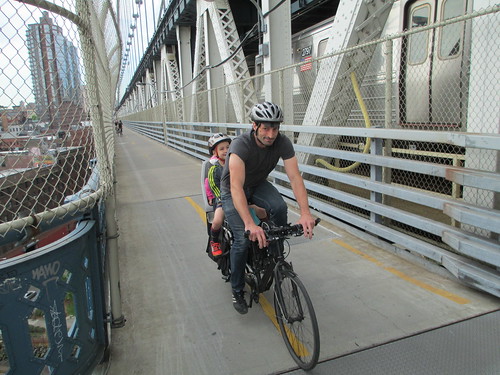
Up the slope, up the slope. Subway train climbing the slope too. Scan the passengers. None to wave at. Shoot me when I no longer feel like racing subway trains. Or maybe shoot me when I no longer feel like racing subway trains but check first if I’ve changed my mind with advancing age.

Clunky hybrid rider: feel like I'll pass her, chance that I'll fail.
Bye, Mr Citibike rider. Bye, Ms Pootling Along on a Cutesie Pink Bike.

Oh, hi, fixed-wheel rider overtaking me. Yeah, well, I’ve got kind of a heavy bike. Oh, there’s the long-bike commuting-with-kids guy. Kind-of hurts when he overtakes me with his kid sitting on the back. This wind catches my big frame. That’s the problem.

But who cares now? Climbing out over the river. Barge down below. What do they carry? Look out towards the Williamsburg Bridge. Always remember now that bushfire day. City covered in smoke, could barely see the Williamsburg Bridge. Met Doug Gordon that morning. He stopped to take a picture. Can see it OK this morning. Odd-looking bridge.
 
Funny-looking bridge, days you can see it.
Now look for the Empire State Building. There it is. Sun on one side, shade on the other. Middle of midtown, looking fantastic.

Best bit of the ride, this, best bit of the ride.

Past halfway now. Getting faster. 20 on the bike computer. Bye, Mr Citibike rider, bye, Ms Clunky Hybrid. Hello, Chinatown. Not much of a cooking smell today. 22.5mph. Let’s go right over that manhole cover. Love that clanking sound. Now slow for the final curves. Final awkward downhill turn. Brake for the lights in Chinatown. Stop. But whish, whish, whish. Other riders running the lights. Oh my goodness that car is going to hit that guy. No, just missed.

Empire State Building: in Midtown, in the sun.
But now green and off, right.

Feels faster now, after the bridge.

‘Chinatown Dragon Fighters’ – always like that fire station name. Not sure it makes sense. But like it.

Allen St bike lane left. Oops, cut across that pedestrian slightly. Feel bad about that. Speed up – but delivery man pushing cart in bike lane. Swing round him.

Speed up. Grand St. Fast down bike lane but red light at Delancey.
Crossing Delancey: but not like in the movies.

Crossing Delancey – wasn’t that a film? Yes, it was a film. Not sure what it was about. Tough street to cross, though. Tough. Probably not a film about cyclist safety, though.

But now green, speed up and off up bike lane and then Rivington, left, fast along Rivington until, oh, that old woman’s sorting her recycling in the bike lane again. Round her, then see old synagogue. Places change. Where did that synagogue’s people go? Four-way stop, hard to see, crane neck, nothing to see, then ambulettes in the bike lane. Not even sure what ambulettes are, but they’re always blocking the bike lane here. Stop at lights. Chrystie-Forsyth Park. Robert Moses built the park, yes Robert Moses built this park the year he built lots of parks. He wouldn’t like that I can ride a bike
Allen and Rivington: left and crosstown.
across it but here I go, here I go dodging the pedestrians, here I go across Chrystie St and here I swerve round the forklift truck working in the bike lane and up to Bowery, right, then up to Prince St left, stop at the lights at Mercer St and look around.

Little Italy. Not really Italian any more of course. No Robert de Niros shouting at their wives about the steak’s being overdone. Nice, though. Like this area but don’t like its drivers. Don’t veer into the bike lane, driver, don’t come too close because the bike lane’s closed here and I need to pull left; don’t walk in front of me, pedestrians. Ah, sorry. Light’s changed. On you go.

Final push now. Lafayette, Broadway, crosstown. Feel like I’m making progress. Posh shops. Taxis stopping suddenly, manholes in the bike lane, gratings, feels like cyclocross some days, stand up on the pedals, hands on the brake levers and ready to steer fast round trouble.

But now at 6th avenue, swing round the taxis blocking the bike lane, Charlton St now, zip up the block. Signal left. No, Mr Taxi, you don’t just drive at me like that. Stop at the lights. Left onto Varick, downtown a block, then wait at lights again.
 
Vandam and Varick, SoHo. Nearly there. Nearly there.
Someone from the office.

“Hi, Randi.”

Doesn't hear me.

Then right, down Vandam, pull over to the right and stop, get off, take off the bike computer. Bike onto the sidewalk, walk to the bike entrance, security pass and in. How many other bikes today?

Lock up the bike, grab the panniers, stride out the door.

Eight bikes today? That’s some – but not many.

Never understand it.

Best bit of the day, my bike ride. Best bit of the day.

The post is an edited and abridged transcript of the things the author says to himself and other people during a typical, 40-minute cycle commute from Carroll Gardens, Brooklyn, over the Manhattan Bridge to SoHo, Manhattan.

Sunday, 27 April 2014

A stunning view, a midtown ride - and why speed is as much the problem as space

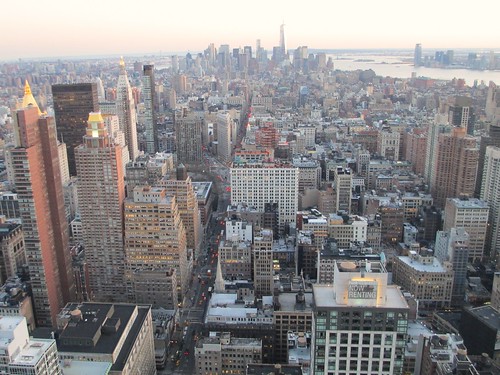
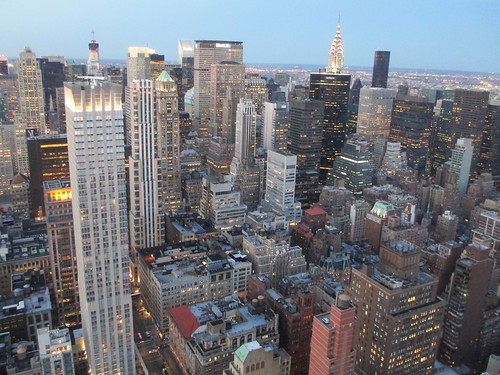
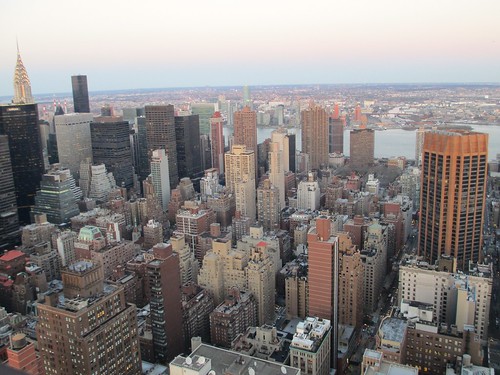
The Wednesday before Easter, thanks to a press event for a company I cover, I had my first chance since moving permanently to New York to go up the Empire State Building. Yet, as I gazed out from the 58th floor, I found myself struck by something other than the extraordinary forest of skyscrapers crowded, like trees straining towards the light, in midtown Manhattan. Looking south, it was clear how the forest canopy seemed to lower around Greenwich Village, SoHo and the Lower East Side into a less dense area of undergrowth or bush. It then rose again at the final, dense clump in the Financial District, teetering on Manhattan’s lower edge.
The Greenwich Village dip, seen from the midtown jungle
Midtown's skyscrapers: the lack of a "cyclists welcome"
sign, I'd suggest, is no coincidence

The view came to my mind the next day when I had to return to midtown for a television appearance at Fox News’ studios on Sixth Avenue. I rode up the Hudson River Greenway as far as 48th street. Then I started pedalling across town into the forest on which I’d been looking down the night before. The deeper I cycled into the mid-skyscraper canyon, the worse conditions became. I was constantly navigating around jammed-up traffic and dodging sites where workers were fixing pipes and cables. I was left wondering if, efficient though they can be, the densest parts of very dense cities such as New York are doomed to be fundamentally problematic places for human-powered transport.

The question’s relevant because many cities around the world are trying to accommodate their expanding population not, as New York City did for much of the 20th century, by sprawling outwards, but by becoming denser. There are calls for London to build new, higher buildings to absorb its growth. There is a similar movement in many parts of North America. It’s easier, so the thinking goes, to serve dense cities with public transport, since more journeys’ starting and end points can be an easy stroll from a station or bus stop. Wouldn’t it be ironic, I thought to myself, if such a movement – intended to make cities more environmentally friendly – made them worse for the bicycle, the most environmentally-friendly transport mode?
 
54th St, midtown. Look on this canyon, cyclists, and
at least consider despair.
It’s certainly tempting as one grapples with the reality of riding in midtown Manhattan – as I used to every day before my office moved downtown – to flirt with the idea that it’s a lost cause. The area crams into densities that in many cities would be associated with slums and squalor a mixture of high-end housing and offices teeming with some of the world’s best-paid professionals. No-one has the space or inclination to undertake a vast range of everyday activities but most have the money to pay to have them done. A stream of dry cleaners, express parcel services and food delivery cyclists consequently flows to and from the area’s offices and apartment complexes, giving the area the feel of being some vast apartment hotel crossed with a serviced office.

Since many of the best-off people feel themselves too important or fancy themselves in too much of a hurry to head into the subway, taxis and limousines buzz constantly around the doorways. The business of supplying food for the millions who swarm the area on a weekday would alone be enough to create a substantial traffic jam. The same goes for the business of keeping the people’s water, electricity, gas, sewage, hot water, internet, cable television and other services running smoothly. Almost none of the people engaged in the stressful business of meeting the area’s needs seems willing to take cyclists’ needs into account alongside the multiple other pressures they face. Cycling can be a slow, stressful business of zig-zagging around double-parked delivery vans, slipping past the edges of traffic jams and swerving to avoid the woman who leaps into the cycle lane to hail a taxi.
 
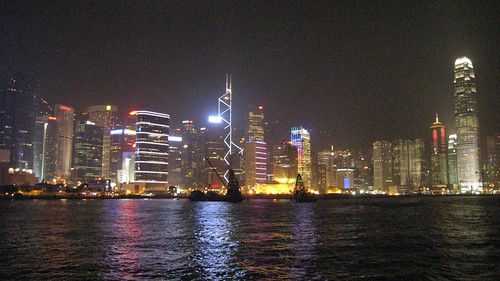
Hong Kong wasn't built specifically to make people feel
optimistic about cycling in midtown Manhattan. But
it serves the purpose very well
The intimidating atmosphere reminds me how I quailed, when it looked as if I might get a job in Hong Kong, at the thought of cycling there. Hong Kong has twice New York’s population density. I started to wonder if it might be London’s lower density – half New York’s level – that makes it generally an easier (if still severely flawed) place to cycle on-street.

Yet an incident later the day I appeared on Fox made me ponder how far space and density really were the problem. I cycled after work to Brooklyn to participate in a Maundy Thursday church service and headed off home afterwards down Garfield Place in Park Slope. I sped down the street, between rows of parked cars, at over 20mph, riding in the middle of the lane for fear a still-faster car would try to pass me. Sure enough, after a couple of blocks I noticed a Jeep Grand Cherokee close behind me, its driver clearly trying to barge me out of the way. I found myself, not for the first time, terrified of being hit from behind if I made a mistake but fearful also that, if I slowed down to pull out of the way, the driver would hit me before I was out of the way.
 
Park Slope: less dense, still speed-plagued
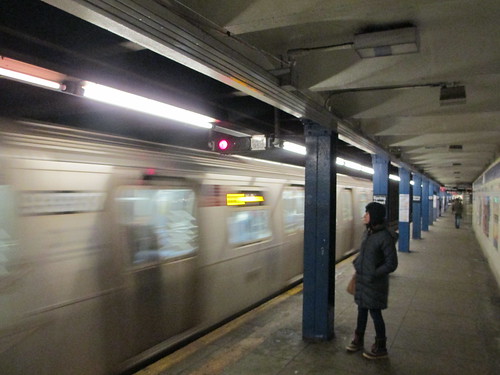
The New York City subway: speed, packaged and hidden away
I realised, instinctively, that the problem was less one of space and more one of speed. I am far happier to have a vehicle pass me on a narrow street at a reasonable speed because the scope for disaster, the room needed to correct a mistake, is so much smaller. I won’t let someone intent on breaking the speed limit on a narrow residential street pass me, because his speed has eaten up the room for error around his vehicle. We discussed some of these issues and a few more – including when he might learn to drive safely since he clearly didn’t know at present – at a red traffic light at Garfield and 5th Avenue.

When I factored speed into midtown conditions, I suddenly saw them in a very different light. The problem wasn’t so much, I realised, that there were so many delivery trucks and other commercial vehicles (although it wouldn’t hurt to switch some of these deliveries to cargo bikes). The problem was that those slow-moving vehicles had to stop every cross-town block to accommodate lines of vehicles sweeping up and down the avenues. I suddenly had a vision of a fast-moving taxi as taking up twice or three times its own road space as one that was stationary. The genius of the New York subway and other urban metro systems struck me. They take the problem of moving people fast – and consequently with lots of space around their vehicles – pack the people into space-efficient vehicles and bury the speed problem below the streets.

Beyond midtown east, out stretches low-rise Queens
Looked at it in that context, it becomes clearer that the real problem in New York lies not in midtown but in the low-rise areas I could see from the Empire State Building, stretching away towards the horizon. In New York and London – and even more so in many other big cities like Los Angeles and Houston – those distant suburbs were built with very little public transport provision. The only realistic way to get about, many residents feel, is to use a motor vehicle. To overcome their distance from the centre, the only way is to drive them fast. To cater to them, cities have built vast, space-eating high-speed roads. A significant part of midtown’s traffic problem is made up of people who drive all the way from those suburbs to work in the city centre.

The sheer unpleasantness of the world that way of living has created came home to me this Saturday as I cycled to meet my family for a day trip to the beach at Coney Island, on the edge of Brooklyn’s low-density sprawl. To cover the last stretch from a harbour-side cycle path to the beach, the marked cycle route heads onto Cropsey Avenue, a terrifying six lanes of suburban automotive culture full of vehicles seeking to drive at 40mph or faster. Far from taking the lane to tame these barrelling lumps of high-speed steel, I found myself letting my fear get the better of me. I cowered - as I once did when cycling in Staten Island - in side streets at each intersection, waited for the herd of charging cars to sweep past. Then I pedalled off after them as fast as I could, hoping to outrun the next charge.At the corner of Cropsey Avenue and Neptune Avenue - a few yards from the Invisible Visible Girl’s school – I shouted at motorists turning fast through a crossing where a man and his daughter were struggling to cross the street.
It's invidious to claim one's city has the worst cycle facility
anywhere. But is there a part of your city's cycle network
quite as grim as Cropsey Avenue?

It remains a stressful and forbidding experience to cycle in the heart of midtown Manhattan and in the densest parts of many other cities worldwide. Although I know space-efficient bicycles have many advantages as a means of urban transport, I don’t know precisely how I’d carve out space on the streets of midtown – or, come to that, the City of London or Hong Kong – to encourage people less hardened than I to cycle.

But, following Saturday’s experience, I feel confident on one point. While W48th St might be chaotic and stressful, it could yet become a healthy, functioning urban space. I’m far less confident the same can be said for Cropsey Avenue.

Monday, 7 April 2014

Miserable subway passengers, a grouchy runner - and a lesson from Bob Dylan

It’s one of those tasks that’s so difficult it’s become a kind of fascination to me. When I ride over the Manhattan Bridge towards work each morning, I’m generally passed, at a gap of just a few feet, by a B or D subway train taking commuters into Manhattan. The passengers stare out the window, blankly, apparently staring straight through those of us labouring up the slope to the bridge’s summit or speeding down from it. The stares are so blank that I’ve taken to waving at individual commuters to see if I can get a reaction.

A subway train passes a cyclist on the Manhattan Bridge:
the subway passengers can't see the cyclist. Fact.
The net result so far, from scores of waves, is one half-smile – and she might just have been reacting to a witty lyric on her iPod. The experience of being in a subway train seems to be so utterly different from the experience of riding a bike that the people on the subway trains can’t react to a human being outside their train on a bike.

Yet the reaction of the subway commuters to cyclists, it’s dawned on me, is only one example of a far more widespread city phenomenon. Big cities are full of people moving around conscious almost solely of their own environment, their own needs and their own sense of right and wrong behaviour. We’re mostly gliding around in little bubbles of our own distinct worlds, over and below each other, avoiding contact as far as possible. But quite a few of the crashes in cities, it strikes me, are cases where, almost literally, two worlds – two contrasting sets of expectations about norms and behaviours and who should give way to whom – collide. This makes it a phenomenon worth noticing and exploring.
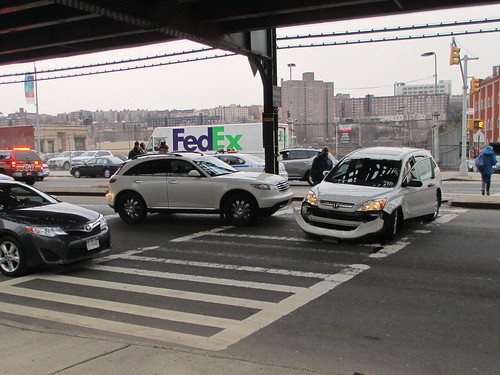
Two cars collide in Northern Manhattan - but so, quite
possibly, do two competing expectations about who
gives way to whom.

The driver I encountered on 55th street in Manhattan 10 days ago illustrates the most obvious form of the problem. I’d spotted that he was driving erratically as he left a parking space near Broadway. He then squeezed past me, dangerously, driving in a parking space, only for me to catch up with him at the traffic lights at 9th avenue. His window was rolled down and he was deep in a conversation on his mobile phone. “Stop talking on your phone!” I shouted at him. “It’s making you drive like an idiot.” He gave me a dirty look and slowly rolled up his heavily-tinted window. I was an unwelcome intrusion from outside the two worlds he was carrying around with him – the world inside his sports utility vehicle and his interaction with his interlocutor in the telephone call. His reaction was to close down his interaction with the place where he was physically present – and where his driving presented a serious danger.

There are multiple ways that people pursue the illusion that their cars are private spaces. They can blast out music so loud that any outside intrusion is inaudible. They can choose to drive a car so large or so fast that it intimidates other road users. They can talk incessantly on the telephone to people outside their immediate confines. People want to drown out the mixture of stress and boredom that comes from sharing a city street with a host of other people with competing claims on the space. Their desire to do so makes the street a little less safe for pedestrians, cyclists – everyone outside their world-in-a-car.

The little bubbles in which people move around also reflect their culture. At my son’s school, it’s mostly the parents with the mild, mid-western accents of hipster incomers that arrive bearing their children on long bikes, tandems and other unlikely bits of cycling apparatus. If I see children spilling out of some huge SUV – there’s a family that arrives daily in a Cadillac Escalade, one of the biggest vehicles on the road – I’m far more likely to hear a traditional Brooklyn accent calling out after them.

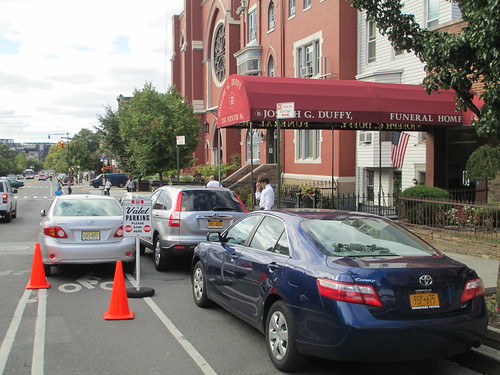
Inhabitants of Duffy Funeral Home's world worry about
where they're going to park. Other users of Park Slope's 9th
St worry where they'll ride their bikes. Here's where those
worlds collide.
The cyclists, I suspect, mainly mix with the other cycling-inclined families and have firm views about the environment, physical fitness and cluttering up the area with cars. The Italian-American SUV drivers come to the school from outlying areas of single-family homes. Many, I suspect, feel that a big car is both a status symbol and a way of keeping one’s loved ones safe. I'm sure they tut-tut quietly at the risks the rest of us are taking.

We maintain our contrasting cultures while sharing the same bits of road partly through the impermeability of a big car’s steel sides. It’s no coincidence in my view that cars that keep the outside world at bay are far more popular than, say, convertibles for city driving.

But it’s not only the motorists that are travelling around in little bubbles of their own worlds. Look on the average city street and nearly everyone is cutting him or herself off from the wider street. Headphones – once limited to discreet earbuds – are now often a large and obvious symbol that the wearer wants to be left alone. Mobile telephone calls and texting take the participant away from his or her immediate surroundings. For many runners, they seem to form an almost indispensable aspect of the experience, providing the rhythm and focus that interaction with the wider world might take away. A pedestrian cursed at me the other day on the Lower East Side for riding, perfectly legally and safely, onto a bike lane across a small city park. It's no coincidence, I think, she was a runner sequestered from reality by her headphones.
A cyclist, runners and motor cars in Park Slope: sure,
they look close together. But they could be worlds apart.

The question, of course, is how far any of this is a bad thing. Would New York City – or any other big city – be a better place if subway commuters were waving to me every morning? Should I expect that runners eschew headphones to try to make their runs as pure an experience as possible of interacting with the city? I’m inclined to say no. When a behaviour is as widespread as this retreat by city dwellers into their private worlds, it suggests a deep need. This is part of how inhabitants of big, densely-packed cities get by without assaulting each other or rioting more often than they currently do.

I'm struck, however, that it’s often the people least cut off from the reality of the city around them – cyclists out on the streets, intensely aware of all that’s going on – that are disproportionately involved in campaigns to make the streets safer. It’s a serious safety issue that so many vehicles allow their users to cut themselves off so thoroughly from events outside. It’s hard not to imagine that people with clearer views of pedestrians and cyclists and fewer barriers to hearing street sounds might be less likely to run them over.

I have no immediate policy magic wand to wave to bring about that change of perception.

But an idea came to me the other night as I undertook a late night ride home past the still-buzzing bars and music venues of Bleecker St, the Greenwich Village street where Bob Dylan performed many of his earliest gigs. In Talking World War III Blues, one of the songs from that early era, he describes a dream about being the lone survivor of a third world war. Then he remarks, in the last verse, that many other people seem to have similar dreams.

"Everybody sees themselves/ Walkin' around with no-one else," he says.

Not everybody’s dream can be right, he says.

"I'll let you be in my dreams if I can be in yours," he drawls.

That's the nearest I have to a solution. I'll let you be in my street-world if I can be in yours.