Sunday, 24 February 2013

Subway fares, gas tax - and why it's too expensive to cycle in New York

There are few New York businesses that command as much of my loyalty as 718 Cyclery, a friendly, specialist bike shop near where I live in Brooklyn. But there’s no question that I’ve handed them a fair amount of my money lately. A quick check through past bank statements suggests that in less than four months since last October 30 I’ve given this deserving business around $270 in spending on my own bicycle, plus another $14 or so on the Invisible Visible Girl’s machine. That’s leaving aside another $30 or so on bicycle maintenance at other bike shops and the $33 I shelled out yesterday for a replacement clip-on light for one that had gone missing. It’s cost me, in other words, around $80 a month over the last four months to keep my bike on the road.
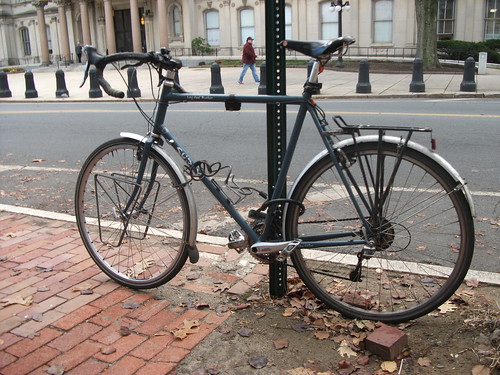
The Invisible Visible Man's Surly Long Haul Trucker:
fun to use - but not that cheap

Some of that spending was certainly making up for a near-absence of spending in the few months before October. But add in the cost of the extra food I guzzle to fuel my nine-miles-there-nine-miles-back commute and the cost of the higher wear and tear on my clothes and it’s not clear I’m doing myself a financial favour by using transport that I don’t pay for daily. At the current basic New York subway fare of $2.25 for a single ride, four weeks’ commuting would cost me $90 – and there are numerous ways of getting the rides cheaper than that. Even a looming – and highly controversial – hike in the basic fare to $2.50 may not put me in the black.

But it’s not the bike shop’s fault I’m getting a relatively raw deal. It’s noticeably cheaper to keep my bike maintained in New York than it was when I lived in London. 718 Cyclery has been more than generous in carrying out free adjustments and calculating its labour charges. I’m at a disadvantage because pretty much every other means of getting about New York City gets a significant explicit or implicit subsidy of some kind.

It’s not a purely New York City problem. Virtually no developed country charges drivers enough in fuel taxes, tolls or car ownership fees to cover the costs that congestion, crashes and pollution impose on everyone else. Nearly every big international city tries to encourage commuters to shift to other transport means by susbidising public transport.

New York is nevertheless an extreme example. According to the Tax Foundation, a think-tank, taxes, tolls and other charges on motorists in New York State cover only 43.8 per cent of spending on the state’s roads. The proportion of the New York subway’s running costs covered by fares is still lower – and the system is visibly crumbling through lack of maintenance and upgrade expenditure. One might think that, along with reducing the appalling death toll on the city’s streets, a comprehensive rethink of charging for and funding of the city’s transport network would be the top subject for debate ahead of this year’s mayoral elections.
Yet there have been only two big transport talking points so far among the likely candidates to succeed Michael Bloomberg as mayor. One is whether the city should hand over a few more slivers of its vast road network to cyclists or, indeed, start taking out the bike lanes already in place. The other has been whether the city should turn its back permanently on congestion charging – the one policy that any city has shown can tackle problems like New York’s.

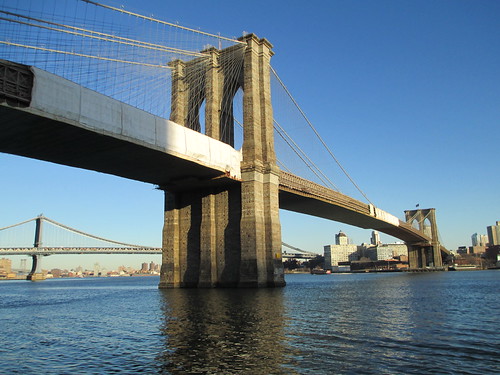
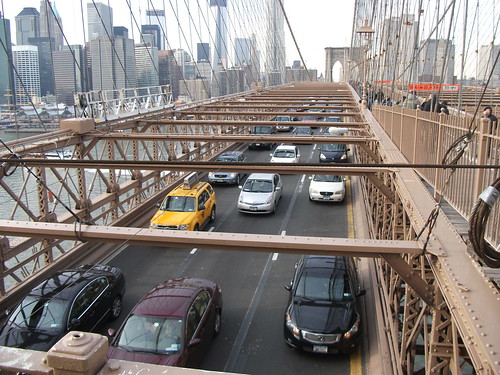
The Brooklyn Bridge: majestic - and under repair after
its pounding from all those New Jersey-bound drivers
Those problems, meanwhile, are immediate and practical. While the £10 ($16) congestion charge used to funnel through traffic away from my cycle route to work in central London, New York’s current financing arrangements actually push such traffic towards me. Every morning in TriBeCa, one of the most densely-packed areas of lower Manhattan, I see swarms of New Jersey-registered cars heading from the Brooklyn Bridge towards the Holland Tunnel going to New Jersey. Many seem to be avoiding the $13 toll charged westbound on the Verrazano Narrows Bridge further down New York Habour linking Brooklyn, Staten Island and ultimately New Jersey. Further uptown, the streets east of Central Park swarm with the traffic that pours from Queens across the free Queensboro Bridge to avoid the tolled alternative routes.

Yet it’s hard to imagine persuading men like the motorist I encountered on Vanderbilt Avenue in Brooklyn the other day that higher fuel taxes are the answer. Clambering out of his car with a weary look, he cast a wary glance over my bike and said, “Well, you’re certainly saving money on gas, buddy.” Precisely because US motorists pay far lower taxes on fuel than road-users elsewhere, they’ve seen far bigger percentage hikes in costs from recent years’ high oil prices. It’s impossible to imagine any politician persuading a US electorate in the foreseeable future of the case for increased fuel taxes.
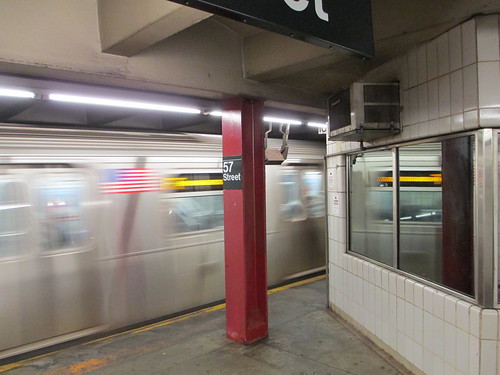
The F Train at 57th street: cheap to use - but not much fun
Nor is it easy to imagine any politician raising subway fares to a level close to covering the system’s high costs. Visiting the New York Transit Museum last Tuesday, I read the grim story of how politicians have always struggled to raise fares on the system, first from a nickel to a dime and then gradually upwards. The problem is further exacerbated by the system’s inability to charge different fares for different distances. Most people would surely agree that $2.25 is a bargain to ride from Coney Island to the outer reaches of the Bronx. But start talking about raising fares and people picture themselves paying $3 to ride from Penn Station to 59th street, a different prospect altogether.
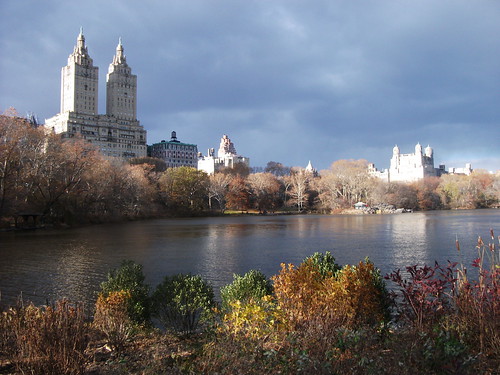
Central Park: scenic - and a neat northern border
for a charging zone
The only feasible answer, it’s clear, is for the successful mayoral candidate to resurrect plans to charge cars to enter the area where they are least needed and do most damage – Manhattan south of Central Park. The area is well defined, excellently served by public transport and currently blighted by vast quantities of traffic, much of which could go elsewhere. A reasonable charge would not only raise badly-needed revenue but also make a subway fare hike far more politically feasible. Those two manoeuvres together could unclog Manhattan’s streets, increase the incentives for drivers to switch to other modes and actually make it financially advantageous for commuters to switch to walking and cycling – the only modes doing virtually no damage to the city's environment or infrastructure. There’s no mystery about such a policy’s effectiveness. Congestion charging has reduced sharply and continuously the number of cars entering central London since its introduction 10 years ago. New York could surely come up with a more cost-effective charging system than the British capital.

Yet Christine Quinn, the city council speaker and the person many people expect to be elected mayor later this year, earlier this month said she didn’t anticipate congestion pricing’s “coming back around” after an effort she spearheaded to introduce the policy in 2007. That effort died after state-level politicians in Albany vetoed it. She has subsequently recanted slightly, saying she still supports the policy but doubts it can be successfully introduced.

That leaves New York City in a far worse state transport-wise than London before its congestion charge’s introduction. The Metropolitan Transportation Authority spends much of its income servicing its growing burden of debt, rather than improving the subway. New York City’s roads are crumbling under the weight of cars that pay far too little to make the damage good. The incentives for other mugs to join me on a less damaging transport mode remain negligible.

Future generations will look back with amazement at such predicaments in New York and elsewhere, shaking their heads and wondering why no-one had the courage to take the obvious policy steps. Some kind of charge for road use in Manhattan and many other big centres will inevitably come along. The spread of electric or partially electric vehicles – which pay no fuel tax – ensures it. In London’s story we already know it was the unlikely figure of Ken Livingstone – left-wing firebrand and scourge of Margaret Thatcher – who finally had the courage to bring in such a policy. For New York, it remains a mystery which visionary mayor will have his or her picture in the museums as the transport system’s saviour.

The tragedy for New York is that the identity of its transport system's saviour looks set to remain a mystery for many more years - through the whole administration of Christine Quinn or whichever other uninspiring choice next sits in City Hall.

Monday, 11 February 2013

Staten Island and why the Invisible Visible Man is the Opposite of a Canary

It was a brief taste of how most of suburban America and Europe lives and it wasn’t, frankly, terribly pleasant. This past Wednesday, for work reasons, I took my bike and, for only the second time in my life, travelled by ferry to Staten Island, an island off the New Jersey shore that historical accident has made part of New York City. Having mostly developed only in the 1960s after the opening of the Verrazano Narrows road bridge to Brooklyn, it was designed around the private car far more than other parts of the city. It’s the nearest thing in New York City to a chunk of true American suburbia – featureless apart from occasional strip malls and criss-crossed by wide, fast-moving, multi-lane expressways.
A shared cycle route marking in St George: much the likeliest
way to see a bike on the road in Staten Island

I began to have concerns about cycling conditions even before I was properly out of St George, the borough’s capital. A bus driver drove at me, apparently astonished that my being ahead of him in traffic meant I thought I should go first through a pinch point. Later on, I started to wonder if I had put myself in serious danger. Unable to use the seafront cycle path – still blocked with sand from Superstorm Sandy – I headed inland along long, straight six-lane avenues. The 30mph and 35mph speed limits on these roads seemed to be regarded as minimum permissible speeds. Encountering a cyclist, such drivers simply drove straight on, at speed, towards the bike, on the apparent assumption the cyclist would scuttle out of the way.


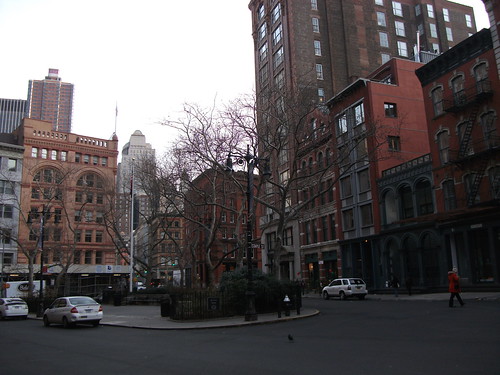
Duane Square, TriBeCa: not specifically cycle-friendly
- but not hostile either
But I probably shouldn’t have found the conditions surprising. While I have multiple complaints about cycling conditions in brownstone Brooklyn and Manhattan – the places where I currently mostly ride – and in London – where I used to ride – these are actually atypically cycle-friendly environments. Many roads are narrow – inhibiting drivers’ tendency to speed – and the traffic’s sheer volume makes the speeds on Staten Island mostly impossible. The obvious attractions in such an environment of the bicycle – which can slip along such streets while cars remain gnarled in traffic jams – have contributed to recent years’ rapid growth in inner-city cycling numbers. Better provision is slowly arriving in the wake of increased cycling.

Conditions on Staten Island are far more typical of the places that most rich countries’ inhabitants live. Such places provide most inhabitants with a house on its own plot of land – but suffer from the sheer volume of traffic that sprawling, low-density cities generate.  I’ve encountered similar conditions in parts of commuter-belt Oxfordshire, Cheshire and Scotland’s central belt. Cyclists tend not to give much thought to such places for the simple reason that very few cyclists live in them.

The natural reaction might be to conclude that cycling is impossible in such places, to avoid visiting them as far as possible and to leave the bicycle behind when circumstance forces one to do so. The only alternative is a wholesale rethink of the car’s role in such societies.

It’s often said that cycling children are a kind of “canary-in-the-coalmine” of cycling policy. If you disperse pretty much every danger factor for cyclists in your city, you’ll find primary school children riding to school. Let even a few of them creep back and the kids will disappear.

After his Staten Island visit, the Invisible
Visible Man will hardly complain in future
about scenes such as this in Manhattan.
By that standard, I’m closer to being the explosion in the coalmine. I regularly cycle along fairly busy, high-traffic roads, including fast-moving dual carriageways in the UK. If the danger factors somewhere have built up to the point somewhere that they’re intimidating me, it’s a reasonable sign cycling conditions are seriously, dangerously hostile.

I mostly managed in Staten Island to stick to the principle that a cyclist should boldly take the lane and force motorists to manoeuvre safely around him. But even I at points hugged closer to the kerb than normal, darting out into the threatening traffic mainly to get round obstructions such as parked cars. It felt hard to keep taking the lane on seeing a line of fast-moving SUVs, three abreast, bearing down on one, giving no sign whatever of yielding to a cyclist in front of them. I wasn’t confident I wanted to waste my dying breaths explaining to some over-sized car’s driver precisely why my road craft should have prevented him from running me over.

So is there an alternative for cyclists to the appalling conditions that currently exist in Staten Island and many other suburban areas? One standard cycling lobby answer is to argue that entirely separate cyclist provision is needed and that to call for anything less is counter-productive. Cyclists and such heavy, fast-moving traffic can never co-exist.

Yet I left Staten Island doubting that calls for a network of dedicated cycle lanes on Staten Island would get very far under current conditions. I saw, as far as I can recall, one other cyclist during an afternoon and early evening on the island. It’s hard to see that a democratic society can risk spending heavily to create facilities for a group – Staten Island utility cyclists – that might not even emerge in the end. That’s all the more the case at the moment, when my cycle route took me past large tracts of shoreline land that remained flooded and empty in the wake of Sandy’s devastation of the island. Even as a dedicated cyclist, I think finite budgets at the moment are best spent on ensuring all Staten Island’s people again have waterproof, heated houses.

There are nevertheless compelling reasons beyond encouraging cycling to stop the cancer of car-dependence from draining the life out of Staten Island. The wide, uncalmed roads, it was clear, were intimidating away people other than cyclists. I saw just as few people walking the sidewalks of the busiest roads as I saw people cycling. The excellent “weekly carnage”feature on Streetsblog, the transport website, features regular stories of Staten Island’s elderly and other vulnerable people crushed by motor vehicles refusing to yield at corners. Many of those fast-moving vehicles end up ploughing into each other, at a high human cost. There’s every reason even for someone who’s not a cyclist to support the installations of road designs that slow drivers down and speed cameras.

Ideally, the United States would increase fuel taxes to cover more of the costs cars impose on places such as Staten Island. A rational system of per-mile charging could calm down the worst of the congestion. Research suggests that cars might even get where they’re going faster under such a regime than they do at present.
Manhattan approaching, from the Staten Island ferry:
a welcome sight, from a cyclist's point of view

A new approach to cars would, of course, produce a better environment for on-road cycling too. It’s far from impossible that in Staten Island calmer, less threatening roads might start to entice out of their hiding places some of the bikes that must be lying unused in the borough’s homes. The island might start participating more fully in the cycling boom that’s taking place, to varying degrees, in New York’s other four boroughs. That, in turn, might make it easy to justify new cycle-only lanes for some future reporter who finds himself heading to a distant corner of Staten Island on an assignment.

As it was, finding dark had descended and contemplating the prospect of a 10½ mile ride on threatening roads back to the ferry, I took, unusually, the line of least resistance. Fending off threatening cars, I rode half a mile to the nearest Staten Island Railway Station and, my bike leaning against my seat, took in the island’s night-time lights as most of its inhabitants do – from within the comfort of a metal shell.

Sunday, 3 February 2013

A dead mayor, a live cycling boom - and why cycling might be back to stay

For new residents of New York City like me, there has been something almost mind-bending about the last couple of days. Ever since Ed Koch, the city’s mayor from 1977 to 1989, died in the early hours of Friday, obituaries have been transporting us back to an unrecognisable city. Drug addicts lie prone on Manhattan streets, looting breaks out when the power fails and the subway is celebrated mainly for the range and inventiveness of its graffiti. It’s hardly surprising that the person who pitted himself against this chaos had a personality as pathologically extroverted as our current mayor’s is buttoned-up and controlled.
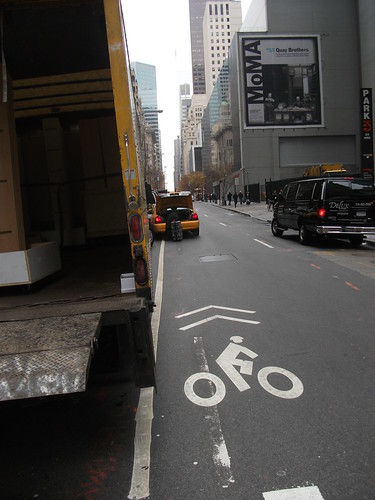
Sixth Avenue: bike-lane-less, as Ed Koch
preferred it on mature consideration

But, for a newcomer who’s a cyclist, one detail of the Ed Koch saga highlights a particularly striking change in the city. In 1980, at the height of the second oil price shock, Koch ordered the installation of segregated bike lanes on Fifth, Sixth and Seventh Avenues and Broadway in Manhattan. Then, only weeks later, having been ridiculed for his bike lane “fetish,” Koch had the lanes torn out again. He went on, in 1987, to try to ban cycling altogether from mid-town Manhattan. While that set-back took years to overcome, Koch nevertheless died in a city criss-crossed by a growing network of bike lanes. Installation is moving – despite setbacks as Nimbys in some neighbourhoods oppose new lanes - so fast that my 2012 NYC cycling map already feels quite badly out of date.

Thinking about that sharp turnaround – a tribute to the commitment of Michael Bloomberg, the current mayor, and Janette Sadik-Khan, his transport commissioner - has linked up in my mind several hopeful signs for cycling over the last couple of months. In both the US and the UK – the countries where I’ve done most cycling – cycling numbers are going up and official acceptance of cycling appears to be growing.

The question is whether this is a fundamental, long-term shift or just another short-term bit of faddism like Ed Koch's.

A Detroit Madison Street: borrowed chic for Lincoln
The question brings to my mind a mental picture of a copper-and-black Detroit Bicycle Company fixed-wheel bike. As someone who likes both gears and highly practical bikes, it’s not a machine I aspire to own. But I came across the bike – a Detroit Madison Street, trivia fans – in the unlikely setting of the Lincoln stand at Detroit’s annual North American International Auto Show. It was being held up as an example of the kind of finely-made luxury product of which Lincoln – which is trying to relaunch itself as a desirable luxury marque – approved.

Still more remarkably, it was one of quite a few bikes I spotted around the show floor.  The Smart stand boasted an E-Bike, which the manufacturer will be selling, while Toyota displayed a concept for a conventional bike. Kia was showing a small-wheeled bike that it sells in Korea, while Hyundai had a fixed-wheel bike sticking out the  back of a coupe. Subaru had stuck a couple of mountain bikes on the roof rack of one of its vehicles.

The unmistakeable impression was that carmakers thought bikes now had a certain cachet – which they wanted to borrow. Compare that with how the UK’s Raleigh in the 1960s felt it had to ape motorbike design to get kids to ride bikes.

The bikes’ presence on the automakers’ stands struck me all the more forcibly because of an article I’d written in my day job just before Christmas. It detailed how all the Detroit Three big automakers – General Motors, Ford and Chrysler – were struggling to reverse or live with recent years’ steep decline in young people’s learning to drive and subsequent buying of cars. Part of the carmakers’ problem stems from a gradual revival in recent years of the US’s inner cities – which are less littered than they once were with unconscious drug addicts - and, for some of the residents, a drift away from cars and towards bicycles. It’s the kind of gain for cycling that would have been scarcely imaginable in most industrialised countries 25 years ago when Mayor Koch was trying to ban cycling altogether.

A YouTube video posted by Gaz, a keen helmet-cam user reminded me that the process has already gone far further in the UK. His video – shot one recent January day – showed 50 cyclists on one short stretch of Cycle Superhighway 7 (a former Roman road, as it happens). If so many people are cycle commuting in January, Gaz suggests, the spring and summer are likely to see London’s highest cycle commuting numbers in many years.

Kent Ave, Williambsurg: Denis Hamil wants
those bike lanes gone
The worry, of course, is that cycling also looked so much like the coming thing in 1980 that a gadfly populist such as Ed Koch briefly took the risk of backing it. If car companies thought there was a way other than sticking two bikes on the roofrack to show their car was associated with an outdoor, aspirational lifestyle, I’m sure they’d happily use it. Denis Hamil, a columnist in the New York Daily News last week said he would support any mayoral candidate who promised to scrap the current crop of bike lanes. One of the likeliest contenders for mayor – Christine Quinn, a Democrat – has sought to appease bike lane haters by saying lanes are “controversial” and advising people not to discuss them at dinner parties.

In London, even Boris Johnson, the mayor, who is a daily cyclist, fell before the last mayoral election into the trap of caricaturing cyclists as dread-locked red-light jumpers. As with road safety – where the current UK government has reversed years of steady improvements by cutting funding for speed cameras – there is always a risk that someone will take steps that reverse apparently inexorable progress in a positive direction.

It doesn’t, for what it’s worth, feel as if such a step is coming immediately either here in New York or in the UK. Concern about the environment, changes in living patterns, concern about health and cycle technology improvements are all conspiring to make this cycling boom feel far more solid and longer-lasting than the second oil shock one.

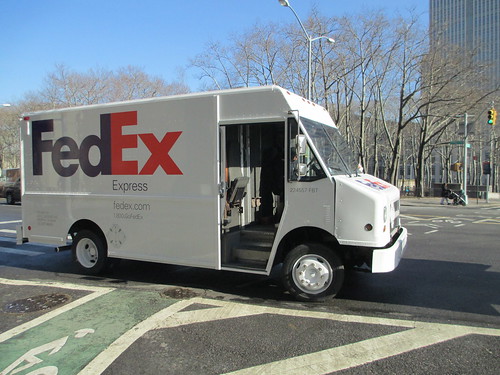
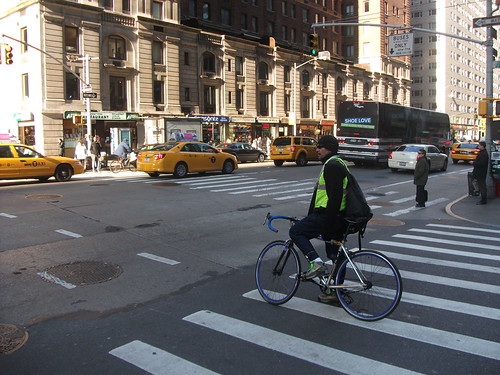
Yes, cycling's made progress. But, as long as FedEx drivers
think across one of  New York's busiest bike lanes is a good place
to park, it won't be mainstream
But it’s worth remembering that, even after recent years’ quadrupling of New York cycling numbers and the last decade’s doubling in London, riding a bike remains a fringe pursuit that’s far from winning mainstream acceptance.

That point came home to me particularly clearly one Friday night just before Christmas. Riding home around 10pm down W55th street from my office, I was surprised to find a limousine pull up next to me and wind down its window. Inside was a curious tourist who couldn’t understand what I was doing. No, I told him, I wasn’t delivering anything. Yes, I was just riding home from my office.

Recognising that he wasn’t going to get to the bottom of it, he finally said: “Just seems kind of… European.”

The incident set a new mental benchmark for me for cycling in New York and other big cities where it’s still not one of the main modes of travel. Cycling, I’ve decided, will finally be mainstream when an encounter with a commuter cyclist is no longer one of the “darndest things about New York” that a returning tourist recounts to his friends in Peoria.

Sunday, 20 January 2013

A blown nose, a blown world environment - and why some people confuse the two


It’s one of the few times I’ve managed seriously to annoy a motorist while stationary on my bike. One dark winter night a couple of years ago in London, I blew my nose while waiting at traffic lights. But, lacking the time to fish out a handkerchief, I snorted onto the road.

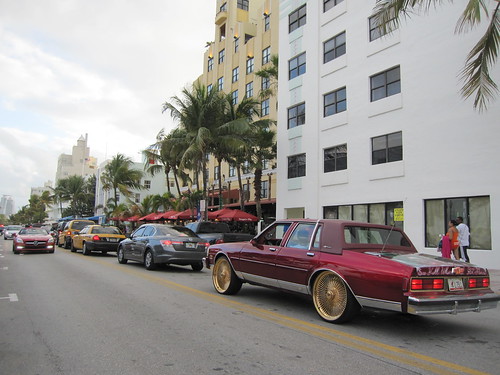
Traffic queuing in Miami Beach. Some of these cars might look to you
like polluters - but the drivers might think snot more offensive
It can’t, I accept, have made for a pretty sight. But the reaction of a woman in a car behind still surprised me. Leaning on her horn, she gesticulated her disgust wildly. The irony instantly struck me. In contemporary society, it’s regarded as entirely acceptable to make urban journeys in vehicles that spew out gases that will pollute and warm the atmosphere for a century or more. Clear one’s airways of a little biodegradable mucus, however, and one puts oneself entirely beyond the pale.

But the more I’ve thought about it since, the more I’ve realised the Outraged Driver of Kennington Park was exhibiting attitudes to environmental pollution and emissions very common in industrialised societies across the world. She regarded herself as having the right to an environment treated as she wanted. She felt perfectly entitled to criticise others’ treatment of that environment. Her attitudes, however, made no reference to any ultimate yardstick about the fate of the world environment as a whole.

I’ve said before on this blog that I am nothing like as exercised about environmental issues as many people assume cyclists are. I enjoy the overall sense that cycling is a rational way to get around – that it makes good use of scarce city space, that it contributes very little to congestion, that it keeps me healthy, that it’s enjoyable. It’s part of that picture that each trip contributes hardly at all to overall carbon emissions. But the environmental factors form only one corner of the overall scene.

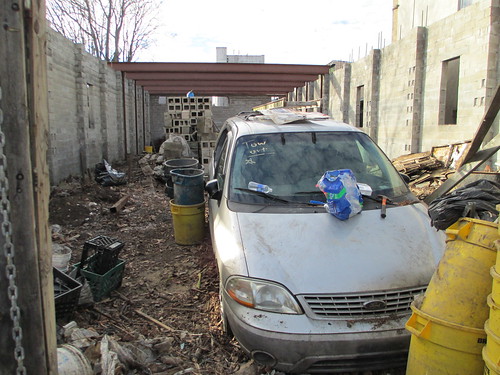
A car abandoned in the lot the Invisible Visible Man
helped to clear. Some scientists reckon the car's emissions
helped to cause the destruction in this corner of Brooklyn
That said, I regularly currently confront vivid evidence of the seriousness of the world’s environmental problems. Parts of the Hudson River Greenway, which I use for nearly half my daily commute in New York City, were under five feet – 1.6m – of water at the height of Superstorm Sandy in October. Many scientists think such extreme weather events are becoming more common as the world’s climate changes. Yesterday, I cycled down to Coney Island, one of the parts of the city worst-hit in the storm, to help clear out a vacant lot that was under seven feet of water on the night the record high water swept up New York Bay. The weather was so unseasonably mild that on the way home it felt oppressively warm. There’s an undeniable sense that climate change is becoming a more urgent, practical issue, which anyone who takes an interest in the wider world needs to address.

A modern, fuel-efficient container ship:
a surprisingly clean way to import food
Yet few of the responses to the issue rise much above the level of honking one’s horn at behaviour one dislikes. I’ve frequently heard it averred, for example, that it’s good for the environment to eat local, seasonal produce. But very few of the people who claim that can give a detailed accounting of local, seasonal produce’s carbon costs – even though the ships that import food to temperate, rich-world countries use remarkably little fuel. It’s certainly far from clear that buying fruit imported on such a ship from a country where it grows easily is worse than eating greenhouse-grown local fruit that’s come to the farmer’s market in a small, inefficient van.

Railway lobbyists also make blanket claims that their transport mode is invariably more environmentally friendly than using a car. But, while that is undoubtedly true for a well-filled train in the London rush hour, it isn’t true for a nearly-empty train spewing diesel fumes into the air to move a couple of passengers to their destinations. When I lived in the UK, my most regular long-distance rail journey was London to Chester on a Super Voyager diesel-powered train. I would give a rueful smile as I remembered that the complex, heavy but fast train issued much the highest level of emissions per seat mile of any UK train model. It was, on average, a better environmental bet to take the train for that journey than to hire a car. But the margin was not very wide at all.

There are some similarly questionable attitudes towards cycling’s environmental performance. I’ve recently come across a number of attacks on cycling’s environmental record that point out, for example, that manufacturing bikes produces carbon emissions – an undeniable point, which makes it clear that one shouldn’t replace one’s bike more often than necessary. Such attacks generally go on to point out that fuelling a bike involves carbon emissions. There are carbon costs to moving the extra food that cyclists eat that they otherwise wouldn’t. And the food generates emissions that the Outraged Driver of Kennington Park would presumably dislike even more than mucus – in the form of methane, a far more potent greenhouse gas than the carbon monoxide from cars.

The most entertainingly bonkers attack of this kind I’ve encountered was a recent blogpost from an Ian Pearson who claims to give “a more accurate guide to the future” (How can he tell?) on bikes’ carbon performance. Cycling might well, Mr Pearson accepts, produce next-to-no carbon emissions per kilometre. But, when a cyclist rides in traffic, he asserts, the extra carbon cost of attending to accidents – and the effect on cars’ carbon performance of slowing down then accelerating to overtake cyclists – probably produces so much extra carbon that it would have been more environmentally friendly for the cyclist to go by car.

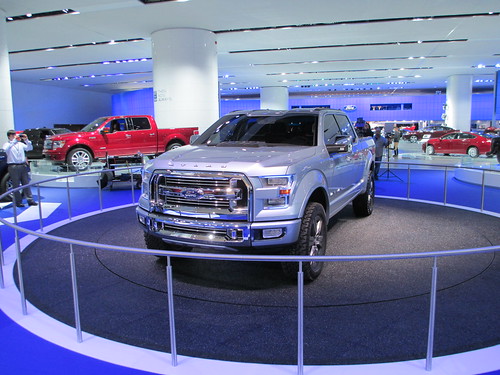
This new Ford pick-up truck concept will be more fuel-efficient
when it launches than its current equivalent.
But that won't make its drivers necessarily
friends of the environment.
The common thread between all these questionable assertions is that they treat the environment’s fate as an abstract matter – as susceptible to objective observation as the question of how to live the good life or whether God exists. People who profess concern about the environment often have a bias in favour of things that appear traditional and prepared without the benefit of complex, modern scientific advances. Many assume locally-produced food must be better for the environment because, well, it feels as if it should be. Similarly, people who are relatively unconcerned about environmental issues have a tendency to work back from their own behaviour to a spurious justification. “My car’s not as polluting as it might be” gets rationalised into “I am environmentally virtuous”. “I don’t like manoeuvring around these cyclists” becomes “these cyclists are bad for the environment”.

Yet, for the effects of air pollution and global warming, it is ultimately possible to estimate the effects objectively. Scientists now have a reasonable idea of what kind of damage different levels of carbon emissions produce. It is even possible to come up with rough figures for the costs that different kinds of emissions impose on wider society.

In a rational world, governments would now be rushing to take the guesswork out of estimating environmental impacts. Food products would include a label detailing the carbon costs of their production and include a tax reflecting them. Air tickets would include something similar, while the carbon costs of burning each unit of fuel would form a clear and distinct part of the petrol price at the pump. Past experiments with introducing new prices for previously-free goods – such as the Central London Congestion Charge – suggest consumers would move swiftly away from the most environmentally damaging behaviours towards less damaging ones.

I am robustly confident that such an exercise would make far clearer than the existing tax systems in most rich-world countries that bikes have big environmental advantages over most other transport modes. It is hard to imagine that the change would not significantly increase cycling levels.

A bicycle sign on New York's W54th street:
the kind of decisive action on the environment
that many governments are taking
The challenge, however, is that such a move would upset groups commonly supposed to be hugely influential – motorists, regular air-travellers and the owners of big houses – while pleasing few others. Governments consequently lay down a few cycle lanes on the roads, offer some subsidies for electric cars, meet some of the cost of better home insulation and generally gesture vaguely in the environment’s direction. Action that would make a real difference remains resoundingly untaken.

Yet that, perhaps, should be no surprise. Across the industrialised world, governments depend on the votes of people as inconsistent as the Outraged Driver of Kennington Park, Ian Pearson and, come to that, each of us reading (and writing) this blog. There’s no firm consensus yet among all those people in favour of firm action to rein in the galloping horse of the worsening global climate. That many governments consequently seem little more rational on the issue than an irritated, late-night driver may be sad – but it is depressingly understandable.

Monday, 31 December 2012

A car crash, Sandy Hook and the limits of freedom

My BlackBerry takes really poor pictures -
but somewhere in there are an upturned car
and a bunch of firefighters

“Bang! Boom-boom-boom-boom.” The successive thuds I heard from my apartment’s kitchen one Tuesday night two-and-a-bit weeks ago sounded out of the ordinary, even for an area where subway maintenance, truck movements and any number of other things are apt to create noise. When I then heard the wails of multiple emergency vehicles, I knew something was seriously amiss. Reporter’s instincts awakened, I headed out to the street, to find a car overturned further up the block. The driver had come down neighbouring Court Street too fast, according to people who’d seen it, misjudged the turn into our street and somehow flipped the car. The driver, who by now was in police custody, had seemed very drunk on getting out – mercifully unhurt – from the car, onlookers told me.

The incident could easily have qualified as the biggest event of my week had it not been for the events of the Friday. Just as I remember working in the Edinburgh newsroom of The Scotsman in 1996 when news started coming through of a shooting at a school 35 miles away in Dunblane, I found myself that Friday following reports of an incident at a school 75 miles away in Connecticut. Once again, I experienced the gut-jolting realisation that this incident, far from being a run-of-the-mill, local tragedy, was on a scale that would grab the attention of an aghast world. Whereas the Dunblane massacre killed 16 children, the one in Connecticut had killed 20.

The crash and the Newtown shootings might, at first blush, look unrelated. They are certainly of contrasting gravity. The car crash dented a few vehicles and led to the driver’s arrest. The Connecticut shootings killed 20 children, seven adults and culminated in the shooter’s suicide. But they both ultimately raise the same questions – ones that apply both to road-users and gun-owners – about the limits of individual freedom. It’s an issue that I confront every evening as I cycle a few blocks on Court Street amid cars that no-one restrains from driving at grossly excessive speed. It extends all the way to my worries about my own children’s safety in their own elementary school, where “shelter drills” train them how to react if a dangerous intruder is on the loose.

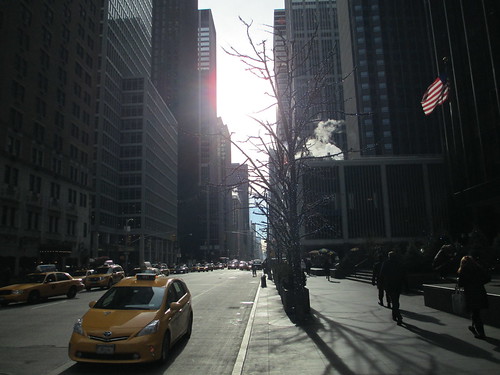
Midtown Manhattan in winter sun:
not self-evidently a city built by stupid people
It certainly makes a difference to my perspective that I’m writing in the United States, where I moved in August, rather than the United Kingdom, where I had been living for nine years. It’s fashionable in Europe to sneer at some of the US’s freedoms – particularly when it comes to gun ownership – as if they were merely factors in a general national craziness. Why, patronising European voices ask, doesn’t the US just ban guns? The tone of the comments often carries undertones of the ultimate European sneer - that the people of the world’s richest, most successful country are either collectively a bit stupid or morally bankrupt.

Yet there is something profoundly valuable about many parts of the American constitutional system – and one of them is undoubtedly the Bill of Rights’ guarantee of certain freedoms. Only the most unbending critic of the United States could fail to be impressed by how the country’s constitution and democracy have flexed to deal with successive historical challenges. The system has adapted to stitching the US back together after the civil war, national mobilisation for the second world war, the cold war and the civil rights movement. Many constitutional rights – including the rights to free speech and freedom of assembly – have come under attack at the times of the worst strain. It has surely been part of the US’s successful negotiation of these crises that the rights have largely survived intact.

Nor is there something unique about US politicians’ willingness to sacrifice the lives of vulnerable citizens in the name of other people’s freedom. The day that Philip Hammond was appointed the first transport secretary in the current UK government, he vowed to end the “war on the motorist” – shorthand for a series of measures that included the introduction of speed and traffic-light cameras at the most dangerous accident blackspots. The gradual withdrawal of funding for such successful safety measures has been accompanied by a slow but steady increase in the number of motorists, pedestrians and cyclists thrown fatally into the air by speeding vehicles, crushed under trucks’ wheels or bleeding slowly to death amid the wreckage of their cars.

These cars were all free to drive over the Brooklyn Bridge on
Christmas Eve - so none of them was free to cross it fast.
There is a similar fear in many countries of the world – including the Netherlands and United States – about introducing distance-based charging for road use. Nearly every transport economist knows that only a direct charge for road use, varying according to the time of day, can tackle most rich countries’ congestion problems. Yet the only country so far to have introduced a national scheme to charge for using the busiest roads is Singapore – which uncoincidentally suffers an acute shortage of land, allied to intense relaxation about restricting individual freedoms.

Even on guns, the shocked insistence of some US politicians that citizens must be able to retain guns for hunting, self-defence and other legitimate uses is not unique. I remember vividly the controversy when the Duke of Edinburgh, the queen’s husband, insisted after the Dunblane massacre that proposed bans on the ownership of certain kinds of handguns were an unfair imposition on sportsmen. He asked whether, if someone had burst into a school and beaten 17 people to death with a cricket bat, the government would also legislate to ban them. The obvious point that guns’ capabilities set them apart from other potentially deadly weapons passed the Duke, like so many US gun lobbyists, entirely by.

Yet I remain instinctively suspicious of any freedom that is predominantly exercised by the well-off and already free at the expense of their poorer, less-free neighbours. US advocates for gun-owner freedoms tend to be overwhelmingly white and relatively rich. Even in a country with car ownership as high as the United States, the heaviest users of cars - and those of whom the politicians are most fearful – are the better off. Anecdotal evidence around New York suggests that the pedestrians paying the price for uncontrolled car use are disproportionately people like Maleka Begum, a 54-year-old mother of three, originally from Bangladesh. Ms Begum died after a bus hit her on a pedestrian crossing in Queens in October, in an incident that witnesses attributed entirely to the bus driver’s poor driving.

A speed-limit sign by the Brooklyn Bridge.
Most people accept in theory that
speed limits are a reasonable restriction
on freedom - for other people, at least.
The truth is that even the keenest advocate of the freedom to drive a car or shoot a gun ultimately depends on some curtailment of those rights. Motorists share roads with each other, cyclists like me and pedestrians. If everyone were given pure freedom to drive anywhere at whatever speed they liked, with no price restrictions to curb demand, gridlock would quickly set in and the accident rate soar. Even the US’s National Rifle Association would surely eventually tire of the arms race if, for example, anyone in the US who wanted it could arm him or herself with a rocket-propelled grenade launcher, depleted uranium rounds or – why not? – biological or tactical nuclear weapons. Drivers depend on the police’s restricting the rights of the worst drivers to drive, while gun-owners ultimately rely on the state to prevent their finding themselves outgunned by fellow citizens toting battlefield weapons.

The question, consequently, isn’t whether to impose curbs on drivers’ ability to speed drunk down Brooklyn streets or to hold large caches of deadly, high-powered weapons. It’s where to set the tipping point between their rights and others’ rights to protection from them.

It’s my powerful conviction, based on my own experience of trying to bring dangerous drivers to account and witnessing the toll of gun crime in the United States, that the emphasis in recent years has fallen far too heavily on protecting the drivers and gun-owners. Some of the clearest evidence is how cowardly many countries’ police forces and legislators have become about enforcing even existing, sensible rules. There are, for example, no speed cameras in New York City, even though excessive speed seems to be a factor in many fatal crashes. Astonishingly, background checks on those planning to buy weapons are not enforced at gun shows, which as a result account for a growing proportion of gun sales. Eagerness to safeguard drivers’ and gun-owners’ rights is slowly but surely toppling over into a lawless free-for-all.

The barriers in the way of better, more effective enforcement of road rules are at least relatively minor, both in the United States and elsewhere. Properly-framed laws or police procedures could re-energise the effort to catch drivers that, for example, speed through busy junctions or ignore red lights. In the US, the constitution’s strangely-worded second amendment, with its guarantee for the right to bear arms, stands in the way of change. It’s not a right that I personally would have chosen to enshrine in the constitution. But it’s not an amendment that’s going to be repealed or changed in the foreseeable future.

As a result, my modest proposal would be that gun-owners should be subject to one new obligation that already faces drivers – and that seems to be reducing deaths on the roads. The owners of the cars that the drunk driver on my street hit could at least be confident, it occurred to me afterwards, that the driver had – or should have – comprehensive insurance. The families of Sandy Hook’s dead will know the guns’ owner carried no comparable insurance. It’s a grotesque mismatch that the owners of vehicles that kill people as a byproduct of their use are forced to insure themselves, while owners of purposely-designed killing machines are not.

An insurance scheme would continue to facilitate the kinds of gun use that the NRA says it supports. A hunter who keeps a shotgun or bolt-action rifle locked up in his study would present only a modest risk and need pay only modestly to insure against it. A woman who wanted to keep a semi-automatic rifle with a large magazine and two powerful handguns unsecured in the house with her 20-year-old would probably face a prohibitively high bill, however.

Insurance companies’ risk assessments already seem to be playing a role in reducing road accidents. The costs of insuring the youngest – and most dangerous – drivers appear to be preventing them from taking up driving until they are older, and safer.

My proposal would not, of course, solve everything. Criminals would continue to pass around powerful, illegally-held, uninsured weapons. Ill-intentioned or unhinged people might still manage to steal or otherwise misappropriate the weapons needed for horrific massacres. But it would, I think, reduce the chances that, one day, it might be my children and their teachers facing an angry young man who has found weapons powerful and destructive enough to express his anger, rage and despair. As such, the curtailment of freedom involved seems to me a very modest price to pay.

Sunday, 9 December 2012

Washington, a stabbing - and why an individual cyclist tells you nothing about the rest

Washington, DC surprises me every time I visit. While New York feels just as bustling, large-scale and chaotic as the films and TV programmes would suggest, the US’s capital feels nothing like the West Wing. Sure, there are people influencing the whole world’s fate in lots of those neoclassical buildings – but Washington’s atmosphere most reminds me of other sleepy US administrative capitals like Richmond, Virginia or Harrisburg, Pennsylvania.

Washington, DC: provincial to me
- but full of cycling savages according to one Facebook user
During a visit last week, it nevertheless occurred what an advantage it was that Washington seemed a far calmer place than New York to ride a bike. The cyclists I saw during the visit mostly seemed to be riding sedately, calmly and in general harmony with other road users around them.

This was, however, entirely the wrong conclusion, according to at least one person I know. On Friday evening, two days after I came back from my DC daytrip, a Facebook friend commented on a story about an altercation between a cyclist and a motorist in North-West Washington the night I visited. The motorist appears to have somehow alarmed the cyclist, who responded by hitting the driver’s car with his D-Lock. The ensuing argument ended with the cyclist stabbing the motorist, who suffered rib injuries but looks likely to survive.

“Savages,” my Facebook friend commented. “Civility is an alien concept,” someone else replied in agreement. The clear implication was that I, as a cyclist, was complicit in an appalling, entirely unjustified assault of a kind I would never have contemplated.

My immediate instinct was to launch into an argument, pointing out the fatuousness of jumping from a single, knife-wielding cyclist to the implied generalisation – all cyclists are savages. Concluding that I was unlikely to change clearly entrenched attitudes, I limited myself to “unfriending” the person responsible.

But, as I cycled home that evening, a more mature reflection occurred to me – one sparked in part by the controversy in the UK over the inflammatory “War on Britain’s Roads” documentary. If it made no sense to draw a conclusion from a single stabbing - or the misleading footage of an alleycat race in the documentary  - to cyclists’ general behaviour, why did I feel free to criticise in general the culture of driving or the police? Was I making any more sense than my former Facebook friend?

One possible response to the “cyclists are savages” claim would, of course, have been to point to some of the numerous incidents of motorist-cyclist violence. In the space of a year of cycling in London, I suffered one actual – albeit mild – assault and had to make an emergency call to police to avert another. The first incident involved a bus driver who abandoned his bus – and passengers - to confront me because I’d photographed him blocking, illegally, a cyclist-only area at traffic lights. He smashed the mobile ‘phone I was using as a camera out of my hand. The second incident came as I tried to photograph a motorist I’d previously seen deliberately drive across the path of a cyclist who’d complained about his driving. He threatened – alarmingly convincingly - to smash up both me and my camera.

The most pertinent case I could have raised, however, was the stabbing in September of Colin Albright, a cyclist in Pittsburgh, whom a motorist pursued as he carried his bike away from a road up a set of steps. The motorist stabbed Albright repeatedly, including in the throat, possibly over some perceived slight involving a traffic incident.
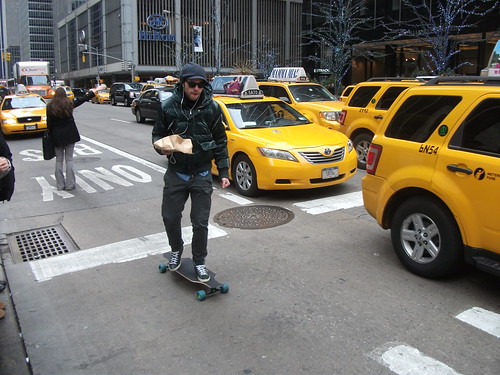
You might have prejudices about people who make strange
transport choices - like skateboarding down Sixth Avenue.
It doesn't mean you know anything about this individual skateboarder.

Albright’s case would have been pertinent precisely because it illustrates the absurdity of generalising from something extraordinarily rare – a stabbing over a disagreement on the roads – to the generality of day-by-day on-road relationships. In late October, Anthony Scholl confessed to attacking Albright. Scholl was already in custody over an alleged attempt to burn down his parents’ house. While there is little information so far on Scholl’s motive for stabbing Albright, the alleged arson attempt seems to have been aimed, in Scholl’s mind, at preventing his parents from killing him and feeding him to their (presumably imaginary) pet alligator.  Albright’s stabbing also looks likely to have stemmed from what Scholl’s mother has called his “psychological issues”. It seems similarly unlikely that the appalling Washington stabbing will turn out to involve an ordinary, mentally-balanced cycle commuter who just happens to pack a knife to mete out summary justice on uppity drivers.

That anyone could ever have thought the Washington stabbing had anything to do with broader cyclist behaviour, of course, stems from humans’ powerful desire to pin blame for problems on out-groups. The only thing so far known about the Washington motorist’s assailant is that he was on a means of transport against which large numbers of people have powerful prejudices. Few people have the mental self-discipline to avoid working on the basis of such limited information and their prejudices to jump to wholly unwarranted conclusions.

It’s telling, for example, that hardly anyone blames the antics of bank robbers’ getaway drivers purely on their being drivers. Drivers are too numerous and familiar to act as convenient out-group scapegoats. No-one sought to blame the assault I suffered or the threatened assault merely on the perpetrators’ status as motorists. I received, instead, some close questioning about the immigration status of the bus driver and the race of the man who threatened to assault me. Establish a link to immigrants or African-Caribbean men, the implication seemed to be, and the incidents were far more easily explained away.

A cyclist, cars and pedestrians at 55th Street. Which of them
is a "savage" will be in the  eye of the beholder
The prejudices are all the more powerful for not appearing to the prejudiced to be prejudices at all. Have your eye out for poor cyclist behaviour in Washington and you’ll spot instances of such behaviour, rather than the courtesy and calm I witnessed. Assume the main road problem is the cyclists and you’re unlikely to spot the multiple ways motorists misbehave.

The truth is that, in all the incidents I’ve described, the attackers acted as individuals, rather than a member of a group. Their behaviour stemmed from their own characters or mental states, rather than their status as cyclists, motorists, bus drivers, immigrants or anything else. To imagine that the behaviour in a single instance of a single member of a large group has anything to say about the wider group as a whole is a thinking error of a kind that would be shocking were it not also fairly common.

That point could, of course, lay me open to the objection someone recently made in an online forum to my use of statistics to point out that cars generally posed a far greater danger to pedestrians than bikes. That was beside the point, the poster wrote. Each motorist or driver differs so much that it makes no sense to discuss a general level of risk from motorists or cyclists. A very poor cyclist could conceivably pose a greater danger to a pedestrian than an extremely careful, conscientious motorist. I am perhaps particularly vulnerable to such a charge because of my habit of illustrating points on this blog by reference to specific – usually extreme – incidents that I take to illuminate a wider truth.

Yet I have, I hope, been careful when complaining about general problems to have sought evidence that my experience speaks to a broader reality. It remains a verifiable fact, for example, that motorists kill a disproportionately high number of other road users in both the UK and New York City. Collisions with cyclists in both places account for a far lower proportion of road fatalities than cyclists make up of road traffic. Research in New York suggests motorists’ failure to yield as required to pedestrians is the biggest single cause of road deaths. Research in the UK suggests failure on motorists’ part to pay attention causes a disproportionate number of crashes.
Court Street at night. Just because most motorists speed here
doesn't mean they all do.

It makes sense on such a basis to say there is a general problem with motorists’ failure to yield to New York pedestrians or to pay proper attention in the UK. I am even confident enough in my own judgement to diagnose a few more local, unmeasured problems. There is, for example, a general problem that many motorists regard Brooklyn’s Court Street as an appropriate place for excessive speed and not somewhere where cyclists’ requirement for space on the roads need be considered. It just doesn’t make sense to predict on this basis that the next motorist one encounters on Court Street won’t be a model of caution, courtesy and respect.

I feel acutely sorry for the victim of the Washington stabbing. His experience last Wednesday must have been appallingly frightening. I trust the District of Columbia police will swiftly identify the attacker and bring him before the courts. I wish the victim a swift and smooth recovery. But I also devoutly hope that no-one in future will make the lazy and offensive mistake of imagining any of what happened had anything to do with me.

Sunday, 18 November 2012

My ride to work - and why the cars resemble little hurricanes

Very few of the runners, stroller-pushing parents, drunks and others who wander into my path each day on the cycle lane up New York’s Hudson River Greenway strike me as especially brilliant people. If they were, they might spot the signs telling them they’re not allowed on the path and stick to the rather pleasant waterside walkway that’s been provided for them.
The runner on the left has, remarkably, chosen the footpath on
the Hudson River Greenway. One can only hope she made
the kind of solid risk assessment the Invisible Visible Man advocates

But, disturbingly, the cycle lane obstructors (CLOs) seem to be better at prioritising the risks facing pedestrians than the head of the New York Police Department’s traffic squad. The CLOs have decided that, if they’re going to obstruct traffic, it’s many, many times safer to get in cyclists’ way than cars’. Having so far seen hundreds – possibly thousands – of CLOs in four months’ cycling in New York, I’ve yet to see one choosing to take his or her chances running down the fast-moving, multi-lane West Side Highway next to the cycle path.

Yet Brian McCarthy, a deputy chief of the NYPD with responsibility for traffic policing, explained in October to WNYC, the public radio station, why its ironically-named Operation Cycle Safe – the programme that focuses police resources on fining cyclists, rather than the road users that cause traffic deaths – was now mainly tackling riding on the sidewalk (pavement, British readers). This behaviour, he reasoned, posed particular dangers to pedestrians. But, while I can find no recent record of a cyclist’s killing a pedestrian on a New York City sidewalk, it is depressingly regular for motorists to do so through excessive speed or lack of attention. The NYPD barely ever prosecutes the motoring offences that lead to such deaths. Its prioritisation is so skewed that, for it to be correct, I should probably be spotting runners every morning taking their chances with speeding SUVs on the highway, away from the terrifying bicycles.

The contrast between the CLOs and Deputy Chief McCarthy illustrates something profound about the vagaries of human beings’ efforts to assess risks. Most humans are reasonably adept at spotting and assessing the most immediate dangers. It’s pretty clear even to a stupid, inconsiderate runner unconcerned about inconveniencing others that it’s less foolish to take the chance of a collision with a cyclist riding at 20mph than a motorist driving at 50mph (the West Side Highway speed limit is 35mph – fun fact that most motorists entirely ignore). Very few people, however, are good at assessing risks in an abstract context such as a decision about how to allocate police resources. The NYPD, as I pointed out in a previous post, hands out 5 per cent of its traffic violation tickets to cyclists, way out of proportion to cyclists’ roughly 1 per cent share of city traffic. But a cyclist last killed someone in New York City in March 2009 – and even that incident wasn’t on the sidewalk. Around 1,000 people have died in the time since at the hands of motor vehicles. A sober risk assessment aimed at bringing down the number of deaths in the city would target an entirely different set of behaviours.

The problem appears to be a widespread one. In the UK, newspaper reporting about the crash that injured Bradley Wiggins – one of my great heroes – ended up producing the same, predictable commentary claiming cyclists endanger pedestrians and, somehow, cars. That’s even though the Tour de France winner’s accident involved his colliding with a car that seems to have pulled out into his path from a filling station without looking. In other words, people started complaining on the basis of the kind of accident that happens quite a lot (one where a negligent motorist injures a cyclist) about things that hardly ever happen – accidents where cyclists hurt other road users.

The question is whether it’s possible to get better to get better at understanding the risks the roads and other places pose - and to start reacting to them more rationally.

A subway station closed for Hurricane Sandy. New York's subway
turned out to be better at assessing risk than many New Yorkers.
My mind’s been particularly drawn to risk assessment in the last three weeks because of events in my new home city. At the end of the week when superstorm Sandy hit New York, I took a trip to Staten Island to report on some of the damage there. Person after person told me they’d ignored the evacuation order for the area on the grounds that a previous hurricane last year – Hurricane Irene – had mostly turned out less damaging than expected. As the sea swept in and inundated their street, they found themselves cowering in their homes’ upper storeys, with waves lapping at the windows even there. A person died in the basement of one of the houses in the street I visited, electrocuted when he stepped into flood water that had electric current flowing through it. The storm was on an entirely different scale from Hurricane Irene.

That miscalculation, it seems to me, is of a piece with people’s miscalculations about road use. In both situations, people rely far too much on personal experience and the evidence of their own senses. In the run-up to the storm, it was clear that the city was very windy but not immediately obvious that the storm would cause historic levels of damage. To realise that, one had to pay attention to something one couldn’t see – the vast storm surge that forecasters were predicting that was preparing to push its way into New York Bay to flood large tracts of the city.

Many people assessing the risks of cycling, meanwhile, look at cyclists in traffic and conclude that the slender, unprotected machines among the big metal boxes are more vulnerable than most figures actually suggest them to be. They see a cyclist on a sidewalk and assume that his greater speed compared with the pedestrians makes him a significant risk to them. It only adds, it seems to me, to people’s irritation with cyclists that bikes are quiet and people tend to notice them only at the last minute. This seems certain to trigger the kind of last-minute, fight-or-flight response that must have been useful for vulnerable cavemen. It’s a far less reliable indicator than people think of the risks around in a complex, modern urban streetscape.

Most people have particular lacunae when it comes to rare events that pose catastrophic risks. A hurricane is precisely such an event. There are fine, hard-to-discern differences between a hurricane that will do little damage – as Hurricane Irene did – kill scores of people and do billions of dollars of damage – as superstorm Sandy did – and one that will kill many hundreds – as Hurricane Katrina did. It is far beyond a normal person’s gut instinct to discern which storms need special attention, yet ordinary people continue to use their gut instincts to assess how they should react.
The motorists are blocking the bike lane. The cyclist's too close to the cars.
And they'll probably all get away with the risks they're taking.

In a road context, the catastrophic events are crashes involving cars, buses and trucks. It’s so common to see motorists driving while ‘phoning, speeding, giving cyclists too little room and so forth that it’s easy to conclude that these behaviours are trivial and pose little risk. Many people compare them with the alarming experience of finding a cycle messenger rush past their nose on a pedestrian crossing and conclude that it’s the cyclist who poses the real danger. The truth is that each time a motorist drives too fast, drives while distracted or turns without looking for cyclists he or she is involved in profoundly risky behaviour – and it’s only the luck of the particular circumstances that divides the outcome from nothing at all and a multiple-fatality crash.

People are still more blind to their actions’ long-term consequences. Almost no-one sees a cyclist on a busy street and remembers that he or she is far less likely to die of heart disease or diabetes in several decades than the neighbouring motorist cursing him or her from the exercise-free cocoon of his or her motor car. The global warming that may be making hurricanes more frequent is a still more remote such risk.

None of this is to excuse stupid behaviour by cyclists. It’s worth stopping for red lights, giving pedestrians plenty of space and going the right way up one-way streets. It shows an example of good practice and avoids annoying one’s fellow citizens. I do my best to obey the rules.

But industries prone to catastrophic but rare risks – the nuclear power industry, for example, or railways – tackle them by looking for the near-misses and minor accidents that suggest people are indulging in risky behaviour. Police forces that hold off warning motorists about dangerous behaviour and minor accidents explicitly miss the chance to follow such a policy.

I at least can do my part. I accept that runners will bound into my path on the Hudson River Greenway and cycle at a speed and on a line that means I should avoid them. I know that cars sometimes sweep across even some lightly-used crossings on the route from angles that are hard to see. So I stop for those red lights as other cyclists and runners speed past me, no doubt thinking me an over-cautious worrier. I do my best to assess when I’ve done something foolish and to avoid repeating the mistake. I can only hope that, as New York and other cities start to grapple with a future made more complicated by extreme weather, far more of those around me start to give the matter the same consideration too.